2
Trauma, Upper Extremity
Michael Blauth, Denise Eygendaal, Alberto Fernandez dell’Oca, René Haag, Harry Hoyen, Martin Jaeger, Reto Jost, Corinne König, Franz Kralinger, Stefaan Nijs, Norbert Südkamp
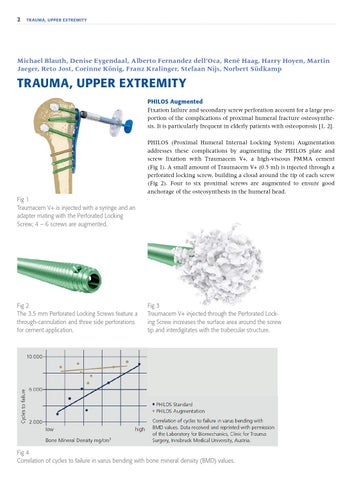
Trauma, Upper Extremity PHILOS Augmented Fixation failure and secondary screw perforation account for a large proportion of the complications of proximal humeral fracture osteosynthesis. It is particularly frequent in elderly patients with osteoporosis [1, 2]. PHILOS (Proximal Humeral Internal Locking System) Augmentation addresses these complications by augmenting the PHILOS plate and screw fixation with Traumacem V+, a high-viscous PMMA cement (Fig 1). A small amount of Traumacem V+ (0.5 ml) is injected through a perforated locking screw, building a cloud around the tip of each screw (Fig 2). Four to six proximal screws are augmented to ensure good anchorage of the osteosynthesis in the humeral head. Fig 1 Traumacem V+ is injected with a syringe and an adapter mating with the Perforated Locking Screw; 4 – 6 screws are augmented.
Fig 2 The 3.5 mm Perforated Locking Screws feature a through-cannulation and three side perforations for cement application.
Fig 3 Traumacem V+ injected through the Perforated Locking Screw increases the surface area around the screw tip and interdigitates with the trabecular structure.
Fig 4 Correlation of cycles to failure in varus bending with bone mineral density (BMD) values.