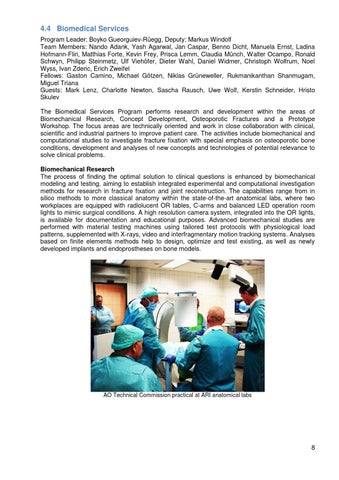
4.4 Biomedical Services Program Leader: Boyko Gueorguiev-Rüegg, Deputy: Markus Windolf Team Members: Nando Adank, Yash Agarwal, Jan Caspar, Benno Dicht, Manuela Ernst, Ladina Hofmann-Fliri, Matthias Forte, Kevin Frey, Prisca Lemm, Claudia Münch, Walter Ocampo, Ronald Schwyn, Philipp Steinmetz, Ulf Viehöfer, Dieter Wahl, Daniel Widmer, Christoph Wolfrum, Noel Wyss, Ivan Zderic, Erich Zweifel Fellows: Gaston Camino, Michael Götzen, Niklas Grüneweller, Rukmanikanthan Shanmugam, Miguel Triana Guests: Mark Lenz, Charlotte Newton, Sascha Rausch, Uwe Wolf, Kerstin Schneider, Hristo Skulev The Biomedical Services Program performs research and development within the areas of Biomechanical Research, Concept Development, Osteoporotic Fractures and a Prototype Workshop. The focus areas are technically oriented and work in close collaboration with clinical, scientific and industrial partners to improve patient care. The activities include biomechanical and computational studies to investigate fracture fixation with special emphasis on osteoporotic bone conditions, development and analyses of new concepts and technologies of potential relevance to solve clinical problems. Biomechanical Research The process of finding the optimal solution to clinical questions is enhanced by biomechanical modeling and testing, aiming to establish integrated experimental and computational investigation methods for research in fracture fixation and joint reconstruction. The capabilities range from in silico methods to more classical anatomy within the state-of-the-art anatomical labs, where two workplaces are equipped with radiolucent OR tables, C-arms and balanced LED operation room lights to mimic surgical conditions. A high resolution camera system, integrated into the OR lights, is available for documentation and educational purposes. Advanced biomechanical studies are performed with material testing machines using tailored test protocols with physiological load patterns, supplemented with X-rays, video and interfragmentary motion tracking systems. Analyses based on finite elements methods help to design, optimize and test existing, as well as newly developed implants and endoprostheses on bone models.
AO Technical Commission practical at ARI anatomical labs
8