A Free Publication
2016 Edition
At Home A Free Publication
in Anza-Borrego Desert State Park
2016 Edition
速
Welcome and thank you for visiting
Anza-Borrego
Desert State Park As the Park’s nonprofit partner, Anza-Borrego Foundation runs the V������ C����� S���� and S���� P��� S���� in The Mall. Stop in to find information and gifts to enrich your visit.
Visitor Center Store October 16 - May 14: Open Every Day, 9am - 5pm May 15 - October 15: Open Weekends and Holidays only • • • • •
Park Information Guidebooks and Maps Road conditions Free Interpretive walks and talks Park films
• • • • •
Apparel and Safety Items Park Posters and Postcards Wildlife sightings Puppets and Games Join ABF to support the Park
ABF State Park Store October - May: Open Friday - Weds., 9am - 3pm June - September: Open Monday - Friday, 8am - 12 • • • • •
F today Join AB 15% to get a n all to discoun ses! purcha
2
Park Information Register for classes & hikes Guidebooks and Maps Native American Arts Join ABF to support the Park
• • • •
Clothing and Accessories Desert Art and Photography Water Bottles and Bags Desert Naturalist Tours for buses and group hikes
All store & membership proceeds support Anza-Borrego Desert State Park!
Partners with the Park
ABF State Park Store 587 Palm Canyon Drive #110 760-767-0446 www.theabf.org
ABDSP Visitor Center 200 Palm Canyon Dr. 760-767-4205 www.parks.ca.gov
Premium Desert Inn Casual comfort, desert wilderness the perfect blend of nature and nurture
Serene, restful getaway quiet, dark, and peaceful
A refuge, not a resort small, intimate, low-key
Surrounded by the Park right outside your door
In the village
close to everything
405 Palm Canyon Drive Borrego Springs, California BorregoValleyInn.com 800.333.5810
3
Anza-Borrego Desert State Park
®
200 Palm Canyon Drive Borrego Springs, CA 92004 www.parks.ca.gov Visitor Center 760-767-4205
Prior to arrival, visitors with disabilities who need assistance should contact the Visitor Center.
Park Headquarters 760-767-5311
This publication is available in alternate formats by contacting the Visitor Center.
711, TTY relay service
Visitor Center: 760-767-4205
Visitor Center Hours
October 16 - May 14 Open Daily, 9:00 a.m. to 5:00 p.m. Off-Season May 15 - October 15 Open Weekends and Holidays only 9:00 a.m. to 5:00 p.m. Hours are subject to change.
Anza-Borrego Foundation 760-767-0446 www.theabf.org
Campground Reservations 800-444-7275 or www.reserveamerica.com
Lodging and Restaurants Borrego Springs Chamber of Commerce P.O. Box 66 786 Palm Canyon Drive Borrego Springs, CA 92004 760-767-5555 or 800-559-5524 www.borregospringschamber.org
Borrego Medical Center 4343 Yaqui Pass Road Borrego Springs, CA 92004 760-767-5051
4
California State Parks supports equal access.
For the latest in wildflower news, call the Anza-Borrego Desert State Park® Wildflower Hotline. We update this recording regularly during the blooming season. For more information, see Page 22.
Wildflower Hotline 760-767-4684
You can see photos on the web: http://www.parks.ca.gov Go to “Visit a Park” Find Anza-Borrego Desert State Park
Like Anza-Borrego Foundation and Anza-Borrego Desert State Park www.facebook.com/ AnzaBorregoDesertStatePark
Join our email list to learn about ABF’s events and exciting opportunities for all ages at http://www.theabf.org.
From the Superintendent of Anza-Borrego Desert State Park
Welcome “Home is where the heart is.” Roman philosopher Pliny the Elder uttered those words over two thousand years ago and to this day we relate to his statement on so many levels. We could also say that home is where your habitat is. For many of us humans, we have some choice in that matter. The vast majority of plants and animals must bloom where they are planted and make the best of the situation they are given. How challenging that can be in a desert environment! In spite of, or perhaps because of, extreme climates and numerous micro-habitats, Anza-Borrego Desert State Park entertains a far more diverse and specialized population of mammals, birds, reptiles, insects and plants than you might expect! It has been said that for every square foot of desert there is a rodent home, that over 300 species of birds either migrate through or take up residence in the park each year, and we host reptiles that live here and in northern Baja California and nowhere else. Some of the most popular hikes in this park are to our native fan palm oases. Remnants of an ice-age landscape, California Fan Palms (Washingtonia filifera) are native only to this desert and have managed to find
a way to hang on where surface water exists. Talk about making yourself at home! Park visitors also hope to catch a glimpse of our iconic and endangered Desert Bighorn Sheep that have adapted specifically to dry peaks, rocky canyon walls and alluvial fans. And of course thousands of guests arrive every spring in hopes of spying desert wildflowers. Try looking into any bloom in spring and see if you do not end up sharing its beauty with an insect of some description – often as colorful as the flower. The Anza-Borrego Desert is a lively home indeed! Anza-Borrego Desert State Park is also unique in its recorded fossil evidence of life before humans, when an alternative landscape encompassed now-extinct creatures who roamed a very different habitat. In later ages the Cahuilla and Kumeyaay people made a good living in this desert for thousands of years. And now we share in that bounty each day that we walk outside and look to the same views of surrounding mountains and clear blue skies. How fortunate we are to call this desert home! Every habitat comes with challenges and we all work to adapt our lives to make ourselves comfortable. I have been lucky enough to call Anza-Borrego Desert State Park home for many years and I hope as you visit you will find ways to make yourself at home here in this beautiful place. Camp out and look up at the night sky, hike to explore new ecosystems, sit quietly to see if you can spot local wildlife or take a bike ride into town for ice cream. All qualify as being part of the desert lifestyle. As L. Frank Baum says in his 1900 fantasy The Wizard of Oz, “There’s no place like home.” It is my opinion that there’s no place like Anza-Borrego Desert State Park. Kathy Dice Park Superintendent Anza-Borrego Desert State Park®
Photo by Don Endicott
5
PARK REGULATIONS DEVELOPED CAMPGROUNDS
general park regulations
Day Use Fees apply in Borrego Palm Canyon, Pets must not be left unattended. Dogs must Tamarisk Grove, Bow Willow, and Horse Camp. be on a leash no longer than six feet and Day users may not occupy campsites. under the immediate control of a person during the day. Dogs or cats must be in a tent or vehicle during nighttime hours. Dogs are Check out time is 12:00 noon. not allowed cross-country or on hiking trails. Speed limit in the campground is 15 MPH. Engine-driven electric generators may be operated in the park only between the hours Park vehicles with all tires on the pavement. of 10 am and 8 pm. Loud, disturbing noise is prohibited at all times, and Quiet Hours between 10 pm and 6 am must be observed PRIMITIVE CAMPING throughout the park. Vehicles must be parked no more than one Gathering or taking of any live, dead or vehicle length off the road. Do not trample downed vegetation is prohibited. vegetation or drive over geological features. Ground fires are not permitted. A metal container must be used for all campfires.
Bicycles (including mountain bikes), skateboards, etc. must remain on roads. All riders under 18 years of age must wear a Bring your own firewood and plan to take your bicycle helmet. cooled ashes out with you. Gathering or taking of any live, dead or downed vegetation The California Vehicle Code applies to all roads in the park – dirt, sandy wash or paved. is prohibited. All vehicles must be highway legal and remain on established roads. There is no garbage collection in the backcountry so you are responsible for packing out all your garbage, including toilet Firearms and fireworks are not permitted paper and human waste. Practice “Leave No anywhere in the park. Trace” ethics. All natural and cultural features are protected. Leave only footprints. Take only memories. Nothing may be removed or disturbed. Certain activities are restricted in Cultural Preserves. Please read and observe posted regulations.
Attention
Some campgrounds may not be open year round. Please check in advance.
6
The operation of powered unmanned aircraft, including drones, is prohibited in Anza-Borrego Desert State Park.
F F F F
X X X X
X X X X
10
24’
8
X
F
X
X
16
24’
8
V
8
V V V
6
6
V V V V
X
X
X X X
X
X X X X
eet
1 1 1 13
X
960
8
X
950
55
3400 1500 880 1730 1400 280 2500 760
10 14 19 12 13 30 32 54
X
HQ
in F
to
775 775 775 1400
X
X X X X
Miles
Tab les
X X X
21’
8 8 25 8
Shade
Picnic
35’ 25’
Ramadas Stoves or C ampfire Fire R ings C Elevation enter
h Flus Toilets
: Vault Showers or
ite Water
Ma
x. L
of ber
Nig per
$10*
V eople Drinking per S
$15*
hR
$25*
x. P
X
engt
52 65 5 27
Sites
$35* $25* $80* $25*
ht Num
X X X X
Ma
primitive CAMPs Culp Valley Sheep Canyon Arroyo Salado Yaqui Pass Yaqui Well Fish Creek Blair Valley Mt. Palm Springs
Fee
CAMPGROUNDS Borrego Palm Canyon Hookup Borrego Palm Canyon Non-Hookup Borrego Palm Canyon Group Camp Tamarisk Grove Horse Camp Campers with Horses only Bow Willow
Reservations
for Reservations 800-444-7275 www.reserveamerica.com
* Prices are subject to change. Off-season rates available. Check with us for current park fees.
Photo by Sam Webb
7
What to See and Do If You Have . . . Two Hours
Half Day
4WD* Fonts Point Four miles of driving on a sandy dirt road take you to a superb view of the Borrego Badlands; 4WD Required
Split Mountain via Fish Creek A geologic wonderland accessed by a rocky, sandy wash requiring vehicles with high clearance as well as 4WD
Desert Gardens A picnic table provides seating for great views of the ocotillo forest in lower Coyote Canyon. (Accessible by 2WD some years; check road conditions for Coyote Canyon Road.) 2WD* Erosion Road Ask at the Visitor Center for a brochure with stops along Highway S-22 through the Borrego Badlands Hike The Slot A short hike through a slot canyon, accessed via Buttes Pass Road from Highway 78 Check dirt road conditions at the Visitor Center
17 Palms Oasis This shady oasis in the midst of the Borrego Badlands was an important historical stopover; accessed via Arroyo Salado, south of Hwy S-22 4WD Required Blair Valley and Box Canyon Foot and Walker Pass and Box Canyon are historical sites on the Southern Overland Trail, along Hwy S-2. Borrego Palm Canyon Trail A 3-mile roundtrip hike through bighorn sheep habitat to a large palm grove. Often crowded in spring. Day Use Fee
Narrows Earth Trail Easy half-mile loop hike with Geology as its focus
Wind Caves Geologic features accessed via Fish Creek 4WD Required
Bill Kenyon Overlook A one-mile hike to a grand vista starts at the Yaqui Pass Primitive Camp
Alcoholic Pass Steep hike to a pass overlooking lower Coyote Canyon and Clark Valley
All-Access Trail Dogs and bicycles are also allowed on this paved walkway between the Visitor Center and the Campground
Yaqui Well, Cactus Loop Short trails begin across from Tamarisk Grove
Culp Valley All-Access Trail A higher elevation hike through cooler temperatures and a different plant community; views down Hellhole Canyon
BOX CANYON Descend into the canyon to walk where the Mormon Battalion hacked out a wagon road for early travelers
All Day or Longer 4WD* Sandstone Canyon High walls of sheer sandstone tower overhead; reached via Fish Creek road High Clearance 4WD Required Indian Gorge and Indian Valley Try to include a short walk in Torote Canyon 4WD Required 2WD* Agua Caliente and Vallecito Stage Station County Parks Hot mineral pools and a restored stage station in the southern end of the park; Day Use Fees Hike Mountain Palm Springs Several palm groves can be reached by hikes of varying lengths Blair Valley Trails ’Ehmuu-Morteros, Pictographs, and Ghost Mountain Hellhole Canyon Less crowded, but longer and much more strenuous than the Borrego Palm Canyon Trail; Maidenhair Falls is the hard-to-find reward
*Dirt road conditions can change quickly, and are posted at the Visitor Center and on our website. Check first, before driving dirt roads in the park.
8
Ask the Ranger... Why must I have my fire in a metal container?
We receive an average of only six inches of rain per year, which is not enough to wash away fire scars or encourage biological removal of charring and soot. Because of this, scars from fires that were built by Native Americans long ago are still visible today. With nearly a million visitors per year, the scars left behind today would ruin the beauty of the landscape. If a campfire were to escape your control, it could quickly turn into a raging brush fire. Many huge fires have been started by conscientious campers burning toilet paper!
Why do rangers carry guns?
State Park Rangers are “generalists.” We are interpreters who can explain the fascinating natural processes going on in the Park. We are safety experts who can help you plan a safe visit or rescue you if necessary. We are also state peace officers, because many state parks are far from local police or sheriff protection and, unfortunately, law enforcement is often necessary to protect the Park or the people in it.
Are there any rules about making noise in the park?
One of the desert’s unique features is the absolute silence experienced here. Singing birds and the chorus of coyotes are also sounds that people come here to enjoy. Everyone is asked to observe Quiet Hours between 10 pm and 6 am, and to be considerate of others at all times. Generators must be kept off between 8 pm and 10 am.
Can I hunt in the park?
California’s State Parks are set aside to preserve and protect the state’s natural and cultural resources. Because of this objective, hunting or loaded firearms are not allowed. Licensed hunters are allowed to hunt in-season on adjacent B.L.M. lands.
Is my dog welcome in the campground?
Yes. Your dog is welcome on a six-foot leash in the campground and on the many dirt roads in the Park. Common courtesy and safety regulations require that you keep your dog under control at all times.
Why aren’t dogs allowed on trails or in wilderness areas?
There are a number of reasons. Many animals in the Park react to the sight or scent of a canine, sensing only “predator.” Although your dog may be friendly, many species that live in a habitat will avoid areas where a predator scent has been left. This means that wildlife may not be able to search for food or find safety in their usual places. In addition, many diseases may be spread either to your dog from wildlife or vice versa. Some of these diseases like plague and Lyme disease are dangerous to humans as well. The desert poses some special problems for dogs. Cholla cactus can easily become embedded in a dog’s paw, then mouth, the other paw, etc. Many dogs have been rushed from the Park to emergency veterinary care an hour or more away. Rattlesnakes are another concern. Humans are wise enough to heed the snake’s warning; a dog may not. Pet dogs have been killed by rattlesnakes (and coyotes) in the Park. Even burned pads on the bottom of your dog’s feet will ruin his visit to the Park. Not only is it illegal to take your dog on trails into the Park, it is dangerous, and your dog would probably rather be at home.
9
PARTNERS WITH THE PARK Anza-Borrego Foundation (ABF) is the cooperating association for Anza-Borrego Desert State Park速 (ABDSP). ABF is the only nonprofit partner working to protect, preserve and expand Anza-Borrego Desert State Park速.
Preserving Wildlife Habitat
Part of our mission is to acquire privately owned lands within ABDSP. Since 1967, ABF has preserved over 53,000 acres of habitat for our desert, ensuring that these lands remain as natural as possible. Deeding these lands to the State preserves the benefits they offer visitors: solitude, starry skies, breathtaking vistas and an incredibly diverse ecosystem.
Research Projects
ABF supports research in the Park, including funding scholarships, sponsoring symposia and the annual Bighorn Sheep Count, which help Park staff make informed decisions about the preservation of resources in the Anza-Borrego region. The more we know about the Park, the better equipped we are to protect it.
These coyote pups feel at home at the UCI Research Center. Photo by Elaine Tulving.
Steele/Burnand Anza-Borrego Desert Research Center
The Research Center, housed in a former country club, is located adjacent to the Park 10
in Borrego Springs. An agreement with ABDSP, ABF and UC Irvine makes the Park available to research center users to study the many plant and animal species that call this Park home. Agave stalks may grow from three to eight inches per day. Photo by Barbara Marrs.
Visitor Center Store & State Park Store
ABF’s Education Programs provide educational opportunities for youth as well- like Camp Borrego, a 3-day 5th grade environmental education program that offers 300 students each year a nature-immersive desert experience.
Become a Member
ABF also supports PORTS distance learning programs. PORTS (Parks Online Resources for Teachers and Students) delivers live interactive programs from Anza-Borrego Desert State Park to classrooms across the country.
ABF operates the retail store in the Anza-Borrego Desert State Park Visitor Center and the State Park Store in The Mall. 100% of the proceeds from sales go to support ABDSP every purchase helps! You can support ABDSP by becoming a member of Anza-Borrego Foundation. Members receive discounts such as 15% off purchases at ABDSP Visitor Center and State Park Store, special members-only hikes and events, and discounts at a variety of local businesses. Sign up at today at www.theabf.org/membership.
Share Your Love of the Park
The Anza-Borrego Desert Photo Contest is now online. We offer adult and youth divisions, with multiple categories in each division. Visit www.theabf.org/PhotoContest for more information, to see entries and to submit a photo of your own. Cholla Cactus | Photo by Vern Elmore
ABF relies on donations and grants to provide these opportunities for youth. You can make a donation in support of these programs at www.theabf.org/give.
Support Anza-Borrego Desert State Park by becoming an ABF member today! Anza-Borrego Foundation 587 Palm Canyon Drive, Suite 110 & 111 760-767-0446 www.theabf.org
Follow Our Social Media!
Facebook: AnzaBorregoFoundation Twitter: @anza_borrego Instagram: @anzaborrego Share your ABDSP adventures by adding #anzaborrego
ABF’s Programs Connect You with Nature
During the cool weather season, join us for special events, field programs and free weekly hikes for members. Topics vary so join our email list to learn about ABF’s events and exciting opportunities for all ages at www.theabf.org. 11
At Home in the Peninsular Range: The Borrego of Anza-Borrego Desert State Park By Mark C. Jorgensen with Photos by Jeff Young
Borrego is Spanish for bighorn sheep.
Anza-Borrego is home to about 600 desert bighorn sheep, the largest mammal in the park. Our bighorn spend their lives in the remote terrain of the Peninsular Ranges, venturing down to feed and find water. They use their keen eyesight to view large expanses of terrain, ever wary of predators, humans or perceived threats. Both rams and ewes have horns their entire lives. Ram horns can be massive, with curls up to 44 inches in length, while ewe horns are smaller and straighter, shaped like sabers for protection of themselves and their lambs. Rams show off their horns to other males as a means of gaining dominance, and will often go head to head in ritualized combat, with the crashing of horns heard up to a mile away! Dominant rams do most of the breeding, passing on their genes to the next generation of lambs. Water is essential for lamb survival and the long-term health of our wild bighorn populations. The park has ongoing projects,
12
Avoid disturbing lambs and ewes near water sources.
including the removal of tamarisk and other non-native plants, to improve water supplies for bighorn sheep and other wildlife. Visitors can help by keeping a respectful distance, especially during spring, when access to water and good forage along streams is vital to ewes’ production of high-quality milk for their lambs. For more information, ask for a Bighorn brochure, and check out the beautifully illustrated and informative new book, Desert Bighorn Sheep: Wilderness Icon, available at the Visitor Center and the State Park Store.
Visitors from around the world hope to catch a glimpse of the magnificent borrego.
We Live Here Too! Rare Encounters of the Anza-Borrego Kind By Ranger Steve Bier Did you know that Anza-Borrego Desert State Park is mostly wilderness? Over 400,000 acres of desert backcountry is set aside as roadless and wild, protecting a large portion of the Colorado Desert and the animals and plants that call this desert home. Taking a hike in Anza-Borrego’s wilderness backcountry can lead to Rare Encounters of the Anza-Borrego Kind. Borrego Palm Canyon Trail is one such place. Your hike begins near one of two desert pupfish ponds found in the park. This rare little fish once tickled the toes of elephants crossing ice age streams in an earlier time. Keep an eye out for birds and butterflies as you walk; you may even spy a lizard doing “pushups” on a rock! A late winter or early spring hike might reward you with wildflowers, ocotillo or even cactus in bloom, but watch out for sharp spines.
Farther along the trail you may encounter one of our more famous residents, the Desert Bighorn Sheep, grazing near the stream below the palm grove. During the breeding season the sound of Bighorn rams butting heads can be heard echoing through the campground. When you finally arrive at trail’s end in the Borrego Palm Canyon Grove, take a moment to marvel at this desert oddity. The only native palm in the United States, California Fan Palms are typically found along fault zones and provide a cool shaded refuge for many of the animals that call this desert home. So many more encounters both rare and wild await you in the Anza-Borrego wilderness. Stop in at the Visitor Center to grab a map and start your own desert adventure today! Photos by Steve Bier
13
Anza-Borrego Desert State Park Activities Anza-Borrego Desert State Park offers a wide variety of interpretive programs. Specific information and a monthly schedule are available at the Visitor Center, campgrounds, and online. Anza-Borrego Foundation offers in-depth programming in cooperation with the State Park at modest cost. ABF uses the funds raised to help protect and conserve our beautiful Park. If you are interested, please call: 760-767-0446 opt 1 or visit: www.theabf.org.
Naturalists’ Talks Presentations by Volunteer
Photo by Robert Thériault
Naturalists take place at the Visitor Center. Most talks last about 40 minutes and are held outdoors or inside our air-conditioned classroom. We offer unique programs covering wildlife, plants, geology, fossils and many other topics. Naturalists’ Talks are accessible to wheelchair users.
Night sky programs Darkness at night is a valuable resource that Anza-Borrego is committed to preserving, and programs are held regularly throughout the year. Telescopes are often set up at the Visitor Center for stargazing and/or observing the Moon and planets.
Nature Walks Beginning at the Visitor Center,
Campfire Programs You don’t have to be a
these are easy quarter-mile walks that last about 45 minutes. Led by Park staff or volunteers, a nature walk offers you the chance to explore Park natural features with a knowledgeable guide. The monthly schedule announces the topic, time and any other information you might need.
Guided Hikes Join Park staff or volunteers for
camper to visit the campground for our free evening programs. Presented by Park Rangers, our unique programs often include a slide program and sometimes games, stories or songs, too! Campfire programs are held at Borrego Palm Canyon Campground amphitheater on most Saturdays November through April. See monthly schedule for details.
Jr. Ranger Programs Jr. Rangers lets children
a longer walk that may cover some rocky, hilly or uneven terrain. The topic and length of time to allow are listed on the monthly schedule. Please note that many of these hikes begin at the end of dirt roads or at other distant locations. Ask about current driving conditions at the Visitor Center.
ages 7-12 have fun and earn a badge while learning about the Park! Parents drop off and pick up their kids at the Visitor Center for this special kids-only hour. Attendance is limited; please sign up at the Visitor Center. Offered most Saturdays in the winter and spring.
Many Activities are Accessible
School Groups K-12 teachers may request a
Please check the Monthly Interpretive Schedule for details or call 760-767-4205 14
program at the Visitor Center, aligned with state educational standards, by calling 760-767-4205.
Self-Guided Trails If you can’t join a naturalist, why not try one of our self-guided hikes? Pick up a brochure at the Visitor Center or look for one at the trailhead.
Yaqui Well Nature Trail Begin across the
road from the Tamarisk Grove Campground to enjoy this 1.5 mile, one-way nature trail. Return the same way, or on the Primitive Camp road for a loop hike.
Borrego Palm Canyon Trail Often crowded
in spring, this popular trail leads to a cool, shady palm oasis. The rocky trail is three miles round-trip and takes a minimum of two hours.
Cactus Loop Nature Trail Start your walk
across the street and to the east of the Tamarisk Grove entrance. This one-mile loop has a short, but strenuous, climb and an uneven surface. Great views and a variety of cactus species await you.
Erosion Road Driving Tour Take your own vehicle on a paved-road tour of the dynamic landscapes in the Badlands area of the Park.
Narrows Earth Nature Trail This easy, gentle one-half mile walk is short, but sweet. In 30 minutes you can fully explore the many geological processes taking place in this small canyon. Elephant Trees Nature Trail Only one living Elephant Tree remains, but this hike through a rocky wash is still a delight. This easy walk covers one mile and takes about one hour. High clearance 4WD is needed to reach the trailhead. ’Ehmuu-Morteros Trail This easy half-mile walk takes you back in time through a seasonal Kumeyaay village site.
All-Access Trail Models the Inner Solar System Take a stroll or a roll along our 0.7-mile concrete walkway connecting the Visitor Center and the Borrego Palm Canyon Campground. Along with interpretive panels describing common plants and animals, you’ll find round panels with information about planet Earth and our nearest neighbors in the solar system. Panels are placed at distances creating a scale model based on a 3-foot diameter “Sun” at the Visitor Center. You can walk all the way to “Saturn”! Dogs (on a leash) and bicycles are also welcome on this path; cyclists should remember to give way to other traffic. 15
Hiking Trails - Numbered on Following Maps Visitor Center & Campground Area - See Map on Opposite Page B
Borrego Palm Canyon Nature Trail 3.0 miles round trip
C
Panoramic Overlook Trail 1.0 mile round trip
D
Visitor Center / Campground Trail 1.4 miles round trip
E
Visitor Center All-Access Nature Trail 0.25 miles round trip
F
California Riding and Hiking Trail 12.0 miles round trip
G
Hellhole Canyon / Maidenhair Falls Trail 6.0 miles round trip
H
Little Surprise Canyon Trail 0.6 mile round trip
I
PeĂąa Spring Trail 0.6 miles round trip
Begins at Borrego Palm Canyon Campground. Self-guided trail brochure describes plants and geology. Gently climbing trail leads to native palm grove. Begins at Borrego Palm Canyon Campground, near site #71. Steep uphill trail ending with a view of campground and Borrego Valley. Begins at Visitor Center or B.P.C. Campground. Easy, all access trail between the two locations. Typical creosote scrub environment. Dogs on leash are permitted on this trail. This trail takes 15 minutes or so and has a firm surface. Begin at the front doors of the Visitor Center. Begins at Culp Valley Campground (north end). Following the ridge, this trail drops more than 2,000 feet in elevation. Taken one way (downhill) it is a moderate hike, round-trip more difficult. One-way trip ends at the Hellhole Canyon parking area. Begins at Hellhole Canyon parking area. Mostly difficult hike up into a canyon oasis. Some rock scrambling required. Begins behind the restroom at Hellhole Canyon parking area. Moderate hike through a complex geologic area. Begins at Culp Valley Campground. Steep walk to an artesian water source, which is piped into a shallow tank used by birds and wildlife.
Coyote Canyon & Badlands - See Center Map on Next Page J
Alcoholic Pass 2.0 miles round trip
[
Trailhead is on Coyote Canyon road, 2.5 miles from end of pavement. Used by Indians and cowboys alike, [ and the this steep, moderately strenuous trail will lead to the top of a pass with views of Coyote Canyon surrounding mountains. Check road conditions online or at the Visitor Center.
K
Calcite Mine 4.0 miles round trip
L
Wilson Trail - Culp Valley Area 8.8 miles round trip
Park on Hwy. S-22 at mile 38.0 (turnout). Walk north to the jeep road and follow it up to the old mine area. This is a steep, difficult hike with no shade. Access from Old Culp Valley Road. This moderate hike follows Pinyon Ridge. It offers spectacular views of the valley.
[
Blair Valley Area - See Center Map on Next Page M M 16
[ [
Ghost Mountain 2.0 miles round trip
Begins in Blair Valley, 2.7 miles from Hwy. S-2. The ruins of the South home, where a family lived[ in the 1930s, can be seen at the top of this short, steep trail.
’Ehmuu-Morteros Trail 0.5 miles round trip
[ [ [[ [
Begins in Blair Valley, 3.5 miles from Hwy. S-2. A self-guided trail brochure explains the Indian grinding holes (morteros) visible in the boulders along this very easy trail.
¯
H Accessible [ Information P Ap Developed Camping [ [ Primitive Camping A L Picnicking [ E [ Drinking Water N Restrooms [ M Showers [ A Amphitheater [ C Campfire Center [ Q Vista [ [ U
A[ [[ LE P [ M[ N[ C AH[ [
Borrego Palm Canyon Campground
B [
QC [ [ D [
N[ [[ LE A Visitor Center [[ HP
[ E
[ P è Y
F [
Trail Number
Palm Grove
!
Point of Interest 0.5
1 Mile
Hellhole Canyon Trail
[ G
H [
Maidenhair • Falls California Riding & Hiking Trail
Pena [ I Springs !
F [ Culp Valley p
N[ QH [ A[ è Y Q [ 17
W ×
A ª
Warner ! Springs
Pacific Crest Trail
Canyon
W ×
è Y!
Ranchita
HP [
L [
O
Plum Canyon
Yaqui Well
!
J [
!
Clark Dry Lake
Mine Wash ! Village Site
Yaqui Pass
Ø W
Borrego Springs
Butler Canyon
Rockhouse Canyon
Desert Gardens !
Tamarisk Grove Campground
[ L
Visitor Center
Borrego Palm Canyon Campground
Horse Camp
Canyon
K[ N M[ [ H[ [ AE
J[ [ A Sheep
p
Coyote
Di Giorgio
A Ú Anza
i
i
18
i
The Slot !
Fonts ! Point
p
è Y To Salton Sea
A ³
! Ocotillo Wells
© A
Ocotillo Wells State Vehicular Recreation Area
N [ A[
Arroyo Salado
!
Palm Slot !
[! K
Calcite Mine
Anza-Borrego
Desert State Park
A ª
!
¯
U [
" ! _ © A è Y
© A
2
Point of Interest
Palm Grove
Trail Number
County Highway
State Highway
4
Interstate Highway
Railroad
Trail
Dirt Road
Paved Road
Cuyamaca Rancho State Park
!
Julian
Pacific Crest Trail
6
8
10
Miles
[ Information P Ap Developed Camping [ [ Primitive Camping A L [ Picnicking E [ Drinking Water N Restrooms [ M Showers [ J Hiking [ K Equestrian [ Q Vista [ H Accessible
W Ö
[ M Morteros
p
One Way
P [
To San Diego
AE J[ [ [N [ H
Bow Willow
J[ N[ [ A
Mountain Palm Springs p
Agua Caliente County Park
!
Pictographs
N[ J[ A [
Ghost Mountain
Vallecito
Box Canyon
Blair Valley
Pinyon Mountain Road
i
19
N [
!
Q [
Carrizo Badlands Overlook
Carrizo Impact Area
" ! _ LLJee 10-2008 CDD GIS
W ×
To Yuma & El Centro
!
Ocotillo
Closed to Public Entry
p
N[ A [
Wind Caves
O [
Fish Creek
Elephant Tree Trail
Blair Valley Area continued - See Center Map on Previous Page M
Pictograph Trail / Smuggler’s Canyon Trail 2.0 or 3.0 miles round trip
Begins in Blair Valley, 3.6 miles from Hwy. S-2. This is an easy trail that climbs over a low pass, leading to a pictograph-covered boulder. Continue ½ mile further to reach Smuggler’s Canyon. The trail stops at the edge of a dry waterfall with great views of Vallecito Valley.
Fish Creek - See Center Map on Previous Page N
Elephant Tree Discovery Trail 1.0 mile loop
O
Wind Caves Trail 2.0 miles round trip
Begins 5.9 miles south of Hwy. 78 off Split Mountain Road. A self-guided trail brochure introduces life on an alluvial fan, including a look at a rare elephant tree. Easy walk. Begins 4 miles from Split Mountain Road on Fish Creek Wash. Occasionally steep hike to carved out sandstone formations.
Bow Willow Area - See Center Map on Previous Page P
Pygmy Grove 1.0 mile round trip
P
Southwest Grove 2.0 miles round trip
P P
Turn off of Hwy. S-2 at mile 47.1 for Mountain Palm Springs Campground, and park at the end of the dirt road. An easy hike to the west leads you to 50 short palms. Turn off Hwy. S-2 for Mountain Palm Springs Campground. Continue beyond Pygmy Grove to this second grove. A steep side trail to Torote Bowl begins at the southwest corner of the grove.
Mary’s Bowl Grove 1.5 miles round trip
Turn off of Hwy. S-2 for Mountain Palm Springs Campground. Park at the end and take the trail to the north. When the trail forks, stay right for North Grove and Mary’s Bowl Grove.
Palm Bowl 2.5 miles round trip
Turn off of Hwy. S-2 for Mountain Palm Springs Campground. Park at the end and take the trail to the north. When it forks, stay left and pass through Surprise Canyon, a large grove. Continue ½ mile further to reach Palm Bowl, ringed by as many as 100 palms.
Tamarisk Grove Area - See Map on Opposite Page Q
Yaqui Well Nature Trail 1.6 miles round trip
R
Cactus Loop Trail 1.0 mile loop
S
Bill Kenyon Overlook 1.0 mile round trip
T
Narrows Earth Trail 0.5 mile loop
U
The Slot 1.5 miles round trip
20
Begins across from Tamarisk Grove Campground. Self-guided trail brochure leads you along path to a historic desert water hole. Easy walk, abundant birds and wildlife. Begins across the road from Tamarisk Grove Campground. Moderately strenuous climb with excellent views and lots of cactus. Self-guided trail brochure available. Begins near the summit of Yaqui Pass at Yaqui Pass Campground. Park and walk to the back of the lot where you will see a rock lined trail leading to the south. Easy hike. Begins on Hwy. 78, 4.7 miles east of Tamarisk Grove. Self-guided trail brochure describes geologic activity on this short, easy walk. From Hwy. 78 east, turn left on Buttes Pass Road. Drive 1 mile to a “Y” intersection. Stay to the left and drive 0.8 miles. The road makes a sharp turn to the left but stop and park here. Climb down into the canyon below the road, turn left and hike through this narrow wash.
© A
Plum Canyon
p
Q [
R [
Stag Cove
Village Site
Mine Wash
[ S
Yaqui Pass
[[ [A P LE [ W Ø M[ C H[ N[
Tamarisk Grove Campground
Lizard Wash
Yaqui Well
N[ [ A
Point of Interest
Grapevine Canyon
!
Trail Number
O
[ U
Di Giorgio
Borrego Springs Rd.
Borrego Valley Rd.
H Accessible [ Information P Ap Developed Camping [ [ Primitive Camping A L Picnicking [ E [ Drinking Water N Restrooms [ M Showers [ C Campfire Center [ Q Vista [
è Y
p
[ A Pinyon Wash
è Y
T [
0
.
Rd
Nude Wash
gs
rin
Sp
Quartz Vein Wash
go
rre
Bo
¯
Texas Dip
2
Borrego Mtn. Wash
Harper Canyon
Old Kane Springs Rd.
San Felipe Wash
Borrego Sink
Rainbow Wash
Q [
Fonts Point
Buttes Pass Rd.
4
Miles
South Buttes Pass Rd.
[ U
© A
Buttes Pass Rd.
San Felipe Wash
Hills of the Moon
Hawk The Slot Canyon !
i
Visitor Center ! !
!
21
When Do the Wildflowers Bloom? This is one of the most often asked questions in Anza-Borrego Desert State Park. Unfortunately, it is also one of the most difficult to answer. Each year, the unique combination of sun, wind, water and temperature sets the stage for the springtime bloom. Use the following information to make your own prediction for this spring’s showing.
Weather
Rain is needed in small doses throughout the winter. Too little rain provides a poor climate for seed germination. Too much rain, and the seeds could rot or be washed away. Showers too early or too late in the season may not help the flowers bloom. Temperature is also critical. Warm days are a good indicator of a full bloom ahead. If the sun gets too hot though (more than 85° in February/March), the seeds may become parched and seedlings scorched. Cool nights can assist flower seedlings by slowing the growth of competitors like grasses and mustards. However, very cold temperatures mean bad news for blossoms. Along with all of these factors, wildflowers must contend with the desert winds. Hot, arid winds may dry out the seeds before they have a chance to grow. High winds during the bloom may scatter the pollen before next year’s seeds have been produced.
Chuparosa is a dependable bloomer, sporting bright red blossoms nearly every spring.
Timing
When will the flowers bloom? None of us knows for sure. Each year’s bloom is unique in its variety, profusion and timing. From late February through March, it is usually possible to find some blossoms somewhere, and the peak often (though not always) occurs in early to mid-March. For up-to-date information, call our Wildflower Hotline (760-767-4684) or check online at www.parks.ca.gov or www.theabf.org. And if you should happen to miss the peak, take consolation in the fact that you’ve missed the peak crowds as well. A tranquil walk in Anza-Borrego Desert State Park will reward you any time of year.
Cacti bloom later in the season as the annual flowers begin to fade.
22
Anza-Borrego Flora: At Home in the Desert By Judy Ramirez, Colorado Desert District
Annual wildflowers bloom after sufficient winter rains. Photo by Judy Ramirez
As humans, we have developed strategies to meet the challenges our home environment presents. For example, we adjust the clothing we wear to match the ambient temperature and store up water behind dams to use during seasonal and long-term drought. Desert plants must meet these same challenges of heat and limited water, and they have developed some fascinating adaptations to ensure their survival in the harsh desert climate. We can group desert plant adaptations into three categories: avoid, endure, and prepare. Annual wildflowers that bloom in late winter/early spring simply avoid unfavorable conditions by going to seed and completing their life cycle, while Creosote Bush is our stellar example of a perennial that endures drought conditions. Small, resin-coated leaves retard water loss and its roots have the ability to extract moisture from soil that would seem perfectly dry to us. Succulents such as cactus and agave prepare for drought by storing up
Top: Creosote Bush (Larrea tridentata) Photo by Sally Theriault. Bottom: Barrel Cactus (Ferocactus cylindraceus) Photo by Kate Harper.
water in their stems. The Barrel Cactus sports pleated stems to accommodate change in water content. The pleats also increase shade, adding to the shade already provided by its spines. Extensive, shallow roots take advantage of even small amounts of rain, and the thick, waxy epidermal layer prevents water loss. 23
Camp Borrego: Sharing Our Desert Home with Future Generations
Anza-Borrego Foundation, in partnership with Anza-Borrego Desert State Park, runs Camp Borrego, an environmental education program that invites fifth grade students to explore the Anza-Borrego Desert in a variety of ways. During each 3-day, 2-night session, students walk in the footsteps of our desert’s human ancestors, picturing a way of life that has long since passed. They hike up Borrego Palm Canyon to the oasis, learning about the different plants that offer shelter, shade and food to our furry and feathered friends. And they learn about the magnificent creatures of days gone by and keep their eyes open for our signature animal, the Peninsular bighorn sheep. Getting the chance to explore this desert first-hand is an opportunity of a lifetime, and is an adventure that has the potential to create lifelong supporters of our public spaces.
24
ports: Bringing Our Desert Home to the Classroom Another way we share our desert home with young people is through our Parks Online Resources for Teachers and Students (PORTS) program. PORTS uses technology to bring students from all over California to Anza-Borrego Desert State Park. ABF has been key to the success of Anza-Borrego’s PORTS programs. Its generous contributions have helped to set up a green screen studio, buy mobile satellite equipment and fund interpreters for program development and presentations. These programs are free for schools. Over the past eight years, more than 70,000 students have experienced Anza-Borrego Desert State Park without leaving their classrooms.
At Home Under a Dark Night Sky By Sally Theriault, State Park Interpreter II “The true joy of a moonlit night is something we no longer understand. Only the men of old, when there were no lights, could understand the true joy of a moonlit night.” ~ Yasunari Kawabata Very few of us live under truly dark skies anymore, but much of Anza-Borrego Desert State Park remains a wonderful place to experience a truly moon-lit night, completely devoid of artificial light sources. The full or even nearly-full moon provides enough light for taking a walk, and may even keep you awake at night! Some would argue that a New Moon (think No Moon!) night can bring even more joy, as thousands of stars twinkle into view and the Milky Way arches overhead. Whenever you visit, be sure to spend some quality time outside under one of this park’s finest features, its dark night sky. Stargazing and/or Moon programs are held at the State Park Visitor Center at least monthly, with telescope viewing when weather permits. Naturalists often lead moonlight hikes during the regular season. Check Interpretive Schedule online and at the Visitor Center. Park concession California Overland (www.californiaoverland.com) and Anza-Borrego Foundation (www.theabf.org) also offer Night Sky programming. Star charts and related books are available at the State Park Visitor Center and at the State Park Store in The Mall.
Full Moons
New Moons
October 27, 2015
November 11, 2015
November 25, 2015
December 11, 2015
December 25, 2016
January 9, 2016
January 23, 2016
February 8, 2016
February 22, 2016
March 8, 2016
March 23, 2016
April 7, 2016
April 21, 2016
May 6, 2016
May 21, 2016
June 4, 2016
June 20, 2016
July 4, 2016
July 19, 2016
August 2, 2016
August 18. 2016
September 1, 2016
September 16, 2016
September 30, 2016
October 15, 2016
October 30, 2016
November 14, 2016
November 29, 2016
December 13, 2016
December 28, 2016
Night Sky programs offer a chance to peek through a telescope. Photo by Robert Thériault
25
At Home in the Desert By Robin Connors, Colorado Desert District Archaeologist Although the desert seems to be inhospitable, it is teeming with resources. We see these resources as dry, spiny and sparse, but animals, plants and springs dot the desert landscape. Within this landscape the Desert People made their homes and crafted their culture. Baskets, pottery, stone tools, arrows, bows and beautiful stone projectile points were among the many tools and utensils created and put to use by the Desert People. The Cahuilla homes were thatched rectangles, supported by forked posts. The thatched roof was ridged and sloped at an angle towards the ground. They may have been covered with mud or adobe, but this would have been an influence from the Mexican jacal, and constructed within the last four centuries. Older representatives of homes were larger, slightly rounded and had a flat roof. Yet another type found at the edge of the desert and into the mountains was constructed of crotched posts connected by logs with poles extending from the logs to the ground.
Top: Cahuilla home similar to what would have been found in the northern regions of what is now Anza-Borrego Desert State Park. Right: Modern Kumeyaay house typical of those made by the original inhabitants of what is now southern Anza-Borrego Desert State Park.
26
Kumeyaay woman outside a home typical of those made by the original inhabitants of what is now southern Anza-Borrego Desert State Park.
In the Kumeyaay tradition, the people would travel between the mountains and the desert, with different houses adapted to the different environments. When the cold winters came to the mountains, the Kumeyaay would travel to their summer gathering places in the desert to collect the food plants that grew here. Houses would be made of mesquite or pine and were thatched with arrow weed, mesquite, or any other suitable plant that could be made to bend and cover over the supporting structure. These structures were sturdier than their mountain counterparts because of the strong desert winds that came from the west.
Cultural Preserves Map Seven Cultural Preserves in Anza-Borrego Desert State Park protect over 42,000 acres of important landscapes containing outstanding historic and prehistoric resources. Please respect the rich heritages represented, and observe posted regulations.
27
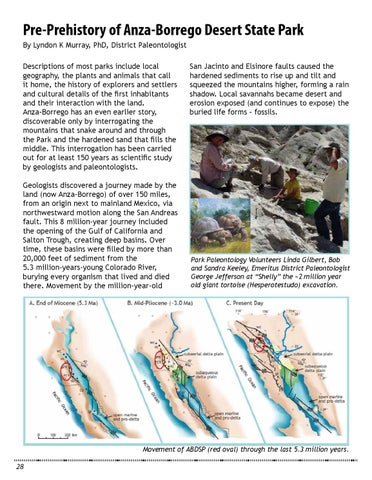
Pre-Prehistory of Anza-Borrego Desert State Park By Lyndon K Murray, PhD, District Paleontologist Descriptions of most parks include local geography, the plants and animals that call it home, the history of explorers and settlers and cultural details of the first inhabitants and their interaction with the land. Anza-Borrego has an even earlier story, discoverable only by interrogating the mountains that snake around and through the Park and the hardened sand that fills the middle. This interrogation has been carried out for at least 150 years as scientific study by geologists and paleontologists. Geologists discovered a journey made by the land (now Anza-Borrego) of over 150 miles, from an origin next to mainland Mexico, via northwestward motion along the San Andreas fault. This 8 million-year journey included the opening of the Gulf of California and Salton Trough, creating deep basins. Over time, these basins were filled by more than 20,000 feet of sediment from the 5.3 million-years-young Colorado River, burying every organism that lived and died there. Movement by the million-year-old
San Jacinto and Elsinore faults caused the hardened sediments to rise up and tilt and squeezed the mountains higher, forming a rain shadow. Local savannahs became desert and erosion exposed (and continues to expose) the buried life forms – fossils.
Park Paleontology Volunteers Linda Gilbert, Bob and Sandra Keeley, Emeritus District Paleontologist George Jefferson at “Shelly” the ~2 million year old giant tortoise (Hesperotestudo) excavation.
Movement of ABDSP (red oval) through the last 5.3 million years.
28
Paleontologists have discovered fossils of many organisms that once made their home here, including: · Marine life Corals, crabs, sand dollars, oysters, clams and snails, whales, dolphins, walrus, sharks · Terrestrial Trees and Mammals: sabre-tooth cats, wolves, sloths, mammoths, badgers, porcupines · Reptiles Giant tortoise, pond turtles, lizards · Birds Ducks, geese, eagles, hawks, giant teratorns, terror birds · Freshwater Fish: razorback suckers, pike minnows, bony tail chubs; and clams. Interrogation and discovery continue in Anza-Borrego, aided by the work of many volunteers who feel quite at home in the paleontology laboratory, the fossil-rich areas of the park, or both! Editor Note: Drawings from Fossil Treasures of the Anza-Borrego Desert, GT Jefferson and L Lindsay (editors) 2006. Photos courtesy of the Anza-Borrego Desert State Park Paleontology Society.
Park Paleontology Volunteer Bob Keeley excavating the ~100,000 year old sand mammoth (Mammuthus) skull and mandible.
(A) Park Paleontology Volunteer Ron Pavlu removing sandstone with dental pick and brush from anterior of giant tortoise “Shelly” (B) top of shell (partial) - right side (C) bottom of shell – posterior view
29
Steele/Burnand Anza-Borrego Desert Research Center: A Home for Science By Jim Dice, Reserve Manager; Photos by Robert Thériault and Elaine Tulving
With renovation and new construction finally complete, the University of California, Irvine’s Steele/Burnand Anza-Borrego Desert Research Center in Borrego Springs opened to classes and researchers in the fall of 2014. A lab and classrooms, as well as indoor and outdoor gathering places, provide flexible working and meeting space, while student dorms and apartments for researchers allow for overnight stays. Solar panels provide part of the facility’s electricity, and native landscaping conserves water. The Center is a cooperative project between UC Irvine, California State Parks, the Anza-Borrego Foundation (ABF) and the UC Natural Reserve System. A primary goal of the partnership is to facilitate access to Anza-Borrego Desert State Park (ABDSP) for researchers from the University of California and other institutions in order to foster informed management of the Park’s natural and cultural resources. In the first full year of operation, the Center housed researchers from ten campuses 30
including UC Irvine, UC Riverside, UC San Diego, UCLA, Rutgers, the University of Connecticut and the University of Alberta. Classes from UC Irvine, UC Berkeley, Colorado College and USC, among others, have taken advantage of its first-rate facilities. The Center also provided a venue for ABF and Desert Bighorn Council events and hosted a visiting delegation of Iranian scientists. Though construction was backed by a Proposition 84 grant to UC Irvine from the State of California, the majority of funds for the project were provided privately by long-time Borrego Springs benefactor Audrey Steele Burnand. The facility is named for her parents, Harry and Grace Steele, and her father-in-law A.A. Burnand Jr, who originally commissioned the building as the Borrego Desert Club.
Annual Day-Use Passes
Practice Desert Safety
From the desert to the sea, California has a most diverse selection of parks and recreation areas waiting for you. Kayak the Salton Sea or surf the Pacific Ocean. Stand in awe of mighty redwoods, crawl through underground caverns or soak in hot mineral springs — all within the California State Park system.
✓ Know your physical limitations in the heat and rugged desert terrain. Summer temperatures can reach 125 degrees F.
An annual statewide day use pass gives you daytime access to nearly all of California’s state parks, beaches, reserves and recreation areas. The $195 permit is on a vehicle hangtag, valid for a full year. Visitors not intending to visit beaches can purchase a $125 Golden Poppy Pass that gives day use access to many of California’s natural and recreational areas, including Anza-Borrego and all of the parks in the Colorado Desert District. Whichever you choose, you can purchase your annual day use pass at the Anza-Borrego Desert State Park Visitor Center.
✓ Wear sturdy footwear and a hat, and use sun protection.
✓ Always carry plenty of water ... and drink it! It does you no good if it stays in your water bottle. One gallon minimum per person per day is recommended.
✓ Do not hike alone — use the buddy system. ✓ Tell someone of your trip plans. ✓ Use maps. Car GPS systems are often less reliable in a wilderness park. ✓ Start out with a well-maintained vehicle. Carry extra water, shovel, tools, flares and blankets. Check the road condition board at the Visitor Center before you start out. ✓ If your vehicle breaks down, stay with it! Raise your hood. It is much easier to find a vehicle than a wandering person. ✓ Should you find yourself in trouble, do not panic. If you have followed the above precautions, help will soon be on the way.
31
California Overland Desert Excursions Get off the beaten path to experience the desert in its most primal state. Anza-Borrego Desert State Park is an intriguing place to view from the road, but it becomes magical when you leave the asphalt. You are no longer just “looking at it”—you are “experiencing it”! Our outdoor adventures—from just a few hours to overnight— focus on fun, education and rugged experiences. So explore Anza-Borrego while exploring your adventurous side with California Overland.
760-767-1232 866-6-EXPLORE www.californiaoverland.com Palm Oases | Slot Canyons | Wind Caves | Amazing Vista Points | Historic and Prehistoric Sites
32
Anza-Borrego Almanac ⁰F
JANUARY FEBRUARY MARCH APRIL MAY JUNE JULY AUGUST SEPTEMBER OCTOBER NOVEMBER DECEMBER
69 72 78 84 93 102 107 106 100 89 77 68
High ⁰C 21 22 25 29 34 39 42 41 38 32 25 20
⁰F
43 47 49 53 60 68 75 75 69 60 50 43
Low ⁰C 6 8 10 12 16 20 24 24 21 16 10 6
Total RainFall 2012 Figures are based on daily readings at Anza-Borrego 2013 Desert State Park® Headquarters (30-year average). 2014
2016 January 1 January 15 February 1 February 15 March 1 March 15 (PDT) April 1 April 15 May 1 May 15 June 1 June 15
SUNRISE SUNSET 6:51 4:53 July 1 6:51 5:05 July 15 6:44 5:21 August 1 6:32 5:34 August 15 6:16 5:46 September 1 6:58 6:57 September 15 6:36 7:09 October 1 6:18 7:19 October 15 6:01 7:31 November 1 5:49 7:41 November 15 (PST) 5:41 7:52 December 1 5:40 7:58 December 15
Rainfall INCH CM 1.14 2.90 1.32 3.35 0.84 2.13 0.17 0.43 0.05 0.13 0.02 0.05 0.30 0.76 0.44 1.12 0.31 0.79 0.24 0.61 0.39 0.99 0.91 2.31 4.02 5.82 2.54
10.21 14.78 6.45
SUNRISE SUNSET 5:45 8:00 5:52 7:57 6:03 7:46 6:13 7:33 6:24 7:13 6:33 6:54 6:43 6:32 6:53 6:15 7:07 5:57 6:19 4:47 6:33 4:42 6:44 4:44
33
5
76
52 163
56
S6
52
79
• Valley Center
•
371
79
•
Anza
Lake Henshaw
Aguanga
76
•
78
Santa Ysabel
8
¯ 5
•
• S2
79
•
78
To Palm Springs
S22
86
78
111
Salton Sea
•
Salton City
To Brawley
To 8 El Centro & Yuma
Ocotillo
•
Split Mtn. Rd.
Ocotillo Wells SVRA
S2
Anza-Borrego Desert State Park®
S3
Borrego Springs
• •
Mt. Laguna
S1
Visitor Center Ranchita
S22
Warner Springs
• Julian
• 10 Miles
Descanso
Cuyamaca Rancho State Park
Ramona
•
Palomar Mtn. State Park
•
S6
67
78
Rincon Springs
S4
76
8
Poway
•
15
•
Temecula
•
Escondido
15
To Riverside & Los Angeles
To Orange County and Los Angeles
5
•
Carlsbad
Oceanside
••
Del Mar
San Diego
0
2013 LLJ, MAR
34 34
Support the Borrego Springs businesses that generously contribute to keep Anza-Borrego Desert State Park protected!
35
It is the Mission of California State Parks to provide for the health, inspiration and education of the people of California by helping to preserve the state’s extraordinary biological diversity, protecting its most valued natural and cultural resources, and creating opportunities for high-quality outdoor recreation.
Anza-Borrego Desert State Park® 200 Palm Canyon Drive Borrego Springs, CA 92004 Park Headquarters 760-767-5311 Visitor Center 760-767-4205
© 2016 CALIFORNIA STATE PARKS® Published in cooperation with the Anza-Borrego Foundation and the San Diego County Community Enhancement Program. Anza-Borrego Desert State Park, California State Parks and park logos are registered trademarks of California State Parks. Edited by Sally Theriault. Cover Photo by Jeff Young. 36 All rights reserved.