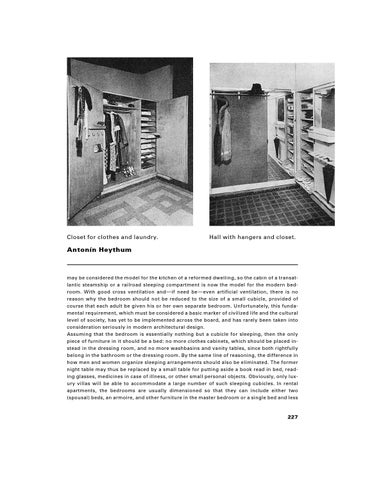
Closet for clothes and laundry.
Hall with hangers and closet.
AntonĂn Heythum
may be considered the model for the kitchen of a reformed dwelling, so the cabin of a transatlantic steamship or a railroad sleeping compartment is now the model for the modern bedroom. With good cross ventilation and—if need be—even artificial ventilation, there is no reason why the bedroom should not be reduced to the size of a small cubicle, provided of course that each adult be given his or her own separate bedroom. Unfortunately, this fundamental requirement, which must be considered a basic marker of civilized life and the cultural level of society, has yet to be implemented across the board, and has rarely been taken into consideration seriously in modern architectural design. Assuming that the bedroom is essentially nothing but a cubicle for sleeping, then the only piece of furniture in it should be a bed: no more clothes cabinets, which should be placed instead in the dressing room, and no more washbasins and vanity tables, since both rightfully belong in the bathroom or the dressing room. By the same line of reasoning, the difference in how men and women organize sleeping arrangements should also be eliminated. The former night table may thus be replaced by a small table for putting aside a book read in bed, reading glasses, medicines in case of illness, or other small personal objects. Obviously, only luxury villas will be able to accommodate a large number of such sleeping cubicles. In rental apartments, the bedrooms are usually dimensioned so that they can include either two (spousal) beds, an armoire, and other furniture in the master bedroom or a single bed and less
227