being human

anthroposophy.org personal and cultural renewal in the 21st century a quarterly publication of the Anthroposophical Society in America spring issue 2018 Beyond Believing (p.14) Not a Waldorf Kid (p.18) Native America & Waldorf (p.20, 22) Spiritual Science & Technology (p.28) Making Yourself New (p.30) Conversations with Saul Bellow (p.45) Approaching the Sacred Gateway (p.62)
“The Threefold Human Being” watercolor by Kelly Beekman from a motif for painters by Rudolf Steiner; (see Gallery, page 35)
Rudolf Steiner Bookstore

Tu-Thu 1-5pm, Fri-Sat 12-7pm, Sun 1-5pm
Closed Mondays; info: 212-242-8945
Steiner has “the most impressive holistic legacy of the 20th century...”
— NY Open Center co-founder Ralph White
ANTHROPOSOPHY NYC
Programs and resources in the arts
Waldorf education · health & therapies

social action · biodynamic farming spirituality · esoteric research self-development
WORKSHOPS TALKS
STUDY GROUPS
FESTIVALS EVENTS
EXHIBITS
Upcoming Programs
EURYTHMY MONDAYS, TWICE A MONTH MONTHLY EURYTHMY WORKSHOP

Linda Larson, Mondays 7pm: 3/12, 4/16, 5/14, 6/11

EURYTHMY ZODIAC CIRCLE
Marta Stemberger, Mon 7pm: Pisces to Virgo: 2/26, 3/26, 4/30, 5/21, 6/25, 7/23, 8/20
ANTHROPOSOPHIC PSYCHOLOGY

David Taulbee Anderson, Wednesdays 7pm. Steiner’s insights into soul and spirit: 3/14, 4/18, 5/16, 6/13


UNCOVERING THE VOICE
singing with Christiaan Boele, Thursday 7pm, 3/1
INNER PATH WORKSHOP with Lisa Romero, Saturday-Sunday, 3/10-11
STEINERBOOKS SPIRITUAL RESEARCH
At NYU Kimmel Center, Friday-Saturday 3/16-17
YAHWEH & JESUS, GABRIEL & MICHAEL with Eugene Schwartz, Saturday 7pm, 4/7; also, “From the Great Lakes to the Salt Lakes,” Saturday 7pm, 5/19
Weekly & Monthly Groups
Meditation as taught by Georg Kühlewind (Tues), Esoteric Science (Tues), Cosmic Memory (Wed), Rudolf Steiner’s Toward Social Renewal (Wed), Festivals of the Year (Thu), How to Know Higher Worlds (Fri). Life Beyond Death (1st Mondays); Art History as a Reflection of Inner Spiritual Impulses (3rd Sundays)
Call or visit us online for details: www.asnyc.org 212-242-8945
The New York Branch Anthroposophical Society in America 138 West 15th Street New York, NY – (212) 242-8945 www. asnyc .org centerpoint gallery spiritual therapeutic world & outsider artists NOW ENROLLING / REGISTERING FOR SUMMER 2018 Low-Residency Elementary & Early Childhood Teacher Education Programs • Music Teacher Intensive • Summer Series Courses & Workshops www.sunbridge.edu Celebrating 50 Years of Inspiring Waldorf Teacher Education! Ask about our option for an Accredited Master’s Degree
Week 1: June 24th to June 29th
Become a Facilitator in the Child Study: Deepening Our Understanding of the Young Unfolding Human Being With Christof Wiechert
Grade 1: Once Upon a Time...The Journey Begins! With Regine Shemroske
Grade 2: Noble Knights are We! With Robert Lanier
Grade 3: Living and Growing on the Earth: Transforming Guests into Hosts With Shannon Wiley
Grade 4: What are We Now?
Gods, Goddesses, Giants, Gnomes, Human, or Animal With Christopher Sblendorio
Grade 5: The Turning Point… the Final Glory of Childhood: The Youngster as Self-Learner at Last! With Patrice Maynard
Grade 6: The World as Seen by a Roman, Experienced by a Knight With Lynn Thurrell
Grade 7: In the Face of Indifference...discover Wonder! With Alison Henry
Grade 8: Revolutions, Discoveries, and Justice With Helena Niiva
Imaging The Feminine: Veil Painting the Beauty & Mystery of Love With Charles Andrade
Also Featuring: Drawing, Painting or Clay
With Elizabeth Auer (weeks 1 & 2)
Eurythmy With Cezary Ciaglo (weeks 1 & 2) Daily Morning Lectures
With Christof Wiechert (week 1)
Science With Roberto Trostli (week 1)
Singing and Recorder
With David Gable (week 1)
Movement With Julianna Lichatz (week 1)
Singing With Meg Chittenden (week 2)
Movement With Connie Helms (week 2)
For Waldorf teachers and administrators -along with parents, trustees, artists, and thinkers seeking to deepen their lives through Anthroposophy
Week 2:
July 1st to July 6th
Our Sensitive Children on the Autism Spectrum: Spiritual and Practical Approaches
With Lakshmi Prasanna, MD
School of Elemental Beings: Learning to Speak with Nature
With Karsten Massei
Exploring Star Wisdom: Cosmic Evolution, Biography, and Birth Charts
With Brian Gray
Fundamentals of Anthroposophy: Observation, Contemplation, and Self Development
With Signe Motter and the Faculty of CfA
The Roadmap to Literacy: Creating an Artistic and Effective Language Arts
Curriculum in the Lower Grades
With Janet Langley
Strengthening the Whole Class: Foundations for Academic Progress
With Jeff Tunkey
The Art of Teaching Mixed and Combined Grades: A Focus on the Lower Grades
With Scott Springer
The Art of Teaching Mixed and Combined Grades: A Focus on the Upper Grades
With Ian Chittenden
Projective Geometry
With Jamie York
Living Thinking
With Michael D’Aleo
Communication and Dispute Resolution
With John Cunningham, Cat Gilliam, and Leonore Russell
Working with Polarities in Copper and Iron: Experiencing Empathy between Sympathy and Antipathy
With Daniel and Colleen O’Connors
Renewal Courses sponsored by Center for Anthroposophy Wilton, New Hampshire

Karine Munk Finser, Coordinator
603-654-2566 • info@centerforanthroposophy.org
Painting out of the Color: Pastel Foundations in Color, Value, and Form
With Charles Andrade
Waldorf High School Teacher Education Program
Douglas Gerwin, Director
Math
Physics & Chemistry
History
Welcome
Visit us online for details of our part-time Foundation Studies in Anthroposophy and the Arts
available on demand around the U.S. www.centerforanthroposophy.org
online at:
to Renewal 2018!
Clusters
Register
www.centerforanthroposophy.org
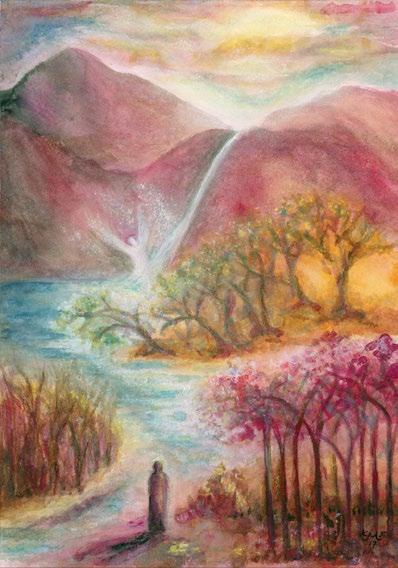
Painting by Karine Munk Finser
July 1st to July 28th
•
•
•
Three-summers program specializing in Arts/Art History
Biology
English
•
training p rog r am S
for independent & public waldorf S c H ool teac H er S & a dmini S trator S |
tHE HEARt OF tHERApEutIC EDuCAtION pROFESSIONAL DEVELOpMENt
transdisciplinary therapeutic Education (ttE)™
July 2 6, 2018
Four Summer sessions beginning 2018 with three school years of practicum weekends
Bringing together Medicine, Psychology & Education to offer Remedial Therapeutic training for Waldorf Class Teachers, Teachers of Special Needs Children, School Psychologists and School Administrators.
tEACHING AS AN ARt
Grade Level Preparation and Renewal Week
July 9—13, 2018 in Denver, CO
Summer 2018
tEACHER tRAINING for Independent & public Waldorf School teachers


Semester 1: June 24—July 7, 2018
§ Early Childhood Education
§ Elementary Grades 1-8


§ Educational Leadership
8 Courses over 7 Semesters (26 months)
§ Inner Development (Imperative Inner Work)
§ Waldorf Culture (School Governance, Culture, Leadership, Community Life)
§ Waldorf Methodology (Monthly Main Lesson Preparation)
§ Field Work (Mentoring & Internship in Your Classroom)
§ Temporal Arts (Eurythmy, Speech Arts, Music, Spacial Dynamics, Storytelling)

§ Visual Arts (Painting, Drawing, Sculpting)
§ Philosophical Foundations (Steiner World View, Human Development, Evolution of Consciousness)
§ Student Study (Accountability, Standards, Remedial Approaches in Waldorf Schools)
CONSIDERING A CAREER CHANGE?
The movement needs Waldorf teachers with a calling!
WHY GRADALIS?
We support working teachers. Our courses provide anthroposophical foundations of Waldorf education. Our faculty has years of experience in both independent and Public Waldorf schools. Gradalis training includes 3 summer intensives, 4 practicums over 2 school years, with 8.8% of the program on-line Interactive Distance Learning.
SCHOOL CONSuLtING Board training, teacher mentoring and evaluation, parent talks, strategic planning, construction financing and more.
CON tAC t u S
at 720-464-4557
www.gradalis.com

Center for Anthroposophical Endeavors


A Place of Learning and Working in the World through Anthroposophy since 1982

Now Available
Mys
The Mysteries of Technology
Journal volume 1 issue 2: featuring articles from Dr. Gopi Krishna Vijaya, Florian Sydow and Andrew Linnell.
MysTech Membership: Through your yearly support, contributions are made to a fund for education, research and development in Moral technology.
MysTech Study Group: This study group is online every Monday from 5:30 to 6:30 PST. For those interested in joining please email Frank at: info@rudolfsteinerbookstore.com Joining the group gives you access to the Facebook page where you’ll find recordings of the study groups and the continuation of the conversations.
More information can be found through: rudolfsteinerbookstore.com/membership and select MysTech
Coming this Year
Local Commons - Available April/May
A new website that is set to bring the Economic Sphere in line with the Cultural Sphere. For those interested in knowing more or wanting to be involved as a Business or Cultural Organization please signup on our landing page at www.localcommons.us
MysTech Website - Available April/May
A new website that will bring together the whole vision for MysTech - Journal, Membership and School. Signup on our mailing list at www.rudolfsteinerbookstore.com - scroll to the bottom of the page.
The Dr. Rudolf Steiner Bookstore is host to: Sound Circle Center Student Bookstore and the Center for Anthroposophy Student Bookstore (Found under Training Courses)

CFAE
Local Commons are a 501(C)(3)
under CFAE
Dr. Rudolf Steiner Bookstore, MysTech &
nonprofit
spring issue 2018 • 5
Connect to the Spiritual Rhythms of the Year...
Religious
Study Groups

Lectures
The Christian Community is a movement for the renewal of religion, founded in 1922 with the help of Rudolf Steiner. It is centered around the seven sacraments in their renewed form and seeks to open the path to the living, healing presence of Christ in the age of the free individual. Learn more at www.thechristiancommunity.org

Early Childhood, Grades and High School Tracks
tiffany@bacwtt.org 415 479 4400 Embark on a journey of self development and discovery Study with us to become a Waldorf Teacher A sacred service. An open esoteric secret: The Act of Consecration of Man Celebration of the Festivals
of the Sacraments Services for Children
www.bacwtt.org
Renewal
Camps
Education Summer
6 • being human
WEEK I - JUNE 17 - 22
History of the Human Consciousness through Art
w/ Patrick Stolfo
Veil Painting | Clay Sculpture
Eurythmy

Nature Stories and Eurythmy for Young Children
w/Andree Ward and Lynne Stolfo
Steiner School of Speech Arts
THREEFOLD EDUCATIONAL CENTER, CHESTNUT RIDGE, NY
2018–2019 programs
~ Foundation Year Course
~ Four-Year Training in Speech Arts
~ Weekend Workshop Speech Intensives
core faculty
Barbara Renold, Helen Lubin, Jennifer Kleinbach
SUMMER COURSES 2018
WEEK II - JUNE 24 - 29
ART IMMERSION WEEK
Stone Carving w/Patrick Stolfo
Painting with Meditation & Interaction w/Nature Processes


w/ Martina Angela Müller
WEEK III - JULY 18-22
Leading with Spirit: The Art of Administration and Leadership in Waldorf Schools: Understanding the Social and Spiritual Foundations

w/Lisa Mahar and Michael Soulé
alkion center | ANTHROPOSOPHY, ART & TEACHER EDUCATION 330 County Route 21C, Ghent, NY 12075 • 518-672-8008 • info@alkioncenter.org • www.alkioncenter.org
FOR COURSE DESCRIPTIONS AND REGISTRATION, VISIT ALKIONCENTER.ORG
TRANS F O RMING THE SPOKE N W O R D Discover the power of the spoken word, build skills, and develop artistic mastery
visit www.steinerspeecharts.org or contact barbararenold@yahoo.com
spring issue 2018 • 7
Enrich your inner world through heartwarming studies, experiences and relationships.
A profoundly transformative series of seminars, focusing on a living experience of the human soul. Studies include a potent mixture of lecture, small group work, art, music, dramatization, and eurythmy.

New programs begin April 2018.
Waldorf Teacher Training in Canada
Programs
Waldorf Early Childhood Educator Training
Next intake, July 2019
July session in Duncan,
North Vancouver, BC 2 year part time program – 5 weeks each year. 3 weeks in July, 1 week in fall and spring with additional mentoring, observation and practicums.
Accompanying the
Waldorf Grades Teacher Training

Next intake July, 2018
July session in Duncan, Vancouver Island; fall & spring in North Vancouver, BC 3 year part time program – 5 weeks each year. 3 weeks in July, 1 week in fall and spring with additional mentoring, observation and practicums.

Courses
Bringing love and joy with puppetry and hand

with Heidi Sponhauer, Lynn St Pierre, Marjorie Rehbach and
Warming the Space
How to get the most out of the Teacher-Parent
July 15 to 20, 2018 with Louise deForest, Blondine Maurice & Ruth Ker
please contact Ruth Ker email: mrker@shaw.ca phone: 250-748-7791
From Transition to Transformation
Working with the emerging adolescent
July 2 to 6, 2018 with Wade Cavin, Jeffrey Levy, Sonia Plewa & Lisa Masterson
Teaching with Heart
Experiencing the Waldorf approach
July 9 to 11, 2018 with Kate Reynolds, Rebecca Watkin & Lisa Masterson
For more information please contact Lisa Masterson email: WCIGrades@gmail.com phone: 949-220-3193
To apply or register go to www.westcoastinstitute.org for the link to the registration form
British Columbia, Canada www.westcoastinstitute.org | info@westcoastinstitute.org

anthroposophicpsychology.org
8 • being human
8 from the editors 13 articles on the internet
14 from the general secretary: “Beyond Believing” 16
16 Taking Council: Update on the Council of Anthroposophical Organizations, by John Bloom
17 Finding Our Voice, by Chris Burke and Jerilyn Burke
18 Not a Waldorf Kid, by Kailea Frederick
19 YIP 2008 to Present, by Lauren Witco (Morley)
20 Exploring Waldorf-Inspired Tribal Schools, by Charles Morin, Loren Silver, & Lars Helgeson 22 Native America and Waldorf-Inspired Education, by Joaquin Muñoz
23 A Path Worth Treading, by Craig Holdrege and Seth Jordan 24 From “Angel-ish” to English, by Michael Ronall
28 arts & ideas
28 Spiritual Science and Technology, by Gary Lamb
30 Making Yourself New, review by David Adams of Cognitive Yoga by Yeshayahu Ben-Aharon 35 Gallery: The Growing Imagination, paintings by artists following Steiner’s path of study
spring issue 2018 • 9 Contents
initiative!
43 Book Notes 44 research & reviews
45 Conversations
48 Living Inner Development
Review
Mackenzie 50 news for members & friends 50 Traveling Speakers Program Pays It Forward 51 New Members of the Anthroposophical Society in America 52 All Souls Retreat & Journey of the Soul Festival,
Fieber-Dhara 53 Central Regional Council Report 54 Intention & Love, by Deb Abrahams-Dematte 55 Living Into the Year, by Laura Scappaticci 55 Note from Katherine Thivierge 55 From Virginia Sease 56 Maitreya Branch of North Texas 56 General Council Meeting in Atlanta 57 Members Who Have Died 57 Basil Williams, DO 59 Kundry Wilwerth 61 Marion Bruce 62 Approaching the Sacred Gateway, by Marianne Dietzel 63-64 Sacred Gateway Conference, Sacramento, California, April 6-7-8
44 Finding the Thresholds, review by Fred Dennehy of Frederick Amrine’s Thresholds
with Saul Bellow by Stephen Usher, review by Dwight Ebaugh
by Lisa Romero,
by Dan
by Marianne
The Anthroposophical Society in America
General Council
John Bloom, General Secretary & President
Dave Alsop, Chair (at large)
John Michael, Treasurer (at large)
Dwight Ebaugh, Secretary (at large)
Micky Leach (Western Region)
Marianne Fieber-Dhara (Central Region)
David Mansur (Eastern Region)
Joshua Kelberman (at large)
Nathaniel Williams (at large)
Leadership Team
Deb Abrahams-Dematte, Director of Development
Katherine Thivierge, Director of Operations
Laura Scappaticci, Director of Programs
being human
is published by the Anthroposophical Society in America

1923 Geddes Avenue
Ann Arbor, MI 48104-1797
Tel. 734.662.9355
www.anthroposophy.org
Editor: John H. Beck
Associate Editors:
Fred Dennehy, Elaine Upton
Proofreader: Cynthia Chelius
Design and layout: John Beck
Please send submissions, questions, and comments to: editor@anthroposophy.org or to the postal address above, for our next issue by 5/15/2018. being human is free to members of the Society (visit anthroposophy.org/join). Sample copies are sent to friends who call, write, or email us at the address above.
©2018 The Anthroposophical Society in America. Responsibility for the content of articles is the authors’.
from the editors
Dear Friends,
On our “Path to 2023” the year 2018 is slated to recall the opening up of anthroposophy, after the disaster of the “Great War,” to new initiatives. That will be reflected strongly later in this year as we expand the new website rudolfsteiner.org as an English-language resource for the man, the ideas, and the initiatives. This issue, however, touches on a more hidden, complementary development, the cognitive or “Michaelic” yoga that Rudolf Steiner also developed from around this time. Interviewed in Fargo, North Dakota, in 2013 by Rich Grams, Yeshayahu Ben-Aharon described it this way:
This (Yoga) is the concept that Steiner uses for working with the Philosophy of Freedom. Forget about the yoga name as such. The important thing is that modern consciousness is the starting point for this spiritual development. Anthroposophy can start directly from our day to day thinking, perceiving, feeling, willing consciousness. ... It’s not instead of the traditional meditation; we still need that. But from that moment on when anthroposophy became socially creative and engaged, [traditional practice] was simply not enough. Steiner needed a spiritual path that people could engage in the middle of life; in social activity itself, in the market, in meeting with one another. There were many anthroposophists and pupils of his who had been meditating and studying for twenty years but couldn’t face another human being in a positive way.
Ben-Aharon brings out this work in Cognitive Yoga , and it receives a lengthy, challenging, but very important review by David Adams on page 30. The spectacular Gallery (p.35-38 and cover) makes an interesting counterpoint. Just communicating about anthroposophy remains a challenge; the Council of Anthroposophical Organizations is working on that (p.16-17). Some programs, however, like Sweden’s YIP, have found ways to open new new, fulfilling paths and vistas to young adults (p.18-19). And Waldorf is being looked at as a resource for Native American tribal schools, where cultural conservation and renewal are urgent concerns (p.20-22).
Gary Lamb shares key ideas from a recent gathering about “Spiritual Science and Technology” (p.28). In the Society’s own work, Marianne FieberDhara reports on the Central Region’s “Bridging Project: Between Life and Death from Soul to Soul,” now concluded, and its new study and sharing on Karma. The “Bridging Project” has been a remarkable preparation for the webinars and upcoming “Sacred Gateway” conference in April; the last pages include details on that, along with an article by Marianne Dietzel. Speaking of webinars —are you getting emails about them from the Anthroposophical Society in America? Since webinars are an online activity, we email notices about them... As best we can tell, as many as half of the addressees aren’t opening these emails. (All emailers report this problem.) If you want to keep up with these splendid programs, please check your “spam” folder, your “promotions” tabs, and any other places they may go astray.
John Beck
Leaving a Legacy of Will
There are three reviews in this edition of being human. Dan Mackenzie, who previously reviewed Lisa Romero’s Sex Education and the Spirit, now reviews her later work, Living Inner Development: The Necessity of True Inner Development in the Light of Anthroposophy. Mr. Mackenzie emphasizes that the “development” spoken of in this book is not simply self-improvement, but constitutes the specific way in which an individual contributes to the community. For the sake of the healthy evolution of humanity, it is essential that we cross the threshold humanity is approaching in a deliberate, spiritually healthy manner, rather than through the many dangerous and spurious avenues that offer themselves as short cuts, decoying us with the promise of avoiding the work of facing the guardian of the threshold—the spiritual being who protects us from entering into cosmic spiritual realities before we can handle the experience.
Dwight Ebaugh reviews Stephen Usher’s Conversations with Saul Bellow on Esoteric-Spiritual Matters, A Publisher’s Recollections, a glimpse into the fascinating story of the discovery of anthroposophy by one of the greatest novelists of the twentieth century. Mr. Usher’s work shows Bellow as an individual painstakingly reverent toward anthroposophy, but somewhat more cautious in his attitude toward anthroposophists. I was incidentally reminded of Bellow’s pursuit, as an admittedly beginning student of anthroposophy, of a relationship with Owen Barfield, and the misfortune that their acquaintance did not ripen into a friendship.
In addition, I have reviewed the marvelously challenging collection by Professor Frederick Amrine, Thresholds: Ten Anthroposophical Studies. Professor Amrine’s essays have appeared regularly in being human
Finally, I will take the opportunity of this Note to call readers’ attention to the notice on the next page about a course to be given this summer in London on Shakespeare, taught by Andrew Wolpert, Sarah Kane, Richard Ramsbotham and myself, in which we will experience (along with other works) As You Like It, Hamlet, Othello and The Winter’s Tale as awakeners of the human spirit at the dawn of the Consciousness Soul Age. We will also be seeing these plays in performance at the Globe.
Fred Dennehy
The Anthroposophical Society in America announces the forming of the
Legacy Circle
Legacy giving offers the opportunity to make a gift which brings expression to your intention and love for anthroposophy into the future.
Thank you to our 27 founding members, who support the Society’s future through a bequest or planned gift, and to those (next page) who have made bequests in recent years.
www.anthroposophy.org/legacy
spring issue 2018 • 11
reviews
www.anthroposophy.org/legacy
Legacy Circle
Many thoughtful and caring members have provided legacy gifts for the Anthroposophical Society in America through their estate planning. We are humbled and deeply grateful for the gifts of these dear friends since 1992:

J. Leonard Benson Susannah Berlin
Hiram Anthony Bingham Virginia Blutau
Iana Questara Boyce Marion Bruce
Helen Ann Dinklage Irmgard Dodegge
Raymond Elliot Lotte K. Emde Marie S. Fetzer
Linda C. Folsom Hazel Furguson Gerda Gaertner
Ruth H. Geiger Harriet S. Gilliam
Agnes B. Grunberg Bruce L. Henry
Ruth Heuscher Ernst Katz Anna Lord
Seymour Lubin Gregg Martens Ralph Neuman
Norman Pritchard Paul Riesen Ray Schlieben
Lillian C. Scott Fairchild Smith
Doris E. Stitzer Gertrude O. Teutsch
Contact Deb Abrahams-Dematte at deb@anthroposophy.org or (603) 801-6584 for information about the Legacy Circle.
SHAKESPEARE and the Spirit of English
Rudolf Steiner House, London
30th July – 10th August, 2018
Come to England next summer and enjoy Shakespeare in London Theatres, Drama Workshops, Text Study Sessions, and through Discussions, Seminars and Lectures
The Spirit of English with Sarah Kane, Richard Ramsbotham, Fred Dennehy & Andrew Wolpert offers an opportunity to engage with Shakespeare for a fortnight of artistic activity, provocative thoughts, merriment & metamorphosis.
Seeing plays on stage is an essential part of this course; when theatres’ plans are published, we will select performances and weave a theme for our work together. Whether connecting threads are old monarchs struggling with failing authority, brave individuals discovering potential Ego sovereignty, the poignant dynamic between fathers and daughters, the inseparable link between knowledge and evil, the painful dichotomy between knowing and doing, the allure of gender fluidity, the metamorphosis of image to vision, the dissolution of dated distinctions, the manifestation of life even in death, or the enabling power of forgiveness, the plays will provide scope for our exploration and discovery.
The beauty, genius and creative energy in the language of the plays and sonnets will be part of our work, as well as historical considerations of England, the world and English at Shakespeare’s time. This treasure of universal culture that celebrates, confirms and lovingly accompanies our still unfinished becoming human was given at the beginning of what Rudolf Steiner called the Consciousness Soul Age. This gift to the world reveals something of the Spirit of English and its timeless contribution that still now and into the future will grow and prosper, long after the illusions of national, territorial or political significance are dispelled.
This course is for adult native speakers and non-native speakers with an upper-intermediate or advanced level of comprehension. Students over 16 are welcome if accompanied by an adult. The course fee is £630, not including theatre tickets, food, or accommodation. You should explore various options; there is great demand for summer accommodation in London.
A course programme and details are available from early 2018; note the dates and let us know if you are thinking of joining us: andrewjwolpert@gmail.com
This course is sponsored by and run on behalf of The Anthroposophical Society in Great Britain
12 • being human
REFLECTIONS
Become
Pacific Eurythmy

Pacific Eurythmy is the new part-time Eurythmy training on the West Coast, Portland, Oregon
“This is what lies behind Eurythmy! The Human Being as a completed form, created out of movement!” — R. Steiner
New classes starting fall 2019 Visit: PortlandEurythmy.com
Rudolf Steiner Library
Contact Information
Rudolf Steiner Library of the Anthroposophical Society in America , 351 Fairview Avenue Suite 610, Hudson, NY 12534-1259
(518) 944-7007 (voice & text)
E-mail: rsteinerlibrary@gmail.com
Hours: Wed–Fri, 10am–3pm.
Home page: www.anthroposophy.org/rsl
Library catalog: rsl.scoolaid.net
intervals by Melanie Richards lulu.com/spotlight/lifeconbrio

Interval Reflections
piano pieces highlighting the musical intervals
by
Melanie Richards
To order: lulu.com/spotlight/lifeconbrio
ARTICLES ON
Articles we could not include in the printed being human are published at www.anthroposophy.org/articles
“It’s Time to Listen to the Dummy: What It Means When the Modest Placebo Speaks,” by Walter Alexander; republished from Pharmacy & Therapeutics, November 2017
“Anthroposophy & The Second Coming: A presentation of the work of Yeshayahu Ben-Aharon,” by Torbjørn Eftestøl
“Anthroposophy & Linguistics,” by Terry Hipolito
“Exoteric & Esoteric: Review-Essay of Volume 7 of the Rudolf Steiner Critical Edition”, by David W. Wood
Steiner & Kindred Spirits, by Robert McDermott, Preface and Chapter One
“Let there be light...” by Sally Voris
Fairy Tales & Art Mirrored in Modern Consciousness, by Monica Gold; updated with additional chapters from the book
Report from Phoenix; Sharing the experience of our October 2017 fall conference and annual meeting in Phoenix, Arizona
“Understanding Pauline Initiation in the New Testament as Key to Meeting Christ in the Etheric,” by Bill Trusiewicz
“Adventures in Ancient and Modern Egypt,” by Linda Connell, experiences from an “Egyptian Odyssey” led by Gilian Schoemaker
spring issue 2018 • 13
a Eurythmist! Flexible Fees & Hours
Anthroposophically based Counseling by Telephone tel. 360.473.7777 alicia@bluepearlarts.com Dr. Alicia R. Marroquin MA Psych., PhD In Esoteric Religious Studies Sponsored Member Anthroposophical Society since 1990 Here and Now: Transforming Ourselves, Transforming Our World 2018 Fall Conference and AGM New Orleans, October 5-6-7 with Joan Sleigh & Orland Bishop
www.bluepearlarts.com
THE INTERNET
Beyond Believing
by John Bloom
Habits of practice die hard; Habits of thought die harder; Beliefs guide habits and die hardest of all.
I was asked a profound question following my remarks “Beyond Polarities” given at the Annual General Meeting of the General Anthroposophical Society in Dornach, Switzerland in April 2017. That question, though I answered it as best I could then, has lived with me since and given rise to the thoughts that follow. The point of my remarks in April was that belief systems operating in the name of truth have actually come to imprison us, and thus isolate us within the broader culture. This separation has hardened into a seemingly impassable polarity. The question was a challenging one: What do I do if I meet someone whose belief system is opposed to mine? What might I do to be able to have a conversation regardless of the result? Of course, this is the essential and hard question—extremely practical and full of opportunity.

My response at the time had two parts. The first was to encourage work in the realm of self-knowledge to understand our own beliefs and how they are formed and inform us. Then, further to know what values are woven into them, and if they are internally consistent. Taking on this work makes it easier to see that each one of us has developed beliefs and a belief system. It then also makes it possible to make our own inner process visible to others and to support others as they explore their own beliefs. One result is the opportunity, given permission and willingness, of sharing insights from each person’s inquiry instead of arguing over the results.
The second part of the response was more focused on the heart forces of forgiveness. If we can be forgiving of ourselves on the path of self-knowledge, then that practice can invite forgiveness for others in theirs. This inner gesture makes it possible to recognize the humanity and dignity in others even if they are denying the same to me. Understand that this is hard work. And, understand that the face of evil is visible when a person’s humanity and dignity are denied.
My response at the time seemed sufficient for the circumstances. But, the original question has become an
extended inquiry for me.
In the geography of human experience, beliefs can be considered bedrock, the fundament upon which each person builds meaning. Each person’s belief system governs what they see and what they create into the future. Since a belief is an inner construct, it does not really require an origination in physical or evidential reality. In fact, there is a term “presuppositionalism” to describe the primacy of belief over evidence.1 This is hard to understand for those of us who have absorbed “science” as the arbiter of reality. And easier to understand if, for example, the Bible is the source for one’s world view.
To move beyond the polarity between belief-predictsevidence and evidence-predicts-belief, we need to accept the value of both and the reality that we are guided as much by inclinations and emotion as by rational thought. These factors contribute to the evolution of human understanding, an understanding that needs to be free of an assumption of rightness, and the notion that anyone can own truth any more than they can weigh and measure an idea in anything other than metaphorical terms. Though of course ideas have a power all their own separate from how they might be corralled as intellectual property.
If you doubt each of us carries within us a belief system, try to answer the question of how we discern truth. This challenge is not just about a polarity between the factual and the poetic, the material and the spiritual, or different belief systems, it is rather about that which is unique to the human being. Namely, the capacity for self-knowledge which would allow us the possibility of seeing into and through our own belief systems to understand their origins, whether inherited, conditioned, or from some other less identifiable source tied to our identity. Without engaging in this depth of exploration, it is hard to arrive at a trust of inner knowing. That is the moral ground on which each of us stands and upon which each of us depends for a sense of integrity. I would venture to say that if one does not travel this path in the freedom of inquiry, then that integrity has been shaped by some other external source—for better or worse. In
14 • being human from the general secretary
1 See Molly Worthen, “The Evangelical Roots of Our Post-Truth Society,” SundayReview, New York Times, April 13, 2017, for a fuller discussion of how the scientific and religious threads play out in contemporary thought. In the article she refers to a school of thought called Presuppositionalism.
an over-mediated commercially-driven world, which some have come to call post-truth, the competition is on to be that external source. The consequence of this competition is the sacrifice of freedom, the very freedom referred to in the quote from the John Gospel Ch. 8: verse 32, “The Truth shall make you free.” And really, whose truth? Or, as a dear friend asked me when we were addressing issues of money and race, “Whose rules govern here?” It takes profound reflection and engagement with self-knowledge to be able to answer both of these questions. Thomas Merton, in a letter to Steve Eisner put it in the following way: “God asks of us, first of all, sincerity and truth… Since He has made us for the truth, it stands to reason that we have to be true in order to know the truth.”2
Belief systems are indicators of our consciousness, a condition of soul. We create them. We can let them dissipate, even if they recrystallize as they were. The exercise has value if just to gain visibility into the belief’s deeper structure, to gain insight into how we construct that which we think is true. Reconciling truth to some absolute is an extraordinarily difficult philosophical, and I would say spiritual, undertaking. To do so one has to work through the history of consciousness. Further, one would have to develop a capacity of thinking able to reach a place where one can observe with a measure of objectivity one’s own thinking. It is in this realm where the morality of truth shows itself, the realm in which truth, beauty, and goodness play as Aristotle articulated. Such a state would look at a relativist view of truth as simply a practice of laziness—an avoidance of having to discern beyond the contextual analysis that established something is true based upon individualized experience. The absolutist views the relativist view as true, but not universal. This sets up the logic of two irreconcilable truths, but only one deserving of capital T “Truth.” Something changes when one is seen as nestled within the other. They are then no longer in conflict but rather subject to understanding on one hand (Truth of truth) and affirmation of the seemingly unknown on the other (truth of Truth).
Humans are capable of this kind of consciousness; such challenges of knowing are the gift given to
2 Found in Quote, Unquote, Jonathan Willliams, p. 116. Ten Speed Press, Berkeley, 1989
human beings. One could ask why arguments about the nature of truth have come to be, rarefied as they seem in the face of day-to-day reality for which we require food, shelter, warmth, and safety. How these basic needs are provided falls directly into a different but equally important polarity. Is it each person’s responsibility to meet their needs out of self-interest, or is there some shared sense of responsibility that falls to the body social out of interest in the wellbeing of others? I raise this not to be problematic but simply to point out that the relativist view tends to land back at self-interest because it is so tied to the individual. The absolutist view would posit that there is something of a universal human—not that we are the same. Quite the opposite is true. Rather, from the perspective of how we stand in the world, our need for love, a need to be recognized as valuable, and the powerful capacities of offering to meet those needs for and with others, such qualities of experience are only possible through association with other human beings. While the relative view is meaningful, the absolute is the meaning—an indicator of the universal in human connections.
Working toward such discernment is a life task and it requires the awakening of the heart as the arbiter. Our thoughts are of course both the object and subject of our thinking, but the recognition of other human beings and their reality calls on a different capacity—that of moving past our “thinking” in order to access our capacity of feeling as centered in the heart. This capacity, actually a complex of senses, makes it possible to connect through the heart’s intelligence the being of another—what is rightly called compassion. The heart can hold both difference and unity in its energetic field, which embodies the operative principle of love. In this field, the meaning of “Truth shall set you free” rings true, so that we can live beyond polarity and willingly in the complexity of life embedded in relationships. We need each other to make and test this ever-changing reality. While our minds are busy making experience meaningful, our hearts are forming the essence of meaning. It is in this frame that we can move beyond belief systems toward heart-to-heart conversation.
spring issue 2018 • 15
John Bloom (john.bloom@anthroposophy.org)is General Secretary of the Anthroposophical Society in America and vice president for corporate culture of RSF Social Finance in San Francisco.
IN THIS SECTION:
The Council for Anthroposophical Organizations
is unique to our US Society, feeding practical experience into the movement.
Sweden’s Youth International Program or YIP has helped many young people connect with their fullest intentions in the world.
Pine Ridge Lakota Waldorf School in South Dakota
is a pioneer in Steiner-inspired education. Tribal schools are also looking at whether Waldorf approaches can be helpful.
The Nature Institute in Ghent, NY, is a small but mighty home for holistic natural science; it has a new Goethean foundation course. Just how did the Christian Community enter the Englishspeaking world?
Taking Council
An Update on the Council of Anthroposophical Organizations

 by John Bloom
Imagine bringing together leaders from associations of anthroposophical organizations from across the United States. Imagine the conversations that might take place, the shared learning from those in the on-the-ground activities such as Waldorf schools, biodynamic agriculture, Camphills, publishers, anthroposophical medicine, social finance, eurythmy and speech, the youth section, and biography and the social arts, and the Anthroposophical Society itself. The full life and scope of anthroposophical organizations are present, along with their successes and challenges. Of note, the US Society is the only national society worldwide with such a Council.
The Council of Anthroposophical Organizations [CAO] is the singular group in all anthroposophical activity that can collectively focus on organizational life across the movement. Organizations cannot operate outside the social realities of culture, the world of rights and law, and economic pressure. This presence is felt, shared, and informs much of the conversation. In listening to the emerging needs across the multiple fields of work, the CAO is developing programs that will have common benefit for all the organizations and their member organizations. One identified need is to look at how we are communicating anthroposophy to the public whether that is a prospective parent at a school, potential biodynamic farmer, or the press shows up at the front door because of some hot button issue. These threads are different, the skills are a bit different, but the capacity to speak out of one’s own experience in a way that can be grasped is core to both.
In November, the CAO hosted a pilot program called “Finding Our Voice” in Chestnut Ridge, New York. The event was framed by these questions: • Are you regularly faced with the challenge of representing anthroposophical ideas and methods to the wider public? • Are you wondering how to find common cause and collaborate effectively with the many like-minded groups and organizations in our midst? • Is your organization struggling with how to stay true to its founding mission, principles, and history in the context of present day needs, pressures, and demands?
Attended by twenty plus leaders, we practiced authentic speaking, first from a personal standpoint and then more form an organizational view. And some adventurous leaders sat in a fishbowl and fielded intensive and sometimes judgmental questions from the
16 • being human initiative!
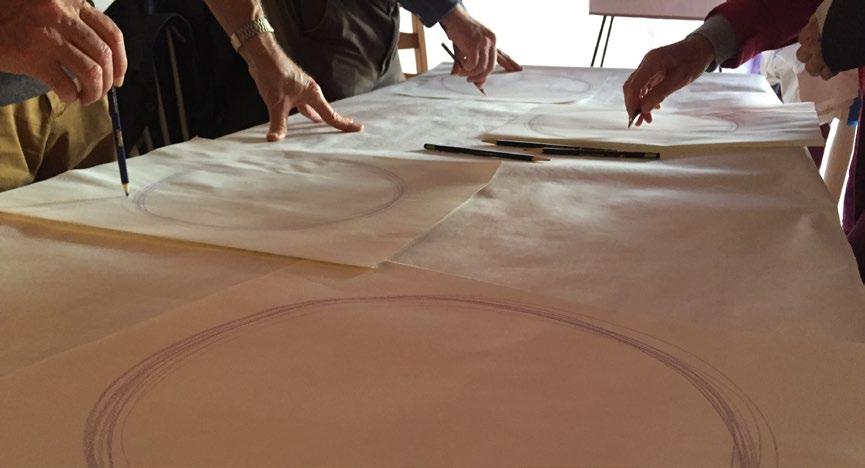
CAO members gathered in November 2017 at Elderberries Café in Los Angeles.
“press” or other role-played “authorities” as colleagues witnessed and provided helpful feedback. It was agreed that such a gathering can be helpful to many organizations and leaders in anthroposophical institutions, and there is a carrying group from the CAO to plan more of them in different regions. This is one example of crosscollaboration in service to anthroposophy. We also are developing a plan to share communications across our many platforms and varied readership on topics common to all.
The CAO is a committee of the General Council of the Anthroposophical Society in America and operates under its auspices. Each of the CAO member organizations makes an annual contribution in support of CAO activities and also compensates the ASA for the time and expenses incurred in carrying the CAO work. When possible the CAO also provides additional financial support to the Society and as part of the Michael Support Circle. Ultimately, there is great value in the camaraderie of leaders both for the movement and for those on the front lines of anthroposophical work in public life.
John Bloom is ASA General Secretary and a member of the CAO.
Finding Our Voice
by Chris Burke & Jerilyn Burke
As a college professor (Chris) and a Waldorf early childhood teacher (Jerilyn), our daily tasks bring us faceto-face with people with no knowledge of anthroposophy. The students and families we serve represent a variety of cultural groups, religious and non-religious backgrounds, and value systems. We know that if we would start speaking in terms Steiner used to share ideas over 100 years ago, we would lose many of them very quickly. Our challenge, then, is to meet each and every one of them with the love and inner light that is kindled in us through our work with anthroposophy, without burdening them with the language of anthroposophy. Yet as we witness the divisiveness, dehumanization, materialism, and environmental destruction in the world around us, we also see the potential for transformative healing that anthroposophy offers—if only it can be taken up broadly.

It is a paradox: on the one hand, we aim to meet others where they are, to not answer the un-asked question, and to translate the difficult language of anthroposophy into something more relatable. On the other hand, we recognize the personal and social good that can be gener-
ated through meaningful work with anthroposophy.
It was with these thoughts in mind that we arrived at the “Finding Our Voice” gathering in November. We were hoping to meet some fellow travelers on this path, to share our own struggles and successes, and to learn from the collective wisdom of the group. The discussions touched on a wide range of pertinent topics, such as how to thrive in a data- and evidence-based world, how to be more inviting to people from traditionally under-represented groups, and how to build collaborative bridges between anthroposophical enterprises and other organizations with complementary objectives. Skill-building sessions invited us to practice fielding questions about our work from naïve or critical interviewers. And breaks and meals together provided opportunities for cross-pollination of ideas. As we said our goodbyes to this new group of good friends, it was clear that this meeting was really only the beginning, and that many more conversations in many more circles would be needed to effectively bring a more public face to anthroposophy. We left full of gratitude and inspired to continue this important work.
Chris Burke is an associate professor of psychology at Lehigh University, and Jerilyn Burke is an early childhood teacher at the Waldorf School of Philadelphia. They have been studying anthroposophy together and with friends for five years. They currently live in Philadelphia, where they are raising their three wonderful children.
Five-year training course in Painting Therapy according to the work of Liane Collot d’Herbois

Two full time six-week course modules per year, research & practicals. English and Dutch spoken. New training course starts with four week Modules I and II on April 9 and October 8, 2018
Emerald Foundation
The Hague, Holland Tel: 0031-70-3247709
Email: stg.emerald@xs4all.nl
www.emeraldfoundation.nl

spring issue 2018 • 17
Not a Waldorf Kid
by Kailea Frederick
I am not a Waldorf kid. My schooling took place in the public school system in Hawai`i. The early years, elementary school, were sweet. I remember the giant lawn that wrapped around the back of the property where I caught ladybugs and played tag. One of Dole company’s massive pineapple fields lay across the highway, and on hot afternoons we would wander into the fields of red dirt looking for a ripe pineapple to make our own. My school was small, I knew everyone and everyone knew me. I loved my teachers and enjoyed being an integrated member of the student body.
Intermediate school was far, and big. The shift was shocking on multiple levels. Kids I had grown up with turned mean overnight, friendships were easily lost. Kids were carted away during recess, physical fights were normal, teachers who would scream inches away from your face were part of daily life. I was a good student, but I began to struggle as an all-encompassing fear took hold of me.
High School only got worse. During 9th grade, I suffered an emotional breakdown and sank into depression. At only 14, I couldn’t articulate what I was going through, and with a student body of close to a thousand it was easy to fall through the cracks. For the next year and a half my parents struggled to keep me in school, completely unaware that it was at school where I was being introduced to drugs. Staff members’ main way of attempting to bring control to classes always on the brink of outbreak was through intimidation. I remember thinking that my teachers and staff represented most adults in the outside world. I sank further into depression, drinking and drug abuse.
At 15, I was living between friends’ houses as my relationship with my family began to fall apart. By 11th grade, teachers unsure what to do with me would give me library passes, hoping not to have to deal with yet another unresponsive student during their class hours. Seeing that school was failing me, my mother said one day, “Kailea, why don’t we get you out of here, get your GED, and en-
roll you in community college.” I was both flooded with relief and intimidated by the idea, but it was obvious I wasn’t going to make it to university by staying in my current situation. A month later, I passed my GED exam and was at our local college for spring semester.

As a teenager with barely any life experience, I had no clue who I was or what I wanted to be. I couldn’t connect with my educational experience and I began to believe that I was simply not smart. I began to create my own life. I rented my own house and made friends outside of my high school peer group. I still didn’t know where I was headed, but I was discovering a deep curiosity about the world. Books transported my mind to distant places where wars took lives and the cry for life made my own feel small in comparison. I wondered what my own hands might be capable of. Could I contribute something of value?

I began searching actively for a place that could harbor some of these secret thoughts. Right before my 20th birthday, my father’s friend called me excited to share the experience of her visit to a program in Sweden called The International Youth Initiative Program (YIP). I’ll never forget the moment she placed a flyer in my hands and encouraged me to apply. I hurried home and looked up YIP online. YIP described itself as a social entrepreneurship program and welcomed individuals between the ages of 18 and 28 to apply from around the world, I was intrigued. The program was organized around three core questions; “Who am I in relationship to myself? Who am I in relationship to others? Who might I be in relationship to the world?” These were questions I carried and I felt

18 • being human initiative!
something in myself lift just knowing that a place like YIP existed. I had found a direction to move in.
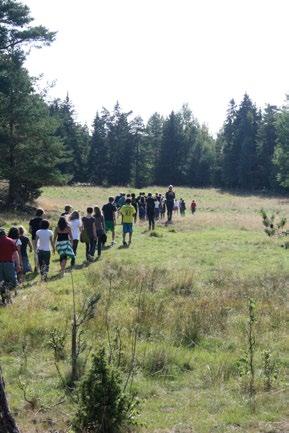
It took two years to fundraise, save, and apply. I invested that time in completely re-orientating my life and focused on continuously asking what my contribution might be. In spring 2013, I received an acceptance letter and that fall I was on my way to Ytterjärna, Sweden, the anthroposophic campus where YIP takes place. From the first moments I stepped foot into our student house, I could feel I was exactly where I needed to be. I lived and learned under the same roof with 19 other participants from around the world. We quite literally did everything together, learning about possibilities that lie within community living and building. Conflict became a space of deep learning, instead of a space to avoid, as we navigated through the joys and challenges of our year together.
I realized how thirsty I was to be in a learning environment that welcomed me. One day could encompass singing, body movement, writing, and getting our hands in the dirt. An educational environment that took my whole being into consideration gave me confidence to believe in myself. I was able to witness, through my own and my peers’ unfolding, the importance of valuing different ways of learning. For the first time since my childhood an excitement for my future began to move through me. My YIP year was pivotal, my first experience coming into contact with my truest expression as a human being.
Today I am a facilitator for my own project called “Earth Is `Ohana,” where I get to pay forward my learnings from this cherished year. There is not a single day that I do not draw from the invaluable tool kit that this program made available to me. I am living my life’s work because of the support that the YIP organization and program provided me. There will never be enough ways to say, “Thank you.”
Kailea Frederick is a First Nations woman dedicated to supporting individuals of all cultures in remembering their ties to the earth. Growing up off the grid in Maui, Hawai`i, forever imprinted in her the importance of reciprocity through indigenous world-view. She feels raised by wild spaces and intimately tied to Honua, our island earth. Earth Is `Ohana is Kailea’s personal response to the many stories that continue to shape her. You can learn more about her work at www.earthisohana.com and about YIP at www.yip.se
YIP 2008 to present
by Lauryn Witco
(Morley)
After two years of dry college lectures and empty written assignments, I realized I was tasting an education that wasn’t nourishing me. The world is full of confrontation, challenges, and suffering. I was asking questions and looking for my place to make a difference. The International Youth Initiative Program (YIP) was my answer.

The underlying philosophy, anthroposophy, that floated YIP was new to me. I was stunned by the architecture, food, and nature-based environment in which the program operated. The other participants, though strangers at first, were recognizable. They were fellow seekers, questioners, and doers. The time of swallowing questions rather than seeking their answers was over for me.
There is a kind of inner conflict that occurs during opportunities of growth—when you get to choose if you will continue as things have always been, or make a change. Sometimes life will shake you to make those changes and sometimes the initiation for change needs to be sought out. I sought this change for years before discovering YIP. I felt strongly that I had untapped capacities and unshaped ideas that could be a benefit to my community, perhaps one day even to the world.
The forty youths in the program lived together, with guiding lights from the courageous organizers and international teachers. Together we tackled difficult subjects
spring issue 2018 • 19
for up to two weeks while getting a taste of world initiatives and the people addressing questions similar to ours. We were forced to confront our own thinking and beliefs, and our tolerance, understanding, and patience grew. We asked difficult questions which ignited our thinking and forced us to a new awareness.
The real challenges for me came after leaving the program. I entered a time of restructuring, rethinking, and reshaping ideas. After leaving the stimulation and support from YIP, I needed reminding about possibilities so I didn’t lose heart. YIP was a program that balanced study and experience. Carrying this balance out into the world led me to extensive travel and an apprenticeship with an anthroposophical doctor and biodynamic farmer. I helped start a farm, discovered a love of teaching, met the man I have since married, and found my way to a graduate program in Waldorf education.
After teaching three years in a Waldorf grade school, I was forced to leave due to an inability to obtain a work visa. During the year that followed, before receiving the appropriate working papers, the skills I had learned from YIP became a mode of survival. A network of compas-
sionate individuals fed me lines of hope and opportunity that I hungrily devoured. I developed compassion for a system that tore me from people and a profession that I loved and forced me to reshape my life. For the last year I have had the great privilege of teaching preschool at Sophia’s Hearth, a Waldorf early childhood center in Keene, New Hampshire.
When I asked my dearest friend if she thought my YIP experience had affected my life, she replied, “You did more than get an MEd; you learned a specific style of teaching that meets children where they are and guides them in a meaningful way. YIP allowed you to travel both during and after the program. The whole experience helped you become the kind of person who can listen respectfully, openly, and earnestly to someone with whom you disagree. I feel strongly that it helped you open and develop your heart, your mind, and your spirit.”
The intentional creation of YIP with its roots in anthroposophy carved a bow from which the students, as arrows, are sent forth into the world. The program played an essential role in determining my path to impact the world.

Lauryn Morley is a Waldorf alumna who grew up in South Africa. She received her MEd from Antioch University New England.
Exploring WaldorfInspired Tribal Schools
by Charles Morin, Loren Silver, and Lars Helgeson
This article arose from lunchtime discussions during the 2014 and 2015 summer sessions on Waldorf Inspired Public Schools at Rudolf Steiner College in Sacramento, CA. Further discussions at various tribal schools added to the topic. We believe there is a close match between American Indian educational needs and the philosophy and methods of Waldorf Schools.
Spirit The American Indian is first and foremost a spirit centered being, as are all humans. At this time in our history there is a rebirth of the need to seek an understanding of what constitutes reality. Among the American Indians there is reverence for the Creator, Who by sacred means brought everything into being, in Reality. Rudolf Steiner says that human beings are soul and spirit, and that our nature is physical, soul, and spirit. He says that when reality returns to our lives then spirit returns too. The education that fits the American Indian is that which nurtures spirit and sustains the expression of the soul.
Language There is respect for Elders, and it is understood that the spoken language is culturally very important. There is a strong movement among tribal Waldorf and Waldorf-inspired schools to preserve the indigenous languages and culture. Waldorf education advises teaching a foreign language as soon at the child starts elementary school. If a child
20 • being human initiative!
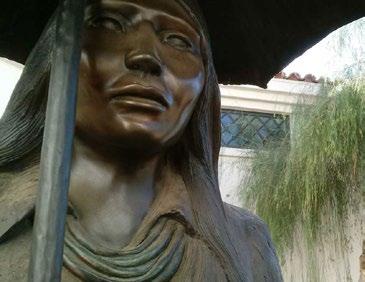
Sculpture at the Heard Museum in Phoenix, Arizona, where the Anthroposophical Society in America held its 2017 conference.
has only heard English then the traditional tribal language is not the child’s native language. So the traditional tribal language needs to be taught early, as one might teach German, French, or Latin.
Rudolf Steiner recognized that different languages each have a different logic and cadence. If the child hears and mimics, for example, the Dakota or Navajo speech in the home and experiences the legends, art, and dance of the tribe from the earliest years, then the memories and culture are established early, too. But that is less and less the case as English is emphasized in most tribal schools. Indeed all humans go through the same developmental sequences and growth with the formation of localized memory, rhythmic memory, and picture memory to form the ego, and then develop the ability to think. We argue that those stages can indeed be in any language, and we believe that language should be the tribal traditional language if at all possible.
Culture Tribal mythology, fables, imaginary characters are as rich in moral lessons, heroes, and examples of various human behavior as any European mythology. Even as Greek, Roman, and Norse skies are rich with images, animals, gods, and demons, so are the skies of all the Native American tribes. All ancient peoples sought to explain the astronomical and natural phenomena with mythical characters and events. The art and dance of indigenous people of the western hemisphere bring these myths to life for the people. The dances give meaning to human existence and connect us to the Creator in a real way. Dancing, according to Black Elk, provides the means to bring the spiritual power of visions into the real world.
In the tribal as well as the traditional public school the elementary grades are rich with drawing, painting, basic writing, and especially gardening activities. Making pictures is good for long-term memory, and thinking in pictures aids development of imagination.
Models The teacher is the model for children to imitate in any culture. Learning respect is a key to further imitation of the loving authority who builds a trusting relationship, one who demonstrates how to be a learner. Children learn about specific human characteristics through fable and myths. They develop the basics for developing the capacity for order by farming, cooking, cleaning, and measurement, and gradually learn to become an individual.
The cooking activities are excellent for developing discrimination as to what is good food through discussion and example. Throughout the grades, the tribal
children are probably more in touch with their spiritual nature than typical public school children. There is more discussion of the importance of visions, intuition, and omens. So it is easier to develop a closer relationship to plants, animals, and spirits. It is our experience that it is traditional to express gratitude to the Creator among children on the reservation—more than in typical city elementary schools!
Mythology & consciousness
It is not only in Norse mythology that children encounter the trickster. All across North America in every native culture the coyote, the raven, the spider are the equivalent of the Norse Loki who is jealous of the hero, who is the creator as well as the one who forces the hero to become conscious. The coyote is a partner in the hero’s liberation.
Throughout the elementary grades there is the gradual evolution of consciousness as is told in myths and legends. It takes the aware Waldorf teacher to help the students in any culture to see what they might eventually become. Tribal culture and western cultures all deal with light and dark, life and death, birth and rebirth. It takes the sensitive and aware Waldorf teacher to lead the children along this path of learning. One of the great advantages of the Waldorf methodology is that the teacher stays with the same class year after year and watches over their maturation, much like the shared responsibility that one finds on many reservations among the young and the elders.
The challenge While the Waldorf curriculum includes a heavy emphasis on Eurocentric history there is sufficient discipline, battles, survival training, horsemanship, animal interdependence, heroism, love, strength, and courage among the various tribes to fill books with teachable stories for children. We see the challenge for tribal Waldorf schools to make the comparison between American and European history to draw the same conclusions so that tribal schools teach the same lessons that are commonly taught by Roman, Greek, English, Germanic, and Nordic myths, legends, poems, plays, and art. Waldorf emphasis on gardening, art, music, dance, languages, math, science, and sociology are easy to integrate into the tribal education and we encourage that to happen.
Charles Morin is superintendent of the Circle of Nations Wahpeton Indian School, Wahpeton, North Dakota. Loren Silver is a Navajo teacher from Winslow, Arizona. Lars Helgeson is professor emeritus of Science Education, University of North Dakota, and advisor on curriculum development. He spent two summers before retirement attending Waldorf teacher training at Rudolf Steiner College.
spring issue 2018 • 21
Native-America and Waldorf-Inspired Education
by Joaquin Muñoz
Meditations on Philosophy and Practice
Editor’s note: this is a brief summary of a longer paper which is available at www.anthroposophy.org/articles
In my research, I explore Waldorf and Waldorf-inspired education, and its potential impact as reforms in modern schools. The U.S. education system possesses great diversity in ethnicity, language, and cultural difference. With this diversity comes a sense of challenge, a sense of possibility, and a beautiful opportunity. For some, though, this diversity represents a problem, a deficit, and a hindrance to teaching—challenges seen as surmountable only through standardization of curricula and testing to prove, quantitatively, the efficacy of schooling practices.
Students often express frustration and discontent with these practices; this may be even more acute for students of color, who often do not see their lived experiences or values reflected in the culture of schools. As a Native American person myself, I am interested in Waldorf as a potential reform for supporting students of color and linguistically diverse student populations. At both a practical level and at a philosophical level, Waldorf education attempts to address the full experience and life of the young person to develop their unique talents and abilities. This work has coincided with the emerging interest in many Waldorf schools to diversify student populations.
It is important to consider both parallels and divergences. Waldorf, born as “a uniquely German reform,” … would seem to be completely out of sync with the needs of Native American populations. [But] Waldorf education is learner centered, with particular stories and mythologies to challenge children in specific ways—an “organic structure that mirrors the developmental changes that take place over the grade school years” chosen due to their relevancy to youth and their changing inner worlds.1
To work with cultural sensitivity, one needs to consider the full potential of each student, while recognizing and appreciating their unique experience in the world. “Steiner was clear that Waldorf education must be 1 Petrash, J. (2002). Understanding Waldorf education: Teaching from the inside out. Gryphon House, Inc. p.64.
responsive to the space and time in which it would be enacted.”2 In many compelling ways, Waldorf education is a functioning system which addresses these needs, providing both a stable structure and a flexibility and fluidity that is open to change and adaptation.
Beginning from a mechanistic view of the constitution of a person (often the case in traditional education), the spirit of a person is fundamentally misconceived. The human spirit is ignored or disregarded, misnamed or misunderstood. The epistemology of Waldorf challenges this stance, holding the human spirit in sacred regard. This is a stance Native American communities might support.
Steiner’s ideas were based on the reality of an “inner life,” and where “philosophy…linked up the world of science with that of spirituality.”3 The cosmology of my community (and indeed, of many Native American communities) includes aspects of life permeated by spiritual beings, spiritual forces, and the potential for knowing and experiencing these beings in some way. It is important to consider deeply whether a model which conceptualizes a spiritual life of its students is in fact beneficial and consistent with Native American cosmology. Conversely, it is also essential to interrogate the possibility that the use of Waldorf education is simply a new form of proselytizing and manipulating a population.
I wonder how Steiner would have sounded in talking with tribal elders. The stories sound very similar, and I imagine a difference in terms, but not in beliefs. This is not to say that they are perfectly matched, or identical. Spiritual worldviews deserve consideration when constructing an education system for Native American youth. Waldorf might be one avenue for this work.
22 • being human initiative!
Joaquin Muñoz, PhD, is assistant professor in the Education Department at Augsburg University. He holds his BS, MA, and PhD from the University of Arizona.
2 Larrison, A.L., Daly, A.J., & VanVooren, C. (2012). “Twenty years and counting: A look at Waldorf in the public sector using online sources,” p.4. Current Issues in Education. 15(2), 1-22.
3 Nicol, J. (2007). Bringing the Steiner Waldorf approach to your early years practice. Routledge.
A Path Worth Treading Encountering
Nature and the Nature of Things
 by Craig Holdrege and Seth Jordan
It is not hard to see the destructive tendencies at work in the world. Our experience becomes ever more fragmented, and our social relationships polarized. We have become almost completely disconnected from the natural world. These are not new developments, but they are intensifying as our lives become increasingly mediated by devices. And as we are inundated with too much information, we lose a sense of orientation. We witness untruthfulness and strife. But the longing for truth—to encounter real presences and experience deeper connectedness—also grows.
At The Nature Institute we’ve found that the heightened experience of nature can counter these tendencies— can provide grounding and orientation. This “heightened experience of nature” means engaging much more fully in our embodied sensory experience. It also means waking up to how our habitual concepts and ideas prevent us from having a truthful, grounded relation to the world. The pathway through the senses to the spiritual was trail-blazed at the beginning of the 20th century by Rudolf Steiner, but it has unfortunately been rarely tread. Walking it for ourselves becomes increasingly urgent in our age of information and abstraction. [See the review on p.30ff.–Ed.]
We have developed this work through courses, workshops, publications, and talks for almost 20 years now. From conversations and evaluations, we know the work has been valuable to participants—that they have experienced new ways of perceiving and understanding the world that matter to them. They have become more conscious of their own relationships as knowers and doers in the world. They have left feeling enlivened, and the work continues to inspire them.
We also see that more is needed. Modern habits of abstract thought are deeply entrenched. The view that the
world is something “out there,” separate from our subjective “in here,” is not easily overcome. People can be serious about spiritual and holistic perspectives, but still frequently fall back into abstractions and static perspectives.
So our question has been: How can we help individuals develop practices that are deeply transformational so that the experience of the world as dynamic and relational becomes an active presence in their day-to-day lives and professional work?
As a significant step forward, we have conceived a new year-long foundation course in Goethean science. For those who want to continue the work with further guidance, we plan to offer a second year with more individualized work which could be followed by a research fellowship. The approach we offer is experience-based and reflective. It is scientific, since it is a conscious and rigorous pathway based on experience. At the same time, it is universally human since it involves the fullness of our human capacities and is concerned with the healthy transformation of humanity in service of world needs.
Core faculty include Craig Holdrege, director of The Nature Institute, who is deeply interested in the interconnected nature of things and how we can understand life in truly living ways as a basis for responsible human action; Henrike Holdrege, a mathematician, biologist, educator, and co-founder of The Nature Institute, who grounds her teaching in human experience and careful, perceptive, and thoughtful inquiry; Jon McAlice, active in the international Waldorf school movement for many years as a teacher and lecturer, who has a special interest in the psychology of learning and the senses; and John Gouldthorpe, who has a background in archetypal psychology and whose interests today focus on the relationship between perception, conception, imagination, and identity.
For more information about the new program go to www.natureinstitute.org/educ/nature

spring issue 2018 • 23
From “Angel-ish” to English
How the Christian Community Has Been Incarnating Into Today’s Lingua Franca Pioneers of Religious Renewal: A History of the Christian Community in the English-Speaking World.
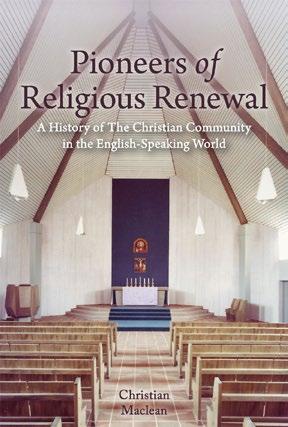 By Christian Maclean. 192p. Floris Books (2016).
Review by Michael Ronall
By Christian Maclean. 192p. Floris Books (2016).
Review by Michael Ronall
Anyone thoughtfully contemplating today’s AngloAmerican and German cultures, particularly those in English-speaking lands who are trying to assimilate anthroposophy and those in German-speaking countries who are reaching across the Channel and across the Atlantic, will wonder what the last century would have been like without the catastrophic wars that so harshly severed the two societies. These brutal cataclysms left a comprehensive rift between the respective peoples long after enmity between their governments had ceased. Thus, an originally political divide now extends, although of course without hostilities, also into all the expressions of the science of the spirit that Rudolf Steiner inaugurated in German as well as in the renewal of religious life through the Christian Community. Contemporary seekers of the spirit must struggle mightily not only to reach that spirit, but even to find the conceptual, aesthetic, and linguistic resources for its collaborative attainment. How many English speakers today are conversant with German Romanticism, or German speakers familiar with the American Transcendentalists? Both movements offered firm if sometimes incomplete guidance for navigating the complementary dogmatic hazards of mechanistic materialism and new-age mysticism that have infected the world-outlooks of even the most well intentioned students of spiritual science today; a broader cross-pollination would have strengthened each continent’s homegrown immunity to withstand these twin pestilences.
But a more useful question than the futile “What would have been different?” is one more in line with Steiner’s own essentially Christian attitude when faced with setbacks of every dimension, namely, “How can we redeem what has been lost, how can we quicken life from the opportunities now available?” If the division imposed between the world’s two dominant cultures was not simply a felix culpa , that is, a tragedy harboring a blessing, neither was the violence that occasioned it civilization’s final death-knell, though at the time it understandably appeared to some to be just that. Faith in the possibility of deepening and enriching the consciousness of our human-
ity, even through tragedy, means being ready ever and again to convert that consciousness into love; this book narrates the path taken by a few resolute souls in the service of that alchemical enterprise.
For all the misgivings that Rudolf Steiner held about counter-evolutionary influences arising from economic and political powers in what he termed the West—meaning west of Central Europe—his regard for English-speaking peoples was patent. Such interest was carried with an eye not merely to assimilating them under a timely central-European cultural leadership, but with an incisive recognition of the specific promises arising from their endowed constitution. This recognition is documented in the book here under review, citing Steiner’s urgent forecast that the survival of the Christian Community in Europe would depend upon its prompt expansion to England and America. The outlook is intriguingly consistent with the prediction attributed to Steiner that his work as a whole, although incarnating in German, would spread through the world in the English language.
As has been widely appreciated, Steiner sprang into renewed activity when beset by even traumatic devastation, whether resulting from the demolition of the global social order by World War I, of the First Goetheanum by arson, or from the many disappointments generated by his own students. It is also related that his grief upon viewing the charred ruins of the Goetheanum was, by his own astonishing account, not for the wasted decade of strenuous effort, but rather because its disappearance would deprive specifically Western men and women of the possibility to view its physical incarnation of spiritual reality. In the more gradual case of the worldwide decline of religion occasioned by nineteenth-century material-
24 • being human initiative!
ism, we find the beginnings of the Christian Community to have been much more tentative than one would guess from the firmness of the rituals’ forms as we know them. But hesitation was only on the part of the theology students who went to Rudolf Steiner with their probing quest. His own response was swift, energetic, and comprehensive, ready to entrust to those who approached him a potent remedy formed out of the spiritual worlds, with power, as we know, radically to consecrate not only earthly substances, but man himself.
The story of the Christian Community priests who have carried its mission across the Channel, the Atlantic, and then into every corner of the world is faithfully and vividly recounted here by the present Chair of the Christian Community in Great Britain. Following a childhood in its religious upbringing, he studied in its seminary in Stuttgart and then for close to forty years managed the movement’s English-language publishing company, Floris Books. In this volume Christian Maclean has enabled those who found the Christian Community in English to meet the figures who made those encounters possible. The book will be invaluable as well to anyone seeking to follow the destiny of this small but efficacious force for the redemption of the earth and its inhabitants.
As the power of the transubstantiation may be detected not through any biochemical analysis, but rather in the introspectively and socially perceptible changes that it effects in its communicants, so human faces come gradually to be animated by and inscribed with the thoughts of their bearers. Accordingly, Christ’s own apostles grew so closely to resemble Him even outwardly that His arresting soldiers were forced to rely on His being pointed out to them among His followers. The pictures in this book reveal the varied physiognomies of their modern successors who often at great personal sacrifice shepherded the renewed sacraments out of their original incubation in German-speaking communities. The faces of these pastors, although certainly distinguishable one from another, nevertheless reveal a common cast of deep, unintrusive responsibility. Their kind eyes show an openness to the ever-surprising manifestations of humanity and a readiness to reflect the essential dignity of each individual whom they would meet, a dignity under systematic and widespread attack across the century in which they worked.
Maclean nevertheless reveals to his readers priests not full-blown from the head of Zeus, but rather arriving from such vocations and avocations as psychotherapy, teaching school, and volunteering in crisis-intervention. In the Christian Community they found opportunities to fashion their own souls into instruments of accessibility for others’ insight and healing, notwithstanding that their religious work often had to be supported by outside jobs. Some had been brought up and even ordained in other Christian sects, some in Judaism; some found the Christian Community directly, others through anthroposophy, and many paths were paved by uncertainties, occasional crises of conscience or loyalty, and in rare cases mental imbalance or the
From the book:
Beginnings in New York
After working in Britain for a few months the Heggs returned to New York in August 1948, and Heidenreich followed them in October. It quickly became apparent that a “visible permanent center, which meant a house where we could create our own atmosphere and where a permanent address would provide a firm anchorage” was needed. But this was easier said than done.
In the two months between October and December, as well as numerous lectures and celebrations of the sacraments in a rented hall, about fifty properties (for both chapel and priest accommodation) were looked at, a legal non-profit corporation was formed, and finances were raised.

By British standards house prices in New York were astronomical. Nevertheless, a five-story house was found at 309 West 74th Street for $42,700 (£ 10,600 then). The house belonged to Duke Ellington, the jazz composer, and the main floor had five white baby grand pianos surrounded by ornate wall paneling. A great deal of conversion was needed to change it into a chapel. It was a typical “Heidenreich model”: a large house with the main floor used as a chapel and community space, the priest living in the basement or attic, and the other floors rented out to bring the income needed to cover the loans.
However, finances were not so simple, as Heidenreich related: “The financing of the purchase ... was the most nerve-racking and fantastic undertaking with which I have hitherto been associated. It gave me a deep insight into the economic life of America. It all comes down to this, that while the USA is at the moment the richest country in the world, and its banks carry astronomical sums, it is easier to borrow £1,000 in the UK than to borrow $50 in the USA ... It was a nasty shock to discover that it was practically impossible to raise a fair mortgage on our proposed property, as one could have done easily in the UK through the usual agencies of a building
spring issue 2018 • 25
dissolution of marital and institutional unity. These are realistic portraits of struggles, of overcoming illnesses, and of sometimes longer periods needed for healing social crises, not all of which could be resolved within one lifetime. But the great bulk of human energies depicted here have been sacrificially and effectively devoted to sowing the Word, and indeed on fertile soil: When during wartime in England, air-raid sirens pierced celebrations of the Act of Consecration of Man, all remained in their seats, resolved to fulfill it worthily. The tenacious nature of this prophetic enterprise puts one in mind of the historically decisive reverse—that is, eastward—trails of Irish and Scottish monks into Europe that stretched over a millennium, beginning in Scotland with their conversion of sixth-century Picts and lasting to the Industrial Revolution, baptizing the Continent into the humanistic civilization that we know today. Those who have become familiar with the subtle power of the renewed sacraments may yet prove justified in wondering whether the present counter-wave of pilgrims carrying the metamorphosed impulse to the West will not have as significant an effect on the future.
society or a bank. The cutthroat conditions offered by one or two banks who would consider the proposition at all left one simply gasping. It was not the individual banker or mortgage broker who was unobliging. On the contrary, they were individually very sympathetic. Some of them could not have been nicer. But they have to refer such matters to a committee, and their committee is underwritten by a committee in Philadelphia, and Philadelphia is underwritten by Washington, which is underwritten by Chicago, which is ... ad infinitum. I came to feel that one was dealing with a vast anonymous octopus, of which even leading financiers are but the servants—and victims.”
With barely half the purchasing sum in sight, they went ahead, signed a contract, and paid a deposit on this house. At the last moment, Ann and Alfred Barnes were persuaded to make a large low-interest loan, and the house could be purchased. And on Saturday, December 11, 1948, the foundation of The Christian Community in North America took place.
Many of the movement’s leaders seemed able to change in and out of various languages like vestments, and this while running an obstacle course through the early twentieth century’s distracting desperations: financial crises, political tyrannies, global war. Some of the pioneers lived in ways that now seem colorful, sleeping under a desk and daily transforming bedrooms into offices, then into chapels, and back again, but these practices were not eccentricities. Rather, the clash of idealism with straitened circumstances forced them into poverty, illness, figurative and literal battle-wounds, hunger, and through brushes with repressive regimes, persecution, imprisonment, and risk of death. But perhaps the requirement to improvise, apparently antithetical to ritual, belongs to the destiny of spiritual movements attempting to enter modernity. The latter, which locates authenticity only in naturalistic spontaneity, adjusts only obliquely to acquaintance with the value of form: Even in the more protected environ-
ment of North America, both the Christian Community and the Anthroposophical Society took their starts in a converted chicken coop and other such structures built to house livestock.

Taking into account this imponderable marriage of ceremony and apparent accident, as well as the mysterious collusion of karma and grace upon which every meaningful human enterprise depends, it seems nevertheless significant that Christian Community founder Friedrich Rittelmeyer came to meet Rudolf Steiner as a direct result of simply doing his homework
In September of the following year, Rudolf Frieling came to New York with his wife and worked there until 1954. Then in 1951 Frederick Burgevin joined them, but as Verner said, “He had a hard time—he was still an Episcopalian priest.”
initiative! 26 • being human
as a Lutheran minister with a project to research heterodox movements. One thinks of the modesty enjoined in Steiner’s paradoxical guidance for souls who seek to transcend the imprisoning boundaries of the sense-world, counseling that “... anyone capable of always performing his duty, even though inclinations and sympathies would like to seduce him from this duty—such a person is unconsciously an initiate in the midst of ordinary life.” (Knowledge of the Higher Worlds and Its Attainment [GA 10], Chapter 3.)
Although, in this religious movement, “Priests undertake to celebrate these sacraments objectively, without personal alterations or additions,” (Preface, p. 9) their every expression outside of celebrated ritual relies on the exercise of individual conscience and judgment. As finite beings, they have therefore varied in being more richly or poorly endowed with diplomatic skills to maintain and express this conscience. There was the occasional gifted mediator, but at least as often those whom others “did not always find it easy to work with” (passim). The characterization might actually reassure readers who would covet the apparently seamless harmony among members of the denomination’s clergy. Yet so often is this depiction repeated that it may well serve as a standard epigram for consciousness-soul-epoch individuals struggling to balance heroic self-propulsion with pious self-denial—a struggle against which ordination, and we must trust providentially, seems not to vaccinate. Strife illumined by fierce ideals and warmed by devoted willing on both sides makes clear that the only available alternative to being “not always easy to
work with” would be “impossible to work with”—precisely the fatal condition that community-building toward the sixth epoch is designed to forestall.
The book is well organized into chronological and biographical sections and includes succinct accounts of the mutual influences between the Christian Community and the Camphill movement, the development of Floris Books, and the voyages of the organization into other countries. The latter includes the translation of liturgy into what Germans insist is a linguistic entity distinct from English, and which they call “American.” Subsequent adaptations into other languages followed, and the list is growing. At the end of the book, following the narratives, is a convenient time-chart and thumbnail biographies of the founding figures.
On the cusp of the Christian era, the Roman philosopher and man of affairs Cicero famously observed that “Not to know what happened before you were born is perpetually to remain a child.” Mr. Maclean has provided a useful and engaging resource to help this movement’s members and friends mature in the mode that Cicero outlined, the better to prepare for the present and coming epoch. This is a stage in which the gods, with a degree of trust defying the predictions that a merely mortal survey could infer from present modes of social conduct, are placing ever more responsibility into human hands.
While the past century has shown how effectively impersonal destruction can divide whole populations, the task of healing depends on individual encounters. Those who find decisive support in that endeavor through ritual communion with the I of humanity will hold among their most urgent tasks making such communion as widely available as possible. Revealing and preserving for future contemplation the connections among this movement’s founders through accounts that vividly show their subjects’ aims, concerns, obstacles, and triumphs will inspire coming generations with confidence in that pursuit, whose fulfillment certainly requires its incarnation through the world-language of the day.

spring issue 2018 • 27
Michael Ronall is an editor and writer currently living in Germany.
IN THIS SECTION:
Anthroposophists’ mixed feelings about technology seem to be more mainstream these days, but Steiner’s insights on the future evolution of technology remains surprising.
Some of Rudolf Steiner’s images of our human future beyond the physical domain are hard to grasp in our modern ways of thinking and perceiving.
Yeshayahu
Ben-Aharon has been working out the transformations that will open up that future of disciplined imagination.
“The Growing Imagination” at the heart of Ben-Aharon’s work is differently central to Steiner’s guidance for painters; our gallery this time shares some paintings from a working group in New York City.
Spiritual Science & Technology Reflections on a Recent Retreat by Gary Lamb


In early December, thirty six people with a “strong connection to anthroposophy” met for three days in Chestnut Ridge, NY, to consider the dramatic advances in modern technology taking place, their impact on virtually every aspect of human life, and how we as anthroposophists can help guide this development in an ethical direction.

Everyone was required to read the first four chapters of Paul Emberson’s book, Machines and the Human Spirit, in which he gives an overview of some of Rudolf Steiner’s main indications on technology, along with his own perspectives.1
Three types of technology
One of Emberson’s most intriguing interpretations of Steiner’s perspectives on technology is his division of it into three types: atomic, resonance, and moral. Nearly all conversation about technology today focuses on atomic or digital technology, which operates mainly by electricity, and, according to Steiner, has an affinity with the
1 Appreciation of Emberson’s work did not imply that these were the only valid perspectives on Spiritual Science and technology. Also, it was not always clear when Emberson was expressing his own views or Steiner’s, due in part to a lack of referencing.
completed or finished dead thoughts mirrored in the brain rather than living thinking. That is, the generative activity of thinking itself. Steiner also suggests that the development of this type of technology, driven to a large extent by egoism, will eventually implode on itself.
Resonance technology rises above the subnatural realm of electricity and physical forces to the level of the human etheric body. Resonance technological devices or motors will operate through resonance with the vibrations of human etheric bodies. Thus, these machines will work for good or ill depending on the moral qualities of the inventor/operator, and operate only at the instigation of the creator. The inventions of John Worell Keely, and the Strader device portrayed by Steiner in his Mystery Dramas, are steps in the direction of resonance technologies.
Moral technology
The highest form of technology that Steiner speaks about is characterized by Emberson as moral technology. It will operate on spiritual forces found in nature and the cosmos. To harness moral forces of this higher type, Steiner suggests researchers
28 • being human
arts & ideas
Presenters included (from left) Virginia Hermann, Michael Howard, Gopi Krishna Vijaya, and Gary Lamb.
investigate the rhythms found in the plant realm and the cosmic forces streaming in from certain constellations, specifically the constellations of Pisces and Virgo. The forces from these constellations, when employed in conjunction with morning and evening forces, “cannot be used by any group to gain ascendance and power over others.”
At this level of invention, it is not only possible to provide devices with motive power but also imbue them with life. The human being ascends to the level of being the creator of new living forms out of selfless love. Personal ambition or egoism can play no part in the development of moral technology. Invention and innovation become sacramental acts on behalf of humanity, not for profit or personal benefit.
From an anthroposophical perspective, technology plays a dual role in earth evolution, both destructive and constructive. The speed at which the atomic technology industry is developed could determine to a degree the life span of the earth. Too much, too soon of the atomic electricity-based type could shorten the intended life span and obviate the possibility of human beings developing the necessary counterbalancing spiritual faculties. So too, the development of moral technologies is integral in developing the future-bearing seed forces of love, which is the foundation for the next phase of human evolution.
One other thought Emberson expressed is of prime importance for us in the United States. Moral technology cannot be developed by lone researchers in isolation, but only through circles of people working together in study, research, and experimentation in the mood of self-
less love. Collaboration within and between groups along with widespread iteration are key. Here Rudolf Steiner’s characterizations of the Reverse Ritual comes to mind, whereby individuals experience the higher being of each other, experience new community forms, and are elevated to the angelic realm.

In our final session we shared delicate imaginations of what working together in the pursuit of moral technology could look like within the anthroposophical movement: in our local communities, schools, farms, Sections of the School of Spiritual Science, and branches of the Anthroposophical Society.
These are some of the profound thoughts that weaved through our deliberations as we wrestled also with more immediate issues such as screen addiction, invasion of privacy, platform monopolies, artificial intelligence, robotics, mind manipulation, digital school curricula, and EMF radiations.
If you would like to read a more detailed account of the retreat and/or be kept informed of future technologyrelated events and activities, please contact Gary Lamb at glamb@thecenterforsocialresearch.org or 518-697-9167.
Note: The Retreat was sponsored by the Threefold Educational Center and the Hawthorne Valley Center for Social Research with financial support from The Rudolf Steiner Charitable Trust.
spring issue 2018 • 29
Gary Lamb is co-director of the Center for Social Research, a member of the Hawthone Valley Association, in Ghent, NY.
Virginia Hermann created a mural to illustrate the stages of technology as described by Paul Emberson and Rudolf Steiner.
Making Yourself New
Cognitive Yoga: Making Yourself a New Etheric Body and Individuality,
 by Yeshayahu (Jesaiah) Ben-Aharon (Forest Row: Temple Lodge, 2016) 213 pp.
Review by David Adams
This is a most extraordinary book—probably the most extraordinary book that has been written within anthroposophy since the original work of Rudolf Steiner. Yet it is unusually challenging to write a concise review of it that does justice to its diverse, groundbreaking, and intimately experiential treasures. Aside from the sheer volume of significant spiritual content, this is because it is so densely written, with a nearly unrelenting content of descriptions and characterizations of mostly unfamiliar spiritual experiences, exercises, processes, and meetings. To be properly grasped, it should really be worked with meditatively— and probably read in shorter segments rather than all at once. Yet there is also a grand, metamorphosing flow and building culmination to the book as a whole.
I have always understood that there are three pathways to spiritual development or initiation offered within anthroposophy: the Christian path focused around working with The Gospel of St. John, the “Rosicrucian” path described in Steiner’s foundational How to Know Higher Worlds, and “a path” (the most safe and modern) based on work with the content and form of Steiner’s The Philosophy of Spiritual Activity (or Freedom). Yet it has never been quite clear what exactly this latter path involves and how ideally it proceeds, how it differs from the work one can do with other philosophical texts, and what specific exercises it might entail. One acquires from that book understanding of how we create reality by linking percept and concept, how this activity is the source of our freedom, the development of sense-free thinking (pure thinking and willing), and how all this can help guide us in living a moral life of “ethical individualism.” But it never seemed to spell out directly a specific path of spiritual development.
For the first time known to me since Rudolf Steiner’s somewhat scattered hints about the spiritual development work related to the content of The Philosophy of Spiritual Activity, someone has both actually traveled quite far on that path, and written (in English!) a kind of understandable, sequential “guidebook” for those wanting to pursue this journey—which proves to be especially about freeing, purifying, and individualizing one’s etheric body and, in the process, connecting it with the etheric world in general—the lowest level of the spiritual world.
It is a unique and significant contemporary achievement to connect and interpret from Rudolf Steiner’s lec-
tures the various comments, suggestions, indications, and explanations relating to this most contemporary of spiritual paths, and then through personal experimentation to forge these into a daily practice of spiritual self-development. In addition to being a first-hand description of the various phases, stages, and meditative tasks of this path, it is also a handbook for would-be practitioners of the path, the “Knowledge of Higher Worlds” for this previously rather obscure path. Ben-Aharon himself mostly refers to it as a report of his spiritual-scientific research, but it is also a handbook for practicing this path.
Perhaps Ben-Aharon’s most decisive insight is that this “Philosophy ” path is actually the same as, or part of, that “new yoga” practice Steiner began to speak about in a few places starting on November 30, 1919 (The Mission of the Archangel Michael, CW 194) and especially in The Boundaries of Natural Science in 1920 (CW 322). Or we should probably say, as Ben Aharon does at one point, that the “new yoga” practice is a kind of intensification (or extension?) of work that can be done with the Philosophy
This path or practice that Ben-Aharon names “cognitive yoga” (also at times “Michaelic yoga”) has been called the “new yoga” or “light yoga” or the “new yoga will.” Perhaps it could be better named “etheric yoga” or even “perceptual yoga” or “sensory yoga,” which would not appear to over-emphasize the work with thinking at the expense of work with sensing, feeling, and willing, a longtime problem within our movement. However, I think that, as chief pioneer of this path, Ben-Aharon should have the right of naming.
30 • being human arts & ideas
In addition to Ben-Aharon’s extensive study of the writings on spiritual science, I think two features from his background helped him uniquely to decipher, pursue, and describe in detail this path, both of which he mentions in his preface. The first was a supersensible experience of the etheric Christ in his early twenties (with various followups). The second has been his lifelong involvement with modern and postmodern philosophy, highlighted by his doctoral dissertation The Cognition of the ‘I’ in Husserl’s Phenomenology. More recently, probably no other anthroposophist has investigated, understood, and interpreted the contemporary spiritual value of the writings of postmodernist philosophy more widely and deeply.
I know anthroposophical friends who have given up reading some of Ben-Aharon’s earlier books (such as The Event in Science, History, Philosophy & Art and The New Experience of the Supersensible) because they weren’t familiar enough with twentieth-century philosophy, especially the terminology and means of expression of contemporary postmodernism, or due to the challenging endnotes in New Experience. That should not be an issue here. I found that the challenge in this generally understandable book is more to maintain focus as the author describes often lofty or sublime spiritual experiences and unfamiliar supersensible meditative methods involved in the various stages of practicing cognitive yoga. Previous study of The Philosophy of Spiritual Activity is probably the best preparation for this book and the cognitive yoga path, although this is not exactly a beginner’s book for anthroposophy.
The first two chapters give a penetrating overview of our ordinary representational cognition and sense of reality, based on ideas in The Philosophy of Spiritual Activity (but also on insights of modern philosophy, though BenAharon doesn’t mention that). He then starts depicting the cognitive yoga path with “how to” meditative instructions that seem very doable and achievable but steadily progress during the course of the book to loftier and more challenging spiritual experiences. Many passages, especially in the last half of the book, are poetic, inspiring depictions of spiritual meditative processes and experiences. Some of these by themselves seem to lift or even purify the soul of the actively involved reader just through mentally and imaginatively following Ben-Aharon’s language. I found that one can almost get a kind of “contact high,” absorbing as if by osmosis the detailed depictions of stages of spiritual experiences along this new yoga path. In any case, much of this book requires “an intensified inner cognition and participation from the reader.” (p. 126)
Cognitive Yoga (and its shorter follow-up book Cognitive Yoga: How a Book Is Born, to be reviewed later) reveals for the first time something of the full scope of BenAharon’s spiritual achievements in pioneering the path of cognitive yoga (and what lay behind the writing of his earlier books), making it easier for others to also pursue this challenging journey of spiritual development. He emphasizes how such progress or achievements are to be received with humility as gifts of grace from the spiritual world. In more than one way he indicates something of the supersensible assistance he has received in traversing this path (and presumably, in writing this book).
He links experientially from an enhanced but also contemporary human perspective to some of the most difficult-to-fathom anthroposophical developments described by Rudolf Steiner (whom he also quotes at times to make these links). After reading Cognitive Yoga , you can start interpreting many things Steiner said in a new light, and it also provides new, fresh, seemingly more experiential understandings within the cognitive yoga context for a number of familiar anthroposophical terms and concepts like Spirit Self (Manas), Imagination, Inspiration, the etherization of the blood, the resurrected bodily Phantom, the sentient body, the etheric Christ, the third eye, Adam Kadmon, the Holy Grail, the future means of human reproduction proceeding from the larynx, and the functioning of several chakras—even for some notspecifically-anthroposophical concepts such as the Immaculate Conception, the Eucharist, the Tree of Life, the New Jerusalem, kundalini, entelechy (Aristotle), and the idea of a purely etheric “world wide web.”
In the rest of this review, I will give a beginning, partial picture of some stages of the cognitive yoga practice, including quotations to provide a sense of the “tone” and quality of writing one can encounter in this book. There are often repetitions in varying language as well as periodic summaries that help the reader keep track of the progress on this journey through mostly unfamiliar spiritual territory. The steps and experiences of this path are not as concisely described as with Steiner How to Know Higher Worlds path. Almost every step is given multiple depictions and reviews—but each time stated somewhat differently, as if circling around a certain reality, approaching it from slightly varying perspectives. Ben-Aharon writes, “Such repetition and recapitulation form a vital part of the cognitive yoga practice and research. One must spiral back again and again to the original practices of each process, in order to move on to a higher level.” (117)
spring issue 2018 • 31
The specific meditative exercises or processes that are described are primarily examples of working with perceptions from a single sense, examples which can be almost infinitely multiplied and deepened by similar work during the course of a lifetime with other examples from the same sense or other senses (of which there are twelve in all, related in groups of three to different aspects of the human constitution). As a new, modern path based fully on the freedom of the practitioner, this path to initiation seems not to have so many fixed stages or practices; there are alternatives and variations for most steps.
Ben-Aharon’s explanation of the first steps of cognitive yoga begins with the electrolysis of water into two gases, hydrogen and oxygen, a scientific analogy to help explain the process of separating and etherizing of sense perception and mental imaging. The goal is to experience pure perception and pure thinking separately as freed etheric forces. He contrasts “presentation” of a real thing with “representation”—the shadowy mental image we form after the original experience. He adds that the first step of cognitive yoga practice involves decomposing (“electrolyzing”) the condensed, hardened result of ordinary knowledge: the mental picture. This liberates the living, light, expansive essences of our experiences and thinking from their representations to their pure, living original etheric state. One must also learn to reverse that process.
The actual activity of thinking, and its source, is not represented—not dampened down or killed—as are all mental representations, although we are not normally aware of this process. In cognitive yoga we resist our hunger to use thinking to explain, name, fix, and possess every sensory experience; we first strive to open up a tiny separation or gap in time between perception and thinking, percept and concept. Then we learn to control and observe this spacing/separation process—or even stop the constant unconscious compositioning of our reality. From this we discover for the first time to what extent our ordinary cognition separates our etheric being-and-becoming from the world’s real, living etheric being-and-becoming.
Both the now liberated percept and concept have an etheric life of their own, which had been killed, devitalized, suppressed, and hidden in the mental pictures that we use to represent reality. Now we experience the brain as an instrument to contract, narrow, condense, degrade, and devitalize the living forces of our own body and the cosmos, transforming them into mere mental pictures. Outside this activity of the head and brain, both thinking and perceiving are free, open, and living streams within
the greater cosmic whole. We can develop a new sort of “etheric breathing,”1 alternating between “inhaling” deeper into the body on the one hand and “exhaling” or expanding into the etheric world, on the other.
In Chapter 4 Ben-Aharon moves on to the “etherization of sight.” First let me summarize part of what Steiner says about this in The Mission of the Archangel Michael . Sense perception is not a purely material process. Each of our sense impressions—whether of light, warmth, sound, language, or touch—produces a kind of “afterimage” in our etheric body. This can be observed most easily with visual phenomena, such as seeing the afterimage of the sun or a bright light seen when closing one’s eyes; or when an exterior color is observed intensely, the ethereal complementary color that can be seen afterwards against a white background. This flame-like, etheric afterimage gradually fades away for our own awareness, but it has been impressed into the cosmic ether, into the Akashic Record, as a real process. This is because an element of exterior soul streams into us on the wings of the etheric with each sense perception. Each sense perception involves this etheric level of apprehension as well as a physical level; it takes place unconsciously unless we specially attend to it. Since the Mystery of Golgotha, there is also an external soul or astral element, an element of thought that we encounter in our sense perceptions, along with the physical and etheric dimensions.
Each external sense impression encounters similar physical, etheric, and astral elements from within our own human nature. Steiner speaks of a “crossing” that takes place between an external, passive soul element of cosmic thought and an active, internal soul element of will. Normally we are not conscious of how the activity of our will in every sense perception forms this “crossing point” with the more “passive” cosmic thought/soul element streaming in from outside. Ben-Aharon introduces with a single extended example the practice of “mental electrolysis” of each of our senses that can be undertaken by the cognitive yogi. Through strengthening our will and devotion to this task, we advance in purifying and releasing part of the physical, etheric, and astral bodies responsible for our continual mental representations, so these can serve new tasks. Ben-Aharon summarizes: “We can individuate these freed bodily forces, make them our own, and use them now to purify, free, intensify and spiritualize sense perception.” (53)
32 • being human arts & ideas
1 Spoken of by Steiner in The Boundaries of Natural Science, on pp. 120-121, where he calls it “breathing of the soul-spirit.”
It has long been part of anthroposophical understanding and method in both the sciences and arts that by practicing a phenomenological or qualitative (vs. merely physical or quantitative) perception, one draws closer to the spiritual reality of a phenomenon. To present the basic cognitive yoga meditative process in this book, BenAharon gives just one example from the practices of each of the first two groups of senses to be worked with: etherizing a color from the sense of sight that is part of the three “higher middle senses” (sight, hearing, warmth) and etherizing a scent from the sense of smell that is part of the three “lower middle senses” (smell, taste, touch). The effective practice of even these beginning examples will be quite taxing and challenging for most readers, most likely extending over many years or decades to achieve the results described by Ben-Aharon. However, many anthroposophical readers will have a certain head start with one process, the etherization of thinking, if they have worked for some time with the Philosophy of Spiritual Activity and its picture of the processes of human knowing.
As a more specific, but still quite abbreviated, example of cognitive yoga practice, I will give a description, often using Ben-Aharon’s own language, of just the first, easiest step, the etherization of the sense of sight through six steps of work with a color impression. He begins:
“The first stage in the etherization of perception begins when we learn how to separate the pure ‘sense qualities’ from the objects to which they are attached.... Then we purify them further, penetrating beyond the pure quality into the next, higher force that works through them. The pure qualities of sense perceptions become transparent to the real formative forces of the world that work through them into our body, and mould, shape and nourish our body mainly until puberty. And then we let them stream inwardly as pure formative etheric forces... The more the purified formative forces of the etheric world impact the etheric formative forces of the body, the more a gradual liberation of the etheric body from the head downward takes place.” (53-54; my italics)
He then uses “the decomposition and deconstruction” of our “cognitive composition” of seeing colors “to demonstrate the process of sense-purification, etherization, and inhalation.” We begin by concentrating on a single color (red, in his example), disregarding the object to which it is attached. Although we can perhaps separate out the pure sense quality of red, we find it difficult to hold and prolong this object-free color awareness for very
long. Ben-Aharon found that, to keep the pure quality of red “alive and growing” in his consciousness, he had to “lend” it some of his own life force. This creates the additional task of making sure we are beholding the red in itself and not some of our own personal reactions to it.
This leads to the first of many paradoxes in the cognitive yoga practice: “we must take special care that the energy we donate to the red impression flows solely from the red ...” (59, my italics) Already at this early step we are confronted with the illusory nature of the strict separation between self and world, subject and object, that characterizes our ordinary contemporary consciousness.
But, persevering, we come to experience red in itself as “a freely given gift” to us, even “a blessed gift.” We then feel we want to give something back to the being of red in gratitude for what we have received from it during our whole life. “This is what establishes the first cognitive-moral bond, an essentially subjective-objective, reciprocal determination and exchange of forces between the red and us.” It establishes a sense of trust and cooperation “with the forces of the real spiritual world working through red.” “This ‘mutual gifting’ makes the purified red quality more intense, vibrant, and saturated. . . . This mutual interplay becomes increasingly more alive and intense until a mutual exchange of intensities comes about, that is self-intensifying and self-supporting.” (59)
Eventually this leads to a moment when we forget ourselves and “experience that our conscious awareness is maintained and carried without our self-conscious reflection.... greatly enhanced forces of red take over and support our self-consciousness when we cannot support it ourselves.” (60) Goethe already pioneered this stage in his study of the moral effects of colors.
In the next stage, called “Falling in Red,” we awake to “a wholly new red self-consciousness” in which we become aware of the difference between “becoming red” and “having a representation of red.” (61-62) Ben-Aharon suggests the analogy of falling in love for this experience, where we briefly feel outside of our “embodied, brainbound, represented self” and within “a wholly different place and time.” “It is our purest love and devotion to its gift that allows us to offer red an individualized, free gift of our own forces.” (62) And the being of red responds in kind. “Becoming red has become, in this way, a mutual exchange of intensities between ‘me’ and ‘red.’ ... Both of us enter into a reciprocal cycle of mutual enhancement and metamorphosis; both of us are changed through this mutual intensification.” (63)
spring issue 2018 • 33
This makes possible the next step on the path called “Quality Becomes Intensity”—
“in which self-consciousness, after it has been lost in the first experiences of purified red, is coming back from the other side, in-versed as it were, sustained and empowered through the transformed being of red itself. I am becoming red-self-consciousness, that is, I experience consciously the world through the fact that I share now the being and becoming of red in the universe.” (63) “The bridge [to red] is completed when there is only red, purified, enhanced, from both sides of the divide that separates human becoming from world becoming.” (64)
Ben-Aharon adds that when we work in this way with other colors as well, it becomes a “rainbow bridge.” However, from the moment we become wholly red “we have not only lost any ability to represent the external color but . . . we also lost its qualitative soul experience.” As our ordinary perception of red disappeared into its pure soul quality, so the qualitative experience of red
“becomes colorless ‘color’ and this colorless color becomes pure intensity, which feels, wills and thinks itself through us.” (66) “The ‘color’ of red becomes the colorless color of pure world power, intensity, becoming.” (67)
This experience leads into the next, fourth stage, called “Intensity Becomes a Revelation of the Etheric World.” This is the point where the work with color must clearly go beyond Goethe’s qualitative-phenomenological soul experience of color to Rudolf Steiner’s purely supersensible being of color. Instead of experiencing the color quality inside our soul, “our soul goes out and unites itself with the objective spiritual being of color.” (67) We now experience how the color is experiencing itself through us. The colorless intensity becomes transparent to forces of the spiritual world working through it:
“Through pure intensity we are becoming aware of a world force working, weaving and creating outside in the etheric world and into our bodily being. It is the real etheric world that weaves, operates, and works through the intensive forces of what we used to represent and experience as ‘red. . . . now pure intensity opens a gate through which real formative world forces are flowing into our whole being.” (68) “This world is experienced as intensely alive and vital, crisscrossed by currents and streams flowing from all directions of the cosmic circumference.” (68-69)
Before proceeding to the fifth stage, “Human-World
Essence Exchange,” Ben-Aharon takes a small detour to add perspectives about what is now perceived about the relationship between the cosmic etheric world and our own etheric body and forces, especially in the brain.
“In daily cognition and conduct, our head is our center that radiates from within outward, but in etheric experience from the outside, the physical head and brain is experienced as a ‘death machine’ into which a multiplicity of etheric world forces pour from expanding cosmic spaces to be annihilated and transformed into forces of wide-awake ordinary human consciousness.” (69-70) “The real, living world of light, color, and other sensations is far too intense and would have totally overwhelmed us and put us to sleep.” (72)
The full etheric light forces are devitalized when striking the retina of the eye, transformed into an electrical current that flows via the optic nerve to the brain, where all that is left of the original intense world-power is a mere mental image in our consciousness, only a shadowy corpse of—in this case—red. But when we are able to intensify and spiritualize color impressions, the etheric body (at least its upper part) can be released from the physical brain and develop an “etheric cognition”; this can serve as a kind of etheric mirror surface to reflect real, fully living etheric experiences to our awakened etheric cognition; this, Ben-Aharon tells us, is the foundation of Imagination.
Able to observe from outside the body, we see how etheric forces extracted from the perception of light and colors strike the etherized blood that flows from the body (especially the heart) into the brain, releasing etheric, soul, and spiritual forces that stimulate a still higher potential power in the already somewhat etherized blood. This is the force that creates our self-consciousness, fired by the blood’s warmth through which the human ego is living in the body:
“It belongs indeed to the most wonderful experiences that one undergoes in the course of cognitive yoga practice: to participate in this remarkable transformation process of the warmth element, the carrier of the Ego forces, that the instreaming world forces unite with, when they flow through our etherized senses, nerves and brain (and also through the whole skin).” (75)
A kind of difficult-to-describe mutual, reciprocal exchange of self-consciousness now can take place between our new etheric cognition, at first centered in the head,
arts & ideas 34 • being human continues on page 39 »»
The Growing Imagination:

From the Contents of Spiritual Science
These paintings are by artists following Rudolf Steiner’s “path of study for painters” and “motif sketches,” a working group led in New York City by David Taulbee Anderson. — Rudolf Steiner gave these in pastels to be developed using watercolor techniques. Gerard Wagner, working with them in 1926, said that “They are exact—no accidental or arbitrary formations. They are not made in the likeness of any natural objects but the particular points of their form and movement are at the same time so adapted to one another, carry and determine one another to such a degree, only as in the limbs of a living organism,—they live.”

spring issue 2018 • 35
Gallery
“Constellations” by David Taulbee Anderson


36 • being human
Clockwise from left: “Nature Moods: Setting Moon” by Sylvia Mandel; “Representative of Man” by Robert Funk; “Group Souls” by Kelly Beekman; “St. John’s Imagination” by Sylvia Mandel.


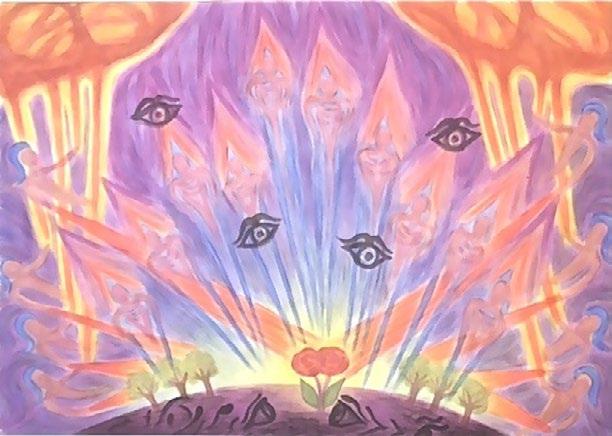
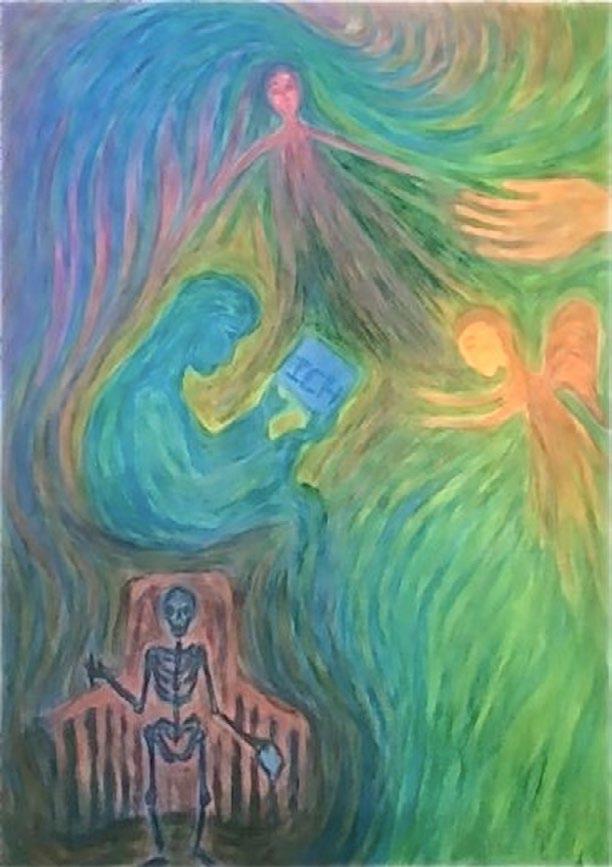
spring issue 2018 • 37
Clockwise from above: “St. John’s Imagination” by Kelly Beekman; “Group Souls” by the late Natasha Wood; “Faust Contemplating the Ich (I)” and “Elohim” by Robert Funk.
Clockwise
These are part of an exhibit at the Centerpoint Gallery of the New York Branch of the ASA. The painters’ working group is on Facebook: “Rudolf Steiner’s Training Path for Painters.” The full exhibit is online via www.asnyc.org


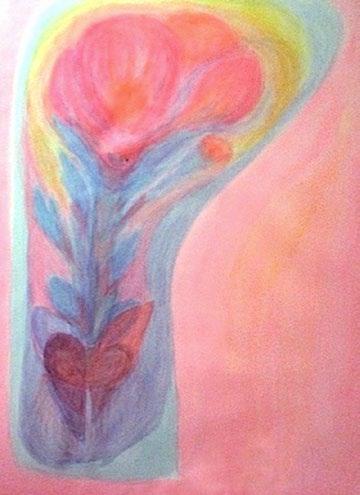

38 • being human
from left: “The Round of Seven” by Akiko Sato; “Adam Kadmon” by Sylvia Mandel; “The Archetypal Plant” by Akiko Sato; “Easter” by Vincent Ropollo.
«« continued from page 34 and the cosmic etheric world. This marks a certain initial culmination in the whole cognitive yoga practice: “the etherization of sense perception joins the etherization of the blood and its spiritualized fiery Ego forces, and the mutual spiritual essence exchange, that began with the exchange between the human etheric body and the etheric forces of the color red, is now intensified, enhanced, and raised to the Ego level. It becomes in this way a true spiritual, that is, a fully supersensible experience, illuminating and actualizing a new, fused human-world Self-consciousness, with the help of which more advanced stages of spiritual scientific research can be accomplished.” (76-77)
Ben-Aharon adds:
“It is also, at the same time, a fully individualized ‘Pentecostal illumination’ event, the conscious flaming up of individual spiritual consciousness, which is caused by means of uniting the inner Christ forces that we take into ourselves, with the ‘holy spirit’ that flows from the spiritual worlds into our etherized senses and thinking. When the two spiritual streams unite, we experience the lighting up of our Spirit Self as World Self, and the spiritual world experiences its own Christ-Self shining back to it from below, from the earth and humanity.” (77)
But there is one final stage in working with this etherization of vision, where we encounter “an unsurpassable body threshold.” If we try to use our new capacity of freed etheric cognition to penetrate into the body below the head, we find we are increasingly hindered and blocked the deeper we descend (starting already in the mouth region and increasing as we descend in the body).
“We discover that the body taken as a whole becomes nontransparent and then even ‘hostile’ to our etherized cognition and the color and light forces that stream from the etheric world into the head. As a matter of fact, the body begins to reject and repel it back.” (78) Interestingly, different etherized colors are resisted by different lower body areas—for example, red by the stomach and green by the lungs.
We eventually discover that this resistance is a psychosomatic astral-etheric reaction experienced as dense, hardened, unconscious instinctive forces forming and possessing what Ben-Aharon calls the “metabolic-emotive-cognitive mechanism” (MECM), part of the human constitution. This hardened barrier serves to protect us in life “so we are not overwhelmed by the powerful forces and streams that connect our bodies with the physical,
etheric, and astral forces of the earth and cosmos.” (79) In fact, this resistance, this “feeling of inward solidity is the basis for our modern [self-]consciousness, without which we would remain ethereal, flowing beings with no cognitive or moral backbone.” (79) It could be said that the ultimate goal of the cognitive yoga practice is to “succeed in consciously uniting the world’s etheric forces, streaming in through each sense perception, with the body’s own pure etheric forces, whose existence and operation is constantly inhibited, individuated, and suppressed by the dominantly astral forces of individuation.” (79)
This barrier is also called the “diaphragmatic threshold.” Below it lie, deep within our unconscious, highly protected pure, virginal, childhood life forces of exalted spiritual origin (“the sleeping beauty”), which the cognitive yoga process hopes to unite with its already liberated etheric cognitive forces. This causes a crisis in the work of purifying sense perceptions, one that can only be overcome if we learn additionally how to “struggle with the senses of smell, taste, touch, and a whole host of related sensations, desires, drive, and instincts, bundled together in the core of the whole MECM complex.” (80) 1
Most of the rest of the book concerns the search for necessarily strong forces, and a navigable passage, to be able to cross this denser bodily-soul threshold. First, we need to produce and gather additional etheric forces from work with the etherization of thinking. Following The Philosophy of Spiritual Activity in this task, we decompose and purify the components of the mental picture (percept and concept), liberating the living spiritual essence of thinking (which is also degraded and killed within our skulls). To free thinking from the senses and brain, we have to stop producing constant new representations from sensory input, and stop also the return of related memory pictures. Ben-Aharon calls these two sides “the soul hands of the two-petalled lotus flower or chakra,” creating a dead, empty consciousness from which pure etheric thinking could be able to resurrect as a vital, living, even cosmic force. Eventually, with “thinking’s released life stream” we then can simultaneously expand higher toward the cosmic etheric sun and “deeper into the new ‘sun in the earth.’” (97) We discover that this pure, life-giving thinking “unites wholly with the same original spiritual force and beings that create the physical earth and all its physically incarnated beings as well as all sun and galactic bodies in the starry heavens.” (102)
spring issue 2018 • 39
We then have the forces we need to tackle the etherization of the senses of smell, taste, and touch, which are imposed and sedimented on top of the lower senses of balance, movement, and life, a condensation from which much of our sense of self-consciousness derives in ordinary life. As an example, Ben-Aharon then embarks on a related but much more complex, seven-step process of fully etherizing the scent of a rose (sense of smell) and then becoming able to use the stronger life forces of its liberated etheric being to gradually penetrate and release the MECM resistance, initially by its connected centers in the middle and rear portions of the brain. He captures the moment when this project of the etherization of the rose scent combined with forces released by previous color etherization and thinking etherization finally after much effort and time succeeds in liberating the etheric brain completely from the physical brain:
“we feel as if our etheric skull cracks open, the brain’s etheric equivalents of the hemispheres are disconnected, separated from each other, turn inside out, and are etherically flattened, spread out and expand like the petals of a flower, or two wings of etheric flight. An Umstülpung [reversal] inside out and outside in, that is, a full inversion of the etheric brain and the etheric head takes place the deeper and longer the etheric ‘tunneling’ proceeds.” (126-127)
With the two-petalled chakra as its “third eye” center, this etheric brain now becomes the chief “cognitive, breathing, rhythmic” organ of etheric cognition, both within the human etheric body and for the cosmic etheric world. But this conscious etheric “seeing” through the chakra and brain is quite different than seeing with physical eyes: “the ‘third eye’ has a simultaneous panoramic etheric vision, and it can view the whole etheric brain process, as well as its connections to the surrounding etheric environment and cosmos, from all directions at once.” (128)
Along the way this knowledge process has involved the free, conscious giving up of oneself, which is “an infinite elevation and spiritualization of freedom through the truest devotion and love to the other being that one is invited to become. This experience of metamorphosis, of coming to be hosted by the true being of the other, through love fired by the highest freedom, is going to be the most beautiful experience of a humanity progressing in the right way. Therefore, in the future the following must be increasingly understood: that any true knowledge demands becoming one with its subject ‘matter,’ which is not
matter at all but real spiritual being.” (114)
Ben-Aharon poetically summarizes the full scope of this achievement of “the first independently built supersensible, etheric organ . . . as an individual achievement of modern spiritual scientific research” as a kind of flowering process of the brain:
“it becomes an unfolding chalice of radiating inner light, opening, awakening, and growing toward and together with the light of the cosmos as a flower unfolds its enclosed petals toward the light of the sun. Its wonderfully flashing and shining radiations reach to the farthest cosmic spaces above, merging with spiritual radiations emanating from the sun, moon, planets and stars, and communicate far and wide with the etheric formative forces of all natural and earthly beings. It is a magnificently dynamic, ever awake and active organ of light, like a flowering, adorned crown, with the third eye as its stirring wheel, by means of which the united human-world’s living forces are regularizing, harmonizing, and directing the circulating ebbs, flows and currents of etheric perception and cognition. This flower that is formed and matured through the cognitive yoga practice becomes the main organ of etheric world-human, human-world cognition and consciousness.” (129-130)
This later develops further through “extension” to centers established in the larynx and heart (chakras) bringing new capacities, and then every area of the entire etheric body is diversely “retooled” spiritually to become an expanded but individuated world-human etheric body or being. Through “etheric essence exchange” within the now united human-world “I” “the world becomes selfconscious through the human and the human becomes world-conscious through the world.” (131-132)
Advancing still further along this path, Ben-Aharon is able to describe difficult-to-fully-imagine, yet at times sublime and even thrilling spiritual-scientific experiences in the last third of the book. Each new development in liberating, and building a new etheric body makes possible new levels of spiritual experiences and revelations. For example, as the human heartbeat and breathing harmonizes with the cosmic etheric heartbeat and breathing, we feel we are drawing closer to “the spiritual heart source of universal life” (the etheric Christ). (133)
Armed with the additional, stronger, condensed etherized sensory and thinking forces (the latter involving overcoming the ahrimanic death forces in the head), additional “heart forces” from the larger etheric world, and a
arts & ideas 40 • being human
new intensifying of etheric cognitive breathing from head to heart, the practitioner is finally able to overcome the hardest MECM obstacles (“the dragon guardian of the lower world”), crossing the diaphragmatic threshold and, through work with the etheric forces of the metabolic and reproductive organs, consolidating a third functional center of “cognitive breathing,” of “mutual essence exchange between the etheric world and human body,” within the whole, threefold etheric body. In the meantime, the activated astral chakras have also been slowly building a new “etheric nerve system” as a “scaffold” for additional etheric cognitive functions as well as helping activate a stronger larynx center about which Ben-Aharon writes:
“It shapes our reproductive, heart, and head radiations with what can be called ‘the creative human-worldword,’ by means of which our interaction with the etheric world becomes spelled out and articulated, formed into etheric vowels, consonants, syllables, syntax, and vocabulary.”
A new essential openness and connection between the etheric body and the cosmic etheric world develops. In this new etheric “body/world continuum,” the etheric body and its forces “are parts of infinitely vast, planetary and cosmic assemblages and networks of functions and interconnections that weave outside the inner physical space of the body.” (145-146) As one of the most fascinating and challenging aspects of the latter part of this book, Ben-Aharon’s often compelling descriptions of vicarious spiritual experiences take place in unfamiliar worlds where the order and organization of the sensory world is reversed, meeting realities and beings we can only experience if we are able to become them. At a certain level the spiritual etheric world functions as a living being in which we participate and which, reciprocally, participates in us—with which we are organically interwoven. Ordinary illusory polarities of experience in the physical/sensory world– inner-outer, subject-object, self-world—dissolve or transform so that both aspects function and are experienced simultaneously and reciprocally. Ben-Aharon describes this:
“In this new topography, the body’s inner space is but the world’s infolded external space, and conversely, the external world is a body turned inside out and infinitely multiplied.” (145) “What we discover is that all inner organs and processes are neither ‘inside’ us nor, for that matter, ‘outside’ us, but that we are outside ourselves: . . . But then trees and animals, mountains and seas, clouds, rain and lightning, sun
and moon, are in the etheric world-body continuum, our inner forces and organs, while the etheric and astral counterparts of liver, kidneys, lungs, heart, are cosmic bodies and beings. The inner organs and organic processes are spread out as etheric-astral natural, biological, meteorological, atmospheric, planetary, and cosmic streams and functions, and participate in infinite flows of universal becomings.”
(146) “We realize that what our senses perceive and what our thinking represents as an external world, distinct from our inner world, is not simply an arbitrary mistake or illusion, but a profoundly meaningful and exact reversal and inversion of the true state of all etheric, astral, and spiritual affairs.” (146)
This experience of a shared etheric planetary body infused by cosmic radiations from the circumference of the cosmos is not the only new experience that penetration of the lower bodily depths and creation of a new etheric body makes possible. In the etherization of the lower body, a kind of reversal of puberty takes place, liberating the “holy treasure” of the purest, paradisal etheric forces hidden there during childhood and preserved from “humanity’s pre-luciferic childhood.” Similarly, the separation of the sexes is etherically reversed, without which human beings “could never have achieved self-consciousness, freedom, and true love based on freedom.” (152) In those depths are also found “Christ’s primordial, paradisal forces working together with his eternal forces of resurrection.” Spiritualized, the flesh begins once again to become Word, and in a kind of “immaculate conception event” a new human-world etheric being is conceived, a new etheric “cosmic child” can develop with the “seed forces of a new universe.”
I don’t want to spoil the experiences of inspiring joyfulness readers can have from discovering some of the spiritual events depicted in the last third of this book, but I want at least to indicate the nature of some of the treasures to be found. As would be expected, Ben-Aharon struggles at times to describe unfamiliar spiritual experiences in language formed for physical world phenomena.
Having freed and formed a new etheric body, the practitioner must further conceive and create a truly independent spiritual individuality that can fully function in the etheric world, the Spirit Self. This involves mastering the forces both of birth or incarnation and of death or excarnation. Ben-Aharon tells us this work is supported, among other sources including astral forces, by “the evergrowing forces of [Rudolf Steiner’s] eternally preserved
spring issue 2018 • 41
etheric body” (166) which have been able to be accessed and individualized since the end of the twentieth century. As part of this process we must “build a hut” as an etheric dwelling, go through a ritual of death and rebirth to enter into communion with the spiritual cosmic community, guiding our newborn etheric body to be consumed by cosmic fire, as we individually re-enact the etheric second death of Christ, the “Second Mystery of Golgotha.” We then rise and gradually re-form ourselves like a phoenix, becoming a kind of perpetual metamorphosis process.
As our “baby steps” in this new phase of the cognitive yoga journey we have to learn how to nourish ourselves and develop the capacities we need; Ben-Aharon depicts this as the cosmic-etheric equivalent of the human earlychildhood stages of learning to walk, speak, and think— but occurring etherically in reverse order. To accomplish this, we enter into the etheric “kinder garden” (“the spiritual region closest to the physical earth”) filled with “mighty everlasting trees with magnificent flowers and fruits of eternal life and bountiful meadows that flourish with indescribably radiant beauty and grace.... We realize that we enter the garden of spiritual earthly accomplishments, which the cosmic gardeners, the angels, tend and cultivate with infinite devotion, joy, love, and expertise.”
(185) These are the splendorous spiritual flowerings of all true moral ideals and deeds, artworks, compositions, and ideas, also unrealized “youthful ideals of the living and the dead of all times and ages.” (185-186) One of the most striking encounters in this garden is with the now reunited two trees from Paradise forming one gigantic etheric cosmic Tree of Life, an achievement in which Rudolf Steiner played a key role.
The next phase of having to learn the cosmic language is particularly aided by working with the etheric effects of great, truthful works of art on earth. Ben-Aharon gives the example of the complementary nature of Leonardo’s Last Supper and Raphael’s Sistine Madonna. “They are experienced as creative and formative, world-creating and shaping forces that teach us our ‘etheric mother tongue.’”
(190) The following development is to draw on spiritual fruits created by moral deeds on earth to produce a “moral gravity” and etheric ground to counteract the one-sided forces of levity in the etheric world. Ben-Aharon comments: “Cultivating and spiritualizing the moral accomplishments of humanity is one of the main tasks of all beings, human and angelic, that work in the supersensible Michael school since the mid-20th century....”
In his final chapter, Ben-Aharon depicts how the
more mature etheric individuality joins in co-creating the “new sun” of the Christ-permeated etherized earth. Although the step of a “mutual essence exchange with the cosmic source” (Christ) is “the most intimate soul experience in the etheric world,” (205) he tries to describe it in ordinary language because, he tells us, sharing this is the wish of the Christ being. In the development of this “communication,” the other being is inside us and we are inside the other. “Communication is here communion” or “mutual essence exchange.” (207) This process involves (for Ben-Aharon at least) working with the mantra that begins “More radiant than the sun,” which Christ first “enhances” and then “reverses” to better express how “He, the highest, is bowing down to embrace and purify the feet of our lowest self....” (211)
In conclusion let me reflect on a couple of questions. Since Ben-Aharon primarily describes the experiences and processes of an etheric body path, does it cover the complete new yoga path to the Spirit Self that presumably also includes the involvement of the astral body and ego? In any case, the role of the astral body and ego need further clarification, especially since development of the Spirit Self is depicted in anthroposophical literature as a transformation of the astral body. Also, in this regard Ben-Aharon has made clear that he is only communicating Imaginative experiences, even though, he says, some Inspired and Intuited aspects belong to the Imaginative faculty.
Secondly, he suggests these processes always happen in an individualized form. Would each of us experience these events somewhat differently? It seems to me more research is necessary by others to confirm these steps and their variations. However, as we might wonder how “objective” his descriptions are of this path, we then realize that actually the whole idea of “objectivity” evaporates in fully subject-objective spiritual (etheric) world experiences like those described here. We come to realize that every truth and being (and every polarity) is multi-sided and must always be individually re-experienced anew from varying perspectives, especially at this level when “knowing” something means becoming it. Of course, this realization may make some people used to the ordinary, fixed, subject-object sensory world uncomfortable—yet this realization seems to be an increasing necessity in navigating the changing spiritual climate of the twenty-first century.
arts & ideas 42 • being human
David Adams (ctrarcht@nccn.net) edits the newsletter for the Art Section in North America and a regular contributor to being human.
Book Notes
Space does not permit us to review more than a few books in each issue. This page is meant to acknowledge a few of the many others that come to our attention. Except as specified, notes are from the publishers. – Editor
SteinerBooks steiner.presswarehouse.com
Autism: Meet Me Who I Am: A Contribution toward an Educational, Sensory, and Nutritional Approach to Childhood Autism that Supports Families and Ignites the Child’s Deeper Wish to Connect to People and the World; by Lakshmi Prasanna and Michael Kokinos; 132 pp.

“The outlook on autism presented here emerges from twenty years of clinical work and individual research by Dr. Lakshmi Prasanna, a developmental pediatrician and neonatologist from India, and Michael Kokinos, an Australian physiotherapist specializing in neurology and the relationship of movement and sensation. They have worked mostly in the rapidly developing cities of South India. They have very different professional and cultural backgrounds, with one from the East and the other from a Greek family in the West. Autistic characteristics present with an incredible diversity; the consultation room alone does not often suffice to see and truly understand the unique riddle of an individual child. The authors’ interest and research has involved observation of the children contextually—behind diagnostic labels (communication disorder, repetitive behaviors, lack of eye contact, etc.).”
The Art of Colour and the Human Form: Seven Motif Sketches of Rudolf Steiner; Studies by Gerard Wagner; edited by Peter Stebbing, foreword by Peter Selg; 218 pp., 163 illustrations.
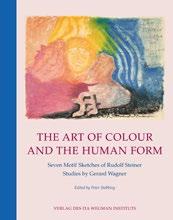
“Based on Rudolf Steiner’s indications, Gerard Wagner shows a wholly new approach to the human form in art. The Art of Colour and the Human Form presents the seven motif sketches concerned with the ‘spirit form of the human being,’ as well as numerous studies that Gerard Wagner painted over a period of thirty years. The intention of this volume is to present an artistic approach to these unique motifs and to indicate their potential ‘color build-up.’” [See this issue’s cover and the Gallery pages 35-38 for recent work with Steiner’s sketches.—Ed.]
Other publishers
Eco-Alchemy: Anthroposophy and the History and Future of Environmentalism; by Dan McKanan; University of California Press

“For nearly a century, the worldwide anthroposophical movement has been a catalyst for environmental activism, helping to bring to life many modern ecological practices such as organic farming, community-supported agriculture, and green banking. Yet the
spiritual practice of anthroposophy remains unknown to most environmentalists. A historical and ethnographic study of the environmental movement, Eco-Alchemy uncovers for the first time the profound influences of anthroposophy and its founder, Rudolf Steiner, whose holistic worldview, rooted in esoteric spirituality, inspired the movement. Dan McKanan shows that environmentalism is itself a complex ecosystem and that it would not be as diverse or as transformative without the contributions of anthroposophy.” Dan McKanan is the Emerson Senior Lecturer at Harvard Divinity School and the author of several books on religion and social transformation, among them Touching the World: Christian Communities Transforming Society and Prophetic Encounters: Religion and the American Radical Tradition.
Childhood Illnesses and Immunizations: Anthroposophic Ideas to Ensure the Wellbeing of Our Children in This Digital Age; by Ross Rentea, MD, Mark Kamsler, MD, and Andrea Rentea, MD; Lili Kolisko Institute
“This book is a comprehensive exposition of the concerns named in the title from an anthroposophical viewpoint. As a bonus one will find all the Rudolf Steiner passages that we could find relating to the topic; we believe it is the most comprehensive collection of such quotes available. We offer a lot of practical advice on dealing with both situations: when giving immunizations and when avoiding them. When taken to heart, the book is also a primer on the practice of anthroposophic medicine. And we point out in a very comprehensive manner the importance of a spiritually oriented (ideally Waldorf) education which should be given to any child in order to overcome the negative influence of the immunizations.” www.koliskoinstitute.org/kolisko-institute-webinars Integrating South Africa’s Waldorf Schools: with a discussion on Cultural Racism and Anthroposophy; by Eric Hurner; self-published, paperpack and Kindle at amazon.com

“This short history of how South African Waldorf schools developed from multi-cultural, through multi-racial to the present trans-cultural schools. It addresses present-day cultural racism and whether racism forms part of the anthroposophical world view. Waldorf schools were started in South Africa by groups of immigrant parents unwilling to entrust their children to the boredom and harsh discipline of public education at the time. Subsequent expansion coincided with their extension into the Black communities. The author attended the first Waldorf School in Cape Town, was a Waldorf teacher in Johannesburg and a lecturer and school consultant for the new Waldorf Schools founded during the later years of the struggle against Apartheid.”

spring issue 2018 • 43
research & reviews
IN THIS SECTION:
Fred Amrine is a great teacher and scholar, and an amazing student of Rudolf Steiner. Fred Dennehy reviews a collection of his essays.
Steve Usher was in charge of the Anthroposophic Press some years ago, and seized the opportunity to engage the world-famous novelist Saul Bellow on the ground of a shared interest in anthroposophy.
Dwight Ebaugh reviews the book Steve has written.
Lisa Romero has developed a very impressive teaching and guidance around “the inner work path,” which Dan Mackenzie unfolds from her latest book.
Finding the Thresholds
Thresholds: Ten Anthroposophical Studies
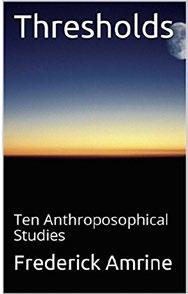 , by Frederick Amrine
(Keryx
2017, Ann Arbor)
Review by Frederick Dennehy
In “Before the Law,” the parable recounted in Franz Kafka’s The Trial, “a man from the country” stands before the open door to “the Law,” asking for admittance. He is confronted by a doorkeeper, a threshold guardian who denies him admittance, at least for the present. There the man from the country sits waiting for days and years. He remains at the threshold for his entire life, wearying the doorkeeper with his importunities, seeking to persuade even the fleas on the doorkeeper’s fur collar to intervene for him and gain him admittance. As he is about to die, he asks the one question that he has kept to himself for all this time: Since everyone hopes to reach the Law, why has no other person come to the door seeking admittance? The man from the country has become feeble and hard of hearing, so the doorkeeper has to bend down low to him and shout in his ear: “No one but you could gain admittance through this door, since this door was meant for you alone. I am now going to shut it.”
What follows is a review of Thresholds: Ten Anthroposophical Studies.
Frederick Amrine, the author of this remarkable collection of essays, tells us that what they have in common is that they represent thresholds—those “places where we can begin the arduous journey of self-transformation.” Robert McDermott, asked to identify “the core practice” of anthroposophy, chose “transformation,” and I know of no other focus of attention more crucial for today’s anthroposophist. What Professor Amrine shows us in these essays is that we don’t have to share the shrunken destiny of Kafka’s man from the country. We don’t have to wait for sudden attainment to be thrust upon us after years of study. Transformation is attainable to us now, if we only have the will to look to the thresholds in thinking and feeling that are everywhere at hand and do the work that Rudolf Steiner told us in a hundred different ways and times that we are capable of doing.
What imprisons us in parables of paralysis and relegates us to parts in tales that never get told is what Coleridge called “the lethargy of custom”—what Steiner called “dead thinking.” It’s the arrogance of behaving as though the hard sharp light of ordinary consciousness were the only light, and that the only way to move through what St. John contemned as “this world” is eyes down and meek hearted.
There is no lethargy in what drives the studies in this collection. Nothing is taken for granted. Everything is up for grabs. Philosophy, the arts, science—these are not seen as ‘disciplines,’ but as defiant questionings. We are not here merely to apply concepts, but to make new ones. Artists are not performers but explorers. Audiences are not spectators and listeners but haunters of deep chasms of the heart, mad for the crossing. These essays range from the challenging to the daunting to the vertiginous, but their cumulative effect is one of bracing possibility, of optimism which may well be an alternative name for anthroposophy’s core. If there is a message here it is this one: All things can be made new.
To make the new we have to clear away the old, and clearings are made here everywhere. Owen Barfield is called upon to disabuse us of the pretentious canard that what fundamentalists of all stripes call the ‘literal’ always was and always will be of the tired level of practiced pundits and casual gossipers, and to show us that the world cannot be caught and dissected, because it is always changing form and slipping away, always evolving along with our consciousness. There is a succinct appreciation of Thomas Kuhn, who should be “treasured” by anthroposophists, not only for dismantling the fiction that science moves scrupulously in a studied path of logic, but for his a confirmation of Steiner’s understanding of the place of intuition in the best science. Prof. Amrine includes his tribute to Thomas
44 • being human
Nagel’s courageous Mind and Cosmos: Why the Materialist Neo-Darwinian Conception of Nature is Almost Certainly False —courageous because Nagel, still a card-carrying atheist and anti-supernaturalist, in skewering the reflex reductionism of Big Scientism, knew that he would have to endure the petty ripostes of wounded true believers. But Nagel is intellectually honest, and shares Prof. Amrine’s aversion for narrow, sclerotic and doggedly centripetal thought. And there is Deleuze. Gilles Deleuze is a notoriously difficult, at times seemingly opaque writer, but for Prof. Amrine the challenges of his language reflect his achievement of body-free thinking, of etheric apprehensions for which we do not yet have names, and his cognitive artistry in the creation of concepts.
The best art is a gateway to the etheric, to cognitive feeling, and we are introduced (or re-introduced) to two of the twentieth century’s more revolutionary artists, the anthroposophical visual artist Joseph Beuys, and the movement artist Loie Fuller, not an anthroposophist but still a spiritual scientist, and perhaps a proto-eurythmist. And through immersing ourselves in “Music as a Threshold Experience,” which draws on the insights not only of Rudolf Steiner but the theorist Victor Zuckerkandl, we can begin to understand music as living metamorphosis and an experience of the etheric, if only we can reach that rare place where the mind is able to turn. That is to say, if we can wake up.
The last two essays in this collection display the author at his imaginative best. “Traumarbeit and Umstulpung : Two Kinds of Metamorphosis in Faust” is far more than a study of trope and meaning in Goethe’s masterpiece; it is an exploration of two fundamental kinds of transformation. As to Traumarbeit, there is dream, “myth writ small,” and myth, the dreams of nature’s unconscious writ large. Umstulpung is a kind of ‘topological’ transformation “where the outside becomes inside and vice versa.” ‘Topological’ is not used here only metaphorically.
If it has not become obvious already in this review, Prof. Amrine is a polymath, and we are afforded a summary excursus into the mathematics of topology, with consideration, inter alia, of the mobius strip and the Klein bottle. Topology, he finds, is another name for ‘metamorphosis,’ and provokes a provisional solution to the epistemological riddle of duality: We “overcome duality by rising up into a previously unmanifest dimension.”
The final selection is “The Beauty of Anthroposophy, or: What’s Spiritual About Spiritual Science?” This essay shows anthroposophy, or spiritual science, to be more scientific than conventional scientific practice, which is in the process of being strangled in the coils of the reductionist paradigm, and has ceased to do its jobs of (1) rendering phenomena meaningful; and (2) providing a methodology of discovery, a gateway to the moment of insight. The author proposes three additional scientific conceptual categories: sublimity, beauty and elegance (not the jejune elegance of reductionism that privileges control over intelligibility, but the basic good of simplicity). It is refreshing to see diagrams of planetary pathways over the years, i.e., the ‘Rose of Venus’ and the “Shield of Mars,” treated as scientific allies specifically on account of their beauty, which is “integral” to their “intelligibility” and hence their meaning. “The Beauty of Anthroposophy” is itself a threshold to the transformation of our own understanding of the very reality of science.
And if you are looking for an introductory piece about Rudolf Steiner to show a friend, or an answer to the comeback, “Okay, if Steiner was such an overwhelming genius, why hasn’t anybody heard of him, there is no better place to go than the direct and comprehensive, “Discovering a Genius: Rudolf Steiner at 150.”
This book is available only on Amazon, and there are other titles of interest there under the same imprint. Don’t miss it.
Looking Toward Higher Worlds
Conversations with Saul Bellow on Esoteric-Spiritual Matters, A Publisher’s Recollections , by Stephen E. Usher; SteinerBooks, 2017; 71 pages.
Review by Dwight Ebaugh
The contents of Stephen E. Usher’s new book are accurately described by the title, Conversations with Saul Bellow on Esoteric-Spiritual Matters, A Publisher’s Recollections. I am happy to add that the conversations are most
engaging and Steve presents the conversations after telling the fascinating story of how he came to be in that improbable situation. In 1980 Steve sacrificed his position as a young Ph.D. economist at the Federal Reserve Bank
spring issue 2018 • 45
of New York to take on the management of the Anthroposophic Press. Managing the Press “was like patrolling a beach where waves were always washing up some curiosity or other to keep one engaged and interested.” One such curiosity was a letter discovered in the attic of a house near the offices of the Press in Spring Valley, New York. The letter was dated December 16, 1919 from Rudolf Steiner in Dornach, Switzerland. The gist of the letter was Rudolf Steiner’s agreement that his book, The Threefold State (now available as Towards Social Renewal ) be published in English and his suggestion that Bernard Shaw be enlisted to write a review of the book. At the time of the letter, Shaw was on his way to becoming the leading dramatist of his generation (he authored Pygmalion in 1912) and he was awarded the Nobel Prize in Literature in 1925.
Steve described the “peculiar effect” that the letter had on his soul. “Chance, I felt, was not the agent that delivered it to my desk. Rather, I felt the agent was Rudolf Steiner.” Seven years earlier, Saul Bellow, the novelist and Nobel Laureate (and a person suspected of being an anthroposophist), had published Humboldt’s Gift, which earned him a Pulitzer Prize. The novel’s protagonist studied Steiner’s writings with an anthroposophist in Chicago. Steve wondered: “Would Saul Bellow be willing to write a foreword to a translation of one of Steiner’s works? Might the impulse that failed with Bernard Shaw succeed with Bellow?” From Steve’s reading of Bellow’s novels, Steve knew that the protagonist in Humboldt’s Gift, Charlie Citrine, was a writer modeled on Bellow himself. In the book, Charlie occasionally visits Dr. Scheldt, an old anthroposophist, and they discuss Rudolf Steiner. Steve knew that Dr. Scheldt was the fictional counterpart to Peter DeMay, a real life anthroposophist with whom Saul Bellow visited regularly to discuss Steiner.
At the University of Michigan, Steve Usher was introduced to Rudolf Steiner by Dr. Ernst Katz (1913-2009), a physics professor and a steady force in the anthroposophical movement for over sixty years. Ernst, in turn, introduced Peter DeMay to Steve. Peter liked the idea of a Bellow foreword and Peter assured Steve that Bellow’s interest in Steiner was genuine and serious. In late 1981, accompanied by Peter DeMay, Steve came face to face with Saul Bellow, the internationally famous writer and Nobel laureate, a name known in households across the world, a person to whom publishers would gladly pay large sums of money for the prestige of a foreword. In the course of this first meeting, with no money to offer, Steve put the question: would the renowned author
write a foreword for a forthcoming English translation of Rudolf Steiner’s Grenzen der Naturekenntnise, a series of eight lectures given in 1920 (eventually published in English as The Boundaries of Natural Science)? Bellow agreed.
Steve characterizes Saul Bellow as an American “great soul,” a great artistic soul, a person who illuminated reality in an especially twentieth-century-American kind of way, a writer able to turn prose into high art. However, it took the great American soul nearly two years to write his eight page foreword to The Boundaries of Natural Science. The finished product is a masterpiece, a beautifully written piece that displays a true coming to grips with Rudolf Steiner’s concepts. It is evident from the foreword that Bellow took it upon himself to go deeply into the effects of the scientific world view on the modern social order, the Ignorabimus (the absolute inability of natural science to explain the source of human consciousness with which we human beings examine the outer world), the phenomenon of initiation, the difference between ordinary thinking and sense-free thinking, and the overwhelming significance of that which our sensory experience does not touch—the spiritual world. During and after the long period in which Saul Bellow worked on the foreword, he met and communicated with Steve Usher. Much of Conversations with Saul Bellow on Esoteric-Spiritual Matters is given over to these interactions.
On one occasion, Bellow spoke to Steve about the difficulties of a writer’s life. You can’t just dive into life like a normal person, he explained. At every moment, part of you is detached; it’s observing and taking mental notes and cataloguing the experiences. He said, “As a writer, you’re handicapped. It’s like going through life with one arm tied behind your back.” It struck Steve that Bellow was describing an essential characteristic of modern consciousness—the “consciousness soul” or observer consciousness or detached consciousness. In May Human Beings Hear It! (Temple Lodge 2004, p. 63), Sergei O. Prokofieff observes the same phenomenon from a slightly different perspective:
At a mature age one knows from one’s own life experience that the true enemies of freedom do not arise from outside but from within, out of the depths of one’s own being that as yet are not taken hold of by the ego and for that reason are full of desires, prejudices, antipathies and passions. All efforts of the self-aware ego that strives after true freedom must now be directed towards overcoming these inner opponents. For in the present epoch of the
46 • being human research & reviews
consciousness soul every human being should become free.
On another occasion, Bellow opined: anthroposophists have an easy time of it. They live in a beautiful cocoon, insulated from the real trauma of modern life. They have their own medicines, their biodynamic foods, their Waldorf education. This protects their health and personalities from the disintegration afflicting modern humanity. Moreover, Christianity has been preserved for them by Steiner’s spiritual insights. They still have it. For much of the educated Western world it is becoming untenable; the possibility of believing in the divine and an afterlife, much less Christ, has been eaten away by materialistic scholarship. It struck Steve that Bellow was characterizing anthroposophists as Essenes in the manner that Essenes were characterized by Rudolf Steiner in The Fifth Gospel lectures: In his late twenties, Jesus came to realize something that caused him great sorrow. He recognized that the Essenes [with whom He lived for periods of time] purchased their spiritual advancement at the expense of other human beings. The pure Essene life made it impossible for certain harmful spirits to approach Essene communities. With supersensible sight, Jesus saw these spirits running from the gates of an Essene village. He knew they were running to other human communities. They attacked the inhabitants of the other communities all the more. Jesus was seeking a road that all people could travel to the spirit, so he rejected Essene life, which could save only the few. Steve understood Bellow to be saying that anthroposophists try to be Essenes, but Steve disagreed on the grounds that modern life simply will not accommodate this, “Modern life finds you out no matter where you try to hide.” In other words, some anthroposophists may attempt to live in an esoteric cocoon but they cannot escape confrontations with today’s deep seated ahrimanic and materialistic forces.
In a telephone conversation, Steve spoke with Bellow about the problem of materialists denying the possibility of a science of the spirit. Bellow recounted his experience
in debating a Kantian philosopher and a mathematician. Both refused to discuss Steiner. They would not even explain their objections. In our time, Bellow felt, academics control what is regarded as credible. Their strategy with Steiner is to ignore him.
Peter DeMay crossed the threshold shortly after Saul Bellow completed his foreword to The Boundaries of Natural Science. The crossing sparked a conversation between Steve and Bellow concerning communication with the departed. They attempted Rudolf Steiner’s exercise for communicating with the dead. Bellow worried that his friend Peter was having a hard time because the afterlife was not as he expected it to be. Steve, on the other hand, likened Peter’s afterlife experience to seeing an elephant for the first time. Even if one is well prepared for seeing an elephant, the actual experience would still be shocking.
Steve Usher and Saul Bellow also conversed about the indications in Rudolf Steiner’s widely read lecture, The Work of the Angels in Man’s Astral Body. As a general proposition, Steiner states in that lecture that every rank of the spiritual hierarchies (Angels through Seraphim) are continually at work in the sheaths (physical, etheric, astral) of each human being in each stage of human evolution. As a concrete example of the general proposition, he details the work of the Angels in each human Astral Body at the current stage of our development (the age of the consciousness soul or spiritual soul). He asserts that the Angels’ current work is bringing about impulses within our Astral Bodies, while the current work of we human beings is to consciously heed these impulses and carry them out with deliberate moral intention in physical life. Specifically, we are (1) to relate to other human beings with genuine brotherly love, with a will to selflessly administer to the needs of others, with the end result being that we are unable to enjoy our own happiness when we are aware of another person’s unhappiness; (2) to recognize in ourselves and in each other human being a divinity, a spiritual essence, to the end that institutional churches will become obsolete as each meeting between human beings carries the full potential for a

spring issue 2018 • 47
sacred religious experience; and (3) to gain direct access to spirit through our thinking, the thinking described by Rudolf Steiner in The Philosophy of Freedom and elsewhere as sense-free thinking or intuitive thinking, a conscious experience in pure spirit of a purely spiritual content (as opposed to our current everyday thinking which amounts to a conscious experience of a purely non-spiritual content). Steiner goes on to say that the Angels will do their work of bringing about the three impulses even if we do not perform our work of consciously heeding the impulses. But if this comes to pass, the consequences will be “baleful;” that is, the impulses will manifest as instincts within our etheric bodies and instead of brotherhood, sacred recognition, and direct spiritual experience, we will produce aberrant sexual behavior, harmful medical treatment, and highly destructive weapons.
Steve and Bellow speculated on whether we are already seeing evidence of these baleful consequences. In Humboldt’s Gift, Bellow compares Rip van Winkle’s twenty-year nap to modern society’s inability to wake up to spiritual reality. In conversation with Steve, he pointed
to the growth of the pornography industry in relation to home video (internet porn would not arrive for another decade) as an initial manifestation of sexual aberrations. Together, they speculated that anxiety disorder medications like Librium and Valium might be examples of medicines that make one “feel good” while actually causing illness. Most of the antidepressants had yet to hit the market and Viagra was still unknown. Steve also recounts an exchange of letters in which they examined Steiner’s indications in lectures similar to The Work of the Angels, namely, Entry of the Michael Forces; Decisive Character of the Michael Impulse and Mechanistic, Eugenic, and Hygenic Aspects of the Future.
The book ends appropriately with Bellow’s foreword to The Boundaries of Natural Science. A warning: after you read Stephen E. Usher’s delightful new book, you may also want to read The Boundaries of Natural Science and Humboldt’s Gift
Dwight Ebaugh is a retired lawyer and secretary of the General Council of the Anthroposophical Society in America. He is active in the Great Lakes Branch of the Society.
Living Inner Development
by Dan Mackenzie
Living Inner Development: The Necessity of True Inner Development in the Light of Anthroposophy is Lisa Romero’s third book on spiritual self-transformation. It presupposes, but does not pre-require, familiarity with her previous works and will be more comprehensible to readers who have some background in anthroposophy. As Romero stipulates in the foreword, however, “it is accessible to those who can utilize it.”
Anyone who has studied Rudolf Steiner’s works on spiritual development knows how overwhelming it can be to attempt to devise a systematic approach to working with the content, so multifarious are his offerings. One feels blessed and awed by the curriculum the founding anthroposophist bequeathed upon humanity, yet bereft of an organized, clear method of taking up the actual work.
The daunting mountain of anthroposophical selfdevelopment towers like Everest among the foothills of many less rigorous contemporary paradigms that dominate the contemporary dialogue of spiritual growth. Enter Lisa Romero, who, having herself ascended the higher realms through decades of inner work within the Michael School—also referred to here as The Path of Love —offers
her services as a uniquely qualified guide. A teacher of anthroposophical meditation, Romero acts as Sherpa to those intrepid souls who would also attempt to take on the life challenge of spiritual self-development in service of humanity. Though her approach may be characterized as strictly “Steinerian,” Romero peppers her writing with quotes from the likes of Goethe, Aquinas, Rumi, and Hafiz.
The book is succinctly organized into four chapters preceded by an introduction in which Romero makes a simple case for the importance of spiritual self-development. She identifies the innate, universal human sense that life is ultimately about growth and development, asserting that the most effective way we can meaningfully contribute to human evolution is to attend to our own personal evolution. “Self-development” is, anthroposophically understood, not about the self per se, but about the individual’s contribution to the community through the development of the self. Romero goes on to describe the threshold that exists between physical reality and spiritual reality, noting that, besides death, it can only be crossed in three ways.
She states that humanity has collectively begun to approach this threshold unconsciously, and that if we wish to
48 • being human research & reviews
facilitate our own conscious crossing, we must undertake healthy spiritual development. The only other way across, the author admonishes, is through unhealthy intervention upon the bodily sheaths through psychotropic drug-induced toxicity or trauma. We can always wait to be carried across by the tide of evolution, but if we rise to the task of our age and actively take up the inner work, Romero assures us, we may productively aid in the healthy evolution of humanity.
In chapter one, Inner Development for the Physical World , we are first reminded that anthroposophy does not exhort us to believe any particular concepts, rather it gives us a means of gaining understanding through our own inner activity. Potentially dangerous misconceptions arrived at through dogmatic belief or limited intellectual thinking may be corrected through true spiritual insight born from a higher form of cognitive thinking. This living thinking, as the author terms it, is arrived at through the practice of time-tested, specific meditative exercises and verses, which safeguard the healthy development of our inner capacities. Our incarnate experience in the physical body gives us the opportunity to experience our basic three human faculties of thinking, feeling and willing through the sentient soul , the intellectual soul and the consciousness soul .
Romero points out that in the present “Consciousness Soul” age, we are called upon to ascend to a higher level of freedom by transforming and balancing our faculties in such a way that we become less beholden to the impulses of the sentient soul and the dry logic of the intellectual soul, drawing instead upon the knowing spiritual wisdom of the consciousness soul. She introduces “more radiant than the sun,” a verse of seven lines that becomes the meditative focus of the book, describing not only how to work with it, but why it is constructed in its particular manner and what results we may expect from working with it.
In Chapter Two, Inner Development for the Elemental World, Romero distinguishes the three modes of initiatory experience: seeing, sensing and enduring. Her ensuing description of the elemental world draws our attention to the fact that there are various distinct non-physical realms,

which the human consciousness will experience in different ways. This realm, home to “elemental beings and the collective consciousness of the animal kingdom,” is characterized as closest to the physical realm in which we normally find ourselves. Nevertheless, we must learn how to navigate its unfamiliar territory of image-experiences, where we encounter aspects of our own being and feeling life that are reversed or mirrored in that they stream back towards us as if coming from outside ourselves. Here we must also grapple with the dark, looming thought-beings of doubt, fear and loathing. These arise directly from those aspects within us that have yet to be transformed if we are ever to approach and cross the threshold into the actual spiritual worlds.
We must develop inner fortitude to bear the discomfort, even horror of what we might see of ourselves in this realm. The crossing of that threshold, past which we may not carry our earthly ego, necessitates a real purification of the soul. Romero elaborates on the inherent challenges of this realm, and the forces of hope, faith and enthusiasm we must cultivate to surmount them. She describes how we may encounter the etheric remnant of a spirit who has moved on to higher realms, a “shell” that still transmits information about that individual’s concluded incarnation. And since this is the realm of animal spirits, we may experience it differently depending on whether or not we have intermingled with animal consciousness by consuming a meat-heavy diet. Inner exercises that require us to work with powerful symbols such as the caduceus, the rose cross and the pentagram will help prepare us for the meeting with our double, which is unavoidable if we aspire to cross the threshold.
Chapter 3, Inner Development of the Spiritual World, finally escorts us across the threshold into the lower spiritual realm, where the soul mirroring of the elemental realm has been replaced with pure soul activity. The ego has been left behind, as only the higher “I” may enter into this realm. Romero explores what exactly it means to achieve this level of development, deferring a few times to quotations from Rudolf Steiner and from another of her preferred sources—Mabel Collins’s Light On The Path.
spring issue 2018 • 49
She then describes in detail the seven different portals through which we may begin to learn the language of the lower spiritual realm: color, measure, number, sound, direction, movement and form.

The final chapter, Preparing for the Higher Spiritual World , delves into the more extreme challenges facing the aspirant at this advanced level, where our emerging inner light casts a correspondingly dark shadow—our dreadful egotism has been revealed to us by the humbling encounter with the Guardian. Whereas the lower spiritual world is the realm of the Hierarchies, there is nothing in the higher spiritual world but the peaceful experience of the “true I.” As we enter here, we must even leave behind the experiencing soul; our only I-experience here is pure consciousness. We perceive the workings of the Hierarchies from a cosmic point of view and gain a profound understanding of the laws of karma.
Romero warns us of other spiritual paths that involve taking psychoactive drugs to facilitate altered states of consciousness. Such interference upon the physical body may indeed give us temporary access to the astral realm, but it constitutes a kind of “gate-crashing” the threshold to the true spiritual word. In doing so we risk sustaining imbalances in our physical, etheric and astral bodies, and worse yet we may be barred by the Hierarchies from access to the higher spiritual realms.
By guiding us step by step first through each of these levels, the Path Of Love strengthens our thinking so we can perceive and integrate thought-pictures engraved upon the elemental substance by the beings of the lower spiritual realm. Thus, when we rise to the higher realms, we may merge with cosmic thoughts of human evolution. Inspired by these cosmic thoughts to selfless deeds, the Michaelic initiate invariably turns down Lucifer’s offer of freedom from karma and incarnation, returning instead to work among fellow humans in the collaborative effort of evolution. This paramount devotion to others is what earns the Michael School its alternate name The Path of Love.
With Living Inner Development, Lisa Romero has contributed another challenging, esoteric workbook for spiritual self-transformation through anthroposophy. This book is recommended to anyone who would intentionally endeavor to become a more conscious, loving and responsible human being.
Traveling Speakers Program Pays It Forward

Are you hoping to expand your study group, branch, or school community? Wishing for a local event to draw people together? Invite a speaker into your community with the Traveling Speakers Program, a low cost way to enliven and grow your community.
Testimonial: “Our branch council was worried that we wouldn’t be able to take care of all the expenses of bringing in a speaker for a weekend event. The Traveling Speakers Program made it possible. And we ended up making enough money from the grateful participants that our community was able to ‘pay it forward’ into the TSP fund, so they could sponsor another event elsewhere. A win win for everyone!” — There is a simple, 3-step process for bringing a Traveling Speaker to your community:
» Decide to host an event; it can be Friday through Sunday or any combination of days.
» Choose a few dates that could work, several months out to give time for planning & advertising.
» To guide you through the details and talk about themes or possible topics, contact Hazel Archer Ginsberg (Hazel@ReverseRitual.com) or Margaret Shipman (shipman2005@sbcglobal.net).
The honorarium and travel costs for the speaker will be paid by the Anthroposophical Society in America, along with a small honorarium for an artistic activity. However, this program is designed to be self-sustaining, so extra donations from one community support any loss from another community. The TSP was launched in 2006 by the ASA General Council. We will work this year to grow it, and we encourage your participation!
50 • being human
Dan Mackenzie is an award-winning songwriter-producer living in Los Angeles. He was formerly a member of the council of the branch in New York City.
research & reviews
Scene from a recent Traveling Speakers Program event in Chicago.
New Members
of the Anthroposophical Society in America, 6/22/2017 to 2/14/2018

Rachael H Abbott, Altadena CA
Nicholas Andrea, Asheville NC
Russell V Arnold, Chapel Hill NC
Isaiah M Bader, Bristol ME
Maria Del Pilar Bastida, Floyd VA
Ralph S Bauer, Lawrence KS
Allan Cesar Procopio Belem, Copake NY
Sarah Bell, San Francisco CA
Susan A Belles, Chicago IL
Tina Beneman, Reisterstown MD
Shabari Bird, Blairsville GA
Sarah Bishop, Saint Charles MO
Holli Blackwell, Grand Prairie TX
Peter Blake, Sarasota FL
Donna L Blevins, Sandyston NJ
Elizabeth L. Bohn, Pewee Valley KY
Sonia Borg, Rancho Cordova CA
Lea Bowsher, La Habra CA
Moises A Brador, Sherwood AR
Kerry Burke, Canton GA
Lana Bernadette Buss, Los Angeles CA
Danette Butler, Colleyville TX
Paul Calabro, Fallbrook CA
Thea Maria Carlson, Santa Rosa CA
Kathleen D Conway, Norwalk CT
Kelli H Craig, Los Angeles CA
Matthew Cummings, Austin TX
Christopher Michael DeRusse, Fort Worth TX
Rochelle Dietz, York PA
Paul L Dolinsky, Spencertown NY
Elizabeth English, Wauconda IL
Mary B Fonte, San Francisco CA
Wayne J. Fowlie, Victorville CA
Alton C Frabetti, Beverly MA
Peggy Garrigues, Coralville IA
Karalee H Greenwald, Santa Cruz CA
Hope Gribble, Maplewood MO
Viktoria Grindle, Lewisville TX
Scott C Grubbs, McKinney TX
Jaren R Haber, Berkeley CA
Mona K Hall, Poultney VT
Karen M Hartz, Chicago IL
Melanie Hatch, Crockett CA
Molly Elizabeth Hernon, Candler NC
Margot Hodgson, Evanston IL
Mark W Hope, Portland OR
Johanna Dieterich Horn, Davis CA
Sheena Ifkovitch, Allentown PA
Amy Kleine, Milford NH
Tanya E Kobyluk, Forest Knolls CA
Joyce Castro Lafuente, Soquel CA
Doug Langstraat, Soquel CA
William J Lippe, Newport RI
Russ Loyd, Pittsburgh PA
Sheila MacNab Millar, Greenfield MA
Terra Malmstrom, Chatsworth CA
Eileen D Malo, Virginia Beach VA
Katherine A Mareck, Flagstaff AZ
Naomi Mattana, Richmond CA
Shiloh McBee, Bozeman MT
Judith McBride, Daytona Beach FL
Russell E McBride, Daytona Beach FL
Maria L McLaughlin, Hudson NY
Brian McNeil, Prescott AZ
Angela Mejdrich, Duluth MN
Leigh Merinoff, Haworth NJ
Clayton D Milburn, Sacramento CA
Jill A Muhr, Montpelier VT
Martha Napolitan, Kimberton PA
Brooke I Natzke, Costa Mesa CA
Margaret Yvonne O’Connor, Corvallis OR
Shannon L Pearman, Pewee Valley KY
Kim Pendleton, Sonora CA
Valerie Perrott, Eugene OR
Serena M Popoae, Glouster OH
Jessica Raterman, Saint Louis MO
Ryan J Rayniak, Greenacres WA
Cristina Reyes, Bellingham WA
Leilani Richardson, Mount Joy PA
Rosa Romero, Swampscott MA
Jon Ross, Venice CA
Georgia Ruiz, Beverly Hills CA
Lilian Bovino Sampaio, Princeton NJ
Josh D Sampson, Denver CO
Thomas Schaefer, Cotati CA
Johannes E. I. Schlitz, Soquel CA
Veronica E Seidemann, Santa Rosa CA
Emily Shaker, Kimberton PA
Susan M M Skokan, Arvada CO
Mary Beth Slivka, New Brunswick NJ
Hillary Sloss, Mill Valley CA
Rod Smith, Stockton CA
Donna Soldano, Garden Valley CA
Diana S Spencer, Conneaut OH
Aaron Spitzer, Syracuse NY
Géraldine Strub, Newport Beach CA
Avery R Sumner, Philmont NY
John A Syphrit, Pleasant Hill CA
Magdalena Szewczykowska, Copake NY
Brad W Teeter, Athol MA
Nancy Thal, Carbondale CO
Emily Turner, Wilton NH
Sally Voris, Taneytown MD
Cathy M Waheed, San Jose CA
Silvia Wend, Boulder CO
Amara A Young, Plano TX
Laura Zech, Pittsburgh PA
Mingxia Zheng, Copake NY
spring issue 2018 • 51
All Souls Retreat and Journey of the Soul Festival

 by Marianne Fieber-Dhara
Sponsored by the Central Regional Council (CRC) and Twin Cities Branch of the Anthroposophical Society
On Friday, November 3rd, over thirty members and friends gathered at the Minnesota Waldorf School in the Twin Cities for the culmination of the yearlong “Bridging Project: Between Life and Death from Soul to Soul.”
Sunday Silence
Not a car in sound. The first round morning In real time expands To grey day.
Though leaves have not fallen Still
A gorgeous rainbow silk surrounded our space for the weekend. We were led through an exploration of the planetary spheres which we have, and will again, journey through as we transition between life in the spiritual world and life on earth. The planetary scales were played by a chorus of lyrists, a song for each planet was sung (composed for voice and lyre by Colin Tanser), and the eurythmy planetary gestures, vowels, and colors brought our work into movement. A synthesized study of the lectures from The Influence of the Dead on Destiny by Rudolf Steiner were prepared by those who participated in our ongoing study. Small groups worked with key themes and created gestures and movements to enliven the content and share with the larger group.

They breathe a November Russet. Fussed in the raw wind I welcome my Dead. They land
als planning, those who arrived and participated, and those across the threshold. Several conversations with trio partners allowed more in-depth conversations. Gems were peppered into the flow of the weekend through the contributions of Raven Garland, eurythmist, Ann Burfeind, Christian Community Priest, Dennis and Marianne Dietzel. Beautiful displays of the planetary seals, eurythmy forms and colors and the stunning array of paintings by local artist Kari Olson, surrounded a table honoring our loved ones through photos and memorabilia. Their names and many others who have crossed the threshold were spoken as a candle was lit in their honor. A touching biography and artistic experience led by Linda Bergh and Marianne Dietzel supported shared meals and conversations. Following a group meditation, we were invited to connect a loved one with the landscape around us and then put that into a visual image.
In the cold water of my far heart, A flock of geese, Near but inaccessible. Even if I strip and swim to them. The strong beating Of their flight Fades through emptying branches, Round an insubstantial clock, To a whisper of traffic
On a highway Still far off.
— Joen Dealande
It was a heartfelt and powerful collaboration: the individu-
During our study and exploration on Saturday, we prepared for the evening Journey of the Soul Festival, when each participant walked the path of a rainbow lemniscate laid upon the floor. The journey through the spiritual world offered a moment to receive the gesture and intention from each planet heading toward the “midnight” hour. It was powerful and somber; we were challenged with the questions one might imagine being posed by each planet as we “reflected” on the life we lived prior to crossing the threshold. Thirty local members and friends joined us for the evening festival.
Thank you for a wonderful weekend! So many good experiences fill my soul as I bask in the afterglow. —
Margaret Thom, Milwaukee, WI
52 • being human news for members & friends
of the Anthroposophical Society in America
I left thinking, anthroposophists really know how to put on a conference! Full of artistic experiences, not just talk. I came away wanting to attend more conferences, and better equipped to accompany my 100-year-old motherin-law, who is in the final stages of dying.
—Mary Mertz, Salina, Kansas
The Sunday morning “wrap-up” was an opportunity for a deep conversation on working with the dead and dying and what it means to attend to those who are crossing or have crossed. Joen Dealande awoke with a poem which she shared with the group setting the stage for leading thoughts from Ann Burfeind and a respectful, authentic discussion.
Our thanks extends to Raven Garland for eurythmy, to Kari Olson for the series of paintings, Dawn Spanton for singing and holding the musical aspect; to the chorus of lyrists; Debbie Barford and Joen Dealande (Chicago), Yushi Zhang and Marianne Dietzel (Twin Cities), to the study prep folks; David Howerton (St. Louis), Laura Iturraldo (St. Louis), Diana Ramirez (St. Louis), Camille Vettraino (Northern Michigan) and Travis Wyley (Little Rock); to Nancy Poer (CA) for the loan of the rainbows, and to the Minnesota Waldorf School for the Festival Hall.
Marianne Fieber-Dhara, of Menomonie, Wisconsin, is the Central Regional Council representative on the General Council.

Central Regional Council Report
During the course of the weekend described above, we took the opportunity to bid farewell to two of our dear colleagues on the CRC.
Raven Garland has been a true inspiration and creative collaborator as we strove to incorporate eurythmy into our programs. It seemed no challenge was too great for Raven to render beautifully, providing clarity and forms for our group to move. We are delighted that she has found a new place as a class teacher at a Waldorf School in Utah but we will miss her engaging creativity. Her students are indeed very lucky and we wish her well.
Dennis Dietzel has been a consistent and profound colleague on the CRC for not one but two terms. He also served as the Central Region representative to the General Council and deepened his work on behalf of Anthroposophy as Council Chair. As a class holder, Dennis often provided class lessons wherever the

CRC met as a group, welcoming local members when possible. We will miss Dennis’ calm, thorough consideration of the details of our work in the region, as well as the insights he brings from his own contemplations. His wisdom coupled with his spontaneous saxophone playing will be missed, and we will be blessed whenever he joins in our gatherings in the future.
As we say a gentle farewell to these cherished coworkers, we are now opening up to finding a fifth member of our council. We will be considering possible CRC members who have demonstrated a commitment to furthering the work within the region and willingness to step into the work planned for the coming year. We invite any member in the region to let us know they are interested in being considered or providing us with a recommendation. We ask that you contact anyone you wish to recommend before sending us their name to follow-up.
The CRC is dedicated to transparency in selecting and inviting a new council member to join our work. We will have conversations with those willing to serve and invite them on a CRC conference call to consider the fit. It is important that the leadership in our region remain as harmonious as possible while welcoming in new energy and impulses. Once we feel we have found a new colleague, we will share who we would like to work with and ask for support from our regional members. Please send any questions or recommendations for new council members to Alberto Loya (aloyavaca@peoplepc.com).
We value face-to-face meetings but have been working with limited resources to create events in our region. The CRC meets monthly in preparation for the work with our regional study via phone/Zoom. We are planning our next regional study on Karma and expect to utilize a similar rhythm as our previous project with two lecture study calls for each online presentation. We’re happy to speak to anyone interested in working with us.
We are excited about the future and our work on behalf of Anthroposophia in the Central Region!
On behalf of the Central Regional Council
Marianne
Fieber-Dhara, Menomonie, WI
Hazel Archer-Ginsberg, Chicago, IL
Alberto Loya, Ann Arbor, MI
David Howerton, St. Louis, MO
spring issue 2018 • 53
Intention and Love
by Deb Abrahams-Dematte
We honor and thank Marion Bruce (1922-2017), a musician, teacher, resident of the San Francisco Bay Area and nearly 60-year member of the Anthroposophical Society. After retiring from teaching, Marion played trumpet with a local mariachi band for many years. Early in the new year, we received a generous bequest from her estate, bringing a timely and wonderful boost to our efforts to serve our members and the movement around the country.
We are strengthened and blessed by the efforts of all people who strive to bring beauty and meaning to the world, inspired by the work of Rudolf Steiner. We share a sense of hope and direction toward inner knowledge, informed action, and a peaceful future. And we are connected with those across the threshold who share our intentions and our love.
Throughout its history, many thoughtful and caring members have provided legacy gifts for the Society through their estate planning. Since 2004, we have received legacy gifts from more than 20 dear friends, whose resources support our shared goal of bringing Rudolf Steiner’s work more fully into the world. We are humbled and deeply grateful for these generous gifts.
Legacy Circle
In their honor, we are excited to announce the founding of our Legacy Circle. This group is composed of those who have shared with us their intention to make a bequest or other planned gift to the Anthroposophical Society in America. They now join the many generous legacy donors of the past.
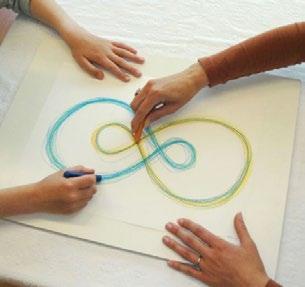
Legacy giving is a far-reaching and meaningful way to support the work of the Society far beyond a person’s current giving capacity. And the magic of this Circle is that it can only continue to grow, no matter which side of the threshold you are on.
Why do people choose to become part of the Legacy Circle? The reasons are as varied as our members themselves. Society member Helvi McClelland offers one perspective: My connection to anthroposophy came through music. As I studied Rudolf Steiner’s ideas, the world began to make sense to me, and as the world made sense, I became more grounded, present, and focused.
So that others might have the same possibility of finding answers to questions about life and purpose, I have made provisions in my will for gifts to support the continued work of the Anthroposophical Society and its related endeavors.
Over the years, legacy gifts have provided an essential stream of support for the Society. Simply put, planned giving offers the opportunity to make a gift that brings expression to our intention and love for anthroposophy into the future. Carolyn Oates, another Legacy Circle member, shares these thoughts:
Anthroposophy has been a source of strength and surety on my life’s path. I am profoundly grateful for the confidence, light, hope and love that has blossomed in me through Rudolf Steiner’s inspired work. It is a privilege to support the Society into the future through a legacy gift to continue the work to uplift individuals and heal communities in a world desperate for peace, healing and hope.
Legacy giving is a meaningful way to support anthroposophy in America, without affecting present income. If you have made estate provisions for the Society already or would like to become a member of the Legacy Circle, please let us know. Email deb@anthroposophy.org for information or visit www.anthroposophy.org/legacy
2017 End of Year Appeal Update
Thank you to all our members and friends who contributed so generously to our end of year appeal. Your support brings anthroposophy into the world today through creative and thought-provoking programs, print and online being human, and so much more. We received more than 300 gifts totaling over $40,000. With your help, we will continue to bring insight, inspiration, and community to all who feel connected to the work for Rudolf Steiner. Thank you for joining with us on this journey.
Deb Abrahams-Dematte (deb@anthroposophy.org) is ASA Director of Development
54 • being human
Living Into the Year Together
Well-attended Webinars, Lively Gatherings!
by Laura Scappaticci
Thank you for an extraordinary year of anthroposophical programming! Beginning with Mary Stewart Adams’ Moon Nodes webinar last January and culminating with a Holy Night’s Journal webinar workshop, nearly 2000 webinar registrants joined us in 2017 to deepen their connection to anthroposophy.
Note from Katherine Thivierge
The 2017 financial statement has been sent to members, as have the 2016 audit highlights. The full audit available on request to katherine@anthroposophy.org and our not-for-profit 990 report is up on the website.
General Council minutes are on the website for members only, to log in and read.
Katherine Thivierge, Director of Operations
From Virginia Sease
Friends have asked how they may stay in contact in view of changes in my work at the Goetheanum. In 2015, after 31 years I withdrew from the Executive Council (Vorstand), however, I continued in the leadership group, the Executive Council and section leaders, with the General Anthroposophical Section and coordination with the Class holders. Now this task is with Paul Mackay.
At our lively fall conference and AGM last October, in Phoenix, Arizona, you connected face-to-face with programs like The Spirit of Money and The Art of Human Becoming biography workshop.

Our festival series, starting with Patrick Kennedy’s Hearts Are Beginning to Have Thoughts Michaelmas webinar, brings the year to life. You can expect to hear from Patrick and others at Easter, St. John’s and Whitsun this spring.
We look forward to seeing you at the Sacred Gateway Conference in Sacramento this April 6-7-8. Please turn to the back of this issue for details along with an article, “Approaching the Sacred Gateway,” by Marianne Dietzel.
And save the dates for the next fall conference and AGM: October 5-6-7, in New Orleans. Keynote speakers will be Joan Sleigh and Orland Bishop.
Finally, as John Beck noted in his editor’s welcome on page 10, please check your email for webinar announcements! If you have email and are not receiving notices from us, either your email address in our files is wrong, or our messages are being directed into your “social” or “promotions” tabs or even the “spam” folder. We do want you to know all the new offerings that are available!
In summer 2017 Andrea Jeserich, my assistant, and I worked through 33 years of accumulated documents, letters, books and so on. All of the relevant documents are now in the Goetheanum Archives. It had been my desire that Dr. Constanza Kaliks should move into my larger office because of her work with the Youth Section, so we exchanged offices. My new office is on the same floor by the North elevator, painted anew in a lovely light pink shade, with the original painting of the Last Supper by Margarita Woloschin. Some amethysts and crystals also found their way. My e-mail remains virginia.sease@goetheanum.ch as does the direct telephone number (0041 61 706 4313).
Andrea Jeserich continues to work with me on a reduced schedule. My work for the Society and First Class continues upon request. My ongoing daily work continues to be with the Anthroposophical Studies in English, a first and a second year with wonderful students from many countries; Joan Sleigh and I share the courses.
It is always a joy to welcome you for longer or shorter visits at the Goetheanum. With many warm greetings and good wishes for your anthroposophical work,
Virginia Sease, PhD
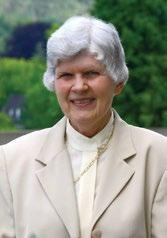
spring issue 2018 • 55
Laura Scappaticci (laura@anthroposophy.org) is the ASA Director of Programs.
Maitreya Branch of North Texas
 by Marianne Fieber-Dhara
The Central Regional Council has unanimously recommended and the General Council approved the recognition of the new Maitreya Branch in North Texas. On Michaelmas Day, 2017 our friends in Dallas/Ft. Worth, Texas received their new branch confirmation. The following is an excerpt from their request for recognition: Anthroposophy has been represented in the area through the years. Impulses regarding Waldorf Education, eurythmy, and to have class readings have been building. We are confident that this area can both support and is in need of anthroposophical initiatives. By forming a firm spiritual core for such initiatives, we hope to provide a basis for our ongoing deepening of anthroposophy and the striving of our members in service to the progressive, upward evolution of humanity... There has been a true spiritual inspiration for the name,
the Maitreya Branch, after that being who, in 3000 years as the Maitreya Buddha, will bear a revitalizing spiritual revelation for humanity according to Rudolf Steiner (lecture of 21 Sept 1911).
In 2012 Tim Mowrey and Chester Davison participated in the Central Region’s annual gathering in Little Rock, Arkansas, representing the Michael Group. This August, Chester Davison and Lisa Dalton joined our event in St. Louis for the Great American Eclipse. This request was signed by twelve members, some very new, of the Anthroposophical Society.


General Council Meeting in Georgia
The ASA General Council and Leadership Team met in Decatur, January 18-21, at the beautiful Anthroposophical Research Center (ARC), and met with a large group of members and friends of the Atlanta Branch at the Atlanta Waldorf School for a potluck dinner and conversation the evening of January 20th. Many thanks to our gracious hosts!

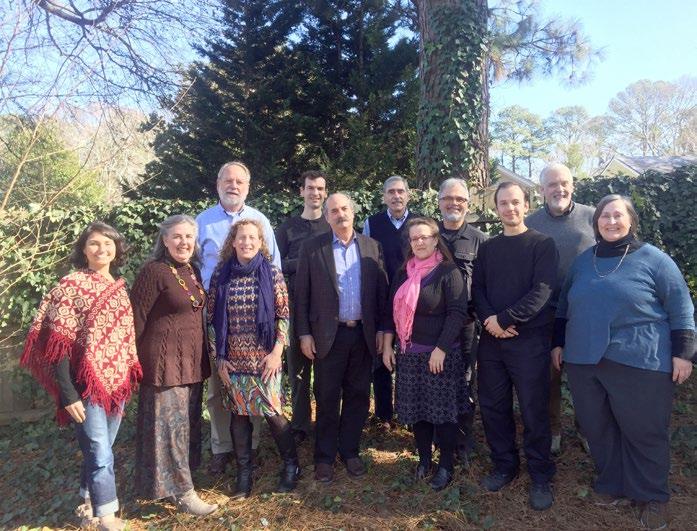
56 • being human
Members Who Have Died
Marion F. Bruce Concord CA died 10/17/2017

Thomas Forman Peterborough NH died 02/08/2018
Portia M. Imle Silver Spring MD died 02/02/2018
Marianne Karnowski Spring Valley NY died 05/30/2017
Anita Lucas New London MN died 08/03/2017
Marianne H. Luedeking Miami FL died 05/27/2017
Ted Mahle Carmichael CA died 12/09/2017
Clifford Monks Carmichael CA died 07/19/2017
Violet Myrvaagnes Winchester MA died 11/15/2017

Charles D. Nelson Ayr ND died 06/20/2017

Anneliese Sinn Peoria IL died 09/24/2017
Michael Stafford Fair Oaks CA died 01/16/2017
Cynthia Biener Trevillion Chicago IL died 10/13/2017
Basil Williams Ghent NY died 07/16/2017
Kundry Willwerth Cortland NY died 06/01/2017
Basil Williams
June 26, 1939--July 16, 2017
by Christiana Williams
Basil Williams was born in middle America, Hope, Michigan, youngest of five sons. Although his mother had a serious health issues, she took the risk to give birth. Since that moment, Basil’s entire being rejoiced with love, gratitude, and enthusiasm for the opportunity to come to this good earth. His early life was on the family’s poor fortyacre farm in Freeland, tending the needs of Earth and her beings. Daily tasks included gardening, chopping wood, caring for the farm animals, and milking the cows by hand.He was born under the sign of Cancer, the sign for “impulse to action.”
Everything about the earth seemed to call for Basil’s love and recognition: land forms, archeological sites, geology, birds, wildlife, trees, smaller plants. He spent hours among the residents of woodland and meadows. He observed, they taught. When his pet owl, two crows, and raccoon were ailing, he responded with compassion but also with a clear plan to do what needed doing. As for his intimate connection with plants, my sister would say, “Give Basil a
stick and he will get it to grow.”
In a small one-room schoolhouse, Basil somehow ignored or slept through basic lessons. In junior high he began to explore art, literature, and his good speaking voice. In high school, biology and natural science stirred longings to be a doctor.
Basil’s parents and my mother were part of a small “Natural Law” group seeking economic and social changes. That link brought us together. When I saw him at the farm, he came riding on his horse. He was the most kind, gentle person I ever met. Within months, Basil proposed, and we married on June 4, 1960. I started teaching English while Basil worked as a microbiologist and completed courses for the B.S. and M.S.
degrees. By 1963 our daughter Linnea was born and son Kirk in 1965.
After years with traditional, “Francis Bacon”-science studies, Basil focused his “can-do” will forces on a medical degree. His first attempt at admission to the local medical school was not successful. He was accepted at the Osteopathic Medical College in Chicago. There he was able to broaden his knowledge with a training that stressed the comprehensive view of the patient as “body, mind,
spring issue 2018 • 57
and spirit.” He learned to use “thinking fingers” in diagnosis and treatment, expanding his innate capacities.
Striving to acquire ever more medical knowledge, Basil chose an Internal Medicine specialty. Then he ventured forth to become a sub-specialist in Infectious Diseases. He used traditional medical protocols but maintained his remarkable underlying ability to diagnose quickly and accurately. He could somehow perceive the “being” of the illness. He was sought in many Detroit area hospitals and the VA to handle acute, difficult cases. He treated veterans for both physical and soul needs. They often said that just his voice was a comfort to them! Basil knew there were many dimensions to healing work; he could enter into their suffering.
After the birth of our third child Lance in 1971, many changes occurred in the family. I discovered the works of Rudolf Steiner in 1975. Basil supported me in finding Waldorf education, anthroposophy, and the Christian Community, but was more focused on his own professional journey. He would find his own way onto this new path. Some time later Basil did experience in a vision a lifechanging opening in consciousness. He knew in a moment the presence of the spiritual world and the reality of Christ: “I knew my life would never be the same again.” Spiritual science studies involved inner and outer work. He was ready. He took classes and attended lectures at the Detroit Waldorf Institute meeting anthroposophical teachers, physicians, and Christian Community priests from the area and from Europe. His non-Christian but intuitive Celtic self made an easy connection with esoteric Christianity.
In 1987, he went to study in Europe to learn more about anthropo -
sophic medicine, the medications, Hauschka massage, and artistic therapies. He attended a pastoral medicine conference at a Camphill in Ireland. All the while, he also enhanced his own gardening work with Steiner’s indications for biodynamic agriculture.


With our move to Harlemville, New York, away from intense traditional-medical hospital responsibilities, Basil was free to take time to listen and to treat patients holistically in our home: “Chrysalis Therapy Center.” He integrated his previous exoteric medical training with the esoteric anthroposophic medical knowledge. He considered touch to be vital in his own work with patients. “One touches heaven when one touches the human body.” (Novalis)
With a warm heart, strong will, and sense of moral responsibility, Basil began to travel more to Europe, Russia, and South America. With his genuine all-inclusive openness, he met and treated people of diverse cultures and world views. He offered anthroposophic medicine, Waldorf education, and biodynamic agriculture, and they shared their perspectives and ways of working with nature. Basil had a favorite quote from Chief Seattle: “We are all connected.” It expressed his own loving gesture with nature and with people.
We lived in the Boston area from 1995 to 2009, hosting anthroposophical events, festivals, and First Class lessons in our home. Basil had a small anthroposophic medical practice at home but also did work at the VA hospital and at the life-sharing House of Peace. On his inward journey, more and more he experienced the central role of Christ in healing work and recognized that rhythms of the Christian festival embodied rhythms of life itself. He began to share this.
Basil developed his way of connecting with nature “intuitively” during his early years with more awakened consciousness and with study, study, study. He said, “For many years I have practiced anthroposophic medicine using healing substances for the illnesses in my patients and I felt the good earth and the elemental world needed those substances as well. When we do not recognize and appreciate nature and the spiritual beings that are part of creation, that is an illness as well. I decided to work with homeopathic and anthroposophic medicines that I use in my practice.” Planting seeds for future harvest was an important task throughout his life. His booklet “Awakening to Festivals,
58 • being human
Basil Williams as friend and doctor with Joseph, House of Peace
Elemental Beings, and Healing Substances” has inspired others.
After we returned to Harlemville, Basil researched and wrote about topics such as autism, allergies, body therapy, lyme disease, and human crises. He stressed the connection between physical-sense-world manifestation and spiritual realities behind the phenomenon. He rejoiced when he met young physicians in his own osteopathic profession who were open and courageous enough to learn subtle and meaningful ways of connecting physical “knowing fingers” with healing supersensible forces. Whatever and whenever Basil acquired new insights from his evolving consciousness he had a strong need to share with others. His enthusiasm and love of life touched the hearts and minds of many people who came to know him as their physician and as a friend.
Basil’s earthly years started with his study of Peterson’s Field Guide to the Birds and ended in his last months with leading a study group with Rudolf Steiner’s lectures about Spiritual Beings in the Heavenly Bodies and in the Kingdoms of Nature
In December 2016 a diagnosis of pancreatic cancer dramatically changed our lives. During the months of the illness Basil welcomed visitors. He engaged in warm, uplifting, profound conversations while sprinkling humor into the seriousness. It reminded me of the easy manner he had with patients during his career. For much of the time he quietly went quite deep within himself to penetrate and review his own path in life. In one conversation with the priest he said, “I haven’t done enough.” He never gave up striving, ever striving, to honor with awake consciousness what is visibly above, below, around us as well as what is supersensible.
Just after Basil’s last breath on July 16, he was free of his body. I looked out of the window. I saw in the front garden two delicate red poppies gently fluttering in the breeze. A golden orange Monarch came, hovered above, then disappeared from sight.
In one lecture, Rudolf Steiner uses the term “super-spatial” for a dimension beyond the usual time and space. I have no doubt we the living and the dead connect in that dimension. Dear life partner Basil: “You are no longer where you were; But you are everywhere we are.” (Victor Hugo)
Kundry Willwerth
April 28, 1932—June 1, 2017
by Gudrun Lillekroken
Kundry was born in Heidelberg, Germany, as the second and youngest child in an upper middle class home. Her sister Christina was two years older. Her father was a doctor and her mother was a nurse who ran the practice out of his home. They were well off enough to have a cook and a nanny, whose job was to take the girls out for long walks during office hours. Kundry and Christina grew up the children of anthroposophists and members of the Christian Community, which was just down the road.

When she was seven years old, World War II broke out. Because she was recovering from tuberculosis, Kundry spent the war years in the country at the farm that the nanny came from, so she was sheltered from what was going on. After the war, she attended a classical gymnasium that taught Latin and Greek; she even did an elective in Hebrew. She then took a year at the Priest seminary of the Christian Community, but ultimately decided against becoming a priest. Her parents wanted her to go to the
University of Heidelberg and study medicine, but Kundry was ready for new adventures and so at age 21 she took off to the University of Missouri.
Because of her mathematics skills she was fast-tracked through college, graduating with a bachelor of arts in 1954. After a road trip in the Northwest with fellow students, she began a Masters in mathematics. Her money began to run out, so she took a job in applied mathematics in Washington DC. There she got a room at the YWCA. The youth group of a local Lutheran church was doing sightseeing tours of the city, and one day Kundry went with one of the other girls at the Y. The young man lead-
ing the tour was named Lyn. He had grown up in Lancaster, Pennsylvania, and learned “Pennsylvania Dutch” from classmates, so he spoke German and a connection was formed. Lyn was active in the Lutheran community and Kundry started going to youth meetings at his house. In 1957 they became engaged and in 1958 they married in Germany.
Kundry and Lyn settled in Auburn, Alabama, where Lyn was pursuing post graduate studies; their first child Gudrun came along in 1959. Lyn then got a job at Kraft National Dairies in Chicago and the young couple moved there. Their second and third children were born in
spring issue 2018 • 59
Chicago: Adam in 1961 and Ilian in 1962. Their fourth child Roland was born in 1973, in Spring Valley.
Meantime Lyn and Kundry were active in the Anthroposophical Society and the Christian Community. Some of my early memories are of them going to the anthroposophical members meetings on Tuesdays while a neighbor baby-sat: basically they left the door open between the two appartments. We were supposed to be in bed, sleeping. I also have memories of going to the Nativity Play at the Christian Community, and of Kundry doing eurythmy with us children in the living room.
The family moved to Sacramento, California, where Kundry got her first teaching job in the Waldorf kindergarden, the start of her life’s work in kindergarden. They moved again a year later to Long Island for Lyn to get his masters in Waldorf Education. The year after they moved again, to Spring Valley, New York; in the kindergarden this time Kundry had her own class. The first thing she did was change everything. Instead of graham crackers and milk for the snacks she cooked soup and baked bread with the children. She got rid of all the toys and used stones, pine cones and pieces of wood as building blocks. She also had some frames built that she would cover with colored cloth to make doll houses. I remember helping her set up the kindergarden before school. She once told me that all children really need is blocks and a sandbox and they will be able to play endlessly. The other kindergarden teachers were scandalized that Kundry was shaking things up, but she had the support of some central faculty members and her way of doing Waldorf kindergarden is now the norm.
The family lived in Spring Valley
nine years, and here Kundry had her first large vegetable garden, and berry bushes. She canned and froze, made jam and syrup and we children all sat around the kitchen table helping while Lyn read aloud to us. When we moved to the farm after the first five years, Kundry continued with a vegetable garden and we were all roped in to help. I have many happy memories of haying with Lyn and Kundry bringing lemonade and scones up to the field for snack.
In 1977 Lyn and Kundry bought the farm on Webb Road in Cortland County. For some years they worked the farm and beside the garden, and pressing cider from the apple trees, Mother processed the milk from their cows, making butter, yogurt and cottage cheese which they sold a farmers market. Kundry continued growing the garden through all their years in Cortland, but after Lyn’s death she started a CSA growing vegetables and berries for herself and five others using biodynamic methods, and inviting the Waldorf school to help make cider each fall.
She also started a small Waldorf kindergarden, Hillside Children’s Garden from which the Waldorf movement in this area was born. Kundry was “famous” in the Waldorf kindergarden world for composing a book of pentatonic songs and another book of circle games, which were part of the curriculum in the Waldorf kindergarden teacher training. In 1992 she became aware of the work of Wilma Ellersiek and began translating these finger and movement games into English to use with the children in her kindergarden. Over the years Kundry gave countless workshops at kindergarden conferences in the US, Germany, even Mexico and Brazil.
Lyn and Kundry also started a
puppet theatre called Magic Garden Puppets. For several years they performed at the Rennaisance Faire in Sterling, New York, at Christmas in the 1890’s house in Cortland, and at the June Ithaca festival.
Kundry made the puppets herself, making faces with great detail and figuring out how to move them realistically. She found creative expression as a true textile artist, creating banners for puppet shows, tapestries for all her grandchildren, and experimenting with quilting tea cozies, felting, making dolls and knitting animals. Her last project was a set of knitted egg warmers made to exactly resemble various breeds of chickens.
Why did Lyn and Kundry move to this area? One reason was that Lyn wanted to farm. Kundry wanted culture. The proximity of the colleges in Cortland and Ithaca meant that there were always concerts and theatre productions to go to. Every time I visited, Lyn and Kundry would look up what concerts or theatre performances we could go to, and typical birthday and Christmas presents were theatre tickets. Music was important in Kundry’s life. During the Spring Valley years she studied the lyre, practicing or having a lesson while our bebe parrot sat on her head or on the lyre frame and plucked at the keys. She also played recorder for many years. When I visited her 2 years ago she got out a book of recorder duets and we played together every day, although I hadn’t played in years and had to relearn the fingering. But singing was perhaps the most important musical expression for Kundry. When I was 10 we had been in Germany for a visit to my grandparents and when we came home, inspired by Kundry’s brotherin-law, we began a morning ritual singing a folk songs in two- or three-
60 • being human
part harmony before breakfast. We also sang on road trips and at Christmas and Advent. And Lyn and Kundry always sang in the community chorus in Spring Valley and very soon after their arrival in this area they began attending the Lutheran Church and singing in the choir as well as the community chorus at Cortland college. Kundry continued to sing until the end. She sang in the choir until early April after which she was too weak. And when the choir came to sing for her the week before she died, she sang along with the chorus from her sick bed.
Personally, what I will miss most will be our conversations about spirituality. We often talked about the books we were reading, about meditation and spirituality in general. I could talk with her in a way that I couldn’t talk with anyone else.

Kundry was not afraid of death. She compared the prospect of dying to how she felt before getting married: excited, and a little scared, knowing
Marion F. Bruce
February 17, 1922—October 17, 2017
Marion was born in Oakland, California, to Guy and Ethel Wallace. She attended Piedmont schools and graduated with a MA of Music from the College of Holy Names in Oakland. She joined the Anthroposophical Society in 1958.

An article in the East Bay Times in 2009 observed that, while “some elders do outlive people close to them and feel isolated in times of need, Marion Bruce of Concord, who turned 87 last week, happily does not have that problem. Lucy and Ekkehardt Keller of Concord are a generation younger than Marion. Like so many others, they treasure her everdeepening friendship. They wrote us about their unsung friend who enjoys the friendship and support of former students from multiple generations.
“After a career teaching music in kindergarten and elementary school, she started teaching music in the early 1980s in the homes of her students. She specialized in the trumpet, piano, violin, cello and guitar. When she had to curtail her driving, she started teaching up to 32 children per week in her own home. She sometimes reduced her fees for children with limited means.
public celebrations, and private parties for many years. Marion recently had cancer and cataract surgery, and now uses a walker to move about safely. She moved into a small assisted living residence where the staff have been surprised at her steady stream of visitors, including many former students.
“When asked why so many have remained so loyal to Marion, Lucy credited her friendliness, patience, and sunny disposition. As the years have passed, Lucy and quite a few of Marion’s students have become closer to Marion as friends. She seems to make that so easy. Although Marion has no children of her own, her ‘followers’ of three junior generations treasure her friendship. They certainly have followed Marion through her difficult transition. As satisfying as her ‘following’ might be, Marion is not completely retiring. She has offered to teach keyboard basics to caregiver staff at her new residence. There is no stopping the spread of music in her heart.”
—Rudolf Steiner, translated by Marianne H. Luedeking 12/22/1919 — 05/27/2017
“On the side, Marion was invited to join an all-male mariachi band in the early 1970s. She enjoyed playing in costume for fiestas,
spring issue 2018 • 61
Here and Now: Transforming Ourselves, Transforming Our World 2018 Fall Conference and AGM New Orleans, October 5-6-7 with Joan Sleigh & Orland Bishop
In
Prayer At Evening Bells Admiring Beauty, Protecting Truth, Honoring Nobleness, Deciding on Goodness: Will lead us humans To aims in life, To dealing with honor, To feeling at peace, To thinking in clarity; And teach us to trust In divine Will In all that exists In the Cosmic World,
the Depth of Soul.
Approaching the Sacred Gateway
by Marianne Dietzel
The conference, The Sacred Gateway: Conscious Living, Conscious Dying, and the Journey Beyond , is an opportunity for anyone caring for loved ones close to the threshold, or wishing to prepare for their own death, to gain knowledge and explore issues. This will be done, not just intellectually, but practically and artistically as well.
Anthroposophy is unique in its relationship to death and dying: it brings a spiritual perspective in a very practical way. It has a history of honoring the first three days after death with a period of quiet in the presence of the deceased, attended to by those who knew and loved them. This practice has become part of a social trend known as “the home funeral movement” in the last few decades. Indeed, many of the pioneers of this movement come from an anthroposophical background.
In this conference, we will be honoring Nancy Poer and her many contributions to this movement (see www.nancyjewelpoer.com/about).
In pre-twentieth century America, before the growth of the funeral industry, families cared for their own dead in their homes. The anthroposophical practice of holding a vigil, however, is based on Rudolf Steiner’s understanding of what happens in the life of the deceased during this three-day period. This is when one’s soul is immersed in viewing a vast panorama of the course of life, seeing the whole picture and what one gave to the world. An atmosphere of peace and stillness, as well as the supporting thoughts of loved ones still on earth, are ideal for this important inner activity at the beginning of a long journey.
The sense of the sacredness when someone has just crossed the threshold may be experienced by those who participate in a home vigil, whatever their background. This gives rise to a common language for anthroposopists to be of service to people of all faiths and life perspectives.
The individuals who have come together to plan this conference with Laura Scappaticci represent a continuation of the legacy of the pioneers in the home funeral movement. They have helped form community groups across the country (along with many others not men-
tioned here) that educate about the choices families have at the end of life, and provide support and resources for families in caring for their own dead. They are Marianne Dietzel and Linda Bergh with The Minnesota Threshold Network (mnthresholdnetwork.wordpress.com) in the Twin Cities; Sandy LaGrega with the Sophia Center for Life Studies (sophiacenterforlifestudies.org ) in Rolesville, North Carolina; Karen Van Vuuren with Natural Transitions (www.naturaltransitions.org ) in Boulder, Colorado; Lynn Stull (www.lynnstull.com), who does her threshold work as an individual eurythmist/author/artist, and Maureen Flannery (whose poems have appeared in previous issues of being human)and Tra-ling Tu, who support families in home-death care in Chicago and Sacramento, respectively.
While these seven will be offering some of their experience and expertise in webinars beforehand or workshops/ presentations at the conference, there are others who have had a voice in creating the unique perspective of this conference. Joan Almon and Dr. Molly McMullen-Laird were involved early in the planning stages, wishing to involve medical doctors and Christian Community priests in the conference. These two spheres of activity have specific contributions to make to the anthroposophical approach to care for the dying. They offer important issues for us to contemplate, and may also add a voice to the public discourse on hospice care and what it means to “die a good death.”
In addition to our keynote speakers and workshop presenters, artistic contributions of poetry, eurythmy, and lyre music will add another dimension to all of our considerations and enhance our feeling for connecting with the dead. We hope that all of these offerings will deepen understanding, diminish fear, and inspire further seeking.
Register for this conference online at: www.anthroposophy.org/sacredgateway
62 • being human
Nancy Jewel Poer
Sacramento Waldorf School, Fair Oaks, CA
April 6, 7, 8, 2018
Conscious Living, Conscious Dying, and the Journey Beyond
4 Bring a new consciousness to your own life and death
4 Support those who are crossing and who have crossed over
4 Expand your practice and knowledge of working with the dying
Interactive workshops and artistic activities throughout Keynote discussions with Dennis Klocek and Sanford Miller
Hear from Nancy Poer, natural death care pioneer, as we honor her years of work in the field.
Workshops include:
• Hands-on-Body Care with Heidi Boucher
• Preparing for Conscious Dying with Linda Bergh & Sandra La Grega
• The Needs of the Dying with Alexandra Attie
• The Home Vigil with Tra Ling Tu
• The Stories and Special Challenges of Sudden Death with Marianne and Dennis Dietzel
• Help In Dying From the Other Side with Rev. Sanford Miller & Rev. Craig Wiggins
• The Soul’s Journey between Death and Rebirth with Brian Gray
• Co-Creating with Loved Ones Across the Threshold with Lynn Stull
• Connecting With Our Loved Ones Through Nature and Art with Marianne Dietzel and Linda Bergh

• A Doctor and His Patient with Dr. David Gershan
Spaces are filling quickly! Register now! www.anthroposophy.org/sacredgateway
CORDIALLY INVITES YOU TO ATTEND
$190 Standard Registration. Scholarships available.

Anthroposophical in America Society The Sacramento Waldorf School, Fair Oaks, CA April 6, 7, 8, 2018 Register now at: www.anthroposophy.org/sacredgateway
