being human
personal and cultural renewal in the 21st century

A Mighty Experience of Steiner’s Mystery Dramas – page 12
A Thread of Light — Rememering Paul Scharff , page 36, 55
Anthroposophy & the Ecozoic – page 28
Johannes Kühl of the Natural Science Section – page 42
“And the World Became a Riddle...” byJon McAlice, page 40
Spiritual Resistance – page 47 a quarterly publication of the Anthroposophical Society in America
21st Century Eugenics, by Andrew Linnell, page 28
anthroposophy.org
fall-winter issue 2014-2015
Inspiring Waldorf Teacher Education

Since 1967
Low-Residency
Elementary & Early Childhood
Waldorf Teacher Programs

• Professional Development Courses & Workshops
• Introductory Experiences & Waldorf Weekends NOW REGISTERING / ENROLLING
The New York Branch of the Anthroposophical Society in America
138 West 15th Street, NY, NY 10011 — (212) 242- 8945
—NY Open Center co-founder Ralph White on Rudolf Steiner

Now open: Sun-Mon-Tue-Wed, 1-5pm, Thu 10am-5pm, Fri-Sat 10am-8pm
WORKSHOPS TALKS
CLASSES STUDY GROUPS
FESTIVALS EVENTS EXHIBITS
visual arts
eurythmy
music
drama & poetry
Waldorf education
self-development
spirituality
esoteric research
evolution of consciousness
health & therapies
Biodynamic farming
social action economics

ANTHROPOSOPHY & YOGA
David Taulbee Anderson, Wed 7pm, 12/10, 1/21, 2/11, 3/11

WATERCOLOR/COLLAGE ART BOOK Workshop with Karl Lorenzen, Sat 12/13 2-5pm
MONTHLY EURYTHMY with Linda Larson, Mon 7pm, 12/15, 1/12, 2/9, 3/9
LUST, LUCIFER, ABUSE: WORKSHOP with Lisa Romero, Saturday December 20, 2-9pm
THE HOLY NIGHTS & EPIPHANY
7pm from 12/26 to 1/6, with a Sun 4pm potluck

LISA ROMERO, TALK ON BIOGRAPHY

Thursday, Jan 15, 7pm
HENRY JAMES’ WASHINGTON SQUARE
Fern Sloan & Ted Pugh of The Actors Ensemble: Feb 21-22-23: Sat 7:30pm, Sun 2pm, Mon 7:30pm
DR. JAMES DYSON, Talk TBD, 3/12 Th 7pm
world & ‘outsider’ art
www.sunbridge.edu
STEINER BOOKSTORE REGULAR PROGRAMS & ACTIVITIES ANTHROPOSOPHY NYC
UPCOMING EVENTS & OFFERINGS RUDOLF
“The most impressive holistic legacy of the 20th century...”
www. asnyc .org centerpoint gallery
therapeutic,
spiritual,
For a complete course listing visit www.centerforanthroposophy.org
Summer Programs Located in beautiful Wilton, New Hampshire 603-654-2566 info@centerforanthroposophy.org

Waldorf High School Teacher Education Program
Douglas Gerwin, Program Chair
A graduate-level summers program leading to a Waldorf high school teaching certificate in:
Arts/Art History –– English –– History –– Life Sciences
Mathematics –– Pedagogical Eurythmy –– Physical Sciences
June 28 - July 25, 2015
Foundation Studies in Anthroposophy and the Arts
Barbara Richardson, Coordinator
Basic anthroposophical principles and artistic exercises that lay the groundwork for becoming a Waldorf teacher. Individually mentored studies available.
Part-time clusters offered in 2014-15 (dates vary by location):
Year One: Anchorage AK, Gainesville FL, Phoenix AZ, Denver CO
Year Two: Atlanta GA, Cincinnati OH, Freeport ME, Shelburne VT
Renewal Courses
Karine Munk Finser, Coordinator

Two weeks of five-day retreats for Waldorf teachers and other professionals seeking personal rejuvenation and social renewal through anthroposophical study, artistic immersion, good food, and fun.
Week I: June 21-26, 2015
with Christof Wiechert, Janene Ping, & others
Week II: June 28 - July 3, 2015 with Michaela Gloeckler, Michael D’Aleo,
Interest for Fall 2015 being shown in Nashville TN, Baltimore MD, Lexington MA & others
STEINERBOOKS SPIRITUAL RESEARCH SEMINAR 2015
“ RUDOLF STEINER & THE WOMEN WHO WORKED WITH HIM ”
Marie Steiner | Mathilde Scholl | Edith Maryon | Ita Wegman
Johanna von Keyserlinck | Elizabeth Vreede | Lily Kolisko
March 20–21, 2015 | Kimmel Center, New York University, 60 Washington Square South, New York City
To celebrate his new multivolume biography of Rudolf Steiner, PETER SELG will give three lectures on significant aspects Rudolf Steiner’s spiritual biography and work.
RAHEL KERN, author of Kindly the Word: The Karmic Background of Marie Steiner-von Sivers, will address little known aspects of Marie Steiner’s life.
CHRISTOPHER BAMFORD will speak about the lives and work of six “esoteric students” of Rudolf Steiner: a mystic, an artist, a spiritual researcher, a mathematician, a physician, and a scientist

The seminar begins
Friday evening and continues throughout the day and evening on Saturday.
Early paid registration
$175
(after January 1, $200) lunch and snacks provided
watch for the brochure and visit our website in december for more details steinerbooks.org | email seminar @ steinerbooks.org | phone 413 528 8233 ext. 2
Christ in a New Way
The Christian Community is a worldwide movement for religious renewal that seeks to open the path to the living, healing presence of Christ in the age of the free individual.

All who come will find a community striving to cultivate an environment of free inquiry in harmony with deep devotion.
Learn more at www.thechristiancommunity.org

Find
Part-Time & Full-Time Training Bachelor of Arts Degree Option Educational Training Public Courses and More Eurythmy Spring Valley 260 Hungry Hollow Road, Chestnut Ridge, NY 10977 845-352-5020, ext. 13 info@eurythmy.org www.eurythmy.org Consider a profession in the Art of Eurythmy, the stunning movement art that supports Study Eurythmy at Eurythmy Spring Valley Healthy development in the child The inner work of the adult Therapeutic steps toward wellness
Marcus Knausenberger
12 initiative!
12 A Mighty Experience of Steiner’s Mystery Dramas, by Lori Barian
13 Steiner’s Dramas: Why Do They Matter, by John Beck
15 The Mystery Drama Conference: Personal Impressions, by Virginia Sease
18 Capesius: Inner Development, Healing, and Gentleness, by David Andrew Schwartz
24 North American Speech Artists Convene, by Helen Lubin
25 Threefold Auditorium Excavation News
25 Individual Experience and the Consciousness Soul, by Adam Blanning
26 A Camphill Youth Conference Overview, by Haleh Wilson
27 Update: Inner Fire, Inc., by Beatrice Birch
28 arts & ideas
28 Anthroposophy & the Ecozoic, by Eve Olive
31 Intuition: Play & Interplay, by Jaimen McMillan
31 Gallery: Sculpting Light, paintings by Victoria Temple

37 The Light-Filled Etheric Tone of the Lyre, by Chiaki Uchiyama
38 What’s in the Wind, by Helen Lubin
39 The Scholarly Steiner, by David W. Wood
42 research & reviews
42 Interview: Johannes Kühl of the Natural Science Section, by Robert McKay
47 Peter Selg’s Spiritual Resistance, review by Bruce Donehower
49 Nick Thomas’s Freedom Through Love, a review by Sara Ciborski
50 Anthroposophy in the Light of Goethe’s Faust, a review Herbert O. Hagens
52 Can You Have a Tumor in Your Feeling Life, by Adam Blanning
53 news for members & friends
53 From the Annual General Meeting: Welcome by Torin Finser
53 General Council Reports: Dennis Dietzel, Torin Finser, John Michael
55 Western Region Report: Joan Treadaway 56 Introducing Rebecca Soloway
57 Central Region Online
57 General Secretary Visits
57 Program Report, by Marian León
58 Connecting with Community, by Deb Abrahams-Dematte
59 Reflections from the Group & Branch Retreat, by Elizabeth Roosevelt
61 Renovations at the New York Branch, by Daniel Mackenzie
62 Goetheanum Leadership: Virginia Sease, Constanza Kaliks
62 Sergei O. Prokofieff, by Justus Wittich
63 John Gower Root, Sr., 1925–2104, by Rev. Liza Joy Marcato
66 Nancy Mitchell Root, 1924–2104, by Rev. Liza Joy Marcato
68
Gustave William Frouws, 1926–2104
69 To the memory of Ben and Estelle Emmett, by Patrick Wakeford-Evans
70 Members Who Have Died – New Members
71 Three poems by John Reinhart
Contents
Gallery: Sculpting Light paintings by Victoria Temple page 31
The Anthroposophical Society in America
General Council Members
Torin Finser (General Secretary)
Virginia McWilliam (at large)
Carla Beebe Comey (at large)
John Michael (at large, Treasurer)
Dennis Dietzel (Central Region, Chair)
Joan Treadaway (Western Region)
Marian León, Director of Programs
Deb Abrahams-Dematte, Director of Development
being human
is published four times a year by the Anthroposophical Society in America
1923 Geddes Avenue
Ann Arbor, MI 48104-1797
Tel. 734.662.9355
Fax 734.662.1727
www.anthroposophy.org
Editor: John H. Beck
Associate Editors:
Fred Dennehy, Elaine Upton
Design and layout: John Beck, Ella
Lapointe, Seiko Semones (S2 Design)
Cover image: Victoria Temple
Please send submissions, questions, and comments to: editor@anthroposophy.org or to the postal address above, for our Spring 2015 issue by 1/10/2015.
©2014 The Anthroposophical Society in America. Responsibility for the content of articles is the authors’.


from the editors
In this issue we have very extensive reports on an event from this past August, “Rudolf Steiner’s Four Mystery Dramas: A Festival and Performance.” Unavoidably these works appear very specialized and esoteric, but they are actually speaking very directly to the human condition today.
These four lengthy plays were first performed in August of 1910-1913, in what might be called the last hours of the (self-satisfied) innocence of modern European civilization. In August 1914 when a fifth play (of seven) was planned, the part of humanity that considered itself advanced—and was indeed carrying important steps for human development—turned back to old group loyalties and animosities and betrayed its own aspirations.
The plays are by contrast uneventful on the surface. Underneath, however, a drama unfolds of individual development which is profounder and more essential than the battlefields and prison-camps and displacements of people which loom large across the 20th century. To the anguished cry of modern times, “Doesn’t my life mean anything?” these plays answer concretely: “Yes, your life if full of meaning, if you have an open mind and the will to see it.”
Steiner’s mystery dramas were created as community theater, and indeed they formed the scattered students and admirers of his spiritual-humanist research into a movement. They inspired the building of the Goetheanum, where they are performed regularly in German, and they wove in new artistic gestures in speech, movement, and lighting. What was brilliant about this past summer’s festival is that the performances were in English, with a single cast, and they rose to a very high artistic level in every aspect. This meant that English speakers could at last see very directly how significant it is for us to study, to ponder, to strive in art and science and cultural insights—and to do this in often-difficult relationship to other human beings. We are on stage here. The usually invisible beings who accompany us in all this—soul forces, nature spirits, the human dead, the double, the spirit beings split off and left behind in our own life course, and of course the great testers and deceivers and opponents of human earthly evolution—are quite visible on stage beside us. And the characters are ordinary persons who have moved beyond doubt to enter into relationship with their own and humanity’s higher existence. How such an event will come about again remains unclear, but it was, as everyone agreed, a miracle for it to happen this once. So we know that miracles happen. Barbara Renold and many others simply accepted impossibility and moved forward toward what ought to happen. And it did.
2
There is a great deal more in the issue. Our second “Gallery” and the cover are both the work of Victoria Temple. Science gets some welcome attention with an interview with Johannes Kühl, leader of the Natural Science
HOW TO receive being human, contribute
Copies of being human are free to members of the Anthroposophical Society in America (visit anthroposophy.org/membership.html or call 734.662.9355).
Sample copies are also sent to friends who contact us at the address below. To contribute articles or art please email editor@anthroposophy.org or write Editor, 1923 Geddes Avenue, Ann Arbor, MI 48104.
6 • being human
Section at the Goetheanum. Reports from the annual conference and general meeting bring us a sense of the forward progress of the Anthroposophical Society in America, something which is very important to the whole movement. Eve Olive shows us how to make common cause with “other human beings of like goals” in her remarks to a gathering interested in Father Thomas Berry. Adam Blanning reports on how mistletoe therapy is getting new attention in cancer treatment. Jaimen McMillan brings his huge experience as a movement artist and teacher toward the challenge of experiencing intuition. 2
Elaine Upton joined our team earlier this year as a volunteer editor helping Fred Dennehy with book reviews which continue the fine tradition of the Rudolf Steiner Library Newsletter. Also, her “Three Poems” graced our predecessor, Evolving News, in spring 2010. Elaine has taught subjects including Shakespeare and African-American and African diasporan literature in colleges and universities, and taught literature part-time in two Waldorf Schools, one in Santa Fe, one in South Africa. She lived and worked with disabled children in Germany. Now retired (perhaps), she is writing a collection of poems, and translating Christian Morgenstern, as well as Rilke. We are grateful for her able assistance!
John Beck
In this issue we present three reviews of widely diverse publications united under the common theme of anthroposophy.

Bruce Donehower reviews the companion books by Peter Selg, Spiritual Resistance: Ita Wegman 1933-1935 and The Last Three Years: Ita Wegman in Ascona 1940-1943. As Mr. Donehower observes, these books are not only about Ita Wegman personally, but about the challenge to the Anthroposophical Society posed by national socialism and Adolf Hitler from 1933 forward, a challenge that presented itself very shortly after Rudolf Steiner’s death and was not met well by the Society.
Sara Ciborski reviews Nick Thomas’s Freedom in Love: The Search for Meaning in Life: Rudolf Steiner’s Philosophy of Freedom , a “recasting” of Steiner’s seminal “philosophy of freedom” with a viewpoint based not upon abstractions or metaquestions of philosophy, but the ordinary experiences of daily life.
Finally, Herbert O. Hagens reviews “Anthroposophy in the Light of Goethe’s Faust,” by Rudolf Steiner. Steiner’s lectures on Faust reveal Steiner’s interpretation of Goethe’s monumental work as a spiritual threshold experience, and reveal deeper insights into a variety of fundamental anthroposophical themes.
Hand Crafted in the USA
Indigenous Biodynamic Herbs
Live Enzymes
Live Vitamins & Amino Acids
Live Essential Fatty Acids
Fresh Cold Pressed Oils
Essential Oils
Organic Beauty and Wellness for the Skin
Call or Email for a Free Sample
Frederick Dennehy
Not only paraben free... completely chemical free… 100% free of animal testing www.starflower.com 941-554-4292 star@starflower.com A Green Company in business since 1994 The Skin Care Company
being human digest
This digest offers brief notes, news, and ideas from a range of holistic and human-centered initiatives. E-mail editor@anthroposophy.org or write to “Editor, 1923 Geddes Avenue, Ann Arbor, MI, 48104.”
WALDORF EDUCATION
More attention for tech restraint...
It’s now the Seattle Waldorf High School that’s getting attention for its restraint in rolling-out high tech for students. A Seattle Times column from late August begins provocatively, “It’s almost too fitting that if you look for the computers at Seattle Waldorf School’s new high school campus at Magnuson Park, you’ll find them in a room once used for munitions storage.” As with previous press coverage, the school represented its approach convincingly. “They weren’t warriors against tech, it turned out. Just surprisingly confident defenders of what kids at certain stages can and can’t handle. Kids get no benefit from using any computer device before the age of 12, Waldorf educators believe. Period.” In fact, “Head of School Tracy Bennett and pedagogical coordinator Lisa Ayrault... beamed brightest when they showed me two rooms in the new building: an airy art studio with a view of Lake Washington and a first-floor performance studio, where students play no traditional sports but practice a movement art called eurythmy.” Reporter Monica Guzman wasn’t wholly convinced, but the Waldorf alternative made its case.
Link (shortened): http://goo.gl/D71O0N
The ad-man who kept his kids from television
Paul Margulies was famous in the advertising world, but his heart was in anthroposophy. His even more famous actress daughter Julianna Margulies has written a lovely reminiscence which is flying around the internet and is elegantly present in Ad Week. “My father always thought it was ironic that people swooned when they found out that he was the genius behind the famous ad campaign for Alka Seltzer [“Plop, plop, fizz, fizz...” and “I can’t believe I ate the whole thing!”]. I grew up not really understanding his fame in the advertising world because he never allowed us to watch television... This is not to say that my father looked

down on his life in advertising; he knew he had a talent for it, I would say a great talent, but I’m just a gloating daughter. But he constantly struggled to enrich his inner life while working in an industry that was only skin deep. At times that was frustrating for him; but at other times he really enjoyed it. However, it wasn’t who he was. It wasn’t where he wanted to be. He always told me that his dream was to retire to the countryside, somewhere in New England, just to be left alone with his books and his study groups. And he did just that at the young age of 50, and embarked fully on a life long dream.” The somewhere was Great Barrington, Massachusetts, part of an extended community reaching through Harlemville, NY and over to the Hudson River. When Paul passed on October 7th, he was 79. And if Julianna wrote a beautiful article for his passing, he had written a beautiful book for her when she was six, What Julianna Could See, illustrated by family friend Famke Zonneveld. You’ll find it in many Waldorf or Steiner bookstores.
Links: http://goo.gl/7mBwXX (Ad Week)
http://goo.gl/nVCO3d (What Julianna Could See)


FARMING – ENVIRONMENT Farms are wonderful schools
At the Biodynamic Association’s blog there’s another fine “paradox,” on the order of “no iPads in kindergartens.” It’s “the school that supports the farmer that wants to grow soil where there was a parking lot.” Or as the blog puts it, “It takes a special kind of community to support
8 • being human
s o p h i a s h e a r t h . o r g 7 0 0 C O U RT S T , K E E N E , N H 0 3 4 3 1 T h e t e a c h e r o f t o d ay n e e d s c o u r a g e , c l a r i t y, w a r m t h o f h e a r t , a n d a fi r m ly g r o u n d e d c o nv i c t i o n t h a t t h e wo r l d i s g o o d . J o i n u s i n a wo r k s h o p o r o u r S u m m e r I n s t i t u t e t h a t yo u c a n b e t t e r t e n d t h e b e a u t i f u l g a r d e n t h a t i s t h e f a m i ly.
The Early Childhood Professional Development Center at Sophia’s Hear th
being human digest
a farmer who wants to take an acre-and-a-half, road-base parking lot and nurture it into an urban farm with biodynamics. At Mountain Song Community School, a public charter school that follows Waldorf methods in Colorado Springs, Colorado, such a community exists.” Ok, but growing soil? “To do that, we started our first year with sixty straw bales, sprayed them with Demeter-certified nutrients from Progress Earth, and grew a small amount of produce directly in those bales. Come December, that used straw was the base for our fifteen-foot-diameter by seven-foot-tall compost windrow. The other main contributor was compost from our all-organic food program, layered with the used bedding and animal manure from our chickens, rabbits, and goats. That pile had the biodynamic preparations inserted into it this May, was turned the end of June, and will be used in September.”
Schools and farms can be the best of friends, and what is now a dynamic collection of initiatives, the Hawthorne Valley Association, started from that awareness. “The idea was to buy a farm and offer children from urban centers a hands-on experience of what it means to be stewards of the land. That autumn, in 1972, the first class of visiting students from the Rudolf Steiner School in New York City took the 2-hour trip North to Harlemville and set to work transforming the main farm house into a bunkhouse (the Visiting Students Program continues today and has hosted more than 13,000 children). Many of our local neighbors who were here to witness this nascent initiative still refer to Hawthorne Valley as ‘the farm school.’ These founding impulses—sensitive land stewardship, healthy child development in connection with nature, and provision of nutritious food—continue to guide our work today.” Well, from school to farm, and from there no doubt you will end up in the arts!
Links: biodynamicsbda.wordpress.com
mountainsongschool.com
hawthornevalleyfarm.org/about/history-philosophy/
THE ARTS Farm Art Show—in New York City
New York City is not known for its farms, but farmers’ markets are very popular, the most visible one being in Manhattan’s Union Square. Hawthorne Valley Farm (mentioned above) has long been a prominent participant despite that two-hour drive down to the city. Produce, baked goods, cheeses and dairy products (“What’s
quark?”) and other healthy goodness come right to the heart of the city of glass and concrete.
But along with education and farming, arts have been central to the Hawthorne Valley community. That, too, reached NYC recently with an exhibit at the downtown LaMama LaGaleria arts center. “The art show is a mixed-media exhibition of works inspired by life on Hawthorne Valley’s 400-acre Biodynamic farm in rural Columbia County, NY. The show highlights the works of critically-acclaimed artists alongside budding young talent and features a diversity of styles tied together by the themes of agriculture, art, and place. Many have been long-time residents of Columbia County and Hawthorne Valley community members. Participating artists include Pamela Dalton, Dan Devine, Leif Garbisch, Jill Jakimetz, Harry Lazare, Thomas Locker, Abe Madey, Shelia Mahut, Jason Middlebrook, Martina Müller, Patrick Stolfo, Lawre Stone, Laura Summer, Helen Suter and the Hawthorne Valley Waldorf School Class of 2017. The student work features twelve individual panels that combine to create the scene of a calf.” The Artists’ Reception included Hawthorne Valley Farm products.
Link (shortened): http://goo.gl/RTqj56
BIODYNAMICS is a holistic approach to agriculture, food production and nutrition that brings health and vitality to the soil, plants, animals and humanity. Join the gardeners and farmers who are using biodynamics to turn their land, whatever its size, into a work of art, overflowing with life forces, diversity and vitality.

fall-winter issue 2014-2015 • 9
us in Rethinking
www.biodynamics.com Join
Agriculture
being human digest


SOCIETY Reflections on Inequality

As Senior Director of Organizational Culture at RSF Social Finance, John Bloom has a full-time concern with non-monetary values as well as monetary ones. In RSF’s Reimagine Money Blog he recently took on the vexing question of inequality. It’s worth reading in full, but here are key notes he sounded, beginning this way: There are only so many ways to describe the widening gap between the wealthy and the poor. No one seems to disagree that the gap exists, and no one seems to question that the defining element of it is money and all that accrues to it. Also no question, the whole financial resource terrain looks and feels quite different depending upon where one stands in it with material assets, a belief system, or philosophical worldview. If one views the wealth gap as a problem, it is clear there is no simple fix. If I have already lost you, here is a radical counterimagination: What if one were to consider love as the defining element of wealth, and further “account” for how much we need and experience the supporting flow of it? This wealth gap might look quite different than the monetary one. So it is important and central to my purpose to determine what problem is worth solving if the intention is one of peace and shared earth. And further on:
I would argue that inequality represents a spiritual or moral crisis, which reaches beyond class, beyond political boundaries, beyond identity, beyond the behavior of any individual, though this is where change can start. This crisis is not about the possession or dispossession of material resources—these are no more than indica-
tors, byproducts or painful reminders of a deeper systemic issue. Wealth is a natural phenomenon; it is the result of economic activity. How that wealth is treated, used, or owned is another matter that bespeaks the state of human nature. From this perspective, when we value money and accumulated wealth more than people and nature, the central issue is dehumanization from both inner and outer dimensions. When someone self-determines or is told implicitly or explicitly that they are less valuable than another because they have less money, then they have to live with a view of self that is distorted by the assumptions behind it and which tends to devalue the gifts and capacities each individual brings into the world. This is the sacrifice we seem to be making at the altar of wealth as defined within the mainstream materialist paradigm. ...
If you are running a competitive race you want to see increasing distance from those behind you. Your chances of winning increase with every inch of separation. If, on the other hand, you are trying to build a house together, appropriate skills contributed, close communication, and interdependent progress are critical. No one wins, and the house stands as testament to collaborative effort. The polarity here is defined on one end by the rule of the individual (or competitive team), and on the other the rule of collaborative intention. By extension, the ends of these approaches point to radically differing and seemingly irreconcilable worldviews—survival of the fittest, or sustainability of the whole. This tension is pretty alive in the world right now, and the reconciliatory conversation, while rumbling in the underground, is rarely to be had where broad-scale change can be enabled.
Link:

rsfsocialfinance.org/2014/10/reflections-inequality/

10 • being human What’s new from WECAN Books? Resources for working with children from birth to age nine and beyond store.waldorfearlychildhood.org 285 Hungry Hollow Rd, Spring Valley, NY 10977 845-352-1590 info@waldorfearlychildhood.org www.waldorfearlychildhood.org
being human digest
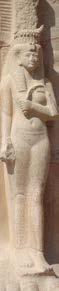
ODYSSEY to EGYPT
December 20th 2015 - January 3rd 2016
Come with us, visit the sacred places of this ancient civilization and its Mysteries!

We will visit many of the famous and not-so-famous sites: The Sphinx and the Pyramids of Giza The tombs of the Valley of the Kings
The great Temples of Luxor, Karnak, Dendera, and more

Visit the anthroposophically-inspired community of Sekem
Cruise the Nile in a traditional dahibiya sailboat
With informal talks and eurythmy
Please have no fear to visit Egypt at this historic moment!
For details, please contact Gillian: 610 469 0864 gillianschoemaker@gmail.com
Join us as we trace threads of spiritual history in the landscape and soul-scape of Scotland with story, song, eurythmy and informal talks.. Visit the stone circles of the Outer Hebrides and Orkney Islands, the glens and mountains of the Highlands, the sacred island of Iona, the spiritual community of Findhorn, historic Edinburgh, castles, rainbows, and much more.

Tour leaders are native Scots: Gillian Schoemaker, eurythmist, and Sean Gordon, Celtic scholar, storyteller and Waldorf teacher
SCOTTISH ODYSSEY
July 17th – August 8th, 2015
Interested? For details of itinerary and cost, please contact Gillian: 610 469 0864 gillianschoemaker@gmail.com
fall-winter issue 2014-2015 • 11
IN THIS SECTION:
We began a discussion of Rudolf Steiner’s Mystery Dramas in the editor’s note on page 6. The following pages give several different reports on the extraordinary festival which presented them so ably last August at the Threefold community in Chestnut Ridge, NY. Lori Barian opens with an overview of reactions to the experience, Virginia Sease (one of a number of guests from overseas) gives a thorough review and reaction, and we are able to share one of the lectures in full, David Schwartz’s talk on the character Capesius and the significant quality of “gentleness.” The festival was a very special event for speech artists, and Helen Lubin reports on their presence and shares a passage from the first play that was a motto for the whole experience. Short updates from several other initiatives complete the section.
A Mighty Experience of Steiner’s Mystery Dramas
 by Lori Barian
A magical festival mood united three hundred fifty people from across the United States and Canada, Australia, New Zealand, and Europe during “Rudolf Steiner’s Four Mystery Dramas — A Festival & Conference, August 8-17, 2014, at Threefold Educational Center in Chestnut Ridge, New York.
The nine-day event gracefully wove the day-long plays with alternating days featuring lectures, artistic workshops, and conversation groups, plus a comedy night and a day off, into a satisfying whole. The breathing rhythm helped participants experience and understand the plays and their significance to their own lives and to the anthroposophical movement while giving everyone space and time for cultivating and renewing friendships.
This huge feat was made possible through the inspiration and leadership of director Barbara Renold and the leadership and collaboration of the staff of the Threefold Educational Foundation and the Anthroposophical Society in America, as well as the many actors and stage hands, conference organizers, lecturers, and workshop and conversation group facilitators.
“A mighty experience.”
Cheryl Martine, Lincolnville, ME

“An initiation.”
Robert Enno, Austin, TX
“A pilgrimage to the source.”
Rachel Pomeroy, Hawkes Bay, New Zealand
“Transformative.”
Albert Spekman, Bronx, NY
“Cathartic.”
Else Wolf, Glenmoore, PA
“Anthroposophical Woodstock.”
Stephen Usher, Austin, TX
“It’s a miracle,” Barbara Renold said to everyone present, “and you’re part of it.” It was also the first time that all four of Rudolf Steiner’s mystery dramas have ever been per-
12 • being human initiative!
Barbara Renold
Johannes listens to others’ conversations after a spiritual lecture; opening scene of the first play. — All mystery drama photos courtesy of Threefold Educational Center.
formed consecutively in one place by the same cast and crew in English. Many people noted the fertile ground of the Chestnut Ridge-Spring Valley community in which this could happen, led by the Threefold Educational Center and featuring Green Meadow Waldorf School, Eurythmy Spring Valley, the Rudolf Steiner Fellowship Community, Sunbridge Institute, The Pfeiffer Center, the Waldorf Early Childhood Association of North America, the Otto Specht School, the Seminary of the Christian Community and more, this community had nurtured the mystery drama impulse for years.
Virginia Sease, Executive Council member who attended from the Goetheanum, reminded participants that thirty-three years ago the whole Executive Council came to Spring Valley and met with 700 society members. That important event planted a seed that has been tended. Stephen Usher, one of the lecturers and conference organizers, spoke a number of times about the importance to the life and cultivation of anthroposophy that the plays be performed and seen. This event was a milestone for the Anthroposophical Society in America, and for the anthroposophical movement worldwide.
“These incredible works of art are an entirely new impulse in the history of human drama,” Barbara Renold said. “They are as significant as the Greek tragedies, as Shakespeare’s plays. These are the next step…” Barbara herself was recognized for her boldness and initiative to bring all four plays to life; even she thought it was a “crazy” idea at first. “There’s always a forerunner at the turning points of time when something new is coming into the world,” said actor Laurie Portocarrero, who portrayed Maria through all four plays, when introducing Barbara on the final Sunday.
Festival Mood & Community Building
A festival mood surrounding, protecteding, and blessing the event was noticed by many participants and the organizers. “Festivals are very important for community life,” said lecturer and conference organizer David Schwartz on the final Sunday, recalling statements Karl Koenig made about the Michaelmas Festivals. “There is something that happens only in a festival. People become softer, like beeswax, so the spiritual world can press in with its “seal.” By setting aside nine days of their life to immerse themselves in the experience of the dramas and the surrounding lectures and activities, participants created inner space and time for personal growth and interpersonal connections.
Steiner’s Dramas: Why Do They Matter?
by John Beck
The August Mystery Drama Festival at Threefold was a profound experience for all who participated. In what ways can it matter to the world at large?
Rudolf Steiner’s perspective on the human story was as large as anyone’s who has lived, and he gave to these odd, long plays a large amount of his time for more than four years. Anciently we were told of being made in “the image and likeness” of cosmic creators, and dramas out of the ancient mysteries like Oedipus the King showed us, in beauty and ritual, deep truths about that relationship. There are a few mystery dramas of modern times: Goethe’s Faust and in Shakespeare’s canon A Midsummer Night’s Dream and King Lear, Hamlet and The Tempest. Wagner’s Ring Cycle was meant to awaken myth, and Mahler’s “Resurrection Symphony” raises life’s tragedy to spiritual triumph.
Superficially, however, Steiner’s plays are less heroic. Johannes is not an appealing figure, truth be told. Maria is struggling at the start with how her devotion to a spiritual path is killing her relationships. And little in the way of drama in the usual sense happens on Steiner’s stage. These plays of the early 20th century may belong already to minimalist and existentialist art.
In minimalist music (Steve Reich, Philip Glass), giving up dynamics and seductive melodies can put the audience to sleep—or awaken it to deeper questions. Rudolf Steiner’s questions are of ultimate depth. From an ancient Egyptian woman’s love for a man who is abandoning her he draws out the essential drama of human individuality, of our becoming—in relationship with others—conscious actors in evolving worlds. We sense a higher human selfhood that seeks, life after life and day after day, a chance to grow. We come to appreciate that a great healing of cultural life may begin humbly, pouring our hearts into community theater.
This Festival’s community theater reached a level of sustained excellence: drama as art was fully served. If these plays had already lived for you, they reached a higher octave of active meaning. And both on stage and off, there glimmered a quiet inner heroism and inspiration, in and behind each human being’s life.
fall-winter issue 2014-2015 • 13
Franz Eilers portrayed Felix Balde and his various incarnations and helped organize and carry the conference. He described in the atmosphere of the event the central gesture of Rudolf Steiner’s sculpture, “the representative of man.” As he raised his arms to imitate the gesture, he talked about the inner space created as well as the activity of moving forward into the world to meet another person. “When we provide a space in ourselves for our own true being, there is an atmosphere, and when two people meet, that atmosphere creates the ground for their meeting. And that is the ground for the future of the Anthroposophical Society.” More than how many schools or farms there are, he said, “I am interested in creating the space with you and everyone else so that the future comes out of us. It is us. It is that activity, that ground, that is the future of the anthroposophical movement.”
Joan Sleigh, newest member of the Executive Council at the Goetheanum and originally from South Africa, brought a number of these themes together when she spoke, also on the final Sunday. “Through the dramas one can have a strong sense of our interconnectedness—how we as human beings and the spiritual beings are interrelated—and of the complexity of destinies, our karmic knots, and the detours people have to go through.
“We know the contents of the dramas are the content of the School for Spiritual Science. We know the Goetheanum is the home of the mystery dramas and the School. We’ve had a small ‘Goetheanum experience’ here. Can we see ‘Goetheanum’ as a process in continuous development through deeds like this? Can we manifest many ‘Goetheanum events’ in many places?”

Joan also spoke about our interconnectedness relative to the School for Spiritual Science. “We have all experienced that the School has the task to manifest deep estoteric truths with the greatest possible openness. The deep -

est possible esoteric is something we do alone. On the human level, we are brothers and sisters, interconnected; how do we manifest openness?” Community building, she said means first being with oneself—knowing, accepting, integrating various levels of oneself and, second, being with every other human being and with spiritual beings, creating places for connectedness. “In between, we take gentle steps, feeling that in-between space. With gentle loving care that we nurture with consciousness, we go with courage and vulnerability with one another into the complexity of our time.”
The dramas, Daniel Hafner’s lectures, the talks on each of the four main characters, and opportunities to converse— all this was inspiring for participants. “It was humanizing and humbling,” said Cheryl Martine. “It’s helpful to be aware of how idiosyncratic our journeys are.”
Each of the main characters at some point tumbled, Johannes more than once, but the other members of the community were there in support and to help, Cheryl noted. “We matter so much to each other and to our leader, to Steiner,” Cheryl remarked.
“We’re all going together,” said Fred Janney. “We’re brothers and sisters, whether you’re on the other side or here.” Gary Lamb, a conversation group facilitator, commented on the experience of the event and its impact individually and in community life. “The dramas give one more awareness of the way one lives personally with Lucifer and Ahriman,” he said. “They also highlight the importance of our pre-earthly relationship as anthroposophists and in the Michael School in the supersensible world.” Gary has been seeking to bring that knowledge and mood into the School for Spiritual Science and into his work with community initiatives. “It helps us sort the essential from the nonessential and get to the real work,” he said. “I wish for new generations that they start out
14 • being human initiative!
Opening the fourth play, a business meeting: trying to bring spirit into the modern economy.
Medieval incarnation: the advanced spiritual pupil Maria is guided by her dead teacher in meeting spiritual opposition.
where I am now and do not have to go through decades of trials and lack of respect. We don’t have time to waste. We have to get going.”
If one can imagine three hundred and fifty people being so inspired, then one can grasp that something real happened. Participants were changed through their experience over the nine days together. The karma and biography of the Anthroposophical Society itself has been affected. The results in our various personal lives and our

The Mystery Drama Conference: Personal Impressions by Virginia Sease
In August 2013 it was possible for me to attend the performance of The Soul’s Awakening, Rudolf Steiner’s fourth Mystery Drama, directed by Barbara Renold and performed in Spring Valley in the auditorium of the Green Meadow Waldorf School under the aegis of the Threefold Education Foundation. It proved to be a most rewarding experience from many aspects. At the time I heard a faint whisper that maybe in August 2014 it would be possible to perform all four Mystery Dramas in sequence, which had never occurred before in English translation. Immediately I reserved the first weeks in August in case the whisper would develop into an announcement which soon happened to the great appreciation and joy of all who could attend this most special event. The following comments represent merely a few of the many deep impressions which I received and which I would like to share with the members of the Anthroposophical Society in America in which I have been privileged to participate as a member since 1959.
The Structure of the Conference
A Conference core group consisting of Barbara Renold, Rafael Manaças, Marian León, Abigail Dancey, Franz Eilers, and Virginia Hermann worked together consistently throughout many months with Barbara Renold to form a conference which could integrate the performances with karmic insights into the lifestream of the characters as Rudolf Steiner described
communities will be seen over the coming months, but there’s no doubt that the anthroposophical movement has been quickened.
Lori Barian is a teacher, administrator, and trainer of teachers. She was editor of the Central Region’s newsletter The Correspondence and represented the region for several years on the General Council of the Anthroposophical Society in America. She lives in Wisconsin.
them, and then as five presenters out of their own experience and study of the dramas perceived them. The titles of the lectures in sequence may give some idea of the point of departure of each speaker:
• “Who is Johannes Really? – An Open Question”
Virginia Sease
• “Initiation, Inner Healing and the Transformation of Memory” (Capesius)
David Schwartz
• “Getting to Know Maria”
Sherry Wildfeuer
• “The Being of Strader”
Stephen Usher.
The fifth presenter, Daniel Hafner, accepted the task to hold a lecture on each of the four evenings when there had not been a performance and also to speak on the last morning of the conference. In Daniel’s evening talks he not only brought important connections to light between the characters and their karmic challenges based on their reincarnations but also the relationship in many dimensions to the deepest core of the Anthroposophical Society both at Rudolf Steiner’s time and in its reality and significant potential for today and the future. The themes of his evening lectures were:
fall-winter issue 2014-2015 • 15
Among the excellent speakers, Daniel Hafner gave thoughtful and witty insights before each play’s performance.
“The Metamorphosis of Goethe’s Tale: Introduction to The Portal of Initiation.” Preceding Daniel’s lecture a performance of “The Refugees Tale” based on Goethe’s Green Snake Parable and created by Glen Williamson and Laurie Portocarrero took place. The following contribution by Daniel Hafner concerned “The Karma of the Anthroposophical Society: Introduction to The Trial of the Soul.” The third presentation was “The Renewal of the Mysteries: Introduction to The Guardian of the Threshold ,” then to conclude the evening lectures, “The Redemption of the Shadow World: Introduction to The Awakening of Souls.”
The days in between the performances also provided wonderful opportunities for discussion groups and artistic activities as well as free space for spontaneous conversations and meetings—destiny in mutual practice. Many states and countries as well as age groups were represented within the audience.
The Artistic Dimension
To try to describe an artistic event results in an exercise in futility and yet perhaps some chief signatures can be mentioned. From my perspective, each actress and actor had united in such an inward way with his or her portrayal of an individuality so that as an observer in the audience the threshold seemed often to disappear between the stage and the auditorium. Coupled with authenticity of mood, in every scene a high level of conscious interaction between the carriers of the various roles served to illuminate destiny complexities which hitherto may not have been so obvious. Just two of numerous examples may be mentioned here regarding mood and conscious interaction which were sustained: The Trials of the Soul (Templar Scenes) and in the last drama The Soul’s Awakening in regard to Hilary’s plan. Another impression warrants mention: each member of the ensemble played the assigned role and not herself or himself in a personal manner. This meant that every player was a star in the performance whether the role was larger or smaller. Authenticity pervaded every word spoken!
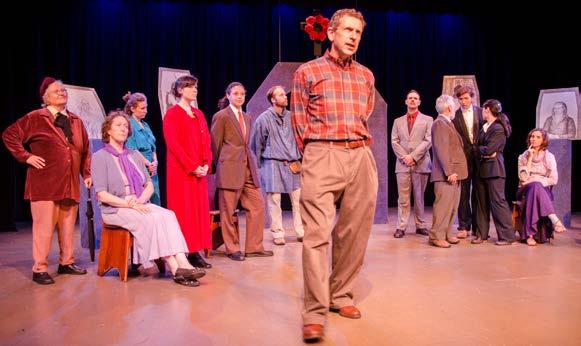
Rudolf Steiner’s indication that supersensible beings should find expression through eurythmy provides a unique and indispensable feature to the staging of the Mystery Dramas. To my perception such supersensible beings moving in eurythmy in synchronization with the spoken word created a mood for the reality of the spiri-
tual world as “living beingness” in every moment of our earthly life. Here for example we think of the soul forces Philia, Astrid, and Luna, and the Other Philia, the Spirit of the Elements, gnomes and sylphs, Lucifer and Ahriman, the Double of Johannes Thomasius, the Spirit of Johannes’ Youth, and the eurythmy to the Fairy Tales told by Felicia Balde.
In conclusion I would like also to emphasize a special quality connected with the staging of these dramas. Many essential esoteric aspects lie concealed in the indications given by Rudolf Steiner for each scene. Naturally there would not be the desire to stage the dramas as if they were historical statements depicting the life and times of the second decade of the 20th century. However, since they are “mystery dramas” and involve perceptions of the sensible and also supersensible dimensions of the actual life of the characters, faithfulness to the original intentions of Rudolf Steiner, an initiate in our age, have a heightened significance. These indications often involve color, which in all cases speaks to the soul of the viewer, hence The Portal of Initiation, Scene One: “A room, rose red in tone...” Indications of nature settings are not just for decoration: Scene Two: “ A place in the open; rocks and springs.” The whole surroundings are to be thought of as within the soul of Johannes, and this setting is repeated in Scene Nine. Then there are settings reminiscent of nature: The Guardian of the Threshold , Scene Three: “Lucifer’s Kingdom: a space not enclosed by artifical walls but by plant- and animal-like shapes and other forms of fantasy.” The indications from Rudolf Steiner contain enormous challenges in staging which tries to remain faithful to the original intentions. When the Guardian of the Threshold appears in Scene Seven of The Guardian of the Threshold , the indications may seem quite impossible to achieve: “A landscape of fantastic forms. Majestic
16 • being human initiative!
In the third play’s opening scene, ordinary people give their views on the expected opening up of the mystic temple.
in its composition of whirling masses of water, forming themselves into shape, on one side; of blazing whirls of fire on the other. In the centre a chasm out of which fire blazes forth, towering up to form a kind of portal. Behind it mountain-like contours formed of fire and water.” Since these dramas were performed under Rudolf Steiner’s direction one century ago, he obviously even then did not suggest a staging which would be impossible to fulfill. When the setting is inside such as the Balde’s house or the home of Strader and his wife, Theodora, it is clear that everyday life also expresses its dimension: “A room in rose-red tones.... One notices by the arrangement of the room that they use it together, each for his own work. On Strader’s work-table there are models of mechanisms; on Theodora’s things to do with mystic studies.” (Scene Four in the Guardian of the Threshold .) Especially the setting of the temple scenes, the Knights Templar, and of course the Egyptian Temple provided staging challenges which for me were met with exceeding skill, artistry and esoteric understanding for which I wish to express my great appreciation.

Two other factors worked together with the settings both of which deserve special recognition. At all times the lighting enhanced the atmosphere and the events—both inner and outer—occurring on the stage. Through the lighting a dimension of depth was achieved which often lent the living relationships and sometimes also the quality of necessary tension between the characters a significant depth. The color mutations in the lighting spoke a language concomitant with the many subtle moments of the drama as well as with those of highest dramatic action. The synchronization of the lighting with the flow of the dramatic movement provided for the many magical moments.
The creativity of the musical interludes during the
dramas evidenced true mastery in regard to the various instruments such as the Japanese bamboo flute (sha ku hachi), glockenspiel, percussion, strings, cello, bass, hand bells, harp, lyre, gong, bassoon. To bring such a variety of instruments into a cohesive and new musical experience for the audience represents a challenge for any composer and musician. An amazing aspect could be perceived with this music in that it definitely exhibited its own identity and yet always served the flow of the dramas, never demanding a spot in the forefront.
Perhaps these few impressions will also live in the memory of those of us who were privileged to attend this most special event and for those who could not be present this description merely represents a scanty reflection of a very rich experience. To conclude I would like to express a consideration for the Anthroposophical Society especially in the English-speaking countries. The English language is for the present time the universal language. Rudolf Steiner’s work, including the Mystery Dramas, must reach today’s humanity often in English translation! Perhaps we can think of this fact as a balancing-out in relation to the ways that the nobility of the English language through today’s technology—as vital as it has become—has been compromised, indeed sometimes even desecrated. Through the experience brought by the many speech artists performing these Mystery Dramas in the fine translation by Hans and Ruth Pusch a deed was accomplished for the soul and spirit of this language whose future destiny may work as a connection between many peoples on the earth today beyond the limitations of mere technology. My gratitude to these speech artists who formed and brought to life every word spoken is boundless. May these dramas appear again and again on the stage through the help of many people in general and especially through the members of the Anthroposophical Society who can appreciate their great mission in uniting the reality of reincarnation and karma with the Christ impulse for our time.
Virginia Sease has been a Member of the Executive Council of the Anthroposophical Society at the Goetheanum for more than thirty years. From 1991 to 2001 she led the Section for the Arts of Eurythmy, Speech and Music.
fall-winter issue 2014-2015 • 17
Taunted by Ahriman, Johannes meets his double, his unredeemed character, in the Guardian of the Threshold’s light.
Capesius: Inner Development, Healing, and Gentleness
David Andrew Schwartz
This report is based on my lecture given at the Mystery Drama Conference held at the Threefold Educational Center in Chestnut Ridge, New York. Lecturers were directed to present a karmic biography of one of the major characters in the plays that would spur questions of inner development from the conference participants and lead them to an alignment of soul with the struggles of the characters. I was asked to speak about Professor Capesius. Capesius’ story involves inner development and also is a healing journey. Something I learned from Capesius is that with him you need to be gentle.
Born in the mid-nineteenth century, Professor Capesius is about 60 at the beginning of the first play, The Portal of Initiation, when he joins the circle around the spiritual teacher, Benedictus. He is in his late 70s by end of the fourth drama, The Soul’s Awakening. He appears to be a confirmed bachelor living alone in his house in an urban setting. He is a professor of history: a scholar and teacher. As a thinker, he searches for a deeper meaning in history and seeks to awaken ideals in his students. He is solitary and lonely, but companionable in conversation, seemingly the bearer of the pain of inner conflict. In the course of the plays he enters a state of mental illness, perhaps a dementia-like state. He becomes a troubled older person, seemingly not-all-there by the end of the second drama, The Soul’s Probation, and into the third drama, The Guardian of the Threshold. His illness lasts for several

years, from his late sixties to his mid-seventies. He eventually emerges from this illness. He becomes a conscious pupil of Benedictus and recognizes his connection to the karmic community of Benedictus’ pupils. His is a Grail story in the sense that he is able to realize his own connection to the saga of the renewal of the mysteries.
Rudolf Steiner speaks about Capesius on several occasions between 1911-1924. When he talks about Capesius it is not as a character in a play, but rather as a real person. For example, he recites experiences and conversations that Capesius has that are not in the plays. These lectures provide opportunities to observe Rudolf Steiner modeling his deeply loving, non-judgmental relation to Capesius.
The last time that Rudolf Steiner speaks about Capesius is in Karmic Relationships Volume IV, the last set of karma lectures.1 In the final lecture of this series he speaks about Karl Julius Schroer and the relation of Capesius to this intimate friend and teacher of Rudolf Steiner.
Rudolf Steiner explains that the Spiritual Soul is the source of the intellect that articulates the materialistic, cold, hard, utilitarian principles that constitute our modern life of cognition. He reminds us that many of us experienced spirituality in our past lives but that these experiences cannot arise to consciousness in and integrate with our present life of intellect because of the materialistic and utilitarian nature of the intellect. At most an idealistic sense for beauty and truth may appear in a person with spirituality in their past life experience. He says that strength, perseverance, and enthusiasm are necessary to transform intellectualism so that the spiritual legacy of a past life can integrate with the intellect. As a matter of fact, he says that intellectualism is the greatest hindrance to the revelation of the spiritual content in the soul.
Rudolf Steiner goes on to say that the process to rise from intellectualism to spirituality was most difficult during the last third of the nineteenth century. As an example he offers Karl Julius Schroer, who bore within himself the spirit-soul of Plato, a being possessing treasures of spirituality. Schroer, who was steeped in the work of Goethe and introduced Rudolf Steiner to Goethe, recoils from materialistic intellectualism rather than going through the process of transforming it. Steiner explains that in Schroer the transformation of in-
18 • being human initiative!
1 Steiner, Rudolf, Karmic Relationships Volume IV, Dornach, lecture 10, September 23, 1924; five days later Rudolf Steiner gave his last lecture on September 28, 1924.
Historian Capesius finds healing in the gentle company of storyteller Felicia and her nature-mystic husband Felix.
tellectualism into spirituality comes to a standstill before the threshold of this transformation. The question that Schroer asks is: How can I bring spirituality into the present so that my connection to my past lives can be maintained and the thread of my earthly lives shall not break?
Rudolf Steiner then says that the situation that prompts this question is shared by Capesius, who is a contemporary of Schroer, and he too asks the same question. It is a Parzival question, a leading question with healing power, a version of the question: Brother, what ails thee? Capesius is in dialogue with himself. He is the wounded Grail King, in need of healing; and Parzival, the future Grail King, who needs to become a healer.
Unlike Schroer, Capesius is able to open the door to his spirituality by joining the circle around Benedictus. At first he expresses doubt and skepticism. But eventually he connects to the circle around Benedictus, especially Felicia. Her stories help Capesius to reconnect to his spirituality from past lives.
After three years, in Scene 8 of The Portal of Initiation, while looking at the painting Johannes has created of him revealing his true being, Capesius confesses to Johannes that his point of view has changed. He recognizes that to know his own being he will need to find his true being hidden within.
We also learn that Maria is going to be one of his important allies. At the end of Scene 3 of The Portal of Initiation Benedictus says to Maria: Your course of life has fitted you as mediator for new healing forces. He tells her due to her inner development she has a gentle soul . This gentle soul will help Capesius to face his inner battles and persevere to victory.
By the end of The Portal of Initiation Capesius has acquired the mood of the threshold. He has started to listen to, notice, and observe others in the karmic circle of pupils around Benedictus. He awakens to the significance of situations involving these people.
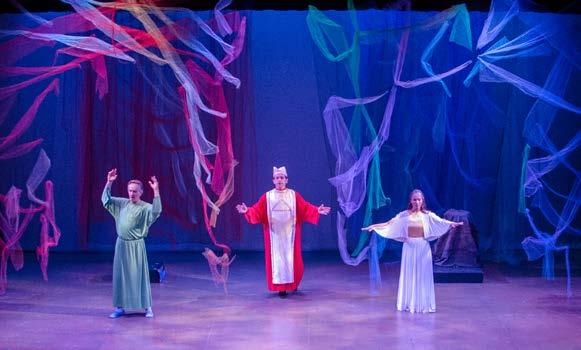
When The Soul’s Probation begins, about seven years after the end of the events in The Portal of Initiation, now in his late sixties, Capesius has taken up the ideas of Benedictus. As a result, spirituality begins to awaken within him. But the changes to his inner life are not confortable for him. He experiences anxiety and begins to lose his grip on his earthly identity. The conversation in Scene 1 between Capesius and Benedictus is challenging. Benedictus remains nonjudgmental, compassionate, and loving. He stays
with him and listens, exemplifying the role of the modern spiritual teacher. Capesius describes to Benedictus his battle to bring spirituality into his intellect, to preserve the thread of his earthly lives.
In Scene 5 of The Soul’s Probation Felicia tells Capesius the story of the rock spring miracle. This story is an imagination about the hindrance that modern intellectualism poses to the integration of spirituality gained from the past. The influence of this story is so stimulating that it awakens past life memories in Capesius. He experiences his life in a medieval period, around 1320-1330 c.e., after the burning of the Knights Templar in the spring of 1314, while the order is still in the process of dissolution. He experiences himself as a Temple Knight, the First Preceptor of his group of remnant knights. He meets all the people in the circle around Benedictus in their medieval lives with him and experiences his varied relations to them.
In Scene 10 of the same play, Capesius returns to his present life and reflects on his experience. The shock of knowing what he has done and the guilt that he feels amplifies his tendency towards solitude, allowing Lucifer, a promoter of isolation, to begin to gain control of his soul. Eventually, he withdraws from earthly life entirely, denying his existence as Capesius. His state of mental illness begins to set in at the moment Lucifer takes advantage of Capesius.
At the end of Scene 10 of The Soul’s Probation the Voice of Conscience speaks to Capesius and lays out his inner journey to a healing balance of soul, warning him about what Lucifer has done and admonishing him: Be aware of what you’ve seen, be alive to what you have done. Renewed, you are a reborn being. Your life you have been dreaming. Rework it out of noble spirit light; perceive the tasks of life with sight-empowered soul. But if you fail in this,—to empty nothingness forever are you bound.
fall-winter issue 2014-2015 • 19
Capesius is offered wise insights in the domain of Lucifer by spiritual guide Benedictus and his mature student Maria.
But Capesius is not able at the moment to take up the guidance given by the Voice of Conscience. Through Lucifer’s influence the experience of his past life lames his healthy connection to his body. His clear thinking is hindered. Physical and mental instability set in. Nevertheless, as the Voice of Conscience indicates, Capesius begins to acquire the mood of knowledge. He starts to recognize and understand what he has perceived. In his case, he begins to know that reincarnation and karma are a reality.
In Scene 13 of The Soul’s Probation, the last scene of the play, Maria declares that she will help Capesius. She stands up to Lucifer and determines to find within herself the inner strength to overcome Lucifer for the sake of her karmic community. Benedictus expresses the necessity of keeping the circle of people together who are bound by karma. Lucifer wants to separate the people in the circle as he has done by isolating Capesius. In relation to Lucifer, Benedictus speaks to Maria concerning her healing power and says to her: May in yourself this light now heal and turn into good those forces which once firmly bound your threads of life with all the others in a knot of destiny. When the third play, The Guardian of the Threshold , opens, several years have elapsed since the events of The Soul’s Probation. In Scene 3 of The Guardian of the Threshold we experience that Capesius has not been mentally healthy for several years. He is minimally engaging in daily life, withdrawn, in state of self-denial, even suicidal. Capesius is in some ways a modern version of King Lear. Like Lear in the storm scenes with the Fool (e.g., King Lear, first speech, Act III Scene 4), Capesius speaks to Maria in Lucifer’s kingdom about himself in the third person:
The man who here is speaking with you dreads those times that force him to put on a body, still alive, that keeps its earthly form although the spirit can no longer master it. At just such times this spirit feels the worlds he treasures are collapsing. It seems to him as if a narrow dungeon, bounded by nothingness, enclosed him cruelly. The memory of all that is pure life to him seems then extinguished for this spirit. And often, too, he senses human beings but cannot understand what they are saying. … He is in his body then, and he is not. He lives in it a life which he must fear when he beholds it from this region. And he is thirsting for the time to come when from the body he will be set free.
With this intimate sharing with Maria describing his condition of soul, Capesius alerts the

audience that his path of inner development is and will be a healing journey. He has lost his health and longs for it. His trust in life no longer streams through his body. He is calling out to his true being to bestow a strength upon his soul and also his heart so that he can regain his health and trust in life. But Lucifer has Capesius’s soul in his grip. Think of Lear carrying out Cordelia’s body at the end of Shakespeare’s play (King Lear, Act V, Scene 3). Capesius is carrying out his soul and placing it before Maria and the audience and calling for the Spirit of God to help him.
Maria is Capesius’s link to the healing forces of Christ. She gently stays with him. Her holy solemn vow that is made at end of Scene 3 overcomes Lucifer and rays out to Capesius and Johannes healing rays of light and warmth coming from the Christ, healing forces of the balance of soul. In Scene 3 Capesius begins his inner healing.
Scene 6 of the Guardian of the Threshold is a significant scene for Capesius in his process to regain his balance of soul and reconnect to the spirituality of his past lives. He starts to follow the guidance of the Voice of Conscience. In this scene Capesius begins to grasp the influence of Lucifer in his life. He starts to move towards being a conscious pupil of Benedictus.
In this scene Benedictus asks Capesius to begin to reunite with his earthly body and in so doing invites him into a conscious relation with him. Benedictus explains to Capesius what his occult situation has been. Benedictus also explains that he has a responsibility to Capesius as one of his pupils. Then Benedictus instructs Capesius to transform his thinking into a meditative activity so that his thoughts become beings in his soul, direct perceptions, that is thinking permeated by the forces of Christ, of the Word. At this moment the voices of the soul forces resound and Ahriman and Lucifer appear. Maria then
20 • being human initiative!
Capesius (foreground) ponders while his friend the scientist Strader experiences the isolation of his soul’s abyss.
helps Capesius experience Ahriman and Lucifer in their unvarnished reality. Capesius awakens from his luciferic dream. Like Jesus calling Lazarus to life, Benedictus calls him to awaken back again into his earthly life. Capesius awakens, saying to Benedictus: I may belong in future to myself again. Now I will seek myself, because I dare, beholding myself in cosmic thought, to live. Benedictus then asks Capesius to reconnect to the stream of his earthly incarnations: And bind what you have won to everything you formerly achieved, for world enrichment. Here the thread of Capesius’s life has been prevented from being broken by Lucifer. Then, at the conclusion of the scene, Felicia comes to Benedictus’s side and tells Capesius the fairy tale of the child of light in order to give him the additional strength to reunite with his earthly body and life.
Capesius has come so far that he is able to acknowledge his relation to Benedictus as a pupil and tells him that he will follow him.
Capesius’s turning away from Lucifer to Christ is a delicate process. Benedictus says to Capesius: Yet love speaks often with a gentle voice and needs support within the depths of soul. It should unite with everything that will devote itself in noble threefoldness here at this place [the temple of the occult brotherhood] in harmony with cosmic law. Maria will unite her work with yours. The vow she took in Lucifer’s domain shall radiate for you its strength. And Maria says to him: …the human being has need of that one God Who…rays forth his highest power only when He Himself dwells in the inmost human being, and in his love, transforms death into life.
The Mystery Dramas were meant to be performed in the original Goetheanum building which burned to the ground on New Year’s Eve 1922. In October of 1923, after the fire, Rudolf Steiner gave a course in Dornach called The Four Seasons and the Archangels. The third lecture is

on the Easter Imagination and the Archangel Raphael.2 This imagination is all about the human being standing between the forces of Ahriman and Lucifer.
Capesius reminds us that the Mystery Dramas are examples of the healing rituals that Rudolf Steiner speaks about in this lecture with regard to Raphael who bears the image of Christ as healer to mankind. At the end of the lecture Rudolf Steiner draws our attention to a particular image. He speaks about the original Goetheanum as a building that, while it does not exist on earth, can still be a present reality for us. He indicates that at the back of the stage is the sculpture of the representative of humanity, the Christ, standing dynamically between Ahriman and Lucifer, and then says:
It belongs to the character of this architecture and this sculpture that a kind of mystery drama would to be enacted with the human being and Raphael as the chief characters—Raphael with the staff of Mercury and all that belongs to it … a mystery drama showing Raphael teaching human beings to see in what way the ahrimanic and luciferic forces make him ill, and how through the power of Raphael human beings can learn to … recognize the healing principle, the great all-pervading therapy which lives in the Christ principle. … that could be expressed in the words: The presence of the World Healer is felt—the Savior who willed to lift the great evil from the world. His presence is felt. … a drama in the earthly realm [is enacted] … embracing things which must be cherished and preserved on earth—the health-giving healing forces, and the knowledge of the ahrimanic and luciferic forces which could destroy the human organism.
The fifth lecture of The Secrets of the Threshold, given at the time of the first performance of The Soul’s Awakening,3 is devoted to a description of Capesius’s inner path of development. The lecture covers the same ground as Scene 6 of The Guardian of the Threshold , but entirely different conversations between Capesius and Benedictus are recited. Even a fairy tale that is not in any of the plays is offered by Felicia instead of the fairy tale of the child of light.
In the lecture Benedictus meets Capesius and starts to instruct him regarding meditation. Like Rudolf Steiner in the Easter Imagination,
fall-winter issue 2014-2015 • 21
2 Steiner, Rudolf, The Four Seasons and the Archangels, lecture three, October 7, 1923.
3 Steiner, Rudolf, Secrets of the Threshold, lecture five, August 28, 1913.
As a woman (the future Johannes) listens telepathically, Pharaoh (in future Capesius) allows an initiation to fail.
Benedictus offers an understanding of Ahriman and Lucifer by revealing their mystery as the secret of the number three. The number three carries the inner nature of polarity. Benedictus presents two polarities to Capesius.

The first polarity consists on one side of unexpressed human thought formed in solitude by an individual. The thoughts of the individual are permeated by the luciferic element which then strengthens the tendency to separate the self from the world and others. On the other hand writing expresses thought and makes thought permanent. The ahrimanic element permeates writing. The balance between the unexpressed thought formed in solitude and the thought expressed in writing is the spoken word. Through the spoken word community between individuals is formed and a balance of soul is established. The mission of the spoken word is to hold the middle for true knowledge expressed in thoughts.
The second polarity described by Benedictus suggests that the forming of concepts within oneself is luciferic. On the other hand listening, that is, taking in the world around one through the senses, is ahrimanic. Balance is achieved through meditation. Meditation is achieved when thinking’s concept-forming becomes perceiving and perceiving becomes cognition, that is thinking that is as alive in the soul as perception. The person who meditates lives with thoughts that have become so alive as to be perceptions within.
Capesius is taught that everywhere polar opposites are revealed and it is necessary for these opposites to balance each other. Capesius begins to understand Ahriman and Lucifer. Rudolf Steiner says: He divined that he had penetrated to a law which exists on the physical plane as though covered with a veil,
and that, possessing this knowledge, he had something wherewith he could cross the Threshold. With the knowledge of the number three, Benedictus leads Capesius into the mood of meditation. His knowledge of Ahriman and Lucifer has become true for him as a direct experience. With this living knowledge, Capesius begins to be able to resist and transform Lucifer within himself.
Moreover, the step of becoming a meditant brings Capesius to the fourth stage in his spiritual development. As a former Templar knight, Capesius carries deeply in his true being the Christian mission to redeem Lucifer and preserve for mankind the spiritual legacy of the past in a way that can unite and integrate with the modern situation that requires spirituality to be purified of the luciferic element of the past. This purification is necessary to spiritualize intellectualism. The impulse to serve the redemption of Lucifer is part of Capesius’s true being. Now he must awaken to the other part of his being and also embrace the Christian task of spiritualizing intellectualism by bringing his spiritual life into his current earthly life in a transformative way for works of good on earth. The transformation of work is the task of his present life as Capesius and of the Fifth Post-Atlantean Cultural Epoch.
In speaking about the Templar impulse Rudolf Steiner says that the Templar Knights prepared for the Fifth Epoch. Their mission was the healing of the European Spirit (from luciferic influences mentioned earlier and from ahrimanic materialism). After their deaths the wisdom of the knights flowed into European life including into Goethe and his fairy tale, The Green Snake and the Beautiful Lily. Rudolf Steiner says that there is a deep connection between the Templars and events of later times. The ideals of the Templars live on in Capesius because he was a Templar. By purging Lucifer from his soul life and reuniting with his earthly life, Capesius can let his past spirituality flow into his present life in the sense that Rudolf Steiner describes the Templar impulse:
A longing for the full Christianizing cosmic wisdom and earthly evolution gradually broke through—a longing for the full Christianizing of earthly life so that suffering, pain and grief appear as the earth’s Cross, which then finds its comfort, its elevation, its salvation in the Rose symbol of
22 • being human initiative!
In the fourth play, a tableau from the spiritual region of the Sun in the life between death and rebirth.
the Cross. Repeatedly in people thus inspired, in whom lived on what was thought to have been destroyed with the burning of the Templars—in these inspired people lived ever and again the ideal that in place of what brings quarrel and discord something must appear that can bring good to earth, and this good may be pictured in the symbol of the Cross entwined by the roses.4
In the fourth Mystery Drama, The Soul’s Awakening, Capesius experiences his past life in ancient Egypt. He learns that it was in his life in ancient Egypt that he embraced the tendency to solitude and that the seed for his vulnerability to Lucifer was sown in that life. Capesius is a hierophant in these scenes. Events are described that make the karmic bonds between Benedictus’ pupils clearer.
In Scene 13 of the last play, Capesius’s final scene in the plays, he experiences Strader spiritually. Strader is speaking to Capesius inwardly and directing him to a true Christ consciousness: a way of meditating (seeking the balance) in the way of the new mysteries whereby the earthly life is connected with the spiritual life. Capesius musters the courage to move in a new direction inwardly, taking Strader’s instruction and severing his last tie with Lucifer. It is a true Raphael moment in Capesius’s healing journey. He is in his late 70s. He must be thinking about preparing himself for the crossing of the threshold of death. The whole scene feels like such a preparation. Strader is about to die. There is a mood of something coming to an end and preparing for the future. Strader clarifies for Capesius the exact nature of the modern meditative practice: Stray not from the true mystic’s solemn mood. … To strive for nothing … wait in peaceful stillness, one’s inmost being filled with expectation: that is the mystic mood—and of itself it wakes—unsought amid the stream of life and when the soul has strengthened itself rightly, in spirit search, imbued with powers of thought. This mood comes often in our quiet hours, in heat of action too, but then it wants the soul not to withdraw in thoughtlessness from gently viewing spirit happenings. Engagement with life and work on earth is essential to the fulfillment of meditative practice, the transformation of the earth. Finally, responding to Philia’s words directing his spiritual activity into the future, Capesius says, as his last word, embracing Strader’s Manichean directive: The admonition that Philia gives to me shall lead me on, so that in coming times may be revealed to me as well in spirit what I as earthly man already 4 Steiner, Rudolf, Inner Impulses of Evolution (The Mexican Mysteries and the Knights Templars), Dornach, lecture VI, September 25, 1916.
find in my life’s circle understandable.
Finally, a word that appears often throughout the four of the Mystery Dramas is: GENTLE. For example, in Scenes 5 and 6 of The Soul’s Awakening, which take place at the midnight hour between death and rebirth, we hear these words: Radiant grace and kindly gentleness holds sway. Maria says of this afterlife in the sun sphere: What flames awaken the word of love? Gently they glow; their gentleness enkindles a lofty earnestness. Capesius needs to be treated gently. Throughout the plays his friends are careful with him. He is met over and over again with gentleness, understanding, and tolerance. The gentleness living within his karmic circle is an important factor in his inner healing. Maria is the outstanding representative of this quality. And we learn over and over again from Benedictus that as a karmic community his pupils have a duty to take care of themselves. His pupils fulfill their inner development and find inner healing through their concern for the others. This caring requires gentleness.
In Knowledge of Higher Worlds Rudolf Steiner writes about the esoteric nature of gentleness:
Every word spoken without having been purged in thought is a stone throne in the way of esoteric training. … [The student] must listen to the speaker as carefully and attentively as they possible can and let their reply derive its form from what has been heard. … The importance lies not in the difference of opinion between the student and someone else, but in the other’s discovering through their own effort what is right if the student contributes something toward it. Thoughts of this and of a similar nature cause the character and the behavior of the student to be permeated with a quality of gentleness, which is one of the chief means used in all esoteric training. Harshness scares away the soulpictures that should open the eye of the soul; gentleness clears the obstacles away and unseals the inner organs.5
Gentleness is deeply connected to the ideal that flows in the karmic community of the Mystery Dramas that was quoted earlier as living in Capesius: … in place of what brings quarrel and discord something must appear that can bring the good to the earth, and this good may be pictured in the symbol of the Cross entwined by the roses.
Gentleness is the essence of Capesius’s path to a healing balance of soul and is essential to the Mystery Dramas.
fall-winter issue 2014-2015 • 23
5 Steiner, Rudolf, Knowledge of the Higher Worlds and Its Attainment, translation by George Metaxa with revisions by Henry B. and Lisa D. Monges, Chapter IV, “Some Practical Aspects,” Anthroposophic Press.
North American Speech Artists Convene
The first Goetheanum was built as the home for the Mystery Dramas and for the spoken word. So it was altogether supportive and inspiring that the recent Mystery Drama Conference in Spring Valley opened and closed with a speech chorus of eleven speech artists speaking the words (center inset) of Benedictus from scene seven of The Portal of Initiation, the first of the four dramas.
A gathering of this many speech artists in one place had not taken place since 2002, when, in the context of the West Coast Educators Conference in Fair Oaks, California, we each offered a speech workshop and demonstrations, and gave an evening performance together.
In recent years, our formerly annual “Speech Meet” has transitioned to a bi-annual rhythm. In summer 2013 we had a smaller but vibrant gathering of speech colleagues who were in Spring Valley also for the Mystery Drama Conference. At that time it was decided that we would meet again already in just a year, given that a relatively large number of colleagues would be attending the summer 2014 Mystery Drama events. The majority of the eleven attending the conference were able to stay for the Speech Meet, and we had a hearty, hardy, heartfelt threeday span of working together. With everyone’s ongoing work variously involved in the three areas of activity of the Art of Speech—pedagogical, therapeutic, and performance—we had an enriching time of shared artistic work and conversation on various themes, with a focus on speaking modern poetry.
In the course of the ongoing centenary-markers of
developments in the life and work of Rudolf Steiner, which will continue for the coming eleven years, there are many that involve the cultivation of the role of the Art of the Spoken Word as developed by Rudolf Steiner and Marie Steiner-von Sievers. In the later chapters of his Autobiography, Rudolf Steiner conveys what this impulse for the renewal of the spoken word meant already at the time of his separation from the Theosophical Society in order that, among other things, the artistic stream necessary for anthroposophical ideas to be experienced in their full livingness could be developed, particularly in connection with the work of the Anthroposophical Society. From the Mystery Drama performances, the birth and development of eurythmy, the presentations on the anthroposophical understanding of the human being, to the Public Speaking Course, and finally the Speech and Drama Course of 1924, one can witness and experience (also in countless additional lectures throughout this span of time) the reality of the living word as a signature of being human and of human potential. This is particularly elaborated as an integral component of Waldorf education.
In all areas of anthroposophy, the ongoing centenary-markers up until 2025 continue to be an opportunity day by day for raised consciousness of our time and tasks. In this sense, may we give this artistic impulse for the renewal of the spoken word for the sake of humankind our full and fervent attentiveness in the times to come.
Light’s weaving essence radiates
From one to another
To fill the world with truth. Love’s blessing gives its warmth
To souls through souls
To work and weave the bliss of all the worlds.
And messengers of spirit
Join human works of blessing With purposes of worlds.
And when those souls
24 • being human initiative!
Who find themselves, one in the other, Can join these both together, The light of spirit radiates Through warmth of soul.
Helen Lubin
Helen Lubin (helenlubin@gmail.com) is a speech artist and represents the Performing Arts Section on the North American Collegium of the School for Spiritual Science. She lives in Fair Oaks, California.
Threefold Auditorium Excavation News


Just as the dust was settling from the August mystery drama conference (previous pages), actual dust began to fly as excavation work began on the $350,000 project to update Threefold Auditorium’s utility service. It’s a much-needed upgrade for the physical and spiritual home of mystery drama work in North America. Until now, the building’s users (also including Eurythmy Spring Valley, the Otto Specht School, and office staff of Threefold Educational Center and the Pfeiffer Center) have made do with electrical lines installed when the building was new, 65 years ago. When completed in December, the newly up-to-date utilities will make possible the eventual installation of central air conditioning, modern stage lighting, and a host of other improvements.
The utility work was funded by donations, including a very generous gift from Herbert H. Hagens. It is the first stage in a project to fully renovate one of the few buildings in the world designed and built in service to anthroposophy. Threefold Educational Center has launched a capital campaign for the second stage, a full renovation of the building. Plans include modern heating and air conditioning systems, a reconfigured interior, and a restoration of the unique interior surfaces.
To learn more, and pledge online, visit the project page at www.threefold.org/auditorium.
Individual Experience & the Consciousness Soul
by Adam Blanning, MD
Within the anthroposophic medical work there have always been questions about “How can we become part of the larger medical conversation?” or “How can we share anthroposophic insights in a way that will help others open to a more spiritual understanding of the human being?” These are not easy questions to answer; as soon as you mention the words “homeopathy” or “astral body” many medical professionals stop listening. There is a big gap to bridge, so finding consistent ways to make inroads on an institutional level has been an ongoing challenge.
What does prove to be consistently powerful, however, is the relationship between individuals, especially as it relates to one’s path of illness and healing. This has proved true in a striking way over the last months as there has been a dramatic increase in interest in mistletoe as a cancer therapy. It is related to a patient of Dr. Peter Hinderberger in Baltimore, Maryland, who refused chemotherapy for her stage 4 colon cancer and instead focused on mistletoe, a high alkaline diet, and prayer. She is now free from cancer. Out of sharing about her experience a grassroots organization called “Believe Big” has formed, which works to promote alternative cancer therapies and which is actively fundraising in order to begin studies on mistletoe safety at Johns Hopkins. A fuller report from the Johns Hopkins newsletter can be found here: (http:// hub.jhu.edu/magazine/2014/spring/mistletoe-therapy-cancer).
It is hard to know exactly how far this will go, but it does feel like this impulse is receiving guidance and support greater than anyone could have planned or specifically orchestrated. PAAM, the anthroposophic physicians’ association, is looking at ways to develop broader training programs for physicians—specifically in mistletoe use—so that there will be enough practitioners to meet the needs of people with cancer. Most beautifully, it is an opportunity to reach and support more people spiritually/physiologically as they are approaching possible death and loss, for a cancer illness is most certainly a very powerful and particular threshold experience. And it is arising not out of large institutional shifts or through financial motivations, but through the power of individual experience and insight.
— See page 52 for a related column from Dr. Blanning.
fall-winter issue 2014-2015 • 25
A Camphill Youth Conference Overview
Deepening Our Questions, Quickening
Our Souls, Forging Our Friendships: Sources of Strength for Future Tasks
by Haleh Wilson
On September 18th, 2014, Heartbeet Lifesharing Community welcomed to Vermont members of Camphill communities all over the United States, along with representatives from communities in Ireland, Scotland, England, Canada, and Russia. They came to celebrate and learn about anthroposophy and to discuss the present state of the Camphill movement worldwide. Nearly eighty attendees came together to frame important questions about prevailing dynamics between the generations of Camphill. After four days, such questions had been identified, parsed, and refined, and participants had struck new friendships of the kind that serve increasingly to knit Camphill together as an international community.
Lecturers David Schwartz and Sherry Wildfeuer explored the mutual history of the Anthroposophical Society and Camphill, commenting on the need for Camphill’s younger generations to take up the “intellectual thread” of anthroposophy. Guy Alma provided an overview via slideshow of the construction of the First Goetheanum. Artistic workshops, including biography work, clowning, and singing, served to punctuate the lectures—along with delicious, wholesome meals prepared and offered up by the regular residents of Heartbeet.
On September 20th, 101 years since the laying of the Foundation Stone of the First Goetheanum, a Heartbeet ceremony incorporated conference participants in a poignant visual reminder of Camphill’s basis in anthroposophy and the legacy of Rosicrucianism. A vast cross was laid on the site where Heartbeet will soon commence construction on its Community Center.*1 Participants joined Heartbeet community members to form a circle around the site while seven bunches of red roses were laid in the circuit that appears on the Rose Cross, a symbol that urges us toward renewal.
On Friday morning, following a lecture introducing
* Editor’s note: the cross described was formed from the ashes of Sophia House, an almost completed new Heartbeet building that burned in 2013.
this form, conference participants broke into rough dozens to embark on “Circle Work.” Then and on each of the two following mornings, the circles met to share and hear each other’s “burning questions,” hopes, and intentions. My own group discovered within that intentional form a safe space that spoke to the vulnerabilities each of us carried into the room and invited purposeful contact. In this exercise, in forming circles of not many, we saw the essence of what we do in community itself, in choosing to live with others where we share a common intention.
The Circle Work reminded us of what we experience on a daily basis in Camphill—that in choosing to live in community, in this deliberate form, we are building a space together every day, a space that invites meaningful interaction. In recent years, the Camphill movement has seen the disruption of community, of our chosen form. In Europe and the United Kingdom, Camphill communities are beset by policies that seek to end lifesharing between disabled and non-disabled residents. Following his lecture on Friday morning, David Adams, who has himself been forced out of Botton Village by such measures, took a moment to comment on these destructive trends.
“A word about England,” he said, addressing the living generations of Camphill, a room of people between the ages of twenty and seventy. “Do not be proud. It can happen here, too.”
Although many people shared stories of pain and loss that reflected the current experience of communities like Botton, the conference atmosphere was overwhelmingly one of security, warmth, affirmation, and hope. In Heartbeet, I saw many people enjoying the benefits of lifesharing in several thriving Camphill homes. The abundant goodwill and warmth in that community is tangible, and speaks to the brightest of possible futures for Camphills around the world.
Certainly in the moment of that September 20th ceremony, the Rose Cross image seemed to speak to the events of today’s Camphill movement, a call for renewal in the face of forces seeking to change us: the cross on the Earth, the wide circle around it, people joining hands, voices lifted in song.
Haleh Wilson (haleh.wilson@gmail.com) grew up in Mississippi. She first encountered anthroposophy as a child by way of her mother’s interest in Waldorf education. Now living in England, she is a coworker at Grange Village.
Heartbeet Lifesharing (heartbeet.org) is a Camphill Community and a Licensed Therapeutic Community Residence in Hardwick, VT; host to youth gatherings for many years, it is now raising funds for a community and cultural center.
26 • being human initiative!
Update: Inner Fire, Inc.

When we created the initiative! section, one of the first reports was about the initiative “Inner Fire” which aimed to offer alternatives to drug treatment for individuals suffering from mental illness. In her latest reports Beatrice Birch reports significant progress and details some of the many facets of getting a complex new initiative going...
Every week, I receive inquiries from desperate parents, individuals in crisis, and disheartened professionals—all demoralized by the medication-based mental health system, which emphasizes short-term relief through the suppression of symptoms, but fosters long-term dependency on drugs and their attendant disabling side-effects. They are searching for exactly what Inner Fire will be: a proactive, healing community offering people struggling with debilitating and traumatic life challenges a path of recovery without the use of psychotropic medications....
In the spring, we intend to start building a home for twelve where, honoring the whole human being of body, soul, and spirit, individuals can slowly ease off their medications, or avoid them all together, while being supported by Inner Fire’s program of both meaningful work and proactive therapies.
From July 29th through August 6th, we offered a sanctuary for two individuals (our legal limit)... [to give] these courageous individuals, while remaining on their meds, a ‘mini’ experience as to what it would be like to engage proactively in their healing process....
Psychiatrist: We are very grateful to have an experienced psychiatrist, Dr. Nels Kloster, join us. He is an extraordinary person who is as enthusiastic about working with us as we are to have such an open-minded and conscientious person on the team. In addition to his private practice in Bennington, Nels hosts a local television program on mental health in Brattleboro.
Primary Physician: Dr. Lynn Madsen, practicing anthroposophical medicine in our neighboring town of Townsend, is Inner Fire’s primary physician.... Homeopath: Julian Jonas of The Center for Homeopathy in Southern Vermont has been a valuable support... Development Director: We have hired Jim Taggart for an initial six month term... Board: Our board is growing, meeting every two weeks at this time. Marshall Hammond, who has developed and run mental health treatment programs over a span of thirty years in Vermont as well as worked extensively with Corrections in prisons and in the com-
munity with Probations, has joined us. We have extended invitations for board membership to several other women and hope to attract younger committed and interested individuals as well.
Day Program: Since the Sanctuary, we have decided to offer and are developing a comprehensive, customized day program of work and anthroposophical therapies for individuals who are able to live alone. Though more needs to fall in place before we officially open, we have a mini program and are very grateful to have Barbara Rolinson, an experienced Therapeutic Eurythmist, Joan Shimer offering Spatial Dynamics, Kathleen Bowen working with Biography, myself with the Hauschka Artistic Therapy (clay, watercolor etc.) and both Doctors Nels Kloster and Lynn Madsen who are supporting individuals on their path toward rebalancing and stepping back out into the community. For the work programs, we are in need of a forester, gardener and cook.
Every month there are new people joining our Foundation Gathering which, since October 2013, has met on a Sunday from 10:301:30, when we study and work experientially together, followed by an update of Inner Fire and a potluck lunch. The Gatherings begin to build an etheric substance which will help to nurture and support individual seekers when they arrive. A strong community is also growing with individuals who have family members in need, or who want themselves to work with us or who simply recognize the need for Inner Fire. We can appreciate the substantial contribution these meetings have made to ensouling and energizing Grace Brook Farm.
Twice we have spread biodynamic preparations on the open land of Grace Brook Farm with the support and guidance of Robert King and Dr. Basil Williams.
Our needs: Residential Program: In the Work Program a BD gardener, a forester, a housekeeper and a cook, who are all aware of the healing powers awakened by engaging in such work. Therapeutically we are looking for a eurythmist, spatial dynamic practioner, music therapist, rhythmical massage therapist and an anthroposophical registered nurse. Administratively, for a house manager.
We are very grateful for gifts already received over the past twelve months—more than $210K!... In order to build this spring, we need an additional $300K for our building fund.... For further information or to help, contact: beatrice@innerfire.us or phone: 802-221-8051.
fall-winter issue 2014-2015 • 27
IN THIS SECTION:
Rudolf Steiner’s overwhelming life work, “anthroposophy,” seems sometimes to bear no comparisons. Unfortunately this can isolate Steiner and prevent a natural field of friendly alliances from growing up. Eve Olive spoke recently at a colloquium devoted to Thomas Berry, the Catholic priest who sought the sacred in modern understandings of the world. Next are rich areas where non-verbal experience rules. Jaimen McMillan, founder of Spacial Dynamics, who works with that wordless art in many areas of life, brings his experience to bear on the mystery of “intuition.”
In our second Gallery
Victoria Temple shares “sculptures in light.”
Chiaki Uchiyama reports the insights of a master of the lyre. Helen Lubin takes us to Sound Circle Eurythmy’s first graduation, a real springboard to the beyond. Finally, David Wood writes in appreciation of a “critical edition” which will make Steiner work more accessible to scholarly consideration.
Anthroposophy & the Ecozoic: Rudolf Steiner & Thomas Berry
by Eve Olive
This paper was presented at the “Colloquium on Thomas Berry’s Work: Development, Difference, Importance, Applications,” co-sponsored by the Center for Ecozoic Societies and the Carolina Seminars of the University of North Carolina, May 28-30, 2014, in Chapel Hill, NC.
Some people are nonplussed by the word “anthroposophy”—others are startled by the word “Ecozoic.” And of course, there are many who have heard of neither. Are these just two curious words, which have nothing to do with oneanother, or are they somehow related? “Anthroposophy” came into the world through the work of Rudolf Steiner (1861-1925). The word comes from two Greek words, and it can be translated, variously, as “the wisdom of the human being”, or “consciousness of one’s humanity”... or, as stated more fully by Steiner in 1924, “Anthroposophy is a path of knowledge which arises as a need of the heart and leads from the human mind and spirit to the Mind and Spirit of the Cosmos.” “Ecozoic” is a term coined by Thomas Berry (19142009). Berry’s observations of the world, as it is now, and the vast sweep of evolutionary history, led him to point to the fact that we have entered a different age which needs its own name.
The most recent period, the Cenozoic, which started 65 million years ago, saw the gradual emergence of the natural world we know now, with its beautiful flowers, its majestic forests, its clear flowing streams and sparkling oceans, its great variety of animal life, and finally the human being. Ah! The human being... This Being of free will, this Being with a kind of consciousness that the animals do not possess. Here we are, each with our individual egos, free to do as we please . . .
And what have we done? We have brought the Earth, which sustains us, to a tipping point. We have created mass extinctions of animal and plant life. We are busy destroying the lungs of the earth as, hour-by-hour, great swaths of forest fall. We have upset the balance of carbon dioxide to a dangerous degree with our extractive economy. We are destroying our home.
Thomas Berry has said that we will not save or protect that which we do not regard as sacred. How do we come to a sense of the sacred? Is it something we are born with? Can it be developed? There are many ecologically-inspired organizations out there doing wonderful work, and maybe it is because they all have a sense of the sacred—though they may not name it.
It is this sense of the sacred, this experience of the numinous, this feeling for, this awareness of something more than the surface appearance of things that interests me in the Ecozoic movement and that encourages me to see a connection between the work of Thomas Berry and Rudolf Steiner—between the Ecozoic and anthroposophy.
Some of you may know that Steiner’s view of the human being as a spiritual being, clothed in a physical body, was developed philosophically in profound ways, in his many books and lectures. In the last third of his life, after the first World War, this wisdom entered into life

28 • being human arts & ideas
“Thomas Berry” by Caroline Webb. Licensed under Creative Commons Attribution 3.0 via Wikimedia Commons
in very practical ways, inspiring many different professions—agriculture, medicine, political/social life, the arts—architecture, sculpture, painting, music, drama, poetry, eurythmy (a new art of movement), and of course education, with the founding of the first Waldorf School in Stuttgart, Germany in 1919. I would like to read you the verse which Steiner wrote for the students of the Waldorf School, and which they, from fifth grade on through high school, recite each morning:
I gaze into the world
In which the sun is shining, In which the stars are sparkling, In which the stones repose, Where living plants are growing, Where sentient beasts are living, Where human souls on Earth
Give dwelling to the Spirit.
I gaze into my soul
That lives within my being. The world Creator weaves
In sun light and in soul light, In world space there without, In soul depths here within.
To thee, Creator Spirit, I will now turn my heart
To ask that strength and blessing
For learning and for work
May grow within my inmost being.
One can see that this verse encourages a sense of the sacred, both when looking out into the world, and when looking within—without any sense of dogma or coercion.
Now, when we look out into the cosmos with our great telescopes and space probes, we see that creation continues. The universe is not fixed, not finished. When we look within, we know that we are not fixed, not finished—we have the option, with our free will, to continue the work of creation on ourselves—to perfect and refine our attitudes and ideals, to become more centered, more aligned with the highest we can imagine.
One wonders if these two great men, Steiner and Berry, had met in this life, if they would have found a connection with each other, or whether it is up to us to make that connection now? Steiner was born first, and had a relatively short life—64 years. Berry, born 53 years later, was a boy of 11 when Steiner died. If Steiner had lived into his 95th year, like Berry, Berry would have been 42 when Steiner died. There is the chance they would have known of each other’s work. However, that is not to say they would have admired each other’s work, or found a
colleagueship with each other.
Those of you who know anything about Steiner know how much his work followed on from that of Goethe (1749-1832), both in a scientific and in a literary way, and yet, Steiner said that if he and Goethe had met in life, they would not have been congenial! Sometimes it is significant that two beings, whose life work is related, need to be born apart in time, and the connections discovered later and developed further. In this case, with Steiner and Berry, I am suggesting that this is our work, if we choose to take it up, to find the connections. Right now, these two great beings are in the spiritual world, with a perspective they could not have had on earth. Both were deeply concerned for the earth and humanity. Now they are able to contemplate possibilities they might not have connected with when they were here on earth.
For me, these two life works, these two biographies, are like two pieces of a puzzle that fit together, that inform and enrich each other. One can say that the one brought the answers before the problems and the questions, articulated by the other, were even apparent.
Steiner foresaw a time when the earth would be devastated, when human life on the planet would be sparse and very difficult. This picture haunts us now in relation to the legacy we are leaving our children, our grandchildren, and our great-grandchildren. Thomas Berry has spelled it out for us with great clarity and urgency. Individually and within all our institutions, we need to wake up. I doubt that Steiner, speaking in the early years of the 20th century, thought that this vision of the earth might become a reality as soon as it now appears possible.
Steiner recognized that we are citizens of two worlds. This world, in which we appear in physical bodies—and the spiritual world, in which we exist as souls, and from which all the splendour of the universe has emanated, and is still emanating, in a great ongoing work of creation.
As souls, we exist before our birth, and at death, we return to our spiritual home. We have been on earth before, and we will return again. We were ancient Greeks and Romans, the monks, nuns, knights, peasants of the Middle Ages. The earth is our schoolroom. The physical evolution which gave us our upright bodies and eyes that could gaze at the stars is complete. Now our task is the evolution of consciousness, and coming to an awareness of the divine spark within us—something we can ignore, or consciously choose to do. When we contemplate the possibility of a devastated planet, it is we who will inherit it.
fall-winter issue 2014-2015 • 29
The idea of reincarnation, of repeated earth lives, may be problematic for some, and the subject is probably not often discussed in academic settings. I have come to realize that not everyone has the same idea of what reincarnation means. We are certainly not talking here of transmigration of human souls into animal bodies. Nor is this some kind of system of easy second chances. The picture presented by an Indian gentleman I met recently— “As Hindus, we believe that four days after death, the soul enters another body”—does not ring true for me.
If there is such a thing as reincarnation and karma, it must be logical—it must help to explain, for instance, the inequities of life. Looking at the different destinies of people, it can be hard to believe in a “God of Love.” Some of us are well clothed, well fed, well educated, while others are starving, illiterate, or mentally or physically handicapped. One life? The possibility of multiple lives can help make sense of this conundrum. And here I should like to dispel the notion that misfortune in this life is a punishment. It may be a consequence. It may be a conscious sacrifice. There are an infinite number of possibilities.
With our consciousness after death, we look back upon the life just lived. We experience all our interactions with others from the viewpoint of the other person, and so we understand the full import of our actions, our thoughts, and our words. We judge ourselves.
It is this understanding, this self-judgment, which leads us to desire to do better in the future life. With great artistry, high spiritual beings help to work on our karma, creating possibilities for the next life on earth, for our continuing biography. But that next life maybe several hundred years away—will there be an earth for us to return to? Will there be healthy bodies for us to inhabit?
If reincarnation and karma are realities, they are part of the story—The Great Story —and we need to include them. We ignore them at our peril. Steiner considered it an important part of his mission in this life to bring to humanity a clear, modern understanding of the reality of reincarnation and karma. It is something we need to consider. Just as we see a need to integrate a religious or spiritual world view with the scientific world view, as Thomas Berry and Brian Swimme encourage us to do in The Universe Story, and as Michael Dowd encourages us to do in Thank God for Evolution —so there is yet another step for us to take.
Behind all natural science stands what we may term spiritual science. Is this what Thomas Berry sensed in his observation, that everything we see has a psycho-spiritual
aspect? Rudolf Steiner devoted his life to this realm of spiritual science. His meditative observations and spiritual research are recorded in over twenty books and 6,000 lectures—a treasure there for us, if we wish to dip into it.
Another thing I find interesting and encouraging about the Ecozoic movement is the interest in culture, in the arts. Yes, yes, yes! If we are going to transform society, the arts must be there—all of them. This is another area where there is a great resonance with the work of Rudolf Steiner. Steiner was in one way or another involved with all the arts—from designing the First and Second Goetheanum buildings to writing four great Mystery Dramas which, by the way, will be performed this summer in Spring Valley, New York. This is the first time all four of them will be performed in English on this continent, in a great nine-day festival. Each play takes a day to perform!
And of course there is eurythmy—the art of movement, which came into being through Rudolf Steiner, together with the art of creative speech. I visualize performances of eurythmy celebrating the beauty of our world in the words of some of our first “environmentalists”, the romantic poets—Wordsworth, Shelley and others, Gerard Manley Hopkins and Yeats.
I hear a yet-to-be-written oratorio, celebrating the creation of our world in a different seven-fold-ness, based on Steiner’s spiritual vision and research. Is there a new mystery drama for our time, waiting, yet to be written and performed? Will the greatest art form of all—that of the social order —be accomplished in our time, or at least start to be consciously worked upon? And will the great gifts of biodynamics be used to heal the earth before it is too late?
Many questions, many challenges, but maybe, as in the finale to Christopher Fry’s play, A Sleep of Prisoners, we too can say:
Thank God our time is now when wrong
Comes up to face us everywhere,
Never to leave us till we take
The longest stride of soul Man ever took.
Affairs are now soul size.
The enterprise
Is exploration into God.
Where are you making for? It takes
So many thousand years to wake, But will you wake for pity’s sake!
30 • being human arts & ideas
Eve Olive is a eurythmist, poet, and teacher, and the author of Cosmic Child: Inspired Writings from the Threshold of Birth.
Intuition Play & Interplay
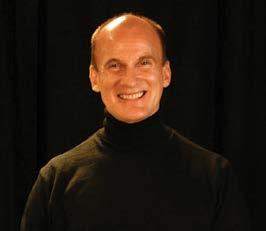 by Jaimen McMillan
Intuition is a word we have for the elusive ability to understand something directly, without the need for prior conscious reflection, reduction, or reasoning. To write about intuition then may seem counter-intuitive. This short essay will attempt, nevertheless, to shed some light on the elusive phenomenon of intuition by showing how one might engage with intuition in such a way so that it will not run away.
Spacial Dynamics can offer some insight into intuition by looking at it as a spatial phenomenon. The discipline of Spacial Dynamics studies the spatial components of movements in sport, movement therapy, physical education, work-place effectiveness, and presence in a business meeting, for example. SD also studies less tangible movements such as sensing, perception, awareness, and understanding. Intuition is one of these refined movements that are so subtle that it can be overlooked. What if this was because intuition does not happen where we are aware of it? What if intuition was a movement that took place outside of the body first, and we were then subsequently aware of it inside the body? If this is true, no wonder we would have a hard time finding it if we were looking for it in the wrong place.
Our present western civilization has largely accepted the theory that the mind is located largely, or even solely, in the brain. Questioning this presupposition may open doors to new ways of knowing. This article acknowledges that the brain is incredibly important for self-awareness. But what if the major function of the brain is to mirror our activities, and then allow for self-reflection? A mirror is not the source of the activity it reflects. Looking into the mirror before we have done a new activity would be a formula for becoming jaded, perhaps even opinionated, because any observations would be based upon see-
Sculpting Light
PAINTINGS BY VICTORIA TEMPLE
Color and the creative process have been Victoria Temple’s passion for 50 years. In that time she has gradually learned to balance inner and outer perception, marrying these dynamic polar, but interweaving, worlds. Her guiding spirits are Goethe and Schiller and she paints in a flowing stream of inspiration from Rudolf Steiner, to Bepe Assenza, to Jennifer Thompson and Laura Summer, founder of the Free Columbia painting training in Harlemville, NY. Not exactly abstract nor an abandonment of representation, Victoria paints out of the inspiration of color itself.
Trained as a high school art teacher in multiple media at the University of Washington in Seattle, Victoria subsequently spent many years working in the social justice movement in inner city communities in San Francisco, Chicago and Boston. Tempered but frayed by this experience, in 1991 her daughter, Molly, led her to the Waldorf school movement where she has served as a development director, painting teacher and parent educator.
Victoria currently teaches painting to adults at Credo High School, northern California’s first public Waldorf high school which she helped found in 2011, and at her small studio in a horse pasture in west Petaluma, CA.

GALLERY
fall-winter issue 2014-2015 • 31
Jaimen McMillan
November, 2012
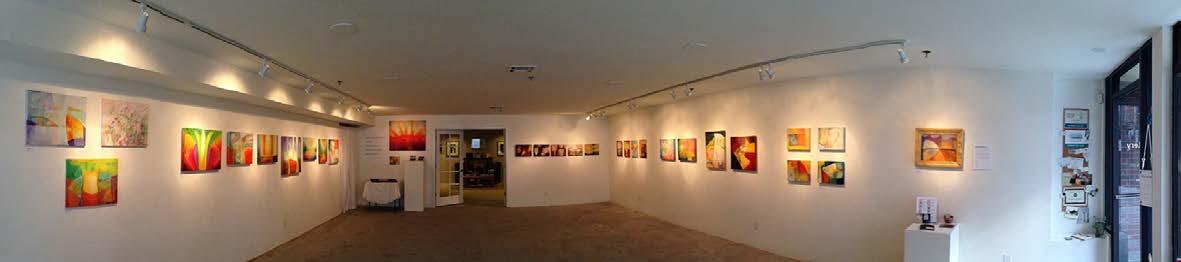


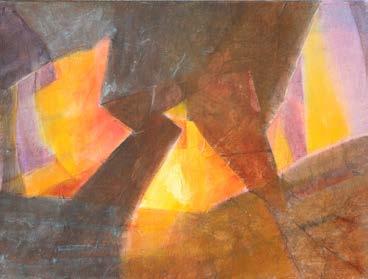


December, 2012

 Mercury, 2014
Mineral Nature, 2013
Animal Nature, 2013
Dragon’s Lair, 2013
Mercury, 2014
Mineral Nature, 2013
Animal Nature, 2013
Dragon’s Lair, 2013
arts & ideas
Old Moon, 2013
VICTORIA TeMPLe
32 • being human arts & ideas
These and other paintings were exhibited in September 2014 at the Prince Gallery, in Petaluma, CA. Owned and operated by Nathan Larimer, the gallery features local and emerging artists in Sonoma County. The artists showing in the galley range from their 20s to 70s and their work represents a wide spectrum of style and vision.
Mercury, 2014
Winter Light, 2014

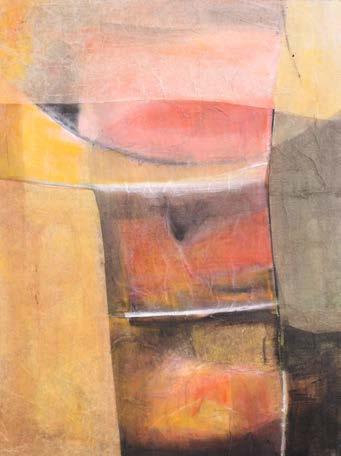

When Mountains Had Wings #1, 2012
When Mountains Had Wings #2, 2012
Spirit
“When asked how I would describe Anthroposophy to someone first encountering it, about 15 years ago, I managed to answer ‘Anthroposophy is for those who love majestic thought.’
I think painting has became my meditative way of entering into and living with Rudolf Steiner’s spiritual science.”


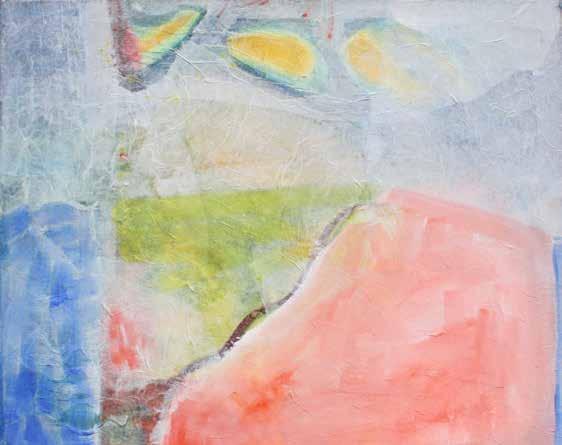
2013 Imagination, 2010
 Plant Nature, 2013
Star Nature, 2013
Nature,
Plant Nature, 2013
Star Nature, 2013
Nature,
fall-winter issue 2014-2015 • 33
Mercury, 2014
Mercury, 2014
Winter Light, 2014
Winter Light, 2014
When Mountains Had Wings #1, 2012
When Mountains Had Wings #1, 2012
November, 2012
November, 2012
November, Mercury, 2014
December, 2012
Winter Light, 2014
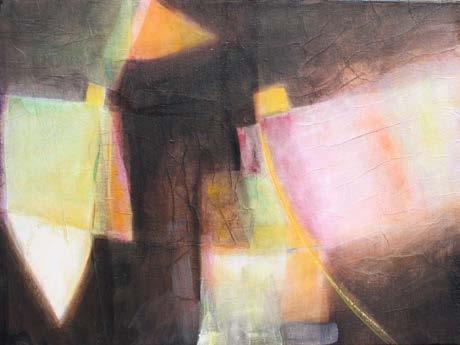

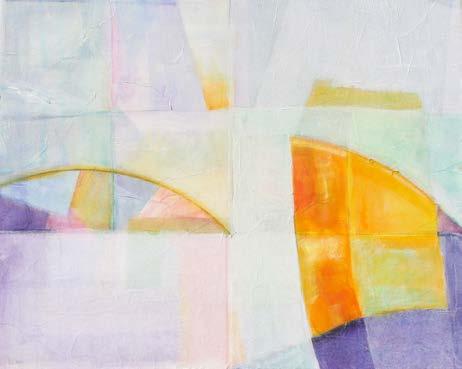


When Mountains Had Wings #2, 2012
December, 2012 When Mountains Had Wings #2, 2012
When Mountains Had Wings #1, 2012
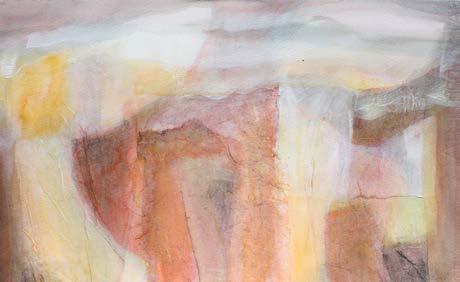
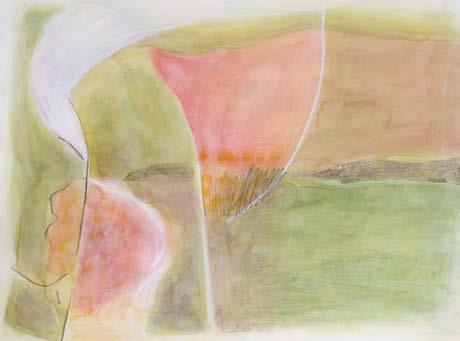


December, When

34 • being human arts & ideas
ing something only one way. Minding only the mirror would then never allow for anything new to appear in the mirror. One could postulate that the location of the mind could be anywhere a person, consciously or unconsciously, places his/her awareness.
“Mind your step!” is an old-fashioned way of telling people to place their attention somewhere else. It is an expression that lets us know that we could “in-deed” put our minds, our awareness, somewhere else besides our heads, which are the seats of self-reflection, not effective stepping.
“You Can’t Get There From Here!”
A major stumbling block in trying to find intuition is that we may be searching in the wrong place. Years ago I was searching for a horse riding stable in Michigan. I stopped and asked a gas station attendant for directions. He knew the stables well. He started to give me directions by beginning with one explanation, and then stopped in the middle, and tried another, and yet another. Perplexed, he stopped in his tracks. He finally said with conviction: “You can’t get there from here!” I never forgot these words. As ridiculous as it may sound, he was somehow right. In order to go somewhere else you have to be able the leave the place where you are, and also be at the place where you are not yet. The attendant who was at a loss to find his way to the stables might have been more successful if he had begun at the riding stables and worked his way backwards towards where we were stuck at the gas station. In a similar way, intuition can start with the end and then begin. Intuition has to do with letting go of what we already know. Moving away from our own old standpoints literally gives us space to be able to see things new, from different points of view.
To Learn Something Inside Out
When we are aware of intuition, it is already over. Intuition takes place outside the body and we reflect and record it inside. It happens with a playful interaction with the outside world. The inside reflection is what we often call intuition, but perhaps the conscious awareness of the intuition is the end result of what went on outside.
An experience of intuition can be deeply moving, and we often call such soul-moving experiences “inner experiences.” Through acute observation, however, we may experience that many strong feelings that we have—interest, fascination, awe, and surprise, for example—begin outside the body. Our body-brain based vocabulary and
worldview may well call these “inner experiences,” even though they were spawned outside. Similarly, intuition can be seen as an outer movement that can lead us to an “emerging knowing”: insight that doesn’t start from the observer, but from interacting with what is being observed, where it is being observed.
First-Hand Experiences
Our extremities, particularly our fingertips and tips of our toes, are particularly sensitive and are possible organs for intuition. An example: I had the honor of working with children with special needs, who in addition to having cognitive challenges, were also without the sense of sight. Witnessing their ability to perceive through their hands made me aware of the importance of the hands as sense organs for the unknown. Not burdened by the intellect, these individuals were able to intuitively make sense of the world through their hands. This limb-wisdom can be trained through any artistic activity such as sculpting, painting, eurythmy, handwork, and Spacial Dynamics, all of which can enliven the hands and legs, and help one to go outside of one’s body in a healthy way. One can learn to go out of the body through the fingertips or toes the same way one’s gaze can span distances without the observer losing the ability to reflect and record.
It is important to remember that an intuitive experience can involve this spatial outreach, before we are aware of this intuitive engagement. We have to learn to live into and linger with what we are observing. We could call it “staying awake in the dream.” We have to live in that dream-state long enough so that new connections are made and can gel sufficiently for them to be reflected so that we are able to reflect, formulate, and remember them. In the subsequent quiet that we give ourselves, we allow them to become conscious. Awareness of this process within the brain follows the outer dynamics of intuitive interaction with the world. Thinking that the brain creates intuition is like adoring the mirror as the producer of what it is reflecting.
Intuition can be further developed through learning how to use one’s body and what is around one’s entire body. The entire gestalt itself can become an organ of perception. Each part of the body can become a key to unlock untold secrets. If we were to go around the world with only one key trying to open every door, we would be standing in front of many locked doors. There are people who because of their limited success in getting out of their
fall-winter issue 2014-2015 • 35
locked head-thoughts make the mistake of maintaining that there is only one key, and very few doors. Intuition offers new keys for countless doors.
The Gestalt as an Organ for Intuition
Intuition can result from using our entire bodies, our gestalts, to explore with, and they can become sense organs. In Spacial Dynamics there is an emphasis on learning to experience the phenomenon of figure/ground. Most people look at a figure and they say that it is the figure, the object, alone that constitutes the form. In one way that is right. But when one looks at the whole picture more intuitively, one might say that a figure is what it is, because everything else in its surroundings is not that figure. Otherwise we couldn’t distinguish it. If one interacts with objects where they are, then intuitively one realizes that objects are made up of what they are, and what they are not.
In a very simple Spacial Dynamics exercise called the “Silhouette,” a person is helped to become aware of the form of his/her body through the help of another person who firmly outlines the form of the partner’s body.
Person A places both hands on the head of person B, and traces the shape of person B’s body all the way down to the feet and toes. This can provide an entire body experience of the gestalt. Simultaneously, as an answer to the firm pressure, Person B learns to expand beyond the limits of his/her “figure” and enter into the surrounding “ground,” slowly experiencing the surrounding space as an extension, and later a sense organ to use in the perception process of intuition. One of the challenges of the process of intuition is to hold onto it long enough to remember it, and not to kill it by making an abstraction of it too soon. There is plenty of time to test it. As poetic as the intuitions may be, if they are true, they will later become even clearer in light of true scientific processes. It is important not to minimize the role of memory and intellect in the intuitive process. The goal is to keep the process alive in a way to be able to create a living reflection of the intuitive process.
Conclusion: Always Beginning
Intuition is pure movement that transpires in enlivened space. Born out of selfless interest, it takes place outside of one’s body. Intuition, when properly nurtured, can be a never-ending source of discovery, revelation, and inspiration. It is a type of space travel that paradoxically involves going out of one’s body, without ever leaving it. Our own limbs can become organs for intuition through “first-hand” experiences. Intuition does not come from seeking answers; it involves living in the questioning. It is a gentle reaching out for engagement in a way that allows for something to reveal slowly its secrets as it flows back towards the questioner. It is learning to be content without content.

Intuition challenges us to learn to live with not knowing. Intuition does not have a goal of collecting knowledge; it is the gift that comes from mindful interest. It involves a dreaming consciously into a perception, while “staying awake in the dream.” It is a tender process of engaging with people or situations where they are, as they are, independent of any preconceptions. It is a meeting that is open ended. It is always a beginning. These words of T.S. Eliot describe the intuitive state in an intuitive way:
“And the end of our exploring will be to arrive where we started, and know the place for the first time.”
Jaimen McMillan is founder and director of the Spacial Dynamics Institute and developer of the Spacial Dynamics® method, directing trainings for movement professionals since 1980 and in private practice working with a wide range of clients, and lecturing in academic and business settings. He received an advanced degree from the Bothmer School for Gymnastics in Stuttgart, Germany in 1980 and then served as co -director of the School for 21 years.
36 • being human arts & ideas
The Light-filled Etheric Tone of the Lyre as a Gift to the Cosmos
by Chiaki Uchiyama
July 30 through August 3 the Summer Lyre Conference was held at the Cedarwood Waldorf School in Portland, Oregon, at which I teach Japanese language. Mr. Hajime Kira from Tokyo, Japan, brought his mission as a master steward of the lyre, a unique instrument with which he has an intimate soul connection.
Alongside his effective skill-building teaching, Mr. Kira’s focus was “listening” and “spacial awareness.” He identified the backside of our hand as a “listening organ,” which maintains an unbroken connection with the inaudible, etheric tones from the cosmos; while the palm side of the hand carries an intention to produce audible tones through conscious contact with the physical strings of the instrument. He demonstrated various ways to “invite” the etheric vitality of the tones from the cosmos through intentional “listening” and expansion of consciousness to the surrounding space. He designated intellectual thinking, physical tightness of our jaws and muscles, and mechanical movement as key factors which undermine our ability to “listen,” and thereby kill the life forces within tones. He encouraged the participants to release all the tension resulting from our physical, intellectual, and emotional clinging in order to allow the tones to stream through our limbs. He especially emphasized the importance of overcoming the intellectual needs of the head. He said, “We practice playing the lyre everyday so that we become able to play it as though the instrument were a part of ourselves. Just as we do not think in order to breathe air or pulsate blood, nor do we control these processes, our lyre playing should come to function as though it were a part of our rhythmic system.”
Although Mr. Kira is a quiet and humble person his teaching was dynamic and penetrated with purposeful will throughout the conference. Through his masterful guidance a distinct improvement in the quality of tones produced by the students was evident. These tones were refined each day, and by the end of the conference they seemed filled with “light.”
In Greek mythology the lyre was known as the instrument of the Sun-God Apollo. This sun-instrument fell out of use and disappeared for a long time, but was eventually “resurrected” as a Christ-Sun instrument in
1926 through Rudolf Steiner’s indications.
In the present “Age of the Consciousness Soul,” the development of the heart as an etheric organ for new quality of consciousness is expected. The etheric heart is a receptive organ. It consciously “listens” and actively reflects the surrounding space. Its development requires a dedicated commitment to disciplining the intellectual needs of the head, opening our etheric heart as its doorway, and actively inviting the cosmic forces (spiritual hierarchies) to work through us. In this regard Mr. Kira’s lyre teaching was directly applicable as a training for the “consciousness soul.”
Playing the lyre we encounter two spaces, divided by the strings: the outer, or surrounding space, and the inner space, inside the soundbox of the instrument. If we become able to play the lyre through an etheric-heart consciousness, the two spaces would mirror each other. As the human being (microcosm) is the mirror of the whole universe (macrocosm), a lyre can become a microcosm of the tonal world of the starry universe, if the musician has developed the etheric heart. When this is achieved the two worlds will become united in harmony through a lemniscatory “breathing.”
Although the lyre is a quiet and humble instrument, its future potential is vast. This instrument is waiting for the human being to become evolved to the point that its light-filled tones will resonate back to the cosmos from the earth. Likewise the starry universe is waiting for the human being to develop to the point that our speaking will resonate back to the cosmos from the earth, as indicated by the Rudolf Steiner’s verse below.
The Stars once spoke to Man.
It is World Destiny they are silent now.
To be aware of this silence
Can become pain for Earthly Man.
But in the deepening silence
There grows and ripens
What Man speaks to the Stars.
To be aware of this speaking
Can become Strength for Spirit Man.
Rudolf Steiner, on Christmas day in 1922
Chiaki Uchiyama (cnucap65@gmail.com) is Japanese Language Teacher and Program Chair at Cedarwood Waldorf School, Port-
fall-winter issue 2014-2015 • 37
land, Oregon.
What’s in the Wind?
Sound Circle Eurythmy’s First Graduation
by Helen Lubin
When Sound Circle Eurythmy in Boulder, Colorado, welcomed fourteen first-year students into its first training course in fall 2010, the tides and currents had clearly brought together a very richly varied and eager configuration of individuals, who chose the name Aspen for their class.

The course of that first year brought much of life’s ongoing juggling of family commitments, weighing up needs in dealing with health challenges, and reassessment of one’s destiny path. The transition into the second year of the training saw a group of six enthusiastic and dedicated students whose forward focus and hard work, under the direction of Glenda and David-Michael Monasch, has made possible all that led to the graduation performance on Saturday, May 31, 2014 at Shining Mountain Waldorf School in Boulder. With the festivities of this day, the final four students, Mary Elizabeth Lenahan, Amanda Leonard, Terryann Stilwell-Masotti, and Audrey Wiebe were warmly welcomed and recognized by grateful attendees.
With the Saturday afternoon event sold out well in advance, Friday’s dress rehearsal was opened up to a thankful audience, thus also becoming a chance for some of Saturday’s audience to welcome the good fortune of seeing it twice. This was indeed a refreshing, engaging, inspiring, and impressive dress rehearsal, with the performance then rising even beyond this on Saturday.
Opening with Beethoven’s Largo e mesto from Sonata No. 7, the pathway of the spoken word then unfolded from Rudolf Steiner’s verse given to the Threefold Group in New York (later to be known as the American Verse) to the first of Steiner’s weekly verses that were a core component of the Calendar of the Soul; and from there to the progression of poetic works of Fiona MacLeod (first The Bandruidh and later The Rune of the Four Winds), T.S. Eliot, a humorously edgy piece by Stephen Dunn, From the Manifesto of the Selfish, and a moving piece adapted from David Whyte’s Coleman’s Bed .
This trajectory of poetry was interwoven with an evolving mu-
sical arc from the classical to the romantic to the modern period, beautifully played by Noah Barkan (piano) and Julia Emery (cello). Coming from the opening Beethoven, we experienced Tchaikovsky, Bruckner, Gershwin, and contemporary American composer George Crumb. In a magnificent closing from Bohuslav Martinu’s Seven Arabesques, No. 5: Adagio, one could experience the transformative reality of the four diligent years singing into the newness of the present. The performance in its entirety shone as a testimony to the potential of the human being.
The artistry of the whole was carried by beautifully differentiated and exquisite costumes by Glenda Monasch, with lighting by Lisa Lindsey-Brändli (in some pieces following original indications by Rudolf Steiner). The short break that followed was vibrant with an abundance of spontaneous meetings and greetings, infused with the atmosphere of the shared artistic experience.
When the graduates reappeared, we all reconvened for the actual graduation ceremony. In his introductory words, David-Michael conveyed profound thanks and recognition to all of the co-carriers of Sound Circle Eurythmy, including adjunct faculty, musicians, SCE board members, members of the advisory circle, and most especially the spouses, partners and families of the students. On behalf of the SCE Board of Directors, Dana Sher then expressed radiant gratitude for all of the striving on many fronts that has made this pathway possible. Addressing the core of this pathway, she spoke of the “turning inside out” that one can actually witness, and that brings to realization the reality formulated in the words from Rudolf Steiner, with which she rounded out her tribute: “This is the essential point—that eurythmy is visible speech, visible music. One can go even further and maintain that the movements of eurythmy do actually proceed out of the inner organization of man…” (Aug. 26, 1923)
Representing in North America the Performing Arts Section of the School of Spiritual Science , speech artist Helen Lubin (who taught blocks of Art of Speech throughout the four years) welcomed the graduates as colleagues of the time arts (eurythmy, speech, music, puppetry and drama) and wished them strong colleagueship.
38 • being human arts & ideas
In the context of our contemporary culture’s crisis in regard to temporal experience, she looked forward to their future work becoming an enthusiastic researching and discovery of how this time art, eurythmy, serves the human being, bringing relationship and health, so that we can experience all that can come to us in the subtleties of time—all that we can meet in the living, loving quality of living with time.
Both speakers addressed Glenda’s and David-Michael’s dedicated, caring, enduring leadership and guidance in carrying the training that has made it possible for the students to take eurythmy into their lives and now into the lives of the many children and others who will come their way.
It was a moving space that opened up as Glenda then spoke to each of the graduates in relationship to the virtue connected with the month in which each one was born. Hearing this in the context of the shared experience of the performance and, for many, of accompanying these individuals from nearer or farther away throughout the four years, we could appreciate how each of these monthvirtues expands to touch aspects of all human effort and growth, and thereby to include each of us: patience leads to insight; control of thought and speech leads to a feeling for truth; courage leads to the strength to redeem; generosity becomes love.
The congratulatory recognition surrounding each graduate receiving her certificate was topped off with a final applause of celebration that spilled over into the reception, beautifully prepared by the graciously supporting second-year students, known as the Borealis group, who regaled the party with glorious and humorous presentations, topped off by Glenda and David-Michael in a eurythmy rendering of “Let’s Call the Whole Thing Off,” the lyrics of a song by George and Ira Gershwin for the 1937 film Shall We Dance?
If “shall we?” was the question that dawned four years ago as the destiny threads found their way together, then dance indeed was the heart’s experience in now witnessing this bound toward the future.
Since then, the Aspens have traveled to the Goetheanum to participate in the International Gathering of Eurythmy Graduates from June 30-July 3, where new graduates of eurythmy trainings met, performed parts of their graduation programs, had master classes, and celebrated together. Already now, we can look forward to what’s in the wind—to what will find its voice in the breath of the world.
The Scholarly Steiner
by David W. Wood
This lengthy review by David W. Wood [published in full online at http://www.anthroposophy.org/articles/] is of the first volume of a new “critical edition” of the written works of Rudolf Steiner, edited by Dr. Christian Clement, a German national teaching at Brigham Young University. Dr. Christian Clement was a Waldorf student in Germany himself and did his dissertation on Rudolf Steiner’s Mystery Dramas for his PhD in German languages and literature.
Little reaction to this edition has been available in English, but the cooperation of the Rudolf Steiner Nachlassverwaltung and of the Rudolf Steiner Verlag was the subject of controversy at the Annual General Meeting of the Society at the Goetheanum last spring. (See Anthroposophy Worldwide 05/14 for a statement by the RSN and RSV.)
Dr. Wood, born 1968 in Australia, is an independent researcher living in Munich. He has a PhD in philosophy jointly from the Sorbonne (Université Paris IV) in France and the Universität München (LMU) in Germany. Those interested in Rudolf Steiner’s recognition in the academic world will wish to read it in full online. We can only present the opening section here (omitting footnotes).
An exciting new development in Steiner research is currently taking place with regard to the publication of his written works in German. The first volume of a critical edition has appeared, edited by Dr. Christian Clement, associate professor of German studies at the Brigham Young University in the United States, and published by the respected frommann-holzboog publisher in Germany. This publishing house is renowned among others for its long tradition of critical editions and collected works of thinkers such as Jacob Böhme, Johann Valentin Andreae (the author of Rosicrucian texts), F.W.J. Schelling, J.G. Fichte, and G.W.F. Hegel. Considering the philosophical, cultural and spiritual roots of Steiner’s thought, it is a perfectly appropriate venue for an edition of his works. Moreover, Dr. David Marc Hoffmann (a leading Nietzsche specialist and head of the Rudolf Steiner Archive) and the executive committee of the Rudolf Steiner
Nachlassverwaltung are to be congratulated for their forward-thinking decision in proposing a joint distribution between Rudolf Steiner Verlag and frommann-holzboog. With this editorial undertaking it can now be said that Steiner’s written work has finally arrived in the scholarly world.
fall-winter issue 2014-2015 • 39
Christian Clement’s critical edition is a natural complement to the existing Rudolf Steiner Gesamtausgabe (GA). Whereas the latter was conceived as a reading edition of the final published version of Steiner’s writings, the Kritische Ausgabe (SKA) builds on this by additionally showing all the textual variations, additions, omissions and modifications carried out by Steiner over the duration of his career. In this respect it is directly in line with Steiner’s own intentions. Writing in his autobiography Mein Lebensgang (The Course of My Life) in an installment published 8th March 1925, i.e. a few weeks before his death, Steiner harboured the hope that future readers might examine the different editions of his writings and see that the various changes were a testimony of his desire to attain greater scientific clarity in his presentations: And whoever wishes to take the trouble to examine how in the successive editions of my book Theosophy I continually recast the chapter on repeated earthly lives, precisely to bring its truths into connection with ideas which can be won from the sense world, will find that I endeavoured to do so by doing justice to the recognized methods of science.
The first published volume of the Kritische Ausgabe is actually volume number five of a projected eight-volume edition of Steiner’s main published writings from 18841910. It contains two of his central texts on religion and mystical/scientific thought which originally appeared in 1901 and 1902: Die Mystik im Aufgange des neuzeitlichen Geisteslebens (Mysticism at the Dawn of Modern Spiritual Life), and Das Christentum als mystische Tatsache (Christianity as Mystical Fact). The contents of volume five (SKA 5; henceforth cited by page number) are as follows: a foreword by the Swiss expert on mysticism Alois Maria Haas that highlights the intellectual climate at the turn of the nineteenth and twentieth centuries, and correctly draws attention to the continuing inspiration of Nietzsche’s Zarathustra for Steiner around this time (pp. VII-XXII). This is followed by Christian Clement’s excellent and lengthy Introduction in which he outlines the principles of the edition, the Goethean and philosophical origins of Steiner’s thought, as well as providing a detailed overview of the structure, content, context, and reception of the two texts under consideration and their various printings (pp. XXV-LXXIX). The core of volume 5 is of course Steiner’s own two texts on Mysticism (pp. 3-101) and Christianity (pp. 103-230). Especially of note is the hundred-page Appendix that includes a commentary on various passages with extensive references to Steiner’s tex-
tual sources, citations and his other works (pp. 231-339). The volume concludes with a bibliography, a name index and an index of Bible passages (341-377). The hard-back cover, unobtrusive footnote system, and clear page layout are attractive and of high quality. The appearance of the next volume—containing Steiner’s texts on the paths and methods of spiritual knowledge (edited and commentated by Clement and with a foreword by Gerhard Wehr)—is expected to be in October 2014.
Clement’s Approach
The SKA is evidently a labour of careful, exact and extensive work on Clement’s part—for which one can only be grateful—and a progressive model for modern academic research into the life and work of Rudolf Steiner. Although similar isolated attempts had been made in the past to present the textual evolution for single works of Steiner such as the Philosophie der Freiheit (edited by Kurt Franz David in 1983, and by David Marc Hoffmann and Walter Kugler in 1994 for the Gesamtausgabe, volume 4a) and Theosophie (edited by Daniel Hartmann in 2004), Clement’s scholarly apparatus is more sophisticated, yet still easy to follow, and when it is completed his edition will consist of over fifteen of Steiner’s principal writings. The SKA not only greatly facilitates the possibility of examining Steiner’s pronouncements such as the scientific basis of his spiritual views and their confirmation in the sense world, but sheds additional light on the working of the man himself. Steiner considered his written texts to be both his most objective and most personal works (cf. GA 28: 443).—Thanks to this new critical edition one can see Steiner’s ongoing intellectual efforts to find the most accurate formulations, and it will better resolve disputed questions such as Steiner’s originality by putting the reader in a position to more directly compare his ideas with those of his contemporaries.
It was an inspired choice to begin the critical edition with these two texts of 1901-1902. As Clement himself remarks, it is exactly Steiner’s writings on the history of mystical and religious thought that directly concern many of the current disputes in the scholarship, especially the controversial relation between Steiner’s earlier and later thought and the place of Christianity in it (p. XXIX). Clement’s overall methodological approach is a balanced one: using the texts themselves he sensibly draws attention to earlier ideas—such as the importance of the Goethean principle of morphology for Steiner—and then points out how certain conceptions reappear in later presentations, as well as signaling other elements which do not
40 • being human arts & ideas
(cf. pp. XXIX-XXX, XXXV-XLV). Alternately, in line with this Goethean image of plant morphology Clement sees the “seeds” of some of Steiner’s later works prefigured in these same two texts: e.g. that Steiner’s interest in Paracelsus’s tripartite conception of the human being and employment of terms like ‘astral’ in the 1901 book Mysticism at the Dawn of the Modern Age had an influence on his spiritual-scientific expositions in later books like Geheimwissenschaft (cf. Clement’s commentary, p. 275). Or the perceptive observation that one can already perceive in certain passages of the book Christianity as Mystical Fact the seeds for Steiner’s later 1913/14 lectures on the Fifth Gospel (p. 323). Naturally, one has to be careful here of projecting continuity and unity into aspects of Steiner’s work in which there is none, but Clement seems to avoid many of the dangers here by noting the differences and changes as well. For example, on the one hand he shows how certain compositional motifs and key concepts in Steiner’s 1894 Philosophie der Freiheit (Philosophy of Freedom) are carried over into the Mysticism book of 1901, yet on the other hand we find a radical modification in the language of the later volume. Clement remarks: “Already the Introduction to the [Mysticism] book conceptually corresponds to The Philosophy of Freedom of 1894. […] The terminology is obviously new: What was called ‘intuitive thinking’ or ‘moral phantasy’ in 1894, is now termed ‘rebirth’ or ‘resurrection’ of the ground of existence in human self-knowledge.” (p. XLIII). In other words, there is conceptual and compositional continuity between the two works, but a rupture or change in their terminology.
Naturally, like in any other domain of scholarly research, it should not be expected that one is in agreement with all of an editor’s judgments, principles and sources, and this reviewer too has a few reservations and differing opinions. For instance, while agreeing with Clement regarding the fascinating nature and occasional helpfulness of the stenographic notes of a listener (Franz Seiler) to Steiner’s 1901/02 lecture-cycle on Christianity, notes which do not seem to substantially conflict with Steiner’s other pronouncements, I would still not give them as much weight as Clement occasionally does (among others, cf. pp. XXXIV, XLIX-LI, LIV, and in commentary, pp. 296-303). For on account of their fragmentary nature and late publication history by a third party they obviously retain a serious potential for error and misrepresentation of Steiner’s views. To understand the worldview of an author I am of the conviction that one is on the surest
interpretative ground when priority is given to, and one immanently begins with, the writings and artistic works that were published or made publicly available by the author during their own lifetime.
Clement also expresses the following opinion concerning Steiner’s transition from a scholar of philosophic/ natural-scientific works to mystical/religious writings: “[Steiner] now moved in the fields of classical, Hellenistic, medieval, and early modern literature, without being able to read the relevant Greek and Latin texts in the original.” (p. XXXI; cf. p. XLVII). This statement concerning Steiner’s inability to read the original languages is, if not incorrect, then surely open to debate, as Steiner’s 1897 work on Goethe’s Farbenlehre (Theory of Color) shows. Steiner’s commentary contains direct citations and references, suggested alternate translations and meanings for selected words, from the original texts of a variety of philosophers and thinkers writing in ancient Greek and Latin.
Just before this statement Clement had written: “In addition, with his book on the nature of the ancient mysteries Steiner approached a field of ancient science for which at that time there hardly existed any reliable sources, and for which he did not possess the necessary philological armory to carry out an examination. In 1883 he had left the Technical College in Vienna without completing his degree, and in the following years until the turn of the century he had essentially published on Goethe and philosophy and natural science of the late 18th and 19th centuries.” (p. XXXI). To me, here and in the above first example Clement appears to be making the point that not only was it a radical move of Steiner to join the Theosophical Society in October 1902, but already beforehand in 1901 and early 1902 he had surprised many of his intellectual contemporaries by speaking and writing on subjects like medieval mysticism and contemporary Bible scholarship without having traversed the orthodox academic paths. Some readers have interpreted the above words of Clement to be a dismissive rejection of Steiner as a serious scientist. I do not share this opinion. Clement certainly considers Steiner’s manner of referencing and citing as unconventional or unacceptable at times according to modern academic practices (cf. p. XXXI); and though it may be said he strikes the occasional false note in his judgments, I find Clement’s overall tone to be balanced and respectful, and sufficiently critical in the positive sense of the word. — [Review continues in full online at [ http://www.anthroposophy.org/articles/].
fall-winter issue 2014-2015 • 41
IN THIS SECTION:
In a wide-ranging interview from a book in progress, Johannes Kühl of the Goetheanum leadership talks about his path into anthroposophy and the place of anthroposophical research and insights in the fields of natural science.

Then reviews from the Rudolf Steiner Library Newsletter team explore three large questions. First is the Anthroposophical Society’s difficulties and failures during the period of fascist ascendancy in Europe. Second is how to approach Rudolf Steiner’s most fundamental book, The Philosophy of Freedom, out of today’s consciousness. And third is the rich relationship between Steiner’s work and Goethe’s great play Faust with its vast perspectives. Finally, anthroposophic doctor Adam Blanning invites us into some holistic ways of looking at illness, in this case the organic significance of a cancerous tumor.
& reviews
Interview: Johannes Kühl of the Natural Science Section
by Robert McKay
Johannes Kühl was born in 1953 in Hamburg, Germany. He studied physics in Hamburg and Göttingen, and worked on fluid dynamics at a Max Planck Institute. After studying at the Natural Science Section at the Goetheanum, he taught physics, chemistry and mathematics at the Stuttgart Uhlandshöhe Waldorf school. Since 1996, he has been the leader of the Natural Science Section at the Goetheanum and a member of the Collegium of the School for Spiritual Science. His research interests include Goetheanistic optics, quantum physics, fluid dynamics, and the relation of technology and culture. He is the author of a number of books and articles including a wonderful book on rainbows and other atmospheric colors that will soon be published in English translation by Adonis Press. He is married and has four adult children.
Question 1 – How did you first encounter anthroposophy? Can you tell us something of your journey in becoming an anthroposophist?
I was born to anthroposophical parents and went to a Waldorf school so I was destined to meet anthroposophy. Of course, there are many steps or levels of coming to know anthroposophy. One important step for me came in the ninth grade, when I was fifteen years old. Several students, myself included, asked one of the teachers to tell us something about Rudolf Steiner. We knew that the school had an anthroposophical background and that this had to do with Steiner but we wanted to hear what this was really all about. The teacher thought about it for a while and then agreed to work with the students but only in the afternoon after school was over. The work would not be part of the school but had to be a separate activity. This led to the formation of a study group that included several teachers and about twenty high school students. We worked through various texts and lectures over several years. That was the beginning of my study of Rudolf Steiner. Now, if you are born into anthroposophy as I was, there comes a certain moment where you have to decide if anthroposophy is really something of your own or not. If you are going to become an anthroposophist, you have to claim your connection to it through your own decision. For me that took place after I had finished school. I went to work on a biodynamic farm for a year, instead of doing military service in Germany. While I was there, I had time to think, and time to read in the evenings and the early mornings. Gradually, I came to the realization, yes, anthroposophy is something I want for myself. It was even a little bit that I wanted to show
42 • being human research
my parents and my teachers what it really means to be an anthroposophist…
Then I started at the university and immediately was in groups with other people studying works on physics by Steiner. The work has been quite steady since then.
Question 2 – How is it that you came be the leader of the Sciences Section at Dornach and what does this position involve?
How long do you want this interview to be? [Laughter.] I developed a connection to the Science Section during my time at the university. I had a professor, who was also a friend, who was a member of the Collegium of the Science Section. He often told us about Section activities. While at university, I went to conferences put on by the Section and got to know many of the Section members. When I graduated, I was faced with the question of whether I wanted to continue at the university with a PhD, or do something else. The idea came to me to do some research on a question Steiner suggested relating to the study of the mechanics of the human body. I asked the people at the Science Section if I could do that work there and they said yes, provided we can find the funding, which I did. So I didn’t go for the PhD at that time but developed a deeper connection to the Section.
After working at the Section for a while, I went on to become a Waldorf teacher in high school for physics, chemistry, and mathematics, but I always kept a relationship to the Section. Then the former Section leader wanted to step back because of his age and he had suggested three individuals who might take over from him. The Section members decided that there should be a meeting so everyone could speak about who the next leader should be. As it happens, I got sick and could not attend the meeting. I just couldn’t be part of it. In my absence, they decided they wanted me to take on this role. That’s how it went.
It was an interesting moment in my life. By then I had been a Waldorf teacher for fourteen years and had been feeling that something needed to change in my relationship to the students and to my colleagues. Then this opportunity came up. At that time I had a strong relationship to the Goetheanum mainly because of Jörgen Smit. His work with the Class Lessons had made a great impression on me. He died just before I took on the leadership of the Section. When the Section opportunity arose, I sent him a letter with my thoughts about it. I know he read it before he passed away. That was important to me.
Of course the role is a big responsibility and on the
other hand, it raises the question of how to stay human when you take on such a role. How do you organize your work so that you are not occupied only with lectures and conferences but you are able to do creative scientific work yourself? Early on I was not sure if it would be satisfying. When you are a teacher you have students and they need you and you have the feeling they learn something. I was not sure how I would have a similar satisfaction in this position and with this work. And there was the question of my family. How would it be for my children to go to school in Switzerland? That turned out quite well. In fact, I joke with my wife that the deeper karmic reason we went to Dornach was so that my children could find their real teachers. Who knows…
That was 1996, so I have been in the role for some time. It is not a term position but after every five to seven years, I have organized a meeting with Section members and others at the Goetheanum to review my work. In this process, people can speak to me directly or speak in confidence to a person from the Section or from the Goetheanum. This process is not part of the job description but was my own initiative and I think it has been a very good process. The Vorstand [Executive Council] and some other Sections are conducting similar reviews. It is a healthy process. It is important to give oneself a time to consider: should one leave now? Is it time for someone else now? Do I still feel called to serve in this way?
Question 3 – Rudolf Steiner clearly believed that spiritual science is completely compatible with the positive discoveries of natural science but is not compatible with physicalist or materialist reductionism. He also acknowledged that a true reconciling of contemporary sciences and spiritual science would be difficult and would take time. How do you see this work proceeding?
My first thought is that today in science it is almost impossible to speak of a general view. There are so many different views. Perhaps in some realms it is possible to identify what “mainstream” science is, but it is getting harder and harder to do. There are new considerations everywhere. This is even true in physics, for example, beginning with Roger Penrose, and others like him whose thinking is stretching into new areas. At the same time, there are scientists who have stopped thinking in a theoretical way altogether. They even use the famous advice “Shut up and calculate! Don’t think, calculate.” That is not a joke. So there are a wide variety of worldviews at the moment.
It is not so useful to try to convince people that this
fall-winter issue 2014-2015 • 43
or that worldview is right. However, it is very important to point out that materialist reductionism is actually dangerous. If we accept this idea, if we act out of this perspective, we actually put the earth and mankind in danger. As anthroposophists we need to contribute to helping people wake up from this.
Let me give you an interesting example of how materialism ensnares people’s thinking. Ten years ago there was a huge movement in Europe of people who were influenced by experiments that Benjamin Libet conducted in the early seventies. He found that in the milliseconds before someone was conscious of a decision, there is a certain signal that can be measured by an electroencephalogram—an EEG. This is the so-called “readiness potential” and based on the existence of this signal, Libet concluded the material cause of a human action comes before the conscious experience of making a decision; and therefore free will is just an illusion. This simplified idea got extensive press in Europe, for example, in Der Spiegel , as proof that free will is an illusion. Some people, for example, Gerhard Roth in Germany, even used this study and follow-ups to suggest we need to change the way we look at responsibility in the justice system. It was all based on very superficial findings and simplistic philosophy but it attracted a great deal of press and public discussion.
Then, a little while later, people were able to show that this “readiness potential” was identical regardless of what decision the person made. It would show up in the EEG in the same way if a test subject, say, decided to place an object on the right or the left. So the readiness potential shows that something is happening in the brain but is not predictive of what the human being decides. This led to other collaborations between psychologists and neurobiologists that are ongoing and open to a wide range of interpretations. Certainly the question of neurobiology and human freedom is far from settled.
Now the problem is that the students in psychology in university today in the first or second semester are still taught, since Libet, that free will is an illusion based on the initial experiments. Here anthroposophists need to take action. My daughter, for example, who is a student at a university in Germany, was quite surprised when we discussed this and I told her about the work that followed Libet’s research and that now other scientists reject Libet’s findings. “But I learned that!” she said. That’s interesting. It is publicity that establishes certain views of the human being. There I see real danger.
Question 4 – In what way is anthroposophy science? What is the same in traditional science and the work of the spiritual scientist?
In both traditional science and in spiritual science, when you describe something to another person, they have to be able to understand it. Both traditional science and spiritual science appeal to our capacity for logical, meaningful thinking.
In traditional science, the effort is made to introduce objectivity to our understanding by quantifying things— by introducing various forms of measurement. So, in addition to understanding an experiment, the other person should be able to repeat it and generate similar values. Gaining this sort of quantitative objectivity is more difficult in areas like human emotions.
For spiritual science, we take a different approach to observation. For example, when Goethe made his study of colors he observed the effect of colors on his soul. The question of wholeness in Goethe’s theory of color—the claim of wholeness—comes up because there are at least six different aspects in his study of color, including both the quantifiable and the non-quantifiable. Wholeness requires these different aspects. But this does not mean sacrificing the comprehensible or the dependable nature of these observations. A spiritual scientist must cultivate the capacity to engage many different perspectives in his work and this process can begin as it did for Goethe before one achieves clairvoyant abilities but this approach— the effort to be wholistic—leads towards this special way of engaging.
Question 5 – It is interesting to consider this idea of comprehensibility. Some of the theories of physics are baffling, for example, the idea time begins with the Big Bang. How can it be that time begins? If science is supposed to explain things, if it is supposed to help us understand the world about us, it seems that in physics the conversation has moved beyond the capacities of the average person. Is it just that the average person can’t keep up or is there something about these ideas of modern physics that is incomprehensible?
That is difficult to answer. The ideas of contemporary physics are produced by specialists so we have to imagine that a certain challenge in comprehension for non-specialists is normal. But, if we take the time to learn about these things, when we review these ideas, we should be able to follow how these ideas developed based on actual observations. If I can’t understand how an idea was developed based on observations, then the idea is at best hypothetical for me.
44 • being human
& reviews
research
With respect to the Big Bang, one can follow the steps that led up to this idea. It is complex but it is based, in part, on observations which imply a certain kind of movement of the galaxy. On the other hand, I read an article recently by an astrophysicist in which he claimed that time began 0.05 seconds after the Big Bang. Well, this is funny. Is he just being careless with his words or are we struggling to talk about things that we do not have language for?
Consider how people imagine the Big Bang. They tend to picture that they are at some point in space and from there, they can watch this tremendous explosion. Of course, if the theory of the Big Bang is correct, there could not be any “place” outside the event where an observer could be. Clearly some of the language and ways of picturing things we have from our day-to-day life do not work so well when applied to physics. Interestingly, this does bring us to anthroposophy. The further you go in an effort to understand the Big Bang, the more the ideas resemble what Steiner describes as the emergence of a phase of cosmic evolution out of the dormant state. Things begin with a kind of energy or intensity. It is true the Big Bang may be a sort of materialist counter image but there are aspects of the thoughts of the physicists that shed light on Steiner’s descriptions and vice versa.
There are similar challenges when we try to understand atomic particles. We encounter similar limitations of language and imagination. We know that imagining protons, neutrons, and electrons as little balls flying around is not right. The image of a wave is not much better. It is very hard to imagine something as a potential state. And, as we learn more, if we say that these particles are actually composed of quarks, we are using the word “composed” in a much less solid way than we normally do.
Is it just that these ideas are beyond the capacities of the average person? I think this has more to do with the challenge of applying the language and ways of thinking from the physical world to these realities. It is similar when we try to understand the spiritual in some ways. The way the concepts are given in popular culture may make them almost impossible to understand—that is another matter—but if you take the time to go into these things deeply, if you follow the observations, you see that physicists are led to think about things that are so unlike the everyday that their efforts are in some ways similar to our efforts at striving to understand the spiritual world. This requires the capacity to think into and sit with riddles and mysteries.
Question 6 – Speaking of riddles, how would an anthroposophically-informed physicist answer the question, “What is light?”
Ah, well, I think Goethe was very wise when facing this question. He noted that people go directly after this question, “what is light?” and that this leads to a lot of commentary that is not of much real use. In his unique way, he began by approaching the question from many different aspects, including with his feelings, so that he would eventually come to see color as the deeds and sufferings of light. He realized that he needed to study the manifestations of light in a very wholistic way in order to approach the central phenomena of light itself.
When we begin to think of the manifestations of light there are many aspects of human experience we need to consider. For example, sight is our most important sense. It enables us to perceive over a distance. It provides our orientation in space. In fact, we can speak of space in part thanks to light. These kinds of basic observations lead into physics. What is going on that I can see an object that is far way? We then develop the idea of emissions and absorptions, ideas which belong together. Then we try to understand this connection. Is light made of particles that fly from there to here? When that picture does not work so well, we think about light as a kind of a wave, but there are problems with that formulation as well. The idea that light is both particle and wave is a kind of compromise. So, that is one pathway and physicists continue to work it out.
There is another pathway that begins with a description I like very much: a space filled with light is a space filled with possible images. This shifts our focus to how light works in terms of conveying images. Consider the great cathedral at Chartres. Here we see light fill a space; and because of the design of the windows—only images of saints and holy stories were allowed there—the room is filled with these possible images in a way that evokes religious feelings. What are the special qualities of light that make this possible? I think there is still a lot of work to do to understand these special dimensions of light which cannot be revealed through measurement of photons.
Question 7 – In what sense did Goethe prove the existence of the archetypal plant? What was the exact nature of his experience that enabled him to say, in effect, “Yes, now I have it!” Is that
fall-winter issue 2014-2015 • 45
research & reviews
experience something others can repeat? If so, how?
It is important to understand that he was not simply imaging the stages of transformation in a plant in a simplistic way. He was imaging these transformations in great detail based on his observations based on many species. It was out of a deep immersion in this inner work that he came to the idea of the archetype of the plant. It came out of a wealth of experience.
Now it is very interesting to understand this famous conversation Goethe had with Schiller. He relayed his inner experience of having discovered the archetype of the plant to Schiller who said, “Oh, you have had an idea.” Goethe did not accept this at first. For him this meant Schiller was saying it was an abstraction. For him it was a great experience. The point is that Schiller was right provided you understand the term “idea” in an anthroposophical way. A real idea is already a lot! For in the idea, we have contact with the spiritual reality. Goethe came to realize this later. When he writes about the archetype of the animal, he writes that this is the idea of the animal.
So out of experience he came to a real idea. Now is this a proof? I am not sure you can prove an experience. Other people, though, can have the same experience, although perhaps in a different way than Goethe did. To have this experience, though, we have to have work through the stages of metamorphosis in intense inward activity. We experience, so to speak, through our own inwardly plastic activity in a way that is, as Goethe called it, an imitation of nature. If we can do this, we come to the point where we experience the archetypal plant.
We can think of mathematics here. You can write down a proof but each person has to work it through in their own thinking to have the insight and see that it is true. When you work with students you watch this process over and over again. They have to become inwardly active to understand something. Everyone has to find the reality of such things in themselves. This is the way with Goethe’s great discovery.
Question 8 – It seems to me that the laws of inorganic chemistry are very well developed. If this is the case, why can scientists not chart a path from the inorganic to the organic and duplicate this process in the laboratory? Why can’t scientists create life?
Well, we have been able to create organic substances artificially for some time and what you say about inorganic chemistry is also true to a certain degree in organic chemistry which is also highly developed.
But to address your question, we need to consider first what we mean when we say something is alive, or to say that something is an organism. Clearly an organism is something far beyond just a complex substance. When we try to characterize living entities we find that they have context they require and that they are formed out of dynamic polarities. Even the simplest single cellular organisms are highly complex. So if we try to understand the cause and effect relationships in these simplest of living beings, we are already in a vastly complex system and this complexity includes how they interact with the environment. For example, it is very difficult to even distinguish the simplest organisms from one another under a microscope. In order to do this, you need to put them under different conditions and watch how they interact with the environment. They are distinguished by their metabolism, not their shape.
If we want to understand living beings we need to think more about this relationship to the environment. That is a big clue. Materialistic approaches tend to look for ways in which things can be built up from simple elements. I am suspicious of this building block approach. I do not think we can understand the emergence of life in this building block way.
Rudolf Steiner’s conception of evolution is quite different. Current evolutionary theory sees the human being as, one might say, an end product of evolution. For Steiner, evolution begins with the human being, although not in the form that we are in now. Humanity descends from the spiritual world and undergoes a process of gradual densification and then new experiences in material life. This is a completely different way of understanding how highly complex organisms emerge and are then subject to environmental impacts.
Question 9 – Can you tell us something of your current research? What sorts of questions are you trying to answer?
Now as you can imagine working for the Goetheanum, the Section and our small institute there is only limited time for research. On the other hand I need to try to be productive in a way. So now I am:
1. Working with the literature for a new project on how to understand quantum physics from a Goetheanistic and anthroposophic perspective and how to bring that in the physics curriculum of Waldorf schools.
2. Following the most important literature on some ecological impacts like nuclear energy and elec-
46 • being human
tromagnetic waves.
3. And last but not least, there is my ongoing interest and love for light and color, Goethe’s approach and the atmospheric colors like rainbows, halos, aureoles, and so on. Currently I am working on the English translation of my book about these.
Question 10 – Is there anyone in the anthroposophical movement who has been able to follow the path through to becoming clairvoyant?
Well, no, not like Rudolf Steiner. Not that I know of. I do not think anyone has followed the anthroposophical path and gotten so far as achieving the disciplined, exact clairvoyance that I believe Rudolf Steiner possessed. But there are many people who have had various degrees of achievement. Some of these experiences seem to me to be of a more personal significance, and less about pursuing the organized approach to the path. Others though come more directly out of the path of training that Rudolf Steiner presented in such detail. A good number of my colleagues report such experiences. I try to listen carefully to their descriptions. Most of these have to do with imaginative cognition and with the etheric realm. Sometimes they speak of experiences with elemental beings. I know some of these people very well and they are serious, careful people, so in general I trust these reports. When it comes to more dramatic reports such as those by Judith von Halle, I think this more a matter of individual destiny. She herself says if one wants to develop as a spiritual scientist one should follow the rigorous path that Steiner described. So I am okay with that.
A last point on this would be to note that over the last few decades, I hear more credible instances of children reporting supersensible experiences to Waldorf teachers. So, of course, there may be bias here but it may also be that those sorts of experiences will become more common over time as Rudolf Steiner suggested they could if we meet this in our children in the right way.
Robert McKay is an anthroposophist, psychotherapist, and philosopher who lives in Toronto, Canada. He is working on a book exploring the transformative power of anthroposophy for the self and society.
Spiritual Resistance
By Peter Selg: Spiritual Resistance: Ita Wegman 1933-1935; The Last Three Years: Ita Wegman in Ascona 1940-1943
Review by Bruce Donehower
The two books under consideration for this review are an important contribution to an understanding of the complicated events that overwhelmed the Anthroposophical Society in the years immediately following Rudolf Steiner’s death—events that culminated in the expulsion of two members of the original Vorstand1 (Ita Wegman and Elizabeth Vreede) appointed by Rudolf Steiner, as well as the expulsion of nearly two thousand members of the Dutch and English societies. These events caused chaos and harm to the Society, compromised its purpose and mission (fatally, some would argue), and cast a shadow into the future that is still perceived. Contemplation of these historical events (and the personalities involved) continues to have power to ignite emotion and controversy. Some readers may shy away from this material—intuiting the depth and difficulty of the themes—while others may not be aware at all of this history. Indeed, until rather recently English-speaking readers would have been challenged to find access to the materials succinctly and cogently presented in these editions. As author Peter Selg points out, J.E. Zeylmans van Emmichoven was among the first in the latter years of the 20th century to undertake in thoroughgoing and clear-sighted manner a biography of Ita Wegman (Wer war Ita Wegman; 3 volumes; Natura Verlag, 19922), and in some respects
1 Vorstand is the German term usually rendered “Executive Council” of the General Anthroposophical Society. – Editor
2 Who Was Ita Wegman - Volumes I-IV is specially available as a set in English from Mercury Press (mercurypress.org). – Editor
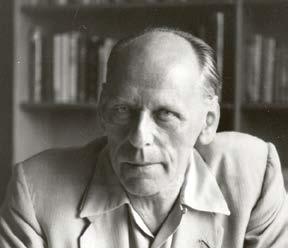
fall-winter issue 2014-2015 • 47
F.W. Zeylmans van Emmichoven
Selg’s Spiritual Resistance serves as a handy introduction to Zeylmans’ impressive and well documented work. To his credit, Zeylmans did not avoid or sanitize the controversies that overwhelmed Wegman in the 1930s, and Selg presents his materials with similar honesty and directness. The question that Selg and Zeylmans ponder— how was it possible in the span of ten years following Rudolf Steiner’s death that the Anthroposophical Society so completely disintegrated that it slandered, attacked, and exiled those who were in a real sense the closest collaborators of Rudolf Steiner? —is a question that students of anthroposophy need still to ponder, although, as was true in the twentieth century and remains true today, such a suggestion may not be received entirely cordially.
It is tempting to read anthroposophy outside the stream of history, but this is not Peter Selg’s intention; rather, as he states in his foreword to Spiritual Resistance, his “monograph describes the life and work of Ita Wegman from 1933 to 1935, in particular her confrontation with Nazi fascism and with the internal dynamic of the Anthroposophical Society.” As Selg and other recent publications in Germany have made clear—publications such as Hans Büchenbacher’s recently available Errinerungen
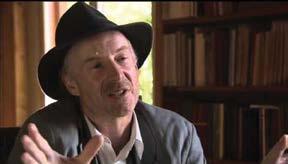


1933-1949: Zugleich eine Studie zur Geschichte der Anthroposophie im Nationalsozialismus, Mit Kommentaren und fünf Anhängen herausgegeben von Ansgar Martins (Mayer Info3, 2014)—the Society was divided and compromised on the issue of how to receive or reject the political events in Germany that led to the rise of Hitler, anti-semitism, the Holocaust, and World War II, and many members and Society leaders (including Vorstand members) welcomed the political events in Germany. Wegman saw the danger clearly, and she opposed it forthrightly and unambiguously. Her stance, as Selg documents, earned her the
enmity and hatred of many fellow anthroposophists who did not view Nazi fascism in this way. If these events of the early twentieth century were indeed the challenge to the School of Michael that Wegman thought them to be, then many of her colleagues and fellow students of Rudolf Steiner failed to meet that challenge. Selg is clear: “the general outlook of anthroposophists after Hitler seized power was primarily one of fear, horror and paralysis, but also on occasion of dubious diplomacy, partial (or complete) misjudgment, and often self-referential opportunism.” He quotes Wegman many times to this effect: “The sad thing is that many anthroposophists are allowing themselves to be seduced by nationalism and are joining in with it.” And further: “I find this incomprehensible. It shows how many people have their heads in the clouds.”
Lest, however, we think that this confusion was due to intellectual or moral uncertainty in the face of complex political/historical events, Selg also documents, as others have in recent years, the degree to which Wegman’s enemies and critics at Dornach and in the Society and in the Class were at the same time apologists to the Nazi regime—confusing the rise of Hitler’s Germany with a heralded fulfillment of Germany’s Michaelic world mission, cataloging agreements between Steiner’s teaching and Hitler’s quasi-spiritual political agenda, asserting the purity of Steiner’s Aryan teaching, and hoping, through appeasement, to avoid a confrontation that might compromise the institution at Dornach. These are hard words, but as Selg’s book makes clear, they resonate with the events of history, as such events find reflection in Wegman’s life. Thus, the welldocumented disagreements between Marie Steiner and Ita Wegman, for example, should be seen as a drama of individuals within the context of larger historical events. (“How great is the hatred of Frau Dr. Steiner against me, and to satisfy this hatred, the work of Rudolf Steiner is to be destroyed.”). Whatever animosity may have existed between these women and their partisans on a personal basis is overshadowed by the compromised response to the historical challenge posed by the rise of fascist Germany. And it is on this point that Wegman’s moral discernment remained clear, as Selg, following Zeylmans, documents admirably.
Peter Selg
48 • being human
research & reviews
The second book under consideration for this review, The Last Three Years, rounds out a reader’s contemplation of Wegman’s biography prior to her death. It is significant that Wegman was able to find equanimity following the dramatic events that culminated in her expulsion from the Christmas Foundation Vorstand and the Society. The two volumes by Peter Selg will greatly assist students of Ita Wegman’s life to understand how she achieved this quality of soul. Those who through their karma are linked to Ita Wegman will find this rendition of the final years of her life to be illuminating and instructive. Others, who have not such a connection, may find the detailed materials less gripping. It is, however, of great interest to any student of anthroposophy to understand how Wegman read the events of the 1930s in light of her understanding of esoteric Christianity and the School of Michael. In this regard, her journey to Palestine, which Selg recounts, and her inner work with the many impressions she accumulated during the travels of her final years, are instructive to those who have an interest in the meditative path. The account of her near fatal illness, from which she recovered after an experience of meeting Christ and Rudolf Steiner at the threshold of the spiritual world, leads one to pose many questions: one of which may be to ponder to what extent Wegman continued her collaboration with Steiner after his death—in which case the journey to Palestine assumes an even greater significance, most especially given the backdrop of the dire world events leading up to World War II.
In this respect, the self-imposed disaster that befell the Anthroposophical Society in the 1930s was counterbalanced, one might reason, at least in some measure by Wegman’s Michaelic wakefulness—her refusal to lose conscience or discernment in the face of overwhelming lies, hatred, slander, and betrayal. In this line of reading, as the society at Dornach disintegrated and collapsed into a private world of exclusionary esoteric concerns, Wegman remained a clear witness of the School of Michael to the event of the reappearance of Christ in the etheric world. In this respect, to read these books allows one to better appreciate the significance and contributions of one of the foremost students of Rudolf Steiner in the School of Michael. Perhaps in future years we will see more materials made available in English that will allow readers to gain a broad and nuanced appreciation of these critical decades in the history of the Society and the personalities who were active at that time.
Freedom Through Love
By Nick Thomas: Freedom Through Love: The Search for Meaning in Life: Rudolf Steiner’s Philosophy of Freedom; Temple Lodge, 2014, 54 pages.
Review by Sara Ciborski
This short book is a personalized condensation of Steiner’s seminal work The Philosophy of Freedom.1 One could say that it is a digest of that work’s main arguments, for Thomas has truly “digested” the Philosophy and made it his own.
It is not (nor is intended to be) a substitute for reading Steiner. Close study and activation of concentrated thinking are required for grasping—indeed are part of—the meaning of the Philosophy. Thomas’s book offers a different reading experience. Without quoting or even paraphrasing Steiner, he re-presents Steiner’s content in a refreshing, close-up, personal way, drawing his examples from today’s trends in thinking and contemporary situations. One of his chapter-opening sentences, for example, is the question, “How many times have you heard of (or had!) a great idea that never gets off the launching pad?”
Although he opens with the same two questions that begin the Philosophy, about the possibilities for real knowledge and human freedom, Thomas states that he will explore them “from a different starting point to suit modern times, with liberal interpretations and additions, and (as he says later) in “common-sense fashion, and deliberately non-scientifically…not out of contempt for science, but because science sets its limits and agenda so as to exclude phenomena like love and inner experience.”

Thomas recasts Steiner’s demonstration of the possibility for free human deeds as something achievable through love in thinking, feeling, and willing. Covering similar ground in the second chapter, “Levels of Freedom,”
1 Published by SteinerBooks as Intuitive Thinking as a Spiritual Path: A Philosophy of Freedom
fall-winter issue 2014-2015 • 49
Nick Thomas
he glosses Steiner’s detailed typology of motives and driving forces in two and a half pages. His summaries (in five more short chapters) of Steiner on sense perception, the objective reality of concepts, and their role in thinking are likewise succinct. Thomas provides an excellent discussion of “qualia,” the secondary qualities inhering in sense perception, and finishes with a discussion of what actually is meant by “spiritual activity.”
The brevity of Thomas’s book may raise eyebrows among readers who have diligently studied the Philosophy, with its lengthy build-up toward the fundamental insight that thinking itself is a secure, reliable starting point for knowing and Steiner’s point-by-point challenge to Kantian dualism, critical idealism, and other isms in order to demonstrate their epistemological unreliability.
Thomas is far less concerned with quashing the opposition. He does briefly respond to objections to human freedom that have been raised by positivists, skeptics, and scientific materialists (who say that feelings are “merely chemical processes in the body”). But more often, his approach is to appeal to common sense and ordinary human experience.
Common sense justifies our dismissing science for failing to “embrace inwardness in human experience” and dismissing also any mainstream philosophy that fails the test of relevance to our daily lives: “Surely the richness and problems of our relationships with other people are the most pressing and ‘real’ aspects of our life! No philosophical denial of their reality can remove them; for example, to point out that we do not know what reality is or that all our supposed knowledge is illusion does nothing to alleviate the problems we have to contend with every day.”
Thomas is an electrical engineer and former General Secretary of the Anthroposophical Society in Great Britain. He has aimed in his writings and lectures to bridge the gap between conventional and spiritual science (according to the author blurb). Given its title and publisher, this book is not likely to attract mainstream scientists and philosophers. Nor, given its conversational style, will it pass scholarly muster.
Nevertheless, to open minds, Thomas’s presentation of the case for human freedom is cogent, convincing, and inspiring. It would be wonderful if the book reached an audience of non-anthroposophical general readers. It would be accessible and excellent reading for teenagers. Best of all, for anthroposophists it suggests an effective way of speaking (to non-anthroposophists or even to each other) about the relevance for our troubled times of Steiner’s views on of love, freedom, and the meaning of life.
Anthroposophy in the Light of Goethe’s Faust
By Rudolf Steiner, Collected Works volume 272; SteinerBooks 2014, 444 pages

Review by Herbert O. Hagens
This long-awaited publication in English of Rudolf Steiner’s lectures on Goethe’s Faust (CW 272) is most welcome. We are deeply grateful to Burley Channer for his highly readable translation from the German and to Frederick Amrine for his scholarly introduction, commentary, and extensive footnotes. The colorful front cover displays a detail from the ceiling painting of the First Goetheanum, depicting Faust contemplating the letters ICH (German for “I”, “ego”).
Actually we may well consider this volume to be an “upgrade” of the German edition: English readers are treated to an additional ten short essays and three lectures that are not contained in GA 272. A chronology of all the texts (ranging in date from 1880 to 1916) provides a much needed and very useful orientation. Most of the lectures took place in Dornach in 1915 and 1916. The talks were held in the carpentry workshop (Schreinerei) in conjunction with performances of select scenes from both Faust I and Faust II. The audience consisted of many people from various countries who were actively engaged in the construction of the First Goetheanum. During all this time the battles of World War I were raging just to the north of the Swiss border.
Let us take a look at a passage from the lecture given on September 9, 1916, entitled “Goethe’s Insights into the
50 • being human research & reviews
Secrets of Human Existence.” Here Rudolf Steiner spoke after a performance in eurythmy of the “Midnight” and “Burial” scenes from the end of Faust II. First we hear Faust speaking:
I’ve only rushed my way through life; Ev’ry desire, I grabbed it by the hair, What failed to satisfy got dropped, What got away, I let it go.
I’ve only lived to crave and to achieve And then to wish for more, and so with might
I’ve stormed my way through life, first great and mighty, But now things go more thoughtfully and wisely. The whole earth’s realm, I know it well enough. Our view into the other world is blocked.
(lines 11433-11442)
Here Steiner tells us that Faust, in his final moments of life, is already “half” in the physical and “half” in the spiritual world, undergoing “the panoramic review that comes over the soul at the beginning of life after death and is now slowly coming over Faust…And so it goes, back and forth from one world to the other: experiencing in the spiritual, but also in the physical, because he is still clinging to his body. This is the state Faust is in when we find him. Care (the figure “Sorge” in German) still holds him to his physical body. But his task is to enter the spiritual world consciously, made conscious by the very Care that weighs him down” (pages 305-306).
This quote clearly illustrates that Steiner is interpreting what Faust is experiencing at the threshold from the anthroposophical viewpoint. But we do need to understand what Rudolf Steiner had in mind with these lectures. He claimed to his listeners that he was not giving explanations: “The reason is to show you that the human soul, by exposing itself to the artistic images that come before it in a performance of Faust, is really able to perceive something of what we can and must call the development or the actual living immersion of this soul into the spiritual worlds. The extent to which we can deepen our knowledge of Faust from the standpoint of spiritual science will permit us to develop further observations in connection with this poetic work. Faust is, after all, the expression of Goethe’s own efforts to enter the spiritual world, the expression, in other words, of the fact that at a significant turning point in modern history a mind as great as his was striving to enter the same world we are seeking access to today as we continue to deepen our knowledge of spiritual science” (April 11, 1915, page 105).
Mainstream scholars of German literature may find it difficult to accept Steiner’s unconventional “spiritual” approach to Faust but nevertheless they ought to appreciate how Steiner goes about unraveling some of the most enigmatic riddles embedded in this monumental work. It must also be mentioned that people should not expect a general introduction to Anthroposophy, as the title might suggest. Serious students of Steiner’s teachings will discover deeper insights and revelations on a variety of anthroposophical themes: Lucifer and Mephistopheles-Ahriman, the separation of the sexes, karma and reincarnation, the function of guilt, earthly and human evolution, older vs. modern paths of initiation, and in particular Goethe’s own spiritual development. The writings and lectures in Anthroposophy in the Light of Goethe’s Faust do provide worthwhile and inspiring study material for groups and individuals who already have a basic knowledge of Anthroposophy. We can also look forward to the publication in English of the second volume of Steiner’s lectures on Faust (CW 273).
It is regrettable that many folks outside of German speaking realms have little or no familiarity with Faust. But they can still benefit from Steiner’s lectures thanks to the generous wealth of commentary and footnotes. That is still no substitute for reading Goethe’s original great work of world literature. The translation of Faust by Walter Arndt (Second edition, Norton, 2000) is widely recommended. Anthroposophists need to acknowledge the tremendous debt to Goethe who laid the foundation for Rudolf Steiner’s spiritual science and even his Mystery Dramas. After all, the landmark building standing on the hill overlooking Dornach is called the Goetheanum! By reading and studying Faust along with Steiner’s lectures we will be preparing ourselves to experience more fully the upcoming production of Goethe’s entire play at the Goetheanum in 2016.
Herbert Hagens has been a German instructor for more than thirty years. He teaches a course on Rudolf Steiner’s Mystery Dramas in the Anthroposophical Studies in English program at the Goetheanum. Herbert lives with his wife in Princeton, New Jersey.

fall-winter issue 2014-2015 • 51
Can you have a tumor in your feeling life?
by Adam Blanning, MD
There is a very unusual description of a tumor in anthroposophic medicine, in some comments made by Rudolf Steiner, who helped to found anthroposophic medicine with a group of physicians almost a century ago. It says that a tumor is a “sense organ”—like an eye or an ear—”in the wrong place.”
That sounds very bizarre, until you spend some time thinking about the process, the activity of a sense organ, which is to create a space where the outside world can penetrate into us undisturbed. Our eye, or our ear, should accurately convey our surroundings without altering them. Those are not the only ways the outside world comes in. We breathe air, but warm and humidify it, and what we breathe in is different from what we breathe out. We take in food, but it is (necessarily) radically transformed through our digestion. Our sense impressions, however, really should come in without disruption or distortion. So our eyes, our ears, and our smell can truly be thought of as little “harbors” where the outside world comes into us.
What we do with these sensory impressions varies. Some we take deeply inside and make our own, such that we go through a kind of intellectual or emotional digestion of our experiences. It is very possible to learn facts by rote memory, and be able to “parrot them back” without really understanding their significance or application. But that kind of learning is very short-lived—like cramming the night before an exam, and forgetting it all two days later. What you have really worked through and understood in a deeper way, however, becomes your own. It is yours. And that usually stays with you for years.
Emotional experiences work similarly—some are met and let go of quickly without much consciousness. Others resonate very deeply and sculpt who we are as individual human beings. Real learning comes when we take those important experiences in and work them through, both those that are joyful and those that bring pain.
It is related to the distinction between being “conscious” and being “self-conscious.” When we are merely conscious the sense impression from the outside comes in and we are aware of it, though we may not act on it. But when we take the time to see how we are in that interaction, and see what we do (or don’t do), then we can learn
from it, make it our own, and hopefully prioritize what make us happy and connected and avoid the patterns that are destructive or isolating.
Now, there are certain times in life when an experience is so strong that we are not able to quickly let go (it is not trivial in that way), but we are also not able to fully take it in and do something with it. Instead it gets “tucked away.” It becomes something that we are conscious of on a deep level—we are still holding it—but we don’t have the time, energy, or tools to know what to actually do with it. An event from the outside world is inside of us, but not really yet part of us. We could use the word “harbor” again, but a better word might be “hole” or “vacuum” because a part of our feeling life becomes walled off, separated out, and is not incorporated into our healthy feeling life.
If this same process happens on the level of our organs and tissues—a part of us becomes separated off, holding its own process and not being incorporated into the healthy physiology of our body—that gives us a kind of functional definition for a tumor. It is in us, and of us, but not in a healthy way part of us.
There are known immunologic connections between our feeling life and our bodily health, so it is not good to carry around these “not us” experiences in our soul life if we can avoid them. Please do not interpret this to mean that someone who has a tumor has developed it as a result of an imbalance in their feeling life. But it does mean that when we have a tumor, or are wishing to prevent a tumor, then working on our soul life and working to warm and integrate all the aspects of our life is helpful.
Mistletoe extracts are often given as a supportive anthroposophic treatment for cancer. Rudolf Steiner described mistletoe’s activity as “creating a mantle of warmth around the tumor” which helps it to be met by the immune system and transformed so that it can reintegrate into the whole. The work of creating a “mantle of warmth” around our experiences comes not through reliving painful past events, but by growing our healthy sense of self for the future. Three helpful resources are: Stairway of Surprise: Six Steps to a Creative Life, by Michael Lipson; Crisis Points: Working Through Personal Problems, by Julian Sleigh; and The Quiet Heart: Putting Stress in its Place, by Peter Gruenewald, Teresa Hale.
—See page 25 for a related article by Dr. Blanning.
52 • being human research & reviews
Adam Blanning, MD, (adamblanning@hotmail.com) is president of AAMTA, the Association for Anthroposophic Medicine and Therapies in America, which is the umbrella organization for anthroposophic therapeutic associations.
news for members & friends of the Anthroposophical Society in America

From the Annual General Meeting, October 10-12, 2014 General Secretary’s Welcome
by Torin Finser
Dear Members and Friends, on behalf of the General Council and the Planning Committee it is my pleasure to welcome you to this annual general meeting and conference of the Anthroposophical Society in America. We are grateful to our hosts here at Rudolf Steiner College and all those who have worked behind the scenes to make this gathering possible. We look forward to three intensive days dedicated to the theme: Bringing Anthroposophy to Life! In letters he wrote to members in the last years of his life, Rudolf Steiner said:
In anthroposophy, it is a question of the truths that may be brought to light by it. In the Anthroposophical Society it is a question of the life that is fostered in it.
The search for truths brings us greater understanding of the world, nature, evolution, other human beings and ourselves. But if this were all, we could remain imprisoned within our selves. So in letter IX Rudolf Steiner continues:
Anthroposophy must become life in the living man, and not remain mere learning. But a thing can only become life when it is constantly fed from life. By cultivating such an attitude as this in anthroposophy, anthroposophy becomes an incentive to human love. And in human love all work must be baptized, which is done in the anthroposophical field. He then speaks specifically of the Anthroposophical Society and uses a phrase that has become one of my favorites:
One should see a sense in coming together with the other persons united in the society, to await in company together the anthroposophical gifts of the spirit.
So dear friends, we are gathered this weekend “in company together” to seek truths and awaken life!
The life forces that we work with as students of anthroposophy are not just those present in this room. We need to constantly remind ourselves of the 3,400 members who cannot be physically present here today but still carry with us the truths and the life arising out of anthroposophy. And there are those members and friends who are now working with us from across the threshold. An opening such as this would be
inconceivable without invoking the name of Sergei Prokofieff, who as you know crossed the threshold this past July. This modern esoteric leader of our movement did not ask for any personal fame or acknowledgement (in fact those of us who had the privilege of working with him knew his extreme modesty at times) but instead Sergei, in virtually every speech and book called for an intensification of our work with anthroposophy and absolute loyalty to the being of Rudolf Steiner. So rather than a eulogy, I would like tonight to simply bring forth one passage, one passionate call from Sergei Prokofieff:
As is often the case he begins with a quote from Rudolf Steiner, who said in the karma lectures, “What unites the members of the Anthroposophical Society? It is that they are to bring order again into their karma.” Then Sergei continues in his own words:
This also explains the particular significance of developing the capacity of forgiveness among anthroposophists, for if it is not developed, the Anthroposophical Society will never be able fully to become what it was to become after the Christmas Conference: a domain of conscious work on the part of spiritually striving human beings to bring order to karma.
In an occult sense this means that after the Christmas Conference the work of overcoming the old Moon karma and creating the new Sun karma was to be begun on a large scale within the newly founded General Anthroposophical Society. [p. 107, The Occult Significance of Forgiveness]
On Sunday, when we speak together of our service to the Society I hope we can explore these themes further in our fishbowl discussion, and that we can do our bit this weekend in “bringing order to karma.” How can we transform Moon karma (which is the karma of the lower ego, that which divides, criticizes, resists change) and develop in freedom new Sun karma which unites us in fulfillment of Michael-Christ in our time? How can we as members and friends this weekend and in the months ahead lay a foundation for a new community of spirit that prepares the way for the sixth cultural epoch? Through our presentations, discussion groups, and artistic workshops we will make a modest attempt at preparing the way, bringing anthroposophy to life, and new life to our Anthroposophical Society. And to get us started tonight, we will hear from a distinguished panel led by our wise Camphill elder, Rudiger Janish.
The Anthroposophical Society in America (ASA) from the Inside Out
by Dennis Dietzel, Council Chair
The story of the ASA over the last ten years can be told from many angles and I would like to share just a brief glimpse from the inside out. The Society has always had a Council which also acts as the Board of Directors, includes the General Secretary and works closely with the Director of Administration and the staff in Ann Arbor. In the early 2000s the staff of the Society was significantly larger than
53
ASA General Council, Oct. 13, 2014, from left – Torin Finser, General Secretary; Linda Evans, Eastern Region; Carla Comey, At Large; Joan Treadaway, Western Region; Jack Michael, Treasurer; Virginia McWilliam, At Large; Dennis Dietzel, Central Region & Chair. fall-winter issue 2014-2015 •
it is today, but was forced by events that coincided with the decline in the stock market to reduce staff and readjust. This left a vacancy which was courageously and ably filled by Marian León, as Director of Administration. In spite of the reduction in staff, the scope of activity continued to grow over the years, with added duties in the areas of member services, programming, and library support; while our basic staffing structure stayed the same.
In January of 2013 the Council met in Arizona where the unsustainability of our situation became obvious. Our management structure did not support an actively growing Society, our current staff was over-burdened and feeling close to burn out, and the reality was that our funds are limited. Having realized these facts we were faced with a difficult decision: maintain the status quo and hope for the best, or find a way to restructure within our budget. The Council mandated the Leadership Team (Torin Finser, Marian León, and Dennis Dietzel) to imagine a structure that would work within our resources and position us to meet the needs of our members and the greater society.
In the summer of 2013 Torin, Marian, and Dennis met in Minneapolis in Dennis’s living room to draw up the outlines of a collaborative leadership team that will serve the Society into the future. As the Council has worked with this initial imagination the positions that have evolved and are being (or have been) filled are Directors of Administration, Programs, and Development. This team will work closely with the General Secretary and Council to achieve the mission of the ASA. The Society membership is a group with incredible initiative, and we hope through this move to be able to meet this initiative with professionalism and enthusiasm.
On behalf of the Council, I would like to thank Marian and the Ann Arbor staff, Cynthia Chelius, Linda Leonard, John Price, and Kathy Serafin, for moving through this change process with us and serving the Society so well.
Report by Torin Finser, General Secretary
As described above by our Council Chair, Dennis Dietzel, our administrative staff in Ann Arbor has experienced reductions in positions over the past ten years while at the same time the needs and activities of the Society have increased. Thus, as Dennis has described, the Council began an internal review and restructuring process in early 2013 to assess our needs going forward and to clarify roles and responsibilities. As mentioned in my AGM talk
in Keene (reproduced a year ago in being human) as well as in subsequent articles by Council members, we came to an imagination of a Leadership Team of three individuals who would be granted authority and responsibility for specific areas of society activity:
• A Development Director who would focus on building relationships internally and externally, increase the size of our donor group, the Michael Support Circle, initiate planned giving and much more.
• A Director of Programs who would focus on networking with initiatives, groups, and individuals to develop Society sponsored programs that would further the aims of the Christmas Foundation meeting and bring close collaboration between those working out of anthroposophy, the Society and the School. The recent Mystery Drama festival is an example of such an activity.
• An Administrative Director who would attend to the smooth functioning of the Society, including finances, budgeting, management of staff, and oversight of our beautiful building in Ann Arbor.
We were very happy to announce last winter that the first position had been filled with the hire of Deb Abrams-Dematte, first part time and as of July 1, 2014 in a full-time position. Through the survey she conducted, recent trips, phone calls, emails and many other points of contact, Deb has already made significant progress on a number of fronts, the most recent being our successful donor dinner in Fair Oaks as part of the AGM conference. She is fully focused on building relationships and helping us realize our mission as a society.
We are now thrilled to be able to announce that Marian León has accepted the position of Director of Programs. Marian is uniquely qualified for this position through her many years of service to the Society, including her work on conferences and special events, her knowledge of the membership and her passion for serving. Unlike recent years in which she had to assume a wide variety of tasks, Marian will now be free to focus upon supporting programs that serve the mission of the society. When the decision was made to create the Director of Programs position and she submitted her letter of intent, CV, and had a “threshold/interview conversation,” it was clear that she was the best candidate for the position. It was also clear that this was the right time in Marian’s biography and in the life of the Society to begin a phase of active programming. Through webinars, conferences, seminars, and a

54 • being human
Marian León & Deb Abrahams-Dematte at Rudolf Steiner House, Ann Arbor, Michigan.
news
for members & friends
wide variety of initiatives, members and friends will soon experience how this single-focused approach will enhance the furtherance of anthroposophy in this country. Please join us in congratulating Marian in her new role!
This then leaves us with just one of the three positions to fill, that of Administrative Director. Although we have received applications, we have decided to keep the search process open until we have a larger portfolio of candidates to choose from. We anticipate candidates will be eager to be the third member of a team that includes Deb and Marian. So if you or someone you know has the qualifications described in the job description (available on the website) please submit applications to Carla Comey (carlacomey13@gmail.com). In the meantime, our staff in Ann Arbor continues their work faithfully, and the day-to-day work of the Society will continue without interruption. Already work has begun on a transition process that will include the three members of the new leadership team.
We look forward to sharing with our friends and members additional steps in the future as we strive to realize the intentions of Rudolf Steiner in the Christmas Foundation meeting and the call for the initiative and leadership that is needed for the 21st century.
Report by John P. Michael, Treasurer
As I noted in my comments to members at the AGM in Fair Oaks, we are a Society in transition: a new administrative structure, an evolving Library with a major investment relative to budget, and increased participation among membership. Our financial position is one of continuity combined with promising new initiatives. Because of these, operating expenses have exceeded operating income but we are making important investments in development and management. We are confident that these will increase financial support and membership and program income.
Obviously, all of the changes take resources invested in time and capital. Our investment is paramount if we envision moving into the future as a vibrant and relevant voice in the world. Our prudent use of Society resources we believe will attract the interest and generosity of the many we now serve and those souls we have yet to touch.
Operations this year were focused on strengthening the investment of the last two years in the areas of communications, use of our member/friends database, programming for members, articulation of a transition plan for the library, and a plan for staffing Society development.
Revenue in the form of member participation, donations, bequests, rentals, and fees was $884k. This was 93% of budget. Expenses for programming (70%), administration (24%) and fundraising (6%) were $1,020k. ASA reduced operational costs which were 94% of budget and down 12% from 2012. This combination of revenue shortfall but lower costs brought the Society in right at budget for the year.
The 2013 audit was recently completed by Maner Costerisan who concluded overall that our 2013 statements fairly present our financial position. The 2013 form 990 has been posted to the website (www.anthroposophy.org/about/).
It is with confidence that I look to the future and expect that through our initiative and heartfelt striving we will speak to the world and fulfill the potential of the Anthroposophical Society of North America.
Welcome & Regional Report
by Joan Treadaway, General Council
Once again, dear members of the Anthroposophical Society in America , on behalf of the Western Regional Council, I welcome you to our Annual General Meeting.
First I wish to introduce my colleagues on the WRC, Linda Connell and Daniel Bittleston, and gratefully introduce our new members, Rebecca Soloway from Portland, Oregon, and Micky Leach from Santa Fe, New Mexico.
What is the work of the Western Regional Council? We serve and work with members of the groups and branches from the spine of the Rocky Mountains in Colorado, down to New Mexico, up to Utah, Idaho, Wyoming, Montana, Nevada, down to Arizona, over to California, up again to Oregon, Washington and Alaska.
Group and branch life and activity require Spiritual Initiative! Without this element they can evolve into unsatisfying and eventually ineffective common work. Through individual activity that is developed and supported through the group and branch work, one furthers the ability and incentive of the single human being to “cooperate” with the gods. In addition to the individual spiritual initiative that is essential, Rudolf Steiner refers to the activity that is engendered through “our brotherly working groups, that streams upward” to those forces that are being prepared for the Spirit Self. In this working together something “hovers invisibly over our work,” nurtured by the Hierarchies that streams down into our souls for the next earth epoch. This activity is fostered through the initiative of groups and branches.
fall-winter issue 2014-2015 • 55
Asset Investments: Investments Total Unrestricted Donor-Restricted % Cash and Equivalents 500,223 384,103 116,120 56% RSF Social Finance 337,405 61,903 275,502 38% Company Stock 1,688 1,688 - 0% Pledges Receivable 19,606 19,606 - 2% Accounts Receivable 24,020 24,020 - 3% Prepaid Expenses 10,423 10,423 - 1% Current Assets 893,365 501,743 391,622 100% Pledges - Long Term 15,731 15,731Building & Equipment 490,516 490,516506,247 506,247Total Society Assets 1,399,612 1,007,990 391,622
for members & friends
We see our calling as developing the Council to be organs of perception, to meet and encourage this spiritual initiative. We can liken it to the child observation/child study strongly working in Waldorf schools, where one listens, observes without judgment, without interpretation, to discern the child’s inner being, to meet the gifts brought by the child and encourage his or her incarnation! In the same way we listen to and observe the work of our colleagues in groups and branches to perceive their uniqueness, their stories, their gifts and challenges. Each of us on the Council is responsible for contacting several states, or groups and branches, where periodic conversations and discussion evolve, often over time regarding the workings of their branch or group. These regular contacts, person-to-person conversations, much like the child study, are brought into our WRC meetings for reflection, often leading us to have a clearer understanding of the strengths and challenges of these groups and branches.
What we begin to experience, to see over time are:
Seeds of relationship building that need to be sown,
Seeds of hope that need to be sown,
Seeds lying dormant with possibilities which may not bear fruit for some time to come,
Seeds of initiative, ready to take the next steps, perhaps with encouragement from outside.
This Goetheanistic way of building a picture together as a Council is at the heart of our work, as we share these stories, taking them into our sleep life as we meet, to discover what next steps need to be taken toward meeting the individual questions raised, and even begin to perceive the silent questions which may be living within a group of members.
Our Council meets three times a year, and participates in a once-a-month telephone conference. Over time it becomes clear where we need to work with members. Our most recent pattern, now for several years, is to visit where we are invited, or at our suggestion, to visit a group or branch. After our own inner WRC meetings, we arrange for a threefold gathering with the local group or branch—sharing a pot luck meal, then facilitating a members and friends circle, where our question to participants might be “What do you see as your future?” or “What do you see as your strengths and your challenges?” and often “What is it you most long for?” It is this inner gesture of listening and having created an inner picture of the particular group or branch with whom we are meeting that comes alive in the conversation, and creates possibilities of renewed enthusiasm, renewed understanding of particular difficulties or miscommunications, and often of new direction. Often we have seen members become astonished at how much they have accomplished, as the story of their particular initiative is retold or re-imagined. Many examples rise up. Recently, in a conversation with a branch leader, I asked how the work was moving forward. Her response was that new life seemed to be growing among members and friends. She further described a new warmth and a new humanity among
the members. Asking further about why, she said simply, “Intention and activity.” She and another member had worked long and hard to discover together what had been missing in their membership. Members were longing for connection among themselves, for warmth, for brotherhood. And they found ways to nurture that. The WRC didn’t create this, but we can share the enthusiasm, this celebration of brotherhood, of spiritual initiative, inspiring other groups and branches.
In another story, members of a branch had struggled for years with small numbers attending events and members’ meetings in a community of many members and many initiatives. Through a series of visits from the WRC, we helped them to identify their challenges, along with a large gathering of members facilitated by the WRC, the branch members concurred that elections needed to take place, and a new coordinating committee took office, with thanks and good will toward the retiring coordinating committee. This was a branch where many years of conflict had alienated many in the community. New life in the branch is surely hoped for.
This is a further example of the strength of the listening gesture, participating with a branch over a long period of time, and as trusted colleagues, being able to help facilitate change in a participatory way.
We see that, through individual activity, developed and supported through the group and branch life, one furthers the ability and incentive of the single human being and of groups to “cooperate with the gods.”
“Bringing Anthroposophy to Life” is about encountering thresholds. I think that in our work with members, over time, this is what occurs. A meeting of a threshold occurs, and what is missing in their branch, what has not come about, as well as finding their question, can become apparent.
Because we have not come to “diagnose” or to hand over solutions, but to awaken in colleagues and ourselves activity that is engendered through our brotherly working together, something can stream upward, and something “hovers invisibly over our work,” nurtured by the Hierarchies.
We see ourselves as humbly offering these possibilities.
Introducing Rebecca Soloway, Western Regional Council
Rebecca’s early years were spent on a dairy farm in northern Minnesota. Despite the distance from an anthroposophical community, she encountered the work of Rudolf Steiner while still a teenager. In 1974, she made her way to the Threefold Community in Spring Valley, New York, and there took the Foundation and Teacher Training years under the directorships of Sigfried Finser and René Querido.
Following completion of her university degree in mathematics, Rebecca married Jerry Soloway and raised two children, Genevieve and Gareth. In the early years of their marriage, they lived in several locations and joined in the
56 • being human
news
Rebecca Soloway
anthroposophical work in each location: Fair Oaks, Denver, and Boston. From 1989 to 2013, they made their home on Long Island, New York. Rebecca taught at the Waldorf School of Garden City for 23 years. During her tenure there, she worked as a math specialist in the middle school and high school, was a class teacher, and carried a variety of administrative responsibilities.
Throughout the years on Long Island, she continued her work in the anthroposophical movement helping to establish an active group of the Society there. She served as a class holder for the School of Spiritual Science for the Garden City area from 1993 to 2013, when she and Jerry retired and moved to Portland, Oregon. She is delighted to find herself in the west once again, not least because she is near her grandchildren. She looks forward to rekindling old friendships in the west and working with new friends to further the work of anthroposophy in the Western Region and beyond.
Our next issue will introduce new WRC member Micky Leach.
Central Region Online
The Central Region of the Society communicates online with a website and e-newsletter. If you live in this huge region, please go to www.anthroposophy.org, click on Groups and Branches, and select Central Region from the list. There you will find contact information for regional council members, news of the region’s “Speaking to the Stars” project, plus links to the region’s monthly e-Correspondence. The November issue includes Regional Conference Calls, May 2015 Retreat, International Lyre Conference, Verses for the Zodiac, and more!
General Secretary Visits
General Secretary Torin Finser visited the new Atlanta branch in early November. He met with the planning group and shared a potluck dinner and branch meeting. Torin congratulated members on their local work and reported on happenings at the Goetheanum and nationally. He heard about many new initiatives in greater Atlanta, discussed regional potential, and ended with a sharing around his research work.
Over three days in September Torin made a whirlwind visit to schools in California, from Los Altos and San Francisco to Davis and Sacramento. The theme was parents’ relationship to schools, and the turnout was large and very engaged.
And over the weekend of Nov 20-23 Torin participated in a meeting of the School Collegium in Chestnut Ridge, NY.
Program Report
Marian León, Director of Programs

I have just returned from the 2014 Biodynamic Conference and find myself inspired, full of enthusiasm, and grateful to be part of the community of anthroposophists working in North America and in our time. Metamorphosis and transformation were prominent themes at the conference, as well as health, community, and the need to embrace complexity.
The Anthroposophical Society in America is also embracing transformation and an appreciation for complexity. I write to you as the newly appointed Director of Programs. While my day to day tasks have not yet changed as the General Council is still actively pursuing their search for a new Director of Administration, my appreciation for the potential and scope of programmatic work is both exciting and sobering.
Over the next months I shall be speaking with many individuals, including leaders from the Society’s branches and study groups, regional councils, the Circle of Class Holders, members of the North American Collegium, Section representatives, members of the CAO (Council of Anthroposophical Organizations) and leaders throughout the movement. What is the state of anthroposophy in the United States? What is being asked of the Society at this moment? How can it support both the individual striving and our collective community in a creative and authentic way? What is our responsibility to the General Anthroposophical Society and our world-wide community?
While we work to create a plan of action, there are a few programs coming up to bring to your attention:
Online Courses – Engaging with the New Images of the Zodiac, The Portal of Initiation
Three of four beautifully illustrated installments—one per season—of Mary Stewart Adams’ free course are posted, with winter constellations coming soon. These stem from Rudolf Steiner’s original Calendar of the Soul. And Barbara Renold’s course on the first Mystery Drama is already in progress, but you can register and listen to the first installments at your leisure. Links at www.anthroposophy.org on the front page.
February 28, 2015 – Destiny Paths: Honoring the Work of Sergei Prokofieff and Maria St. Goar
“Destiny Paths” is a new program of the Society, created to give recognition and thanks those individuals who have given a life-time of service to anthroposophy. The program on February 28 is co-sponsored by SteinerBooks and the Rudolf Steiner Library.
March 20–22, 2015 – Study Retreat for Groups and Branches
The second in a series at the Rudolf Steiner House. This retreat will focus on the Karma lectures given by Rudolf Steiner in 1924. Presenters include Fred Amrine and Ted Roszell.
fall-winter issue 2014-2015 • 57
The Portal of Initiation – Online Course
It is still possible to sign-up for the online course with Barbara Renold on “The Portal of Initiation.” Initial sessions have been recorded. A link to details is on the Society’s website, (www.anthroposophy.org).
Details and registration information for these programs will be available shortly. An important way to stay informed is to create your online account in our new database. A postcard with instructions will be mailed to all members within the next few weeks. For those who do not prefer to receive material via email, information will be sent by post. We ask that you help us in our communication efforts by keeping your contact information up-to-date. Thank you!
I am grateful for the opportunity to continue to serve anthroposophy through my work with the Society. Over the years I have come to appreciate each interaction I have with the many people connecting with anthroposophy and the Society. You are my teachers and my colleagues. Thank you for your warmth and enthusiasm. I look forward to our work together!
Connecting with Community
by Deb Abrahams-Dematte, Director of Development
Love. It’s at the heart of human experience and at the core of anthroposophy. Over the past several months I’ve been blessed to engage more deeply with Society members, and witness their love for humanity, the natural world, and our shared future. Though our members are diverse in their perspectives, ages, experiences, and points of connection with the anthroposophical movement, an overarching theme of striving good will connects us all.
I’m just recently back from a trip to northern California, starting in the San Francisco Bay Area, and continuing on to Fair Oaks for the Society’s Annual General Meeting and conference. It’s been a bit of a whirlwind! I had the chance to connect (and re-connect) with a number of members and friends during my travels, and am continually grateful for the friendly and thoughtful people who are part of our Anthroposophical Society community.
I started my trip in the San Francisco area, where I spent time with a former general council member, as well as several other members and donors. It is so inspiring and helpful to me, as I grow into my role with the Society, to meet and hear from all of you. I appreciate your warmth and your perspective on the past, present, and future of our work together. I also had the chance to visit Camphill California for the first time. I met several co-workers at the Heartbeet Youth Conference in September and appreciated the invitation they extended to visit their beautiful home. I was warmly welcomed
and really enjoyed my tour—especially when we got to eat a pomegranate right off the tree. This is something that never happens where I live in New Hampshire!
Then, off to the conference—Bringing Anthroposophy to Life! Rudolf Steiner College was a beautiful setting, and the staff went out of their way to make us feel welcome. Daniel Bittleston (of the Western Regional Council) and I had the privilege of hosting a conference kick-off gathering of new members. We intended to create a space where people could get to know one another and bring questions, either about the Society, the conference, or anthroposophy in general. We had no idea how many people to expect, and were gratified by the turn-out, which included over forty people, some brand new to the Society and anthroposophy, and others quite familiar. Thank you to all who participated.
Conversation was wide ranging and spirited, and included discussion about the different paths to anthroposophy and the desire to be better at bringing awareness and practice more significantly into the world. There were comments about how we can, and must, engage with the new souls and the questions of our time, and how the Society sees its role in this broader dialogue.
Some participants identified limiting preconceptions about membership in the Society, related to knowing enough, or doing the “right” thing. There are many individuals working from Steiner’s insights who are not members. Are they welcome? Yes! The Anthroposophical Society is for everyone who is interested in, working out of, and learning from anthroposophy. Please help us spread the word!
On Sunday I had the opportunity to address the membership during the morning session. I tried to create a picture for understanding the power and the importance of our community, and of gifts to the Anthroposophical Society. That’s why I’m here, to help bring that power and potential to life.
I see my role as creating opportunities for all of us to invest in the work of the Society. That is, to deepen and promote and engage with anthroposophy in the broadest sense, weaving together the people and initiatives who are bringing this inspiration into their personal and professional lives.
I’ll end with a quote we worked with at the Heartbeet conference, one that has such resonance for our work together: Maybe one thinks to be strong one should create a form. But it is much more relevant that a truthful relationship is established as a form. If one loves, one goes to those one loves, not to an empty form. It may be wrong to even look for a form. The point is that you come together, not because you agree, but because you love to be together. This is the healthiest form.
Rudolf Steiner, Breslau, 1924
Thank you for being part of the Anthroposophical Society in America, and for the gifts of all kinds that you bring. Thanks for your generous efforts in bringing Steiner’s insights into practice, now and in the future. I look forward to getting to know you all better.
58 • being human news for members & friends
Reflections from The Life, Nature, and Cultivation of Anthroposophy
Ann Arbor, Michigan, September 19-21, 2014
 by Elizabeth Roosevelt
On the third weekend of September, twenty-two people gathered at the Rudolf Steiner House in Ann Arbor for a weekend retreat on The Life, Nature, and Cultivation of Anthroposophy, the first in a series of September retreats to take up this theme. Eleven men and eleven women from around the country had responded to the invitation to discuss and support the cultivation of anthroposophical work in groups and branches. On the opening evening, as we introduced our home communities, snippets of individual biographies emerged as well. How had we come together in this new constellation? What could we build together? The answer that became clearer and clearer to me was “bridges.”
As a Society, as in this small gathering, we come together from a variety of geographic areas. We also unite various streams to form a totality—a harmonious one if we take up our tasks well. We must come to know one another more fully, to build a stronger sense of community among all. These intentions echoed throughout the conversation that Marian León facilitated on The Right Relationship of the Society to Anthroposophy. The weekend offered an opportunity to take a look at the Society (our Society) and how we are with one another.
Before arriving, participants had read Steiner’s Letters to Members, which informed and inspired conversation throughout our time together. In the final letter, Steiner offered:
The point is not that anthroposophy should be simply listened to or read, but that it should be received into the living soul. It is essential that what has been received should be worked upon in thought and carried into the feelings… If this point of view is not sufficiently considered, then the nature of Anthroposophy will be constantly hindered from manifesting itself through the Anthroposophical Society.1
Though we can say that the center of the Anthroposophical Society is at the Goetheanum, Marian shared that Joan Sleigh has suggested that we experience the Goetheanum when we gather together in groups. It is a process of becoming. My notes from that moment of our discussion read, “The Goetheanum is here.” Could we be standing in the “Goetheanum of the soul?”2 What would be the true nature of such a soul structure?
Anthroposophical ideas are vessels fashioned by love… Anthroposophy must bring the light of true humanness to shine out in thoughts that bear love’s imprint…Since anthroposophy cannot really be grasped except by the power of love, it is love-engendering when human beings take it in a way true to its own nature. That is why a place where love reigned could be built in Dornach in the very midst of raging hatreds… Love was embodied in [the Goetheanum].3
The question, then, seems to be how much love we can embody in our groups, in our togetherness. Rudolf Steiner called for “real enthusiasm and warmth of heart”4 in our group work. Is branch life in our country working sufficiently with the warmth element? Does love reign in our groups? As a Society, what is our culture? How do we work together? How is the American Society active in the world, and what do we have to bring?
In our weekend gathering, the need resounded to step aside from personalities. The key to anthroposophical branch work, it was suggested, can be found in the question that a Dutch youth group posed to Karl König in 1948: How can human beings find each other in such a way that more than their individual karma can unfold? In his third letter to members, Rudolf Steiner wrote: “When human beings come together to seek in honesty for the spirit, they also find the way to one
fall-winter issue 2014-2015 • 59
1 Rudolf Steiner, Letters to Members, 10 August 1924 (GA 26)
2 Rudolf Steiner, The Christmas Conference, 27 December 1923 (GA 260)
3 Rudolf Steiner, Awakening to Community, 23 January 1923 (GA 257)
4 Rudolf Steiner, Letters to Members, 10 August 1924 (GA 26)
Our compliments to the branch in Santa Cruz, CA, for this community event!
Leaving a Legacy of Will
others in our groups? Do we bring enthusiasm and earnestness to our gatherings? If we are to form a more harmonious whole, we must create space for the other. In so doing, we overcome judgment and foster interest. We seek variety over uniformity. We recognize and encourage initiative. Also in the third letter Steiner stated that “ in the Anthroposophical Society it is the Life that is cultivated.”


We joined in speech with Beatrice Voigt and eurythmy with Claudia Fontana. In those moments of moving and speaking together, the space was buzzing with life. We began a consideration of Goethean conversation with Harold Bush, and with Carrie Gibbons we practiced the art of conversation with Listening Bowls, handmade porcelain bowls with an outer ring of feldspar held by listeners. Just then our circle had become the vessel, lined with warmth and radiating with intention. Something new had been formed.
As the weekend drew to a close, ideas were shared about coming together for future conversations as a group, perhaps with a Skype check-in by spring. We would like to continue our work together while creating room for others to join. Perhaps we will facilitate conversations in regional groupings of branches throughout the country. There was interest as well in ongoing activity in the economic realm, the realm of brotherhood.
another along the paths which lead from soul to soul… In anthroposophical meetings people can find one another.” 5
Nathaniel Williams shared Rudolf Steiner’s advice to young people to associate, to find joy in being together. Nathaniel has taken this advice to heart in his process of building community in upstate New York. There, a group of young people joined with a shared commitment to meet regularly, cultivate openness, bring joy into their gatherings, and maintain an appreciation for the earth. Over the last several years, their Monday night meetings have grown to include a community meal, singing, study, and action. Theirs is a beautiful picture of commitment and flexibility that allows room for multiple perspectives, while each finds his or her own voice through passing facilitation and presentation.
As Fred Amrine spoke on the theme of presenting anthroposophy to the general public or to members, he reminded us that anthroposophy has a mission of healing. There are no passive, timid anthroposophists. Fred also spoke about the need to build bridges in the way we speak about anthroposophy. We are tasked with finding a common language to meet those outside of our own circles.
Again and again, we were called to find true fellowship. How do we welcome someone in? How do we welcome someone home? In our meetings, we should find more than when studying alone. Do we look forward with joy to seeing the
The Society, it was suggested, has a free, undetermined spirit of where things are going. If this weekend was any indication, then we are a Society working toward greater collaboration, open listening, and honest dialog.
As I drove away from Ann Arbor that Sunday afternoon, a rainbow spanned the sky—a bridge from north to south that bore aloft our shared intentions and our earnest, heartfelt striving.
Postscript
In addition to those mentioned in Elizabeth’s reflections, we would also like to thank Harold Bush, Ryan Boynton, Lori Barian, and Carrie Gibbons for their presentations on the Letters. Several individuals who attended the retreat offered to speak with communities who would like to know more about the weekend conversation. Several ideas were sounded, including a willingness to meet by phone, regionally or with individual communities. A fund was established to help provide support for communities who may need assistance in sending someone to future gatherings. If you would like to know more about either of these offers, please contact Marian León at the Society’s office in Ann Arbor (marian@anthroposophy.org). Our next study retreat on The Life, Nature, and Cultivation of Anthroposophy is scheduled for September 18—20, 2015! Thank you to all who participated!
— Frederick Amrine, Marian León, Nathaniel Williams
you know?
a planned gift doesn’t usually affect a person’s current income.
Did
Making
BRING EXPRESSION TO YOUR INTENTION AND LOVE FOR ANTHROPOSOPHY INTO THE FUTURE PlannedGiving_QTR AD_FINAL.indd 1 10/25/14 6:44 AM 60 • being human news for members & friends
For more information, contact Deb Abrahams-Dematte at deb@anthroposophy.org
5 Rudolf Steiner, Letters to Members, 3 February 1924 (GA 26)
Renovations at the NY Branch



The summer renovation of “Anthroposophy NYC,” the New York Branch of the Anthroposophical Society, actually began in spring 2014 when the council decided to allocate funds toward the refurbishing, streamlining, beautification, updating and revitalization of the bookstore, the auditorium and the offices. The funds were part of a generous bequest by Fairchild “Bibi” Smith, a long-time branch member, which also allowed for establishing an emergency reserve fund.
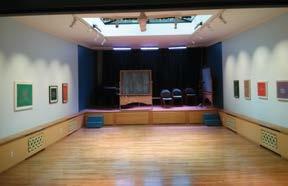
The branch owns its building, a four-story brownstone at 138 West 15th Street between 6th and 7th Avenues in Manhattan, and tropical storm Sandy made all New Yorkers aware of ownership risks. Improvements have been made to the ground floor spaces used by the branch ever since it moved in, in the late 1980s. It was time again for repairs and improvements.

Laura Tucker, as well as the seemingly indefatigable staff veterans Silvia Mandel, Marianna Regis, and Joyce Monges, who is still immersed in the massive task of reorganizing files!
The newly-blue bookstore is open for business again. Josh and Laura and their team have reorganized the book categories and display (a real challenge in a truly holistic bookstore), and the bookstore is now open every afternoon plus three mornings and two evenings. The new sculpted sign has had a powerful effect; many visitors in the first weeks remarked on how good it was to see a new bookstore open!
Throughout, Daniel and Ryan worked as a tag-team, hiring various contractors to complete the work of painting, construction, lighting design and installation, and floor refinishing. They each also managed to attend to hundreds of details, from replacing doormats to buying light switches, shopping for curtain fabrics to getting chairs re-upholstered, pursuing contractors and negotiating with the neighbors over a new storefront bench (it was not acceptable, after all).
Project coordinator and branch council member Daniel Mackenzie worked with project manager Ryan Freeman to create a truly communal, collaborative effort involving the help of many branch members and volunteers. Ted Petrenko built both a wonderfully practical and impressively constructed storage structure behind the stage curtain, and an attractive archway in the bookstore that was conceived, designed, and later carved in an anthroposophical style by David Anderson. John Beck helped clear spaces, reorganize storage areas, and sort out old documents and property. Some dated from the time when speech artist Lydia Wieder and eurythmist William Gardner lived and worked in the building.
The Rudolf Steiner Bookstore is the branch’s main way to meet and greet new people. Joshua Kelberman led the charge of the bookstore staff, moving the entire contents of the bookstore into the auditorium to allow floor refinishing, and then back again almost single-handedly. He was helped in various other organizational matters by his new managerial partner

Most of the aesthetic decisions were advised and approved by ad-hoc committees of certain council members (notably Walter Alexander, Joyce Reilly and Doug Safranek), and a few outside advisors including Rudolf Steiner School teacher and anthroposophical architect Yael Hameiri and Free Columbia’s Laura Summer.


One of the stars of the project was Lachlan Grey, hired to bring his considerable woodworking skills and creative inspiration to a variety of projects. The results include his “retroanthro” wooden chairs, an imposing new bookstore desk, the gorgeous mantle piece, the bold bookstore sign, and most impactfully his beautiful storefront sculpture which brings Rudolf Steiner’s Jupiter Seal into three dimensions. These truly lend the branch a powerful, organic, and even stylish flair, rooted in anthroposophy yet entirely in step with our metropolis.
Reporting and photos by Daniel Mackenzie, Laura Tucker, and John Beck.
fall-winter issue 2014-2015 • 61
New signs, vivid colors (clockwise from top): View from the street. Lachlan and Daniel with new sign and Jupiter Seal. Red bathroom. Meeting room. Violet bathroom. A corner of the bookstore. Center: Entry hall & library corner.
Goetheanum Leadership
Message from Dr. Virginia Sease Dornach, November 2014
On the occasion of the Annual General Meeting from March 27 to 29, 2015, after 31 years as a member of the Executive Council (Vorstand) of the General Anthroposophical Society at the Goetheanum, I have decided to enter the status of Executive Council Member emerita, having now reached my 79th year. Despite stability of health and joy in the work, one fact is decisive for me, namely that in the future decisions taken by the Executive Council may not have followthrough by me for a sufficient length of time.
I will, however, remain responsible in the Goetheanum Leadership for the coordinating task in regard to Class Holders and members of the First Class of the School for Spiritual Science. Also I will continue to participate in the weekly meetings of the Leadership of the General Anthroposophical Section.
Other areas of my work such as Lessons of the First Class, Conferences, lectures and the Anthroposophical Studies in English Program will continue without interruption.
Constanza Kaliks is nominated
The Goetheanum's Executive Council has nominated Constanza Kaliks, leader of the Youth Section, to join the council. This was announced on Members Day on November 7, 2014 at the Goetheanum.

For the forthcoming Annual General Meeting of the General Anthroposophical Society to be held in late March 2015, there will be a proposal to the members voting that Constanza Kaliks be confirmed as a member of the Executive Council. The General Secretaries from various countries welcomed the proposal at their November meeting. The leadership of the Youth Section, which Kaliks took on in 2012, will remain as her responsibility.
Born in Chile in 1967 and raised in Brazil, Constanza Kaliks earned a degree in mathematics in São Paulo and studied at the teacher seminar at the Goetheanum. For 19 years she taught advanced mathematics at the Rudolf-Steiner school in São Paulo and was a lecturer at the local teacher training college. She successfully defended her PhD on Nicolaus Cusanus in August, 2014.
Sergei O. Prokofieff †
January 16, 1954 • July 26, 2014
by Justus Wittich, Goetheanum Executive Council (Anthroposophy
Worldwide 09/14)
After three years of serious illness, Sergei Prokofieff crossed the threshold of death in the early morning hours of July 26, 2014—only one day before more than 300 members of the School for Spiritual Science were to meet at the Goetheanum for a week-long opportunity to deepen their work with the School.
Intensive work with the mantras of the First Class (the subject of the last major work he completed) coincided in a special way with the commemoration of Sergei Prokofieff’s life. On July 29 a throng of several hundred people passed by his coffin in the Carpentry Building where there was scarcely enough room for the many who attended the Christian Community committal service at 2:00 p.m. European General Secretaries, representatives of the anthroposophical movement, and Erzoberlenker Vicke von Behr came to the Goetheanum for the service. A written version of Peter Selg’s eulogy can be found in this issue [posted at www.anthroposophy.org]. A memorial in the Foundation Stone Hall rounded out this intensive week on August 2; it included personal recollections by members of the Executive Council and friends in the Anthroposophical Society as well as artistic contributions.
Difficult Years at the Start of the 21st Century
Sergei Prokofieff’s acceptance of emeritus status in 2013 and his death mark the end of a particular human constellation in the leadership of the Anthroposophical Society. It was one that began when Manfred Schmidt-Brabant initiated an invitation to Sergei Prokofieff, Bodo von Plato, and Cornelius Pietzner to join the Executive Council, thereby doubling the number of members in 2001/2002 (Virginia Sease, Heinz Zimmermann, and Paul Mackay were already members). In a certain way this brought into the Executive Council a representative from the East, one from the West, and one from the Middle—younger individuals in their forties. This Executive Council community (together with the Collegium of the School) had to confront the difficult years at the start of the 21st century, years marked outwardly by the failed attempt at a new constitution, legal challenges, and financial worries, but also by many challenges to the operation of the Goetheanum itself—alterations in the stage, changes in the Sections, and much more. The Executive Council and the Collegium of the School often held differing viewpoints about how these developments would take place and where they would lead. Although very little of that was outwardly visible, it clearly hindered the effect of the Goetheanum in the world.
Sergei Prokofieff participated in all these processes, lengthy discussions, and difficult decisions leading up to the serious financial turning point in 2010—even though he was prin-
62 • being human news for members & friends
cipally concerned with the work of Rudolf Steiner. During the newly instituted seven-year vote for members of the Executive Council (and a no-confidence motion) in 2011 he emerged with more votes than the others—and he felt this to be a confirmation of his efforts. He became seriously ill shortly after Easter, 2011, and—no longer a participant in the discussions and decisions—he took an increasingly critical view of developments at the Goetheanum.

He made this unmistakably clear in his last address in the Great Hall on March 30, 2012, during the remembrance for Rudolf Steiner held as part of the Annual General Meeting. The sense of responsibility for the Society he shared with the entire Executive Council could be clearly sensed in the course of two later conversations with them— but it was destined to be too late to allow for a new beginning.

John Gower Root, Sr.
April 20, 1925 — June 29, 2014
Eulogy by Rev. Liza Joy Marcato
Today we gather together to accompany our dear John Gower Root, Sr. on his further way into the heights and widths of Spirit towards which he turned his attention and his love his whole life long and to celebrate this life together in all its richness. He was Johnny to just about
everyone, Fa to his dear children and grandchildren.
Johnny Root was born April 20, 1925 at the American Hospital in Paris, France. When he returned home at three months old with his family, he was driven to Maine in the sidecar of a motorcycle, which became a lifelong passion: motorcycles and cars and interesting vehicles of all kinds.
His mother Jeanne Gwendolyn Gower was a gifted soprano but due to a fire in childhood which resulted in facial scarring, she never went professional with her singing. She was deeply committed to anthroposophy and The Christian Community.
On his mother’s side came an inheritance of language, as they were descendants of the poet John Gower, a contemporary of Chaucer; and on his father Waldo’s side, a real new American stream with descendants arriving in the new land already in 1632. The Roots a hundred years later helped settle nearby Sheffield.
As a four year old visiting his family’s house on Bailey Island in Maine, with his insuppressible curiosity to understand how things work, he stuck his finger in a windmill apparatus, and cut off part of it. When he got stitched up, they wanted to give him an ice cream for being such a good boy, but Johnny wouldn’t have it—he was afraid the ice cream would come out his finger!
At the age of six or seven years old, during the Depression years, someone stole little Johnny’s bicycle. It bothered him deeply, but he thought it through and decided that the person who took it must have needed it more than he did. The experiences during those years left a strong impression on him which he carried through his life—one of both im-
measurable generosity, amazement at abundance and creativity in making do. Even much later in good times, when his wife and children would come home from shopping, he would remark “Well, I guess the Depression’s just about over!”
Johnny’s mother was older than his father, and she felt he should have a younger wife. But Waldo had also promised her that he would become an anthroposophist—which never came to fruition. They divorced. Waldo remarried and brothers David and Johnny were joined by two half-brothers Tommy and Dougie. The big age differences made it difficult to get particularly close but Johnny had a cordial relationship with everyone. His parents even maintained a friendship over the years.
Until 1936, the family lived in NYC. Johnny attended the Rudolf Steiner School—but not for long. He was a bit of a hellion back then, as his schoolmate called him: “a naughty boy.” He was kicked out of the Steiner School, and at 11 years old, he moved with his mother to Jug End Road, where his grandmother “Glam” lived. Soon he attended the Lenox School for Boys, and boarded there. There he learned the Bible in and out, and thrived in his studies. When he was 16 years old, he wanted to get home, but was having a hard time arranging it with the train—so he found the old school station wagon in the garage, and availed himself of it. Of course, the school called the police, and soon, Johnny found himself in a high speed chase with the local police, 90 MPH through the country roads... When they finally caught up with him, the police officer who stopped him first said to him, “Man, you’re a helluva driver!”
While this story is characteristic of Johnny and his love of cars—it is also characteristic to note that he never really let go of it, muttering in his later years in self-dissatisfaction about how he should not have done it.
During the summers and also after high school, Johnny worked on the farm. While haying and raking behind a horse one day, the horse bolted, and dragged
fall-winter issue 2014-2015 • 63
for members & friends
Johnny, stuck in the rake, all the way across the field and down to Blue Rider stables, breaking his leg. That rake is still at the bottom of the drive.
He met his best friend Walter Leicht on the farm. Walter was a refugee from Nazi Germany, who now had to go to war as a US soldier. When Pearl Harbor happened, Johnny wanted to join up, even though he was too young. At 17, he joined the army, and went off to boot camp. Pneumonia and a cyst at the base of his spine kept him from going abroad, but the experience in the army left a strong impression on him. Johnny was always such a moral and fastidious young man—and the crassness of the other soldiers, especially in regard to the opposite sex shocked and upset him.
Another friend of his from the Lenox School was killed (Jimmy Williams) in battle, and Johnny visited his parents every year thereafter. His children remember going with him. For years, he sent money to his old babysitter, whose son was also killed in the war.
His mother was incredibly selfless, and was probably one of his greatest influences. Even after the divorce, when his mother could have asked her exhusband’s family for money for support, she instead chose to line her coat with newspapers for warmth. She had grown up with anthroposophy and The Christian Community, and it was natural for Johnny to find his own path here as well.
Along with Walter Leicht, Johnny learned the art of draftsmanship. On the GI Bill, he also went to Bowdoin College at someone’s suggestion to “go be one of Fritz’s boys!” Fritz Koelln was a professor from Germany teaching at Bowdoin, who was also an anthroposophist and led many young men to spiritual science. But he would do so by responding to their questions which arose in class, saying “Just remember, you asked me!”
Johnny majored in German at Bowdoin. During this time, he drove down in his 1926 Studebaker to the NYC “Headquarters” at 211 Madison Ave, where he met Nancy, who had just graduated from Bryn Mawr.
Sitting in the audience seeing her perform Eurythmy on the stage, he turned to the woman next to him and said, “That’s the girl I’m gonna marry.” The woman looked at him—he looked no older than thirteen years old—she thought him a “whippersnapper”—that was Nancy’s mother, Gammer.
The two had their first date on January 12, 1947 and fell in love. When Johnny told Fritz Koelln about Nancy, and asked him “Fritz, will you marry me?” Fritz answered “I can’t, I’m already married.” The two were indeed married by Fritz on March 21, 1948 at the Steiner School in New York. They went to Europe for Johnny’s junior year abroad, where he studied with Ernst Lehrs and others. Johnny got a motorcycle—a 1300cc Indian—a great bike they used to make in Springfield, MA—and they took many trips over the Alps in their black leather outfits. Nancy studied eurythmy in Dornach on the weekends.
John Jr. was born in Portland, Maine when they returned home. Ann Elizabeth followed three years later and Christina three years after.
Johnny got his Masters at the University of Maryland and started a PhD at Columbia University, but the academic life was wearing on him, and when he was offered a teaching position at the Steiner School in New York, he took it. He later regretted not getting his PhD, which he felt kept him from becoming a professor at the Anthroposophical University he hoped to start with other anthroposophists (what later became Sunbridge College).
But as it is with these important twists in our destiny, his holding back one possibility opened up a very important door. He became a much loved high school teacher at the Steiner School, who for the next twenty-six years inspired and touched the lives of many, many young people. Nancy taught Eurythmy. He taught just about everything under the auspices of History and Literature, but his best loved courses were Parsifal, Ancient Philosophy, and Mechanical Drawing with Perspective.
It was the late 60s, and the spirit of revolution and renewal was in the air. The story of Parsifal as he brought it to these young idealistic minds transformed their lives, giving them the feeling they were part of something much, much bigger and that they all had a role to play in world evolution.
He was a patient teacher, and an incredibly upbeat colleague. He was full of humor and good will, gentle, and a master of playfulness. He knew how to recognize and encourage you—but also give you the kick in the pants you needed. He was incredibly insightful.
During his years in New York City, he and Nancy were very involved in the branch work of the Anthroposophical Society, filled with love for anthroposophy, and a great sense of duty. Johnny was particularly gifted at sorting through the messes that arose between people. He was often down at Headquarters, as was Nancy. He also traveled to Europe to help sort conflicts in the larger Anthroposophical Society. They were faithful members of George and Gisela O’Neil’s study group on the Evolution of Consciousness with the Kress’s and Pusch’s. Anthroposophy was part and parcel of everything they did.
Johnny’s love of practical things and automobiles led to the transformation of a chassis into the Goetheanumobile, as people called it, which the family used for cross country treks over the years. He also converted a city bus into a motor home in which he took his students on trips all over.
One of the impulses of anthroposophy that moved Johnny deeply was the impulse for a threefolding of society. The threefold social organism involves clarifying the economic, rights and free cultural spheres that human culture may thrive and develop, and the ideals of brotherhood, equality and freedom can truly be put into practice. Johnny longed to make the Waldorf school more accessible and looked into ways to make it more an expression of threefold ideals—looking into ways to serve the underprivileged population, but he
64 • being human news
found little or no support for these ideas at the school. When Nancy made it clear that she didn’t want to die in Jackson Heights (in Queens, where they lived), Johnny took it as an impetus to start a new chapter.
Leaving high school teaching behind, the family moved to Jug End Road and the Berkshires where his ancestors had long ago settled. This began a time of starting projects. With Owen DeRis and Bob Swan, he set up a land trust, which the family is still part of to this day. Johnny wanted to live off the grid, self-sustaining, in an anthroposophical community. With a bumper crop of apples and the help of John Jr, the first Community Supported Agriculture farm began on Jug End Road. Berkshire Village came into being. Johnny and John also started a recycling business that ran from 1995 to 2001. And while there were many successes along the way, there was something in Johnny’s impulses that never really could be realized the way he hoped. Money was lost, disappointments flourished.
While he was masterful in his teaching capacity and as a mentor for others, as a social entrepreneur he remained something of an apprentice. He was wildly interested in the practical, loving the material and mechanical world, but his practicality was very CREATIVE, and was not always practical to others! About his childhood accident from sticking his finger in the windmill and getting it cut off: he said “It did not deter me from my fascination with the mechanical.” He could build all sorts of contraptions—but they were always somewhat unique. He was in a sense, too far ahead of his time, even himself in a certain sense. He was not one for the nitty gritty. Even in the Anthroposophical Society, it was Henry Barnes who was gifted in the administrative side, not Johnny. Johnny’s strength lay in his incredible ability to clean up messes and smooth things out between people. He was a great executive director, but never a general secretary, which did cause him some pain.
But many people were guided to their own paths by this ever playful, boyish spiritual leader. He was a leader because of his faithfulness to the spiritual path, his utter devotion to practice and learning and his great concern for the development of others. Out to dinner at a restaurant with others he had a lecture by Rudolf Steiner on his lap, which he was either reading or translating. His leadership in the School for Spiritual Science was important for many, and his free renderings of the texts were deeply appreciated. He was instrumental in the founding of the Berkshire-Taconic branch, the Chanticleer newsletter, the Teacher Training at Antioch, and very active in the deliberate mentoring of others—including his two sons-in-law and numerous Waldorf teachers. He taught out in California at Highland Hall and widened the circle of those he touched.
He loved music, and his perfect pitch and beautiful tenor voice have been cherished by all. He brought down the house on more than one occasion— singing in the Steiner School chorus and shows, and the Berkshire Choral festival. When he could not remember his lines in a Gilbert and Sullivan musical at the Steiner School, he improvised rhymed lines. Even up till the last, he sang along when someone visited him and played guitar for him.
In 1979, he was diagnosed with late onset diabetes, which Nancy helped him manage through his food intake. No more sugary sweets made things challenging, life lost some of its sweetness— but the family got creative and learned to sweeten things in healthy ways for Fa.
His dexterity and playfulness in language is imprinted in all those he knew, from the endless stream of nicknames— Snipe, Snips, Whips, Snippity Snoop— to his taking to heart Rudolf Steiner’s advice on changing handwriting to develop strength in one’s life forces, to witty answers, as when his daughter called late at night and said “Hi Fa, I hope I didn’t wake you.” “No,” he said, “I had to get up to answer the phone anyway.”
His life was one of a dance between adventure and devotional practice to the inner life. He built a home for his family and for his work in this dance. He could be asked about any happening in great world evolution and tell you in which epoch it would or did occur.
In his last years, his grip on the practical reality of earthly life slipped further as dementia set in. But many recount that they could still have incredible spiritual conversations if you were willing to wade through a bit with him. All the ideas and spiritual work he did in devotion to anthroposophy and the Christian path combined with his incredible love of drawing of architecture and temples—we can perhaps imagine him now entering that world of light he worked to understand and teach here on earth with an amazing wonder and joy and readiness to work hard building that new city of humanity the New Jerusalem.
His long and loving relationship with Nancy—66 years this past March—will continue to buoy him and guide him as he reunites with loved ones over there— perhaps now teaching them of all he learned in life—and he will now work to stay connected with all those still on earth who he loves and has mentored through the decades. He will continue to mentor if we but ask him.
His question to the grandchildren was often: Have you been good? And to many: Are you serving the cosmos? We can end with a quote by his beloved teacher Rudolf Steiner that Johnny lived with and made his own translation of, from the first sentence of The Michael Mystery (Anthroposophical Leading Thoughts):
The age of Michael has dawned. Hearts begin to have thoughts. Inspiration can no longer flow from mere mystical darkness but from clear soul brightness—thought informed and thought sustained. To understand this is to take Michael to heart. Today thoughts that strive to grasp the spirit must spring from hearts that beat for Michael, the fiery thought-prince of the Universe.
~Rudolf Steiner (trans. by John Root, Sr.)
fall-winter issue 2014-2015 • 65
for members & friends
Nancy Mitchell Root
September 25, 1924 — July 12, 2014
Eulogy by Rev. Liza Joy Marcato
Just 13 days ago, our dear Nancy Root sat in the front row here at her beloved husband Johnny’s funeral—and true to her word, the two have, within a relatively short span, crossed the threshold together. We gather now to celebrate Nancy’s life and accompany her crossing into the world of the Spirit.
Nancy’s family, like her future husband’s, were also descendants of some of the first Europeans to set sail for the new world, arriving in 1639, and soon thereafter to provide Harvard with its fourth president. In the 1800s the family set out as pioneers for Indiana in a Conestoga wagon. Nancy’s grandfather later started the Indianapolis News. Her mother made the move back east when she went to Bryn Mawr College, along with her sisters. Nancy was born to Mary and Harold Mitchell, and an older sister Evelyn, on September 25, 1924 in Fall River, Massachusetts. When Nancy was born, the family moved on, traveling for her father’s work in public health, finally landing in Jackson Heights, Queens.
Nancy’s family was close-knit, warm and loving. She also had extended family in upstate New York who she loved to visit, and a beloved nurse Isabel, who later would nurse Johnny’s grandmother. Nancy’s was actually an incredibly happy childhood. Her father “Mitch” became the Public Health Commissioner of New York, and worked to provide school lunches and immunizations for all children. When Nancy’s mother “Gammer” was visiting cousins the Macbeths, where one of the sisters had died in childbirth, she found a book by Rudolf Steiner on understanding death. Anthroposophy became Nancy’s mother’s passion, though her father found it completely uninteresting.
When Nancy was eleven years old, in 1936, Gammer wanted to take the girls to Europe—so she could see the Goetheanum, the world center for anthroposophy, and the girls could each
pick a country to visit! The girls did not want to visit Germany because that of that horrible man in power, but they ended up there as well for a time. They set off on the Queen Mary for an adventure that would leave a deep impression on Nancy and influence her own life in many ways. It was on this trip that Nancy saw eurythmy for the first time, forming a seed that would later blossom.
Back in Jackson Heights, she attended the Garden Country Day School, a very supportive and stimulating educational environment for Nancy. She also met her lifelong friend Philly Lou there. From there she went on to Bryn Mawr as her mother had. It was wartime, most men were off at war, and the all-women’s college provided Nancy with some of the best years of her life. She drank in the experiences, studying philosophy with Paul Weiss, who called Bryn Mawr “the self-chosen destination of the most intellectual, intelligent, determined, and well-prepared young women in America.” That was Nancy! She had a very philosophical, analytical mind, but she also worked hard to make her thoughts experiential. She was also an avid reader of literature, especially the classics.
She made the most of college, and after graduation, went with her closest friends to Guatemala where they shared some great adventures, like tasting whiskey for the first time. Nancy was sure the locals were leading them through a ritual and giving them the ritual drink, until she realized it was the whiskey her friends had given as a gift!
Returning to New York, Nancy attended Columbia University Teachers’ College to get her Masters’ in teaching, one of the professions open to smart young women like Nancy! But she also became very involved at Anthropo-
sophical Headquarters at 211 Madison Avenue. It was there that she got involved with Hans and Ruth Pusch and their Mystery Drama circle, and in a eurythmy class, as Nancy moved on stage, there in the audience a young man who looked to be a boy sat next to her mother Gammer and said “That’s the girl I’m gonna marry!” Well, Nancy thought he was too young, but he did have an army discharge button, and the two went on their first date on January 12, 1947, when they shared their first kiss of many! They were married by Fritz Koelln at the Steiner School in NY on March 21, 1948, and spent the following year in Europe for Johnny’s junior year abroad. There Nancy could continue her beginning studies in eurythmy in Dornach on the weekends.
Returning home to Portland, Maine, Nancy began her career as a mother. John Jr. came along in 1950, followed by Ann Elizabeth in ’53 and Christina in ‘56. When John Jr. was old enough, back in New York, Nancy sought out a Eurythmy teacher. Hanni Schlaefli was certified by the Goetheanum to train eurythmists and grant diplomas. Nancy traveled to Poundridge, NY many weekends. Hanni Schlaefli was not a small personality—somewhat terrifying actually—she even sent her girls to Hanni one weekend for a bit of discipline because she found she herself couldn’t say no! Hanni would say: “You can’t be a eurythmist unless you completely change your etheric body! But Nancy was undaunted and up for the challenge.
She became the first eurythmist trained in America. She threw herself with vim and vigor into the development and carrying forth of eurythmy, She was at Headquarters every Friday night for the stage group, and when the kids were bigger, out in Spring Valley, and later still in the Berkshires. She was the driving force for the founding of the Eurythmy Association in North America, and the Performing Arts Section in America. She worked to bring great eurythmists to America like Marguerite Lundgren and Else Klink, organizing the whole

66 • being human news
thing as a real impresario. In 1966, Nancy helped to organize and perform in an international eurythmy conference on the big stage at the Goetheanum in Dornach, where she performed with her troop a quintessentially American program of African American Spirituals and the Song of Hiawatha. They brought the house down. She was also a teacher of eurythmy; when the children were in school, she would catch a quick flight to Washington DC every Tuesday where she would teach in a number of Waldorf schools, and be back home in time to cook supper!
Over the later years, her eurythmist friends would visit, it was clear what a deep bond was formed through their shared love for this meaningful work. And the eurythmy she brought to special needs folks in the Lifesharing community was also a special gift. Angels were in the room!
Utterly dedicated to her family, when the children were small, Nancy was their mother first and foremost. There was also always room for other people in their home—the children’s friends would write in their high school yearbooks: “I love your parents so much!!”
Always over the years, she and Johnny were passionately engaged in the work of the Branch, and often when Johnny got embroiled in affairs down at Headquarters, Nancy would first complain that he was involved and try to get him to extract himself, and then he would convince her to join him and off they went to work things through together. Anthroposophy was one of the languages that united them.
The other common language was Enthusiasm. Nancy was totally interested in all that her children, her husband, friends, colleagues were involved in. She was so very often thrilled! Her children called their home “Hyperbole House.”
Her frantic side perhaps came as the unavoidable mirror of that unbridled enthusiasm. Thanks to Johnny’s being diagnosed with diabetes, Nancy committed herself to keeping him healthy through diet. Of course, mischievous
and playful as he was, Johnny was always sneaking sweets. And even if the children would go to grab a banana, Nancy might shriek: “You can’t have that banana! It’s Johnny’s Tuesday banana!” Her frantic nature only went so deep of course, it was merely a reflection of the care and concern she had for the world and her loved ones. But almost everything she was supportive of, she was thrilled about. She liked to have things in hand, though later she would admit “Johnny does what he wants anyway.”
The marriage that Nancy and Johnny shared was always filled with delight and interest, respect and shared passion in their search for true spiritual knowledge through anthroposophy. Family dinners always began with a discussion of the children’s lives, and then in the second half, Nancy and Johnny discussed all of their work with the Branch and the Society, all their groups and studies, their work teaching and working to bring eurythmy and anthroposophy into the world. During this, the children were allowed to leave the table. They remember too that there were discussions that happened behind the glass doors, a picture of the clear boundaries of these parents, who knew what to burden their children with, and what was grownup talk. They shared a rich conversation culture as well, which stayed alive and thriving their whole life together. Even when differences of opinion arose, they knew how to fight fairly with one another, never losing the central respect.
When John Jr. was young, and Johnny had his beloved motorcycle, he would take John riding. When Nancy discovered that Ann Elizabeth was on the way, she decided it was time to get rid of the motorcycle. Johnny wasn’t having it! The story goes that he drove that motorcycle right into the living room in Jackson Heights. “It’s me or the motorcycle.” Well, she sent him off to have one more blissful ride with his son, and then he sold the motorcycle.
Johnny was always coming up with practical jokes and Nancy was most often his straight man. But Nancy too
loved to joke especially on April Fools’ Day—offering the children her favorite Oreo cookies, only for them to find they tasted of lemon and pepper; or handing out the desert the children had requested: chocolate pudding and whipped cream, which they discovered was black bean curd soup with egg whites. She even managed to trick Johnny once, looking out the window and shouting “Johnny, the car’s gone! The car’s gone!” which sent him into the street running, only to find his wife had got him.
If Fa was the only one in the house and someone came, there might only be a light on in his office. If Nonny was there, many lamps were lit and it was “home.” She always had nourishing food (lots of whole grains and at least five vegetables per meal!) for anyone who came to the table, and at holiday meals, she held forth as the matriarch. The silver came out, which the grandchildren polished even if it didn’t need it, the table was set, grace was said or sung, and in this moment Nonny made sure also to invoke their parents who came before. She had the deepest respect especially for her mother who had really worked to change herself and overcome her own temperament. Nonny commanded with elegance and grace. Stories were told, as they always were with Nonny.
She could tell you all about someone so that you became involved as if you knew them. She had a particular way about her—either frantic or thrilled— but you could see how she took people into herself with deep love and devotion, not only for who they were, but also for who they could become, their highest potential. Many people, in the arts especially, speak of how she was their champion but all the grandchildren, and her children and students all along the way.
As grandmother, mother and staunch supporter of many—everyone’s champion—she was never really in front, but often the driving force behind things happening. She had a gift for inspiring people to see how important it would be for them to step in and take on a task, so that they then did it out of themselves!
fall-winter issue 2014-2015 • 67
She was a kind of social alchemist, with an unquenchable fire of enthusiasm. Even in eurythmy she was not the star, not a performer with particular flair, but a competent, steady member of the ensemble, creating community wherever she went. And she was indeed a lovely eurythmist, I have heard.
In her work, she threw herself in so completely, that sometimes it seemed impossible for her to judge when something wasn’t going to work out or wasn’t meant to be. She had a real gift for waiting until something seemed ripe—but occasionally hung on too long. Her work with the Social Science Section probably needed to end before it did. Her forces could no longer meet the task at all, but she tried desperately to hang on, and felt it as a deep pain when they no longer met at her house, though she had long been sleeping through the meetings.
Her health was remarkably good—but she was diagnosed with cancer at several points. But she saw it as something that appears in your life to tell you it is time to change something. And each time she set to work, only having surgery and taking on the rest with anthroposophical medicine and therapies. She was even grateful when the first bout with cancer brought her to Europe for a year, and she took full advantage of all the healing therapies she could partake in! Never was there a firmer believer in anthroposophic medicine. And never a better example! For Nancy did not die of cancer, and her heartbeat was strong until the last!
Nancy and Johnny spent 66 years married to one another. The grandchildren and children have all looked to them as a model. In a world where divorce is more common than staying together, Johnny and Nancy’s always affectionate, interested and loving way with one another have inspired many. The two of them drove everywhere together, arriving with Nancy’s baskets of wheatgerm and vitamins and remedies for Johnny, and their books, and joy at life and readiness to experience anything and everything. Together they were a powerhouse.
With an unbelievable commitment on the part of their children and their spouses to keeping Nancy and Johnny at home for their final years, and the amazing help of caregivers Stephen, who spiritually and physically accompanied their passing with a new Haiku written every morning “From the Endearing Duet;” Leila, who cared for them as her own grandparents; and grandson Jason who was able to experience a special time with them and remarked how Nonny called everyone “Precious”—and they could both die in Orchard House, the home Johnny had built for them and in which they raised their beautiful family.
Matriarch of the family, holding everyone together, waiting until significant events like the right job, the finalization of the adoption and her own dear Johnny’s passing, Nancy was again, always where she needed to be until the last. As her daughter Ann Elizabeth wrote: Nancy crossed the threshold peacefully in her sleep this morning just before 4 a.m. True to her Libra nature the full moon was setting in the west as the morning star was rising in the east. They were equidistant from the horizon. Harmony and balance in the heavens as she headed off to join her beloved Johnny less than two weeks after he crossed the threshold. A beautiful reunion, a precious event.
She had said just after he died: “I tried so long to keep him!” and “Johnny went off to a Vorstand meeting, and I’m late!”
Now she has joined him and others in the spiritual realms they both love, and will surely continue working for the good of humanity and the earth.
Gustave William Frouws
December 9, 1926 – February 21, 2014
Gus Frouws’s parents were both Dutch. However, they were traveling between France and Holland when Gus was born, so his place of birth was Saeherbeck, Belgium. This apparent happenstance proved important in Gus’s later life. Gus grew up in Amsterdam and experienced the Second World War
there as a teenager. He attended seminary with the intention of becoming a Protestant minister but didn’t finish the training. Seeking wider horizons, Gus emigrated to Canada in his early twenties. On a visit to San Francisco, however, Gus fell in love with the city and decided to try to emigrate to the United States. When he applied for a visa, Gus learned that because of his Belgian birth, he was not subject to immigration quotas and could immediately receive a visa.
Gus moved to San Francisco, where he began a long career in banking. In San Francisco, Gus, through the Christian Community there, first learned of Rudolf Steiner and anthroposophy. Also at the Christian Community, Gus met his future wife, Johanna Lips, a recent immigrant from Switzerland. Gus and Johanna were married in 1961.
Gus and Johanna lived in Auburn, Fair Oaks, and Sacramento for over thirty-five years. During that time, Gus held management positions in several banks. He was also very active in the anthroposophical community, using his energy and financial acumen to help several spiritually based initiatives to find an appropriate home.
For several years, the fledgling Christian Community of Sacramento was located on Gus and Johanna’s property near Watt Avenue. In 1971 Gus was instrumental in helping the congregation find a permanent home in Rosemont. Gus and Johanna’s two children were in the Sacramento Waldorf School when it was located on Watt Avenue. Gus and Johanna were among the people who discovered the current site in Fair Oaks, and Gus helped arrange the purchase. In the early 1980s, Gus was the CFO at Rudolf Steiner College, a period when Philadelphia Hall was built and the ten acres of the south campus were purchased. He played a critical role in both projects.
Johanna had a lifelong interest in persons with special needs, and Gus, also a very warmhearted, compassionate person, supported her in this, as in all else.
68 • being human
news
for members & friends
At one point, they hoped to start a home for special needs children in the Foothills, but it proved infeasible. In 1981, they rented a large house in Carmichael and established a care facility for elderly people with special needs. It was called “Michael Home.” However, the costs connected to being compliant with state regulations caused them to close the home after nine months.
In 1992 Gus retired, and he and Johanna moved to Pilot Hill near Auburn. In 1999 Gus moved to Palm Springs and spent the rest of his retirement years there.
The funeral/memorial service for Gus Frouws was held on April 22 in Palm Springs.
From Rudolf Steiner College News&Clues
To the memory of Ben and Estelle Emmett
by Patrick Wakeford-Evans
These two warriors for the spirit, for Michael, crossed the threshold within a year of each other in or near Albuquerque, New Mexico: Estelle on August 10, 2014; Ben near the same time in 2013. But, this is not where they spent the lion’s share of their lives. Forgive me if I speak of them in a mythic narrative but their lives were heroic. In the words of Joseph Campbell, they lived a kind of hero’s journey.
Ben was the archetypal Irish farmer who, once he found his plot of land, used his strong hands to pull stones from the land—and there were many!—in order that he could plant his beloved biodynamic garden. He remained true to biodynamics and, throughout his life, taught the many young people who came his way what he had learned. In searching for a place to live, after his stint in the military, for himself and his bride, he found a one-room cabin perched on a rocky knoll near Cedar Crest with an expanse of New Mexico’s soil. His hands were his gift; he studied art, making skillful and intriguing pen and ink and pencil sketches, He built
a garden and added on to his humble cabin that which “needed to be built”: his skill emerging as more of a farmer who builds rather than one of a carpenter. Never a night went by, however, when he did not read a lecture from Rudolf Steiner—often accompanied by one beer, a nod to this time spent in Germany as a member of the United States Army. There were many flowers in Ben’s garden, mostly calendula as companion plants, but his most prized flower was a giant sunflower who stood by his side during the building of the terraced garden, the terraces contained by the stones pulled from the largely caliche-bearing soil. This tall sunflower, whose hair was close cropped and framed her face, a face that shown like the sun, was his wife and life companion—Estelle.
Estelle was the perfect companion for Ben because she not only helped with the gardening and building but created biodynamic, culinary adventures for the young people who came to study the work of Rudolf Steiner, to join in the festival-life of anthroposophy, or to be married in the garden. It was a real treat to be married in the garden because you knew at the festival afterwards, you would be treated to cake designed just for you and your wife, sweet and layered, with all the things her imagination spilled forth. This was also true if you happened to have your birthday celebrated in the cabin, lined with dark stained pine, the rounded cuts, where grooves made by hungry insects were preserved in varnish by Ben’s farmerhands. If you were very, very lucky Estelle would make a meal for you using her ample arms, her bowls purchased in yard sales and thrift stores, and her humble white porcelain stove that warmed the kitchen. I remember sitting in her breakfast nook waiting anxiously for a first glimpse of the main course which was always a highly guarded secret. The most memorable, and my first main dish was one I will never forget. It remains my favorite dish to eat to this day though I have never found it since, possibly because it was created out of
the heart-mind of Estelle in the tradition of cooking in Estonia, her native land. This dish I can only describe as follows: it was a kind of rounded loaf stuffed with buckwheat, eggs, fish, and all manner of savories, from her and Ben’s garden. She cut a slice for me over which she ladled a special sauce. I always thought of her and Ben as my own personal “Felicia and Felix Balde.” Estelle was Felicia because of her love of storytelling with her remarkable warm Estonian accent; Ben was Felix because he was a gardener and an herbalist. They both lived in the hinterlands of Albuquerque in a hut perched on a hill surrounded by terraces of herbs and vegetables, festooned with Mesquite and scruffy piñon trees. They both lived a life dedicated to anthroposophy in every aspect of their daily lives. They were not luminaries on the anthroposophic circuit, so to speak, but are better spoken of in the native tradition of luminarias, lighting a path to the spirit.
And I dare not forget Mary Haemmerle who rounded out this merry but earnest band of anthroposophists. Mary emerged from Emerson College after a life of nursing and searched for community. Finding none that satisfied her she decided to begin her own. She moved to Cedar Crest, bearing with her the library of Melrose Pittman author of Genius Astrii and purchased a piece of property that had once belonged to an established tuberculosis recovery community. A road wound through this property, higher up the crest than the Emmett cabin, creating interconnecting loops which ended back out onto the highway again. In the islands made by these loops “recovery-homes” were built consisting of smallish trailers with a kitchenette a tiny bedroom, a hallway connecting the two lined with storage cupboards and a small bathroom. Centered on the trailers front door was built a cinderblock room, completely rectangular, and painted cross between sea foam and minty green. This was to be Mary’s sanctuary where she led study groups on Steiner’s work. These groups
fall-winter issue 2014-2015 • 69
news for members & friends
happened every Sunday evening and were centered on one of Steiner’s basic works or a lecture cycle requested by the ever changing flow of young people who attended the sessions. These sessions were conducted by Mary with the help of the Emmetts who often led sessions themselves. These sessions encouraged free-spirited conversation and were the least dogmatic/doctrinaire meetings on anthroposophy I have ever attended. My devotion to anthroposophy began there. The sessions often ended with a walk that wound through Piñon and Mesquite out into an open area where Mary introduced her legion of young people to the constellations in the myths that bound them together—all with the help of her smallish, poodle-mix Osita (Little Bear).
Tom Baudhuin, who told me of Estelle’s passing said “the last of the generation of around here.” This generation that has passed weaved a mantle which was passed on to the young people who occasioned there: Michael and Sheri Hughes—both went on and graduated from eurythmy school and have taught in Waldorf schools; Tom and Marianne Bauhuin—Tom a kindergarten and class teacher, Marianne a painter who went on to study with Peter Stebbing and Gerard Wagner; Patrick and Rosemary Wakeford-Evans—Patrick studied at Rudolf Steiner College and became a class teacher, adult educator, and class holder, Rosemary works as a registered nurse and has cared for a series of elder women and frequents the Christian Community. Each of these couples were married in the garden; each attended Mary’s study groups; each celebrated the festivals on Cedar Crest; each were profoundly influenced by the experiences with these three celebrants of Michael.
Pause with me now as I weep: with sorrow for the gradual loss of my earthly spiritual teachers and with joy as I envision those who met them as they crossed. I will not be surprised to see them again when, with open arms they greet me when I cross.

Members Who Have Died
Athanasios Alexiou, Commerce Township, MI; 8/2/2014
William R. Crow, Canton, GA; 10/20/2014
Estelle Emmett, Edgewood, NM; 8/10/2014
Leilani K. Houtchens, Sacramento, CA; 7/18/2014
Robert Kress, Hillsdale, NY; 5/9/2014
Paul Margulies, Great Barrington, MA; 10/7/2014
Alice R. Munang, Chestnut Ridge, NY; 9/25/2014

Gerda Ogletree, Spring Valley, NY; 6/20/2014
Wiltrude Paprotta, Kennett Square, PA; 9/7/2014
John G. Root, Great Barrington, MA; 6/29/2014
Nancy Root, Great Barrington, MA; 7/12/2014
New Members of the Anthroposophical Society in America
recorded 7/16/2014 to 11/23/2014
Lorraine Abate, Sacramento, CA
Alexis Ahrens, La Mesa, CA
Allyson Anthony, Pahoa, HI
Lidia Barbosa, Tarzana, CA
Anthony Benham, Silt, CO
Pam Bickell, Tucson, AZ
Chris Burke, Bethlehem, PA
Benjamin Butler, Colleyville, TX
Stephanie Cleary, North Valley Stream, NY
Maria-Gloria Contrada, Harrison, NY
Joyce Coy, Fair Oaks, CA
Caylen Crawford, Pasadena, CA
Abigail Dancey, Chestnut Ridge, NY
Benjamin Davis, Hudson, NY
Valeska Davis, Hudson, NY
Aimee de Ney, Olympia, WA
Valerie Elliott, Greenbelt, MD
Dean Fairbanks, Chico, CA
Milo Fiore, Los Angeles, CA
Roxanne Foster, Gainesville, FL
Sonia Frank, Whitefish, MT
Karen Geisler, Grass Valley, CA
Christine Grimaldi, Northampton, MA
Nicole Grinsell, Mill Valley, CA
Lars Helgeson, Grand Forks, ND
Julie Henderson, Plainfield, VT
Camilla Herrick, Santa Barbara, CA
Michelle Hollandsworth, Lakewood, CO
John Lika, Essex Junction, VT
Anne Menconi, Carbondale, CO
Sandra Mendez, Sacramento, CA
Daniel Mercer, Pennsauken, NJ
Elizabeth Murphy, Stanhope, NJ
Terrie Murphy, Albuquerque, NM
Karen Nelson, Berkeley, CA
Robin Nichols, Newbury, NH
David O’Bryan, Mechanicsville, VA
Catherine Rayne
Carrie Brown Reilly, Eugene, OR
Shannon Reilly, Eugene, OR
Barbara Renzullo, Sebastopol, CA
Senna Riahi, Brooklyn, NY
William Rogers, Knoxville, TN
Evelyn Royce, Louisville, KY
Mikhail Sagal, Wakefield, RI
Bret Schacht, Lawrence, KS
Rachel Schmid, Phoenix, AZ
Edward Sickels, Copake, NY
Jodi Silver, Cocoa Beach, FL
Douglas R Smith, Gloucester, MA
Cathy Smock, New Albany, IN
Cody Smout, Santa Rosa, CA
Bonnie Stambaugh, Eugene, OR
Ethan Sudan, Glenmoore, PA
Anna Lynn Underwood-Gordon, Chagrin Falls, OH
Clinora Venho, New York, NY
Michael Wilt, Jacksonville, OR
James Wood, Detroit, MI
Jamie York, Boulder, CO
70 • being human
Three Poems by John Reinhart
in darkness
I try to leave you all behind, creeping, searching, blind, to whom I often bend and bow, having fostered here and now; haunting but a little during day at evening you are here to stay like furies screaming in my sleep. Evening’s hill is ever steep: against all arguments you press, inching up upon my neck.

I put on armor, you down arms when in slumber my angels warm renewing forces of the heart that give me strength to stand apart so I may face my other self. Such courage comes from other realms from whom I ever ask for help with kindness, patience, resolve, faith. I must go forward now I must, each step a prayer, each step in trust.
Hamlet Had It Half-Wrong
dying one by little one in my window well, in my periphery, in my hexagonal heart –bees build hexagonally, exactly, yet mankind can find little more than poor four-sided collapsible structures based on Euclidean parallelism destined never to meet, alone on one way tracks to stagnation wherever that may be and yet we be or claim to be –it is an important distinction –never quite managing to bee –chamber by chamber of pulsating nectar yearning to sweeten a right angled binary world begging for the light from a hexagonal window
remember me
here lies one who stood true, broke but never broken when all the world said build and all of nature said heal when the skies opened to rain down frustration and nothing grew but resentment he soaked it in and pulled the weeds, increasing the expanse of heart to include today, mine and yours, in a simple tribute to the beating warmth of a single child digging in the mud
John Reinhart (johnreinhart@hotmail. com) lives in the Weird, between now and never, collecting and protecting discarded treasures, and whistling combinations of every tune he knows. He is a one-time beginner yo-yo champion, a state fiddle and guitar champion, a high school English teacher, a tinkerer, and certifiable eccentric. His poetry has recently been published in Black Heart Magazine , Poetry Nook Magazine , FishFood & LavaJuice Magazine , Apeiron Review, and forthcoming from 94 Creations Journal and Star*Line , the official journal of the Science Fiction Poetry Association.
fall-winter issue 2014-2015 • 71
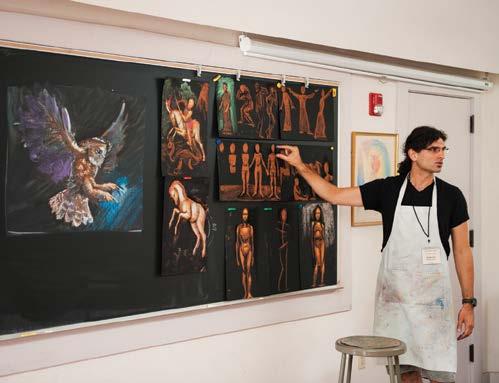


Transformative Education and the Arts Sacramento Campus 9200 Fair Oaks Blvd. Fair Oaks, CA 95628 (916) 961-8727 San Francisco Campus 2938 Washington Street San Francisco, CA 94115 (415) 347-7827 rudolfsteinercollege.edu Explore our offerings at
