‘Only the Arab still sailed his wind ships over the free sea, keeping steadfastly to the quieter ways of a kinder past’
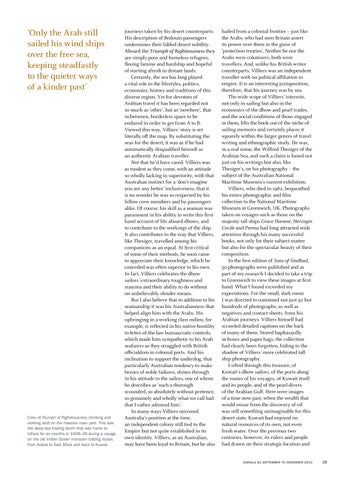
Crew of Triumph of Righteousness climbing and working aloft on the massive main yard. This was the deep-sea trading boom that was home to Villiers for six months in 1938–39 during a voyage on the old Indian Ocean monsoon trading routes from Arabia to East Africa and back to Kuwait.
journeys taken by his desert counterparts. His description of Bedouin passengers undermines their fabled desert nobility. Aboard the Triumph of Righteousness they are simply poor and homeless refugees, fleeing famine and hardship and hopeful of starting afresh in distant lands. Certainly, the sea has long played a vital role in the lifestyles, politics, economies, history and traditions of this diverse region. Yet for devotees of Arabian travel it has been regarded not so much as ‘other’, but as ‘nowhere’, that in-between, borderless space to be endured in order to get from A to B. Viewed this way, Villiers’ story is set literally off the map. By substituting the seas for the desert, it was as if he had automatically disqualified himself as an authentic Arabian traveller. Not that he’d have cared. Villiers was as modest as they come, with an attitude so wholly lacking in superiority, with that Australian instinct for a ‘don’t imagine you are any better’ inclusiveness, that it is no wonder he was so respected by his fellow crew members and by passengers alike. Of course, his skill as a seaman was paramount in his ability to write this firsthand account of life aboard dhows, and to contribute to the workings of the ship. It also contributes to the way that Villiers, like Thesiger, travelled among his companions as an equal. At first critical of some of their methods, he soon came to appreciate their knowledge, which he conceded was often superior to his own. In fact, Villiers celebrates the dhow sailors’ extraordinary toughness and stamina and their ability to do without on unbelievably slender means. But I also believe that in addition to his seamanship it was his Australianness that helped align him with the Arabs. His upbringing in a working class milieu, for example, is reflected in his native hostility to letter-of-the-law bureaucratic controls, which made him sympathetic to his Arab seafarers as they struggled with British officialdom in colonial ports. And his inclination to support the underdog, that particularly Australian tendency to make heroes of noble failures, shines through in his attitude to the sailors, one of whom he describes as ‘such a thorough scoundrel, so absolutely without pretence, so genuinely and wholly what we call bad that I rather admired him’. In many ways Villiers mirrored Australia’s position at the time, an independent colony still tied to the Empire but not quite established in its own identity. Villiers, as an Australian, may have been loyal to Britain, but he also
hailed from a colonial frontier – just like the Arabs, who had seen Britain assert its power over them in the guise of ‘protection treaties’. Neither he nor the Arabs were colonisers; both were travellers. And, unlike his British writer counterparts, Villiers was an independent traveller with no political affiliation to empire. It is an interesting juxtaposition, therefore, that his journey was by sea. The wide scope of Villiers’ interests, not only in sailing but also in the economics of the dhow and pearl trades, and the social conditions of those engaged in them, lifts the book out of the niche of sailing memoirs and certainly places it squarely within the larger genres of travel writing and ethnographic study. He was, in a real sense, the Wilfred Thesiger of the Arabian Sea, and such a claim is based not just on his writings but also, like Thesiger’s, on his photography – the subject of the Australian National Maritime Museum’s current exhibition. Villiers, who died in 1982, bequeathed his entire photographic and film collection to the National Maritime Museum in Greenwich, UK. Photographs taken on voyages such as those on the majestic tall ships Grace Harwar, Herzogin Cecile and Parma had long attracted wide attention through his many successful books, not only for their subject matter but also for the spectacular beauty of their composition. In the first edition of Sons of Sindbad, 50 photographs were published and as part of my research I decided to take a trip to Greenwich to view these images at first hand. What I found exceeded my expectations. For the small, dark room I was directed to contained not just 50 but hundreds of photographs, as well as negatives and contact sheets, from his Arabian journeys. Villiers himself had scrawled detailed captions on the back of many of them. Stored haphazardly in boxes and paper bags, the collection had clearly been forgotten, hiding in the shadow of Villiers’ more celebrated tallship photography. I sifted through this treasure, of Kuwait’s dhow sailors, of the ports along the routes of his voyages, of Kuwait itself and its people, and of the pearl-divers of the Arabian Gulf. Here were images of a time now past, when the wealth that would ensue from the discovery of oil was still something unimaginable for this desert state. Kuwait had enjoyed no natural resources of its own, not even fresh water. Over the previous two centuries, however, its rulers and people had drawn on their strategic location and
Signals 92 september to november 2010
19