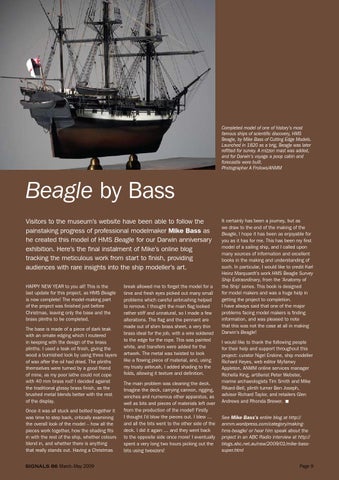
Completed model of one of history’s most famous ships of scientific discovery, HMS Beagle, by Mike Bass of Cutting Edge Models. Launched in 1820 as a brig, Beagle was later refitted for survey. A mizzen mast was added, and for Darwin’s voyage a poop cabin and forecastle were built. Photographer A Frolows/ANMM
Beagle by Bass Visitors to the museum’s website have been able to follow the painstaking progress of professional modelmaker Mike Bass as he created this model of HMS Beagle for our Darwin anniversary exhibition. Here’s the final instalment of Mike’s online blog tracking the meticulous work from start to finish, providing audiences with rare insights into the ship modeller’s art. HAPPY NEW YEAR to you all! This is the last update for this project, as HMS Beagle is now complete! The model-making part of the project was finished just before Christmas, leaving only the base and the brass plinths to be completed. The base is made of a piece of dark teak with an ornate edging which I routered in keeping with the design of the brass plinths. I used a teak oil finish, giving the wood a burnished look by using three layers of wax after the oil had dried. The plinths themselves were turned by a good friend of mine, as my poor lathe could not cope with 40 mm brass rod! I decided against the traditional glossy brass finish, as the brushed metal blends better with the rest of the display. Once it was all stuck and bolted together it was time to step back, critically examining the overall look of the model – how all the pieces work together, how the shading fits in with the rest of the ship, whether colours blend in, and whether there is anything that really stands out. Having a Christmas SIGNALS 86 March–May 2009
break allowed me to forget the model for a time and fresh eyes picked out many small problems which careful airbrushing helped to remove. I thought the main flag looked rather stiff and unnatural, so I made a few alterations. The flag and the pennant are made out of shim brass sheet, a very thin brass ideal for the job, with a wire soldered to the edge for the rope. This was painted white, and transfers were added for the artwork. The metal was twisted to look like a flowing piece of material, and, using my trusty airbrush, I added shading to the folds, allowing it texture and definition. The main problem was cleaning the deck. Imagine the deck, carrying cannon, rigging, winches and numerous other apparatus, as well as bits and pieces of materials left over from the production of the model! Firstly I thought I’d blow the pieces out. I blew … and all the bits went to the other side of the deck. I did it again … and they went back to the opposite side once more! I eventually spent a very long two hours picking out the bits using tweezers!
It certainly has been a journey, but as we draw to the end of the making of the Beagle, I hope it has been as enjoyable for you as it has for me. This has been my first model of a sailing ship, and I called upon many sources of information and excellent books in the making and understanding of such. In particular, I would like to credit Karl Heinz Marquardt’s work HMS Beagle Survey Ship Extraordinary, from the ‘Anatomy of the Ship’ series. This book is designed for model makers and was a huge help in getting the project to completion. I have always said that one of the major problems facing model makers is finding information, and was pleased to note that this was not the case at all in making Darwin’s Beagle! I would like to thank the following people for their help and support throughout this project: curator Nigel Erskine, ship modeller Richard Keyes, web editor Myfanwy Appleton, ANMM online services manager Richella King, artillerist Peter Webster, marine archaeologists Tim Smith and Mike Rikard-Bell, plinth turner Ben Joseph, advisor Richard Taylor, and retailers Glen Andrews and Rhonda Brewer. See Mike Bass’s entire blog at http:// anmm.wordpress.com/category/makinghms-beagle/ or hear him speak about the project in an ABC Radio interview at http:// blogs.abc.net.au/nsw/2009/01/mike-basssuper.html Page 9