At the hearing Macarthur claimed the judge-advocate was his debtor and an enemy, incapable of presiding impartially over the trial. His claim was supported by the six New South Wales Corps officers who made up the court, and the trial adjourned in stalemate. Bligh ordered Major George Johnston, senior officer of the New South Wales Corps, to discipline the officers involved, but his order was ignored. The standoff came to a head
who sailed for England with Bligh aboard HMS Hindostan to give evidence in the court martial of Major Johnston. Another signatory was John Turnbull, ancestor of the former federal Minister for the Environment, Malcolm Bligh Turnbull. When John Turnbull’s wife Ann gave birth to a son in June 1808, he was named William Bligh Turnbull in honour of the deposed governor, and the name Bligh continued to be incorporated in the names of Turnbull males through succeeding generations.
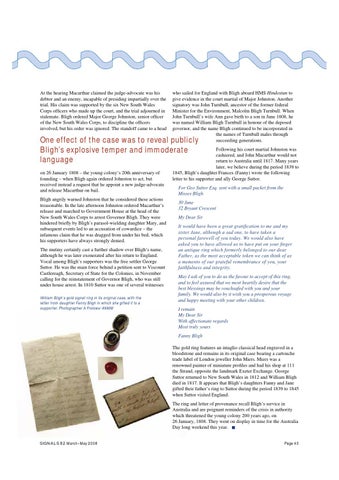
One effect of the case was to reveal publicly Bligh’s explosive temper and immoderate language on 26 January 1808 – the young colony’s 20th anniversary of founding – when Bligh again ordered Johnston to act, but received instead a request that he appoint a new judge-advocate and release Macarthur on bail. Bligh angrily warned Johnston that he considered these actions treasonable. In the late afternoon Johnston ordered Macarthur’s release and marched to Government House at the head of the New South Wales Corps to arrest Governor Bligh. They were hindered briefly by Bligh’s parasol-wielding daughter Mary, and subsequent events led to an accusation of cowardice – the infamous claim that he was dragged from under his bed, which his supporters have always strongly denied. The mutiny certainly cast a further shadow over Bligh’s name, although he was later exonerated after his return to England. Vocal among Bligh’s supporters was the free settler George Suttor. He was the main force behind a petition sent to Viscount Castlereagh, Secretary of State for the Colonies, in November calling for the reinstatement of Governor Bligh, who was still under house arrest. In 1810 Suttor was one of several witnesses William Bligh’s gold signet ring in its original case, with the letter from daughter Fanny Bligh in which she gifted it to a supporter. Photographer A Frolows/ANMM
Following his court martial Johnston was cashiered, and John Macarthur would not return to Australia until 1817. Many years later, we believe during the period 1839 to 1845, Bligh’s daughter Frances (Fanny) wrote the following letter to his supporter and ally George Suttor. For Geo Suttor Esq. sent with a small packet from the Misses Bligh 30 June 32 Bryant Crescent My Dear Sir It would have been a great gratification to me and my sister Jane, although a sad one, to have taken a personal farewell of you today. We would also have asked you to have allowed us to have put on your finger an antique ring which formerly belonged to our dear Father, as the most acceptable token we can think of as a memento of our grateful remembrance of you, your faithfulness and integrity. May I ask of you to do us the favour to accept of this ring, and to feel assured that we most heartily desire that the best blessings may be vouchsafed with you and your family. We would also by it wish you a prosperous voyage and happy meeting with your other children. I remain My Dear Sir With affectionate regards Most truly yours Fanny Bligh
The gold ring features an intaglio classical head engraved in a bloodstone and remains in its original case bearing a cartouche trade label of London jeweller John Miers. Miers was a renowned painter of miniature profiles and had his shop at 111 the Strand, opposite the landmark Exeter Exchange. George Suttor returned to New South Wales in 1812 and William Bligh died in 1817. It appears that Bligh’s daughters Fanny and Jane gifted their father’s ring to Suttor during the period 1839 to 1845 when Suttor visited England. The ring and letter of provenance recall Bligh’s service in Australia and are poignant reminders of the crisis in authority which threatened the young colony 200 years ago, on 26 January, 1808. They went on display in time for the Australia Day long weekend this year. SIGNALS 82 March–May 2008
Page 43