BEING A JOURNALIST IN THE DIGITAL WORLD BY ELEXIS RUIZ, JUNIOR, COLUMBIA COLLEGE CHICAGO
O
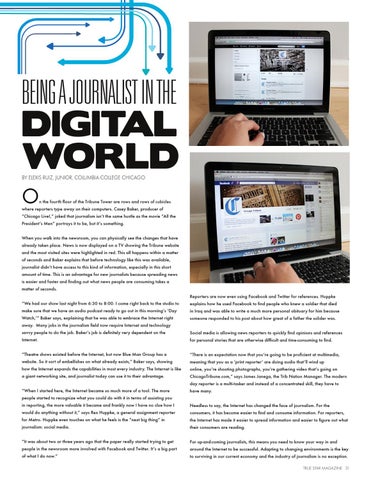
n the fourth floor of the Tribune Tower are rows and rows of cubicles where reporters type away on their computers. Casey Baker, producer of “Chicago Live!,” joked that journalism isn’t the same hustle as the movie “All the President’s Men” portrays it to be, but it’s something. When you walk into the newsroom, you can physically see the changes that have already taken place. News is now displayed on a TV showing the Tribune website and the most visited sites were highlighted in red. This all happens within a matter of seconds and Baker explains that before technology like this was available, journalist didn’t have access to this kind of information, especially in this short amount of time. This is an advantage for new journalists because spreading news is easier and faster and finding out what news people are consuming takes a matter of seconds. “We had our show last night from 6:30 to 8:00. I come right back to the studio to make sure that we have an audio podcast ready to go out in this morning’s ‘Day Watch,’” Baker says, explaining that he was able to embrace the Internet right away. Many jobs in the journalism field now require Internet and technology savvy people to do the job. Baker’s job is definitely very dependent on the Internet. “Theatre shows existed before the Internet, but now Blue Man Group has a website. So it sort of embellishes on what already exists,” Baker says, showing how the Internet expands the capabilities in most every industry. The Internet is like a giant networking site, and journalist today can use it to their advantage. “When I started here, the Internet became so much more of a tool. The more people started to recognize what you could do with it in terms of assisting you in reporting, the more valuable it became and frankly now I have no clue how I would do anything without it,” says Rex Huppke, a general assignment reporter for Metro. Huppke even touches on what he feels is the “next big thing” in journalism: social media. “It was about two or three years ago that the paper really started trying to get people in the newsroom more involved with Facebook and Twitter. It’s a big part of what I do now.”
Reporters are now even using Facebook and Twitter for references. Huppke explains how he used Facebook to find people who knew a soldier that died in Iraq and was able to write a much more personal obituary for him because someone responded to his post about how great of a father the solider was. Social media is allowing news reporters to quickly find opinions and references for personal stories that are otherwise difficult and time-consuming to find. “There is an expectation now that you’re going to be proficient at multimedia, meaning that you as a ‘print reporter’ are doing audio that’ll wind up online, you’re shooting photographs, you’re gathering video that’s going on ChicagoTribune.com,” says James Janega, the Trib Nation Manager. The modern day reporter is a multi-tasker and instead of a concentrated skill, they have to have many. Needless to say, the Internet has changed the face of journalism. For the consumers, it has become easier to find and consume information. For reporters, the Internet has made it easier to spread information and easier to figure out what their consumers are reading. For up-and-coming journalists, this means you need to know your way in and around the Internet to be successful. Adapting to changing environments is the key to surviving in our current economy and the industry of journalism is no exception. TRUE STAR MAGAZINE 31