VISAS NA ISSUE 22_Jerkins feature.qxd 14/10/2011 16:25 Page 3
INDUSTRY
fair for workers and viable for preserving jobs,” Mikulski said in a press release. “These are jobs that once they are lost, they will never come back. I will not stop fighting until we have a sensible approach to H-2B wages. The people who work in the seafood industry are in danger of becoming an endangered species themselves. Their livelihoods, which depend on Mother Nature and require temporary and seasonal workers, are fraught with uncertainty. To change the rules in the middle of the tide is inappropriate.” Violette is happy to have non-racing allies on the issue; in this case, the senator from Maryland. “She’s in it because of the Maryland crab fishermen,” Violette said. “They’re in the same trap. They introduced legislation to delay it and to re-examine what [the Department of Labor] is doing. We welcome it. This plight is taken very seriously by a number of legislators. This is obviously a problem across the board. There is bi-partisan support on this.” Indeed. Mikulski was one of 48 members of Congress who wrote a letter to U.S. Labor Secretary Hilda Solis contending that business owners should be able to keep the minimum wage at its current level. Another congressman who signed that letter was Representative Lou Barletta (R-PA), normally a critic of permissive immigration who is seeking to preserve small businesses in northeastern Pennsylvania. Virginian senator Mark Warner, concerned about the seafood industry in Virginia, called for a long-range solution “that is both fair to workers and employers, and helps to preserve jobs not only in the Virginia seafood industry, but other industries that depend on seasonal labor. We look forward to a long-term legislative
74 TRAINERMAGAZINE.com ISSUE 22
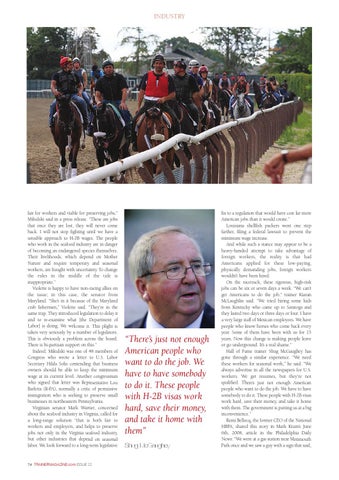
“There’s just not enough American people who want to do the job. We have to have somebody to do it. These people with H-2B visas work hard, save their money, and take it home with them” Shug McGaughey
fix to a regulation that would have cost far more American jobs than it would create.” Louisiana shellfish packers went one step farther, filing a federal lawsuit to prevent the minimum wage increase. And while such a stance may appear to be a heavy-handed attempt to take advantage of foreign workers, the reality is that had Americans applied for these low-paying, physically demanding jobs, foreign workers wouldn’t have been hired. On the racetrack, these rigorous, high-risk jobs can be six or seven days a week. “We can’t get Americans to do the job,” trainer Kiaran McLaughlin said. “We tried hiring some kids from Kentucky who came up to Saratoga and they lasted two days or three days or four. I have a very large staff of Mexican employees. We have people who know horses who come back every year. Some of them have been with us for 15 years. Now this change is making people leave or go underground. It’s a real shame.” Hall of Fame trainer Shug McGaughey has gone through a similar experience. “We need these workers for seasonal work,” he said. “We always advertise in all the newspapers for U.S. workers. We get resumes, but they’re not qualified. There’s just not enough American people who want to do the job. We have to have somebody to do it. These people with H-2B visas work hard, save their money, and take it home with them. The government is putting us at a big inconvenience.” Remi Bellocq, the former CEO of the National HBPA, shared this story in Mark Kram’s June 6th, 2008, article in the Philadelphia Daily News: “We were at a gas station near Monmouth Park once and we saw a guy with a sign that said,