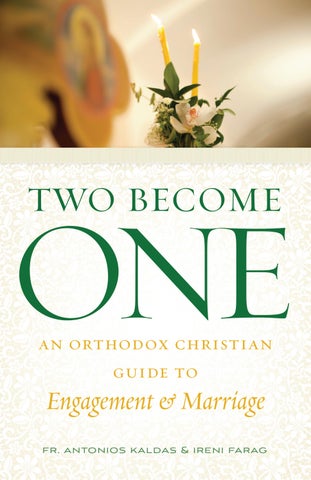
TWO Become ONE An Orthodox Christian Guide to Engagement and Marriage fr. A n t on ios K a lda s & Ir en i Fa r ag
ancient faith publishing chesterton, indiana
Two Become One: An Orthodox Christian Guide to Engagement and Marriage Copyright © 2017 Antonios Kaldas and Ireni Farag All rights reserved. No part of this publication may be reproduced by any means, electronic, mechanical, photocopying, recording, scanning, or otherwise, without the prior written permission of the Publisher. Published by: Ancient Faith Publishing A Division of Ancient Faith Ministries 1050 Broadway, Suite 6 Chesterton, IN 46304 All Old Testament quotations, unless otherwise identified, are from the Orthodox Study Bible, © 2008 by St. Athanasius Academy of Orthodox Theology (published by Thomas Nelson, Inc., Nashville, Tennessee) and are used by permission. New Testament quotations are from the New King James Version of the Bible, © 1982 by Thomas Nelson, Inc., and are used by permission. Cover photo courtesy of https://icon.spbda.ru. ISBN: 978-1-944967-21-5 Printed in the United States of America 30 29 28 27 26 25 24 23 22 21 20 19 18 17 16 15 14 13 12 11 10 9 8 7 6 5 42 1
Copyright ©2026 by Antonios Kaldas and Ireni Farag. All Rights Reserved. Published by Ancient Faith Publishing.
Contents Preface Introduction The Riddle of Life 7 Marriage Today 9 A Holistic Approach 11 Outline of This Book 12 Chapter One The One: Marriageability Who You Are 16 How to Change 21 Chapter Two One and One: Engagement What Engagements Are For 28 The Five Stages of a Relationship 30 Spirituality during Engagement 34 Compatibility 36 Making the Right Decision 56 But How Can I Know? 62 Chapter Three Not Two but One: What Christian Marriage Is Love 76 Humility, Submission, and Surrender 81 Unity and Vulnerability 86 Metanoia (Repentance and Change) 89 Salvation 90 Loyalty 92
Sample pages only. Purchase the full book at https://store.ancientfaith.com/two-become-one-an-orthodox-christian-guide-to-engagement-and-marriage/
5 7
15
27
73
Purity 96 Creation 97 Service 99 Chapter Four Two as One: Living the Dream Living Together in Christ 105 Wise Counsel 109 The Importance of Intentions 111 How to Be United 115 Personalities in Marriage 118 The Power of Words 122 The Way We Speak and Act 126 Gender Differences 135 Rupert and Cynthia Have an Argument 142 Commitment 145 Chapter Five Twoness and Oneness: Some Important Issues Male and Female 156 Contraception and Abortion 170 Abuse Warning Signs 177 Chapter Six Two Become One: Orthodox Marriage Rites The Orthodox Marriage Ceremony 185 Outline of Two Ceremonies 189 Appendix: Role Play with Translations Select Bibliography About the Authors
Copyright ©2026 by Antonios Kaldas and Ireni Farag. All Rights Reserved. Published by Ancient Faith Publishing.
103
155
183
211 217 221
Preface
T
h is bo ok gr ew ou t of a n u m ber of s ou rces. It began as a section from the Year 12 Coptic Orthodox Studies textbook, Understanding, used in the Coptic Orthodox colleges in Australia. Some of the material came from a talk Fr. Antonios delivered at a youth meeting at Archangel Michael and St. Bishoy Church in 2007, while the role-play in Chapter Six is from a session run by Fr. Antonios for some years at the Coptic Orthodox Diocese of Sydney, Marriage Preparation Day. Much of the significant psychological and counseling material has come from Ireni’s regular Relationship Seminars, which she has conducted for some years with the Archangel Michael and St. Bishoy parish, as well as from her work at St. Bishoy Coptic Orthodox College, her work with the congregations of the Coptic Orthodox parishes of Sydney, and of course her experience in her own private practice. We thank Fr. John Behr for his generous advice and for sharing some difficult-to-find articles with us; Fr. Vassilios Papavassiliou for giving of his time so generously to help us understand the Eastern Orthodox wedding ceremony; Fr. Gabriel Yassa and Mario Ghobrial for revising the manuscript and providing much valuable and very practical advice; Katherine Hyde of Ancient Faith Publishing for patiently and gently guiding us through the editing process; and Dalia, Samuel, and Bethany Kaldas for many valuable discussions on some of the more complex and controversial issues covered in this book. Ireni Farag Fr. Antonios Kaldas
5 Sample pages only. Purchase the full book at https://store.ancientfaith.com/two-become-one-an-orthodox-christian-guide-to-engagement-and-marriage/
“But above all these things put on love, which is the bond of perfection.” (Col. 3:14) We dedicate this book to our families and other loved ones.
Copyright ©2026 by Antonios Kaldas and Ireni Farag. All Rights Reserved. Published by Ancient Faith Publishing.
Introduction One becomes two. Two become one. One becomes two. From two, one comes. And we begin again. One becomes two . . .
The Riddle of Life This is the riddle of life. Our lives are characterized by the constant interplay between the one and the many, between unity and plurality, between isolation and community. This interplay describes everything that is most important to us as human beings: our sense of ourselves, our relationships with others, and our relationship with God. One becomes two. The cycle begins when a lonely person seeks the comfort and security of companionship. We all need someone we can trust, someone we can love who will love us in return. We seek this not only to meet our own selfish needs but more importantly to fulfill our inbuilt need to give love to others, for this is how we are made: in the image of the God who is love. And so we seek out another person to whom we can dedicate our lives and give unconditionally, being loved in return in like manner.
7 Sample pages only. Purchase the full book at https://store.ancientfaith.com/two-become-one-an-orthodox-christian-guide-to-engagement-and-marriage/
two become one
Two become one. When we find that person, we cement the bond of love through the holy “mystery,” or sacrament, of Christian marriage. Here the Holy Spirit sanctifies the unification of two individuals into one, a frighteningly intimate transformation that mirrors and prepares us for our ultimate unity with God. One becomes two. God is generous and fruitful, and so are we when we live out this sacrificial love in marriage and share with God in the act of creating a new human life. As He made us to be individuals yet bonded by love, so the couple gives the gift of independent yet beloved life to the child born of them. From two, one comes. Parents who truly love their children do not seek selfishly to hang on to them forever but find no greater joy than to see them grow and flourish and develop their own independent personalities, finding their own unique paths in life. So has God loved each of us and bestowed upon us the ability to determine our own fate. The miracle of marriage is that it produces more images of the God of love who then go out into the world to seek the comfort and security of companionship. And so . . . And we begin again . . . The cycle repeats. The cycle of love and growth, of giving and becoming, of the one and the many, of unity and plurality—the cycle of divine love that mirrors the nature of the God who is love. This is the riddle of life.
8 Copyright ©2026 by Antonios Kaldas and Ireni Farag. All Rights Reserved. Published by Ancient Faith Publishing.
introduction
Marriage Today This book is chiefly intended to be read by couples who are intending to wed, although it may be of use to those who are still some distance from taking such a step, as well as those who have been married for some years already. It is offered in the hope that, by better understanding what they are embarking upon, they will be better able to navigate their journey together and enjoy a more fulfilling experience. We felt this book was needed because every day we see couples, young and old, who suffer so needlessly in their married relationships. None, as far as we know, go into marriage intending to harm their partners. But that is what people often end up doing, out of ignorance, and harm so easily turns into resentment, anger, and hatred. Modern Western culture is dominated by the primacy of the individual over the role of that individual as part of a community. This has led to more self-centered attitudes in many facets of our personal lives, a trend that is surely at odds with the Christian Gospel’s message of unselfish, unconditional love. For the Christian, the only true fulfillment of one’s individuality lies in the voluntary, even joyful surrender of that individual self to God and to others on the altar of love. Yet Western society today, with its relentless emphasis on individual happiness, consumerism, and the obsessive need to protect us from infringing on each other’s rights, has shifted the focus of modern life away from self-sacrifice and made words like “submission” and “surrender” almost dirty words. This focus on the individual has had consequences for the health of our marriages. We can see this in the numbers. As society has changed, so have patterns of marriage and divorce.
9 Sample pages only. Purchase the full book at https://store.ancientfaith.com/two-become-one-an-orthodox-christian-guide-to-engagement-and-marriage/
two become one
According to the Australian Bureau of Statistics,1 the number of marriages in Australia fell from 6.4 marriages per one thousand people in 1993 to 5.1 per one thousand in 2013. Perhaps as people become more self-focused they become less willing to commit their lives to another person in the complete way that marriage implies. In the same period, from 1993 to 2013, the percentage of weddings performed by religious celebrants dropped from 57.9% to 27.4%, while the percentage performed by civil celebrants rose from 42.1% to 72.5%, an indication of how Western culture is moving away from the religious underpinnings of marriage. This is both good and bad. It is good in that people are no longer marrying simply because their parents and their society expect them to. Thankfully, long gone are the days when your parents chose your spouse for you, and you might have met him for the first time at the door of the church at your own wedding. To be sure, other societal factors made many of these marriages ultimately successful ones, but those other factors have long since disappeared. Today we rightly value the concept of freely choosing to love and marry one’s spouse, just as God leaves us to freely choose to love and follow Him. But this shift is also a bad thing, because it means that people are entering into marriage without access to its deeper spiritual and eternal meaning and are thus being severely shortchanged. In the Orthodox Christian view, this is sin in the ancient sense of the Greek word hamartia: missing the mark, as an archer’s arrow might fly astray and miss the target. Losing the sense of the holiness of marriage is not something worthy of divine punishment but of profound sadness and pity. We are diminished as 1
Australian Bureau of Statistics, “3310.0—Marriages and Divorces, Australia, 2013,” http://www.abs.gov.au/ausstats/abs@.nsf/mf/3310.0, April 2015.
10 Copyright ©2026 by Antonios Kaldas and Ireni Farag. All Rights Reserved. Published by Ancient Faith Publishing.
introduction
individuals, as groups, and as a human race when we subtract the sacred from the image of divine love that is marriage.
A Holistic Approach Interestingly, psychology today is finding that the things that make for a good marriage are basically the things that Christ taught: mutual respect, mutual self-sacrifice, unselfishness, humility, and, of course, unconditional love. To be a good spouse, all you really need to do is be a good Christian. And that is something we all, as Christians, have to do, whether we marry or not. Psychology has taught us that the most influential factors that shape adult relationships begin in childhood. By and large, those who formed healthy, secure relationships in their childhood are those who are most likely to form healthy, secure relationships as adults. For Christians, the foundational securely attached relationship is the one we have with Christ. A person who has a healthy relationship with Christ is well placed to form a healthy, secure relationship in marriage. He is then able to bring into the marriage the mutual respect, mutual self-sacrifice, unselfishness, humility, and unconditional love required for its quality and survival. In addition to this, research has found that the marriages that thrive are those in which couples embrace their differences, are aware of the words they use with each other, and have a healthy view of intimacy. Psychology, therefore, does not disagree with the biblical foundations of marriage. In fact, modern psychologists are conducting research and writing papers, articles, and books that affirm the need for the Christian virtues of honesty, love, forgiveness, and so on. As you can see from the above, in this book we will attempt
11 Sample pages only. Purchase the full book at https://store.ancientfaith.com/two-become-one-an-orthodox-christian-guide-to-engagement-and-marriage/
two become one
to bring together material from a wide variety of sources—spiritual, theological, liturgical, medical, psychological, and social— to provide the reader with a holistic approach to marriage that “marries” the best of modern human knowledge with authentic, age-old Orthodox Christianity. As Orthodox Christians, we reject the division of our lives into partitioned territories of the sacred and the profane, the religious and the secular. This false division leaves God out of our dayto-day lives, as if He were only to be found in church and in the place where we say our daily prayers, but not in the workplace or in the local shopping mall. But God is everywhere, and we are happiest when we involve Him in every aspect of our lives. He is waiting for you in the aisle of the supermarket, in the traffic jam on the highway, and at the baby-changing table at three am on a cold winter’s morning. He is there, not only before the altar on your wedding day, but also in the reception hall afterward and in the bedroom after that. Everything we do in our lives is meant to be sacred, to be shared with Him and sanctified by Him, from the smallest detail to the most momentous and life-changing decision. He is sharing your life from the moment you are conceived until the moment you die and beyond. In that spirit, then, let us begin the great journey of marriage, the riddle of life.
Outline of This Book We will begin in Chapter One by considering something few people think of deeply these days: What might you do to prepare yourself for marriage and family life before you even meet your partner? What can you do to make yourself more “marriageable,” to make yourself a better gift to your future spouse and children?
12 Copyright ©2026 by Antonios Kaldas and Ireni Farag. All Rights Reserved. Published by Ancient Faith Publishing.
introduction
From there, we move on in Chapter Two to some practical issues about how to go about finding the right person, how to work out whether you are suited for each other, and how to make a decision that is often quite frightening for many couples. It is, after all, a lifelong commitment, and one you don’t want to get wrong! In order to safely navigate through married life and get the most out of it, it is tremendously helpful to understand its nature and purpose and to share this vision with your partner. Chapter Three therefore explores the meaning of marriage in detail, explaining how marriage works best when harmonized with our Christian faith and practice. Chapter Four gets down to the nitty-gritty of a lifelong marriage. How can a couple understand themselves and each other and communicate effectively? How can they relate to each other in positive ways rather than negative ones? And what are the inherent differences in the ways men and women think, feel, and deal with life? We spend years training formally for our jobs—it is worth investing a little time and training in the much more difficult task of marriage and family life. Chapter Five addresses some sensitive topics that are often glossed over, although they can play a big role in some relationships: gender roles, intimacy and sexuality, contraception and abortion, and domestic violence and abuse. The final chapter takes us into the beautiful world of the Orthodox wedding ceremony, full of rich symbolism and pregnant with meaning. We compare the Coptic and Greek wedding rites, their similarities and differences, to help readers better appreciate these beautiful rites and use them to begin their journey as husband and wife as they mean to continue it: as a life- affirming, joyful spiritual experience.
13 Sample pages only. Purchase the full book at https://store.ancientfaith.com/two-become-one-an-orthodox-christian-guide-to-engagement-and-marriage/
two become one
We understand that in today’s world many couples are timepoor, so we have included a set of reflection questions at the end of each chapter that provides a kind of summary of the main points, as well as a stimulus for discussion between couples. Whether you begin with these questions and use the main text to elaborate on specific issues, or whether you use the questions to review what you read in the main text, we strongly encourage couples to reflect on these questions together. There is nothing so beneficial as honest, thoughtful dialogue to open the lines of effective communication, create mutual understanding and respect, and bring about a healthy, sustainable relationship. We offer these questions for that purpose.
14 Copyright ©2026 by Antonios Kaldas and Ireni Farag. All Rights Reserved. Published by Ancient Faith Publishing.
Chapter One
The One Marriageability Be diligent to present yourself approved to God, a worker who does not need to be ashamed. (2 Timothy 2:15) Let love be without hypocrisy. Abhor what is evil. Cling to what is good. Be kindly affectionate to one another with brotherly love, in honor giving preference to one another; not lagging in diligence, fervent in spirit, serving the Lord; rejoicing in hope, patient in tribulation, continuing steadfastly in prayer; distributing to the needs of the saints, given to hospitality. Bless those who persecute you; bless and do not curse. Rejoice with those who rejoice, and weep with those who weep. (Romans 12:9–15) If we would judge ourselves, we would not be judged. (1 Corinthians 11:31)
15 Sample pages only. Purchase the full book at https://store.ancientfaith.com/two-become-one-an-orthodox-christian-guide-to-engagement-and-marriage/
two become one
Who You Are Many people spend a good deal of their lives thinking about their life partner. They think long and deeply about the characteristics they are looking for in a spouse, about what is more and less important, what they would be content with and what they certainly could not stand. They put a lot of thought and effort into choosing the “right one.” Once they find this person, they put yet more effort into molding that one to their own needs and tastes, consciously or subconsciously. Such a person will work hard to educate his partner, to expose her to his friends and interests, to get her involved in his pre-existing life. Sometimes this leads to disappointment, and people often see the reason for this disappointment as being the failure either to find the right one or to mold the partner into the right one. This brand of disappointment is sadly all too common in modern life and perhaps has been common throughout the history of marriage, although expressed in different ways. Nowadays, it is often expressed in depression and the breakdown of marriages. While putting all this effort into finding and molding the right one, many people do also see the need to work hard on themselves in preparation for marriage. A young lady will invest barrow-loads of energy, time, and money into making herself physically beautiful, or working to develop a cute way of speaking or an attractive walk, to make herself an attractive prospect for the army of eligible young men. A young man will be equally diligent in building up his muscles and learning to talk or act with a sense of authority and control in order to make himself desirable to the army of eligible young women. Both genders today also work hard to establish themselves in a successful career and build themselves up financially in this effort to make themselves a “good catch.” 16 Copyright ©2026 by Antonios Kaldas and Ireni Farag. All Rights Reserved. Published by Ancient Faith Publishing.
the one: marriageability
Unfortunately, the skills and traits that may help a person to find and attract a suitable partner are not always the same skills and traits that one needs to maintain a marriage for a lifetime. That is a totally different skill set—and one to which very few people seem to give a lot of thought. So before we start talking about finding the right person, getting to know him, forming a relationship, getting engaged, and eventually getting married, we need to take a little detour down a very private lane and do a bit of self-examination. The question we need to ask is, “Am I marriageable?” Before I think of what my prospective spouse has to offer to me, I need to ask what I have to offer—not in the superficial or material things, nor in the features that will attract her to me—but what I have to offer as a life partner, as a human being. This turns out to be a surprisingly complex question to answer. What is it that makes a person a good spouse? To answer this question, you might think about your most direct experience of marriage so far: your own parents’ marriage. We are far more influenced by what we experience than by what we are taught. We learn our patterns of behavior, our strategies for dealing with relationships and other people, when we are young—when we are dealing with our parents, our brothers and sisters, and our friends. We learn from them habits of behavior—some good, some not so good. If a child grows up with parents whose chief method of problem solving is a long and loud shouting match, she is likely to find herself using the same method to solve problems with her husband. At the very least, she is more likely to be comfortable with such methods than is a boy who grew up never once having seen his parents speak an angry word to each other. A man who was accustomed to solving problems with his sister
17 Sample pages only. Purchase the full book at https://store.ancientfaith.com/two-become-one-an-orthodox-christian-guide-to-engagement-and-marriage/
two become one
by hitting her is more liable to solve problems with his wife the same way. He never had the chance to develop and become comfortable with any other strategy. When he finds himself under stress, the ingrained reflex habit often overshadows the rational, thinking mind. The girl who kept the peace with her authoritarian parents by frequently lying to them is liable to try to maintain the peace of her marriage by frequently lying to her husband. Why should she change? How could she change? Change isn’t easy. Even those who detested their parents’ habits may sadly end up imitating them, much to their own disappointment. It is hard to change when you have never had the new mode of behavior modeled for you. You simply don’t know how. So whenever you are faced with the need to get on with life, to make a difficult situation bearable, you fall back on the old practiced coping strategies. When we bring negative habits of behavior into our marriage relationships, they can become our natural patterns of behavior with our spouses. This can lead to serious problems and unhappy lives—seriously, deeply, and depressingly unhappy lives. Those caught in the cage of their own negative habits often feel worse because they feel trapped, because they can neither understand why things are so horrible nor see any way out of that horror. But this need not be the case. Some of us are blessed with happy, calm homes in which to learn good habits, but others are not so fortunate. It is possible to change your mindset and habits—lots of people have done it before. But a few ingredients are required: the humility to acknowledge that change is needed; the desire, the motivation, and the courage to pursue that change relentlessly; and availing yourself of support and expert help when you need it. Above all,
18 Copyright ©2026 by Antonios Kaldas and Ireni Farag. All Rights Reserved. Published by Ancient Faith Publishing.
the one: marriageability
the grace of God working in our hearts and minds is the fuel that powers the change, a fuel that is always available in abundance for those who seek it. In fact, becoming more marriageable is one facet of becoming a better Christian. The transformation we are talking about is in essence a type of repentance, that spiritual practice every Christian needs to pursue daily. What makes a person marriageable is what makes a person a good Christian, and vice versa. This comes as no surprise. Marriage is a relationship with another human being in the grace and care of God. Replace “another human being” with “all human beings,” and you have a pretty good description of what the life of the Christian is all about. In a way, marriage acts like a magnifying glass, focusing our general relationships of love into one very intense relationship. Even before you marry, even before you meet your partner, if you are motivated to make yourself more marriageable, you are also motivated to make yourself a better person and a better Christian. We can find the kinds of things you need to be marriageable in the famous Bible passages that speak of the things you need to do to be a true Christian (of course, we spend our lives striving to live up to these ideals). Here are a few examples. As you read them, think about how they would apply within an engagement or a marriage. Love suffers long and is kind; love does not envy; love does not parade itself, is not puffed up; does not behave rudely, does not seek its own, is not provoked, thinks no evil; does not rejoice in iniquity, but rejoices in the truth; bears all things, believes all things, hopes all things, endures all things. Love never fails. (1 Cor. 13:4–8)
19 Sample pages only. Purchase the full book at https://store.ancientfaith.com/two-become-one-an-orthodox-christian-guide-to-engagement-and-marriage/