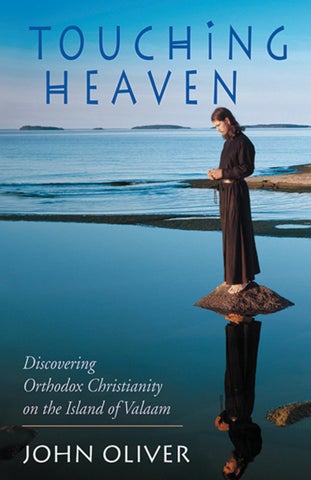
TOUCHING HEAVEN Discovering Orthodox Christianity on the Island of Valaam
by John Oliver
ANCIENT FAITH PUBLISHING Chesterton, Indiana
TOUCHING HEAVEN: Discovering Orthodox Christianity on the Island of Valaam © Copyright 2003 by John Oliver
All Rights Reserved Published by
Ancient Faith Publishing (A division of Ancient Faith Ministries) P.O. Box 748 Chesterton, IN 46304
Printed in the United States of America ISBN: 978-1-888212-65-5 All scripture quotations, unless otherwise indicated, are taken from the New King James Version. Copyright © 1979, 1980, 1982 by Thomas Nelson, Inc. Used by permission. All rights reserved. Front cover photo: by Hierodeacon Savvaty, Valaam Monastery
Copyright © 2003 by John Oliver. All Rights Reserved. Published by Ancient Faith Publishing.
Contents FOREWORD BY FATHER JONAH PAFFHAUSEN .......................................5 Prologue Entering Wonder............................................................... 11 Chapter 1 Tapestry and Family......................................................... 17 Chapter 2 Fumbling Toward Faith.................................................. 21 Chapter 3 Awakening to Orthodoxy............................................ 27 Chapter 4 From Routine to Russia.................................................. 37 Chapter 5 Salvation and Sweat........................................................ 45 Chapter 6 The Rhythm of Vigilance, the Pulse of Prayer........................................................... 55 Chapter 7 Monk for a Day.................................................................. 65 Chapter 8 “Don’t Just Do Something, Stand There!”............... 77 Sample pages only. Purchase the full book at http://store.ancientfaith.com/touching_heaven/
Chapter 9 Raphael: Astonishment.................................................. 87 Chapter 10 John the Baptist: Suddenness...................................... 99 Chapter 11 Farewell...............................................................................109 Chapter 12 From Eternity To Here..................................................121 Chapter 13 Poverty................................................................................127 Chapter 14 Chastity................................................................................137 Chapter 15 Obedience.............................................................................147 Chapter 16 Stability...............................................................................159 Chapter 17 The Story..............................................................................171 epilogue BY FATHER JONAH PAFFHAUSEN ..................................177 notes ......................................................................................179
Copyright © 2003 by John Oliver. All Rights Reserved. Published by Ancient Faith Publishing.
Foreword
by Father Jonah paffhausen
V
alaam Monastery remains forever in my mind and heart. The silent islands amidst the sometimes placid, sometimes roaringly tempestuous waves of Lake Ladoga rise with forested cliffs like a beacon. Towering over them, visible for miles, is the great bell tower and church of the main monastery. The immense granite cross on the island of the Skete of St. John the Forerunner marks the otherness of that sacred place with a solidity that transcends this world. The other sketes, the forests with the ruined hermitages and dwellings of ancient ascetics, echo a life of sanctity and beauty of which this world has no consciousness. It is not simply the place, though. The monastery is not the buildings or the institution. Nor is it the exquisite church services, their majestic austerity, the hymns glorifying God and stirring repentance and compunction, echoing in the cavernous temples. The monastery is the people, the community, the fathers. Through ascetic labors the fathers of the monastery strive to bring themselves under complete control through spiritual effort, being purified, enlightened, deified. Their efforts have one goal, to remove all barriers to love of God and neighbor. These are men filled with grace, striving after grace, struggling with themselves to overcome all barriers to that grace, which is itself the love of God. 5 Sample pages only. Purchase the full book at http://store.ancientfaith.com/touching_heaven/
TOUCHING HEAVEN A monastery is a place of spiritual struggle, of purification through trials and temptations. Wherever grace and sanctity are, so will there be trials and temptations in the same measure. My life at Valaam was one permeated with temptations, struggles, trials; for by dealing with these temptations, one works out one’s salvation, one learns how to cease reacting to the provocations from others, from one’s own passions, from the world. One comes to realize that the tempter is real, and that he exploits our weaknesses and shortcomings. But through those often bitter lessons, one comes to a more profound awareness of grace, of the tangible Presence of God. Truly Valaam is a dwelling place of God. I became a novice at Valaam in the summer of 1993 and was there for about six months. As I already had an extensive theological education, mine was not a usual kind of novitiate. And being a Westerner with a background in finance, I had some skill that others there did not. So I was assigned to work with the abbot, Archimandrite Pankratiy, on business and missionary ventures of the community, and in dealing with foreign visitors. I joined the community after finding in Fr. Pankratiy a true friend and brother, one with whom I shared the same vision of the Church and of the monastic life, and one in whom I could see who and what I wanted to become. He is only a few years older than I, and I esteem him profoundly as a father in Christ. He in turn led me to others—to his own elder, Archimandrite Kyrill of the Trinity-St. Sergius Lavra, who blessed my path as a hieromonk; and to Fr. Raphael, the wonderful elder whom Fr. Pankratiy had known in the Caucasus, and who had come to Valaam at his invitation. I’ll never forget that first life confession with Fr. Raphael when I was received as a novice. I confessed to him the sins I remembered and knew; and then he took 6 Copyright © 2003 by John Oliver. All Rights Reserved. Published by Ancient Faith Publishing.
FOREWORD over, telling me of the sins I had not remembered to confess, those unknown and those I had tried to hide. This began my relationship with him, and would become a foundation of healing for the rest of my life. Father Pankratiy had taken over the abbacy at Valaam in February of 1993. Monks had been there for about four years, but the place was still mostly ruined, inhabited by Soviet villagers who had sunk into the most decrepit poverty and destitution. The community was rife with issues of zealotry and a great uncertainty as to how to go about the task of reconstructing a great institution, from the buildings to the inner life of the community, after seventy-five years of desolation. There were about fifty men then, in various stages of monastic commitment, mostly novices. The main complex was only partially in the hands of the brotherhood, and the sketes were mostly ruins. I had seriously intended to stay at Valaam long-term. When Russia looked to be on the brink of civil war, with the shelling of their own parliament building, we reevaluated this intention with the help of an eldress near St. Petersburg. It was determined that I could help the monastery far more from America than by being present there as just one more hieromonk with a funny accent. So I returned home in late November, soon to be ordained as a deacon, trying to find support for Valaam and its rebuilding efforts, and with hopes of establishing an American branch of Valaam in California. I returned to Valaam in February of 1994. Fr. Pankratiy had an idea, to fulfill a need and provide an opportunity for a working pilgrimage: A group of Americans would raise some money for materials, come to Valaam, and build a building. We fleshed this out and conceived a plan to bring two groups, successively for three weeks each, to construct a building at the 7 Sample pages only. Purchase the full book at http://store.ancientfaith.com/touching_heaven/
TOUCHING HEAVEN Skete of St. John the Forerunner. The groups would raise the money, and the monastery would buy all the materials. And the groups would get tours of Moscow and St. Petersburg in the process. But what we hoped for, without realizing how great it would be, was the impact of the experience of the monastery on the pilgrims. The community that came together for this was quite remarkable. There was a large contingent from the recently converted Antiochian Evangelical Orthodox Mission, with several priests from various parts of the country and many young people. Then there were people from the broad spectrum of the Orthodox community in America, from several jurisdictions, and some on the fringes of the Church. For all, it was a life-changing event. It was not simply the experience of camping on an island that had been inhabited by the most severe ascetics of the Russian North, sanctified by their sweat, labors, and graves. It was not simply being exposed to the services in the main monastery on weekends, the great Saturday night vigil, from one to eight in the morning. I can still hear the immense bell, echoing in my memory, across the miles of lake and islands. It was not just the ascetic sacrifice of time and labor to rebuild this hermitage, nor even the visit of His Holiness, Patriarch Alexei II, blessing the workers and the foundations. The experience that transformed most people was the encounter with Fr. Raphael. I had the blessing to be his translator, and thus had the immense blessing to benefit from all the advice given to each, to see how he dealt with each person uniquely and could see their zeal, their love, their pain—even despite my poor efforts at translation. And in him, through him, each one, to some degree, encountered the Living Christ. Fr. Raphael, by his joy and humility, his wisdom and clairvoy8 Copyright Š 2003 by John Oliver. All Rights Reserved. Published by Ancient Faith Publishing.
FOREWORD ance, showed each one that Orthodox Christianity works. It produces elders, living saints, who embrace each one with the love of Christ. It showed us what monasticism, what Christianity, is all about.
—Hieromonk Jonah Abbot of the Monastery of St. John of Shanghai and San Francisco Point Reyes, California
9 Sample pages only. Purchase the full book at http://store.ancientfaith.com/touching_heaven/
Copyright © 2003 by John Oliver. All Rights Reserved. Published by Ancient Faith Publishing.
Prologue
Entering Wonder
D
eep in a northern Russian forest of jade and brown, far from any hint of civilization, Valaam Monastery sinks into the seasons of the year as it has for a thousand years before. Nearly one hundred monks labor in this place that rests on an island over 100 miles north of St. Petersburg, and an immeasurable distance from the Western world. Valaam is accessible only by ferryboats that must cross wide Lake Ladoga, and the lake isn’t always cooperative. The trees, plants, animals, water, air, soil, and the whole life cycle here in this wilderness flourish without much stain from overpopulation or industry. It is quiet here, and these quiet roots run deep. The paradox of Valaam is that this place is peaceful but not without violence. In our world, the treasure of stillness requires a fierce guarding. Remember, it is not a flimsy sign but a flaming sword that protects the Garden of Eden. The Gospel according to St. Matthew puts it best: “From the days of John the Baptist until now the kingdom of heaven suffers violence, and the violent take it by force” (11:12). One traditional interpretation of that verse is that the Christian life is not for the faint of heart. The renunciation of self, the taking up of one’s cross, the salvation work of “fear and trembling” (Philippians 2:12)—these are 11 Sample pages only. Purchase the full book at http://store.ancientfaith.com/touching_heaven/
TOUCHING HEAVEN soldier-images that suggest a disciplined struggle is needed if we are to enter fully into the journey of defeat and victory that is the Christian life. Defeat can bring humility, and victory, joy. The monks at Valaam are a band of fierce fighters who sing and pick wildflowers. When I stayed at the monastery, the fullness of life there revealed some gaping holes in my own. I was told to “enter in” to the monastic cycle of services. As a young American, I do not “enter in,” I observe . . . cautiously. But I did what I could as often as I could with as much devotion as my feeble spirit could produce. It took a few days to lay down my resistance and accept that this is how they do things here. Indeed, this is how they have always done things: wake with the sun, offer prayers in the church, eat, labor; more prayers, more labor, a bit more food, a walk in the woods, more prayers into the night. The Christian year is built upon the Christian day, which is built upon the Christian hour and the Christian moment. When it was time to pray, we prayed. When it was time to eat, we ate. When it was time to play, we played. The civil war between what my spirit craved and what my flesh would settle for eased as the days passed. Monastic life has a rhythm, and I wanted to learn it. Or, at least, I wanted to absorb enough of it so that I would never forget it, but spend the rest of my life trying to get it back. It’s a bit like pruning a small shoot off a plant and then planting the shoot in soil elsewhere so that it will grow into a life of its own. Then, a key thing happened during the Divine Liturgy one Sunday morning—during the Little Entrance, that moment when the Gospel is carried in the uplifted hands of the priest before the people. The church is dark and cool. Candlelight illuminates the smoke of incense into silver scarves stretching toward the ceiling. There is quiet movement around the long cement room as candles are lit and icons are venerated 12 Copyright © 2003 by John Oliver. All Rights Reserved. Published by Ancient Faith Publishing.
Prologue • Entering Wonder by monks, novices, pilgrims, and residents of a small village nearby. Then there is the chanting; this music that has been seasoned by centuries of honored use resonates within my deepest places. I stand very still. The chant, so beautiful, is offered as one sound, no monk louder than another. The language of the service is Slavonic, but in this moment we are deeper than language. The door on the far left of the iconostasis opens and the monks and celebrants bring the Gospel into the view of the people. The people bow; I strain my neck to observe. And there is the difference. Our culture in America is in a passionate love affair with itself. An unbridled pursuit of personal happiness and a worship of individualism have spawned a worldview inadequate to receive the mysteries of God. I am a product of this culture and have sacrificed myself to it. Its worldview discolors my own. Certainly there are good and honorable qualities of our culture, but they are not the qualities toward which I naturally gravitate. I am thoroughly American in that life is lived on my terms; I am emphatically Christian in that I believe it shouldn’t be. Rebellion, of course, respects no geography; it is present in all humans everywhere. But as I’ve studied the Holy Scriptures, for example, I have noticed my tendency to want to master, rather than to be mastered. Consider this passage from The Communion of Love by Matthew the Poor, a monk and spiritual father in the Monastery of St. Macarius in the Egyptian desert: There are two ways of reading [the Holy Scriptures]: The first is when a man reads and puts himself and his mind in control of the text, trying to subject its meaning to his own understanding and then comparing it with the understanding of others. The second is when 13 Sample pages only. Purchase the full book at http://store.ancientfaith.com/touching_heaven/
TOUCHING HEAVEN a man puts the text on a level above himself and tries to bring his mind into submission to its meaning, and even sets the text up as a judge over him, counting it as the highest criterion.1 Notice the difference? When I come to the Word of God on my own terms, I am trapped in misguided questions: “How do I feel about this?” “What does this do for me?” “How does this satisfy my understanding?” “What argument can I win with this information?” If my desire to learn and apply the practical truths of Holy Scripture is disconnected from the Holy Tradition of the Church and left to my own clever thinking, it can deteriorate into treating the Bible as the brightest gold on my throne or the heaviest weapon in my arsenal. But here at Valaam, in the precious hush of the ancient Divine Liturgy, the Holy Scriptures were held high above bowed heads and bent knees. These Orthodox Christians chose the only attitude appropriate for a people before their God—humility. And as an Orthodox Christian living in an American culture where humility is dismissed as a sign of weakness, I was blessed with the sacred exposure to another way of doing things. The violence at Valaam Monastery is the violence of spiritual warfare. And it is the violence I will carry with me when I leave Valaam, if I ever want to live at peace with God, with my neighbor, and with myself. It is the renunciation of those selfish parts of myself so that I may become more like the loving Christ; it is the taking up of my cross so that the comfort of the Holy Spirit is made known; it is the salvation work of laying down my arrogance so that I may draw near to the Holy Scriptures in the context of the Church, the way a dying man draws near to the only medicine that can save him. I do not have a clear sense of how to do this, of how to become this man 14 Copyright © 2003 by John Oliver. All Rights Reserved. Published by Ancient Faith Publishing.
Prologue • Entering Wonder of whom I have caught a glimpse at the monastery. I do know, however, that it begins with learning how to bow in humility to the Lord Jesus rather than straining my neck to observe all the interesting things He can do for me. As the monks and celebrants carry the Gospel to the altar, I shift my weight from one foot to the other. This is the eighth consecutive hour of services, and in traditional Orthodox churches there are no pews. Benches line the walls of the nave for the elderly and infirm and those who need a break from standing. But most of us stand; we stand like soldiers. I observe the old women, the babushki—who, thrice my age, have none of my impatience. I observe the aroma of the incense that is the dried sap of those ancient trees outside. I observe the candles that give light to the church and that shine with the names of people offered in prayer to God, some of whom are praying for us. I observe the icons, the windows of heaven, that give detail to the faces of saints, and I wonder if they observe me. The Liturgy carries on peacefully and invites each of us to participate in the worship of God. I reflect for a moment that at one time in church history, a man could not become a bishop unless he knew the entire Book of Psalms by heart. “Well,” I think to myself, “I might know a couple of psalms.” I decide it is time to stop thinking. I decide it is time to “enter in.”
15 Sample pages only. Purchase the full book at http://store.ancientfaith.com/touching_heaven/
Copyright © 2003 by John Oliver. All Rights Reserved. Published by Ancient Faith Publishing.
Chapter 1
Tapestry and Family
W
e are often unable to see our own stories in the making. But in reflective moments, we see our stories lying like tapestries behind us and notice how individual threads of experiences, of decisions, of persons whose paths crossed ours, weave a life that is our life. I remember my plane ride to Moscow for the Valaam trip; in fact, I remember remembering. As I stared through the window of seat 22-J, I took an inventory of the threads of my life that offered some explanation as to why I was headed for a monastery on the other side of the world. Taking an inventory is risky, I thought, because of the temptation toward self-importance. It is one thing to reflect on the evidence of God’s guidance in my life; it is another to take credit for it. The reflection was worth the risk. My story is peppered with gifts and graces from God, both joyful and painful, that appeared often when I was most unaware of my need for them. My family is one of those joyful and painful gifts. I am not sure anyone really remembers his childhood accurately, but images do linger: a small yellow house on a short suburban street with a driveway that seemed to stretch into the next town; chasing an older sister whose approval was more cherished than toys; reaching for a five-dollar bill from the large, wrinkled hand of 17 Sample pages only. Purchase the full book at http://store.ancientfaith.com/touching_heaven/
TOUCHING HEAVEN a grandfather. I searched my past for the seeds that had grown into this current hunger for an experience like Valaam, where issues that we all face, such as identity and rootedness, might receive some needed clarity. Some seeds—of my hunger, and of the issues—were found scattered among the relationships in my family. Certainly a strong image rich with emotional detail is a photograph I have of my parents, my sister, and me taken when I was two or three years old. The fading print shows my father, a historian, standing behind a couch where the other three are seated, his hands resting on the back of the couch. My mother, leaning away from my father, is holding me in her lap. In contrast to her quiet elegance is my “deer-in-theheadlights” expression that kids get when a flashbulb goes off. My sister, restless with toy in hand, sits to our left on the edge of the couch. The photograph carries a hint of an early uneasiness, a kind of subtle groping for an understanding of our roles and relationships. Our home often had an invigorating atmosphere that comes from loving the life of the mind, for both my parents were book-lovers. But in all the grammar and arithmetic, we lost a precious intimacy with each other. Attempts at true knowing were made, of course, but without enough selflessness to become habitual. I felt this struggle between my father and mother, even though much of their suffering was done in private. They lost each other in the years, then gave up looking. The hardening, the exhaustion from shattering each other’s ideals, was too strong to do no damage. My father was a leading evangelical in the community during my childhood, and I remember our doors were often darkened by men and women who brought fascinating conversation with them. My mother would move along the fringes 18 Copyright © 2003 by John Oliver. All Rights Reserved. Published by Ancient Faith Publishing.
1 • tapestry and family of these living room conversations, aware but uncomfortable. She poured the coffee out of duty while quietly fighting her own battles. Her struggle, no less serious for being quiet, came from not knowing who she was while knowing too well what others wanted her to be. And when she did catch glimpses of who she thought she was, she didn’t always find that person worth loving. We see this struggle around us; we see it in us. We get used to struggling quietly and do not notice that we’ve drifted into isolation. The four of us lived in a large house of many hidden spaces, and now I see that perhaps that wasn’t such a good thing. As I considered these threads of my story while on the plane to Moscow, I reached for a pen and paper. A quotation from St. Augustine drifted to mind and I thought it pertinent enough to keep it handy. As he considered his own threads, he wrote: “Thou hast made us for Thyself, and our hearts find no peace until they rest in Thee.” 2 I wonder if I still have that piece of paper somewhere. Perhaps it lies with that old family photograph, or with a twentyyear-old letter from my father trying to explain the mess. Or perhaps it lies in the pages of one of my dusty books on Zen Buddhism or Native American spirituality. More likely, it is a lost bookmark in whatever magazine I’d been reading to pass the time between musings, as the huge silver bird droned on toward the coming night.
19 Sample pages only. Purchase the full book at http://store.ancientfaith.com/touching_heaven/