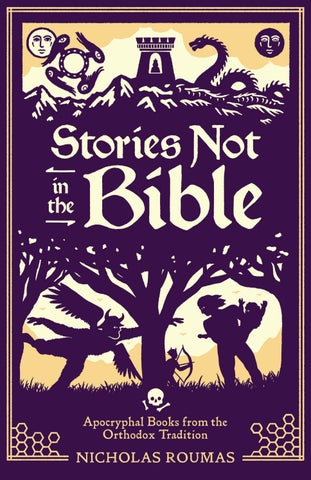
Stories Not in the
Bible
Apocryphal Books from the Orthodox Tradition
NICHOLAS ROUMAS
ancient faith publishing c h e s t e r t on, i n di a na
Stories Not in the Bible: Apocryphal Books from the Orthodox Tradition Copyright © 2026 Nicholas Roumas All rights reserved. No part of this publication may be reproduced by any means, electronic, mechanical, photocopying, recording, scanning, or otherwise, without the prior written permission of the publisher. Published by: Ancient Faith Publishing A Division of Ancient Faith Ministries 1050 Broadway, Suite 6 Chesterton, IN 46304 All Scripture quotations are translated by the author. Front cover artwork and design by Micah Peek ISBN: 978-1-968863-12-8 Library of Congress Control Number: 2026947213 Printed in the United States of America
Copyright ©2026 by Nicholas Roumas. All Rights Reserved. Published by Ancient Faith Publishing.
For all the scribes who passed this knowledge down to us
Sample pages only. Purchase the full book at https://store.ancientfaith.com/stories-not-in-the-bible-apocryphal-books-from-the-orthodox-tradition/
Copyright ©2026 by Nicholas Roumas. All Rights Reserved. Published by Ancient Faith Publishing.
CON T E N T S Acknowledgments
vii
Introduction
1
The Death of Adam
53
Enoch and the Watchers
79
The Coming of the Flood
95
Abraham and the Idols
113
Aseneth’s Prayer
135
The Genesis of Mary
177
The Trial of Jesus
193
Select Texts and Translations of the Original Works
227
About the Author
231
Sample pages only. Purchase the full book at https://store.ancientfaith.com/stories-not-in-the-bible-apocryphal-books-from-the-orthodox-tradition/
Copyright ©2026 by Nicholas Roumas. All Rights Reserved. Published by Ancient Faith Publishing.
Acknowledgments
S
everal people deserve particular thanks for their support for this project. My initiation into the pseudepigrapha came from Andrei Orlov, whose seminars unveiled complexities in these stories that I was truly privileged to learn about. After falling in love with the genre, I began reading these texts to my pregnant wife while she was in bed. They amused us enough that I got the idea of making a children’s book out of them. Sometimes one has an idea that seems too insane to carry out. In these situations, one only needs someone else to reassure them that the idea really deserves to be turned into reality. Petra Vaporis thought the idea was great, and that gave me the impetus to start the work. It became clear to me soon that no amount of work could make the Book of Enoch appropriate for children, so the project shifted to literary translations for more mature readers. Petra read, reviewed, and encouraged the work all the way through, and none of it would have happened without her. My mother, Marguerite Landry, a retired literature professor, also read and discussed the stories with me as I wrote. She provided a great amount of insight and editorial criticism. Sarah, my wife, calls this my best book, and has been enthusiastically supportive of the project. Once the writing was done, I was left wondering who would be willing to publish a book that doesn’t neatly fit a category. Father
vii Sample pages only. Purchase the full book at https://store.ancientfaith.com/stories-not-in-the-bible-apocryphal-books-from-the-orthodox-tradition/
s t or i e s no t i n t h e bi bl e Romanos Karanos suggested Ancient Faith, and hit the nail on the head. I would like to thank my editors, Marci Johnson and Lynnette Horner, for their enthusiasm and professional contribution to the book. One is lucky to have such supportive editors. I earnestly thank all of these people for their contributions.
viii Copyright ©2026 by Nicholas Roumas. All Rights Reserved. Published by Ancient Faith Publishing.
Introduction
T
he Bible is the story of salvation. It describes the goodness of the world as God made it, the entry of sin and death through Adam and Eve’s disobedience, the failures and glories of the holy nation of Israel, and the moral truth revealed by God through the prophets for the purpose of bringing God’s light into the human heart. The Bible also describes how the Law God gave to Israel was insufficient for restoring the natural well-being humanity was created to enjoy, and how God’s Son brought God Himself directly to people. Since Jesus is God—the full divinity of the Father dwelling on earth as a human being—the distance between humanity and God is reduced to zero. Man and God remain distinct yet become united in and through Jesus. This is the Orthodox story of salvation. It is usually expressed through rather abstruse theology—talk of essences, natures, and persons, all terms the Holy Fathers borrowed from the ancient Greek intellectual heritage. Yet the Bible, this collection of Jewish scriptures that the Church regards as a faultless reference for its teachings, conveys its ideas not through abstruse exposition of dogmatic concepts but through plain stories, parables, and histories. The Gospels, the Book of Genesis, the story of King David— these accounts convey truth in a way that is both simpler to access and capable of conveying greater complexity. That is, if one can say
1 Sample pages only. Purchase the full book at https://store.ancientfaith.com/stories-not-in-the-bible-apocryphal-books-from-the-orthodox-tradition/
s t or i e s no t i n t h e bi bl e biblical storytelling conveys anything at all! Perhaps it would be better to say that it invites its reader into its playground of meaning. Let’s take an example that will help us appreciate the complexity of biblical storytelling. Consider the story of the Garden of Eden in the Book of Genesis, chapters 2 and 3. Even if you are closely familiar with the way the Bible tells this story, go pick up your Bible and reread the text with me. What do you see? What is the point? Adam and Eve ate the fruit and were banished for it. What do you now know? The common Orthodox way of reading the Garden of Eden story is that Adam was created to share in God’s eternal life, but he sinned, and as a result his descendants—all of humanity—were burdened with mortality and a propensity to succumb to temptation. Yet very little of this story is apparent from the version told in Genesis. In Genesis it is Eve, not Adam, who drives the action, only Adam is cursed with death, and sin is nowhere mentioned. Adam’s curses focus mainly on the toils of farming, Eve’s on childbirth and female subordination, the snake’s on his ongoing feud with human ankles. The biblical Garden of Eden story seems more about the origins of agriculture and patriarchy than about sin and death. To be sure, the Gospels, at the other end of the story arc, also spend a good deal of time talking about farming and gender. But the Gospels are also replete with talk of sin and evil spirits. Where did these subjects come from? And one would not be wrong to think that there may be more elements of the story that are missing from the Genesis background than just these. So the biblical story is not as simple as we thought. One might even suspect there is more than one story. Open your Bible again, and read the first nine chapters of Proverbs. These pages describe a lady called Wisdom, through whom God created the universe. Fathers in the Orthodox Tradition such
2 Copyright ©2026 by Nicholas Roumas. All Rights Reserved. Published by Ancient Faith Publishing.
Introduction
as Athanasius the Great identified her with Christ, the Wisdom and Power of God (1 Cor. 1:24). In Proverbs she is called the first of God’s creations (Prov. 8:22) and a tree of life (Prov. 3:18). Everyone who enters into her house and dines with her will learn what’s what in life, the right paths to follow to live in a successful and morally correct way (Prov. 9:1–6). So, whereas in Genesis God’s pinnacle creation is a male, Adam, and a woman causes all things wrong with the world by eating from the Tree of the Knowledge of Good and Evil, in Proverbs God’s highest creation is this woman, Lady Wisdom, and she wants you to come eat in her house so she can teach you the knowledge of good and evil. The two stories sharply contrast, one wonders if deliberately. And whereas in Genesis, evil is caused by a failure of human responsibility, in Proverbs it is ignorance of the workings of the universe that causes human beings to suffer in life. So the contrast between these two stories is quite important: They give different etiologies of evil and prescribe different remedies for human suffering. Genesis obedience, Proverbs knowledge. A thorough study of the Old and New Testaments would reveal that the Bible is, in fact, a whole web of different narratives that play together like a symphony rather than agree on all particulars. Ancient Israel and the early Church were a soup of traditions, all of great antiquity, and few of which are well represented in the official central writings such as the Torah and the four Gospels. A complete reading of the Old Testament will hardly prepare a reader for the worldview of the Gospels, replete with evil spirits, angels, a Son of God, and notions of a Fall and a resurrection of the dead! The same can be said of the relationship between Scripture and Orthodox Tradition. Simply consider how central Adam is to Orthodox belief, and contrast this with the lousy three pages he gets in the Old Testament. Or consider again the importance of Mary, the
3 Sample pages only. Purchase the full book at https://store.ancientfaith.com/stories-not-in-the-bible-apocryphal-books-from-the-orthodox-tradition/
s t or i e s no t i n t h e bi bl e Theotokos, versus her scant screen time in the Gospels, or Christ’s descent into Hades, described nowhere in the New Testament. The books that make up the Bible simply cannot account for the breadth of the Church’s beliefs. So where do these traditions come from? In this volume I have presented a selection of ancient stories, translated and adapted from texts that give us our earliest written records of these nonbiblical traditions. The traditions themselves are, in many cases, older than the texts. Yet these books played an important part in the transmission of these traditions within the Orthodox Church, and for this reason we should read them. The Orthodox reader will find in them familiar themes concerning the fall of Satan, the marriage of Joseph and Aseneth, the miraculous conception of Joachim and Anna, and Christ’s descent into the lower world. Readers without interest in these theological topics will find in them delightful storytelling. Out of the many nonbiblical sacred books that exist in Christian tradition, I picked the seven translated here for their enjoyability, edifying quality, and particular relevance to Orthodox Tradition. My translations of these works are correspondingly geared toward the reader’s enjoyment and benefit. That means, besides giving my best attention to literary style, I have abridged, excerpted, and here and there modified some of the content of these books. I have taken this liberty for two reasons. First, excellent academic translations of these books already exist in volumes such as Charlesworth’s Old Testament Pseudepigrapha and Schneemelcher’s New Testament Apocrypha, listed in the bibliography at the end of this introduction. These academic volumes render the text with precise fidelity to the best manuscripts but are generally a drudge to read. A more vibrant and enjoyable rendering of the texts was called for.
4 Copyright ©2026 by Nicholas Roumas. All Rights Reserved. Published by Ancient Faith Publishing.
Introduction
Second, slavishly faithful translation of the originals would have been out of keeping with the spirit of the tradition. Whereas Christian and Jewish scribes rarely tampered with the text of the canonical scriptures, they took great, even wild, liberties in copying these nonbiblical texts. Manuscripts of any given book presented in these pages vary so much in what material they retained, deleted, inserted, revised, or downright changed that it is often quite impossible to reconstruct the original form of the book. The scribes’ reasons for such modifications seem to have included abridgment of overly long material, excision of parts the scribe found boring or irrelevant, rewriting confusing passages, adding traditional material from other sources if the scribe deemed it worth passing on, and simply improving the style. These complexities of the scribal history of each text are described in their separate introductions. As the modern-day scribe of these texts, I have kept with my predecessors’ policy of freedom when passing them on. The presentation of these texts is for the lay reader. Before modern times, these unsanctioned sacred books were never subjected to scholarly scrutiny, and it is a pity that this is the only way they are treated nowadays. Contemporary scholarship on these books, which classifies them variably as “pseudepigrapha,” “apocrypha,” and “apocalyptic literature,” has without doubt uncovered much valuable information about the historical development of ideas in Christianity and early Judaism. As an academic, I myself encounter these texts largely in this way. But historical inquiry is not my concern in bringing these texts to the general reader. My concern is rather to highlight the forgotten power of these texts as story telling, and specifically as theology through storytelling. So, consider these stories creative exercises for you—as they have been for me—just as much as historical curiosities.
5 Sample pages only. Purchase the full book at https://store.ancientfaith.com/stories-not-in-the-bible-apocryphal-books-from-the-orthodox-tradition/
s t or i e s no t i n t h e bi bl e It would be fair to ask why most readers of the Bible have never heard of these books. The answer lies in a combination of Church regulations and historical accident. From an ecclesiastical point of view, these texts, while considered useful reading by some (they continued to be copied for many centuries, after all), were not numbered among the canonical books—those deemed fit to serve as witnesses to correct teaching on apostolic authority. All seven books in this collection are of unknown authorship and contain fantastic material that is sometimes of questionable orthodoxy. The books were therefore never considered fit references for teaching in the Church, though the Book of Enoch stands as an exception to this in the Ethiopian tradition. So these texts, while passed on by Christian copyists, were nonetheless consigned to relative marginality. As for accidental circumstances, these texts must be considered victims of the printing press. Copied by hand from the first century until as late as the nineteenth, they were effectively forgotten once printed matter became the predominant medium for the dissemination of sacred texts. The printed Bible became all- important for the believer, while books that failed to reach the printing press fell by the wayside. All seven texts in this book fall into the latter group. A word needs also to be said about the relationship of these texts to Judaism. Five of the seven books presented were composed by Jewish hands and passed on to us by Christian scribes, sometimes in altered, Christianized forms. These books did not survive in the Jewish tradition at all. Following the destruction of the Temple by the Romans in ad 70, the Jewish community began to undergo a shift toward a rigorous textual orthodoxy centered on the Hebrew Bible and the Talmud. Nonconforming texts such as those here were totally suppressed by orthodox rabbis, resulting altogether in their elimination from Jewish tradition. Hence, despite their Jewish
6 Copyright ©2026 by Nicholas Roumas. All Rights Reserved. Published by Ancient Faith Publishing.
Introduction
provenance, not one of these books survives in Hebrew or in more than fragmentary Aramaic. They have come down to us in Greek, Slavonic, and Latin forms, as well as in other languages used by Christian copyists. These texts may fairly be considered integral parts of both Jewish and Christian tradition, originating in one, preserved and reshaped by the other. I commend these stories into your hands. I have told them mainly via direct translation from the original texts but, again, with some reworking for the sake of the needs and pleasure of the lay reader. These stories now belong as much to you as they did to the generations of scribes who copied them and the monks who read them. Take delight in what you read in these pages.
The Death of Adam “The Death of Adam” is a synthesis of Greek and Latin versions of the same book, known respectively as the Apocalypse of Moses and the Life of Adam and Eve. The Greek version is misleadingly named because it is framed as a revelation from God to Moses on Mount Sinai. The Apocalypse and the Life differ so substantially that they are traditionally classified as separate works, even though they are two divergent versions of a single original book, possibly written in Hebrew. The Latin and Greek versions each exclusively contain some of the best material in the story. Only the Latin Life, for example, contains Satan’s rich account of his expulsion from heaven, while only the Greek Apocalypse contains Eve’s lengthy frame story1 about her temptation in the Garden. Hence, I chose to combine both versions in order to preserve what is best in both. Since the order 1
A frame story is a story within a story.
7 Sample pages only. Purchase the full book at https://store.ancientfaith.com/stories-not-in-the-bible-apocryphal-books-from-the-orthodox-tradition/
s t or i e s no t i n t h e bi bl e of events is quite different in the two ancient versions, and since they are inconsistent with each other at a number of points, I have taken some liberties in arranging and harmonizing the material. Slavonic, Armenian, and Georgian versions of the book also exist, though their unique material does not fit well with the story as a whole, and I omitted it for that reason. The Apocalypse and Life are our earliest comprehensive narrative accounts of the sin of Adam and Eve. The story may be considered an ancient precursor to Milton’s Paradise Lost. Set (in my synthesized version) after Adam and Eve’s expulsion from Paradise, the plot revolves around the first family’s struggle to survive in the harsh outer world while they try to regain God’s favor. Adam’s mortal illness gives occasion for Eve to tell her children how sickness and death came into the world. Eve and Seth’s plea for oil from the Tree of Mercy is denied at the gates of Paradise, but Adam is vouchsafed future salvation for his descendants, and his climactic funeral demonstrates God’s continuing devotion to His greatest creation. The Apocalypse and Life might be thought of as expansive fiction on the Bible. A small story from the Bible is expanded and enriched, and the many unanswered questions with which the biblical version leaves us are answered by the author’s imaginative retelling. Here, the author has addressed such matters as the role of Satan in the Fall, the nature of Eve’s sin, and the emotional responses of the characters to the devastating consequences they face. The narrative style is novelistic, with a touch of the epic. While the Apocalypse/Life has come down to us only through Christian transmission, it is undoubtedly of Jewish origin, as God’s promise of restoration to Adam in the heavenly Paradise makes no mention of Christ. Michael’s prophecy of Christ, placed at the gates of Paradise in “The Death of Adam,” is a Christian insertion to
8 Copyright ©2026 by Nicholas Roumas. All Rights Reserved. Published by Ancient Faith Publishing.
Introduction
the original text. The fact that this book was disseminated into so many languages by Christian scribes speaks to Christian interest in Adam as well as to the good quality of the story. Johnson, introducing the text in Charlesworth, dates the original version likely between 100 bc and ad 200. In addition to the Apocalypse/Life’s wide distribution in the Orthodox world, this story is an important historical witness to early theologies of the Fall. Readers familiar with patristic inquiries into the nature of Adam, the ancestral sin, and the origin of evil will find much material to dialogue with. Greek manuscripts copied as recently as the seventeenth century attest to the popularity of the Apocalypse prior to the printing press.
Guide to Reading “The Death of Adam” may be read as a meditation on the severity of life and human hopes that God will save His creatures. As Adam’s children, we find the reality of death incomprehensible. Death’s twin, pain, also defies moral explanation. Why should sentient beings need to endure such evils? The story answers this basic moral question with the notion of the Fall, an idea so central to Christianity yet missing from the Book of Genesis. Adam and Eve were created in an exalted state, the highest of God’s creatures. They lived in harmony with the animals in the Garden of Eden. But through an act of disobedience, the first couple were driven out from the Garden. Adam nonetheless receives a promise of future restoration, a time when God will again dwell among humans, as He now dwells at the foot of the Tree of Life in the earthly Paradise. Adam’s status as an exalted being goes back to his creation, not on earth, but in heaven. Satan, recounting his rebellion, tells Adam
9 Sample pages only. Purchase the full book at https://store.ancientfaith.com/stories-not-in-the-bible-apocryphal-books-from-the-orthodox-tradition/
s t or i e s no t i n t h e bi bl e about the Protoplast’s own origin as God’s image. Adam, Satan tells us, was brought into heaven by Michael, who commanded all the angels to worship him. Satan, refusing, was driven from heaven. What is striking about Adam’s heavenly veneration is that Adam himself appears to have no memory of it—as if his heavenly existence preceded his conscious life on earth. Also noteworthy in this scene is that Michael appears to refer to Adam by the name of God, Jehovah, although the Latin text is rather ambiguous here. If my interpretation of the Latin is correct, and Adam really is called Jehovah in heaven, then we should read this passage alongside the following two passages from the New Testament: Have this attitude within yourselves, which was also in Christ Jesus, who, existing in the form of God, did not treat being equal to God like booty, but emptied himself by taking the form of a slave, coming to be in the likeness of humans, and, being found like a human in shape, he abased himself, becoming obedient to the point of death, even death by a cross, wherefore God supremely exalted him, and graced him with the name that is above every name, that in the name of Jesus every knee should bow, of heavenly beings and earthly beings and subterranean beings, and every tongue should confess that Jesus Christ is the Lord, to the glory of God the Father. (Phil. 2:5−11) God, who at various times and in many ways spoke in time past to the fathers by the prophets, has spoken to us in these last days by his Son, whom he appointed heir of all things, through whom he also made the ages; who, being a reflection of his glory and an imprint of his substance, and upholding
10 Copyright ©2026 by Nicholas Roumas. All Rights Reserved. Published by Ancient Faith Publishing.
Introduction
all things by the word of his power, when he had purged our sins through himself, sat down at the right hand of the throne of the Majesty on high, having become so much better than the angels as he has inherited a more excellent name than they. (Heb. 1:1−4) Christ, when He was exalted into heaven, was given the name of God. Though He was always the divine Son, He has also become the new Human Being and, as a Human Being, He is able to undergo deification, that is, receive the divine name. It is perfectly logical, then, that Adam too, being the image of God, was created to bear God’s name. This putative Adam tradition may well be what these two New Testament passages have in mind as the basis of their Christology. Without it, the passages simply do not make as much sense. Adam was made to be the icon, image, cult statue of God, in whose person God could be worshiped. But by attempting to seize divinity illegitimately from the Tree of Knowledge, Adam fell from grace. Christ reversed Adam’s fall, willingly emptying Himself of His divine appearance and descending to earth in humility. Through His humility and obedience even to the point of death, Christ merited the divine name that Adam lost. Christ, then, is the new Adam (Luke 3:38). Just as Christ is the glory of the Father, Adam wears the glorious garment of righteousness, lost by him and Eve when they disobeyed God but evoked once again by Adam’s hair, spreading like the rays of the sun as he prays in the Jordan. The shadow of the divine glory remains with him. The origin of evil and the role of human responsibility form another topic relevant to the Apocalypse/Life. The story of the Garden in Genesis leaves us wondering how evil could have entered into the world if everything was created good by God. Was the Tree
11 Sample pages only. Purchase the full book at https://store.ancientfaith.com/stories-not-in-the-bible-apocryphal-books-from-the-orthodox-tradition/
s t or i e s no t i n t h e bi bl e of Knowledge bad? How could God make a bad tree? Eve’s account of her sin, taken from the Greek Apocalypse, takes steps toward answering this question. The character who motivates Eve to sin is Satan, and he in turn is motivated by envy of Adam. Envy, the desire to seize status for oneself, is the original sin in this story. Eve, on the other hand, does not harbor any ill will. Satan relies on manipulative tactics to entice her to eat. Satan’s mission is accomplished when Eve eats the fruit poisoned by the snake’s venom, called epithymia, a Greek word I have translated “craving.” This Greek term occurs across the New Testament and monastic literature, where it is usually translated “desire,” which I find too weak, or “lust,” which misleadingly suggests sexual desire only. It refers rather to any desire that risks bending our will away from obedience to God. So, to recapitulate, the origin of evil is Satan’s envy of humanity, and craving, our strong human desire that turns us away from God, is Satan’s “venom” through which he has poisoned our will. The figure of Cain deserves a special note. He is a light-child, luminous at birth, like Jacob in the Book of Genesis (Gen. 27:11) and Noah in certain traditions (1 En. 106:2). Perhaps Cain retains some of the glory his parents lost. Or perhaps he is not of fully human parentage. The text does not give us enough information to be certain. But it is worth observing that epithymia, while not so narrowly connotative of sexual desire as “lust,” is capable of carrying sexual connotations. Did Eve conceive Cain with Satan? How else would Adam be ignorant of her pregnancy? Consider also that when God pronounces Eve’s curses, He refers to conception as “the sin of the flesh.” The text appears, unfortunately in my view, to link sexuality with sin. “Yahoel” is my rendering of the name of the angel who acts as God’s presence on earth during Adam’s funeral. The name is
12 Copyright ©2026 by Nicholas Roumas. All Rights Reserved. Published by Ancient Faith Publishing.
Introduction
a fusion of the divine name and El, the Hebrew word for a god. Angelic figures who manifest the divine presence in their persons are a common theme in ancient Israelite religion and recur frequently in the stories presented in this book. The Old Testament’s “angel of the Lord” is another example of such a being. These figures were identified by some of the Holy Fathers, such as Athanasius, with God the Son. Yahoel will appear again in this collection in “Abraham and the Idols.” I have placed “The Death of Adam” at the start of this collection not only because it sets the stage for the grand story of redemption but because it is a meditation on the role of storytelling in theology. Replete with back narrative and frame stories, and driven by Eve’s actions and storytelling from start to finish, “The Death of Adam” is not only about the events that lie beneath human origins but about the fact that these events are conveyed to us as story. Eve is the grand storyteller, the matriarch who, like so many elder women, preserves family lore for her children and grandchildren. Seth carries Eve’s knowledge onward in written form, inscribing her oral stories on tablets. Solomon, who discovers the tablets, is a stand-in for the reader.
The Translation “The Death of Adam” is translated from Tischendorf’s Greek text of the Apocalypse and Mozley’s Latin text of the Life. As mentioned previously, the passages from the two original versions have been combined and rearranged in “The Death of Adam.” I will note here the handful of places where I have modified the meaning of the original text, as well as places where my translation choices call for special justification.
13 Sample pages only. Purchase the full book at https://store.ancientfaith.com/stories-not-in-the-bible-apocryphal-books-from-the-orthodox-tradition/
s t or i e s no t i n t h e bi bl e Michael’s command to Satan, “Worship Jehovah, the image of God!” could also be translated “Worship the image of God Jehovah!” I prefer the former translation for reasons I have explained. Michael’s promise of Christ to Seth at the gates of Paradise is only found in a few manuscripts, but I have chosen to include it because the episode is alluded to in the Acts of Pilate, also included in this collection as “The Trial of Jesus.” The angel Yahoel is called in the Greek Ioel, which is a composite of Hebrew Yaho and El. I have regularized the spelling of the name to Yahoel. In the Greek text, Eve says at Adam’s funeral that the sun and moon have become dark “like Ethiopians.” I have omitted this descriptor in the translation. “Styx” is in the Greek Acheron, a river from pagan mythology that serves the same function as the more familiar Styx. While I have omitted passages found only in the Armenian, Georgian, and Slavonic versions of the Apocalypse of Moses, one passage from the Slavonic bears including in this introduction. The translation is adapted from Charles (1913): The archangel Yahoel commanded Adam to sort out the cattle, and every kind of flying and creeping thing, and every animal, both wild and tame, and to give names to all of them. Then he took oxen and began to plough. Then the devil approached, and stood in front of the oxen, and hindered Adam from tilling the field. And he said to Adam, “The earth is mine, and heaven is God’s. If you will be mine, then labor on the earth; but if you will be God’s, go off to Paradise.” Adam said, “Heaven and earth and Paradise and the whole world are God’s.”
14 Copyright ©2026 by Nicholas Roumas. All Rights Reserved. Published by Ancient Faith Publishing.
Introduction
The devil said, “I will not allow you to till the field unless you write a bond that you are mine.” Adam replied, “Whoever is lord of the earth, I and my children belong to him.” Then the devil was overcome with joy. But Adam was not unaware that the Lord would come down to earth and trample the devil under foot. The devil said, “Write me your bond.” And Adam wrote, “Whoever is lord of the earth, I and my children belong to him.”
Enoch and the Watchers “Enoch and the Watchers” is a portion of 1 Enoch, also known as Ethiopic Enoch or simply the Book of Enoch. The history of this text is complex and will require a more extended explanation than I have granted to other works in this book. 1 Enoch is an ancient Jewish work of scripture that is today preserved and revered only in the tradition of the Ethiopian Tewahedo Church. It was omitted from lists of approved scriptures by all the early councils and Greek-speaking Fathers, owing perhaps to its bizarre angelology as well as to the book’s rejection by the Jewish rabbinate. Notwithstanding its rejection from the canon by the Orthodox Church, 1 Enoch is quoted as prophecy in the Epistle of Jude: The seventh from Adam, Enoch, prophesied to these very people, saying, “Behold, the Lord came among his holy ten thousands, to carry out judgment on all, and to try every soul for all their works of wickedness that they did wickedly, and for all the hard things that wicked sinners spoke against him. (Jude 14, 15 = 1 En. 1:9)
15 Sample pages only. Purchase the full book at https://store.ancientfaith.com/stories-not-in-the-bible-apocryphal-books-from-the-orthodox-tradition/
s t or i e s no t i n t h e bi bl e 1 Peter also alludes to 1 Enoch when it mentions that Christ “preached to the spirits that are in prison, who had once disobeyed when God waited patiently in the days of Noah” (1 Pet. 3:19–20). These “spirits” are the fallen Watchers we will read about shortly. What Christ may have had in mind by preaching to them I cannot say, but the allusion to the Enochic story in 1 Peter is clear. 1 Enoch was nonetheless consigned to marginal status in Orthodox Tradition, and for this reason the book’s textual sources are rather fragmentary. Substantial portions of the Greek version of 1 Enoch have been preserved in the writings of the Byzantine historian George Synkellos as well as in Egyptian papyri known as the Gizeh fragments. A very brief Aramaic fragment containing only the names of the fallen angels was also discovered among the Dead Sea Scrolls. 1 Enoch is preserved in its entirely only in its Ethiopic version. As for 1 Enoch’s original language, the portion I have translated, known in scholarship as the Book of the Watchers, was composed in Aramaic, possibly in reliance on earlier Hebrew source texts. Assuming that the source texts were in Hebrew, that means much of the text of the Book of the Watchers was translated from Hebrew to Aramaic to Greek to Ethiopic. That is a lot of translating! The complexity of this transmission chain means that there is a great deal of uncertainty in how faithfully our Ethiopic and Greek versions represent the original and how much has been lost in translation along the way. Fortunately, the surviving versions are coherent enough for a modern translator, in this case myself, to try to triangulate the original meaning of the text. 1 Enoch is a composite work consisting of five originally separate books that were combined into a single work by the first century ad. The first of these five books is the Book of the Watchers, which is the oldest part of 1 Enoch, dating from either the late Persian or
16 Copyright ©2026 by Nicholas Roumas. All Rights Reserved. Published by Ancient Faith Publishing.
Introduction
early Hellenistic period (4th–3rd centuries bc). It is our earliest source on the figure Enoch, aside from the few verses about him in the Book of Genesis: And Enoch lived five and sixty years, and he begot Methuselah. And Enoch walked with the gods after he begot Methuselah three hundred years, and he begot sons and daughters. And all the days of Enoch were five and sixty years and three hundred years. And Enoch walked with the gods, and he was not, for God took him. (Gen. 5:21–24) The mythology of the Book of the Watchers appears again in the next chapter of Genesis: And it came to pass, when man began to multiply on the face of the earth, that daughters were born to them. And sons of the gods saw daughters of men, that they were beautiful, and they took wives for themselves from any whom they preferred. And Yahweh said, “My spirit will not remain in man forever, because he is flesh, and his days shall be one hundred and twenty years.” The fallen ones were on the earth in those days, and even afterward, when the sons of the gods came into daughters of men and they bore them to them, the giants that were of old, famous men. (Gen. 6:1–4) These passages from Genesis must be archaic. They speak of “the gods” (traditionally misrendered “God” in translations), among whom Enoch spends his time before being taken up into heaven after living a solar 365 years. Clearly there is a mythology behind these passages that is largely lost to us. The Book of the Watchers is a parallel testimony to this same mythological tradition.
17 Sample pages only. Purchase the full book at https://store.ancientfaith.com/stories-not-in-the-bible-apocryphal-books-from-the-orthodox-tradition/
s t or i e s no t i n t h e bi bl e The Book of the Watchers opens with a poetic blessing spoken by Enoch that serves to introduce the book’s themes, including the obedience of creation to God, the disruption of natural cycles by rebellious beings, and God’s future judgment of the wicked and the righteous. The book then narrates the rebellion of Watchers, heavenly beings named also in the Book of Daniel (4:13, 17, 23), who coincide with the “sons of the gods” in Genesis. These rebellious angels descend onto Mount Hermon, near the ancient Israelite sanctuary of Dan, and conspire to marry human women, whom they teach heavenly secrets. The hybrid offspring of the women and Watchers cause havoc on the earth, so the earth sues. Four chief angels, Michael, Gabriel, Raphael, and Uriel, represent the plaintiff, and win a victory in heavenly court. After the Watchers are condemned, they ask Enoch, a scribe, to write an appeal. The Watchers’ appeal is denied, but God’s heavenly ministers nonetheless grant Enoch the privilege of witnessing the secrets of the cosmos, making Enoch the legitimate purveyor of heavenly knowledge. The figure of Enoch formed the center of a whole branch of narrative theology in ancient Israel, only a portion of which survives today. The emphasis of Enochic literature on heavenly visions, including visions of God Himself, stands in contrast to the Old Testament’s emphasis on law and insistence on God’s invisibility. The Enochic notion of heavenly mediators of God’s presence is particularly important. In later layers of the Enochic corpus, Enoch himself is transformed into such a being, turning into Metatron, the heavenly librarian who is also the angel of God’s face. This notion approximates the Christian belief in the Trinity, Enoch corresponding to the Son through whom God the Father is known and who embodies God’s word. Like Christianity, Enochic belief was deemed heretical in Rabbinic Judaism, but its texts and ideas
18 Copyright ©2026 by Nicholas Roumas. All Rights Reserved. Published by Ancient Faith Publishing.
Introduction
survive—largely through Jewish mysticism such as the Kabbalah and, in the case of 1 Enoch, through Christian scribes.
Guide to Reading The story of Enoch and the fallen angels is about knowledge and power. It is also more broadly about the origin of evil. Both of these themes should be attended to by the reader who wishes to dig deeper into the story’s meaning. As a story of knowledge and power, “Enoch and the Watchers” draws a line between legitimate sources of heavenly knowledge, which would be Enoch and his books, and illegitimate sources, which the story identifies as women and metalworkers. Enoch is a priest and a scribe, a combination that reflects the close marriage of hierocracy and writing in ancient Israel. As a priest-scribe, then, he stands in marked contrast to women and smiths, persons of lower social status. Books about Enoch, of course, take his side, since he, as a divinely sanctioned scribe, is the patron saint of books. The knowledge of the women and smiths, on the other hand, is passed down orally and originates from the rebellious Watchers. We are probably looking at a parable about the ascendancy of priestly religion based on the written word over popular religion, whose knowledge must have been passed on orally in ancient Israel, largely by women. The oral Israelite religion is characterized in the Enoch myth as polytheistic and magical, the Watchers holding the status of lesser gods and their knowledge giving the power to mysteriously create, whether children, potions, or metals. Enoch’s divinely sanctioned technology of writing is also a form of magic, of course, but it is one that the ancient author approves of. Gender dynamics are an aspect of the Book of the Watchers that should not be overlooked. The Watchers are male, in stark
19 Sample pages only. Purchase the full book at https://store.ancientfaith.com/stories-not-in-the-bible-apocryphal-books-from-the-orthodox-tradition/
s t or i e s no t i n t h e bi bl e contrast to Christian depictions of angels as sexless. In the Enochic universe, males are the default form of human and divine beings, women being created only so that mortals have the opportunity to perpetuate their existence through reproduction. Since angels do not die, God did not create wives for the Watchers. This extremely patriarchal worldview should be contrasted with Genesis 1:27, where humans are created male and female in seeming equality, and Genesis 2, where Eve is a subordinate but still human being, created for companionship rather than reproduction. Both the Edenic story and the Enochic myth, however, regard women’s knowledge as critically dangerous. The Enochic myth’s polytheistic features are likewise striking. The traditional phrase “sons of the gods” means in Hebrew “divine beings,” and the names of the Watchers appear to tie them to natural elements (rain, clouds, stars) after the manner of lesser deities. Surely this is what Paul refers to in Colossians when he says that Jewish worship of angels is service to “the elements of the world” (Col. 2:8, 18, 20). That stars were regarded as gods in ancient Israel is evident from Deuteronomy 4:19. Without a doubt, then, the fallen stars whom Enoch is shown in prison, who “did not go forth at their set times,” are at once the Watchers and the seven planets. As a story of the origin of evil, “Enoch and the Watchers” may be read as a complement to Genesis in the Christian tradition. In Genesis, evil comes about through human responsibility. Eve chooses to take the forbidden fruit, she and Adam willfully disobey, and the universe is cast into disharmony as a result. The Enochic myth paints a different picture. It is evil angels who wreak havoc on a passive humanity and whose children, the human-angelic hybrid giants, become the spirits that torment humanity for ever after. It is fair to say that the Enochic worldview is better represented in
20 Copyright ©2026 by Nicholas Roumas. All Rights Reserved. Published by Ancient Faith Publishing.
Introduction
the Gospels than that of Genesis, since in those four sacred books unclean spirits are humanity’s main problem. The notion of evil is itself different in the Book of the Watchers than in the canonical Bible. It is not so much moral obedience or trust in God that counts, but adherence to one’s role in nature. Enoch’s blessing speaks extensively of natural cycles and the obedience of the elements, especially the stars, to their Creator in doing their work at the appropriate time. The wicked are those who turn aside from their natural work. This moral framework sets up the reader to understand the sin of the Watchers, who left their natural place in heaven and disrupted the created order. Finally, the Book of the Watchers introduces into written tradition the notion of God’s judgment at the end of time, something totally lacking from most of the Old Testament. No matter how distant God seems in the Book of the Watchers, He will come to earth in the future to judge the righteous and the wicked. This promise of judgment should be contrasted with the view of the Book of Genesis, where time is headed toward no particular end point and human beings are not neatly divided into good and bad people. The Enochic worldview is, once again, closely akin to that of the Gospels.
The Translation In translating “Enoch and the Watchers,” I have relied mainly on the Greek and Aramaic fragments and assumed that the Book of the Watchers was created using Hebrew source texts. The translation includes the entire Book of the Watchers except for Enoch’s redundant second heavenly journey. The original author’s introductory glosses on his source material are represented in italics in the translation.
21 Sample pages only. Purchase the full book at https://store.ancientfaith.com/stories-not-in-the-bible-apocryphal-books-from-the-orthodox-tradition/
s t or i e s no t i n t h e bi bl e The Watchers’ “craving” of human women translates the same Greek root as Eve’s “craving” in “The Death of Adam.” When Shemihazah proposes the Watchers’ blood pact, he appears to say in the Greek that he fears he “alone shall be liable for a great sin.” I presume that the Greek hamartia, “sin,” translates an original Hebrew Hattath, as it does in the ancient Greek translation of the Bible, the Septuagint. In that case, hamartia is probably best understood to mean “punishment” or “penalty,” as it does in the Book of Leviticus. “Kohl” is literally the plural of “antimony.” “Hybrid” is in the Greek kibdelos, meaning adulterated. “Bastards” is mazereos, the word used in the Septuagint to refer to cloth made of mixed kinds of thread. The “slab of heaven” that Enoch witnesses is the familiar “firmament of heaven” from English Bibles. As in Genesis, the Hebrew word raqiya, translated into Greek as stereoma, “hard surface,” and into English with the peculiar word “firmament,” means a hard sheet. The biblical heaven, like the biblical earth, is a hard, flat surface held up by pillars. Uriel says in the translation that the wives of the Watchers will become “sirens.” This is what the Gizeh fragment says, but the Ethiopic says they will be “peaceful.” Neither reading is particularly sensible, but the Greek reading at least appears to be older.
The Coming of the Flood “The Coming of the Flood” is an extract from the book known as 2 Enoch or Slavonic Enoch. 2 Enoch appears to be composed of two originally independent works, comprising a book of Enoch’s heavenly journeys and a book about the succession of the high priesthood from Enoch’s assumption into heaven until the coming of the
22 Copyright ©2026 by Nicholas Roumas. All Rights Reserved. Published by Ancient Faith Publishing.