ONE YEAR WITH THE DIVINE LITURGY
jennifer hock
illustrated by kaitlin gallimore
chesterton , indiana
One Year with the Divine Liturgy
Text copyright © 2026 Jennifer Hock
Illustrations copyright © 2026 Kaitlin Gallimore
All rights reserved.
No part of this publication may be reproduced by any means, electronic, mechanical, recording, scanning, or otherwise, without the prior written permission of the publisher. However, permission is granted for multiple photocopies of individual pages (not exceeding 1 copy per pupil) to be made by or for a teacher giving a course for classroom use or for discussion.
All Old Testament quotations, unless otherwise identified, are from the Orthodox Study Bible, 2008 by St. Athanasius Academy of Orthodox Theology (published by Thomas Nelson, Inc., Nashville, Tennessee) and are used by permission. New Testament quotations are from the New King James Version of the Bible, 1982 by Thomas Nelson, Inc., and are used by permission.
Liturgical texts in English: www.goarch.org
Book of Psalms Translation © 2016 Ancient Faith Publishing Translated by Monks of the Orthodox Church.
“Matthew, Mark, Luke, and John” song, written by Marti Iatridis and used with permission. Interior book design and illustration support: Sophie Ries
An imprint of Ancient Faith Publishing 1050 Broadway, Suite 6, Chesterton, IN 46304
store.ancientfaith.com
ISBN: 978-1-968863-07-4
Printed in India
To my faithfully guiding parents, always supportive husband, persistently patient children and grandchildren as I finish “one more lesson,” and the encouragement of Fr. Vasile, Fr. Joseph, and Fr. James.
–J.H.
INTRODUCTION
This book has been such a long time coming. For all of those who have ever nudged me to publish the work I’ve written over the years, you now hold a sliver of it within your hands.
The lessons contained in this book were initially developed for our church school program at Saint John the Baptist Greek Orthodox Church in Euless, Texas. Since then, the lessons have been revised and expanded for future use in our parish again and also for other teachers and parents. This curriculum can be used as part of a parish church school program, homeschool co-op, or within the
home as part of a family or homeschool study of the Divine Liturgy.
There are twenty-nine lessons—a year’s worth of teaching—in this curriculum. Each lesson is structured with one or more goals, lesson content and guidance for the teacher, and also suggestions for activities. Guidance is provided for three age groups:
• early elementary
• upper elementary and middle school
• high school
Each of these groups is a block of four years. Parents and teachers can use this curriculum while working with a single age group or with multiple ages at the same time. While some of the teaching methods and activities lend themselves better to a younger or older group, the content is set up in such a way that you can ultimately pick and choose from all the options provided and make adjustments based on your students. Ultimately, this is a flexible curriculum for those new or not-sonew to the Faith, for those working with an individual child or group of children, and for those working with a child with special needs.
Classroom Supplies
Each lesson will mention supplies that may be needed for the various activities. Make sure you look at them well in advance in case you need to order or track down a certain item. Aside from special materials you may need for an individual activity, we assume that your classroom or home has basic supplies on hand, including paper; pens, pencils, crayons, markers, or colored pencils; tape; glue; scissors; rulers; Post-it notes (we love Post-it notes!); and at least one Bible.
Consider the Year-long Projects
Every lesson in this curriculum has suggest ed activities to help bring the material alive for the students. Some of these activities are designed just for that one lesson, but other activities are ongoing, helping to build con nections and learning over the whole year. These projects are summarized after this introduction. They have proven successful in classroom and home settings, so consider one or more of these year-long activities to help
your students grasp the beauty and breadth of all that happens during a Divine Liturgy.
Parish Icons
Many of the lessons in One Year with the Divine Liturgy use icons as teaching tools. We have provided many illustrated icon images for your use in the classroom. However, if an icon of the same saint or feast day mentioned in a particular lesson can be found within your parish, we greatly encourage you to interact with that, as it is already familiar to your students. This interaction will link real-time church life and veneration to the lessons they are learning.
Liturgical Photos of Your Parish
This curriculum provides the illustrations you need for each lesson. However, please consider taking photos of the defined moments during the Divine Liturgy at your parish as well. (Please talk to your priest beforehand.) It is natural for younger children and those with special needs to think concretely, meaning they view the world very literally. They

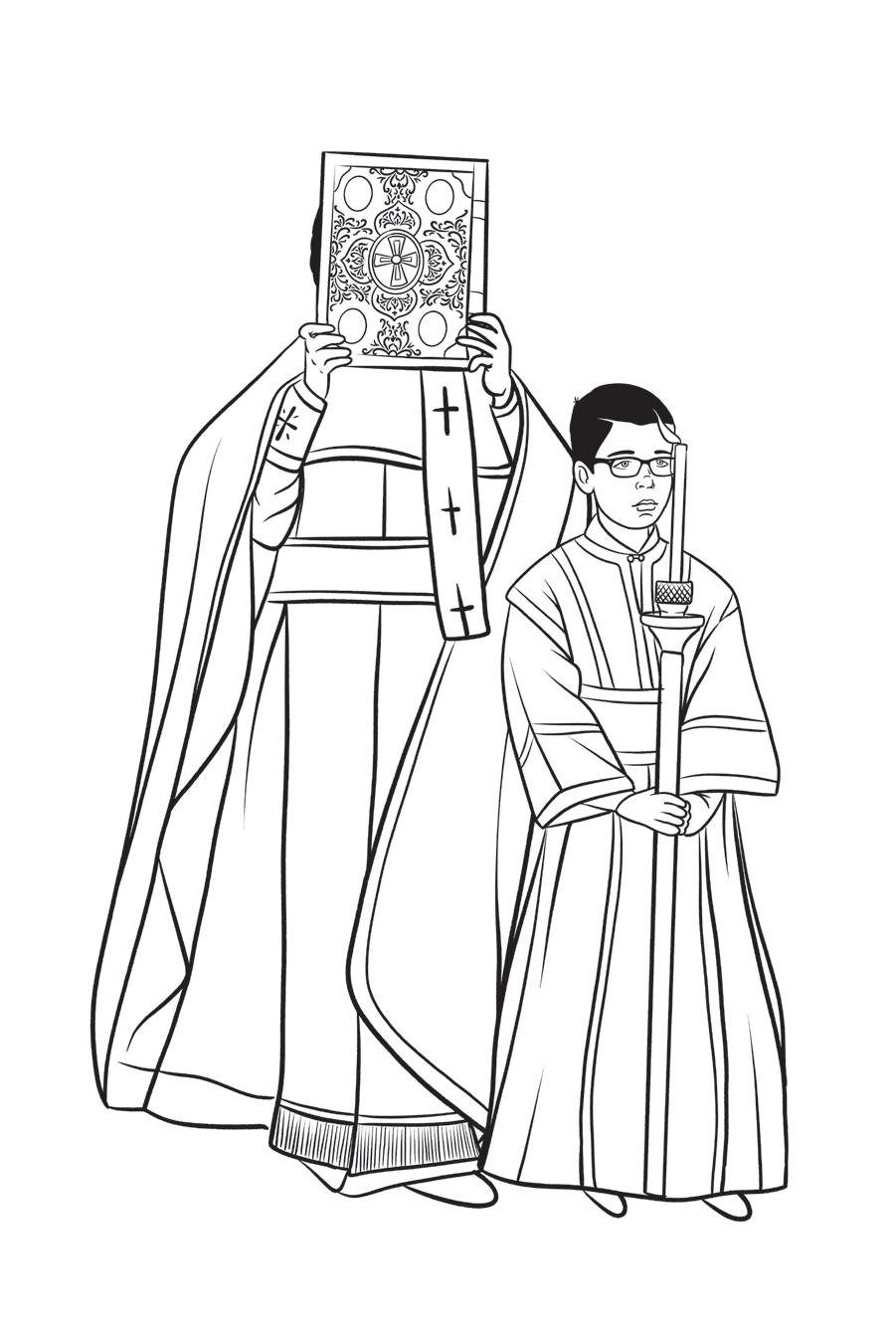
in different moments throughout the Divine Liturgy, such as the Great Entrance along with their brothers or friends in the procession. This will help them make connections and develop a fuller understanding of the Divine Liturgy. The photos from your parish can be used throughout the curriculum. Taking your own photos will also be particularly helpful in spanning cultural differences between what is shown in our illustrations and what might be taking place in your own parish.
Psalm Numbering
Regarding Scripture references from the Psalms: When the Hebrew tradition (used in most English Bibles) and the Greek tradition (on which the Orthodox Study Bible and certain other translations are based) differ from one another, the numbering from the Hebrew tradition precedes the Greek, and a slash (/) separates them.
Video Resources
On the Ancient Faith Kids YouTube channel you'll find a helpful video resource pertaining to this curriculum. Each short video will provide additional background information about the Liturgy, teaching tips, notes about child development, and tips for bringing to life the curriculum. Search for One Year with the Divine Liturgy!
Your Next Task!
Please, provide yourself with some time to read and study the very first lesson (starting on page 17), which is written just for you, not for the student. The content of any curriculum is one small part of teaching. The teacher is arguably a more significant element. This book found its way into your hands either out of your own desire to learn more and teach others about our Faith or because someone else would like you to teach those around you. Let’s continue our journey toward Christ as we turn the page and reflect on our calling to teach.


Divine Liturgy Ongoing Projects
Following are projects for each age group that can be worked on a little bit at a time over the course of many weeks. At the end of the year, the students will be able to see their long-term accomplishment, and teachers can use these projects for periodic or end-of-theyear reviews.
The materials used for these projects can be those you already have or those you choose to purchase. This curriculum is flexible to the needs and abilities of each family, classroom, and parish.
The Divine Liturgy projects will begin for all ages in Lesson 5 and will continue again in Lessons 10–18. Lessons 6–9 cover various liturgy-related subjects.
The Saints Timeline for Upper Elementary / Middle School will begin in Lesson 2 and continues periodically until Lesson 24.
Early Elementary
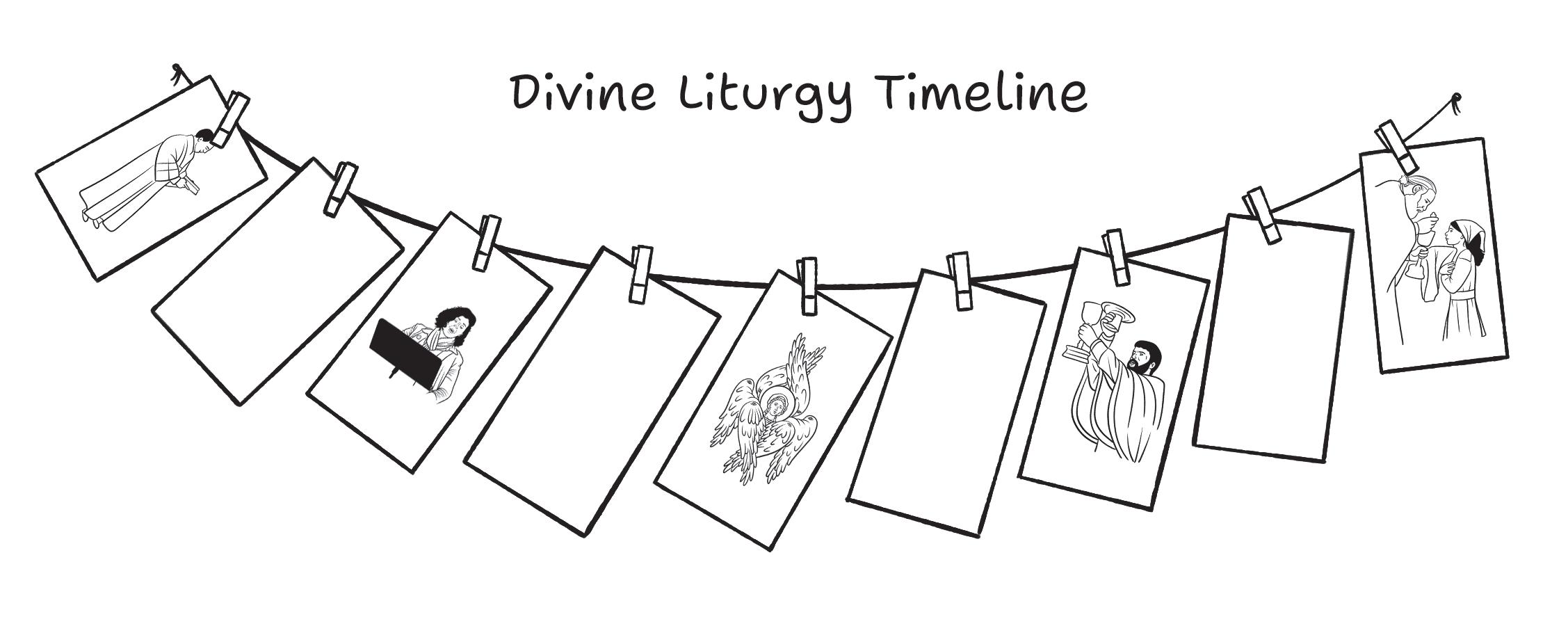
Divine Liturgy Timeline
Goal: Young students will become familiar with the main parts of the Divine Liturgy and each student will build a sequence of events to help them learn what happens first, next, and last in the Divine Liturgy.
Materials: The timeline paper could be made with sentence strips, roll of white craft paper, printing paper, or large index cards; drawing supplies such as string and clothespins; crayons; tape; glue or velcro dots; and one printed copy of the events of the Divine Liturgy per student from this book.
Directions:
Choose the materials you will use for your project. Each child will take home their project at the end of the year.
You can have the students make a permanent sequence of events as they glue their illustrations to their timeline, or they can make a reusable timeline with velcro dots on the back of the illustrations. The velcro dots allow the ability to periodically take off the events students have already studied, mix them up, and ask the students to put them back on the timeline in the correct order. This decision really depends on how you want to use this timeline as a teaching tool with your students. As an example, if you choose to use one sentence strip for each child (available online or at teacher stores), you can add the event from the Divine Liturgy during each indicated week with either glue or velcro dots.
Upper Elementary / Middle School
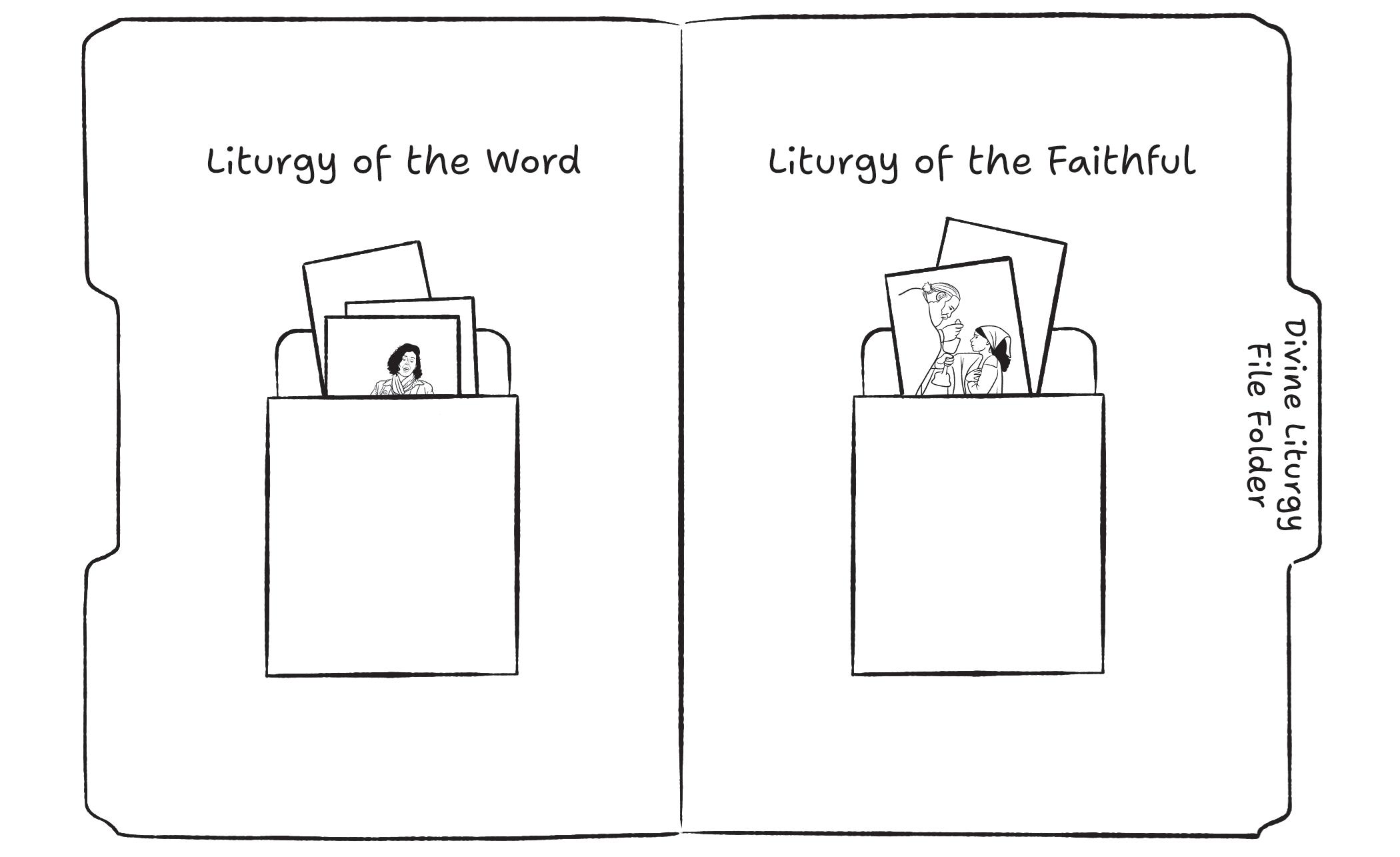
Divine Liturgy File Folder
Goal: Each student will learn about what happens in the two main parts of the Divine Liturgy and take home the file folder containing images and short summaries about the Liturgy.
Materials: You’ll need file folders; pockets; glue or tape; index cards; pencils; crayons or colored pencils; and one printed copy of each highlighted moment of the Divine Liturgy per student from this book.
Directions:
Choose the materials you will use for your project. Each child will take home their project at the end of the year.
In Lesson 5, the students will prepare their folder for their project. Starting in Lesson 10,
they will add illustrations to either the left or the right side of the folder as they learn what happens in the two main parts of the Divine Liturgy. Additionally, you can use these cards to periodically review the parts of the Divine Liturgy or the sequencing of these events.
In each indicated lesson, the students will color the illustration(s) related to the lesson and attach each one to a regular-sized index card. On the other side of the index card, the students will write one or two sentences summarizing this part of the Liturgy. The index cards will then be placed in either the pocket on the left side of the folder (Lessons 10–12—Liturgy of the Word) or the pocket on the right side of the folder (Lessons 14–18— Liturgy of the Faithful).
For the folder pockets, you can use teacher card pockets (available online or at teacher stores), make your own pockets, or use any alternative that will hold index cards.
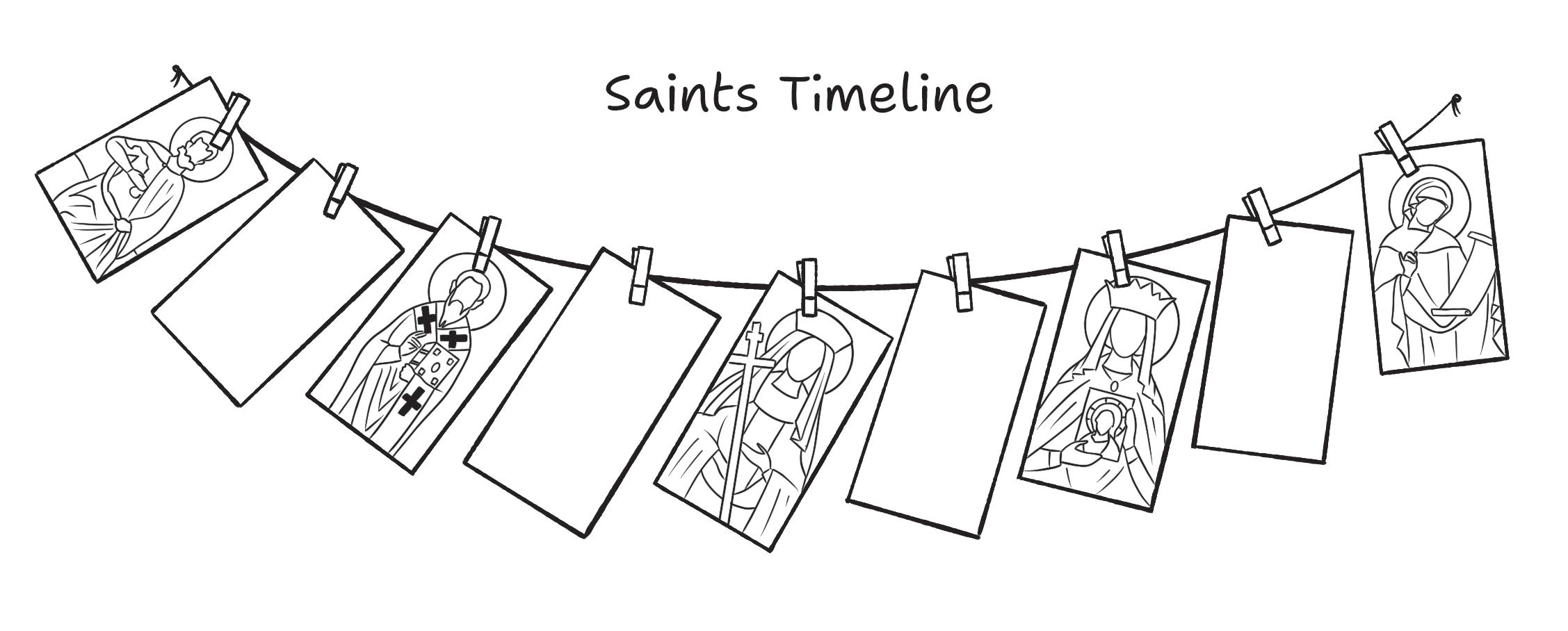
Saints Timeline
Goal: Students will draw connections between the lives of the saints and the influence of the Roman emperors and/or heresies developing during these time periods.
Materials: The timeline paper could be made of sentence strips, roll of white craft paper, paper, or large index cards; plus drawing supplies, such as crayons; and tape.
Saints:
Lesson 2: Saint Justin Martyr, ad 165
Lesson 3: Saint Ignatius of Antioch, ad 107; St. Tarcisius, c. ad 253 (martyred during Valerian’s rule)
Lesson 4: Saint Constantine, ad 337; St. Helen, ad 327; St. Macarius, ad 334
Lesson 6: Saint Basil the Great, ad 379 (Optional: add St. Basil’s family)
Lesson 7: Saint John Chrysostom, ad 407 (Optional: add St. Gregory the Theologian, ad 390)
Lesson 11: Saint Paul, c. ad 64
Lesson 21: Saint Theodora the Empress, ad 548; St. John of Damascus, ad 749 (also for Lesson 24)
Lesson 24: Saint Romanos the Melodist, c. ad 556; St. Kassiani the Hymnographer, ad c. 865
Directions:
Before each lesson, do some research online or in the Synaxarion about each featured saint. Prepare any printouts needed or make an electronic presentation using Keynote or Powerpoint for your students ahead of time. Each student will complete a timeline from ad 64–865 as part of their studies for this year and then take it home with them when completed. It is up to you whether you want to start with the entire timeline at the beginning of the year or add a little bit as you go. For example, if you use large index cards to make your timeline, you can use one index card per saint. At the end of the year, you can use tape to connect each card in sequential order to form your timeline of saints. Don’t forget to add the Roman emperors who were ruling at the time of each saint’s life (if applicable) at the bottom of the timeline, and discuss together: how did the decisions of the emperors affect the lives of the saints? For example: During times of persecution, we see that oftentimes the saints were martyrs who refused to deny or stop worshiping God. During the times when Christians were free to worship God, we see the saints defending against heresies or composing hymns for the Church. We are all called to be saints as we deal with the current situations within our lives.
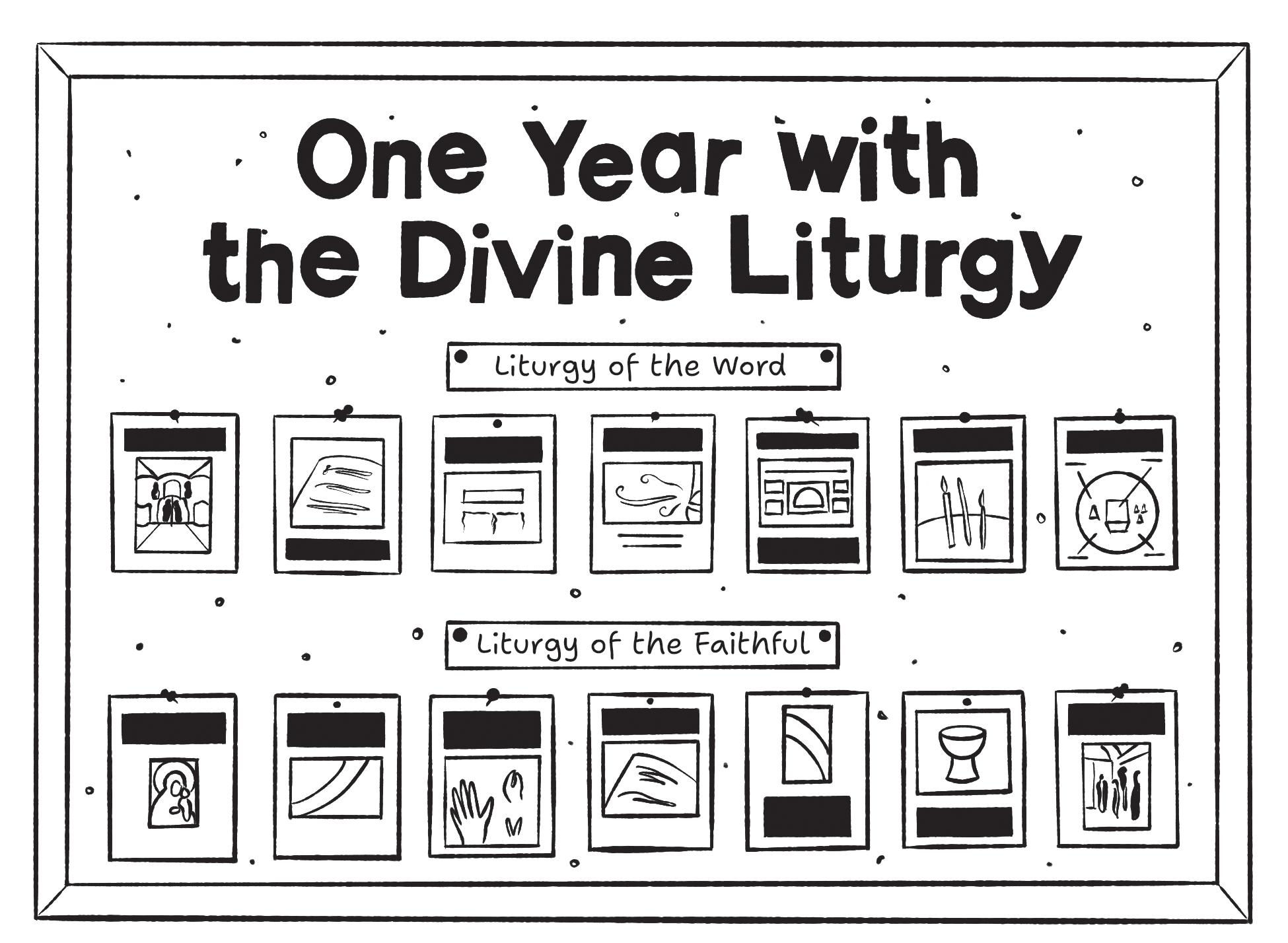
High School
Divine Liturgy Bulletin Board
Goal: Students will work together to create a teaching bulletin board for their parish about the Divine Liturgy.
Materials
Bulletin board paper (optional), bulletin board alphabet letters (optional), paper or large index cards, pencils or pens, drawing supplies, tape or Command strips.
Directions:
Choose the materials for your project. You can use an actual bulletin board (if you have one) or use a portion of a wall to display your project. This project will help the students summarize and record what they learn in their lessons while also teaching others in the parish about the Divine Liturgy.
This project is very flexible. You can use the Divine Liturgy illustrations provided in this book, ask the students to draw their own illustrations, or use photos of these events from your parish. (Make sure to ask permission from your priest before taking photos during the Divine Liturgy.)
This bulletin board can be an ongoing project for the year that is exclusively for the students in your class, or it can be shared in a common area with your entire parish. You can either set up all the illustrations or photos on the bulletin board at the beginning of the year or add them gradually as you study each event, then add your class collaborative summary on a large index card under each illustration or photo as you learn about them.
by Jennifer Hock.
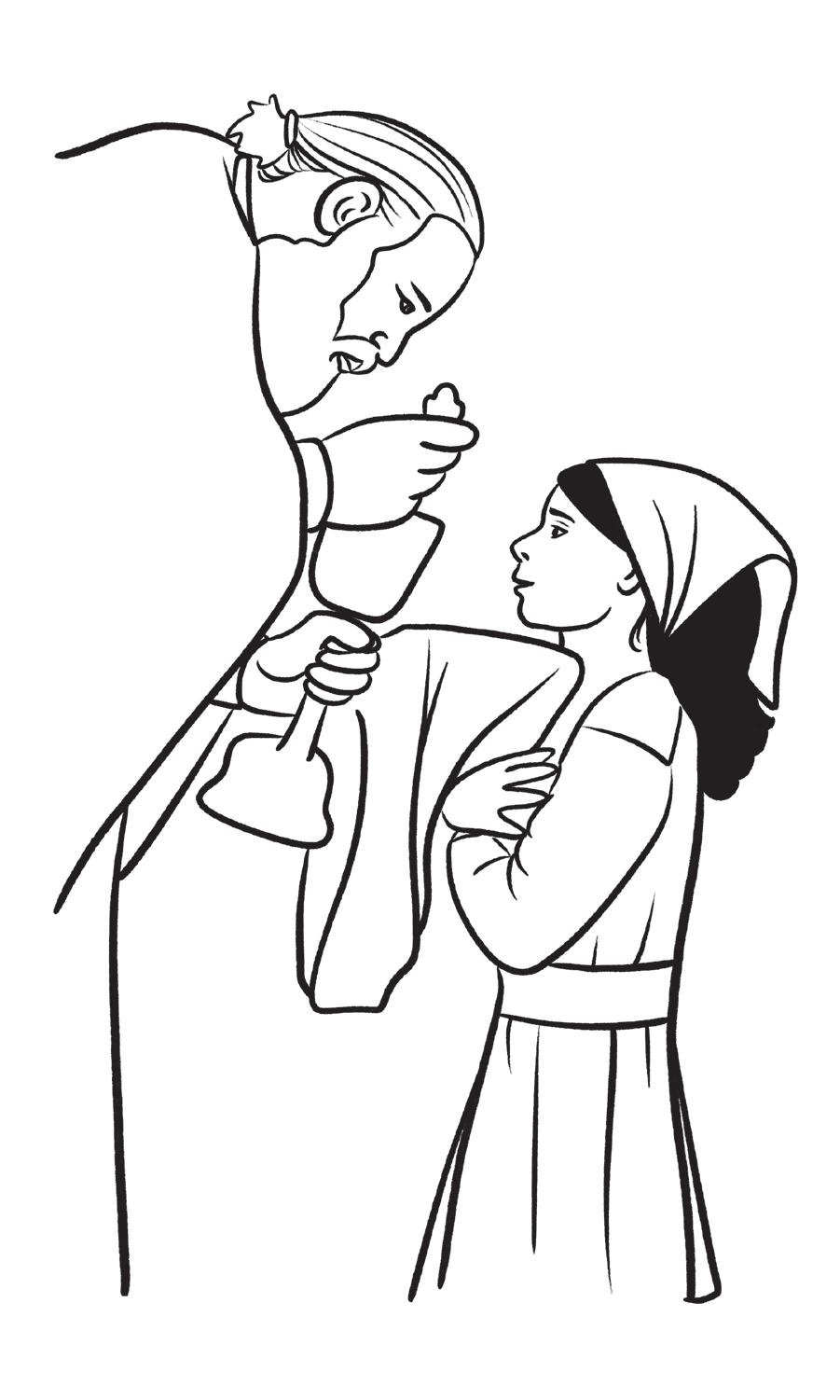
Project Materials 3x5 Cards
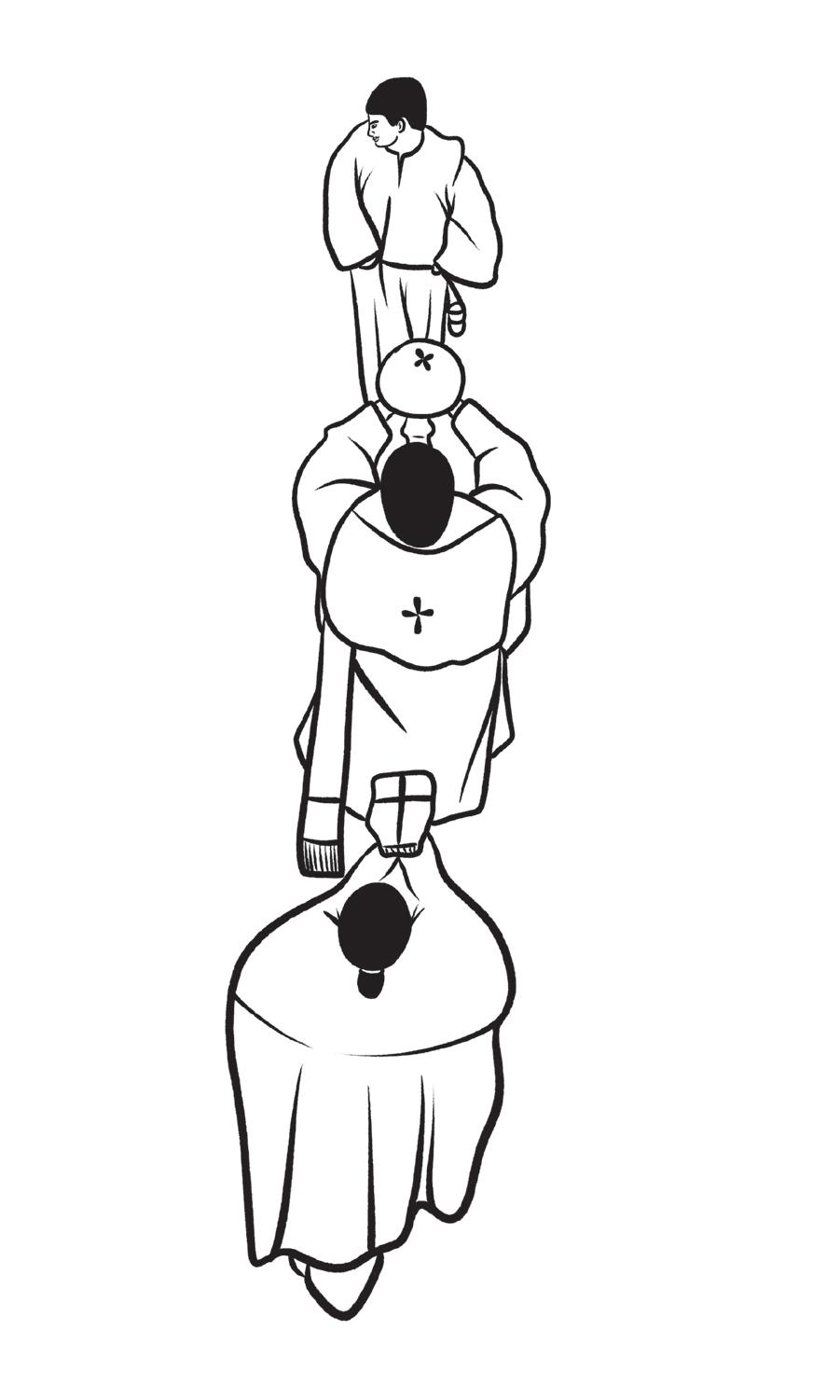
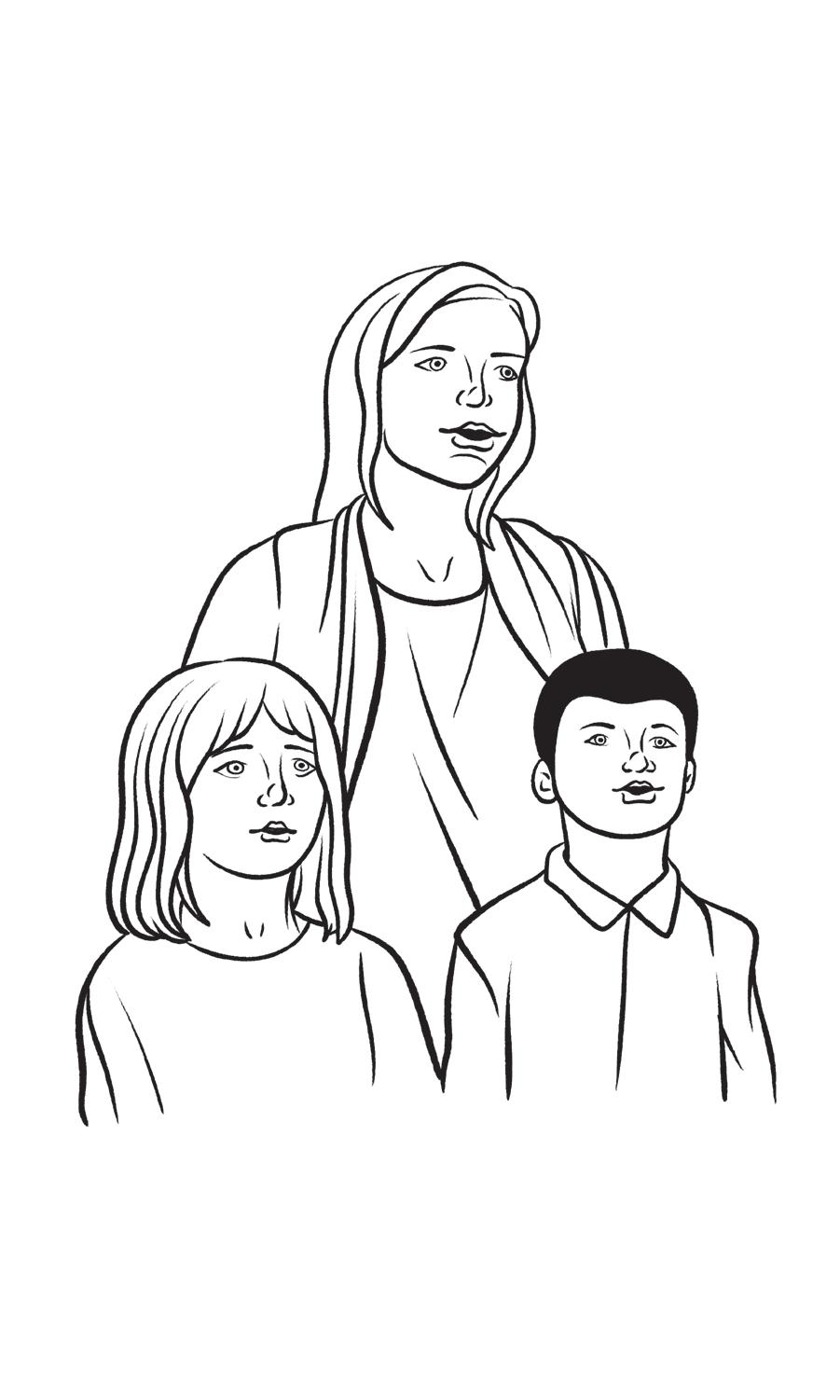
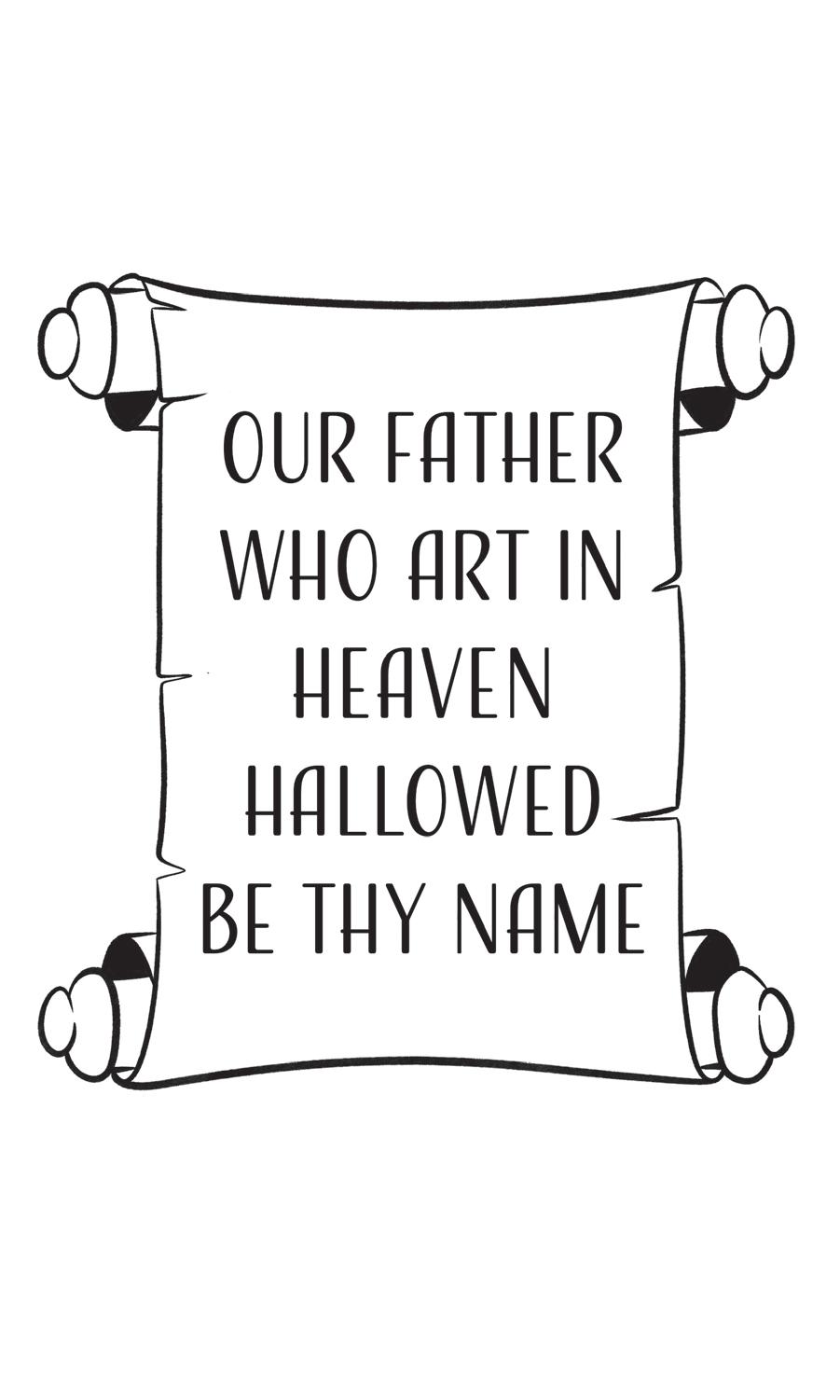
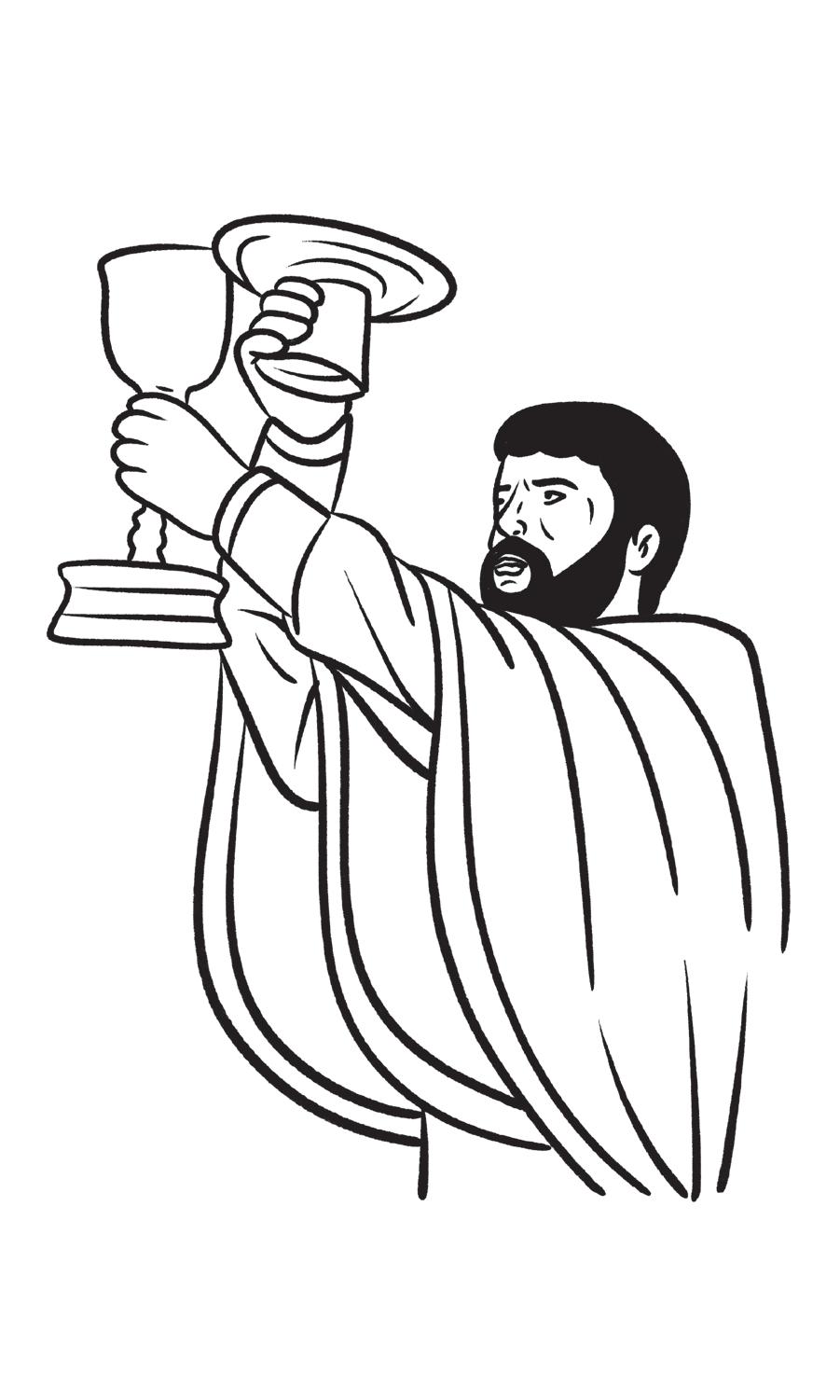
christ the good shepherd
LESSON ONE A
Training the Teachers
CALLED TO TEACH
Now you are the body of Christ, and members individually. And God has appointed these in the church: first apostles, second prophets, third teachers, after that miracles, then gifts of healings, helps, administrations, varieties of tongues.
1 CORINTHIANS 12:27–28
GOAL
How do we teach our children about their Orthodox Christian Faith?
God has provided each of us with individual talents and gifts. For those who have been called to teach, it is important that we continuously cultivate a better understanding of our Orthodox Christian Faith as well as guide others through our lived example. Our ability to be effective teachers depends greatly on our correct understanding and our daily participation within the life of the Church. As with any topic, the more experience and knowledge we have concerning our Faith, the better equipped we will be to explain con-
cepts, provide stories, and answer questions. Our ability to effectively teach will be closely related to how well we know the topic.
Let’s begin by assessing our own knowledge and participation in the Divine Liturgy as we continually strive to grow closer to Christ. Ask yourself:
• Do I attend the Divine Liturgy regularly?
• Do I show up on time?
• Do I participate in the Divine Liturgy through prayer, singing, making the sign of the cross, and kneeling?
• Have I prepared myself to receive Holy Communion with prayer, fasting, and regular confession?
Teacher Preparation & Classroom Management
Here’s the thing: It’s really important to be completely prepared to start the lesson the moment your students arrive. This includes your knowledge and understanding of the content for each lesson and having any materials you may need, nearby, ready to go. If you are studying these lessons on Sundays, you can prepare your classroom before or after Saturday Vespers or well before Liturgy begins on Sunday morning.
Additionally, your teaching will be more effective if you can simply glance at the lesson and use it as an outline instead of as a script. This enables you to look your children in the eyes as you instruct them, notice any situation as it unfolds, and handle it immediately. For example, if two children begin to whisper and giggle while you’re talking, you can calmly walk over, stand behind them, and gently shake your head no as you continue the lesson. If they keep talking, you can move one of them to a seat closer to you.
Curriculum Structure
As a whole and for each individual lesson, the curriculum has been organized in the following manner:
1. Content: What will we be teaching?
The Divine Liturgy, with weekly sub-themes
2. Goals: What do we want to achieve with these lessons?
For the year:
Develop a deeper understanding of the Divine Liturgy
Foster a deeper participation in the Divine Liturgy
For each week:
The goal for each week’s topic is stated at the beginning of each lesson.
3. Developmental Levels: Each lesson has been developed to meet the needs of three age groups: early elementary, upper elementary / middle school, and high school.
With the intention of developing a single volume of curriculum for a wide range of ages, we have written one main teacher lesson and have included instructions for adapting the lesson to different age groups.
Teachers are encouraged to make necessary modifications based on individual students. Personalities, maturity, special needs, and knowledge of the material will vary from class to class and from family to family.
Becoming Christlike
Christ provided the example of catechism for us. A great deal of His ministry involved teaching and spiritual development. We can look to the Gospels and the lives of the saints for guidance on how to put this into practice with our students:
Worship: Participation in the services
First, we see that Christ placed prayer to God the Father as a high priority. He offered thanksgiving (John 6:11; 11:41). He sought to do the Father’s will in times of distress (Matt. 26:39). He interceded on behalf of others (Luke 23:34). He also journeyed to the temple in Jerusalem regularly and participated in the feasts days as well (Luke 2:22–40; 2:41–52). Then most importantly of all, Christ provided us with the Holy Eucharist for the first time during the Mystical Supper (Luke 22:19–20).
Education: Continually learning
Second, we see a teaching aspect throughout Christ’s ministry. He guided individuals (Mark 10:17–22), small groups (Matt. 28:18–20), and large crowds (Matt. 5:1–12). He also provided direct instruction to His disciples on many occasions, including during the Mystical Supper: “Do this in remembrance of Me” (Luke 22:19).
Praxis: Living our faith daily
Third, Christ instructed that we should incorporate all that He taught us into our daily lives: to love one another (John 13:34), to take care of those in need (Matt. 25:34–36), to forgive (Matt. 6:14), and more!
Later, the apostles were sent out to make disciples of all nations. They established Christian communities by teaching them about Christ, how they should live their lives as followers of Christ, and how they should worship—just as the apostles themselves had been taught. Additionally, the apostles would send letters back to these communities with further instruction on how they should live as Christians.
In the years following, we witness time and again the saints following the example of Christ and His apostles as well. Both St. John Chrysostom and St. Basil the Great encouraged people to participate in as many services as possible, taught others extensively through their sermons and writings, and took care of the hungry, the naked, the sick, and the homeless. For over two thousand years the Church has taught and guided one generation after the next synergistically through worship, education, and praxis.
Teaching Methods
The Divine Liturgy is a teaching service intended to guide the Body of Christ in worship, learning about Christ, and then carrying Him into our homes with us. The service is structured to educate everyone, from infants to the elderly, and does so using all our senses. When we teach our children, we should strive to incorporate as many senses as appropriate to the lesson. New material is retained to a far greater degree when we incorporate the content of the lesson with the children using their various senses. We can do this in the classroom or at home by showing photos, watching videos, reading books, making the sign of the cross, attending services, lighting
candles, helping to make prosphora, planting basil, and in many other ways!
It is through the Divine Liturgy that we learn to transform our senses from seeking the things of this world to seeking God.
Reviewing the Lesson
Throughout this curriculum, you are encouraged to review the material at the end of each lesson with the students. Ask them to recall the main points in their own words. This challenges their brains to:
1) Recall the information
2) Organize their thoughts
3) Then articulate the information verbally to you in the way they understood it.
Here’s an example: “What is the Gospel reading?”
The teacher might:
a) verbally tell the students the lesson while showing them a photo of their priest reading the Gospel passage in church,
b) then read the Gospel passage to the students while showing the correlating icon.
c) As part of the review, the teacher hands the icon to a child and asks them to describe what they remember about the Gospel passage using the icon as a reference.
You’re asking the child to:
• Cross-reference both the linguistic and visual–spatial aspects of the lesson;
• use a series of executive functions skills, such as working memory and organization;
• and then share with you what they learned.
There’s a lot happening with a student review! This process also allows you to assess your own teaching. Did I hold their attention? Did they learn the main goals? Did they correctly understand the content? This, then, provides the opportunity for you to gently correct any misunderstandings or change your teaching approach for next time. In addition to the feedback you receive about your own teaching, the review also encourages their brain to store the new information in their long-term memory.
Teacher Activities for You Right Now!
1. Highlight or underline the main points of this lesson and circle any words you didn’t fully understand and look up their meaning. It is amazing the depth of knowledge that can come from gaining a better understanding of a word or concept.
2. Set aside a few minutes to fill out the “Teacher Reflections and Goals” found on the following page.
3. Expand your own knowledge through books, podcasts, or conversations with your priest. This is highly recommended! Continual learning will deepen your faith and will benefit your students as well.
Teacher Reflections and Goals
Now you are the body of Christ, and members individually. And God has appointed these in the church: first apostles, second prophets, third teachers, after that miracles, then gifts of healings, helps, administrations, varieties of tongues.
1 Corinthians 12:27–28
Teachers instruct and guide many people, and they can have a great impact on a community. Take some time to consider and answer the questions on this work page.
What do I need to do to prepare for this upcoming year?
How will I hold myself accountable?
God has provided each of us with strengths and gifts to contribute to the work of the Body of Christ. What are my strengths? What am I genuinely good at doing?
What gifts can I offer to my family and my parish community?
Our life goal is to become more and more like Christ. The Church has wisely provided us with guidance to aid our spiritual development through participation in the services and sacraments, continually learning more about being an Orthodox Christian, and living our lives as followers of Christ. What could I do this year to increase my attendance at more services?
Many of us have busy schedules. It may be helpful to start with a small goal such as: I’ll attend vespers the first Saturday of each month, or I’ll attend one of each of the lenten services this year. In what aspects of my daily life do I hope to apply my new experiences and knowledge?
For example, Am I trying to learn more about the virtues? Am I wanting to look to the saints as examples of how to apply the virtues in my own life? Do I want to learn more about prayer and develop more consistent prayer?
LESSON ONE B
What is the Divine Liturgy?
“I am the light of the world. He who follows Me shall not walk in darkness, but have the light of life.”
JOHN 8:12
GOALS
Why is the Divine Liturgy so important? What does liturgy mean?
VOCABULARY
Liturgy: is the work of God for the sake of His people, who enter mystically into the eternal heavenly liturgy through earthly participation.
Holy Communion: the Holy Body and Precious Blood of Christ.
FOUNDATIONAL KNOWLEDGE FOR THE TEACHER
At the celebration of every Divine Liturgy, Christ is among us. Jesus told His disciples before His Ascension, “and lo, I am with you always, even to the end of the age’” (Matt. 28:20). Each and every time our priest celebrates the Divine Liturgy, we have the opportunity to draw near and receive the Light of Christ (John 8:12) through Holy Communion. We take this Light with us out into the world and share Christ with others through our lived example as Orthodox Christians—with our family, friends, co-workers, and each person we encounter.
As we participate in the Divine Liturgy, our mindset is shaped by hearing the prayers, Scripture readings, and hymns as well as being part of the rites—or movements— such as making the sign of the cross, kneeling, prostrations, and processions. Towards the end of the Liturgy, we receive the Bread of Life—Christ (John 6:35)! Jesus taught His disciples, “‘Most assuredly, I say to you, unless you eat the flesh of the Son of Man and drink His blood, you have no life in you. Whoever eats My flesh and drinks My blood has eternal life, and I will raise him up at the last day. For My flesh is food indeed, and My blood is drink indeed. He who eats My flesh and drinks My blood abides in Me, and I in him’” (John 6:53–57). We are part of the Body of Christ because we all partake of the Holy Eucharist. Then we go home with Christ dwelling within us, and the Divine Liturgy continues to guide the practice of our daily Orthodox Christian life.
How do we participate in the Divine Liturgy as the Body of Christ? Let’s think about how
many people are needed for one Liturgy to take place. During a weekday service, when fewer people are present because of work and school, who and what is needed in order to celebrate a Liturgy?
We need:
• our priest
• prosphoro
• wine
• and at least one other person present, because a Liturgy is a work of the people and also for the people.
During the Divine Liturgy, it is through the amen of the people present that we have the prayer of the Body of the Church instead of the prayers of just one man, our priest. Our job—our work—during the Divine Liturgy is to participate with the amen, the Lord have mercy, confessing our beliefs as we say the Creed, and so much more. The Body of Christ consists both of individuals—you, me, our priest—and also groups: our immediate household family, our extended family, our parish community, and the worldwide parishes of Orthodox Christians. Just as our bodies consist of many parts with different functions that work synergistically on behalf of the whole, so the Body of Christ has many people who have different callings serving Christ. Some of them serve or assist at the altar, and others prepare before or clean up after the Divine Liturgy. We are all called to participate in this life-giving work, using the gifts, talents, and resources that God has lovingly provided us.
As we consider this theme more closely, think about how Communion bread is made. First we need a farmer who grows the wheat. Then we need someone who mills or grinds the wheat. Someone ships the flour to a store, where we buy it. Then the prosphora baker makes the bread at home and brings it to the church as an offering to God. The same is true for the wine. You can quickly see that there are many people involved each time a Divine Liturgy is celebrated, even when only a few people are present.
Now, let’s think about a typical Sunday Divine Liturgy. We have our priest (and some parishes have a deacon too). Often we also have acolytes, chanters, a choir, greeters, those who have cleaned the church, those who have restocked the candles, and those who have paid the bills for us to have lights,
heating, and air conditioning. It is through the unity and faith of all these people working together that we fulfill the reality of the Church with the presence of Christ among those who believe in Him.
How is a Divine Liturgy a work for the people? Each and every Liturgy is also personal. The Divine Liturgy is structured as a teaching service. The Church, in all her wisdom, nurtures each person individually during the service on their own developmental level—young, old, new to the Faith, or long-time Orthodox Christian. We are beneficiaries of Christ’s gift to each of us—Himself.
LESSONS & ACTIVITIES BY AGE GROUP
Possible Materials Needed
Classroom supplies (see page 6)
Book: The Man and the Vine or The Woman and the Wheat by Jane G. Meyer
Pictures relating to the Divine Liturgy
Early Elementary
Developmental Concepts
• The Divine Liturgy is important because we receive Holy Communion.
• The Divine Liturgy is: a) the work of a lot of people and b) helps me to learn more about Jesus as I listen and participate.
Teaching Methods and Activities
Storytime — Read The Woman and the Wheat or The Man and the Vine while showing the illustrations to the children.
Ask the students: How many people are involved in order to make prosphora and/or wine to bring to the priest at church?
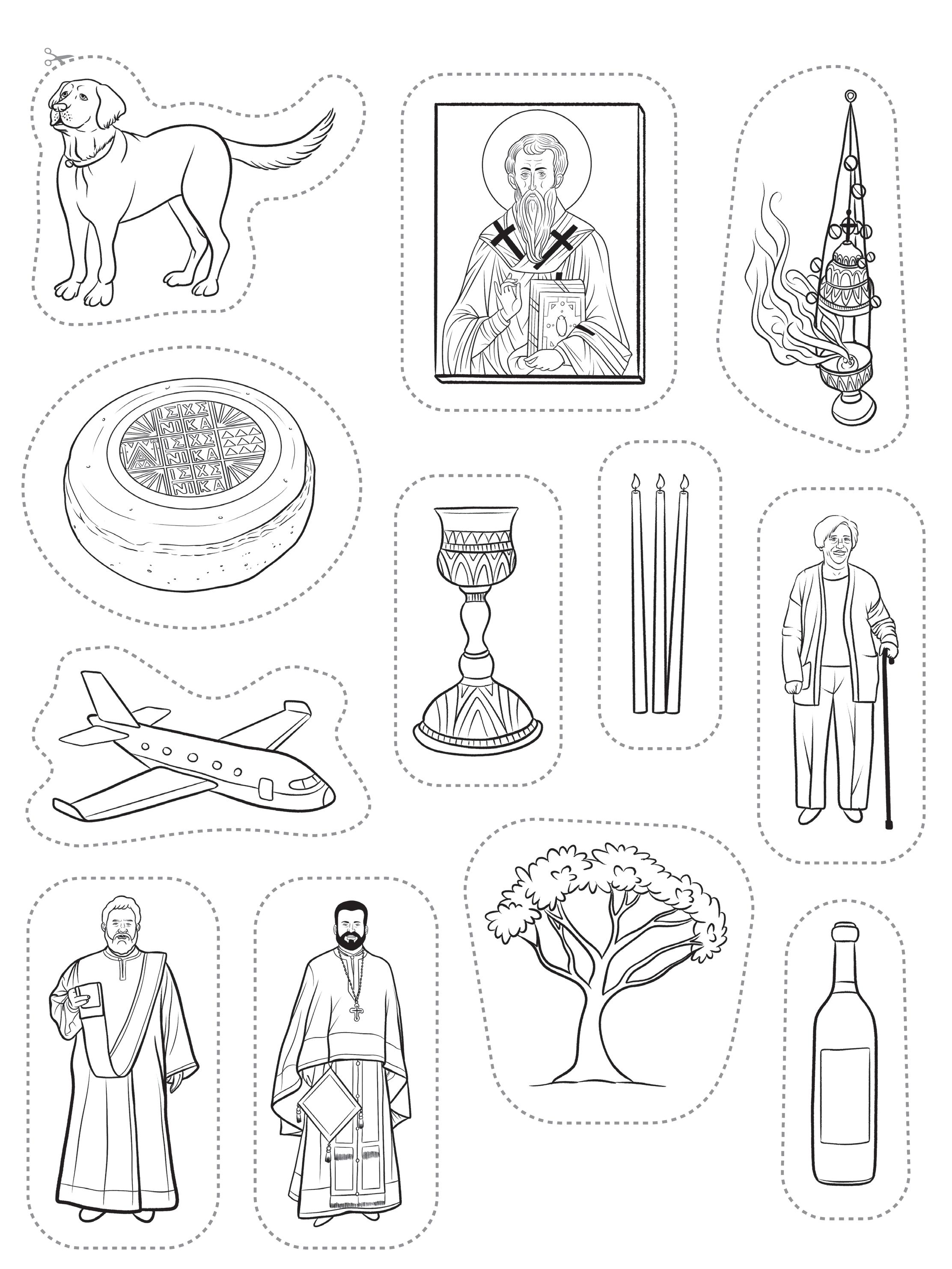
Sorting Task The goal of this activity is to sort through pictures and place them into two categories (see page 28):
Pile 1 belongs to the Divine Liturgy
Pile 2 does not belong to the Divine Liturgy. Ask the students: Who and what do we need to celebrate a Divine Liturgy? Provide photos or images on the table: priest, prosphora, wine, people, etc. You can also include a few unnecessary images, such as a dog, an airplane, and a tree. Ask each student to choose one photo on the table of someone or something needed to celebrate the Divine Liturgy. Then place tape on the back of the photo and hang each image on the wall. Ask the next student to choose an image and continue until all correct photos have been chosen.
End result: A lot of people work together in order for us to celebrate a Divine Liturgy!
Upper Elementary / Middle School
Developmental Concepts
• I receive the light of Christ each time I receive Holy Communion, and I can shine that light through my actions as an Orthodox Christian when I go home.
• Liturgy means “the work of God for the sake of His people, who enter mystically into the eternal heavenly liturgy through earthly participation.” The work of many people makes each Divine Liturgy possible: our priest, deacon, acolytes, chanter, choir, prosphora baker, those who make or buy the wine, the architect who designed our church, our iconographer, those who pay the church’s bills, those who clean the church, and more!
• The Divine Liturgy teaches me how to live as an Orthodox Christian.
Teaching Methods and Activities
Discussion What are some ways that we use our gifts and talents for God?
You can work on this as a class or split the students into groups to make a list. If the kids are working in small groups, ask them to choose one person to share the list they created together with the rest of the class.
Discussion — What are some ways that you can lead others to Christ through your actions?
High School
Developmental Concepts
• Christ is among us during every Divine Liturgy, and He “abides in me, and I in Him” (John 6:53-57) when we receive Holy Communion.
• The Divine Liturgy is the work of God for the sake of His people, who enter mystically into the eternal heavenly liturgy through earthly participation. How do we participate in the Liturgy as the Body of Christ? How is the Liturgy a work for the people?
• We offer our time, talent, and treasure to God, and in return, He offers Himself to us.
Teaching Methods and Activities
Discussion — How can we offer our time, talent, and treasure to God through our parish’s ministries?
What are the ministries in our parish? What ministries does your family participate in now?
Invite a Panel of Speakers to Your Class
— Invite someone from one or more of your parish’s ministries to share with you about what they do. Why do they love being part of this ministry?
EARLY ELEMENTARY SORTING TASK
REVIEW ACTIVITIES FOR ALL AGES
1. Post-it Note Summary (or Discussion): Split the students into two or more groups. Make the groups small enough so that everyone feels comfortable speaking and has the opportunity to contribute.
• Provide Post-it notes and pencils to each group.
• Ask them to write down some of the ways people share their time, talent, or treasure in your parish as they contribute to the celebration of the Divine Liturgy. (Priest, deacon, acolytes, chanter, choir, prosphora bakers, candle makers; those who bring wine, pay the church bills, clean the church, etc.)
• Then ask the students to do their best in labeling people in their parish who fulfill these roles. (Priest: Write your priest’s name. Deacon: Write your deacon’s name. Write the name of the people who bake prosphora, etc.)
• Place the Post-it notes on the white board or wall, then review the answers as a class.
• Finally, discuss ways the children can participate now or in the future as they contribute to the celebration of the Divine Liturgy, such as learning to chant, baking prosphora, apprenticing with the festal decorators, later teaching in the church school, etc.
2. Summarize: As a group or individually, highlight the main points of today’s lesson either out loud, on paper, or on the board.
Worship in the Homes
And as they were eating, Jesus took bread, blessed and broke it, and gave it to the disciples and said, “Take, eat; this is My body.”
Then He took the cup, and gave thanks, and gave it to them, saying, “Drink from it, all of you.
For this is My blood of the new covenant, which is shed for many for the remission of sins.”
MATTHEW 26:26–28
GOALS
When was the first celebration of Holy Communion? Where did Christians worship during the early Church?
VOCABULARY
Disciple: a student of someone; the twelve disciples were students of Jesus.
Apostle: someone sent out by Jesus to share the good news with others.
Christian apologist: a person who defends or explains Christianity to others.
FOUNDATIONAL KNOWLEDGE FOR THE TEACHER
During the first one hundred years of the Church, the apostles and their disciples traveled extensively throughout the known world to instruct people about Jesus’ life, teachings, and miracles. As they shared firsthand knowledge about Jesus, they left a lasting impression on those who listened to their preaching. The people clung to their every word as they learned about Jesus healing the blind, the paralyzed, and those possessed by evil spirits. They listened in awe at His wise teachings and parables. And they eagerly wanted to know more about Jesus’ life and what happened to Him after His arrest in Jerusalem. The people were humbled and astounded that Jesus sacrificed Himself for the salvation of each and every one of us— that He rose from the dead on the third day after His Crucifixion—and that He continues to offer Himself as the Bread of Life in Holy Communion. As a result of the apostles’ sermons and travels, Christianity rapidly spread around the world, and people in the early Church were being baptized in large numbers!
The apostles were specifically traveling to places where the people had likely never heard of Jesus. In each new city they:
• preached the gospel
• baptized new believers
• and ordained successors (bishops) to continue to guide the new Christian community left in their care.
When an apostle appointed a bishop to guide a community, the apostle would do so by laying his hands on him while praying. The bishops, in turn, ordained priests and deacons to assist them. The priests primarily helped with the functions of worship, while the deacons assisted the priests in various ways, such as visiting the sick and helping the poor. This allowed the bishops to focus on preaching and administrative duties. Today, during every ordination, the bishop will lay his hands on the man while praying. Every bishop, priest, and deacon can trace their lineage of ordination directly back to a specific apostle through the laying on of hands.
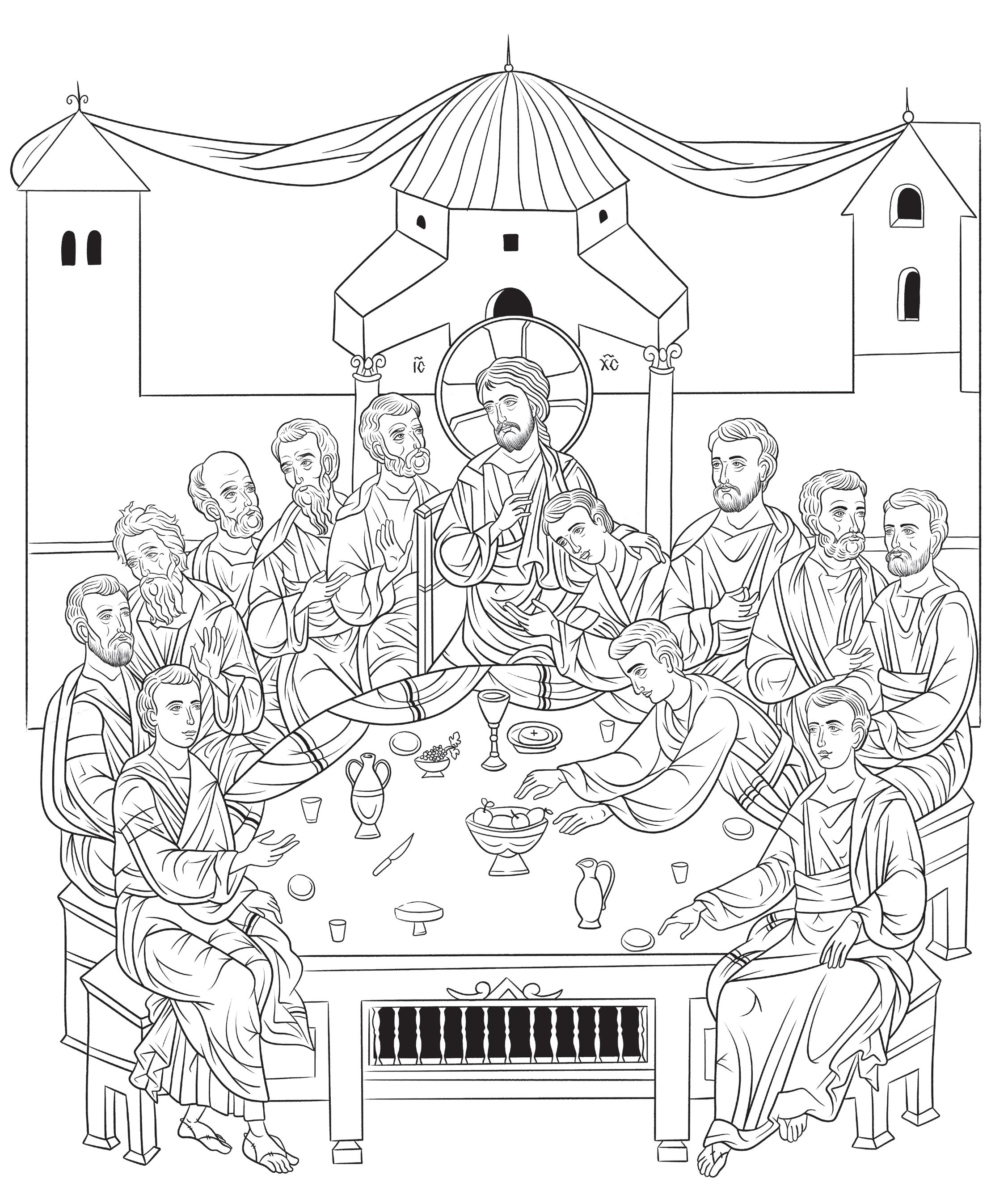
The very first Holy Communion was at the Mystical Supper (icon page 30), just before Jesus’ arrest and Crucifixion. Jesus had instructed His disciples during the Mystical Supper as He took the bread, blessed and broke it, and then gave it to them saying, “Take, eat; this is My body.” Then Jesus took a cup of wine, gave thanks to God the Father, and passed the cup around saying, “Drink from it, all of you. For this is My blood of the new covenant, which is shed for many for the remission of sins” (Matt. 26:26–28). The apostles instructed the bishops to continue to do as Jesus had instructed them: “Do this in remembrance of Me” (Luke 22:19).
Saint Justin the Martyr, who lived around ad 100–165, was a Christian apologist who described the worship of the early Church in his writings. He described the Christian worship service:
• They gathered on Sundays in the home of a fellow Christian.
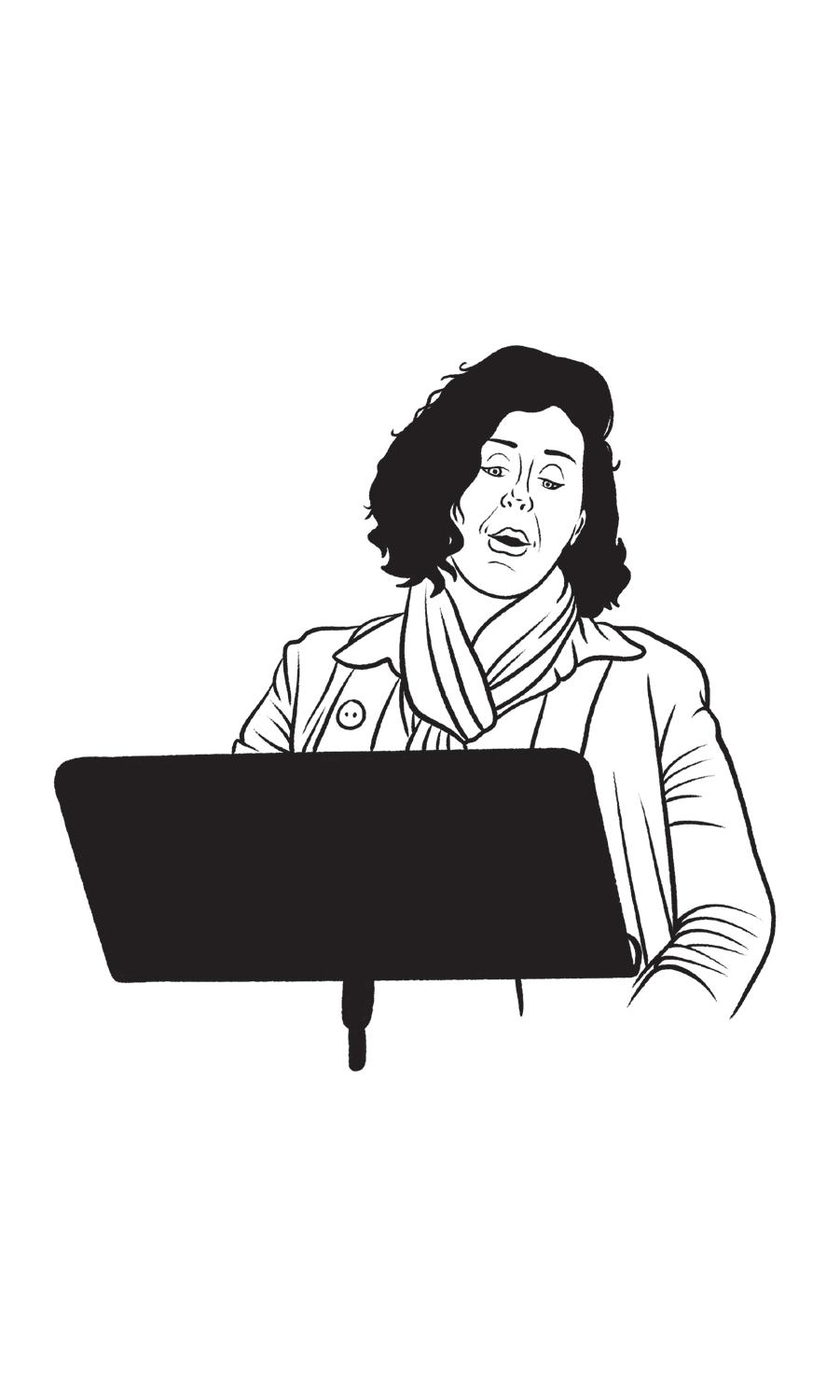
• They read the writings of the apostles (epistles) and prophets (Old Testament) and listened to a sermon.
• Next, they stood and prayed to God, after which the priest offered up the Gifts of bread and wine.
• Lastly, everyone received Holy Communion, and all the Christians present gave an offering for those in need. This collection was typically distributed by the deacon after the service.
When we think about the Divine Liturgy today, we can see that all these elements have remained unchanged in our worship for over two thousand years!
LESSONS & ACTIVITIES BY AGE GROUP
Possible Materials Needed
Classroom supplies (see page 6)
Copies of “About Me” worksheet
Icon of the Mystical Supper
Icon of St. Justin Martyr
Early Elementary
Developmental Concepts
• We celebrate the Divine Liturgy every Sunday.
• The Divine Liturgy is very old!
• The Mystical Supper was the first Holy Communion. Jesus called Himself the Bread of Life.
Teaching Methods and Activities
“About Me” Worksheet: I am an Orthodox Christian! — Pass out the provided worksheet to each child along with crayons or colored pencils. (Optional: You could also have the students cut and paste photos for each box.) Go over each section on the paper and discuss ideas for what the kids can draw or write. (See page 36)
Icon Study Learn about the icon of the Mystical Supper (see page 30): Read or tell your children about the Mystical Supper from one or more of the Gospels while showing the icon to them (Matt. 26:14–30; Mark 14:12–26; Luke 22:7–23).
Ask the children, Where is Jesus? How do you know this is Him? (The cross inside His halo and his Greek initials, “IC XC.”)
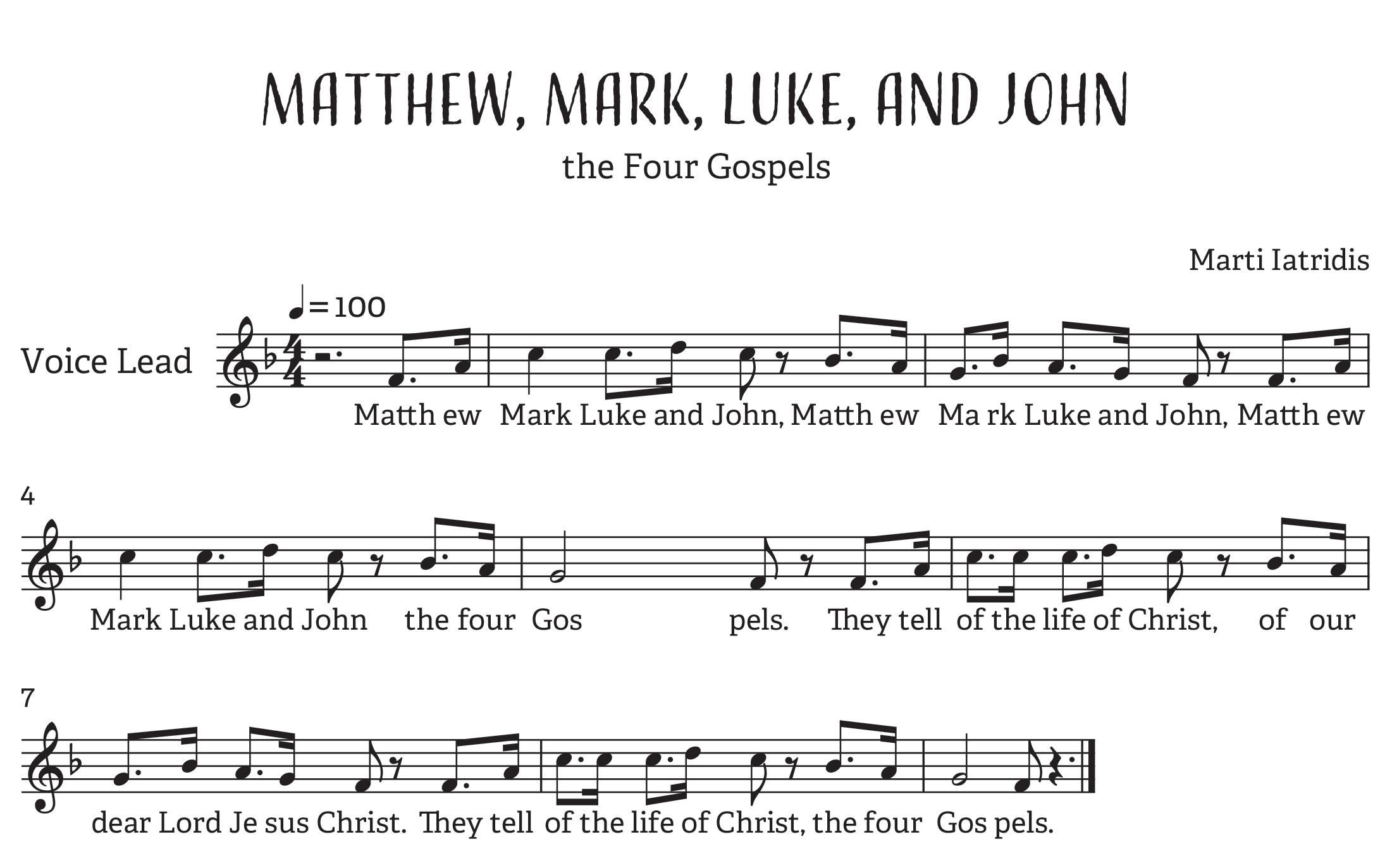
Singing — Learn the names of the four evangelists/Gospels (see song on page 33):
“Matthew, Mark, Luke, and John. Matthew, Mark, Luke, and John. Matthew, Mark, Luke, and John—the four Gospels. They tell of the life of Christ, of our dear Lord, Jesus Christ. They tell of the life of Christ, the four Gospels.”
Upper Elementary / Middle School
Developmental Concepts
• The Mystical Supper was the first Holy Communion.
• Jesus instructed His disciples to offer bread and wine to God, give thanks, and receive the Bread of Life—Holy Communion. The apostles instructed the bishops to continue as Jesus had instructed them: “Do this in remembrance of Me.”
• Saint Justin Martyr described how the Christians worshiped during the early Church. Christians would gather on Sundays in a Christian home, read the writings of the apostles (epistles) and prophets (Old Testament), listen to a sermon, stand and pray. Then the priest would offer up the gifts of bread and wine, everyone would receive Holy Communion, and finally an offering for those in need would be collected from everyone present.
Teaching Methods and Activities
Icon Study — Learn about the icon of the Mystical Supper. Read one of the Gospel passages while the students look at the icon.
Ask the students: Where is Jesus? Who is sitting with Him? (Jesus’ disciples)
Who is leaning against Jesus? (St. John the Theologian) What is on the table? (Bread and wine, or Holy Communion)
How do we know this is an indoor event? (There is a curtain draped in the icon.)
Saints Timeline
1) Guide the students to create a timeline from ad 64–865.
2) Learn about St. Justin Martyr. When and where was he born? When did he die?
Summarize and relate some details about his life. Label your timeline with St. Justin’s name, year of death, short summary of his life, and a drawing relating to his life above the line. (Label emperors below the line.)
High School
Developmental Concepts
• Through the apostolic succession of laying on of hands, bishops were appointed to guide and instruct their local community of Christians. The apostles gave the same instructions to their bishops as Jesus gave to them—“Do this in remembrance of Me”—just as He had taught them at the Mystical Supper.
• Saint Justin Martyr provided us with a rubric of early Church worship. These elements are still present in our Divine Liturgy two thousand years later!
Teaching Methods and Activities
How do we use the Bible?
Option 1: Pair up the students who know how to use the Bible with children who do not. Instruct the students who have Bible experience to teach their partner (with kindness!)
Option 2: Show where to find a digital copy of the Bible, and encourage them to download it.
Ask for volunteers to read the following passages: Matthew 26:14–30, Mark 14:12–26, and Luke 22:7–23, while the rest of the students analyze an icon of the Mystical Supper.
ABOUT ME!
I am an Orthodox Christian:
Our bishop is: Our priest is: Our deacon is:
I go to church every Sunday. My parish is: I receive Holy Communion during the Divine Liturgy on Sunday. Copyright ©2026 by Jennifer Hock.
CHAPTER 67 OF ST. JUSTIN THE MARTYR’S FIRST APOLOGY , “WEEKLY WORSHIP OF THE CHRISTIANS”
And we afterwards continually remind each other of these things. And the wealthy among us help the needy; and we always keep together; and for all things wherewith we are supplied, we bless the Maker of all through His Son Jesus Christ, and through the Holy Spirit. And on the day called Sunday, all who live in cities or in the country gather together to one place, and the memoirs of the apostles or the writings of the prophets are read, as long as time permits; then, when the reader has ceased, the president verbally instructs, and exhorts to the imitation of these good things. Then we all rise together and pray, and, as we before said, when our prayer is ended, bread and wine and water are brought, and the president in like manner offers prayers and thanksgivings, according to his ability, and the people assent, saying Amen; and there is a distribution to each, and a participation of that over which thanks have been given, and to those who are absent a portion is sent by the deacons. And they who are well to do, and willing, give what each thinks fit; and what is collected is deposited with the president, who succors the orphans and widows and those who, through sickness or any other cause, are in want, and those who are in bonds and the strangers sojourning among us, and in a word takes care of all who are in need. But Sunday is the day on which we all hold our common assembly, because
it is the first day on which God, having wrought a change in the darkness and matter, made the world; and Jesus Christ our Savior on the same day rose from the dead. For He was crucified on the day before that of Saturn (Saturday); and on the day after that of Saturn, which is the day of the Sun, having appeared to His apostles and disciples, He taught them these things, which we have submitted to you also for your consideration.
Ask the students to underline the main points presented by St. Justin about worship in the early church.
• How did they help the poor and needy? (The wealthy gave money for the needy.)
• When did they worship? (Sunday)
• Where did they gather? (Together in one place, in someone’s home)
• What did they read? (The letters from the apostles—the epistles)
• Who leads the people in prayer and gives a sermon? (The “president,” or the leader of the community—the bishop)
• The people present receive Holy Communion. Who brings Holy Communion to the people who were not able to be present? (The deacon)
• Why do they worship on Sundays? (It is the day God created the world and the day Christ rose from the dead.)
REVIEW ACTIVITY LABELING PAGE
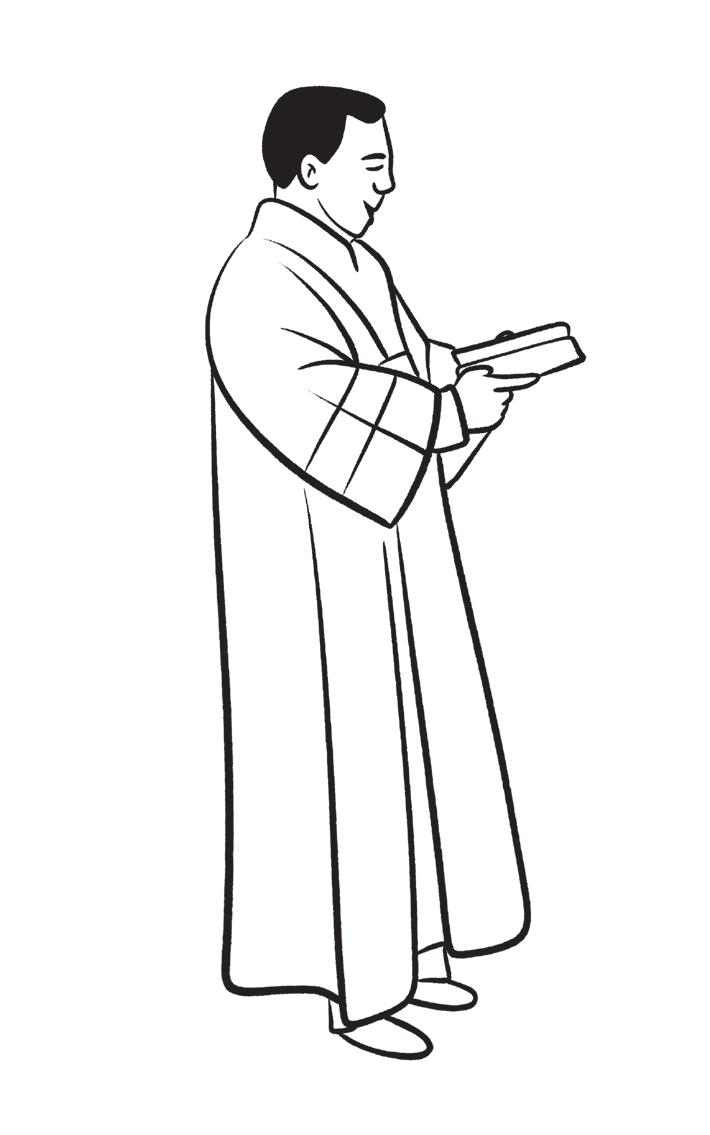
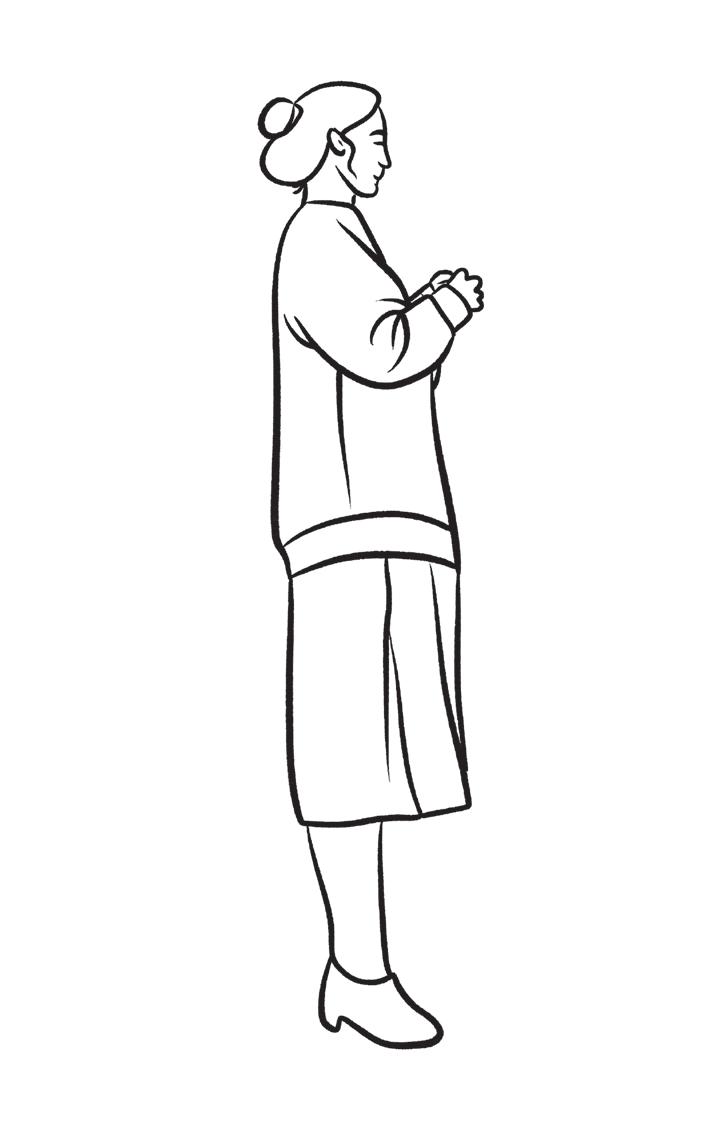
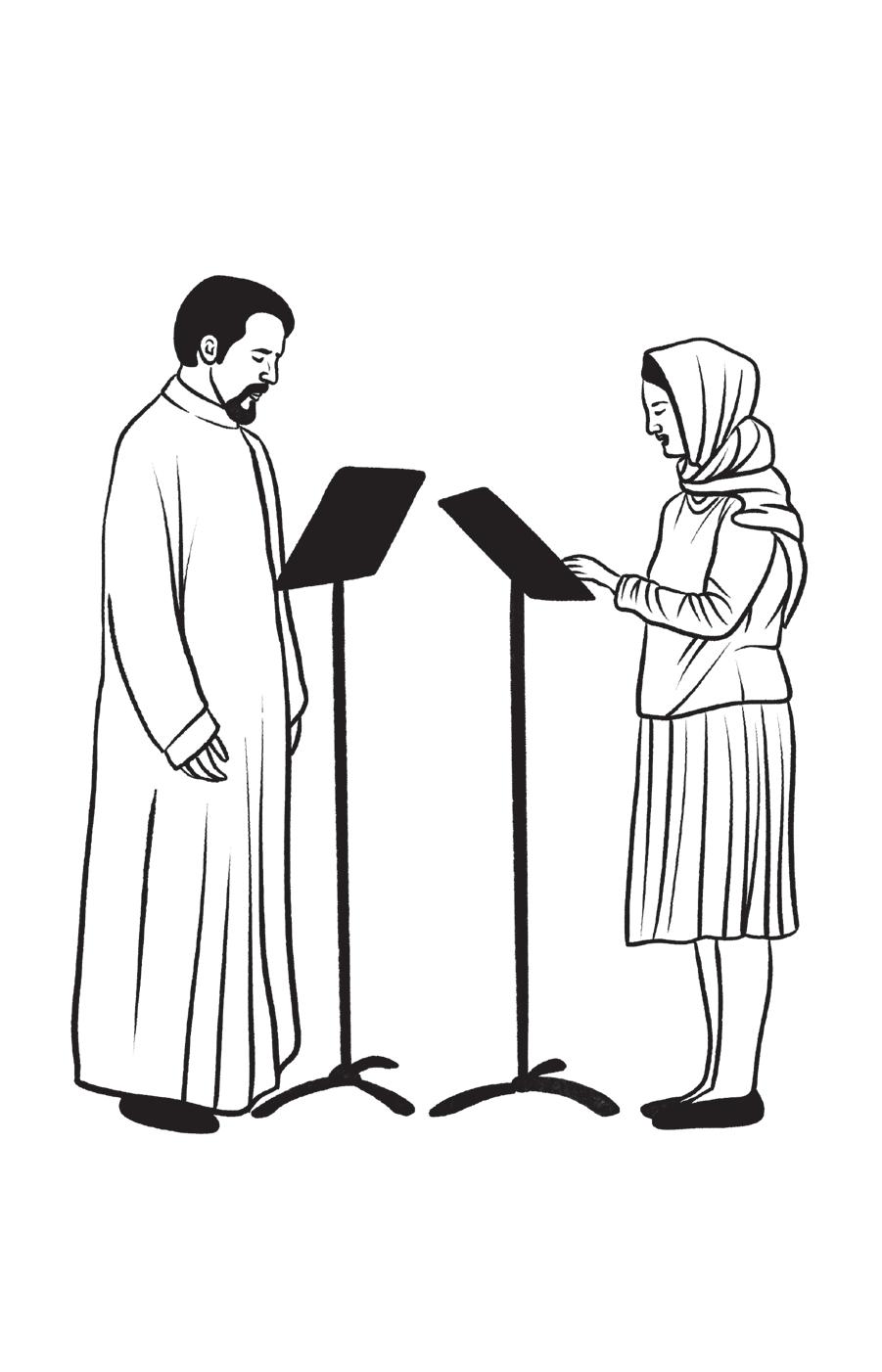
Read the writings of the apostles (epistles)
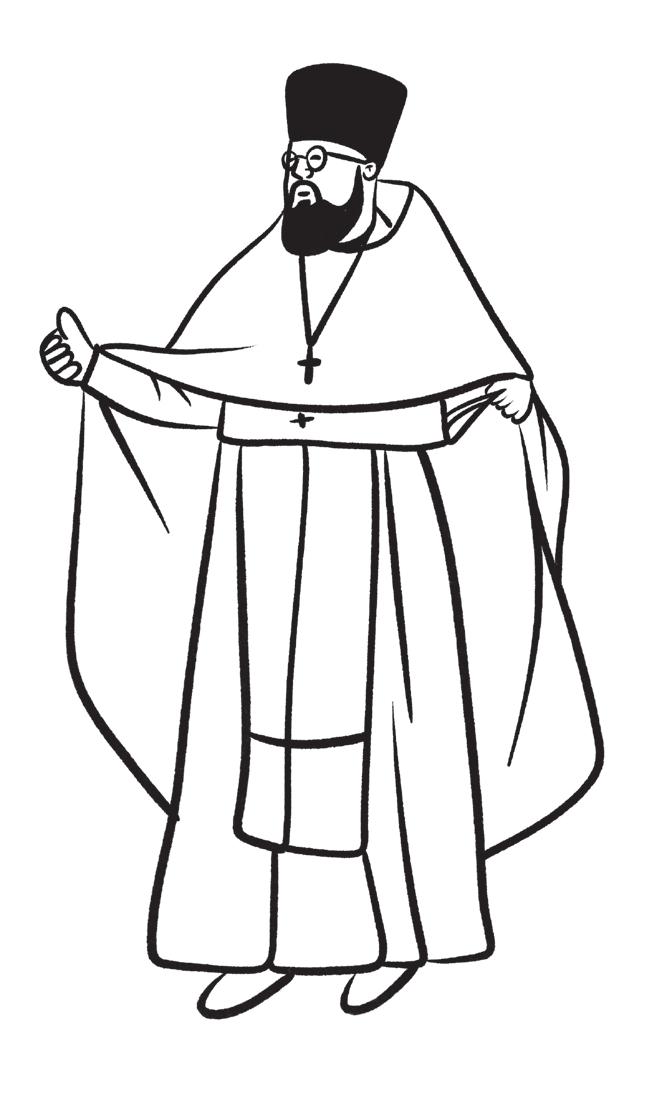
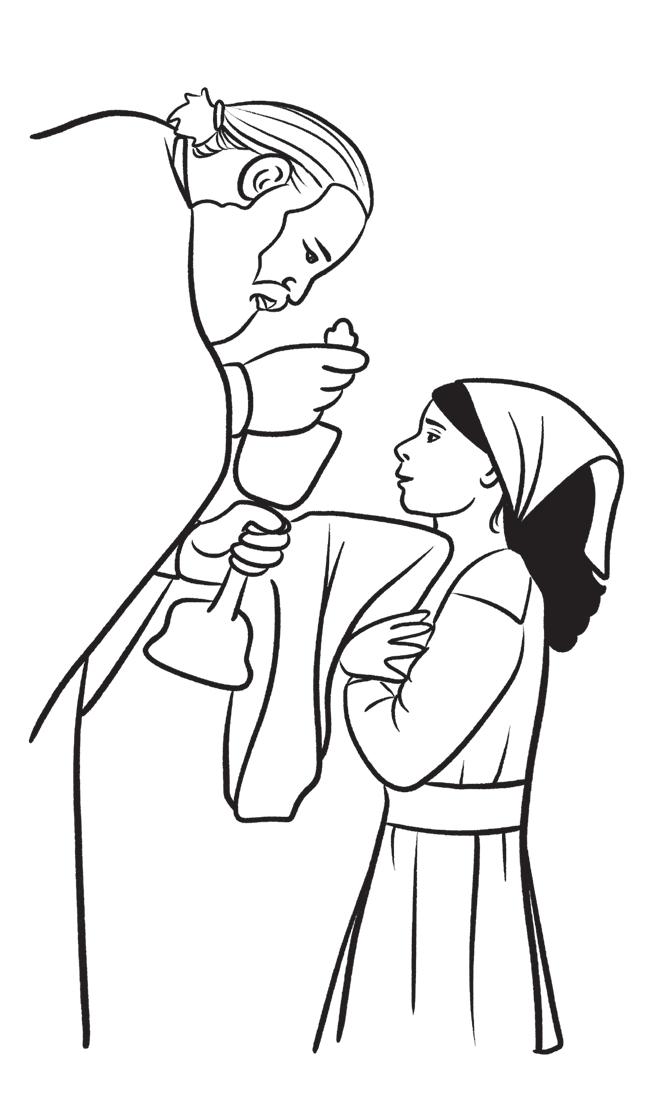
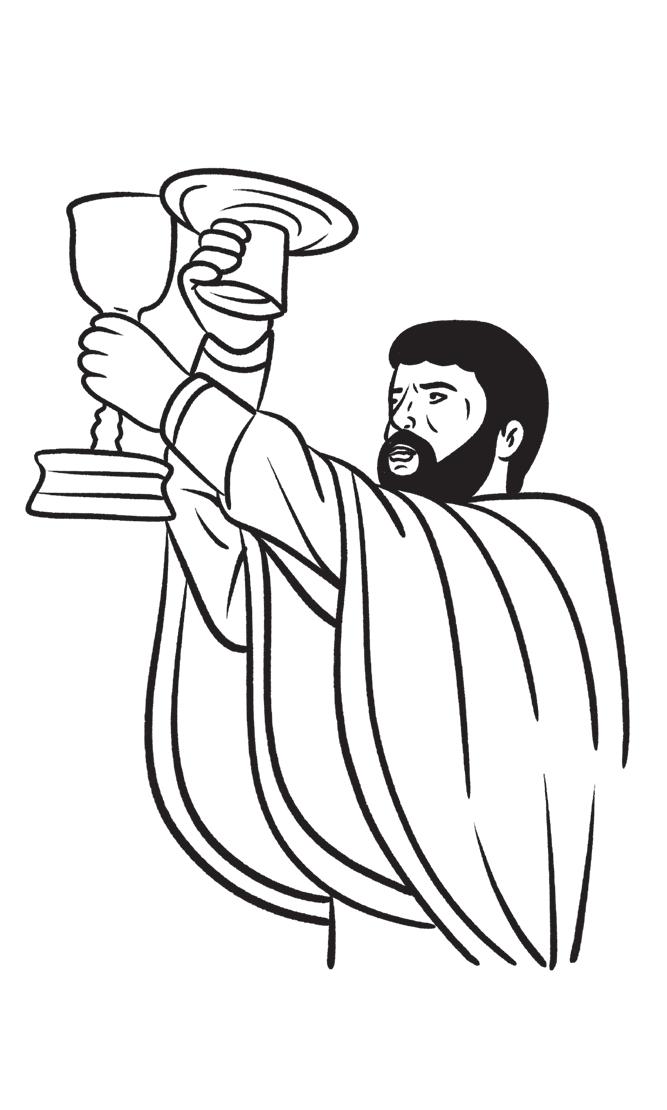
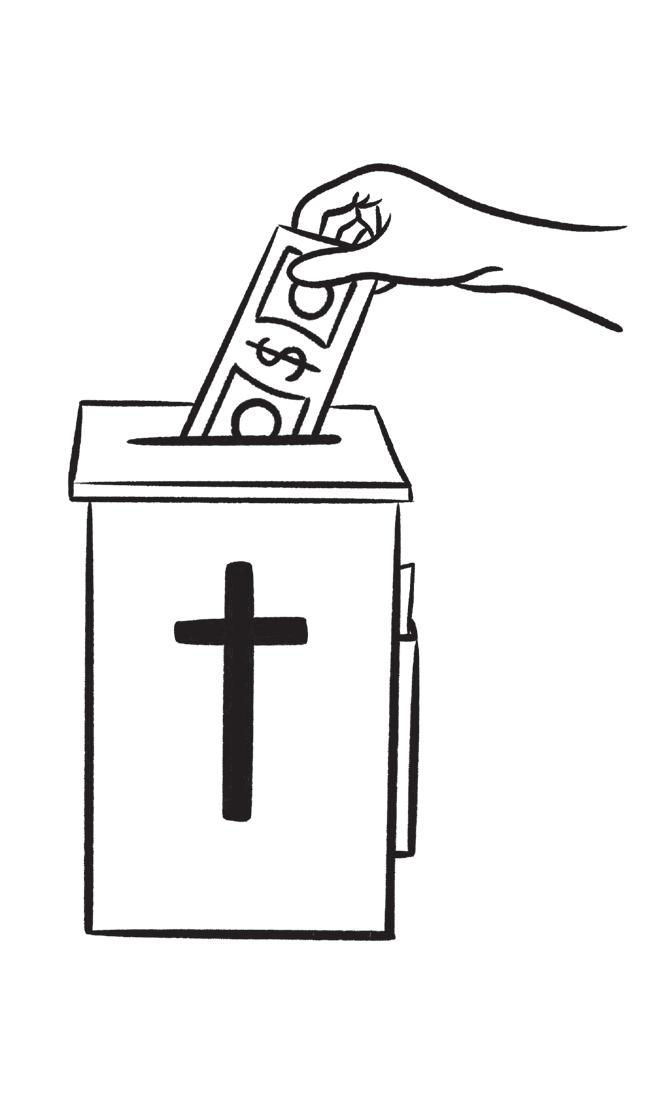
Listen to a sermon
The priest offers up the gifts
Stand and pray Receive Holy Communion An offering is collected
REVIEW ACTIVITIES FOR ALL AGES
1. Label the Photos or Drawings: *Note: For this activity you will need photos of the Divine Liturgy from your parish or the line drawings provided on the opposite page of the epistle reading, sermon, people standing and praying, the priest offering up the Gifts, people receiving Holy Communion, and people giving a donation.
Saint Justin Martyr provided us with an outline of worship in the early Church. Make a copy of the provided labels, cut them out, and give one to each of your students. You may need to group kids into pairs if you have a large class. Ask each child to find the correlating photo and place the label under the correct photo. Then ask:
• Do we still do the same things during the Divine Liturgy today as the first Christians did two thousand years ago? (Yes)
• Do we still gather on Sundays to receive Holy Communion? (Yes)
2. Visual Aid Summary: Review out loud the day’s lesson using the icon of the Mystical Supper (see page 30) as a visual reminder.
3. Post-it Note Summary: Provide each child with a Post-it note and pencil. Ask them to write a short summary about what they learned today.