traditional and non-traditional licensing deals in less-exploited territories, such as Latin America, South America, China, India, and Asia Pacific. “When I first started in licensing, I worked in international and I couldn’t do a deal in Latin America to save my life,” says TLC’s Kopcha. “Now that is a very big priority for our business and our licensors.”
lose some control over their equity by trusting another company to deliver the same product quality and performance as the core brand,” says Brand Central’s Misher. “When brands build strategic licensing programs that are validated with consumer research and managed correctly, they can achieve enhanced brand value while generating significant revenue.”
WHAT BRANDS MEAN
CHALLENGE AND OPPORTUNITY
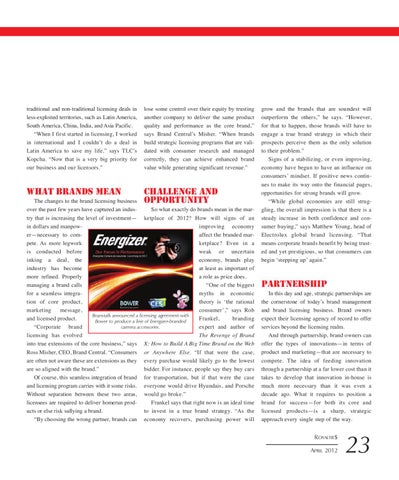
The changes to the brand licensing business So what exactly do brands mean in the marover the past few years have captured an industry that is increasing the level of investment— ketplace of 2012? How will signs of an improving economy in dollars and manpowaffect the branded marer—necessary to comketplace? Even in a pete. As more legwork weak or uncertain is conducted before economy, brands play inking a deal, the at least as important of industry has become a role as price does. more refined. Properly “One of the biggest managing a brand calls myths in economic for a seamless integratheory is ‘the rational tion of core product, consumer’,” says Rob marketing message, Beanstalk announced a licensing agreement with Frankel, branding and licensed product. Bower to produce a line of Energizer-branded camera accessories. expert and author of “Corporate brand The Revenge of Brand licensing has evolved into true extensions of the core business,” says X: How to Build A Big Time Brand on the Web Ross Misher, CEO, Brand Central. “Consumers or Anywhere Else. “If that were the case, are often not aware these are extensions as they every purchase would likely go to the lowest bidder. For instance, people say they buy cars are so aligned with the brand.” Of course, this seamless integration of brand for transportation, but if that were the case and licensing program carries with it some risks. everyone would drive Hyundais, and Porsche Without separation between these two areas, would go broke.” Frankel says that right now is an ideal time licensees are required to deliver homerun prodto invest in a true brand strategy. “As the ucts or else risk sullying a brand. “By choosing the wrong partner, brands can economy recovers, purchasing power will
grow and the brands that are soundest will outperform the others,” he says. “However, for that to happen, those brands will have to engage a true brand strategy in which their prospects perceive them as the only solution to their problem.” Signs of a stabilizing, or even improving, economy have begun to have an influence on consumers’ mindset. If positive news continues to make its way onto the financial pages, opportunities for strong brands will grow. “While global economies are still struggling, the overall impression is that there is a steady increase in both confidence and consumer buying,” says Matthew Young, head of Electrolux global brand licensing. “That means corporate brands benefit by being trusted and yet prestigious, so that consumers can begin ‘stepping up’ again.”
PARTNERSHIP
In this day and age, strategic partnerships are the cornerstone of today’s brand management and brand licensing business. Brand owners expect their licensing agency of record to offer services beyond the licensing realm. And through partnership, brand owners can offer the types of innovations—in terms of product and marketing—that are necessary to compete. The idea of feeding innovation through a partnership at a far lower cost than it takes to develop that innovation in-house is much more necessary than it was even a decade ago. What it requires to position a brand for success—for both its core and licensed products—is a sharp, strategic approach every single step of the way.
ROYALTIE$ APRIL 2012
23