35
Identity and the Living Environment
Julie Bosch
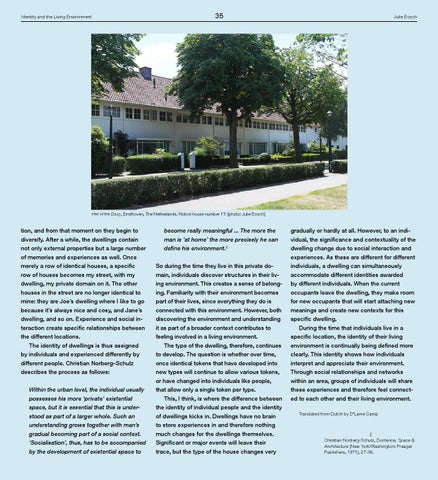
Het Witte Dorp, Eindhoven, The Netherlands. Notice house number 11! [photo: Julie Bosch]
tion, and from that moment on they begin to diversify. After a while, the dwellings contain not only external properties but a large number of memories and experiences as well. Once merely a row of identical houses, a specific row of houses becomes my street, with my dwelling, my private domain on it. The other houses in the street are no longer identical to mine: they are Joe’s dwelling where I like to go because it’s always nice and cosy, and Jane’s dwelling, and so on. Experience and social interaction create specific relationships between the different locations. The identity of dwellings is thus assigned by individuals and experienced differently by different people. Christian Norberg–Schulz describes the process as follows: Within the urban level, the individual usually possesses his more ‘private’ existential space, but it is essential that this is understood as part of a larger whole. Such an understanding grows together with man’s gradual becoming part of a social context. ‘Socialisation’, thus, has to be accompanied by the development of existential space to
become really meaningful ... The more the man is ‘at home’ the more precisely he can define his environment.2 So during the time they live in this private domain, individuals discover structures in their living environment. This creates a sense of belonging. Familiarity with their environment becomes part of their lives, since everything they do is connected with this environment. However, both discovering the environment and understanding it as part of a broader context contributes to feeling involved in a living environment. The type of the dwelling, therefore, continues to develop. The question is whether over time, once identical tokens that have developed into new types will continue to allow various tokens, or have changed into individuals like people, that allow only a single token per type. This, I think, is where the difference between the identity of individual people and the identity of dwellings kicks in. Dwellings have no brain to store experiences in and therefore nothing much changes for the dwellings themselves. Significant or major events will leave their trace, but the type of the house changes very
gradually or hardly at all. However, to an individual, the significance and contextuality of the dwelling change due to social interaction and experiences. As these are different for different individuals, a dwelling can simultaneously accommodate different identities awarded by different individuals. When the current occupants leave the dwelling, they make room for new occupants that will start attaching new meanings and create new contexts for this specific dwelling. During the time that individuals live in a specific location, the identity of their living environment is continually being defined more clearly. This identity shows how individuals interpret and appreciate their environment. Through social relationships and networks within an area, groups of individuals will share these experiences and therefore feel connected to each other and their living environment. Translated from Dutch by D’Laine Camp
2 Christian Norberg-Schulz, Existence, Space & Architecture (New York/Washington: Preager Publishers, 1971), 27-36.