Archiprint6—Creating & Experiencing Identity
11
A Kind of Space —An Interpretation of the Atmosphere in twelve Parisian Quarters
Annemiek Osinga
In February 2014, the graduation studio A Kind of Space, led by Jacob Voorthuis and Sjef van Hoof, started. The initial idea was to grab the atmosphere of a Parisian street. Twelve different areas in Paris were chosen and analyzed. As a process, and in order to come up with a comparable outcome, several models (of which two are published in this issue) were made to encapsulate the identity – or atmosphere – of a certain area.
The Opéra itself, designed by Charles Garnier, was constructed in 1875. Until the opening of the Opéra Bastille in 1989, it was the primary opera house of Paris.1
Avenue de l’Opéra Between 1853 and 1882 Paris was transformed in order to create a healthy and modern city. This urban renewal, designed by Napoleon III and Baron Haussmann, included several boulevards that provided the city light and air. The Avenue de l’Opéra, situated in both the first and second arrondissement of Paris, was one of them and required the demolition of a large amount of Parisian building blocks.
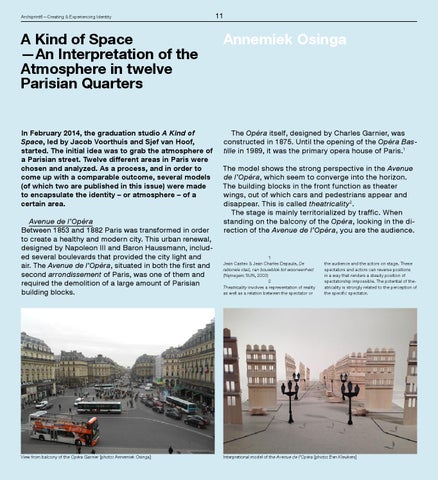
View from balcony of the Opéra Garnier [photo: Annemiek Osinga]
The model shows the strong perspective in the Avenue de l’Opéra, which seem to converge into the horizon. The building blocks in the front function as theater wings, out of which cars and pedestrians appear and disappear. This is called theatricality2. The stage is mainly territorialized by traffic. When standing on the balcony of the Opéra, looking in the direction of the Avenue de l’Opéra, you are the audience.
1 Jean Castex & Jean Charles Depaule, De rationele stad, van bouwblok tot wooneenheid (Nijmegen: SUN, 2003) 2 Theatricality involves a representation of reality as well as a relation between the spectator or
the audience and the actors on stage. These spectators and actors can reverse positions in a way that renders a steady position of spectatorship impossible. The potential of theatricality is strongly related to the perception of the specific spectator.
Interpretional model of the Avenue de l’Opéra [photo: Ben Kleukers]