
AMPLEFORTH A B BEY AMPLEFORTH A B BEY The Ampleforth Journal 2021 - 2022 Volume 125


Return to Ampleforth and take time for reflection and spiritual nourishment at our modern Retreat Centre. l Guided Retreats l Self-led Retreats l Group Retreats Find out more www.ampleforthabbey.org.uk 01439 766087 retreats@ampleforthabbey.org.uk Ampleforth Abbey Retreats

- 2022
125
T he Ampleforth Journal 2021
Volume

2 THE AMPLEFORTH JOURNAL 2021-2022 CONTENTS Abbot Robert Igo: CHOOSING A FUTURE TOGETHER ....................................................6 Nicholas Reynolds: A LIFE IN THE DAY OF A PERMANENT DEACON 8 David Moses: WHYT IS THI NAKED BREST 15 Nicholas Wright: REFLECTIONS OF A SCHOOL GOVERNOR 19 Gerry Rogerson: GREATNESS IS NOT ALWAYS FLAWLESS 23 Peter Robinson: GILLING AND THE PRACTICE OF ITALIC 30 Fr Kentigern Hagan: ST LAURENCE RAILWAY COMPANY .......................................... 33 Fr Terence Richardson: 25 YEARS IN ZIMBABWE ................................................................. 36 Gerard Simpson: ST AIDAN’S, OSWALDKIRK 45 Fr Bernard McInulty: A MONASTERY IN THE HIGHLANDS 47 Fr Ambrose Henley: REVIEW OF THE TALE OF THE TAILOR AND THE THREE DEAD KINGS 49 Sebastian Roberts: REVIEW OF THE MAKING OF THE ANGLO-IRISH AGREEMENT OF 1985 ......................................................................................... 51 Bernard Bunting: RECOLLECTIONS OF A SOUTHWOLD GP ................................... 55 Gabrielle Foster: REVIEW OF HILD OF WHITBY AND THE MINISTRY OF WOMEN IN THE ANGLO-SAXON WORLD 57 Fr Philip Rozario: REVIEW OF EXTERMINATING POVERTY –The true story of the eugenic plan to get rid of the poor, and the Scottish doctor who fought against it 59 MONKS OBITUARIES: Fr Alban; Fr Michael; Fr Matthew; Fr Cassian; Fr Andrew 62 OLD AMPLEFORDIANS OBITUARIES ........................................................................................ 69
VOLUME 125 3
EDITORIAL
FR RICHARD FFIELD OSB EDITOR OF THE AMPLEFORTH JOURNAL

FrAbbot, in his first contribution to this Journal, sets out his vision for Ampleforth’s future and invites you to be part of it: to share in the evangelisation of a nation that for the first time has a Christian population of less than 50%. The last popes have each emphasised that evangelisation is the task of every Christian: the bringing of the good news that each and every human being is loved to bits by God. Over the last year Fr Abbot has invited a number of Bishops, priests and lay people to speak to the Community on how they see our role in this. The consensus is that monks evangelise not by going out and making speeches but by being praying monks in our monastery and meeting people who come to visit and stay with us. St Benedict wrote that a monastery is never without visitors.
Gabrielle Foster reviews a new book on St Hilda, the 7th Century abbess of the monastery of men and women at Whitby who gave hospitality to kings and peasants alike. The evidence is overwhelming that people do come here and find the peace that they did not always know they were seeking and hear what they did not always know they needed to hear. As an example of God’s propensity to bring good out of every evil, the live streaming of our Office, of our Mass, of our weekly Home Retreats and our daily Home Prayers, that grew as a result of Covid, has brought many more people in contact with us than would ever fit in the Abbey Church. The refurbished Grange has been attracting greater numbers of guests for retreats and the nearly completed refurbishment of Alban Roe House (formerly JH) will bring more school retreats from outside the valley.
As this is written, we are hosting for the first time a Council meeting of Aide Internationale Monastère, in which Fr Mark Butlin (O49) has been so active for many years, with a large number of Abbots and Abbesses from all over the world. You can read in this issue about the first 25 years of our own monastery in Zimbabwe. And the obituaries of OAs show the various ways in which so many of you have taken a variety of roles in evangelisation over the years and Nick Reynolds writes of his experience as a Permanent Deacon.
It is a joy to report that the school has passed its latest Ofsted inspection and as the school bids farewell to Robin Dyer who has seen us through the last four inspections,
4 THE AMPLEFORTH JOURNAL 2021-2022
we welcome his Catholic successor, Peter Roberts. Nick Wright writes about his own experience as governor of school with a non-Catholic head and David Moses shares his experience of teaching English.
Fr Ambrose reviews a Ghost story set on the road from Ampleforth to Gilling, written 600 years ago by a monk of Byland Abbey and in the year that Gilling Castle has been sold, Peter Robinson recalls the Italic handwriting he was taught there.
General Sebastian Roberts reviews David Goodall’s memoir of the Northern Ireland Agreement in which he played such a prominent part. Gerry Rogerson shares some views of the Abbey Church that very few people have seen.
We hope that this issue will reach more readers than ever before. This is due to a joint decision made by the Abbey, the College and the Ampleforth Society.
VOLUME 125 5
CHOOSING A FUTURE TOGETHER
ABBOT ROBERT IGO, OSB
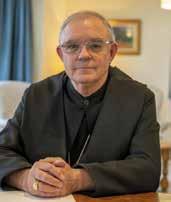
Asyou may imagine the 19 months since becoming Abbot have been an interesting learning curve. Not having been present for the Chapter of election in January 2021, and having lived away from the Abbey for 25 years, I have still to discover why the Community thought I was the person to lead them as Abbot. What has become clear however is that we are at a moment of change, a ‘kairos moment’. A moment where significant decisions must be made about who we are and what we desire to be as a monastic community in the future.
I would therefore like to make it very clear that I believe that this monastic community has a future - but it will only do so if we become protagonists of that future. Hence in January this year we launched our strategic plan: ‘Choosing a Future Together’. This is not a catchy ‘sound bite’. It underlines a fundamental necessity. We can only have a future if we choose to walk and work together. This is about a partnership, a relationship. We have had to engage in important conversations and make significant decisions about what is ‘core’ to our mission as we go forward. We have had to look at the size of our community, at its age profile and at what is possible. Already in 23 months I have buried five members of the community. We simply cannot continue to do what we did previously.
We set out our strategic plan in a document ‘Choosing a Future Together’. This shows our proposed direction of travel. We are a Benedictine community for whom prayer is essential, a fundamental element of our mission. Our desire is to point others to God and, through our hospitality, to create a place where others can find meaning and purpose, where people can find God. We were not founded to administer parishes, to run a school or even a private hall of residence in Oxford. These were part of the work that we responded to and that we have handed on.
Benedictines have existed since the sixth century and have had the ability to adapt to different circumstances and challenges. Our love for God is why we want to share that faith with you and others; to invite you to become an extension of this community of faith; to share in our mission of evangelisation of the nation, revitalisation of the Church and transformation of our society. Our relationship with you and our pastoral support of you is therefore important to us.
6 THE AMPLEFORTH JOURNAL 2021-2022
We are having to change. But our identity remains ever the same. We are a monastic community that seeks to create a place of faith, prayer, formation and encounter. Our doors are open to all who want to share in our ongoing search for God. We have a future because we choose to have one, because we see our way of Christian living as important for our world today; it is a world lost, confused, hurting.
And this brings me to something painful but important.
I take this opportunity as Abbot to offer my sincere and heartfelt apology to anyone who suffered abuse while in the care of our schools, parishes or other ministries. I take this opportunity to say I am sorry for the breach of trust to members of the Ampleforth Society who have supported us. We are deeply sorry, and I can assure you that we have worked hard to ensure that this could never happen again and have implemented credible change. We have put into place safeguarding policies and protocols that put children and adults who might be at risk at the very centre of what we do and the decisions we make. This includes a strong commitment to mandatory reporting of any suspected or actual case of abuse to statutory agencies.
We have been under ‘close scrutiny’ for many years from external regulators. We consider such ‘close scrutiny’ a valuable opportunity to listen, learn and move forward demonstrating integrity and transparency. There is no room for complacency.
In our strategic plan, ‘Choosing a Future Together’, we make demonstrating our safeguarding commitment a priority. Actions, not just words. Actions, not just nice bureaucratic structures. Ampleforth Abbey is committed to embedding a safeguarding culture that demonstrates care and respect for individuals. This is a basic tenet of our Christian faith (Matthew 18:5) and the Rule of St Benedict that forms the lives and attitudes of the Ampleforth Abbey monks and employees.
We ask ourselves “Is this enough?” Sadly, however much we strive to improve, it will never be ‘enough’. It is of course a work in progress, an extremely important work as we seek to untangle the web of abuse that is the cause of so much human suffering. We continue to listen, learn, and move forward with the help of those who engage with us and share their thoughts and stories. We seek to be a place of healing and recovery, and to be a place of safety where all our visitors can encounter the peace that Jesus longs to give.
VOLUME 125 7
A LIFE IN THE DAY OF A PERMANENT DEACON
REVEREND NICHOLAS REYNOLDS (D61)
The approach came as a shock and my reaction took me totally by surprise.
My parish priest after Mass one Sunday early in 1991 passed me a copy of the latest Ad Clerum, open at the page where the bishop was asking his priests for possible suitable candidates for the permanent diaconate that he was anxious to expand in the diocese. “Read that bit, Nick and tell me what you think” he said , as he pointed to the open page. I barely knew what a Permanent Deacon was, the diaconate was still in its infancy and there were only 6 in the Portsmouth Diocese in which I was living.
I was 49 years old with 5 children between the ages of 8 and 18 and a demanding job in export to Europe, the Middle East and South America so I was away quite a lot. My wife, Meg, was at the time running the diocesan bookshop and studying also for an external Theology degree. We were both involved in our little parish of Alresford, where she had a naturally higher profile than mine. Being away a lot and family commitments largely determined how much time I was prepared to give to the Church and the parish.
But all that was to change the moment I read that piece in Ad Clerum.
My reaction came totally out of nowhere. Two incidents that had taken place in my life about which I had not thought about since they had occurred burst into my mind – one back in the early 60’s and the other in the late 80’s. It was a shock because it was suddenly clear that those two incidents and the call to diaconate were somehow inextricably linked. It was scary – a kind of ‘“divine” nudge ? It stopped me in my tracks, yet I just knew then that I had to say ‘yes’! But that didn’t stop me trying to run away from it for the next 18 months. Scariest of all was the thought of having to preach! I shared all my doubts with my parish priest who listened patiently and then just told me to come back in a month with an answer. I did, and said ’Yes’.
This calling unearthed a second vocation which somehow had to be interwoven with my marriage to Meg with all its responsibilities that go with raising and providing for a family of 5 young children. I was a layman when Meg married me and now, 20 years later, I was becoming a clergyman. The diaconate would now have to be slotted in; but where and how? Inevitably marriage and family dynamics would change yet one of the first things we were told was that the order of life’s priorities had to be: family, work, and then diaconate.
8 THE AMPLEFORTH JOURNAL 2021-2022
One of the first consequences of this was that Meg had to lessen her parish profile to allow me to increase mine. Not easy for either of us and it never came between us. But, as always, the Lord knew what He was doing because seemingly totally unconnected with my move into the diaconate, Meg, a fluent Spanish speaker, was asked by the Catholic Chaplain to Winchester Prison to assist him initially with a number of South American women recently arrived and serving sentences for bringing drugs into the country. Another ‘divine nudge’?
It was a ministry for which she was ideally suited and which she did for the next 10 years until her premature death in 2006 from a brain tumour.
When I announced to the family over lunch that Sunday in 1991 that I was going forward for the diaconate, there was a sense of uncertainty and unease among the children as to what was this going to mean for us as a family. These were issues that concerned me too, as this was a whole new way of life to accommodate.
Questions and comments from the children started coming: Will you be the same Dad to me? Will we be having to spend more time in church and less with you? Promise me you will NEVER EVER wear a dog-collar when collecting us from school or a party or around any of our friends? In a more humorous vein Will it help you queue jump at the Tesco checkout? And, if I wasn’t careful, I could be like Rowan Atkinson in “Four Weddings and a Funeral.”
Will you have to dress like a priest? said one of my boys. Will you be different in the way you behave? More pious? Less fun? Still wanting to play as much table tennis with me? What about us? As the family of a dog-collar wearer, maybe we would have to be different? Pray more? Swear less? Could we still watch Baywatch?
He now says, looking back on all that: I noted that any increased piety or reduced enthusiasm for table tennis seemed to be staying at church, and the Dad I knew was still present and correct once back home after Mass. A great relief.
In the order of the Ordained Ministry in the Church, that of Deacon is the third after Bishop and Priest. There are two levels of Deacon: - the Transient Deacon, usually in his last year before priestly ordination, and the Permanent Deacon, usually a married man over the age of 35.
The order of Deacon is traced back to Acts 6:1-6 where seven men were called to service of the community, preaching and spreading the Gospel message. As the role developed in the early Church he became the eyes and ears of the bishop, “his right-hand man”. But early in the 5th Century deacons had their wings clipped, as it were, because they became too powerful and so their numbers declined. The
VOLUME 125 9
ministry of Permanent Deacon was finally revived in 1972 by Pope Paul VI following the directives of Vatican ll. A deacon is ordained by a bishop in line with tradition. Though his ministry in modern times is parish based, it is a deacon, not a priest, today who stands at the altar alongside the bishop who is presiding – like his pilot-fish !
It has been left to bishops worldwide to decide upon the introduction of permanent deacons in their dioceses The USA went in for them in a big way. In the UK the uptake was slower. I was the 14th to be ordained in the Portsmouth Diocese (to which I still belong even though I now live in London). Now 25 years later, it has nearly 60. The Diocese of Westminster has about half that number - a slow starter under the late Cardinal Basil Hume.
My training period lasted 3 years and began in September 1992. Candidates attended lectures one Sunday a month in term time at Wonersh Seminary, and wives were also expected to attend. There were about 15 of us drawn from four or five dioceses across the South and East of England. At that time the training programme was not nearly as stringent and structured as it is now, 30 years later, due largely to the fact that the Permanent Diaconate was still relatively in its infancy in the whole Church. As far as I can recall, the training was delivered almost exclusively by priests, covering relevant Canon Law, Theology, Church documents, Scripture, the Sacraments and Liturgy. Only one weekend in all this time was devoted to preaching, and we were expected to preach in our parishes after ordination on about one Sunday in four.
We were focused principally on the necessary background to the principal roles of ‘diaconia’ which are Altar, Word and Charity.
Altar: because he assists the presider (bishop and priests)
“..in the celebration of the divine mysteries”
Word: “he proclaims the Gospel and preaches the Word of God”.
Charity (I prefer the word Service and Pastoral Care): “he conforms himself in the likeness of Christ the Servant whom he represents” (I’ve always prioritised them in reverse order: Service, Word and Altar.)
These are very simple thumbnail definitions which, when unpacked in the context of a parish, embrace a wide spectrum of its community life and activities - sacramental, liturgical, administrative and pastoral and so on.
Before candidates are accepted, the Church needs to be sure that certain requirements are met as set out in Church law and the relevant Vatican Documents based on Pope Paul Vl’s directives:
“In the case of married men, care should be taken that only those are promoted to the diaconate who have lived as married men for a number of years and have shown
10 THE AMPLEFORTH JOURNAL 2021-2022
themselves to be capable of running their own homes, and whose wives and children lead a truly Christian life and have good reputations”.
Moreover, in addition to stability of family life, married candidates cannot be admitted unless “their wives not only consent, but also have the Christian moral character and attributes which will neither hinder their husbands’ ministry nor be out of keeping with it”.
So it is abundantly clear that suitability of the wife is critical. And so it should be!
My Ordination on the Feast of the Sacred Heart in June 1995 was a very happy event conducted by Bishop Crispian Hollis in our small church in Alresford attended by over 200 people, with an inter-church choir and a particularly large contingent of clergy, which would have been Meg’s doing through her popular role running the diocesan bookshop where most of them were regular customers. The reception which followed was held in the teetotal Methodist Church Hall within walking distance, so we had our drinks in the car park on the way there!
About a month before, I was having a serious wobble! In my lunch hour one day, I popped into one of the churches I know well, close to where I worked. The sun was shining through the beautiful Rose Window and as I gazed at it as I had done many times before, I noticed for the very first time that in the ‘bullseye’ of the window was the figure of the Sacred Heart ! Uncanny. Why had I never noticed it before? But the message was clear: the third ‘divine’ nudge … and my wobble vanished!
By now 3 of my children were at university and the 2 boys away at boarding school. Then 11 months later I was made redundant but with a good package, thank God. I started up on my own making use of all my trade contacts and export experience to drum up some income. Being at home more meant that I had more time to devote to my ministry. As the parish priest was working full time for the diocese in another role, he left me to attend to pastoral visiting, baptism and marriage preparation, helping families of recently deceased plan funerals, undertake RCIA., organising the Easter and Christmas liturgies etc. As the parish was small with only 120 Mass goers the load was not huge.
Where Mass was not required I would occasionally take funerals and conduct marriages, and cremations. On one occasion I totally forgot, after one cremation to inter the ashes a few days later for the widow who had just lost her husband. She never held it against me. On the contrary she gave me a big hug when I went to apologise, hiding behind a huge bunch of flowers. She had been very worried that some accident had befallen me! My sense of shame was intense and we became even firmer friends!
VOLUME 125 11
It soon dawned on me that in the eyes of the community Ordination makes a difference. I realised that suddenly I was seen as a person worthy of greater trust and therefore available and accessible pastorally in a way I wasn’t before. (Meg and I decided that I would spare one evening a week for the parish and so I had to learn to say ‘no’ when asked to do more!)
The Diaconal ministry is necessarily different from that of the presbyterate both in essence (‘being’) and in the detail (’doing’) though this may not be immediately evident on the surface either to him or to others, especially as after ordination they ‘hit the deck running’. Apart from Eucharistic Consecration and Absolution, there is effectively nothing the deacon cannot ‘do’ that the priest does. And that does nothing to help either deacon or others to grasp that the calling to diaconate is not the same as the calling to priesthood. It is about ‘being’ but in a different way. In fact, it took me 10 years before I could preach about how I understood my ministry.
There is a constant tension in trying to keep the balance between the Deacon’s dual roles of layman (family man with mortgage etc) and cleric, and the better the balance the more clearly the role of deacon is understood by everyone. His role is on one level to be the bridge between priest and laity yet he will always have one foot on either side of the fence. Among many there is the feeling of unease that the diaconate is just another layer of clerical hierarchy preventing the development of collaborative ministry. Not without reason, therefore, do women in particular feel ‘here we go again’.
When it came to my children’s weddings, I walked my daughters up the aisle. At my sons’ I was in the pew alongside Meg and the family. When my youngest son was confirmed I was in the pew with him and the family, not alongside the bishop at the altar.
Importantly, the diaconate is not about Power. It is about Service. The diaconate will never be fully understood, I fear, if deacons are allowed to appear too clericalised. In my experience when at clergy gatherings or inset days, for instance, it is deacons who appear in clerical dress while the priests come in mufti.
I have never possessed a black suit and will only wear a dog-collar when it is pastorally appropriate – like visiting a hospital or Care Homes. On other occasions when necessary I wear a small cross in my lapel.
I found preaching to be the most difficult aspect of the ministry - and still do. It was from the start my greatest dread. In practice putting each homily together is a bit like ‘pulling teeth’. I deal with this by having a blank sheet of paper and pencil and asking
12 THE AMPLEFORTH JOURNAL 2021-2022
the Lord for inspiration on the basis that He knows who needs to hear what: and then I leave the rest to Him. More divine nudging!
In 1999 I was asked by Bishop Crispian to set up Child Protection in the diocese according to the directives of the Nolan Review. Each parish had to have its own Child Protection Team and training would be delivered to both clergy and laity across the diocese, often assisted by input from the statutory authorities. The Review contained 83 recommendations and is considered by many worldwide as the most robust available. The consequences, as we know, for failing to meticulously follow procedures can be very damaging and far reaching.
Early on and still green behind the ears I launched into my first training session before about 40 newly appointed parish CP officers. Things began to go horribly wrong when I got my papers in the wrong order and lost my way! Cringingly embarrassing and humiliating. But people were very kind.
After 6 years I resigned my Child Protection role in order to care for Meg in the last months of her life. Following her death I found security in immersing myself in my ministry but soon found that I was experiencing ‘Church overload’ which answered questions that some were already asking whether I would be going forward for the priesthood.
Happily, the Lord seemed to have other plans for me.
About a year later I re-met Lis whom I had not seen for 40 years since the mid 60’s when briefly we had been ‘an item’. We were widowed 3 months apart and had both been born and brought up in Portugal, so we had a lot in common. The rest, as they say, is history!
The fact that Lis is Church of England has not been a problem, thankfully. On the contrary she is extremely supportive, respecting and encouraging, and for whom her faith is also very important.
We married 2 years later once the Vatican eventually, and with the help of firm intervention from the bishop, discovered that the request for permission for me to remarry - as required by the Church in the case of widowed deacons - had lain there for a number of months in the wrong in-tray! I chose to move to Twickenham where we now live and where Lis had made her life. Between us we now have 7 children and 17 grandchildren, 12 of whom are mine all under the age of 15. And both sets of families get on like old friends. Such a great blessing!
VOLUME 125 13
With these growing family commitments, I chose not to incardinate into the Westminster Diocese. Although now attached to the parish of St James in Twickenham I do not figure officially on any parish or diocesan records. In that respect I’m a kind of ‘phantom deacon’. However I help out when possible if requested – usually for baptisms and cremations, and in other ways – pastoral and liturgical. There is also a Care Home I’ve been visiting regularly for the past 10 years.
On being asked recently how I thought I’d succeeded in doing what I had been called to do, I found it difficult to answer apart from saying “you’d better ask God“. One of the mysteries of life is the way the God uses us. Doors open along the way. You either walk through them or He has to pull you through, which is what I feel happened to me. What I have grown to realise is that once through the door He has so much to offer to enrich your understanding of who you are and how He wants you to be. He keeps me going through the encouragement I receive from the affirmation I get especially from my children, and from the way Lis has helped me to accept the gifts I have which are God given and not of my doing.
This comes across strongly when I spend time with the sick and the dying. I come away inspired and humbled by their dignified acceptance of their own condition of vulnerability, helplessness and dependency, and I tell them that I bank all this to draw upon later for strength should anything similar happen to me.
Reluctant as I have been to step beyond my comfort zone in so much of my life my Faith tells me that the ‘Divine’ has nudged and prodded me all the way with amazing patience – a bit like a Driving Instructor.
Perhaps it’s just as well, therefore, that I still feel I need my ‘L’ plates on.
14 THE AMPLEFORTH JOURNAL 2021-2022
TEACHING THE MIDDLE ENGLISH BEAUTIFUL TRUTH IN CONTEXT
DR DAVID MOSES
Whenbeginning to read a play by Shakespeare in class I always ask our young people to try to define the language used by that playwright. Hands shoot up; ‘Old English’ is invariably the confidently delivered answer. Poetic, and archaic at times though it may be, Shakespeare’s language is, however, early modern, and far from Old (Anglo-Saxon) English. At that point I usually read aloud Anglo-Saxon versions of The Lord’s Prayer (10th century, Fæder ure þu þe eart on heofonum) and get students to attempt to read ‘Cædmon’s Hymn’ (7th century, Nu scylun hergan hefaenricaes uard). They certainly come to understand the difference then.
That begs the question, for them, of what comes in between the old and the modern. Middle English emerges after the Norman conquest and we find its various (regional) forms until the late fifteenth century. I always now introduce it by looking at a poem which I first used because of its accessibility. In addition, the version (below) of it which I use is regularised to make it visually easier to read. As time has passed, I have found it increasingly compelling, and have taken to using it often with our older students. The poem presents us with a fixed image, though it is also an ‘open text’ accessible at several levels of interpretation:
Whyt is thi naked brest and blodi is thi side, Starkë are thine armes that stretcchëde are so wyde. Falwe is thei fairë ler and dimmyëth thi sighte, Drie is thin hendë body on rodë so y-tight.
Thine thighës hongen colde al so the marble-ston, Thine thirlëde fet the redë blod by-ron.
This beautiful poem, versified as a lyric to be spoken in Middle English, has several versions, many of which are in manuscripts and sermon books from the early 14th century. It is older, however; its analogue has been said to be St Augustine of Hippo’s Candet nudatum pectus, though recent commentators now attribute it to a sermon
VOLUME 125 15
by
John of
Fécamp (d. 1079),
whose Latin text is homiletic, reflecting as it does on the sufferings of Christ. It is, of course, the crucifixion on which we gaze as we read, but in its newer Middle English context the description is highly poetic. The first word ‘whyt’ here sets the theme of purity in the poem, but also sets up a number of oppositional visual contrasts. The tortuous description of Christ, not just pale but ‘Starkë’, ‘stretcchëde’ and ‘thirlëde’, is matched by the continued sense of grace in suffering - the ‘fairë ler’ and the ‘hendë’ body. Light and dark imagery seems dominant but gives way to the more visually arresting red of the blood. The description suggests at once an overwhelming sense of vulnerability, yet acceptance and composure. Christ – never named here - is described as having thighs cold ‘as marble’. It is a perhaps unwitting simile which makes us think of sculptural representations of the crucifixion. Figuratively and literally, beneath all of that visual ‘noise’ those final lines emphasise silence. Indeed, the final punctuating image of the blood-soaked, pierced feet, abruptly finishes a poem in which a strategy of significant contrasts has been used to maximum artistic and theological effect. The word ‘passion’ was rarely used in the earlier part of the medieval period; ‘pathos’ was more common and often translated to affectus. The lyric’s beauty lies in its ability emotionally to affect those who read it by their involvement. The speaker addresses Christ. There is a real intensity to the words spoken because of the way it places the speaker as present – a witness to the scene of the crucifixion – and who addresses Him on the cross. The intimate, observational ‘thi’ takes us closer still to the physical body, not merely highlighting the visual details of the Crucifixion and its effects, but producing an intimate communion between the speaker of the lyric and its subject: Christ.
Most of our students enjoy reading this and, with a little effort, quickly comprehend the literal elements of the text. With further guidance and encouragement, they start to see more. In its medieval context the genre is that of devotional poem. It is perhaps meant to be read in the oratory of a household; its styling in the vernacular is a sure sign that its intended audience were not going to hear it at Mass. As they should be, Ampleforth students tend to be ready to search for, find, and be moved by Christian meanings in the texts they read, whether those meanings are oblique or direct. An uncomplicated way to see this poem is to look at it as an icon. We could say that language fails adequately to represent the transcendence of the moment contemplated; once the words are spoken, we are left in silent prayer and contemplation before Christ on the cross.
Older readers want to discuss the poem in more detail still, and it was those A level class discussion groups which have prompted my further reflection and my next comments. It is worth noting that I cannot now separate the poem from the crucifix which I lived with for so many years and which is still on the wall of the study in St John’s House. Its near white ivory Christ stands out in relief from the ebony black cross, and allows me to attach the poem to a cherished image. Like the poem, it
16 THE AMPLEFORTH JOURNAL 2021-2022
was and remains for me full of beauty because of its message, its delicacy, and its light. Indeed, thirteenth century thinkers placed great emphasis on proportion and light, and the term we use for this approach to art and beauty is Hylomorphism. This aesthetic says we can experience beauty through proportion, light, and the references, reminders and manifestations of God in things. It was asserted that one is able to experience physical being (ousia) and metaphysical beauty at once, and thus may feel an associated passion. We should be moved by a beauty which represents not just the outward appearance of things, but their inner significance. The most challenging aspect of any such discussion with students can be when I say that a piece of writing is ‘beautiful’. How does one define ‘beauty’? Beauty, perhaps because of this increasingly secular world, seems to have fallen into disrepute; and yet beauty until relatively recently was a value as much as Truth, and in much of western art the two are synonymous.

VOLUME 125 17
The very juxtaposition, in a literature class, of discussing notions of beauty with an ugly act and suffering, seems contradictory. I think, though, we can and must reconcile the two. Medieval artists and poets were aware that human life is full of chaos and suffering. Roger Scruton has described the simple remedy as ‘beauty.’ ‘The beautiful work of art brings consolation in sorrow and affirmation in joy. It shows human life to be worthwhile.’ Indeed, the first readers of the poem were supposed to take delight (delectatio) in such images and texts, and the poem certainly suits an imagistic, devotional context. Honorius of Autun had said, back in around 1025, that images were the literature of the laity (laicorum literatura), so there may be a sense in which we see this image, even in its original context, as having a role in education. To see it as devotional is important too because this image also requires us quietly to participate, to kneel before the cross, and to recognise its beauty. Works of art were designed with aesthetic perception in mind, presupposing the nature of experience and empathy in the subjectivity of the perceiver.
The medieval mind was passionate about the truth, though its notions of evidence were different to ours. It might be enough to say simply that this poem is beautiful because it is True. Uncompromising in itself though the statement is it does not help our students pass exams, and something more is needed. We do seem to have lost our ability to define beauty, and to have lost the conceptual tools that allow us to recognise and identify with it as the medievals did: as interactive, significant, and comprehensively meaningful. They knew that beauty can restore the sacred space, and this lyric does perfectly what beautiful art is intended to do by lifting our gaze, by making us look beyond, by closing distances of time and space, and by bringing us closer to the Divine.
18 THE AMPLEFORTH JOURNAL 2021-2022
Dr David Moses has been housemaster of St John’s, Headmaster of Gilling Castle and Housemaster of St Edward’s and St Wilfrid’s House.
REFLECTIONS OF A SCHOOL GOVERNOR
NICK WRIGHT
Whenour Editor Fr Richard asked me to pen a few words about my experiences as a School Governor I readily agreed but it has turned out to be more of a challenge than I thought it would be. Essentially, how to make it interesting with a few personal anecdotes, coupled by necessity with some rather dry, factual, legal requirements. Obviously, schools come in all shapes and sizes and each one will face different problems at varying times. There is one constant – the next problem is just round the corner. A Governing Body with a broad range of skills sets is absolutely essential in any type of school to support the Head and give strategic direction to the Senior Leadership Team. These life skills include detailed knowledge of financial management and governance, property matters, integrity, education in the round, health and safety, safeguarding and wellbeing, understanding special educational needs or disabilities: the list goes on but both local authority and diocesan courses are available to support you.
I am a Foundation Governor of Wardour Catholic Primary School, primarily by virtue of being a Trustee of Wardour Chapel, a private chapel attached to Wardour Castle in the diocese of Clifton. Uniquely, for a state school, the Bishop of Clifton does not own the school as it predates the formation of the Diocese and as such is owned by the Chapel Trust. This article will therefore focus on my experiences and responsibilities as a Foundation Governor in a small Catholic rural primary school but this can be read across to other primary and secondary schools whether they are state run or independent. In addition to the Foundation Governors, who form the majority of the body, we have a Local Authority Governor, a couple of Parent Governors, a Staff Governor and of course the Headteacher. The chairman allocates governors to various sub committees such as resources, education, Headteacher’s performance management and property matters. These sub committees then support the Full Governing Body. Chairmanship appears an almost full-time job and I am sure the outstanding Chair of the Ampleforth Trustees, Edward Sparrow, will know just what I mean!
Foundation Governors in Church Schools are appointed by the Diocesan Bishop and are expected to follow Diocesan guidance. They are specifically appointed by the Bishop to ensure that:
• The distinctive nature of the school is promoted, developed and evaluated;
• All aspects of school life are conducted in accordance with the trust deed of the diocese and Canon Law;
VOLUME 125 19
• The Religious education curriculum and the curriculum for Relationships and Sex Education are in accordance with the Bishop’s policy for his diocese;
• Religious worship is in accordance with the rites, practices, discipline and liturgical norms of the Catholic Church;
• All Bishops’ Conferences directives are fulfilled; and
• The Bishop’s vision for his schools is fulfilled.
Readers will not be surprised to hear that local authority and OFSTED inspections do not major on the above directives! Governors of course know the particular local challenges facing their schools and occasionally this can bring them into conflict with the Bishop and some of his directives. I will return to this later as it can be a very troubling situation in which to find oneself, as Ampleforth Trustees will be well aware.
So why do people become school Governors in light of their considerable timeconsuming responsibilities? Cardinal Hume’s answer was: “To be a Governor of a Catholic School is to be in involved in the mission of the Church because our Catholic Schools are a very important part of our work for young people in the Church. I believe profoundly in our Catholic Schools and the Governors are there to make quite certain that the Catholic character of the school is maintained and forwarded. That is, in terms of teaching the Catholic faith and ensuring that the whole atmosphere is in fact Catholic: a good Catholic community. But it is also very important that our Catholic schools should be first class schools, giving an excellent education. This means the realising of the potential of every pupil, high academic standards, good vocational training and the development of the whole of the young person, preparing them for adult life. In all of this Governors play a key role, a very important role.”
The Bishop has high expectations of a Governing Body but so too does the Department for Education, as in maintained schools it is ultimately the taxpayer who pays the wages. Unlike independent schools, the role of the Governing Body is reflected in law which state that “the purpose of maintained school governing bodies is to conduct the school with a view to promoting high standards of educational achievement at the school”. It does this by adhering to the following core strategic functions:
• Establish the strategic direction of the school by setting a clear Catholic vision, values and objectives for the school and by agreeing the school improvement strategy with priorities and targets;
20 THE AMPLEFORTH JOURNAL 2021-2022
• Ensuring accountability by appointing the Head; monitoring the educational performance and Catholic character of the school and performance managing the Head;
• Ensuring financial probity by setting the budget, monitoring spending against the budget and ensuring money is well spent; and
• Ensuring that other stakeholders are heard by gathering the views of pupils, parents and staff and reporting on the results and by reaching out to the school’s wider community including the parish.
A key area of cooperation is the relationship between the Governors and the Head and this is key to the success of any school. The Governors are responsible for the overall strategy and thus determine the school policy in conjunction with the Head. They act as a critical friend to the Head who is often in a rather isolated position. The Head’s role is to determine how the strategy and policy should be implemented and does so on behalf of the Governors.
It goes without saying that Governors are expected to adhere to the Nolan (a hugely distinguished OA) principles with which all public servants should be familiar – in an ideal world everyone should conduct themselves according to the 7 principles of selflessness, integrity, objectivity, accountability, openness, honesty and leadership.
Many of the challenges facing school governors are common across the education spectrum. Safeguarding and good governance are obvious and ongoing challenges which will be only too familiar to members of the Ampleforth family. At our last Ofsted inspection the inspectors really concentrated on this area. Wardour School has always had a public footpath running straight across our playing field and OFSTED said this should be diverted for safeguarding reasons. Straightforward and obvious one would think, but diverting a footpath in a rural environmental is a bureaucratic challenge. Ampleforth’s excellent Headmaster explained, at the thankfully reinstated Brompton Oratory Mass and reception on 10th November, that the school’s governance and emphasis on student wellbeing is now recognised as a ‘Beacon’ example of what can be achieved. I am sure I am not alone in thanking Robin Dyer, Edward Sparrow and their excellent supporting team for their outstanding Teams updates to the Ampleforth family during the existential crisis the school was facing at the beginning of 2021. It was particularly encouraging to hear from Robin that 129 new pupils entered the school in September and that the proportion of Catholic students has gone up to over two thirds. A really heartening example of the faith and trust these new parents showed in a reborn and refocused Ampleforth. And remember Edward and his fellow trustees invested all their time, energy and knowledge for love, not personal gain.
VOLUME 125 21
Another constant challenge facing the Wardour governors is pupil numbers. Wardour school, like Ampleforth, is set in an idyllic rural location and, unlike the other local competing primary schools, our pupils can’t walk to school. This is important because pupil numbers dictate local authority funding so we have to be imaginative in attracting our pupils, the majority of whom are of course non Catholic, given that we are in a remote part of southern Wiltshire. Ampleforth faces similar challenges and probably, although I do not know the facts, has fewer pupils from the south of England than in previous years.
A further similarity between Wardour and Ampleforth is that both these high achieving Catholic schools have non Catholic Heads which is contrary to a directive of the Bishops’ Conference and herein lies the difficulty for Catholic school governors who have to live in the real world and recruit from the market place. We recently appointed our non-Catholic Head, who had previously been deputy Head, as she was streets ahead of the other candidates during the interview process. Her vision, knowledge and experience have turned the school round after a failing Catholic Head, whose removal for the good of the school was another bureaucratic challenge. Numbers are now on the increase, optimism abounds and our last OFSTED inspection was Good. A familiar story I hear you say. However, it took a formal meeting between the Bishop, the Chairman of the Chapel trustees and the chairman of Governors for common sense to prevail. The pupils walk to Mass at Wardour Chapel every Tuesday and the Catholicity of the school is assured, as it is at Ampleforth. The Wardour governors are in absolutely no doubt that an outstanding practising Christian Anglican Head, who regularly attends Mass, is far better for the success, indeed very survival of the school , than having a failing Catholic Head. That way we obey the Bishops’ directive that the School should be at least as good as other local schools. It is gratifying that the Ampleforth trustees have taken the same pragmatic approach.
I have tried to set out the role and purpose of a school governor and what is involved. It is time consuming, challenging and at times frustrating but it does have its unique rewards. Not only are you involved in the mission of the Church, but you are closely involved in the life of your local community, and if all is going well in the life of the school you certainly sleep well.
Captain Sir Nicholas Wright, KCVO, RN (T68) after retiring from the Royal Navy and following 17 years as Private Secretary to the Princess Royal, has been a governor of Wardour Catholic Primary School for the last four years.
22 THE AMPLEFORTH JOURNAL 2021-2022
GREATNESS IS NOT ALWAYS FLAWLESS
GERRY ROGERSON (H85)
The Abbey Church dominates the valley it overlooks. Its position, scale and architecture make it the pivotal point for life at Ampleforth. It is the heart of this institution. But there is a very special part of the Abbey that few of us are lucky to see… its loft. This hidden space is a vast, cavernous and inspiring journey through the mind of its creator, Sir Giles Gilbert Scott. Below, in the familiar main body of the Abbey, the two periods of its development are clearly defined by the Blue Hornton stonework of the older 1924 portion, Monks’ Choir and associated chapels, aisles and crypt, compared with the larger 1961 portion of the Sanctuary, Nave and Transepts, with pale rendered walls and lighter stone dressings from Dunhouse Quarries of County Durham. The same definition is above the domes, out of sight and “back of house”, where the stage development is seen in the construction details employed. Older parts to the west are all formed in mass, shuttered concrete, beautifully cast to reveal the grain of timber shutter boards crisply moulded into its structural beams, pitched concrete roof, and the Monks’ Choir dome itself, which is also concrete cast and can be walked on, despite being only 3 to 4 inches thick.
The Abbey Church dominates the valley it overlooks. Its position, scale and architecture make it the pivotal point for life at Ampleforth. It is the heart of this institution. But there is a very special part of the Abbey that few of us are lucky to see… its loft. This hidden space is a vast, cavernous and inspiring journey through the mind of its creator, Sir Giles Gilbert Scott. Below, in the familiar main body of the Abbey, the two periods of its development are clearly defined by the Blue Hornton stonework of the older 1924 portion, Monks’ Choir and associated chapels, aisles and crypt, compared with the larger 1961 portion of the Sanctuary, Nave and Transepts, with pale rendered walls and lighter stone dressings from Dunhouse Quarries of County Durham. The same definition is above the domes, out of sight and “back of house”, where the stage development is seen in the construction details employed. Older parts to the west are all formed in mass, shuttered concrete, beautifully cast to reveal the grain of timber shutter boards crisply moulded into its structural beams, pitched concrete roof, and the Monks’ Choir dome itself, which is also concrete cast and can be walked on, despite being only 3 to 4 inches thick.

VOLUME 125 23
(H85)
Fig 1. Concrete roof and dome structure over Monks’ Choir
Gerry Rogerson
Fig 1. Concrete roof and dome structure over Monks’ Choir


24 THE AMPLEFORTH JOURNAL 2021-2022
Fig 2. Lightweight roof and dome structure over the Nave
Fig 3. Retro lattice support beams to dome over the Sanctuary
Fig 2. Lightweight roof and dome structure over the Nave
Fig 2. Lightweight roof and dome structure over the Nave
By contrast, the newer portion is lightweight in structure, with sectional galvanised trusses supporting a traditional timber roof, from which thin hanging straps support mild steel hoops and expanded metal lath (EML) formwork, (Figs 2 & 3) through which the render that forms the domes is pressed through like mincemeat. Stand on these domes and you would doubtless crack the egg!
These were all pioneering details typical of Gilbert Scott. He was an Architect out for adventure, pushing boundaries and using new and often untried techniques to achieve his goals. Such giant leaps are inspirational and formative in the standing that Gilbert Scott has earned in the architectural community. But greatness is not always flawless. The loft also shows evidence of failure, mistakes and last minute changes. The highest of the three domes spans the Sanctuary. Part of the second phase build, the dome is of the lightweight form. The domes, once cast, became self-supporting, but to form them, the framework and EML had to be supported initially. The straps used for this purpose remain in place and create a strange sense of temporary stage set within the loft. On first sight, one might assume the domes are suspended from these straps. But they are no longer taut, instead they flex freely when touched, as they are no longer in tension… their work is done and they remain a memory of the construction process. Above the Sanctuary dome however, there are signs of a different story and this one starts the next level up, at the concrete floor of the Belfry.
The Belfry floor spans the 10 x 10m of the Tower footprint, strengthened with a pair of concrete beams, framing a central opening through which Gregory John was raised into place. Gregory John is the giant bell that calls us to Mass, strikes during the Consecration, rings the Angelus, and tolls the Death Knell when a member of the Monastic Community dies. It is a thing of beauty and I feel blessed to have seen it, tapped it with my finger tips and heard that familiar “A flat” tone sound softly back at me. (Fig 4)
When it rings though, there is nothing soft or gentle about it. The bell is 4.8 tonnes of bronze, set within a 1 tonne chassis. This combined weight had more impact on the structure than had been catered for, as the concrete beams and floor below are visibly bowed under the load. Consequently, the dome below had to be installed differently. Here, the temporary support straps hang not from the abandoned connector straps cast into the underside of the concrete slab above, but rather from sectional, lattice truss beams, brought into the loft in sections and assembled in situ to span the space. This alternative solution, clearly retro developed, negated the need to impose any additional load on the concrete slab, which had been pushed to its limits of performance, before completing the task it was designed to do.
In this instance, the flaw was identified, addressed and dealt with. But there are other areas where design ideology took precedent over detail, with questionable success. A
VOLUME 125 25

26 THE AMPLEFORTH JOURNAL 2021-2022
Fig 4. Gregory John in the centre of the Belfry
rings though, there is nothing soft or
about it. The bell bronze, set within a 1 tonne chassis. This combined weight
Fig 4. Gregory John in the centre of the Belfry
gentle
prime example of this was the design and execution of rainwater drainage. Ordinarily, we see rainwater collected off roofs into gutters, discharging into downpipes, running down the external wall face and into underground drainage. But Gilbert Scott did not want visible gutters on his Abbey, or rainwater downpipes, so instead he detailed hidden gutters and buried the downpipes in the walls. This led to convoluted routes for rain to get from roof to underground drains. Rain landing atop the tower, for example, discharges through gullies into exposed downpipes mounted on the internal wall face in the belfry, before disappearing into the walls and popping out again into external, hidden gutters below the main roof eaves. These gutters then discharge back into the walls, before popping out over flat roofs below. By this time, the potential volume of water can be significant as numerous roof areas are combined into very few, concentrated routes across the lower flat roofs, before draining to more gullies and yet more downpipes buried in the wall. By design, from the tower to the ground, rainwater is led into the building and back out again three times. Usual good practice would be to avoid doing this even once.
There are 28 downpipes buried within the Abbey walls. These were first investigated during roof repairs carried out in 2017, concentrating on the upper half of the building (the tower and main, upper roofs). A second phase to complete all the roof and downpipe repairs was undertaken late 2020. Historic plans in the Monastic Archive were consulted during early stages, to identify the locations of pipes. In reality though, Gilbert Scott’s drawings were not necessary, as every one of the buried, internal downpipes was clearly mapped out by the stains on walls and ceilings within the Abbey. With safe scaffolded access, we were able to get to gully outlets at the head of downpipes, enabling jet washing and CCTV surveys to be carried out. Each pipe was surveyed, allowing the material and length of pipe to be established. We found a mix of materials used, some iron, some copper, some lead. There is no explanation for this… it was as if the build was making use of materials available in any given week, or the project had become a test bed for alternative products. The worst of the leaks related to copper downpipes, which had become severely corroded. This was attributable to their encasement within the walls, where the copper was in contact with cementitious compounds, which of the period often contained high levels of sulphur (from cinders or fly-ash, a by product from power stations, being used as aggregate), which is highly corrosive to most metals.
Lack of maintenance was another contributor to the issues. Regardless of material, pipes were installed in sections, with socketed connections. The principle of sectional pipes is sound, with water running seamlessly from one pipe into the next. But when the pipe becomes blocked, with moss or leaf litter, water can’t flow and instead backs up. When the head of water rises above the first joint, that joint becomes compromised. The worse the blockage and the heavier the rainfall, the higher up the pipe water would rise, bringing the added problem of high head pressure, with some
VOLUME 125 27
bell is 4.8 weight had more
height. The worst of the pipes, in the south west corner of the south was found to have been installed upside down; from day one it leaked with every rainfall, as water within the pipe would simply each joint. Of all the pipes, this was the one that caused the worst internally, and after rainfall this corner remained wet long after Abbey had dried in the sun. (Fig 5.)
downpipes being over 15m in height. The worst of the pipes, in the south west corner of the south transept, was found to have been installed upside down; from day one it would have leaked with every rainfall, as water within the pipe would simply have leaked at each joint. Of all the pipes, this was the one that caused the worst damage internally, and after rainfall this corner remained wet long after the rest of the Abbey had dried in the sun. (Fig 5.)

28 THE AMPLEFORTH JOURNAL 2021-2022
Fig 5. South west corner of South Transept, before repairs
inconsistencies didn’t stop there… we also found differences in pipe ranging from 6” diameter pipes right down to 3”. There were
Fig 5. South west corner of South Transept, before repairs
The inconsistencies didn’t stop there… we also found differences in pipe diameter, ranging from 6” diameter pipes right down to 3”. There were just two of these smallest size outlets, found draining off the north aisle to Monks’ Choir, over which four separate downpipes of 4” (100mm) diameter pipes brought water from roofs above!
Given the encasement of downpipes, they could not be removed or replaced. The only viable solution was to reline them, for which we turned to a local company, InSitu, who specialised in lining underground drains. Ordinarily, their works would involve accessing two ends of a pipe, firing a sleeve between the two before inflating it under extreme pressure, all in a matter of seconds. These silicate resin-based sleeves start off sticky on the inside and smooth on the outside. When fired through the pipe, they turn inside out, so when inflated they bond to the pipe walls, leaving a new, smooth and continuous lining, with no joints. This is a system that worked underground, so we saw no reason why it could not work within a wall. It worked a treat. Once equipment was position in often precarious areas, the rest was relatively plain sailing. We did not expect to see immediate results; the Abbey walls are hugely thick and it is expected they will take years to dry out. Moreover, until render repairs are carried out internally, historic damage will remain evident. But in one part the result was immediate. The southwest corner of the south transept, with its old upside down downpipe newly lined, drained away its first rainstorm without a drop of water being lost from within. I went to the Abbey on that day and for the first time in years, the outer wall was not soaked… in that moment, I knew the work was done and the leaks had stopped.
I first visited Ampleforth in 1976, as a nine-year-old, to attend the Blessing of Abbot Ambrose Griffiths, second cousin to my father. While I was already “signed up” to join the school later in life, I had an adventure on this first visit that would shape my future. While the grown-ups enjoyed their hospitality, my sister and I were left in the hands of our babysitter, Fr. Charles Macauley. This meant trips to the tuck shop, riding around the valley in the Green Goddess fire engine and, most significantly for me, a climb of the 185 steps through the loft of the Abbey to the tower top, from where the very best view of the valley can be found. I fell in love with this building on that day, and when I returned four years later to start my Shack career, I was still overwhelmed by it. I hold that experience, this Abbey Church, responsible for the path my life then followed and I have no doubt that, in some way, the Abbey and indeed all of Gilberts Scott’s masterful works at Ampleforth will have played a fundamental part in the formation of every student that has passed through this valley.
VOLUME 125 29
south it would have worst after the pipe were just
GILLING AND THE PRACTICE OF ITALIC
PETER ROBINSON (A61)
On a recent visit to the passport office the young lady in front of me, when asked for a signature, responded “Can’t I just print it?” The officer behind the counter scowled. “No, I need a signature. And not just squiggles and dots.” The clerk looked at the chicken scratch and shook her head. For this pleasant twenty-year-old the experience was humiliating. Yet I wondered was it fair to judge her generation for lacking what is apparently a basic life skill? Today, iPads and laptops already dominate the classroom and many schools have pushed aside the study of penmanship. As the world spends an increasing amount of time on electronic devices, are handwriting skills even needed?
At Gilling Castle, thanks to Fr Christopher Topping, we spent productive hours learning how to write in cursive italic. I practised signing my name until I developed a one-of-a-kind italic autograph. Today kids who are old enough to produce a signature certainly don’t write letters to their friends; they text. If the need to write a note, they more often than not print, but not in longhand. And on the rare occasion when a signature is required – like on an iPad at the checkout counter – a fingerdrawn squiggle usually suffices. Recently I signed some sale papers via Docusign, so it’s clear that we can all get by without even a ballpoint pen. Until we can’t.
I fear that if signatures go the way of the manual typewriter, future generations will miss out. They may never experience the nervous pleasure of signing a love letter and dropping it in the mail. They may never sign a cheque for a significant amount of money, then dramatically say “Yes, I’ve finally paid off this loan!”
Recently, Norman MacLeod (B57) shared his Common Place Book entries with me and there, in magnificent italic, were bon mots from another era. (Ah yes! Those days of the Common Place Books reminded me that the last one I reviewed was Monsignor Gilbey’s, my old Cambridge Chaplain, as good for practical tips as spiritual advice: ‘always choose your main course first and then your first course to go with it’.) Each year, I receive fewer holiday cards in the mail and more through email and Instagram. It’s clear we are going into both a handwriting-free and paperless direction This is great for the environment, but are there costs? Apparently, I’m not the only one to lament the disappearance of penmanship.
Studies show that penmanship provides certain academic benefits. Experts say writing in cursive boosts brain development in the areas of thinking, language and working memory, and that children composing essays by hand can more quickly generate words and ideas. A UCLA/Princeton study found that college students
30 THE AMPLEFORTH JOURNAL 2021-2022
remember lectures better when they’ve taken handwritten notes rather than typed ones. So maybe cursive – like all things retro – is slated to make a comeback. Until then, the up-and-coming generation will continue to send ‘hbd’ text greetings to friends, announce their adoration for crushes on Snapchat and, yes, hold up passport renewal queues as we wait for a signature.
Italic handwriting has long lost its grip on the public consciousness. There was a time in the 1950s when, to judge from the extensive newspaper cuttings, everybody knew about it and tried to reform their writing styles. Not being able to do it of course didn’t prevent anyone being Prime Minister or a lawyer, and certainly not a doctor. It was about projecting an image of yourself as you wished to be seen on the page. This was an age of quick brown foxes and lazy dogs that was firmly aspirational.
Now it would have to be a website, an interactive DVD or even a text message. It is strange however, at a time when society is so obsessed with appearances, that writing Italic should be such a little sought out art. We have experts to vet our wardrobes so that we may project the right image and yet who hasn’t received a note or letter where a poor impression of the writer was formed because of the handwriting?
The well penned handwritten note, in an age of texts, emails and Blackberries, may well be a way of adding significance to that message you wish to convey. Sadly, this is a generation for whom the usefulness of handwriting has largely come to an end, in the same way that old buttons and fountain pens have gone.
Cursive eulogies are everywhere these days but they are reserved for the sole formality of diplomas and wedding invitations. On those rare occasions when we do trade the keyboard for the quill, there’s the nagging worry readers will find our scrawl totally illegible, or at the very least, unconventional.
Cursive, which comes from the Latin currere, meaning ‘to run’, refers to any script where letters are joined and the pen only lifts from the page between words. It is, quite literally, a ‘running hand’ rather than a texting thumb. Perhaps a handful of teachers still teach the older handwriting styles, maybe owing to a sense of tradition. Gone are the days of a large selection of high quality steel nibs and oblique penholders … so has penmanship lost its value?
On a personal note, I still prefer to hand write my first draft for an article or broadcast as I have that strange belief that the words run from the pen to my hand up my arm and then to my brain. And imagination and memory are all flowing and kicking in on that journey. Recently, when preparing a broadcast on The Spiritual Value of Doubt in Graham Greene’s novels, I was thumbing through old copies of The Third Man, The Power and the Glory and The Quiet American and my doodles in the margins were
VOLUME 125 31
all in legible italic. For me that handwriting was an imprint of my earlier readings and brought with it an awareness of all the historic changes that have happened as time passes.
And then I wondered about Gilling Castle and all our yesterdays! When it was sold did they sign a cheque with a signature or was it just another electronic transfer? Quod Scripsi, scripsi.
Peter Robinson is the editor of ‘San Francisco Books & Travel’ magazine and critic at large for NPR in San Francisco at KALW radio. Reach him at sanfranit@aol.com
32 THE AMPLEFORTH JOURNAL 2021-2022
THE ST LAURENCE RAILWAY COMPANY
THE MONASTERY MODEL RAILWAY
FR KENTIGERN HAGAN OSB
There is a long history of clergymen being interested in railway matters. We think of Wilbert Awdry and his Thomas the Tank Engine stories and Bishop Eric Treacy and his vast collection of photographs.
Here at Ampleforth we had Fr George Forbes (OA20) with his encyclopaedic knowledge of timetables, and for our purposes Fr Leonard Jackson (W36) and the model railway he developed and transported around the parishes he served.
I come into the picture late on. Although I knew Fr Leonard, we never ever had any conversation about model railways. I had a small collection of my own with no permanent base whilst growing up and had always loved railways and watching trains go by. (No, I was never a trainspotter.)
My involvement at Ampleforth began whilst I was working at Gilling. There was a small Model Railway Club with a rough and ready layout housed in one of the courtyard outbuildings. Having shown an interest in the activities of the students involved I soon became “Chaplain and Technical Advisor” as we tried to rebuild the layout, make it more reliable and maintain its stock.
When Fr Leonard died in February 1999, his extensive collection was offered to us and so one half-term weekend I took a minibus to Parbold, dismantled his layout and brought it to Gilling.
After a period of integration of items and giving renewed pleasure to club members a change of circumstances saw the railway dismantled and stored in boxes. In later years some small scale temporary sets were used and a new form of club created, providing a challenge to build miniature layouts on a bookshelf. However, much of the stock remained boxed and gradually deteriorating.
This led me to ask permission to establish some sort of Railway Layout Room back at the monastery, so that the Community could enjoy the fruits of Fr Leonard’s interest (and mine).
At first a simple oval layout was created, but this was extended with the edition of a branch to a terminus station.
From here various developments took place leading to an extensive “h” shaped layout
VOLUME 125 33
with an oval mainline, two branch termini and a large freight terminal. A third major rebuild, after an amazingly generous bequest from an elderly parishioner of St Chad’s, Kirkbymoorside saw an extensive oval main line an enlarged branch with through station and terminus and two freight terminals, all allowing multiple operators or a busy task for a single person. Hidden amongst these developments were references to members of the Monastic Community and their interests and other little cameos for visitors to spot. Gradually a fleet of specific freight vehicles have been built up representing Abbey Produce and other local businesses.
The Monastery Refurbishment project and the move to Bolton House meant that this layout had to be dismantled and once again put into storage, but the return “down the hill” allowed further negotiation and the opportunity to rebuild a new layout.

This current incarnation of “The St Laurence Railway Company” sees a large “L” shaped main line running around two smaller oval circuits with loops.
This allows up to four trains to be in continuous motion. There are two small freight yards linked to the main stations, a small branch to the “Hatton Orchard” a further branch to a village terminus and two other branches which lead to areas where different modules can be attached. Thus, more freight facilities can be added, or other passenger termini. There is also a diesel maintenance shed, a steam shed, a coal mine or a fishing harbour. With such a modular approach there are all sorts of interesting possibilities for action and a sense of the railway serving locations with passenger and freight trains. Again, a group of operators can take charge of different areas or a single operator can have a busy time.
I do hope that this whistle-stop tour of the development of the “St Laurence Railway Company” and the accompanying photographs may be of interest to some. I also hope to provide a link to a short video clip showing things in operation.
34 THE AMPLEFORTH JOURNAL 2021-2022
The Phase Three “h” shaped layout
The Phase Three “h” shaped layout
I do hope that this whistle-stop tour of the development of the “St Laurence Railway Company” and the accompanying photographs may be of interest to some.


Some of Phase Three B

VOLUME 125 35
Some of Phase Three B
The Llan Teigr Terminus
Jackson St Leonard
The Llan Teigr Terminus
Some of Phase Three B
The Llan Teigr Terminus
Jackson St Leonard
A BRIEF HISTORY OF THE MONASTERY OF CHRIST THE WORD
FR TERENCE RICHARDSON OSB
2021–2022 was the silver jubilee year of the Monastery of Christ the Word in Zimbabwe. This monastery was founded from Ampleforth Abbey in 1996 and it was the first Benedictine community to be founded in the country. Unfortunately, the jubilee occurred during the height of the COVID-19 pandemic. Nevertheless, on 25th September 2021 Archbishop Robert Ndlovu of Harare, Archbishop Paolo Rudelli, the Papal Nuncio to Zimbabwe, and Bishop Paul Horan O.Carm., Bishop of the neighbouring diocese of Mutare, came to join the monks for a special Mass to mark the silver jubilee of the first Benedictine monastery in Zimbabwe. Because of the COVID pandemic, the number attending had to be restricted to one hundred, and most of these had to sit in the garden outside the chapel, safely spaced apart. Because of the restriction on numbers it was decided to try to live-stream the Mass. In a rural area of an African country this is asking a lot of the infrastructure, but fortunately both the electrical supply and the internet connection remained live throughout the Mass. Hundreds of people were able to tune in to the Mass on YouTube, or even to watch it later. It was particularly sad that no-one, especially Abbot Robert, could come from Ampleforth Abbey, but the monks there were able to at least watch the live-stream.
Though the Monastery of Christ the Word is the first Benedictine monastery in the country, it is not in fact the first monastic presence. In 1882 a Trappist Abbey had been founded at Mariannhill in KwaZulu-Natal, South Africa, by the Austrian Abbot Franz Pfanner. Recognising the need for evangelisation, they adapted their Trappist customs and became missionaries. In 1896 they opened a mission at Triashill, 40km south-east of Rusape, only for them to have to close the mission four years later due to the Shona uprising. In 1902 the monks returned to Rhodesia, this time to a farm about 7km south-east of Macheke railway station (the railway line from the Mozambique coast at Beira through Umtali (Mutare) to Fort Salisbury (Harare) having been completed in 1899). The farm had been negotiated for by Abbot Pfanner with Cecil John Rhodes himself. They named this new mission Monte Cassino after St Benedict’s own monastery between Rome and Naples in Italy. Community life began on the site on 4th October 1902. In 1909 the Trappist monks were joined by the Missionary Sisters of the Precious Blood, a congregation also founded by Abbot Pfanner to assist in the work of evangelisation and education.
The Trappists from Mariannhill became a separate congregation (the Mariannhill Missionaries) in 1909. They remained at Monte Cassino until the 1920s when there was an exchange of mission territories with the Jesuits. But the Missionary Sisters
36 THE AMPLEFORTH JOURNAL 2021-2022
of the Precious Blood stayed on and became responsible for the Mission under the guidance of Jesuits, Franciscan and Carmelite chaplains. The site at Monte Cassino became a leading girls’ boarding school for local girls, and as such has played a key role in educating many prominent women in the country. After the last of the Jesuits retired, the archdiocese of Harare has provided a priest chaplain to the convent and the school.
Meanwhile at Ampleforth Abbey there was considerable interest in helping to establish a more modest monastery. Saint Louis Abbey had been founded in 1955 and became independent in 1973. From that time on there were various schemes for starting a new monastery, simpler in style than at the Abbey, but still pastorally engaged, though probably not through traditional parish or school work. A scheme at Rixton near Warrington was proposed, which eventually morphed into the experimental community at Barn House, Little Crosby in 1977, and subsequently at Ince Benet. St Bede’s Monastery in York opened in 1987, being replaced by the Monastery of Our Lady of Mount Grace at Osmotherley in 1994. St Benedict’s Monastery at Brownedge, Bamber Bridge followed in 1998. Though all these foundations have closed, it is clear that the Ampleforth Abbey community was open to support any opportunity to be involved in a simpler style of monastic living.
The foundation of the monastery in Zimbabwe had its origin in a conference organised by AIM (Alliance Inter-Monastères) for English-speaking Benedictine monasteries in Africa which was held at Chishawasha Seminary just outside Harare in January 1991. This location was chosen because it enabled monks and nuns from English-speaking African countries to meet. It so happened that Zimbabwe was one of the few countries that would be able to host this event, due to the continuing presence of apartheid in some other countries and civil unrest elsewhere. One of the key organisers of the conference was Fr Mark Butlin of Ampleforth Abbey. The meeting prompted Archbishop Patrick Chakaipa and subsequently the whole Bishops Conference to issue an invitation to Ampleforth Abbey to make a foundation in the country.
The community at Ampleforth Abbey debated and researched the proposal for five years. Several monks visited the country to give retreats, and to get advice from other religious congregations. Therefore it was not until 21st September 1996 that the monastery was actually established. The Bishops asked that it should be a centre of prayer and hospitality, with the intention of deepening the spiritual life of both the clergy and the people in Zimbabwe.
The first four monks chosen to begin the foundation were Fr Robert Igo, Fr Alexander McCabe, Fr Barnabas Pham and Br Colin Battell. When the first two monks arrived at Harare in 1996 they based themselves at the Dominican Convent on Fourth Street.
VOLUME 125 37
Even before leaving England, they had already begun discussing the details of the foundation, and these discussions continued. Should the monastery be located in the city, or in a rural area? What would be the style of life? What sort of Divine Office would they use? Should they employ cooks, cleaners and gardeners? What work would the monks do? What concessions should be made to the climate? One view was that the monastery should be within easy reach of the city, and that this would provide the opportunity for contact and possibly teaching and studying opportunities at the seminary at Chishawasha and elsewhere. But in the end it was decided to accept the kind offer of a house from the Missionary Sisters of the Precious Blood near Macheke. The monks continue to be very grateful to the sisters who generously offered them a building in the grounds of Monte Cassino Mission, with the option of taking over additional land for gardening or small-scale farming. Though it is in a rural area, there is a good main road from Macheke to Harare, and it is possible to be in Harare by car or bus in two hours. The area is at about 1500m (5000 feet) above sea level. The climate is very pleasant: it is cold at night in the winter, and we do have occasional frosts at night, but tolerable even without central heating; and not too hot in the summer, not much above 30C. Wearing white habits does help. The Monastery is separate from the school and is located next door.
From the very beginning, the monks have lived a structured monastic life of prayer, work and hospitality. The Divine Office follows schema B from the Benedictine Thesaurus, consisting of seven offices each day on a one-week cycle of the psalter, in addition to the daily conventual Mass. The Divine Office and the Mass are sung to simple tones. The cooking, cleaning and routine maintenance is done by the monks. We grow most of our own food, and offer hospitality to all people, both lay and religious. We welcome all to pray with us, to rest and to be spiritually refreshed.
The early years were difficult, forming the monks into a community and drawing up a formation document. It was decided to not take novices for the first ten years, but instead to reach out to all the dioceses through retreats and to deepen the links with other religious congregations, and with people in the vicinity. The Old Amplefordian Fr David Harold-Barry SJ (A57) was always most helpful with advice. Local Catholic farmers were very helpful, especially with guidance about buildings and other practical matters.
Father Robert Igo was the first Prior. He continued in office until 1999. Fr Christopher Gorst took over until 2005, whereupon Fr Robert resumed the role. In January 2021, Fr Robert was elected Abbot of Ampleforth Abbey, and Fr Barnabas Pham (another founder-member of the community) was appointed Prior. In addition to Fr Barnabas, the current other members of the community are Br Placid Mavura, the first Zimbabwean to be solemnly professed, who is the sub-Prior, Fr Cuthbert Madden and Fr Terence Richardson, the most recent arrival.
38 THE AMPLEFORTH JOURNAL 2021-2022
The timetable of the monastery on weekdays is as follows: 5.00 am Vigils; 6.40 Lauds; 7.00 Mass; 8.00 Lectio Divina; 10.15 Terce; 12.45 pm Sext; 1.00 light lunch; 2.00 None; 5.30; Vespers (5.00 on Saturday); 6.45 Supper (6.15 on Saturday); 7.10 Adoration (Wednesday & Friday); 8.00 Compline (Vigil on Saturday). And on Sundays, 7.30 am Lauds; 8.30 Mass (at the Mission Church with the sisters and the school); 10.00 Terce; 11.45 Sext; 12.00 noon Lunch (at the Convent with the sisters); 1.00 pm None; 5.00 Vespers; 6.00 Supper; 8.00 Compline. The Office and Mass are sung in English, with occasional antiphons in Latin or in Shona. Supper is the main meal and it is accompanied by reading, either pre-recorded on a computer, or sometimes a commercially-produced series of talks.
All the monks share the domestic chores – especially cooking, cleaning and looking after minor repairs. Fr Barnabas and Br Placid are particularly involved in the care of the garden (both the flowers and the vegetables and fruit) and the animals. Additionally, Br Placid makes our habits and looks after the repair of curtains and other sewing tasks. Fr Terence does some repairs and also cares for the library. When Fr Alban Crossley was here he developed the liturgy and produced many of the leaflets which are still in use. Fr Christopher Gorst was here during the height of the economic crisis in the country and so was heavily involved in charitable work with the destitute people in the locality. Fr Richard ffield took on much of the maintenance work at the monastery and also involved himself with local schools and maintained contact with the University in Harare. Every year successive Abbots have visited the community, often accompanied by another monk from the Abbey. Over the years, many monks (mainly from Ampleforth Abbey) have visited and stayed for longer or shorter periods, including Br Sixtus Roslevich from Saint Louis Abbey and now Portsmouth Abbey. All the monks have been involved in giving retreats both at home and away.
The original house is an L-shaped single-storey building, with the bedrooms and calefactory in one wing, and the more public rooms (kitchen, refectory, meeting room and library) in the other wing. It has proved to be very suitable for the monks’ use. A guesthouse with four bedrooms and ancillary facilities was the first extra building to be completed. What is now the library in the main house was first used as the temporary chapel until the present chapel was built in 1999. That same year saw the construction of two double-rondavels for lay guests and monk guests. There was then a plan to construct an entirely new monastery building on a site 2km south of the present monastery. Eventually it was decided that such project should wait until the monastery had more novices. Two temporary buildings were erected instead that would serve as noviciate accommodation, with the intention of relocating these buildings to the new site when eventually the monastery moved. Other improvements have been made, for example to the water supply. And a fibreoptic cable has improved the communication links. Solar cells, with a battery and
VOLUME 125 39
inverter have been installed to provide a back-up electrical supply for the frequent power cuts. And in 2021 solar hot water heating was installed, so that hot water is available even when the power is off.
The community is economically reasonably stable. The monks have on two occasions since the foundation turned for help from Ampleforth Abbey but have had no financial help since 2005. The major source of help has come through donors for major expenditure and for this we are very grateful. Payments from those on retreat just about cover our running costs - fuel, insurance and those items that must be bought (for example salt, sugar, cooking oil, rice).
The monks do have a charitable outreach but this is not their main purpose. This is supported by groups in the UK, notably the parishes of Ampleforth and Kirbymoorside, and by the Ampleforth Catenian circle. At the time of writing, this enables us to fund the school fees of some 40-50 children, to help 40 poor families with a monthly handout of staple foods, helping 11 people suffering with AIDS pay for their anti-retroviral treatment, and occasionally assisting with other medical needs. Br Placid is in charge of this assistance programme.
The economic crisis in the country began in 2000 with the invasion of white-owned farms. The resulting economic downturn created massive inflation, unemployment, food shortages, and difficulty in finding fuel supplies. Many people fled the country looking for work elsewhere. Because we had access to hard currency, the effect on the monastery was much less serious than on the poorest sections of society, where people were actually starving to death. The monks had to learn about the black market, the parallel economy and the official and non-official exchange rates from the US dollar to the Zimbabwean dollar, and to be prepared to queue for hours to get the simplest supplies. It was an emotionally draining time, as we saw the local people suffering through no fault of their own.
Nevertheless the shortage of fuel meant that the number of retreatants dropped, as people simply could not get to the monastery. The economic downturn contributed to the decline in public health provision which had been struggling for many years to manage the HIV/ AIDS pandemic. The situation meant additionally that more and more people were coming for help in simply getting enough food for themselves and their families. The worst aspects of the crisis continued for the best part of ten years, though in some respects the poorest people in the country are still living with the consequences.
The key events in the early years were the solemn profession of Br Colin Battell in 1997 and his ordination to the priesthood later that same year. Br Placid Mavura’s solemn profession in 2014 was special because he is the first Zimbabwean to reach this
40 THE AMPLEFORTH JOURNAL 2021-2022
point. During the Jubilee of Mercy in 2016 the monastery was granted the privilege of having one of the Holy Doors, the only one in the diocese apart from the one at the Cathedral in Harare. Over five thousand people travelled considerable distances to come and pray at the monastery and enter the chapel through the special door. On the day assigned to the local deanery, one thousand and fifty people came through the door. The celebration of the silver jubilee in 2021 would also have attracted a large crowd, but the COVID-19 restrictions in force at the time made this impossible. One regular highlight is the open-house Christmas lunch that the monks provide for up to 100 people every year. Roast home-grown chicken, rice, green vegetables, followed by ginger cake, washed down with fizzy drinks makes a fitting celebration of the birth of Christ for people who live in the local area.
Apart from the regular demands for retreats, especially from priests and religious, some of the monks have had responsibilities outside the monastery: Fr Colin taught at Chishawasha seminary for several years; Fr Robert was active on the Health Desk of the Conference of Religious for Zimbabwe for many years and was a President of this Conference for some years. He was appointed Diocesan exorcist; he also found time to write two books for the World Council of Churches on the pastoral care of those suffering from AIDS. All three monks who have been Prior have taken a leading role in supporting other Benedictine communities (monks and nuns, Catholics and Anglicans) in the region, principally through BECOSA (Benedictine Communities in Southern Africa). They have also taken a full part in the Zimbabwe Conference of Religious. More recently the monks hosted meetings to discuss the synodality process and thereby contribute to the diocesan report.
All our visitors, from the Apostolic Nuncio and the Archbishop down to the simplest local people, tell us how much the monastery is valued. They assure us that it has contributed to the spiritual life of the nation, and that it continues to do so. And it is impressive to see that many of our retreatants return time and time again: they say they find here a source of spiritual encouragement. We now have a group of oblates, mostly married lay people, attached to the monastery who attend regular days of reflection, and who seek to live their lives according to Benedictine values. The effect of the monastery in Zimbabwe on the founding monastery of Ampleforth Abbey has also been considerable.
However, the crucial test of the foundation will be whether it manages to attract and keep novices. For without a steady stream of local recruits the outlook must be uncertain. To help the monks make themselves known we have a Facebook page which carries regular posts to tell our followers what is going on, and we now have a website as well. The past quarter century has given the monastic community much to be grateful to Almighty God for, and we look to the future with hope.
VOLUME 125 41
Monastry from the South


VOLUME 125 43
Fr Barnabas and Br Placid in the Library
Monastery and Grounds


44 THE AMPLEFORTH JOURNAL 2021-2022
Monastery from the South
ST AIDAN’S CHAPEL OF EASE, OSWALDKIRK GERARD SIMPSON
Thechapel of St Aidan built in the years 1961 - 1963 was appropriately named after the great friend and adviser of St Oswald, the patron of the nearby Anglican church, who brought St Aidan from Iona in the seventh century to convert his kingdom of Northumbria.
Before the church was built, Mass was said in private houses and then, as the congregation grew, in the Village Hall. It was a condition of employment for the first lay teachers at the College that they lived in Ampleforth, Gilling or Oswaldkirk and so when the church opened it had a regular congregation of around 50 which included several large Catholic families. Fr Cuthbert Rabnett (A28) and Fr Edmund Hatton (O40) appealed for funds. Parishioners saved up for 20 years to build the church which cost £11,270. Adrian Stewart (C43), and later a member of the Physics Department, remembered being one of the first Old Boys of the College to subscribe in 1953. By 1972 parishioners were inviting visitors to help them clear the remaining debt of £2,300.
The site was donated by Richard Fairbairns (O34) and the Architect was Ewan Blackledge (O37). Sarah Fram of Easingwold, Ewan’s youngest daughter, said her father had great ideas but was restrained and disappointed by the brief that the church should be built on a shoestring! However, William Hunter (O65) described it in the book, Ampleforth Country, written by Ampleforth students and published in 1966, as ‘a handsome modern building which strikes one forcibly from the road with its simple front and commanding golden cross. Although modern in style, it is dignified; simplicity is its keynote’.
The south facing windows in the church, behind the altar, were specially tinted to cut down the glare from the sun and were designed and executed by Derek Clarke (B31) of Edinburgh. The figures representing choirs of angels around the throne of God were sandblasted into the glass. The style of representing angels without heads, signifying super-human qualities, comes from Sicily and the Middle East. Unfortunately, they were fitted without expansion joints and gradually cracked. One of them survives and is specially framed and mounted inside the church. Across the rear of the church John Bunting (W44) carved four oak panels with the 14 Stations of the Cross. The pews were from the old Abbey Church. Fr Edgar Miller (O61) remembers as a junior monk the hard work of sanding them down to remove all the dark stain!
VOLUME 125 45
Our ‘Priests in charge’ have been Fr Cuthbert Rabnett, Fr Gregory Carroll, Fr Vincent Wace (B33) and, for the last 31 years, Fr Edgar Miller. Much of the woodwork around the altar has been made by Fr Edgar in his workshops.
One of the great joys has been to see ecumenical links between the two village churches becoming stronger: The Harvest Festival, Service of Remembrance and more recently Compline services, alternating between the two churches; sharing of St Aidan’s lunches and St Oswald’s Safari lunch and supporting each other’s fund-raising events. A big ecumenical occasion for many years was the Christmas Eve Carol Service in St Oswald’s with the Oswaldkirk Symphony Orchestra (up to 39 players squeezed into the Choir of St Oswald’s - complete with double bass, euphonium, timpani, ...) And, of course, the Stations of the Cross through the village every Good Friday.
When Fr Colin Batell was Prior, he gave Fr Edgar the role in the Monastery of hosting visitors from Eastern Europe. From this our congregation has developed strong links with families in Hungary and the Czech Republic. 10 of us accompanied Fr Edgar on a trip to Székesfehérvár in 2011, 23 Czechs and Hungarians visited to help us celebrate the Golden Jubilee of the church in 2013 and in 2017 a coach party of about 50 Czechs visited us for a week.
But now our Catholic chapels in Oswaldkirk and Gilling will have no clergy to serve them. Fr Abbot announced that St Aidan’s and Our Lady & the Holy Angels in Gilling would close on September 5, 2021. The future of the buildings in Gilling and Oswaldkirk is ‘undecided’.
Here in Oswaldkirk there was great sadness, but also celebration. Fr Edgar retired after 31 years as our ‘priest in charge’. He has devoted much time and energy over the years to Oswaldkirk and has been well loved by both Catholic and Anglican congregations. On 5 September we shared a special Mass at 11am followed by a lunch with a number of our Anglican friends. This belatedly celebrated the Golden Jubilee of Fr Edgar (5 July 2020), and also thanked Fr Edgar for his service and loyalty to us. He will be greatly missed.
Gerard Simpson taught maths in the College for many years, took part in many expeditions and ran the Sea Scouts. He still lives opposite St Aidan’s Church building, of which he has been long been a mainstay.
46 THE AMPLEFORTH JOURNAL 2021-2022
A MONASTERY IN THE HIGHLANDS
FR BERNARD MCINULTY, OSB.
Theclosure of the Monastery of St Benedict at Fort Augustus in 1998 marked the end of the English Benedictine Congregation in the Northwest Highlands of Scotland. Founded in 1876, the Benedictines had been in Fort Augustus for over 150 years. The buildings, originally a military fortress, were built between 1729 and 1742. It was named after William Augustus, Duke of Cumberland, youngest son of George III, and remained in army occupation until 1854. The 14th Lord Lovat, Thomas Alexander, bought the buildings from the government in 1867 and in 1876 they were given to the English Benedictine Congregation by his son the 15th Lord Lovat.
This brief account of the Monastery is a simple record of the monks who lived, prayed, studied and worked there. Canonically Fort Augustus was a new foundation but the founder’s intention was to continue the line of two older Abbeys, one English and the other Scottish. The Abbey of Saints Adrian and Denys, at Lambspring in Hanover in Germany, had a community of English monks until its members were scattered by the French Revolution. The common life was revived later in England but did not continue and some of the survivors were able to join the house at Fort Augustus. The Abbey of St James of the Scots, at Ratisbon in Bavaria, founded by Irish monks in the eleventh century, became the house of Scottish Benedictines in exile at the time of the Protestant reformation. It remained a centre of missionary and educational work for Scottish Catholics until the mid -nineteenth century. The last Scottish monk of Ratisbon was affiliated to Fort Augustus, giving a connection with the long tradition of Scottish Benedictines.
During its long history the Abbey of Saint Benedict produced many gifted men, both monks and laymen, including three Bishops: Archbishop Andrew Joseph McDonald of St Andrews and Edinburgh, Archbishop Maurus Caruana of Malta and Bishop Bennet of Aberdeen. The monks included scholars, artists, craftsmen and writers while the school contributed to the national life of Scotland.
In an area of outstanding natural beauty, tucked in between mountains and forestry on the shores of Loch Ness, the Abbey was an ideal setting for the Benedictine Contemplative life. In its early history it was an important centre for the Catholic Church in Scotland and a seat of learning. It was heir to a great tradition of Christian and Scottish religious life and culture. The district can trace its Christianity right back to Saint Columba of Iona about 563. From the beginning the Benedictine community flourished and numbers in the monastery reached its peak in the early 1900’s. The Monks’ cemetery, overlooking Loch Ness, is testimony to the large number of monks
VOLUME 125 47
who dedicated their lives to God in the Benedictine Monastic life over 150 years of its existence. This short history is their story, this brief account is a record of the men who lived, prayed, worked and gave glory to God in this place. St Benedict’s Abbey was the first post reformation Abbey in Scotland. Two other Abbeys were later founded, one at Pluscarden, refounded in 1946, and one at the Cistercian Abbey of Nunraw also in 1946.
Editor’s Note: The Ampleforth Sea Scouts used to go to Fort Augustus every three years for their Easter camp, sailing and mountaineering.

48 THE AMPLEFORTH JOURNAL 2021-2022
Sea Scouts on Loch Ness with Fort Augustus in the background c.1979.
Photo: Ben Ryan (E81)
REVIEW BY FR AMBROSE HENLEY OSB OF
The Tale of the Tailor and the Three Dead Kings
BY DAN JONES (PUBLISHED BY HEAD OF ZEUS 2021)
I’vealways had quite a lively sense of things at Byland Abbey since, during my studies in Rome, I discovered an entry in the college guestbook by a monk of Byland of the 1490s.
But the eyes of my Year 8 Latin set were like soup plates when I read them this adapted short story (it takes exactly the 50 minutes of one lesson to read out loud) taken from a collection of medieval tales of late fourteenth and early fifteenth century Byland Abbey. Firstly, they were delighted to discover that monks had written ghost stories into the blank pages of their own Latin textbooks some 600 years ago. And then, whilst one or two boys and girls could make sense of the Byland reference - their noses pressed to the windows of their coaches along the Byland/Wass road back from sports fixtures – they were all stunned into rapt silence when I began to read to them:
De mirabili certatione inter spiritum et viuentem in tempore regis Ricardi secundi. Dicitur quod quidam scissor cognomine Snawball (sic) equitando remeauit ad domum suam in ampilforth quadam nocte de Gillyng…
One year, a few winters back, in those dark days before King Richard II, (d.1400) was put from the throne and starved in his cell till he died, Snowball (protagonist) the tailor was riding home on the road from Gilling to Ampleforth. [trans. & retold by Dan Jones 2020]
Latinists amongst the readership will spot straight away the retelling. But I don’t know that it’s lost much at all in the adaptation. This is a great story and, like so many, has grown in the telling. Whilst Danish sounding builders perched in the scaffolding on York Minster don’t quite find a home in the Latin original or possibly a home in the imaginations of our history starved young, nevertheless, Ampilforth, Gillyng, Pikering, Eborum (York), Hogge Beck, are thrilling enough local references. Fat, thin, warty and money grabbing priests were a vivid delight to Year 8, and familiar (to the boys and girls) religious references mixed in with magic spells and conjuring up ghoulish creatures of the night seemed only to confirm my students’ suspicions of what monks really get up to off-timetable.
Dan Jones introduces the text and his re-telling:
“Most of the stories have an explicitly Christian flavour, with lost souls helped to pass through the afterlife after atoning for some earthly sin… What is clear, though, is that
VOLUME 125 49
the stories are closer to reportage than polished homilies: they are folk tales, circulated by the ordinary people who live around Byland Abbey…
“Most of the stories are short, often just a few lines long. Without exception, they are weird. But one of them, the Snowball story, which is the second recorded and the longest by far, is a late-medieval humdinger.” (Introduction)
“Most of the stories are short, often just a few lines long. Without exception, they are weird. But one of them, the Snowball story, which is the second recorded and the longest by far, is a late-medieval humdinger.” (Introduction)
I won’t say more to spoil the surprise, but I think alongside every Amplefordian’s bookshelf copy of the Holy Rule, should sit a copy of The Tale of the Tailor and the Three Dead Kings.
I won’t say more to spoil the surprise, but I think alongside every Amplefordian’s bookshelf copy of the Holy Rule, should sit a copy of The Tale of the Tailor and the Three Dead Kings.
Ambrose Henley OSB Nov 2022
Ambrose Henley OSB Nov 2022
The opening lines of manuscript (Ampleforth and Gilling underlined in red):
The opening lines of manuscript (Ampleforth and Gilling underlined in red):

Review by Major-General Sir Sebastian John Lechmere Roberts, KCVO, OBE (J72) of The Making of the Anglo-Irish Agreement of 1985, A Memoir by David Goodall (W50). Edited by Frank Sheridan.
Published in 2021 by the National University of Ireland
50 THE AMPLEFORTH JOURNAL
2021-2022
REVIEW BY MAJOR-GENERAL SIR SEBASTIAN JOHN LECHMERE ROBERTS, KCVO, OBE (J72) OF
The Making of the Anglo-Irish Agreement of 1985, A Memoir by David
Goodall (W50)
EDITED BY FRANK SHERIDAN
PUBLISHED IN 2021 BY THE NATIONAL UNIVERSITY OF IRELAND
“The great Gaels of Ireland Are the men that God made mad, For all their wars are merry, And all their songs are sad.”
Tomany who have taken part in the quest for peace in Ireland down the years, GK Chesterton’s quatrain has a certain ring of truth: even between the closest neighbours in an era of globalisation, there is still a profound mismatch between Anglo and Irish perspectives on history (and indeed life itself), which goes some way to explaining the misunderstandings that have bedevilled that quest. In common with the rest of the Roman world, the English have their imperial conquerors (and the missionaries and monks who followed them) to thank for a long-established rational and logical approach to life that dominates their public dealings. For the Gaels of Ireland, almost alone in western Europe, history and life remained much more the province of poetry and song and blood.
Hot blood and cold logic is not a formula for easy agreement.
Early in David Goodall’s fascinating Memoir of the Making of the Anglo-Irish Agreement (finely edited by Frank Sheridan and published by the National University of Ireland) he acknowledges that there was a fundamental difference between the Irish and British (English?) approaches from the very start of the negotiations, when the Irish Ambassador in London floated the idea of agreeing first a set of principles as the framework for determining the practical measures required to achieve their joint objectives. Goodall records that this held no attraction whatever for Mrs Thatcher or any others on the British side, who all believed that such an abstract approach would be a waste of effort: they wanted to concentrate on concrete measures. It is striking that by the end of the negotiation, when he summarised the Agreement in a minute to Anthony Acland, his boss at the Foreign and Commonwealth Office, what he and his interlocutors had so assiduously achieved was indeed a framework for reconciliation, not a set of actual measures.
In a world accustomed to measuring everything, in which Management Agreements define relationships and Key Performance Indicators mark them, this is a timely
VOLUME 125 51
reminder that making peace is never a matter of the instant gratification people have come to expect in lives lived so much on-line. It is telling that when he first wrote down this memoir, at Ampleforth between 1992 and 1998, Goodall concluded that he did not want then to assess its significance with the benefit of hindsight. He recorded instead what he thought at the time, contained in a minute to Antony Acland, then Permanent Under-Secretary at the British Foreign and Commonwealth Office on 9 December 1985:
“As both governments have emphasised, the Agreement is not a solution to the Irish problem: it is intended to create a framework within which, once the dust has settled, both communities in Northern Ireland can feel secure and reconciliation between them may become possible. Judged objectively, it neither blocks Irish unification nor represents a step down the “slippery slope” towards it: but adjusts the Anglo-Irish geometry so as to take some account of the uniqueness of the relationship between the two parts of the island of Ireland and between both parts of Ireland and Britain. In the Secretary of State’s (Geoffrey Howe’s) phrase, that is probably as much as can be done “for this generation”. ”
Years later, in 2010, in an article published in the Dublin Review of Books, Goodall did allow himself the benefit of hindsight:
“The anger and resentment of the unionist community was understandable, if mistaken; and the fierceness of their reaction blunted any positive impact the Agreement might have had in the short term on inter-community relations. But the fact that it was concluded solely between the two governments, and that none of the political parties was a party to it, turned out to be its strength. The Sunningdale Agreement had collapsed mainly because it depended on the unionists’ willingness to operate it, and the unionist leaders had walked away from it under pressure from their own people. The 1985 Agreement could only have collapsed if one or other government had walked away from it, and neither of them did. As a result, it remained in force long enough to change the political chemistry in the North and oblige all the political parties – even in the end Sinn Fein –reluctantly and privately to realise that it would not go away unless and until they could jointly agree on a mutually acceptable alternative.”
The significance of time and the engagement of governments, and not political parties, are both lessons of enormous importance: to give voice to every political party ensures little but delay and dilution (and to admit some and not others invites worse); and though giving time (time for reflection, for argument, for understanding) takes time, it is essential for the dialectic (thesis, antithesis, synthesis) of agreement. And changing hearts does takes generations, even after shattering defeats. It takes change in the broader circumstances too, and here it is noteworthy that the wider context lies beyond not only David Goodall’s purpose in his memoir, but is also left outside
52 THE AMPLEFORTH JOURNAL 2021-2022
the scope of the other illuminating essays which complete the book. Only Michael Lillis, Goodall’s principal Irish interlocutor, touches (elegantly but very lightly) on the fundamental importance of wider events in the commentary he co-authored with Goodall, “Edging Towards Peace”. In it he quotes the French historian Pierre Joannon (Histoire de l’Irelande et des Irlandais” (Paris, 2006)), himself quoting James Joyce: “ce que je veux faire par mes écrits, c’est européaniser l’Irlande et irlandiser l’Europe” Lillis praises Joannon’s “continental European perspective which persistently broadens the context of Irish history beyond the cauldron of Anglo-Irish claustrophobia”.
War is raging in Ukraine as I write. The world cries out for peace, and negotiators try desperately to make it, with a speed unknown in earlier times, hastened by means of communication that enflame as much as douse. Demands that “something must be done” are more widespread, strident and urgent than ever before; David Goodall’s memoir of assiduous peacemaking is a timely reminder that making and sustaining peace is a never-ending duty of mankind, demanding the unceasing efforts of people of goodwill, and the acceptance that it requires giving as well as taking. It also depends on negotiators who have the humanity, skill and forbearance – and time - that governments and electorates almost inevitably lack. For belligerents at war, compromise may seem unthinkable; but to make peace it is essential, for it depends on all parties having what in War and Peace Tolstoy called a golden bridge: a way to a future of hope and self-respect. As Goodall himself put it in his 2010 essay “An Agreement worth remembering”, republished in this volume alongside Michael Lillis’s:
“Looking back on the negotiations at a distance of nearly twenty-five years, I am struck by how important a part was played in producing a positive result, first by mutual trust between the negotiators and then by the two governments sticking to what had been agreed, even though neither was satisfied with it. As it happened, shortly after the Agreement was signed, I was posted to India, where I found that the long-running dispute with Pakistan over Kashmir had striking similarities with the Northern Ireland problem. Both disputes had deep historical roots and arose from the partition of a territory (the island of Ireland and the Indian sub-continent) which was previously under a single jurisdiction. Both sets of troubles arose from antipathy between two communities who defined themselves by their religious allegiance (in Kashmir, Hindu and Muslim). Both involved one of those communities (the Muslims in Kashmir) being left on the side of the border with which they did not identify in religious and cultural terms, separated from those with whom they did; and in both cases the country across the border effectively laid claim to the territory concerned.
Given these similarities, the Kashmir dispute seemed to cry out for a peaceful settlement on lines similar to those adumbrated in the 1985 Hillsborough Agreement and filled out in the Good Friday Agreement of 1998. I found many people in both India and Pakistan
VOLUME 125 53
interested in such a possibility and keen to understand how it was being realised in negotiations between Dublin and London. But what was missing, and is sadly still missing in the sub-continent, were the key ingredients of mutual trust, together with stable governments on either side willing – and able – to ride out the ensuing turbulence. The 1985 Agreement and its successors exemplify the fact that Britain and Ireland in recent years have been fortunate in both respects.”
David Goodall’s own achievement, as well as the truth of his words, is tellingly summarised by the principal architect of the subsequent Good Friday Agreement, Jonathan Powell:
“Talking is not an easy option and it often doesn’t succeed the first time. Martti Ahtisaari says of his negotiations on Aceh, ‘There had been time to think through earlier failures. History matters and time itself is important for weighing up options and opportunities.’ The eventual success of the Good Friday Agreement was built on the failures of the Sunningdale Agreement of 1973, of Margaret Thatcher’s Anglo-Irish Agreement of 1985, and of John Major’s 1993 Downing Street Declaration. Seamus Mallon, the leader of the moderate Catholic SDLP, described the Good Friday Agreement as ‘Sunningdale for slow learners’ because it contained many of the same provisions on power-sharing as had the Sunningdale Agreement twenty-five years earlier; but his joke misses the point that successful peace agreements are built gradually on the back of previous failed efforts.” (Jonathan Powell, “Talking to Terrorists – How to end armed conflicts” Bodley Head 2014).
We must all remember this – and pray for negotiators like David Goodall.
Sebastian Roberts died 9th March, 2023, aged 68. May he rest in peace.
54 THE AMPLEFORTH JOURNAL 2021-2022
REVIEW BY BERNARD BUNTING (E76) OF
Recollections of a Southwold GP
BY DR CHRISTOPHER HOPKINS, (A44)
Chris Hopkins and my Father, John Bunting, were good friends. Both born in 1927 and, unknown to each at that time, spent their early years in North London: Christopher in Hampstead Garden Suburb and my Father in Highgate and Barnet. Both were sent to Preparatory School in Kent, Christopher at Kings Rochester and later Gilling Castle, while my Father was sent to St Lawrences (as it is today) in Ramsgate. It seems likely they both took the same train north from Kings Cross to York in early September 1939, to arrive at Ampleforth College – Christopher to St Aidan’s and John to St Wilfrid’s both representing the school in the 1st XV for rugby. Child birth is an unpredictable event as Christopher knows better than most, though it’s clear from his recollections of life (94 years to date and still going strong) delivered at pace, in what has been a whirlwind of experiences neatly summarized across four parts in his recollections.
The first three cover the period from childhood to qualification as a General Practitioner and the fourth covering no less than forty-four ‘topics’, representing half his story and clearly demonstrating both his passion and compassion as husband, father, sportsman and medical practitioner.
To an Ampleforth audience one such topic is that of religious belief as a Catholic doctor. He recounts how, on his arrival at Southwold, the vicar immediately left his list though he gained a number of non “conformists” as well as Jehovah Witnesses. He also describes some amusing encounters around the problem of contraception.
Included in this list are no fewer than ten sports – if you include Fun and Games together with Social Life - all described with humour and delightful anecdotes. One such topic is that of holidays of which Christopher recounts several with two of which I can claim association. The first was the Hopkins family holiday on the North Yorkshire coast at Runswick Bay where I have particularly fun and happy memories of Christopher’s second daughter Tina and secondly, Christopher has had the good fortune to have danced Boomps-a daisy (bumping bottoms) not once but thrice –with a “very willing Queen of Norway” a fact I shall remember on the off chance that I meet her since her husband King Harald V is a past Colonel-in-Chief of The Green Howards, a Regiment with which I served, and a Friend of the Green Howards Museum in Richmond, North Yorkshire, of which I am the Chairman.
Over the course of the last decade of his career as a General Practitioner, Christopher describes how his interest in complementary medicine, hypnotherapy and
VOLUME 125 55
acupuncture in particular, had a profound effect on his medical practice. After 35 years in practice, it was with this knowledge that he took a sabbatical in India visiting first Tamil Nadu State and subsequently Sri Lanka. One of several experiences he describes is a trip with four Indian doctors to an orphanage in Madras where in four hours they conducted a total of no fewer than 142 cataract operations - operating time for the quickest surgeon was an impressive four minutes …. with which no doubt Roger Bannister, himself a doctor, would approve!
One can understand on his return from India, and having served the NHS from its inception in 1948, that the changes through the 1980’s “in the interests of economic conservation” raised frustrations. Christopher did not join the college of General Practitioners and acknowledges that he practised as he thought best: “the government paid us of course but after that left us alone ….. I could then prescribe what I liked and send patients to consultants and hospitals wherever I liked.”
Matters came to a head in 1990 when Ken Clarke set out a special contract for all to follow in General Practice: this was the last straw for Christopher and he resigned from his practice in the NHS …… but with excitement at the prospect of continuing his practice in complementary medicine ….. privately!
[Since this review was written, Christopher Hopkins has died. His obituary appears later in this issue.]
“Recollections of a Southwold GP” is available from Southwold Books, Ford House, Wangford, Beccles, Suffolk NR34 8RR Price £20, postage free.
56 THE AMPLEFORTH JOURNAL 2021-2022
REVIEW BY MISS GABRIELLE FOSTER OF
Hild of Whitby and the Ministry of Women in the Anglo-Saxon World
BY ANNE E. INMAN (PUBLISHED BY FORTRESS ACADEMIC, 2019)
Inman’s book offers a history of the life of Hild born from careful and skilful interrogation of primary sources and their context, and from which follows valuable debate about the role of women in the church in the Anglo-Saxon world. Inman argues that her study confirms that “abbesses once held positions of authority that were in many respects on a par with those of bishops and that they engaged in many pastoral, liturgical and sacramental activities, which, in the Catholic Church are now the sole preserve of the male priesthood.” (xi).
Inman highlights the importance of the works of Bede, and the lack of surviving writings from Hild, but carefully locates Hild in the texts of other important figures of her day. Inman raises questions about the accuracy of Bede’s account which we see perhaps most clearly in “Hild the Overseer”. Inman argues that Hild was likely the most educated believer in her region and, though Bede does not use the title “teacher”, other accounts show this must have been the case (118-119). She highlights the perhaps political tension that may have troubled Bede as he considered the role of the abbess in relation to that of a bishop. Inman tells us that “given her probable ordination to the clerical state when she became abbess, it would seem unlikely that she was also not a teacher and in that respect on a par with bishops” (122) but that identifying Hild as a teacher for Bede would “blur the distinction between abbess and bishop” (119).
Inman, as one would expect, carefully considers The Synod of Whitby and explains that “at the time of the Whitby Synod, Hild was the most influential Church leader in the north of England, and Whitby the leading Christian institution” (167) but it seems even she was not able to recognise the “profound changes that were to take place” (168). Inman’s examination of the different Celtic and Roman practices and debate is engaging, but her commentary on the significance of Wilfrid’s role in “The Aftermath” is particularly interesting and worthy of the chapter devoted to it.
In “Hild the Confessor” and “A Window into Ancient Liturgies”, Inman highlights the active ministry of Hild and is determined that the reader accept her significance. Inman tells us that “though a priest was needed for the celebration of the Eucharist to take place, it would seem that an abbess like Hild would take an active part in the Liturgy”, dispensing sacraments and especially anointing the sick (98). This is an important statement, though Inman recognises the context of her comment in relation to the number and availability of priests at this time. Inman’s study of St
VOLUME 125 57
Ita as well as Bede’s comments about Hild in relation to confession are compelling and result in Inman’s near certainty that “Hild heard confessions and set penances” (84), and that “Hild played an indispensable part” (85) as the sacrament of penance developed over the centuries. Inman explains “the innovations that Hild surely helped to consolidate remain part of the sacramental process to this day” (85). It is perhaps apt to note that in her consideration of Hild as a confessor, Inman accepts “if ‘confession’ is not ‘sacramental confession’ unless absolution is given, then there was no sacramental confession in the early medieval period” but “to argue a distinction between sacramental confession and disciplinary confession is to argue for a distinction that would not have been understood during this period and which simply did not exist.” (88).
Inman convincingly argues, through careful analysis, that Hild was a spiritual master of her time, and her influence should not be underplayed. Readers of Inman’s study will enjoy her academic rigour and bold advocacy for Hild, produced so that “her brilliant light might shine out more fully in the tradition that she helped to shape”. (204).
Miss Foster, recent Housemistress of St Margaret’s House, is now the principal lay chaplain of the College.
58 THE AMPLEFORTH JOURNAL 2021-2022
REVIEW BY FR PHILIP ROZARIO OSB OF
BY MARK H. SUTHERLAND (A78) IN CONJUNCTION WITH NEIL SUTHERLAND (A77) [AMAZON, 2020, AT £14.95 OR FREE IN THE KINDLE EDITION.]
Howpopulation growth and poverty interrelate remains hotly contested. This absorbing study of a landmark 1923 libel case between contraception enthusiast Marie Stopes and Dr Halliday Sutherland vividly depicts a culture in turmoil –channelled through the ordered passion of a lawsuit.
Darwin’s Origin of Species had encouraged reflection on how selective breeding might improve livestock quality. The human dimension was added by Francis Galton’s realisation that transmission of hereditary traits was traceable between successive generations: hence “eugenics” – from the Greek for “good” and “breeding.”
Dr Marie Stopes’ opening in London (1921) of the British Empire’s first birth-control clinic arose from this cultural ferment and offered a focus for intense argument on deeper issues around provision and promotion of contraceptives.
In Exterminating Poverty, the defendant’s grandsons, Mark and Neil Sutherland, vividly revive clashing popular, legal and medical positions on birth control, skilfully highlighting widespread assumptions that contraception was an obvious social benefit. In Stopes’ words this would: “furnish security from conception to [the] racially diseased, already overburdened with children, or in any specific way unfitted for parenthood.” Dissenters were readily cast as unenlightened reactionaries.
Human ‘stock management’ was bluntly promoted, as in the Daily Mail:
Are these puny-faced….feeble, ungainly withered children the young of an imperial race? Why has Mrs. Jones had nine children, six died, one defective? [Should not] the leisured, the wise, tell her the facts of life, the meaning of what she is doing, and ought to do?...Mrs. Jones is destroying the race.
Fears of military defeat also emerged. Lloyd George insisted: “you cannot maintain an A1 Empire with a C3 population.”
Stopes – a noted palaeobotanist and first female lecturer at the University of Manchester – first gained prominence with her best-selling Married Love (1918);
VOLUME 125 59
‘Exterminating Poverty – The true story of the eugenic plan to get rid of the poor, and the Scottish doctor who fought against it’
followed by Wise Parenthood (1918) and Radiant Motherhood (1920). The latter noted:
“…the vast and ever-increasing stock of degenerate, feeble-minded and unbalanced who are now in our midst and who devastate social customs. These populate most rapidly, these tend proportionately to increase, and are like the parasite upon the healthy tree...”
On founding the Society for Constructive Birth Control and Racial Progress in 1921, Stopes’ insistence on “the sterilization of those totally unfitted for parenthood made an immediate possibility, indeed made compulsory” was broadly shared by cultural heavyweights such as HG Wells, Bertrand Russell and Maynard Keynes. She also recommended X-rays to sterilize both sexes.
In the 1922 general election, Stopes urged candidates to: “agree that the present position of breeding chiefly from the C3 population and burdening and discouraging the A1 is nationally deplorable…”
Enter Dr. Halliday Sutherland; received into the Catholic church soon after Great War service. His opposition to eugenics and reproductive control predated his conversion. He was attracted to Catholicism by its clear opposition to these – not vice versa. Sutherland’s position on the poverty/contraception issue was already on record: “So far from high birth rates being the cause of poverty…poverty is one of the causes of a high birth rate.”
In 1921, George V’s doctor (Lord Dawson of Penn) spoke in favour of contraception – presaging the Anglican volte face at the 1930 Lambeth Conference. The Catholic Church was left to defend the immemorial Christian stance.
In The Evils of Artificial Birth Control Sutherland attacked Stopes’ clinic and her eugenic programme, describing the poor as “natural victims of those seeking to [experiment] on their fellows” – a clear reference to Stopes.
Legal opinion held that his statement was defamatory, the only available defence being Justification – i.e. that his assertions were true in substance and fact. However, if Sutherland’s attempt to establish the truth of his claims were unsuccessful, he would risk being sued for “aggravation of the original injury.” With help from Cardinal Bourne, and Sunday Mass special collections, Sutherland was able to pay initial legal costs.
A second line of defence was that Stopes had had the ‘Gold Pin’ pessary applied to her clients. The crucial issue was that this device was seen as experimental, with uncertain effects and a possible abortifacient. Abortion was at that time still illegal.
60 THE AMPLEFORTH JOURNAL 2021-2022
With a high-powered legal team, Stopes seemed certain to win. However, there were at least two potential Achilles’ heels. Stopes – heedless of advice – liked to speak at length about her broader racial and social program. This eroded the image of a selfless charitable woman as portrayed in the opening speech on her behalf. It also showed her work as publicly significant – hence a reasonable target of criticism.
The Gold Pin also refused to ‘disappear.’ One of Stopes’ witnesses admitted that –having opened the way to conception – the Pin tended later to induce abortion. Stopes’ dilemma was that if she knew the Pin was abortifacient, she was inciting crime. Otherwise, she was experimenting on the poor – the very point at issue.
The turning-point came with disclosure of a letter from Stopes to Dr Norman Haire which effectively admitted that the Gold Pin was an experimental technique. It also revealed that she had lied in court and that her standards of care were below those to be expected of a physician.
Perhaps confused by the complexities, the jury gave a rather paradoxical verdict - holding the comments to be defamatory but true in substance and fact, yet not constituting fair comment. Judgement was given in favour of Sutherland. The Court of Appeal allowed Stopes’ appeal. However, the House of Lords restored the original verdict and awarded costs to Sutherland.
The authors skilfully summarise the witnesses for both sides, recreating the courtroom drama and highlighting the impact of effective and well-focused advocacy by counsel for both Stopes and Sutherland. Marie Stopes’ lack of self-awareness in revealing her wider eugenic goals was an unexpected windfall for the defendant.
After a further century, Stopes v Sutherland remains highly topical. Contraception –especially since the 1960s sexual revolution – is taken for granted in wider society. Bishop Charles Gore of the 1930 Lambeth Conference minority – and Cardinal Michael Browne OP at Vatican II who opposed the ambiguity of §50 of Gaudium et Spes on the relationship of openness to children to spousal love - saw clearly that a ‘nuclear bomb’ had been placed under the entire rationale for Christian marriage. The unquiet spirit of Marie Stopes remains to be firmly laid to rest.
VOLUME 125 61
Fr Alban Crossley

DIED 2ND FEBRUARY, 2021
AlbanCrossley’s life was outstanding for two features, his spirituality and his friendship. Both of these are best illustrated by an excerpt from his last circular to friends and family at Easter 2020: ‘If I get Covid and die, that’s OK: I’ve had a good innings and I trust in God’s mercy. I am only sorry that I won’t have seen any of you again and that you will not be able to come to my funeral [because of Covid-restrictions], which is a pity’. His final years were hampered by age: after he broke his hip in a fall he could never walk unaided, but insisted on walking at least a kilometre twice daily on his walking-frame, admiring the flowers on the way. Invincible, on his final holiday he even hiked his zimmer up a ski-lift into the snow. As time advanced he developed throat-cancer which demanded first the removal of polyps in his throat which left him with only a barely audible voice. At the time of his death he was on the point of entering uncomplainingly into a gruesome course of further treatment. Nevertheless, a visit to Alban in the monastic infirmary was an unfailing source of peace and encouragement for the visitor. His friendships were life-long: his holidays were spent circulating between a host of long-standing friends from Austria to USA, a few days with each family. He kept up with his friends on zoom till the end, and frequently had running on his computer a scroll of photographs of his many expeditions with them.
Born in 1934, like many a good Amplefordian monk, in Lancashire, Edward was the only child of elderly parents. Growing up in Leyland, he was fascinated from an early age by church ornaments and ceremonies. He was educated at the Catholic College in Leyland. It was no surprise when he applied to enter the monastery at the age of twenty. There he went through a conventional training, including a physics degree at St Benet’s Hall, Oxford. He was also a member of the first post-war batch of EBC students to be sent (in 1961) to Fribourg for theological studies. There he became co-editor of the fortnightly English-language bulletin on the progressing Vatican Council – information sent direct from the Vatican Press Office.
Alban was one of the few members of the community who functioned in each branch of the Ampleforth apostolate. He did not seek distinction but devoted himself to hum-drum tasks with solidity, kindness and initiative. After the conclusion of his studies and his priestly ordination he served for a decade as assistant housemaster of the Junior House, while also teaching physics. At JH his speciality was scouting,
62 THE AMPLEFORTH JOURNAL 2021-2022
which for him was not only fun but an important means of education in country pursuits, camping, hill-walking and friendships which lasted a lifetime. He also practised scouting in a wider field, as District Commissioner and finally the Chief Scout’s Commissioner for RC Scouts.
As soon as he left the Junior House Alban was appointed Master of Ceremonies at the Abbey. He began this ten-year ministry with a half-year of sabbatical, travelling to monasteries in Europe and America to pick up ideas, many of which have become permanent features of the monastic liturgy at Ampleforth (the static incense-burner at solemn Vespers; never begin the Office without the Hebdomadarius in position). He possessed a combination of qualities not always found in Masters of Ceremonies, a fierce clarity on details of how to proceed and the tolerance not to bully others into exact conformity.
In 1990 began his apostolate on the parishes, for six years at Brownedge, later followed by four years at Kirbymoorside-with-Helmsley, where he skillfully held together the two mutually suspicious villages (Helmsley is said to have trashed Kirbymoorside market as recently as 1136). At all his parishes he still has a legion of friends. Between these appointments fell a decade in the nascent Ampleforth foundation in Zimbabwe at Christ the Word. Soon after his return he was appointed Guestmaster (2012), an office he fulfilled with care and affection until shortly before his death. On the 2nd February, the Feast of the Purification 2021 he was unexpectedly taken into York Hospital, where he mercifully died, later that day, of a heart attack.

Fr Michael Phillips
DIED 8TH AUGUST, 2021
FrMichael Phillips had an extraordinary ability as a quiet, reliable administrator which carried him through important offices both within and beyond the monastic community for half a century. There was never any fuss. He held his cards close to his chest, and in discussion with him there was always an uncomfortable feeling that he was leading from a stronger suit than was immediately obvious.
At Oxford (St Benet’s Hall) he did a four-year course in mathematics and physics, and after a surprisingly short time of teaching in the school he became first senior physics master (1966) and then senior science teacher (1969), a post he held for a decade until he left the teaching staff to become Abbey Procurator for a dozen years (1979-1990). During all
VOLUME 125 63
this time as a teacher he quietly acquired other jobs besides his main activities, in all of which he was highly valued. For ten years he was the much-loved chaplain to the nearby St Martin’s Preparatory School (1969-1979); when on becoming Procurator he relinquished this activity he was made a governor of the school. Every couple of years he would lead (with Richard Gilbert) school expeditions with important scientific research to a variety of different and far-flung places (Iceland, Morocco, Norway, Himalayas), as well as functioning in the summer holidays as chaplain to the cruise-ship for youngsters, Uganda. More surprising, especially in view of his slight figure and thick spectacles, he was a devoted coach of the 2nd XV Rugby, honoured and feared as an impeccable and perceptive referee, aloof and dauntingly fair. He even functioned as Games Master for a short stint. Few were aware that for twenty years of this period (1962-1983) he was also playing an increasingly important part in the national Association for Science Education, ending up as Minutes Secretary and both setting and marking examinations; his importance in this role also is clear from the fact that on leaving that administration he was made a Trustee of the Association.
In 1990, refreshed by a short recyclage course in Rome, Michael was moved to the other half of the Ampleforth apostolate, becoming parish priest, first of Parbold and then of Workington, each for a decade. With this he exchanged the financial responsibility of Procurator for that of Economus of the Mission Fund. In this role his insistence on careful accountability, and especially of exact presentation of the accounts, was not always popular with his brethren, the other parish priests. On the mission his pastoral warmth and openness to people of every kind won him a devoted following, while his careful refurbishment of the lovely Pugin church at Workington fully justified his co-option onto the Historic Churches Committee (1995-2008). However, Michael remained a very private person, careful not to over-commit himself. Apart from a great family holiday to Santiago to celebrate his 70th birthday, he always took his holidays alone, mostly a last-minute booking to a Greek island.
After a score of years on the mission Michael returned to the Abbey, but was quickly whisked away to Oxford to become librarian and chaplain at St Benet’s Hall, a task to which he devoted himself with characteristic energy, becoming an important resource for staff and students alike. Here he also became chaplain again to Summerfields Preparatory School, for which he wrote a series of catechetical booklets with a strong scriptural basis. An unexpected additional value was that it enabled him to be near his brother Jonathan as a support to his declining health and eventual death.
Michael’s health was similarly declining, and in 2017 he moved to the monastic infirmary, where he stoically endured increasingly complex and painful illness, mostly respiratory. For his last couple of years he said that he hardly knew a day without pain. This did not prevent him in his final year engaging in a spirited campaign in The
64 THE AMPLEFORTH JOURNAL 2021-2022
Tablet and other publications about parish administration, insisting that a healthy parish is run by its community, not exclusively its parish priest.
Fr Matthew Burns OSB (W58)
DIED 24TH APRIL, 2022
FrMatthew was born in Birmingham in 1940 and, after a local prep school, came to Junior House and then St Wilfrid’s House. He read French and Spanish at St Edmund Hall and tried his vocation as a Dominican novice for a year after coming down from Oxford. He then taught refugees for a year before joining the novitiate at Ampleforth in 1962, later gaining a Pass degree and a Dip. Ed. at St Benet’s.

From 1968 he was active in the school: teaching modern languages and RE, helping boys produce good work in the carpentry shop and the printing shop, taking games and acting as Assistant School Guestmaster. He spent five years teaching at Gilling before coming back in 1981 to be Housemaster of St Wilfrid’s House for eleven years. In 1992 he returned to Gilling as Chaplain to the Prep School and Priest in Charge of the Gilling Parish. This was followed by five years on the parishes at Brownedge and Lostock Hall, returning to the Abbey in 2003 and serving as Infirmarian, Postulant Master, Guestmaster, looking after Gilling Parish and the West Wing Garden as well as three years as Chaplain to St Dunstan’s House. It was in 2018 that he became unwell and then lived in the Monastery Infirmary suffering from increasing dementia until he died peacefully on 24th April, 2022.
Because of these four years, which he found very frustrating, it is easy to forget how widely he was respected and loved in so many different roles: as a friendly and supportive housemaster – (where he was sometimes known affectionately as ‘Oddie’), as priest in the parishes, on the Lourdes Pilgrimage, as a spiritual director, in his work with Alcoholics Anonymous, for his devotion to Our Lady (which he tried to express in carving a number of wooden statues of the Madonna), in talking to children about God and enjoying playing with them as well as teaching them to pray, using his mantra of ‘power in praise’ to seek God’s hand in all, even the darkest moments. They would sometimes ask him years later to officiate at their weddings. He enjoyed showing people round the Abbey and they enjoyed and appreciated what he shared with them. More than one of the letters received after his death spoke of his great gifts of empathy, sympathy and gentle pastoral care. It was striking how many people came to spend time with him in the Infirmary in his last years, talking with
VOLUME 125 65
him and listening to him and just being with him in his confusion. Even then he had the knack of bringing out the best in people as Jesus did, as Fr Abbot reminded us in his homily at Matthew’s funeral.

He loved playing golf and playing and watching cricket – the more informal the better. One of the photographs sent to us was a welcome reminder of his joy in playing golf with a family group. And he took a simple pleasure in picking apples in the Orchard. A day after his burial in the Monks’ Wood, a piece of apple blossom was placed on his grave. May he rest in peace.
Fr Cassian Dickie OSB
DIED 1ST OCTOBER, 2022
FrCassian was born in 1941 and went to school at Robert Gordon’s College in Aberdeen and then worked in the family pharmacy business for a couple of years during which he was baptised into the Catholic Church. He trained as a Chartered Accountant for two years before reading history at Aberdeen University and then, after a Dip Ed at Edinburgh teaching at St Mirin’s Academy in Paisley. He spent a year at the Scots College in Rome, reading philosophy at the Gregorian and then lectured in liberal studies at Peterborough Technical College and was the prospective Liberal Candidate for Peterborough before becoming Assistant Head Teacher at St David’s High School in Dalkeith. In 1988, he entered the novitiate at Farnborough Abbey and was happy there but two years later was clothed as a novice at Ampleforth. He served in a number of roles, both in the school – housemaster of St Aidan’s for two years - and on no less than eight of our parishes. Most Mondays he went to help and at the Cenacolo community in Kendal where he was able to offer real support to some of the most vulnerable in society.
In 2019, in ill health, he moved to St Mary’s Leland to join Fr Jonathan and Fr Bernard. He was soon diagnosed with cancer and surgery, followed by radio- and chemo-therapy, offered hope of recovery but after a year it was apparent that this was not to be and after three years he came to the monastery infirmary in May of 2022 where he died peacefully on the 1st October, 2022.
He was a person who knew something about almost everything and was widely read but never dominated conversation. If asked a question, he would ponder with
66 THE AMPLEFORTH JOURNAL 2021-2022
careful thought before answering. In all his difficult time, suffering from cancer, he remained very positive as he became weaker and was much loved by all who cared for and looked after him, both at Leyland and in the monastery infirmary.
Fr Andrew McCaffrey OSB

DIED 19TH NOVEMBER, 2022
Thomas Andrew McCaffrey was born in Glasgow and read classics at Glasgow University followed by an MPhil and gaining a First in an M Ed and started a teaching career, first at St Anthony’s Glasgow, then two years VSO teaching in Kenya and as Head of Classics at St Joseph’s Academy in Kilmarnock. He tried his vocation as a Jesuit in 1980 but left during the 30-day retreat. Three years later he tried his vocation at Ampleforth but left a year later. He returned in 1986 and, after gaining an external B Div degree from London University and a year at St Benet’s studying at Blackfriars, started teaching Classics and RS in the school and later teaching Scripture to the Novices in the Monastery for a year before making his Solemn Profession in 1994. He then went to St Anselmo in Rome to gain a Licentiate in Scripture and was ordained priest in 1996. After two years as Assistant Priest at St Austin’s, Grassendale, he was appointed parish priest of St Mary’s, Knaresborough where he was for four years. After four years as Abbey Librarian, he was sent on the parishes again, this time at St Mary’s, Bamber Bridge as Assistant Priest for three years. There followed a period of ill health during which he was away from the Abbey for two years until 2014. After this he was resident in the Monastery, giving occasional retreats until his deteriorating health caused him to move into the Infirmary for three years until he died peacefully.
The following is taken from Abbot Robert’s Funeral Homily:
Anyone who knew Fr Andrew, knew that he was gifted academically. Those whom he taught in the schools in Glasgow, Kilmarnock, Kenya, Ampleforth College and Gilling would readily acknowledge this, they benefited from his scholarship. Those who listened to talks or homilies in the parishes of Bamber Bridge, Grassendale, Knaresborough or on retreats here in the Grange all appreciated another side to Andrew, his pastoral concern. As one parishioner wrote about Andrew:
‘…during his time at Brownedge I came to know him as a kind and compassionate
VOLUME 125 67
monk, with a great gift for pastoral work. Please forward this email to Fr Abbot so he can know how well-respected Fr Andrew was and that his great gifts far outweighed his failings.’
People knew that Fr Andrew had a sharp mind, but they also knew that he had a sharp tongue, a quick ability to articulate what he thought, which was a gift, but it also cost him and others dearly.
Though teaching was his first choice, Andrew felt that God had another vocation in mind. At first, he thought that this was to the Jesuits, a thirty-day retreat made clear that that this was not the way. Eventually he came to the monastic life here at Ampleforth first in 1984, leaving after three months and then again in 1986 making Solemn profession in 1994. Andrew would be the first to acknowledge that he struggled to be at home in the community and he would readily admit that nothing in his vocational journey came easily to him. His final request before ceasing to speak was that a member of the community pray with him. It was a privilege therefore to be able to pray the Apostolic Pardon for him, assuring him of full pardon and the remission of all his sins.
Fr Andrew’s intellectual capacity meant that he knew many things but the one essential thing that escaped him time and time again was the crucially important truth that he was appreciated and loved by God. Here was his Achilles heel. But then he is not alone in that respect. His vulnerability was evident and yet there were moments when the guard came down and one became aware of a keen sense of humour, a lively interest and deep sensitivity. In one of those moments just weeks ago in our last conversations, he smiled that cheeky smile he had and remarked, ‘Well when all is said and done the community has put up with me all these years (pause) so there might be something good here after all!’ Many true things are indeed said in jest.
68 THE AMPLEFORTH JOURNAL 2021-2022
OLD AMPLEFORDIAN OBITUARIES
The following pages contain a number of obituaries of Old Amplefordians who have died since the last Journal. A full list of Old Amplefordians’ and Ampleforth Society Members’ deaths is available on the website: www.ampleforth.org.uk/society
JAMES DOVE (T95) died 21 October 2018, aged 41 James was one of six brothers including Nicholas (A64), Richard (A93), Simon, John (J62). His mother, Christina, had lost her husband ten years previously. Following adventurous ancestors, he was into anything and everything, entirely mischievous, funny, a prankster, willing to take risks, in short he loved living life. He loved life completely and he lived it intensely. At the Dragon School he learnt to dance the ‘Slide’ among other boring stuff and went on to Ampleforth and then Bristol University, where he learnt the arts of social life, which often involved driving to London. On holiday with his family in Palm Beach he got a speeding ticket on roller-blades. Suffering first diabetes, then financial hardship after his father’s debacle at Lloyds insurance, he was then diagnosed with Multiple Sclerosis. Rather than surrendering to self-pity and becoming bitter, James threw himself into life with even more abandon and enthusiasm. He remained a friend to many, always quick with an infectious smile, a funny line and always eager to seek out another adventure. He needed love and support, and always seemed to have a devoted and stunning girlfriend at his arm until he met Candy, to whom he was going to be married. His exuberance and flamboyance were his courageous counter to the limits that increasingly closed in on him. He would laugh with all the problems of life and left behind his love to support his many friends and family whom he left so prematurely.
CHRISTOPHER DAVID (O44) died 26 December 2019 aged 93 was ordained priest from the Beda in 1955 and served in parishes in Wales before deciding to leave the priesthood. He trained as a teacher and started and ran pastoral centres at Wick Court, Bristol and Crosby Hall near Liverpool. From his family home near Monmouth, he and his wife Gill organized convoys of lorries taking supplies to refugee camps in Croatia during the Bosnian war. They moved to Lanzarote in the 1990s, where they set up Niños del Tercer Mundo, which raised money to build schools and community centres in the developing world. Christopher and Gill supported the Chambo seminary in Ecuador; they were asked by the bishop to take charge for a time, which they did for several months. After Gill’s death, Christopher returned to Lanzarote, where he held a weekly meditation group. A deeply spiritual man, he would always support and take the time to listen to those to in need. His cousin Guy Neely (E50) wrote: “Nothing very remarkable but his life shows how much former priests can contribute, and what others might do in the post-sacerdotal era into which we are moving.”
VOLUME 125 69
PROFESSOR NEVILLE MORAY (D53), died 15th December 2019 aged 84 became an eminent psychologist after reading medicine at Worcester College, Oxford and specialised in psychology. He taught in Scotland, Canada, USA, Japan and China with professorships in engineering as well as psychology. After four years in Canada in 1970 he headed the department of psychology at Stirling and then returned to Toronto as Professor of Industrial Engineering as a specialist in ergonomics. After his final retirement he sailed his 26 ft yacht across the Atlantic.
PETER CHARLES KING (T60) died 1st May, 2020 aged 78 was born in Carlisle, where his father, a doctor, had moved to escape from London during the war. When Peter was very young the family moved to the East Riding of Yorkshire where his father had a general practice. It was here that Peter, encouraged by his mother who was a keen horsewoman, learned to ride. He later owned a racehorse, Duomo which he rode in point-to-points. At Ampleforth after Gilling, he made friends who he remained in touch with for the rest of his life. In 2012 to celebrate his 70th birthday he organised a trip to the Italian Derby in Rome with 4 of his old schoolfriends and their wives. Abbot Timothy Wright, also a contemporary, was living in Rome at the time and the group were able to meet up with him. After a year in Paris studying at the Sorbonne, Peter obtained a position in a firm of solicitors in London. He qualified as a solicitor in 1968 and was offered a job with a shipping insurance firm. This was the start of his career as a solicitor specialising in the complicated world of shipping insurance. His work took him abroad and he had contacts all over the world, many of whom became friends. He remained in this industry, working in the City of London until his retirement in 2006. One group of friends became known as the Friday Club, meeting on the last Friday of the month for many years. In 1972 he and Prudence Whiting married and together with Peter’s mother they settled in Kings Langley in Hertfordshire. Peter’s family was very important to him and he was very happy to spend weekends at home in contrast to his busy professional life. In addition to horseracing he was keenly interested in cricket and boxing. In retirement Peter renewed his association with the Society of St Vincent de Paul and helped an organisation in Watford providing accommodation for the homeless. His warmth, kindness and humour and occasional eccentricity belied great determination. He was extremely good at dealing with problems and when he undertook a task it was done very thoroughly. He always read instructions very carefully before assembling any new piece of equipment and was very methodical in all his dealings. He was wholehearted in his actions. Peter’s faith and grace stood him in good stead until the end of his days.
70 THE AMPLEFORTH JOURNAL 2021-2022
CONOR FFRENCH DAVIS (T59) died November 2020 aged 79 was born in Dublin, the son of Francis ffrench Davis, a market gardener and his wife, Ingrid (née MacDermot). After Francis was killed in the second world war, Ingrid moved Conor and his brother, Dermot, to Co Mayo when she remarried in 1948, to Myles PeryKnox-Gore. This marriage gave him a stepbrother, Simon, and later two half-siblings, Sarah and Mark. Dermot was killed in a traffic accident aged seven. After Ampleforth, Conor studied veterinary medicine at Trinity College Dublin. He married Prue Smith-Wright in 1962 and graduated in 1964. Their first son, Dermot, was born in the same year, and then they moved to Matlock, Derbyshire, where Dominic was born. They soon returned to Ireland and set up home and Conor’s veterinary practice near Kentstown, Co Meath. Two more sons, Stephen and Michael, were born there, followed by two daughters. He treated small animals in the evenings, trained the occasional racehorse and somewhere in between ran his own small farm. He kept many animals but pigs were his favourite. He was in his element leaning over a gate and scratching a sow’s back. Ferociously intelligent and well read, Conor loved sharing his knowledge and would lecture his children on anything under the sun. He loved music of many varieties, Irish traditional, baroque, early gospel, flamenco, reggae, fado and much more. He also adored cricket and with his neighbour established Knockharley cricket club. For the last seven years he had to cope with Parkinson’s but his hearing never gave up on him and there was music to the end. He is survived by Prue, his children and grandchildren, and his half-siblings.
MICHAEL CLANCHY (D54) Died 29 January 2021 aged 84 was born in Reading in 1936, the son of Henry, a Royal Navy captain from an Irish Catholic family, and Virginia, a New Zealander. After Ampleforth he gained a 2nd in history at Oxford in 1959. He married Joan Milne in 1963 and they had a daughter and a son. In 1964 he became a lecturer at Glasgow University and wrote a number of books that were well received. In 1985 he moved to London and taught at UCL. His life of Abelard led to his election as FBA. He spoke on BBC radio several times.
STEPHEN HARWOOD (W49) died 19th FEBRUARY 2021 aged 90 His early life was overshadowed by war. At the outbreak of WW2, aged seven, he learned his father, Commodore Henry Harwood, was a national hero after commanding the victorious British forces at the Battle of the River Plate. The threat of German invasion also meant his prep school, Avisford, in West Sussex, was moved north to Junior House, Ampleforth, where it remained for the duration of the conflict. In 1944, Stephen transferred to the senior school and St Wilfrid’s where he became friends with the future headmaster, Fr Dominic Milroy. School holidays were spent in Orkney where his father was stationed in deteriorating health after a period as C-in-C, Mediterranean. By the time his father died a year after he left school, Stephen was already a cadet in the Royal Navy. Due to poor eyesight he joined the newly formed Electrical Branch and gained a place at Trinity College, Cambridge and a degree in
VOLUME 125 71
Mechanical Sciences. During the 1970’s Stephen was part of the team that developed the Seawolf missile and the Stingray torpedo. For his family the benefit of these shore appointments meant that he could enjoy more time at home, although he did spend periods at sea, most notably in HMS Ark Royal. Stephen left the navy in 1980 and joined John Brown until his retirement in 1993. He was always a countryman with a love of gardening, fishing, nature (especially butterflies) and golf. After retirement he became chair of his local CPRE and warden of a local nature reserve. He died on 19 February 2021, aged 89, leaving his wife, Julia, daughter Kate and three sons, Christopher (C78), Jonathan (C80) and Anthony (C83).
JAMES PIERS MACKENZIE-MAIR (O56) died 9TH MARCH 2021 aged 82 Born in Mumbai, India. At Ampleforth he excelled at rugby and swimming, which developed his sense of fair play that was an asset later when he had many dealings with union leaders in the haulage industry. After Ampleforth and Trinity College, Oxford, he did National Service in the Seaforth Highlanders. An adventurer at heart Piers emigrated to Canada in the late 1960s. He worked and lived throughout the country, developing a love for the expanse of the country especially the landscapes of the West. In the early 1980s he settled in Toronto and met and married (in 1981) Lise (née Girouard.) Lise died in 1995 but during their marriage they enjoyed many happy times and travels to various places in the world. Piers continued to live in Toronto until his death. His Old Gregorian nephew and family moved there in 2018, so in his final few years he was close to his family and home once again. He died on the 9th March 2021 in Ajax, Ontario.
MAJOR GENERAL JEREMY PHIPPS, CB (T60) died 16th March 2021 aged 78 was the son of Alan Phipps, a naval officer, who was killed in 1943, never seeing his son, and Veronica, sister of ‘Shimi’ Lovat (C29) who later married Fitzroy Maclean, MP, who had served in the SAS in North Africa with her cousin David Stirling, (O34). At Ampleforth, Fr Walter recalled that Phipps learnt little history, but did cast a “very pretty dry fly”. His step-father persuaded him not to follow his father into the Navy but to join the Army. The story is that he found out too late that QOH stood not for the Queen’s Own Highlanders, which incorporated his grandfather’s regiment the Cameron Highlanders, but the Queen’s Own Hussars. After commanding a troop in BAOR he was the first cavalry officer after the war to pass Hereford selection and followed his stepfather into the SAS. After service in Oman and Brazil he returned to his regiment for service in Northern Ireland. He married Susan Crawford, an equestrian artist, whose father had been a naval cadet at Dartmouth in the same intake as his father. In 1979 he took part in the Fastnet Race, helping to rescue a French crew in the Force 10 gale. Back in the SAS, he was the operations officer who helped plan the operation ending the Iranian Embassy siege in 1980, though when the order was given to go in, he had just gone off duty and was eating rhubarb and custard in the C & G Club. After a posting in command of his regiment, he received
72 THE AMPLEFORTH JOURNAL 2021-2022
a double promotion to command an armoured brigade (enquiring beforehand if his accommodation would have a north window – otherwise his wife would not be accompanying him) before being appointed Director of SAS. After he retired from the army he became Director of Security for the Jockey Club. Retiring finally in 2011 he and his wife retired back to the Borders where he continued to enjoy gardening and fishing. He died of lung cancer, leaving Sue and his son and daughter, Jake and Jemma and five grandchildren.
JOHN COLUM CRICHTON-STUART, 7th MARQUESS OF BUTE (W73) died 29th March 2021 aged 62, left Ampleforth before his ‘O’ levels to pursue a career in motor racing, preferring to be known as Johnny Dumfries, at first earning a living as a painter and decorator. Despite breaking both ankles in a karting accident, he learnt how to prepare a racing car alongside other young men with similar ambitions. In 1984 he won the Formula 3 championship and two years later graduated to Formula 1, racing a single season for Team Lotus but found his progress blocked by his team mate. He never made his way back into F1 but did achieve the first win of the Le Mans 24 hour race by a member of the aristocracy since Lord Selsdon in 1949. He retired from the circuits in 1991, with the reputation of a likable, unpretentious man, talented enough to have made more of a mark. Two years later, on his father’s death, he became the 7th Marquess of Bute. Thereafter he devoted himself to the upkeep of the ancestral home, Mount Stuart, a Victorian gothic pile near Rothesay on the Isle of Bute. He turned disused farm cottages into holiday homes, revived the Bute Fabrics company, which had been founded by his grandfather, and opened the great house to the public. He also inaugurated the Mount Stuart Classic, in which competition cars of all kinds raced through the grounds, although it lasted only two years.
JAMES THOMAS MACDONELL DALGLISH (A68) died 8 April 2021 aged 71 James, the eldest of three, was brought up close to Richmond Park. He went to Gilling aged eight, and two years later was captain of Rugger, playing 2nd row for Gilling, Junior House, Colts and then 1st XV for nine of his ten years in the valley. At JH he was Head Monitor, then joined St Aidan’s in 1963. He had jobs for big chaps: Drum Major, Thurifer in the Abbey, double bass in the orchestra. He threw discus, javelin and shot for the school and spotted for the Shooting VIII, but his proudest sporting result was 16th in the Cross Country, winning £5 from John Willcox, 1st XV coach, who had bet him he couldn’t make the first twenty. After Sea Scouts, where he absorbed Fr Thomas Cullinan’s progressive views, he moved on to Rover Scouts. He liked the autonomy, with nights spent at Redcar Farm which the Rovers were fettling to be a residential centre. Among the visitors they hosted were underprivileged children and Borstal inmates. A fuse was lit. Fr. Brendan Smith made James Head of House, a good match as both perceived the irony of monks educating winners to remain winners. James was always Jim (or Big Jim) at school and work.
VOLUME 125 73
His size and quiet confidence gave him the persona of gentle giant with whom boys did not mess and around whom bullies did not prosper. An aborted year of science A levels probably spurred him to seize all the school experience, take advantage of what Shack offered, catching up in maturity what he had lost in education. He saw the big picture, what he could learn and profit from. From science James switched to HEE, opening windows on to injustice, and a door into a different future. He left in 1968 to read African History at SOAS where he was drawn to radical politics. James’s loyalty to socialist figures and ideas remained life-long, but his involvement became muted after 1969 when a small Senate House demo became a Special Branch ambush. James was arrested and spent three nights in Ashford Remand Centre. In due course the fabricated case against him was dropped. James described this in a letter to the Guardian in 2020, noting that the demo was a success: London University severed links with UC Rhodesia in 1971.
In his first year James had digs in Islington. This planted a life-long devotion to Arsenal FC and launched an unusual career, for further up Liverpool Rd was an Adventure Playground (AP), run by volunteers. Islington was not chic back then: for some children the playground was their only safe haven, and the young men at the AP the only protective male role models they knew. James became a volunteer, and on graduating from SOAS a full-time employee at an AP in Southwark. He was promoted to ‘Peripatetic Play Leader’ for the London AP Association, their senior worker.
Also at SOAS James met Avril. They married in 1974, creating a West London home for themselves, two sons, visitors, family and friends world-wide, dispensing hospitality, beds, family news, advice and home-grown tomatoes. 1970 brought the first of several trials when James’s father lost his sight. He died in 1976. James’s mother was left paraplegic after an accident in 1980. James and Avril lost their first child after two days of life. He took these disasters in his stride, along with new responsibilities. They moved back to his mother’s house to support her transition to life in a wheelchair, and maintained the house as centre of a larger family life until her death in 1998. When her sister died in 2006 James drove weekly down the M4 to care for his aunt’s partner until his death.
After ten years of Playgrounds it was time for a change. James took a Diploma in Public Administration at the LSE, where he learned to row. He became Recreation Office for the Borough of Lambeth. The politics became unbearable after a few years, and he qualified as a primary school teacher. He relished the company of children, opening their eyes to the world, sharing songs, nonsense and fun.
After five years at a primary school in Hounslow, it was no surprise when James took consecutive jobs at special schools, for ten years teaching West London’s
74 THE AMPLEFORTH JOURNAL 2021-2022
most challenging children. To this he brought endless patience, evident good will and implacable resolve. A teacher’s job was to lead children to connect cause and effect, and the hardest of cases were still entitled to education. Indeed, to James the casualties of society and dysfunctional families were those to whom most was owed. It was putting children and their voices and needs first which enabled him, tall, posh and white as he was, to work successfully in Afro-Caribbean areas. James also modified his vowels and dropped a few consonants, which helped. His ability to mix was partly from his father (Ampleforth novice for eight months) who spent much time in public bars, not the more genteel saloon bars adjacent. James’s job at a special school in Wandsworth yielded a photo of him with members of So Solid Crew, which he proudly hung in the loo.
From his teens James was keenly aware of others. It was not his style to lecture: he was carer as much as teacher. Those who had a problem got more listening to than talking to. His style was to plant teasing questions to lead pupils or supplicants to work out answers for themselves. James was chair of trustees 1993-98 at Wentwood, a college teaching independent living to young adults with mental disabilities, for which he was well qualified. He stood as a Labour councillor for Richmond for years, with no expectation of success, but to support the movement; General Elections saw him on the streets for Labour. He was proud to have met figures such as Ken Livingston, and it amused him to award Labour the acronym TiGMOO (This Great Movement of Ours), heard so often at meetings.
On leaving Shack James played rugby for Rosslyn Park for two seasons. He became a keen skier, and a Ski Club rep, as his mother, an Olympic skier, had been. James’s two sons were skilled oarsmen, and he willingly ferried them to rowing fixtures and training before dawn for years. He sang in his church choir and Chiswick Choir, whereof he was chair for three. James loved the Proms and encouraged family and friends to join him there. He would queue at the Royal Albert Hall from 0500 on the first day of booking before buying dozens of tickets for a well-planned Proms season of music and socialising. He endeavoured to read ‘War and Peace’ every year.
In his last job at Surrey Council, James coordinated Social Services and Education functions to ensure that children in care received education. It was stressful. James suffered a first heart attack in 2010, and his health deteriorated over the next eleven years. The birth of twin grandsons in 2017 brought Avril and him great joy. When Covid-19 arrived he wryly remarked that he was at risk on four separate counts: age, heart, lungs and diabetes. As ill-health confined him he continued to savour small things: reading to his grandsons, an Arsenal victory, a Boris blunder, posting photos of his formidable whiskers dyed pink or green. He died at home, Covid-free, in Avril’s arms. Restrictions allowed a small choir of three OAs and one niece to sing him onward.
VOLUME 125 75
ANTHONY HUGH PATRICK MARTIN DILLON (B83) died 25 April 2021
aged 55 gained a scholarship from Moor Park to Ampleforth where he did well before studying modern languages at Bristol where he became mentally ill and was diagnosed with schizophrenia and for the next twenty years was in and out of hospital. Though able to do some work, his concentration was poor and his ability to look after himself deteriorated. On a number of occasions he was sectioned under the Mental Health Act, a truly frightening and horrible experience for him, but sadly necessary for his safety. Visiting him was difficult as he was often withdrawn, sometimes hostile or threatening. His sense of humour had been extinguished by schizophrenia. When not in hospital he lived on his own but needed constant support. He enjoyed holidays and meals out with his family. He owned a succession of cars and enjoyed driving, until driving the wrong way up a one-way street led to a crash from which he escaped unhurt but not knowing which country he was in (Luxemburg). As he moved into middle age his psychosis declined, though he still mumbled in response to the voices in his head, and he remained on medication. Gradually physical problems developed – diabetes, slight asthma, a cataract in one eye and, the most debilitating of all, Parkinson’s. He lived in a bungalow until, after two falls, he caught Covid in hospital and needed constant care until dying just after being visited by his mother.
NOEL WHITE (C53) died 16th May 2021 aged 85 was born in Whitley Bay to Christina and Stanley White, an only child. He came to St Cuthberts House under Fr Sebastian Lambert. He worked with Fr Leonard Jackson in the Cinema Club and met his future best man and good friend for life Chris Davy (C53). National Service took him to Cyprus, Israel and Egypt. After an apprenticeship at GEC in Coventry, Noel returned to Newcastle and started working for British Rail as a Signalling Design Engineer. In 1969 he was introduced to Margaret on a blind date by one of his office friends and they got married in 1972 and two children and two grandchildren followed, all of whom he loved and was very proud of. In 1994, after over 30 years of service for British Rail, Noel took early retirement and they bought a static caravan by the beach in Scotland, a place where they both loved to relax and enjoy walking together with their dogs. Photography, steam railway engines, volunteering at Tanfield Railway occupied his time and he was also a member of the Rail Sport National small bore rifle shooting team where he won many national trophies and accolades. As well as volunteering in the Cathedral cafe Noel took guided school tours of St Mary’s Cathedral, explaining the history and artefacts along the way, receiving lots of thank you letters from the schools. Noel died suddenly yet peacefully at home in the arms of his wife Margaret with their dog Isla by his side.
MAURICE ALOYSIUS FRENCH (W48) died 20th May 2021 aged 91 was born in Bletchingley, Surrey to the Hon. Bertram and Maud French, who were both émigrés from Ireland. After leaving Ampleforth, where he was a contemporary of
76 THE AMPLEFORTH JOURNAL 2021-2022
his life-long friend Fr Dominic Milroy, Maurice joined the Royal Fusiliers, following in the footsteps of his late maternal uncle Maurice Dease, who had been awarded the first Victoria Cross of World War One. In 1952 he sailed to Korea as part of the Commonwealth Brigade and took part in the Battle of the Hook, where he was Mentioned in Despatches as Regimental Signals Officer. His military career took him to countries including Sharjah, Turkey, Germany and Norway, and his last job in the army was running the Officer Training Corps at Bristol University, which he greatly enjoyed. After retirement, Maurice remained closely involved with the School of Infantry shoot in Warminster, the Soldiers, Sailors, Airmen and Families Association (SSAFA), and the Fusilier Museum at the Tower of London, where he served as chairman of trustees. He wrote several books about his family and two volumes of memoirs. At the commemoration of the 100th anniversary of the outbreak of the First World War in 2014 at Mons in Belgium, he enjoyed giving an impromptu lecture about his distinguished uncle to Prince William, the prime minister David Cameron and the Irish President Michael D. Higgins. Maurice was married first to Heather Tarbutt and then for 40 years to Lavinia Burke, until her death in 2005. He had three daughters, Nicola, Claudia and Emily, and three sons, all of whom went to Ampleforth: Dominic (W76), Patrick (J84) and Hugh (J94). He also had 25 grandchildren and great-grandchildren, of whom he was immensely proud.
NIGEL JOHN IVO STOURTON CBE, (D47) died 22 June 2021 aged 93 was born in Mauritius – where his father, Ivo (later Sir Ivo) Stourton, was serving as a colonial police officer – and remembered a happy childhood in Bermuda. During World War II Ivo Stourton was posted first to Zanzibar and then to Aden, and Nigel, his siblings and their mother Lillian moved to South Africa to be closer to him. In 1942 Lillian, after visiting her husband in Aden, lost her life to enemy action; her ship was torpedoed in the Indian Ocean. It marked all her children deeply. Nigel Stourton’s education was disrupted by war and the demands of empire, and he was sixteen when, in the autumn of 1945, he first arrived at Ampleforth. Although he spent only two years as a pupil, his links with the Ampleforth community endured for the rest of his life. After National Service Nigel Stourton joined the Special Air Service during the regiment’s post-war incarnation in the Territorial Army. In 1949 he was recruited by the Bank of England but, as he later said, “could not get my head around the utter boredom of the tasks I was set”. He opted for the more adventurous world of British American Tobacco, which he joined in 1951. BAT took him to Nigeria (where he met his wife Jenny), Sierra Leone, Malta, Switzerland, and Ghana – where he lived for seven years, being appointed OBE for his services to Anglo-Ghanaian relations. His final BAT posting, in 1980, was to the newly-independent Zimbabwe; his brief was to reform the BAT subsidiary there following the end of white-minority rule. After his retirement in 1982, Nigel Stourton focused on charitable work, most successfully as the chairman of the Orders of St John Care Trust, which he helped to establish, and which runs highly regarded care homes. He served as Hospitaller of the Sovereign
VOLUME 125 77
and Military Order of Malta, organising the annual pilgrimages to Lourdes; his battered black boiler suit and thoughtful management style are still remembered fondly by regular pilgrims. And in the early 1990s he helped drive aid convoys to help victims of the Balkan wars. In 2008 he was appointed CBE in recognition of his charitable works.
In 1974 Nigel and Jenny Stourton had bought a house in Wensleydale, some forty minutes from Ampleforth. The area remained their home for the rest of his life, and they continued to enjoy close connections with the Abbey. Nigel Stourton was buried at the Church of St Simon and St Jude at Ulshaw Bridge, on the River Ure, a place he loved. The tiny chapel provided room only for his immediate family, but a substantial crowd gathered in the graveyard to wish him farewell. Sheep from the surrounding pastures lent their voices to the prayers at his interment, and a soft rain came down from the dale.
LT COL RONNIE HUGH DERENZY CHANNER MBE HLI RHF (D56) died 7th July 2021 aged 83, was born in Bearsden, in Glasgow, on 11 January 1939, one of five children and son of Hugh and Nancy. He came to Ampleforth in the mid 50s and was in St Dunstan‘s in the time of Fr Oswald Vanheems. A keen sportsman, he claimed until his final days to be the holder of the record for the Ampleforth Steeplechasehelped by the fact that it was not run in recent years. After Ampleforth he went to RMA Sandhurst and the Army for a full career before retiring to Malta, where he and his wife Esme had married so many years earlier. His brothers, sons and grandsons were all in St Dunstan’s and he remained always a friend of Ampleforth.
MICHAEL ROBIN OGILVIE LEIGH (A58) died 2nd August 2021 aged 80 at home in Ledbury, Herefordshire. He was the eldest son born to Sheila Mari Ogilvie and John Evelyn Thomas Leigh in Edinburgh in October 1940. After his father was killed in a point-to-point accident, Michael and his brother David were raised by their widowed mother on farms in Oxfordshire and Herefordshire. He was a natural athlete and excelled at sprinting and long-jump. He held the school triple jump record for many years. After Sandhurst, Michael joined his Father’s regiment, the 4/7th Royal Dragoon Guards in 1960. His military career took him to various postings, including two years as an instructor in Land Warfare Training in Australia and commander of the United Nations Support Unit in Cyprus. His sporting skills became renowned amongst his regiment, winning the Army long jump title and going on to represent the Combined Services. He married Gilla in 1964 and together they had three daughters. Michael retired from the army to Herefordshire in 1986 as a Lieutenant Colonel, where he undertook a career in mixed farming and was able to indulge his love of nature and pursue his passion for field sports. He approached farming as he had his military career, proudly winning numerous awards for his cider orchards and hops and ensuring his staff (and dogs) were on parade bright and early
78 THE AMPLEFORTH JOURNAL 2021-2022
every morning. His numerous community and charitable activities resulted in his appointment as High Sheriff of Herefordshire and Worcestershire in 2008, a position he approached diligently. In 2010 Michael sold the farm and moved to Ledbury with Gilla to enjoy his retirement and be closer to his Church. He continued to administer the Eucharist to sick parishioners and was Chairman of the St Vincent de Paul Society until his death. Michael is survived by his wife Gisela (née von Moers), brother David, his three daughters and seven grandchildren.
MAJOR IAN FREDERICK HODGSON
(T59) died 14th September 2021 aged 82 He had battled with Alzheimer’s for years and went into full time care at the start of lockdown before anyone realised how little his family would then see of him. Ian left Ampleforth before taking A’levels, soon shunned the world of insurance, went to RMA Sandhurst, where he became a Senior Under Officer, and was commissioned into the Royal Tank Regiment in 1963. He served in Germany and Northern Ireland and attended the Indonesian Staff College for which he had to learn Indonesian. In 1980 he married a WRAC officer, Christine, and shortly afterwards went to Beaconsfield for a Russian Interpreter course which took him back to Germany. After the Wall came down the family, which now included a daughter and two sons, went to RAF Scampton where Ian served in the newly formed Joint Arms Control Implementation Group. They were optimistic days and seemed to Ian, who travelled in Russia, Ukraine, Azerbaijan, Moldova, Czech Republic etc with the British and other NATO teams, to be a fine way to end his military career before spending 10 years at GCHQ. The war had rather spoiled Ian’s family life but his years at Ampleforth, where he made lasting friendships, did much to rectify that. He put his children in the care of Richard Coghlan (T60) at wonderful St Richard’s and enjoyed a 70th birthday trip to Rome with Richard, Peter King (T60), John Robertson (T60) and wives where a jolly good time was had with Abbot Timothy Wright (T60). Ian’s faith endured, he served our local parish in Winchcombe and, at the end, the hospital allowed a priest to administer the last rites with all his family present.
ANTHONY
GERARD ASTLEY BIRTWISTLE (E46) died 26th September, 2021 aged 93 was born on in Hoghton, Lancs. His parents were James Birtwistle and Muriel (née Marwood). He was one of eight siblings. After Gilling and JH he joined his brother, David in St Edward’s with Fr Raphael Williams.
He served as a 2nd Lieutenant in the Lancashire Fusiliers and was a member of the Occupation Force in Trieste. Later, he joined his three brothers, Michael, Edmund and David (all OA’s) in the family textile business but left after a few years and moved to London to become a marine reinsurance broker in Lloyds. In 1954 he married The Hon Diana Barnewall, the sister of his best school friend, the Hon Anthony Barnewall. Their father was Lord Charles Trimlestown, also an OA. They moved to Surrey and had four daughters. Caroline, Emma, Lucinda and Sophie. On
VOLUME 125 79
retirement he spent his time gardening and travelling with Diana. He had loved his school days and much enjoyed coming to Ampleforth to watch his grandson, James Pawle (H) play cricket. His faith was enormously important to him throughout his life. Anthony’s connections with Ampleforth are numerous: His great uncle, Thomas Marwood was one of the first pupils in the mid 19th century. His uncles, Gilbert, Basil, Cyril M.C. and Reggie followed on. Reggie became Father Stephen Marwood OSB, housemaster of Oswald’s. Anthony’s oldest brother, Michael was Head Monitor. He and Edmund were in Wilfred’s under Dom Columba Cary-Elwes. His brothers in law were Patrick Pritchard, Ian Maclaren and also the Hon Raymond Barnewall (now Lord Trimlestown). His nephews are Mark and Jeremy Birtwistle, Patrick Pritchard, Hugo and Marcus Kirby. His brother Michael, married Glen Craig whose brother Derek was killed riding his bicycle down Sutton Bank. There is a memorial to him as you come into the Abbey.
BRIAN SWEENY (E57) died 7th October 2021 aged 81 was born at the Dorchester Hotel to Margaret Whigham (later Margaret, Duchess of Argyll) and American businessman Charles Sweeny. He was one of the youngest students to be admitted to Oxford University, Christ Church, at age 16. A financial investment consultant, Sweeny spent many years working in New York and London and was a long-standing member of Whites Club.
MARK BLASZCZYNSKI (O76) died 21 October 2021 aged 63 came to Ampleforth in 1971 from his prep school, Assumption House in Ramsgate. He developed a wide range of interests from music, in which he played the clarinet and piano, joining the orchestra and contributing a composition to one of the end of term recitals, to more practical interests such as woodworking, in which he distinguished himself by winning the Alpha Prize in 1975 for a chess table he had designed and made. He was a member of the Sea Scouts and the RAF section of the CCF, and at one time nursed an ambition to make the RAF his career. His abilities in maths and science took him to Imperial College, London where he graduated in Mechanical Engineering in 1979, after which he joined Westland Helicopters and underwent a period of RAF training with a view to pursuing a flying career. But instead he pursued a career as an engineer in the field of oil and gas drilling, which took him all over the world and in which he became prominent, his services being much in demand in the use of greener speciality fluids in oil extraction, particularly in difficult terrain. Mark loved animals and, when back in the UK from time to time, was a volunteer helper at Battersea Dogs’ Home. After a period working in Cairo, during which he found time to help a local vet, he returned to England bringing with him two cats that had found a home with him there.
He was without doubt a private person and sometimes gave the appearance of being shy. But the reality was that he loved to laugh and had a sharp sense of humour, much
80 THE AMPLEFORTH JOURNAL 2021-2022
enjoyed and shared by those who knew him. He was generous and selfless, always putting the needs of others before his own, and gave generously to charities. Friends were vitally important to him and he became godfather to the children of some of them. He also enjoyed adventures such as climbing most of Mount Kilimanjaro, and later to the base camp of Mount Everest, and cycling around Cuba. And there were more plans in the pipeline before his illness took hold of him. Coping with an aggressive form of prostate cancer, he somehow managed to maintain his humour and optimism to the very end. He died peacefully surrounded by his family. He never married, his lifestyle somewhat precluding a normal family life, but he always remained close to his family and leaves two sisters, Magda and Danusia, and their children as well as many friends from all over the world. His presence and the warmth of his personality are greatly missed by all. His funeral in Richmond was very well attended by his many friends from the oil industry as well as friends from Egypt and other places he used to work.
JOHN ALEXANDER (“ALEX”) MACDONALD (H79) died 22nd October 2021
aged 60 His Mother, Freda, (Mrs Mac) was matron of Bolton House from 1968 to 1980 and the family home was nearby in Nawton. Alex studied pharmacy at London University and then medicine at the Royal Free Hospital School of Medicine in London. In 1994 he became a GP partner in the former mining village of Cotgrave in Nottinghamshire and he continued to work there until his retirement in 2020. He was a dedicated doctor, sometimes caring for several generations of the same family. He was renowned for his extensive medical knowledge and for his reassuring, informal manner, which was much appreciated by the ex-miners and the other patients that he served. Alex had a particular interest in the needs of disabled children and of the residents of a local dementia nursing home, and he worked tirelessly to help them. He was the chair of governors of two local special schools for over 25 years. In a rugby career spanning over 50 years, Alex was a prop-forward for his medical school, Harlequins and the Paviors in Nottingham. He would never hesitate to travel to play for the Old Amplefordians when called to do so. He Alex died in October 2021 after a year’s illness. He was a devoted family man and leaves a widow, Sue, and two adult sons, Edward and Dominic. He is greatly missed by his patients, who turned out in their hundreds to pay their respects.
PATRICK REYNTIENS OBE (E43) died 25th October, 2021, aged 95, loved being at Ampleforth and then joined the Scots Guards but was taken ill just before leaving for battle and then served two peace time years in Germany before studying at Regent Street Polytechnic and then at Edinburgh School of Art, where he met his wife, Anne Bruce. It was Edward Nuttgens, well known to Ampleforth, who started him on stained glass, which was to become his life’s work, later in association with John Piper to whom he was introduced by John Betjeman. Their first project was the chapel at Oundle School and this was such a success that other commissions
VOLUME 125 81
followed swiftly, including 50 church windows, notably Coventry Cathedral and the magnificent lantern tower in the Catholic Cathedral in Liverpool. When the 1960 nave of the Abbey Church was built much of the stained glass was his, including the memorial window in the Holy Cross Chapel, depicting George Hume (D41, later Cardinal Basil) and his sixth form contemporaries on their performing troupe tour for war charities. He later added more stained glass in the South Transept. In 1964 until 1977 he and his wife ran an art school: she would teach day courses while he taught stained glass students who came mainly from America for a year, including a ‘cathedral crawl’ round Europe in a camper van. He also taught at the Central School of Art In London. He published several books, including The Technique of Stained Glass and wrote as an art critic for The Tablet, The Oldie and the Catholic Herald. He never lost his sense of mischief ‘Nobody knows I’m a lesbian’. A documentary film ‘From Coventry to Cochem’, traced his career until 2009. His wife died in 2006 and he leaves four children, including John who worked with him as a stained glass artist.
MICHAEL JOSEPH MAXWELL STUART (B50) Died 1st November 2021 aged 89 was first cousin of Fr Walter. An ardent Catholic and supporter of Ampleforth in every way, enjoying many retreats, he sent his son Justin Stuart (C92) in his footsteps. He died peacefully in his sleep.
FRA’ (ROBERT) MATTHEW FESTING, (C67) 79th Grand Master of the Sovereign Military Order of Malta, 2008-2017 died 12 November 2021 aged 71, read history at Cambridge and served in the Grenadier Guards in Northern Ireland and Belize and held the rank of colonel in the Territorial Army. He was an international art expert and served as Deputy Lieutenant in Northumberland. In 1977 he became a Knight of the Order of Malta, being profoundly moved by his experience of helping the sick with the Order in Lourdes, where he first went on pilgrimage in 1974. Between 1993 and 2008, he became the Grand Prior of England, the first holder of that role for 450 years. During the Kosovo War in the late 1990s as the Balkans descended into violence and civil war Fra’ Matthew borrowed a battered old truck, piled it with food and medical supplies, picked up a few volunteers and drove to the Balkans from Northumberland. In 1998, Fra’ Andrew Bertie (E47), the then Grand Master of the Order, recognised Festing’s bravery by awarding him the Grand Cross of Justice, one of the highest ranks in the Order. Festing himself was elected Prince and 79th Grand Master on 11 March 2008. During his decade of service he travelled all over the world strengthening diplomatic relations with countries and seeing for himself the Order’s works. He led dozens of pilgrimages to Lourdes and other Marian shrines, taking personal care of disabled pilgrims. He resigned the position of Grand Master on 28 January 2017.
82 THE AMPLEFORTH JOURNAL 2021-2022
BRIAN BEVERIDGE (A51) died 12th November 2021 aged 88 was the middle of five children, including Jim (D47, died 2005), Hugh (W55, died 2004) and Clare – who married Captain Jeremy Elwes (A39, died 1999); he was thus the uncle of Gervase (B73), Giles (A75), Robert (079) as well as John Beveridge (T82). Hugh Elwes (081) was his Godson. Brian’s father, Arthur, was in the RAMC and when stationed at Pocklington used to come to Mass at Ampleforth and got to know Fr Paul Nevill which led to the three brothers coming to the school; Brian came to St Aidan’s in1946 and did well, playing in the 2nd XV and swimming for the school. He read medicine at UCD where he was Captain of Swimming: in a match against English Universities, his opposite number was his former swimming captain at Ampleforth. He specialised in Ophthamology, preparing for Fellowship at Edinburgh while working in the Edinburgh Medical School, keeping himself by intermittent work in Casualty, General Practice and as an RAMC Territorial Officer. After locum work in Nova Scotia and registrarships in Birkenhead and Northampton, he went to Moorfields and became a consultant at Whipps Cross in 1973. In 1968 he had married Victoria Wright and they had three sons: Richard, Dominic and Edward who followed him into Medicine, practicing Psychiatry in London. Brian built a private practice in East London which became his full-time occupation for eight years after he retired from the NHS in 1994. He was elected to the newly formed Royal College of Ophthalmologists in 1989 as a Fellow. He travelled extensively, training junior doctors in Lagos, Nigeria and delivering conference papers in India and Australia. Brian was active in the Third Sector, as president of the Essex Blind Charity and a Board Member of Medact (a group of Physicians against the Arms Industry). In June 2019 he was left partly paralysed by a stroke and died 12th November 2021, survived by Vicky and his sons.
SIMON EDWARD BASIL MOSTYN (T64) died 26th November 2021, aged 74 was born in Tamworth, to Jute Tuzinkiewicz & Hermione Mostyn. After attending Ampleforth with his brothers Paul & Jan, a twin with Wanda, he lived on a barge in Chelsea. He had an all consuming passion for vintage cars from an early age. He built his own Austin 7 Special, which he drove around London at great speed. Alison was introduced to Simon, but only saw his overall clad legs, sticking from under a car he was mending. They married in 1973. He joined the Legal & General and trained as a chartered surveyor, specialising in Commercial property management. In 1985 he moved with his burgeoning family to The Kings Court, a medieval hall house in wild West Wales, where Henry VII held court, on his way to the battle of Bosworth. He worked as District Valuer in Carmarthen, often seen whizzing along the country roads on his favourite CZ motorbike, files strapped to the back. Always dapper in his pin stripe suit and colourful ties he was one of the most knowledgeable and well respected valuers in the country. Retired in 2013, they upped sticks to Wiltshire where Simon truly embraced his new found freedom. He loved birds, gardens, tinkering in his shed and volunteering with the ‘old codgers’ fixing things around the
VOLUME 125 83
village. Simon was a shy, private person, a bit of an enigma, truly kind, who loved a joke. He leaves Alison, Polly, Sam, Fred, Megan, Harry, 11 grandchildren and Dinky his beloved ginger cat. A complete one-off who is much missed.
MICHAEL FESTING (C57) died 16 December, 2021 aged 82, was the elder brother of Fra’ Matthew Festing (C67), sons of Field Marshal Sir Francis Festing and served in the Rifle Brigade and was a Knight of Malta.
RICHARD COGHLAN (T60) died 21 December 2021 aged 79 went on to Sandhurst after heading St Thomas’s, serving in the Royal Engineers and then the 9th/12th Royal Lancers before becoming Headmaster of St Richard’s Prep School at Bredenbury Court, from where came many boys to Ampleforth.
Lt Col JOHN NICHOLAS LEONARD (B53) died 12th January 2022 aged 86 was born in Ireland and grew up on a farm outside Dublin with his sisters Margaret and Annette and 2 brothers Patrick (B51) and Peter (B57). At JH and then SHAC, he excelled both in the classroom and the field. He secured a place at Oxford to read Geography which he bitterly regretted having to give up as he was needed to help run the farm back home. When Peter his younger brother finally took over the farm, he headed off, via a short stint in London with Lloyds, to join the Royal Irish Fusiliers, the last remaining southern Irish regiment in the British Army. His military career with the regiment and then NATO took him and his family to Singapore, Canada, Northern Ireland, and Turkey. He was the first southern Irish officer to be given a command in Northern Ireland during the peak of the “Troubles” and was based in the city not in barracks. “Much later did he confess that an IRA safehouse had been found a few doors up from us and that he hadn’t told my mother that I had found a spent bullet case on the drive. The other postings were glorious. In the late 1970’s he drove the family from England to Izmir in Turkey and filled our lives with exploration and adventures, often with a fly rod in hand.” He retired to a village outside Andover in Hampshire where, as governor, he turned around a local school in special measures, he ran the parish council, trained hundreds of pony club children how to shoot straight and significantly improved his golf handicap. In his latter years he turned his hand to the gardening and it was on a crisp, bright, January afternoon as he was gardening, his heart decided to stop. A small prayer in his wallet seemed so appropriate: “The kiss of the sun for a pardon, The song of the birds for mirth, One is nearer God’s heart in the garden Than anywhere else on earth”. A countryman, a man of deep faith, and loving husband and father, he leaves behind his wife Mercedes and children Philip (C84), Joanna, Brigid, Juliana and 8 grandchildren.
CHRISTOPHER WRIGHT (T64) died 17th January, 2022 aged 76 was the eldest of three sons of Commander Ted Wright, who taught maths in the school for many years. He excelled at cross-country, both at school and at St Andrews. After five
84 THE AMPLEFORTH JOURNAL 2021-2022
years’ service in the Instructor Branch of the Royal Navy he set up as a solicitor in Northallerton with his younger brother, Simon (T74) (killed in a road accident in 1995 on his way to represent a client in Court) where they jointly ran a large and successful practice for many years. At Ampleforth Chris had been a keen member of the Beagles and when he moved near Catterick he joined the Catterick Beagles, and in due course he became Master of the Hunt for many years which he thoroughly enjoyed. He was a keen countryman and a regular visitor to north Yorkshire’s many race courses. He died with the Last Sacraments after three years in the Ripon British Legion care home with cancer.
JONATHAN FITZGERALD (E60) died 20th January 2022 aged 78 was born in Dublin, the younger brother of Anthony (T59) and, after Gilling and JH, left in his 3rd year in St Edward’s. He died in London after a lifetime of severe arthritis.
CHRISTOPHER GOODMAN (A80) died 4th February, 2022 aged 58 was born in 1963 to David (B50) and Helen Goodman who moved to Oswaldkirk in 1974 to build a house in the garden of Dick and Dorothy Goodman: Dick teaching Chemistry in the College for many years, being one of the first four laymasters. Chris went from JH to St Aidan’s and particularly enjoyed music: organ with Simon Wright and piano with Otto Greenfield. After school Christopher gained experience at Nicholson’s Organ Builders in Malvern before taking a Business Studies Course at York College. He then started his own business, teaching the piano, travelling round to local villages, later at home in Nunmill Street, York. He also played the organ for 25 years at St Oswald’s Church in Oswaldkirk and at St Clement’s in York. His collection of ‘Singing Together’ and ‘Music Workshop’ was added to the BBC Archives and he was interviewed about them on Radio 4. Christopher attended the local Gym especially enjoying Body Building. He lived in York for 25 years, slowly developing Parkinson’s Disease. He never complained and coped courageously with his illness. He then moved to Helmsley, near his parents, where he had wonderfully helpful neighbours. In the week in which he died unexpectedly of heart failure, aged 58, he enjoyed local shopping with his father, his own birthday party and joining in with his regular Scottish dancing in his parents’ home.
DR JAMES GERALD DANAHER (B43) died 13th February 2022 aged 97 Within an hour of being born on 7th October 1925 baby Gerry Danaher was being passed around the bar of the neighbouring golf club in Stockton-on-Tees. His proud father Dr Jim Danaher, the local GP, having a considerably jollier time than his proud mother, Nora, a diminutive 4’ 10” lady who’d just given birth to an 11lb baby. She survived, thankfully, though the marriage did not, and it was soon decided that Gerry would be raised by his father while Nora moved back to Tyneside with his 2 older sisters, Moira and Oonagh (who sadly succumbed to diabetes soon afterwards). At the outset of war in 1939 Gerry was evacuated to school in Dublin. After 18 months at Blackrock
VOLUME 125 85
College he finally persuaded his parents that he’d rather take his chances with Hitler, and was delighted to be brought back and enrolled at Ampleforth. Here he thrived for the rest of his school career, becoming captain of swimming and athletics, and subsequently heading off to study medicine at Trinity College, Oxford. After house jobs at St Thomas’ and Chesterfield Royal and two years in the RAMC, Gerry –devoutly Catholic at this stage, and attending Mass daily – was thinking about joining the Community at Mount St Bernard Abbey, but the need to care for his mother ruled this out. 10 years of locums in London, often with 100 hour weeks led to a decade of single handed general practice in Raynes Park before becoming a partner in Wimbledon. At the age of 48 he married Mary and had four children –“I feel like I’m on the Cresta Run” he said and set up his own practice in Leicestershire. They remained very happily married for 48 years full of teenagers, dogs, seaside holidays, grandchildren and all the rest, and Mary cared for him devotedly until the end. Anyone who knew Gerry knew that “population, population, population” was his thing. He had a lifelong interest in the causes of poverty, and in the 1960s it became clear to him, and many others, that the rapid redoubling of populations which was taking place in parts of Africa and the Middle East was not sustainable. He believed that the provision of effective family planning, to those who wish to avail of it, was as vital to the prosperity of developing countries as it is to our own. And that without it poverty, hunger, water shortages, conflict and the migration of millions of desperate people would be inevitable. In retirement Gerry was able to devote himself fully to the campaign for worldwide access to contraception. Gerry was an extraordinarily kind, humble and generous man who was loved by his patients and by all who knew him. His natural warmth, keen intellect and unfailing sense of humour made him wonderful company. His curiosity never dimmed. He could talk knowledgeably on almost any subject, from the First Council of Nicaea to Zambian demography, before breaking into old show tunes or laughing about the latest celebrity scandal. And even at 96 he was learning Shakespearean speeches, which were performed with great panache for visitors. He died on a Sunday. The gospel acclamation that morning was his favourite verse from his favourite reading - the one that he’d requested for his funeral: “I thank you, Father, Lord of heaven and earth, because you have hidden these things from the wise and the intelligent and have revealed them to infants.” (Matthew 11:25). Gerry loved coincidences, and thought of them in the same way as Einstein - “when God winks”. He’d have especially loved that one.
PETER JOHN CLARKE VINCENT (JOHN) (O50) died 26th February 2022
aged 89 Born in Banstead, Surrey, John was the eldest of four brothers and a sister, who grew up across the road from the Catholic church which the family attended every Sunday. At six, he was sent to board at Gilling Castle, which must have felt a world away from home. But, once settled, he stayed at Ampleforth for the next 12 years, moving to St Oswald’s House, where he was followed by his brothers, Alan, Philip (Pip), and Bobby. He made lasting friends at school, including Dom Adrian Convery
86 THE AMPLEFORTH JOURNAL 2021-2022
who was house master to the next generation of Vincents, beginning with John’s son, Peter. The Vincent boys were at school during the war years, spending holidays with relatives in Cornwall. John hated those holidays but he was happy at school, successful academically, good at sports and, eventually, head boy. The Vincent name made a fairly impressive indent on most of the school’s awards tables: John is rumoured still to hold the record for the 100-yard dash, though metrification may have helped him hang onto that accolade after 1970. He remained active in the OA Golfing Society, serving as secretary 2003-7 and always enjoyed coming back to North Yorkshire. John went up to Oxford, a little early as he had expected to do national service but was rejected on the rather prosaic grounds of flat feet. He went to New College as, later, did Pip and Bobby—Alan broke the mould by going to Cambridge—and read classics mods, but graduated in law. He then began work in the family accountancy practice, which he, and then Bobby, were the third generation to join. But times were changing and, in the late-1960s, the firm merged with Buzzacott and John left for a new career in commerce, joining the manufacturing firm, Trianco, as company accountant. Honesty and probity characterised his personal and professional life. He was always the kind of accountant who pays all his tax. Personally, John was much happier at Trianco but in the early 1970s the company was struggling. They saved the product rights, and what was left of the company relocated to Sheffield, where it is still manufacturing. But John was headhunted by a small family-run Danish firm and spent the rest of his working life as UK director of Hudevad radiators. Throughout this period, he had the support and companionship of his wife, Margaret (née Jervis). They had married in 1959, after being introduced by a mutual friend, Tom Fattorini (O50), and brought up their three children through the 1960s and 70s. As for many men of his generation, the assumption was that John would be the breadwinner and it was a responsibility that in many ways defined him. But he also had a talent for enjoying life, which came to the fore once he’d retired. For some men, leaving the world of work can be hard, but John and Margaret pursued many interests and hosted wonderful family holidays for a growing number of grandchildren. Family, friends, and faith were the centre of their life and they brought much joy. With Margaret, he created a stable and loving family home. He had a dry, even slightly sardonic, sense of humour and in company—which he loved—and with friends—whom he valued— he didn’t seek to dominate. In their long and happy marriage, he gave his wife and family room to grow and space to develop. He was a reliable source of practical help and advice, always stepping up in a crisis—though not always without some initial panic. He was understated but perceptive, much more likely to give a quiet, kind word than to grandstand. He thought through his actions and was always alive to possible consequences. He was careful and steady, and throughout his long and happy life he showed just how valuable and enriching these quiet and often unremarked values can be. As his brother Pip said, he was always a sensible chap.
VOLUME 125 87
(WILLIAM) PHILIP GRETTON (B65) died 5th March 2022 aged 74 was born to Peter and Judy Gretton in February 1948 in Devon, the third of four siblings. He attended Donhead Prep School, before coming to St Bede’s and gained an exhibition to Cambridge, where rowing and friends played a significant role. Philip trained as an accountant with Cooper Brothers and met Niccy Tollit, whom he married in 1974, before settling in Wappenham, Northamptonshire. A very happy period in Philip’s life, his sons Edward (94) and Tommy (O95) were born in 1976 and 1977, with Jessica arriving in 1981 following a move to Middle Bouts Farm, Worcestershire. He learnt to ride with Niccy, and hunted for more than 20 years with the North Cotswold Hunt, with which he was closely associated. Philip then started his own accountancy business in the late 90’s, serving a number of local businesses, working from home right through until his retirement. He served as a Worcestershire county councillor for more than 15 years, including 8 years as a Cabinet Member. Combining public service and politics was Philip’s absolute passion, never wavering from his ardent euro-sceptic position. Having diligently cared for her for many years, Philip lost Niccy in 2011. He himself was then sadly diagnosed with PSP, a situation he faced with stoicism and courage. Despite his very much reduced quality of life in the last 5 years in particular, he never lost his charming manner and continued to enjoy visits from friends, round-the-clock political commentary and seeing his six grandchildren growing up.
(AUGUSTINE JOHN) ROGER IVESON (O58) died 9th March 2022 aged 82 was a solicitor in the family partnership in Hull. One of his high profile cases was representing the prison officers involved in the 1976 riots at Hull prison. He later practised in Driffield in all branches of the law. He enjoyed representing the ordinary man and would always give up his time to anyone asking for help. He married Di in 1965 and had three children all of whom, like him, played rugby for Driffield. Roger had played rugby for Yorkshire and at one time was given only 24 hours to live after fracturing his skull but was playing again after six months. He was also a very successful rugby coach.
AIDAN WALKER (D76) died 11th March, 2022 aged 63 He was born in Corbridge, the youngest of 4 children. During his early years, the Walker family lived in Riding Mill, and it was during this period that Aidan first developed an interest and love of Cathedrals and buildings that later developed into his future direction and career in architecture. The Walker family moved to Leicester in 1966 and Aidan was sent to the Benedictine prep school at Alderwasley. In 1971, he followed the family tradition and went to Ampleforth. It was in St Dunstan’s that he made some of his longest and best friends. Father Dunstan was soon replaced as Housemaster by Father Leo. If the move from the Old School buildings to the then ultra-modern architecture of Nevill House influenced Aidan’s interest in architecture he hid it well. Instead, during this formative period, he took the opportunity to express the more rebellious
88 THE AMPLEFORTH JOURNAL 2021-2022
and nefarious side of his sense of humour. Always careful to cover his tracks, he was involved in several ‘practical jokes’ normally at the expense of the increasingly exasperated Fr Leo. It was always suspected, but never proven, that he was involved in carrying the School Matron’s Mini to the top of the Big passage and painting Fr Leo’s Golf Wagon white to look like an ambulance with big red crosses. Aidan was always a keen walker, frequently going quite long distances across the local moors, to Kilburn, Oldstead, Scawton, Hawnby - basically anywhere with a pub that was off the beaten track. He was in the Sea Scouts under Frs Richard and Jeremy and spent much time sailing at the Lakes, as well as hill-walking and caving. He completed the 45-mile Lyke Wake Walk on the second attempt – on the first abortive attempt the group encountered 100 mph gales on top of Carlton Bank and witnessed the roof of the glider hangar being ripped off by the wind. He bagged his first Munros on expeditions in Scotland. Besides playing tennis he was the House Captain of Cross-Country and later received university colours. He read architecture at Bath, with an elective year in Johannesburg. On graduation, he joined Wallace Gilbert Wolstenholme and later moved to several other smaller architectural practices in London. Aidan then met and married Pippa, moving out of London to set up his own practice in Shropshire. He specialised in architectural work for educational establishments providing apprenticeships, and for charities that provided education for children who had been excluded from mainstream schools, or who had special needs. For this, he drew on his detailed knowledge of Churches, monuments and buildings developed over all these years. It also meant that wherever you were in the country, he would be the most well-informed and enthusiastic guide to travel with. He settled into family life in Much Wenlock with Pippa, and then Benedict and Harriet. This was the start of many intrepid adventures. As a family, they travelled the country and the world, often meeting family and friends on their travels and almost always doing some walking. Aidan’s love of walking continued to the end and he was about to embark on the Pennine Way. Aidan was always generous with his time. He was a kind-hearted and genuine friend to many and had a wonderful sense of fun. He was a huge contributor to his church and local community and a family man through and through. Poignantly, Aidan and Pippa were busy planning for the weddings of both Benedict and Harriet later this year when his life was suddenly cut short.
CHRIS McCANN (A69) 24th March, 2022 aged 71 was born and raised in Liverpool. He enjoyed time at Gilling and went on to be captain of Ampleforth at swimming and led St Aidan’s to winning the House rugby cup. In addition to this, he played flank for the 1st XV and earned a reputation for his fearless flying crash tackle. He was proud to have been the Drum Major in the CCF Band. However, Chris’ greatest memories from school were predominately centred around the people, both masters and contemporaries, many of whom remained close friends until his passing. After leaving school he moved down to the south coast where he fell in love with sailing
VOLUME 125 89
and touring the countryside in his red MG. In the summer he would be on the water at every opportunity often ending the day with a barbeque surrounded by family and friends. It was in Bournemouth where he met his wife Mary and settled by the sea. He worked for the majority of his career as a building society manager but later moved to Scotland for 10 years with his family to work for his brother Peter (A58)’s clinic, Castle Craig Hospital, which he found greatly rewarding and where he was well loved. In his retirement he moved back to Bournemouth and took up playing the concertina so that he could take the sailor stereotype one step further and play his own sea shanties on the boat. Throughout his life Chris kept the values he learnt from the valley, such as the importance of family and community, close to his heart and was a true Gentleman. He will be remembered as a kind and generous man always ready to lend a hand or offer advice. Most of all though he will be remembered for his zest for life and love for everyone. He leaves behind his wife, Mary, and two children, Rosalie and Charles, who meant the world to him and who miss him greatly.
ANTHONY ERIC ANDRE FORD-JONES MB BS (J67) died 31March, 2022 aged 74 was born in Salisbury, and at Ampleforth, began a close friendship with Fr Alban Crossley while helping with the JH Scouts. After qualifying at Guy’s hospital he moved to Canada and specialized as a paediatrician in Ontario, where he married Lee Pearson and had two daughters, Carrie and Polly. Anthony made the most of life, constitutionally happy and believing that he could, by being happy, make the world a happier place. Forever humble, he met every person and situation assuming he could learn something. Contrary opinions made him curious and sparked his sense of fairness and he could always be counted on for considered thoughts. He loved music, and enjoyed playing his joyful button accordion as well as choral singing. He read widely, loved words and languages and immensely enjoyed photography. He found cooking with care, however simple, to be a great source of joy. There is nothing he would not try to fix in his workshop and while he believed in do-it-yourself, (and thrift), new technologies intrigued him. He advocated locally for children and youth in many ways. He rallied medical colleagues to declare an environmental emergency. In 2014 he received the Distinguished Community Paediatrician Award.
ROBERT MONTEITH (C70) died 3rd April 2022 aged 70 followed his father and uncles to Ampleforth where he spent his happiest days, making friends who remained steadfast throughout his life. After studying agriculture at Cirencester he undertook a variety of occupations, before settling at Cranley. Like previous generations of his family he was a devoted member of the Order of Malta, participating enthusiastically in its activities, including the provision of services to sick pilgrims at Lourdes, and he was deeply influenced by the Order’s spirituality.
90 THE AMPLEFORTH JOURNAL 2021-2022
DESMOND SEWARD (E54) died on 3rd April, 2022, aged 86, was born in Paris and went from Ampleforth to St Catherine’s College, Cambridge. He wrote extensively on medieval France and about the military religious orders on which he was considered an authority. He was fluent in French and read Italian, Latin, medieval English and Norman French. He was noted for conducting research on primary sources at relevant foreign locations, and wrote historically-oriented travel books. His work was translated into ten languages, including Hebrew and Japanese. Seward’s work was generally well received by critics as offering a balance of readability and modern scholarship. The Tablet, reviewing his book ‘The Dancing Sun: Journeys to the Miracle Shrines’ (1993), observed that Seward had approached the subject as a sceptic but was “honest about the fact that his journey is also in part a search for reassurance for his own faltering faith”.
TIM LEWIS (A61) died 14th May 2022 aged 79 was born in 1943 in Ipswich, started at Gilling in 1950. He forged a successful career with Coutts & Co, where he held managerial positions at branches in Lombard Street, Park Lane and Cavendish Square, before returning to head office, organising the Queen’s visit in 1978, and progressing to assistant company secretary. Retiring in 1996, he took up a full-time role with the Freemasons, of which he was a longstanding and senior member, having been particularly drawn to the Christian orders. He became Grand Secretary of Mark Masons Hall in St James’s, one of the most high profile positions in the organisation dealing with Masonic matters worldwide, including regular overseas visits often accompanying Prince Michael of Kent. In his spare time, Tim was an enthusiastic orchid grower, amassing a collection peaking at over a thousand plants. He was a longstanding member of the Orchid Society of Great Britain, holding the position of treasurer for several years, and contributing both his plants and his time to the society’s stand at the Chelsea Flower Show, which on more than one occasion won a gold medal.
ALAN MICHAEL WOODWARD PORTER (E46) died 21st June 2022
aged 94. After Gilling he joined his older brother Hugh (E43) in St Edward’s and was eventually Head of House, Master of Hounds and played for the First XV. In 1946 he served with 10 anti-tank regiment in Dortmund, before a posting home and some very happy weeks clearing Butser Hill near Portsmouth of wartime ordinance. He trained as a doctor at St Thomas’s, going to Newfoundland as Medical Officer to the British Schools Exploring Society and to the Far East as Senior Surgeon of Orcades, involving a horrendous passage across the Red Sea on which four passengers died but also providing an opportunity in Gibraltar to commandeer a lifeboat to row across to say “hello” to his future wife, Jackie, a nursing sister on another Orient ship. They married in 1959 and together built up a general practice in Camberley. Jackie became Alan’s ‘secretary-nurse’ whilst bringing up their three children. Alan was a superb and dedicated clinician with a reputation for being a sharp diagnostician. Eventually
VOLUME 125 91
the single-handed practice morphed into a much larger concern, working out of a purpose-built surgery and with a strong reputation for research and teaching. Alan had an extraordinary thirst for, and commitment to, knowledge. His enthusiasm for marathon running in the early 80’s led to an interest in exertional heat illness which was killing 2 to 3 soldiers every year and causing the collapse of many more. For 15 years Alan engaged in a single-handed battle with the army and Ministry of Defence. This ultimately led to a BBC programme “Dressed to Kill”, in which Alan appeared, and to his widely quoted paper in The Lancet in 2000. As a result of Alan’s disruption, the army changed training routines and battle dress worn, and many young lives were saved. Alan was awarded an MD in 1967 for his work in which he coined for the first time the phrase “patient adherence to treatment”. In 1980, not content with two post-graduate degrees, Alan undertook his third, a PhD in anthropology at University College London. His research took him to Africa and led to a thesis that he successfully defended eight years later. Alan’s faith was strongly held and very important to him. He greatly admired the Rule of St Benedict and in 1985 became a Benedictine oblate. He was deeply compassionate and, appalled by the suffering of farm animals, he and Jackie became vegetarians. Jackie’s death in 2009 was a huge blow, made worse by the distressing events around her final weeks. This experience led Alan to submit evidence to the independent enquiry into the use of the Liverpool Care Pathway for the Dying Patient (LCP), which ultimately led to the phasing out of the LCP. Alan is survived by his three children, Mark (E80) and James (E84), a daughter and six grandchildren. Of his surviving relatives are other Old Amplefordians – his nephews William (D74) and Martin (D81), and his cousin Derek Clark’s (B31) sons.
JOHN FRANCIS HARWOOD STEPHENSON (W51) died 27 June 2022, aged 91, joined the Monastery after leaving school but later left the Community and spent most of his life working with the BBC. He had been on the Ampleforth expedition to Russia in the early 60s. In his latter years he joined his sister, Clare Johnston, on the Ampleforth Lourdes Pilgrimage. On one occasion, when a priest failed to show, his impromptu leading of the Stations of the Cross with a group of pilgrims moved them to tears.
CHARLES CAZALET (E53) died 29th June 2022 aged 87 had a long career with Shell and enjoyed living in Holland for several years where he made many lifelong friends. He spoke several languages and his proudest moment was when a Dutch colleague asked which part of the Netherlands he was from. He later taught some of them to his grandchildren and also in the University of the Third Age in Sydenham. He was a devoted record keeper and logged, filed and labelled everything from the fruit harvest of his garden to his extensive music collection. He adored his family and was kind and generous to all who enjoyed his hospitality.
92 THE AMPLEFORTH JOURNAL 2021-2022
DAVID CRAIG (H66) died 6th July 2022 aged 74 was born in York on 1st November 1947. His father Alfred, son of the chief clerk of HM Dockyard, Malta, was professor of surgery at the Royal University of Malta and the island’s senior surgeon. David’s mother Emily, née White, was a Yorkshirewoman and wartime nurse. David was educated at St Edward’s College in Malta before coming to Ampleforth. As a tall and fearsome fast bowler he set an unsurpassed record of five years in the 1st XI. On leaving school his only ambition was to be a rock guitarist (a dream which never left him) but his Maltese godfather, Marquis John Scicluna, arranged an internship with Credit Suisse in Zurich – including a stint in the airport branch observing “all sorts of dealings which seemed to me in contravention of all the bank’s rules”. He made his name in the Eurobond market for Hambros in the 1970s and then as deputy managing director – “the backbone” according to a colleague, – of the London operation of Morgan Guaranty in the early 1980s. In December 1983, with three colleagues and $25 million of institutional backing, he left to form his own niche firm, International Financial Markets Trading (IFM), investing in arbitrage opportunities across a range of securities markets. One such opportunity was the market’s mispricing by a wide margin of “Giscard bonds” – French government debt on which the return was tied to the price of gold. After IFM bought a large holding, the price moved up to parity with physical gold, netting Craig’s team a spectacular profit. But it was not always easy: as one of London’s first leveraged hedge funds, IFM was, in Craig’s words, “severely tossed around” in the crash of October 1987, teaching him what he called “Rule 101 for confronting losses: Get out, stop losing and live to fight another day.” His private investments included the online greetings card venture Moonpig and – reflecting his love of music – Operadio, a streaming service for opera buffs. In 1984 he married Sara Plummer, a general’s daughter and a banker herself. They lived for some years in the Hall at Oswaldkirk before moving to Terrington. Afflicted increasingly by Parkinson’s, he was often on the Lourdes pilgrimage. As the cruel disease advanced he did his best to maintain an active life: though he had to give up riding his Harley-Davidson, he could still shoot and swing golf clubs to surprisingly good effect. He held several school and monastery advisory roles and there are many family Ampleforth connections as evidenced at his funeral in the Abbey Church.
JOHN ROBERT JACQUEMOT WATSON (E50) died on 28th July, 2022 aged 89, was born in Newcastle upon Tyne. After Gilling and JH he went into St Edward’s House. Following his National Service, where he read Russian in the Joint Services School for Linguistics at Cambridge qualifying as a Russian Interpreter with the rank of Flight lieutenant RAF, he went up to Trinity College, Oxford where he read French, English Literature and Law. On coming down he initially joined the family firm of J H Burluraux in Newcastle before branching into Export Sales Management, mainly in Eastern Europe, the USSR and China. From 1986 to 1993 he and his wife, Joan, lived mainly in France where he took over an existing French company in the leisure
VOLUME 125 93
field before setting up a completely new company – Yachting Mediterranée, which looked after vessels belonging to an international clientele of some thirty owners running a boat charter operation.
MARK GIROUARD (C49) died 16th August, 2022 aged 90 was born at his family’s home on Upper Berkeley Street, Mayfair, the son of Blanche (née Beresford), a novelist and the eldest daughter of the sixth Marquess of Waterford, and her husband, Richard Girouard, a stockbroker. His mother died in a car crash when he was eight, during his first term boarding at Avisford preparatory school and he was not allowed to attend the funeral. With his father in the army his first experiences of country houses came through holidays spent in Britain and Ireland, at establishments including Chatsworth and Hardwick Hall in Derbyshire, with his great-aunt the Duchess of Devonshire. At Ampleforth, where he was known as Coconut on account of his sparse brown hair, he enjoyed exploring buildings such as Rievaulx and Castle Howard. He did his National Service in Africa where he manged to stab himself while unfixing a bayonet. He read Greats at Oxford, sharing digs with Thomas Pakenham (E51). From 1958 to 1966 Girouard worked as a staff writer at Country Life, which gave him the opportunity to “get paid for the highly enjoyable work of digging and delving, and with luck finding neglected rolls of architectural drawings under country house billiard tables, or boxes of mildewed building accounts in their attics”. He would normally be put up as a guest by the owners, so when the Earl of Carnarvon at Highclere Castle, Hampshire, made him eat alone, separately from both servants and nobility, he was wryly put out. While at Country Life he wrote The Victorian Country House (1971), which looked at the plumbing as well as the exterior of the houses. This was followed in 1978 by Life in the English Country House: A Social and Architectural History, which sold more than 140,000 copies in hardback. He was a founder member of the Victorian Society and refused to vote Conservative ever again when the Euston Arch was demolished. He was a distinguished squatter: occupying two condemned 18th century houses to prevent their demolition, giving dinner parties during his seven week occupancy. Later, while he was training as an architect, he met and married Dorothy Dorf, who designed some of his books. They had a daughter, Blanche, but eventually separated. His final work was A Biographical Dictionary of English Architecture 1540-1640 (2021) which was very well reviewed. Free of pomposity, puckish, self-effacing and urbane, he was much loved by all sorts of people for his kindness and sense of fun.
JAMES PEEL (B82) died 24 July, 2022 aged 58 was born in London in February 1964 and spent his early years in Hampshire where he started prep school at Sunningdale School, then run by the cricket-mad Dawson twins. Ampleforth followed, joining his brother Robert (O79). Here began his great love for rugby, shooting and CCF. He and an Ampleforth pal opted to spend their “Year Out” on an Israeli kibbutz, a new thing at the time, during which they somehow managed to notch up a night in jail for climbing the Sphinx. Then to London to work for a spell with Barclays in Cockspur
94 THE AMPLEFORTH JOURNAL 2021-2022
Street. James married Belinda (Billie) Smith in 1987. About this time he became a very active member of the Honourable Artillery Company clocking many happy years – and injuries – with them. Moving north and working in Leeds in recruitment gave James the opportunity to play rugby union. Unfortunately, the marriage did not last, and work took him to Birmingham, working first for Veolia and finally for the French firm, Vinci, in facilities management. He was with that firm when he died. James’ life revolved around his friends, family, cricket, rugby, shooting, dogs, Formula One, and being on the farm, helping his mother with the sheep. In 2021 he married Mike Monticello, his partner of 19 years, who nursed him through his ghastly, fatal illness from cancer.
CHRISTOPHER HOPKINS (A45) died 12th August 2022 aged 92. During medical school he bought a 1925 Rolls Royce for £39 with John Bunting (W44) and John Odoni (B44) and went on pilgrimage to Lourdes, Compostella and Fatima, eventually being put up in the English seminary in Lisbon. As a keen sailor he crewed in RORC races and helped deliver yachts to Gibraltar or Norway. After two years in the RAMC he went into General Practice in Southwold. See also Bernard Bunting’s review of his book Recollections of a Southwold GP in this issue.
GUY NEELY (E50) died 28th August 2022 aged 90 spent six months at Gilling as a Day Boy in 1940/41, with fees of £10 a term, before returning to St Edward’s House in 1945. He read History at Christ Church, Oxford and, after qualifying as a Chartered Accountant and National Service spent forty years in the City, including time as Finance Director of Glaxo and National Bus and as Treasurer of the Mercers Company. In retirement he worked with Charities and his local community and was a Special Minister of the Eucharist from 1987. When asked by his wife, Anne Cave, and their children, on their Diamond wedding, how he would like to be remembered, he quoted Belloc. “There is nothing in this world worth having save laughter and the love of friends.”
JOHN LOVEGROVE, MB BS, FRCS (J64) Died 31st August 2022 aged 76, was born in Brighton to Sam and Elizabeth Lovegrove, the second of five brothers to be educated at Ampleforth. From Wellbury prep school he went on to Ampleforth in 1959 where, amongst many contributions, he played hooker for the First XV and was a keen member of the Rovers, visiting the Cheshire Home at Alne. He was by nature unassertive, quietly thoughtful, kind, caring and conscientious and from an early age wanted to be a doctor so went on to study medicine at St Bartholomew’s Hospital, London. He was very artistic and as a junior doctor made a life size plywood ‘cut-out’ of an intimidating hospital matron with a cat o’ nine tails in one hand and a poor fearful junior doctor peering nervously out of her top pocket. In those days matron’s rule was paramount! He gained FRCS at the young age of twenty-eight. To widen his technical expertise, John spent ten years serving in the Royal Army Medical Corps,
VOLUME 125 95
rising to the rank of Colonel. He was awarded a Mention in Dispatches in recognition of his “gallant and distinguished service” during two tours in Northern Ireland and he received a Montefiore Prize for being judged the best army surgeon in that year. John married Julie, a physiotherapist, with whom he enjoyed an adventurous life in Germany, Cyprus, Nepal and Hong Kong, together with their two sons, David and Nicholas. He was passionate about raising awareness of, and treating, bowel cancer. He ran 35 marathons in a T-shirt which proclaimed “JUMBO – walking, running, crawling to fight bowel cancer”. His nephew Simon, (E85), recalls:
“He was an outstanding surgeon whom I was lucky enough to witness in action during my pre-medical school ‘work experience’ in Nepal. Methodical, calm, and totally committed to doing his level best, he performed many operations in the Gurkha military hospital in Dharan. Despite having fairly primitive surgical instruments by today’s standards, he was flexible and innovative in approach and almost always had really good clinical outcomes. He was the ultimate general surgeon. He seemed very comfortable with all manner of operations including obstetrics, orthopaedics, neurosurgery, paediatrics and even complex respiratory procedures. However, what really struck me was John’s ability to listen carefully to patients. In this respect he was an excellent physician; few surgeons have this natural gift. A human being doing his best, in difficult circumstances and with limited resources, for a fellow human. Six years later I headed to Dewsbury District Hospital, with a car full of anxious medical students whose Final Exams were imminent, to seek John’s guidance and reassurance. He put us up in the mess where, having re-joined the NHS, he was living in temporary accommodation at the time. For two full days he drilled us on all manner of surgical scenarios until the early hours and woke us with a cup of tea to join him on his 7.30am ward round. As we drove back down the M1 all five of us medics breathed a sigh of relief knowing we had the surgical long and short cases and viva voce in the bag. The RAMC and the NHS were lucky to have him, and so were we. John’s increasingly obsessive dedication to his work adversely impacted his ability to live a balanced family life. He and his family became evermore challenged by a resultant decline in his mental health. He died with his sons by his side and is greatly missed by his whole family. John was brother to Edwin (J61), David (J70), Simon (J73) and Richard (E80), uncle to Dr Simon Lovegrove (E85), James Lovegrove (E93), and great uncle to Charles Brett (O21), Sam Lovegrove (DO 22), Emil Lovegrove (DO), and Louisa and Emily Brett (St Margaret’s).
FRANCIS WILLIAM GIBSON CAZALET (E56) died 6 September 2021 aged 83 spent his early childhood during the war in Cairo until, with his mother and brother, Charles (C53) were evacuated to South Africa, where they stayed with cousins on their farm in the Transvaal until returning to Egypt in 1944. At Ampleforth he made friends easily and read history and rowed at Corpus Christi, Oxford, after National Service with the Royal Fusiliers in the Persian Gulf. After a
96 THE AMPLEFORTH JOURNAL 2021-2022
few years working in the paper industry and marrying Rosemary, who lived next door to his shared flat in Fulham, and by now aged 30 and father to a baby boy, he took the bold decision to take a pay cut and move into teaching. Former pupils and colleagues have described Francis as an inspirational teacher whose unorthodox approach successfully combined authority with a sense of fun and a store of witty anecdotes. His final appointment, as head of history, was at Tonbridge School in Kent where he coached rowing, took an active part in the CCF in the rank of Captain and also looked after Catholic boys, taking them to church where he was a reader and Eucharistic Minister. He took early retirement in 1993 to pursue a new career as a one-on-one English language tutor for European industrialists, military officers and other professionals, as well as continuing his genealogical research into the Cazalet family. This involved first-hand investigation of their French Huguenot (Protestant) origins in the ruggedly beautiful Cévennes mountains, as well as their travels around Europe and the world, including almost 150 years as British expat merchants in Tsarist Russia. He was respected for his strong and deep faith and was instrumental in the conversion to Catholicism of one who later became a priest.
FR WALTER BEALE (JH52) died 6th September 2022 aged 83, was the youngest of four sons of Roy and Isabelle (née Adamson) Beale who came to Ampleforth. However he left JH when his family emigrated from their home at Glenforsa, Isle of Mull (where several Ampleforth monks often spent their holidays) to farm in what was then Southern Rhodesia. After school at the Jesuit St George’s College he trained with Brendan Conway (later an Oblate of the Ampleforth monastery of Christ the Word) for the priesthood: they were the first white men to be ordained as diocesan priests in the country. He served as a Chaplain to the Rhodesian army in the war of independence, piloting his own light aircraft to different parts of the country, crashing the aircraft more than once. After independence he returned to England to serve in several parishes in the Diocese of Portsmouth. He took a catechetical course in Louvain and for a time was attached to an Apostolic Congregation in France. As his health deteriorated he lived for some time with his nephew William Beale in Cheddar where an oxygen line was rigged in the local church enabling him to celebrate Mass regularly. He moved briefly to a nursing home in Burnham on Sea and died in hospital in Weston Super Mare. His funeral was in Portsmouth Cathedral, concelebrated by the Bishop and many priests of the diocese and his cousin Richard ffield OSB.
JOHN BOWES-LYON (E60) died 18th September 2022 aged 80 arrived at Ampleforth in 1955 from his prep school at Avisford in Sussex, which was still regaining its feet following evacuation to Ampleforth during the war. John, while not excelling in sums or languages, nevertheless showed aptitude for history and the arts and whereas he was never to impress the examiner with the highest grades, he found that both schools were happy to encourage his interests. His housemaster at
VOLUME 125 97
that time, Fr Jerome Lambert, was characterised by his uniquely individual style of running a house to the benefit of those fortunate enough to be its members. On one occasion John’s cousin, Andrew Parker Bowles, who was Head of House at that time was asked to check reports of boys smoking while taking a bath. From behind John’s bathroom door a large curl of Havana smoke was seen rising to the ceiling, but subsequent admonishment was not seen to be as important as the confiscation of the remaining Romeo and Juliettas. On leaving Ampleforth John joined the art auctioneers Christie’s where he flourished and quickly established a reputation for engaging new clients, but this was interrupted by his Godfather, Lord Derby, who persuaded him to join the newly formed TWW or Television Wales and the West. He found himself unsuited to media life so he returned to the world of the art auction, this time with Sotheby’s. Here he was able to confirm what was of real interest to him and rose to working in the Chairman’s office and becoming a director. These were the growth days of interest in fine art and opportunities presented themselves in frequent succession through the 1970’s so that when the late Michael Tree suggested a partnership for a new company called Mirador Fine Art, John joined him with alacrity and the two of them positioned themselves in suitably grandiose but customer friendly premises in St James’s Street. Subsequently John worked in Manhattan where his voluminous address and contact book was enlarged even further. John became a Knight of Malta in the 1980’s but, being a great friend of Matthew Festing (C67), he felt unable to continue in its work after Matthew resigned as Grand Master. His wide circle of friends from all over the world were saddened when in 2018 John suffered a major stroke at his flat at The Albany in London which left him without speech, though he remained cheerful in his Amesbury Abbey nursing home until he died, surrounded by his brother David (E65) and sister Fiona’s families.

98 THE AMPLEFORTH JOURNAL 2021-2022
VOLUME 125 99

100 THE AMPLEFORTH JOURNAL 2021-2022

Have the monks of Ampleforth Abbey had a lasting impact on your life? Would you like to support the future of the Monastic Community and their works by making a gift in your will? To learn more about leaving a legacy to the Ampleforth Abbey Trust please contact us, we would be delighted to speak about what matters to you. Call 01439 714 112 or email development@ampleforthabbey.org.uk Ampleforth Abbey Trust is registered with the Fundraising Regulator. Registered Charity No. 1026493
A Lasting Connection

