FrogLog
www.amphibians.org
Issue number 107 (July 2013) ISSN: 1026-0269 eISSN: 1817-3934
Volume 21, number 3 Promoting Conservation, Research and Education for the World’s Amphibians
The Global Bd Mapping Project Awareness and Citizen-based Initiatives Sabin Award Recent Publications And Much More.
Boophis pyrrhus. Photo by: Jörn Köhler
Amphibian Survival Alliance Website
Urban Amphibians and the Challenges They Face
FrogLog 21 (3), Number 107 (July 2013) | 1
FrogLog
CONTENTS
3 Editorial
NEWS FROM THE AMPHIBIAN COMMUNITY 4 ASG Membership Update 4 Online Action Plan Library Continues to Grow 5 Updates from Durrell Wildlife Conservation Trust 5 New Amphibian Survival Alliance Website 6 Symposium: The Global Amphibian Conservation Action Plan: Connecting systems, disciplines and stakeholders to save amphibians worldwide
8 A New Association for Amphibian Conservation to Accelerate Progress and Assist the Amphibian Specialist Group Madagascar 9 The Survival of the Earth Depends on Frogs 10 Formation of the Global Ranavirus Consortium 12 Camouflage and the Amphibia 15 The Global Bd Mapping Project: Update 2013
REGIONAL FOCUS — Africa, West Asia, Madagascar, Mediterranean and Europe 17 Dramatic Decline of Fire Salamander Populations (Salamandra salamandra terrestris) in the Netherlands 19 Great Crested Newts (Triturus cristatus): Juvenile Terrestrial Ecology 21 Salamandra algira spelaea: A Vanishing Salamander to Protect 23 NaturaServis s. r. o.: Successful Story from the Czech Republic 24 Life History and Conservation of Spadefoot Toads (genus Pelobates) in Romania 27 Aridification, Phenotypic Plasticity and the Fate of Mediterranean Amphibians 30 Urban Amphibians and the Challenges they Face: Connectivity of a Small Community of Amphibians During Spring Migration in Leeuwarden, the Netherlands
35 WWF’s Program for Amphibian Wetlands in Finland 36 Successful Breeding of Neurergus kaiseri in the Gerhart-Hauptmann Secondary-School Gelsenkirchen, Germany 38 Awareness and Citizen-based Initiatives in Madagascar Boost the Conservation of its Endemic Amphibians 41 Ngome Forest, Kwazulu-Natal, South Africa: Long Term Survey of Amphibians 43 Reptile and Amphibian Program— Sierra Leone 44 Unsutainable Hunting Jeopardizes the Future of Edible Frogs in Cameroon—What Can Local NGOs Do? 46 Tapping into Amphibian Conservation
49 Early Detection of Amphibian Chytrid Fungus in Madagascar is Possible Through International Wildlife Trade Surveillance 50 The Harlequin Mantella Mantella cowanii in Antoetra Region, High Plateau of Madagascar: New Steps in Conservation 52 Saving a Frog Leads to Increased Livelihoods and Pride in Fohisokina 54 Ongoing Atlasing of the Amphibians in Southern Africa: The FrogMAP Virtual Museum 57 Jumping in to Frog Conservation: A New Program for the Endangered Wildlife Trust, South Africa 59 African Amphibians Lifedesk: An Online Gateway for Information Regarding African Amphibians
48 African Journal of Herpetology Celebrates John Poynton
Recent Publications 61 | Meetings 68| Internships & Employment 68 Funding Opportunities 69 | Author Instructions 71
2 | FrogLog 21 (3), Number 107 (July 2013)
FrogLog
Editorial
A
mphibian conservation, particularly among vertebrates, is encompassing ever increasing importance and urgency worldwide. The rally call is emanating out to all those with an interest in this unique class of vertebrates and increasingly groups are assembling to fight for their importance as species and document, defend, salvage and recover their loss—a testament to these efforts can be seen in every issue of FrogLog. As knowledge of their declines grows and people become more educated of their particular causes this often elicits efforts to become involved. It cannot always be burdened upon experts (always a limited resource) to take action but more and more a concerted effort between stakeholders (professional and nonprofessionals a like) to help move a worldwide conscience for animal conservation and habitat protection efforts (e.g., for this issue see articles starting on pages 34, 48 and 55, among others). We as a world community must awaken to the stark reality of what is happening in the world around us and the continued loss of animal species and habitats. The fight is clear: if individuals, groups and greater spheres of influence are not awaken and positive action decisively taken quickly to save species then ever increasing species and habitats will continue to decline. We the human species, have a moral responsibility to clearly see what it is we want to become as a world. The vision needs to be clear and progress measured in reasonable ways and involvement by all stakeholders and interested individuals maximized for the protection and securing of animal populations and habitats globally. The Earth and its life live in the greatest and the most challenging times of its history. Humankind has the ability and means for vast changes and improvement for a more desirable world which includes protection for species great and small. FrogLog is a tremendous beacon and guidepost for change and involvement from the amphibian conservation macrocosm. Read FrogLog, pass it to others, and become involved in more meaningful ways. We all have our talents; please contact those in need through the pages of FrogLog and lend a hand; you will be glad you did. Pick you fights and pick them well. Do you have a favorite group, species or habitat? Then learn and spread your passion until your sphere of influence believe as you do. This is not an easy task, but nothing worthwhile ever is easy. But more importantly, never ever give up, and continue in your fight for protection of beauty in all the world. The staff of FrogLog, the Amphibian Specialist Group (ASG) and Amphibian Survival Alliance (ASA) will be your inspiration and guides as we do this noble task of Earth protection together—saving amphibian species and all life on Earth for generations to come! Humankind holds the future of biodiversity in its hands; let all the world come together to help make a favorable future, with greater diversity and opportunities for all life. Join with us in this action.
Craig Hassapakis Editor, FrogLog
ASG Secretariat Claude Gascon ASG Co-Chair
Phillip J. Bishop ASG Co-Chair
Robin D. Moore ASG Program Officer
Candace M. Hansen ASG Program Officer
James P. Lewis ASG Program Officer
Sally Wren ASG Program Officer
Ariadne Angulo Amphibian RLA Coordinator
Jennifer Luedtke Amphibian RLA Deputy Coordinator
FrogLog Editorial Board Editor-in-chief
Candace M. Hansen Editors
Craig Hassapakis James P. Lewis
Editorial Office Global Wildlife Conservation PO Box 129, Austin, TX 78767, USA froglog@amphibians.org
Please consider the environment before printing this publication. Reduce, reuse, recycle.
FrogLog 21 (3), Number 107 (July 2013) | 3
NEWS FROM THE AMPHIBIAN COMMUNITY ASG Membership Update
T
he membership of the ASG continues to grow with a number of new and renewing members added to the list since the last publication of FrogLog. We are pleased to welcome onboard the following people: Sally Wren, Reid Tingley, Muhammad Rais, Tom Devitt, Craig Hassapakis, Mohsen Kalboussi, David B. Wake, Stephen Mahony, Gonçalo M. Rosa, Justin Nowakowski, Neil D’Cruze, Cristian Marte, Michael Bungard, Denis Vallan, Mark Scherz, Nicolas Dubos, Andolalao Rakotoarison and Carl R. Hutter. If you are interested in joining the ASG or know someone who is not yet a member but can contribute to our efforts please feel free to contact ASG Program Officer James Lewis (jplewis@amphibians.org). In addition to recently joining the ASG as a member, Sally Wren has also taken on the role of a Program Officer. Program Officers within the ASG donate approximately eight hours a week to helping develop a specific element of the group. Sally’s role within the ASG is to help coordinate the creation and updating of the Amphibian Conservation Action Plan (ACAP) into a living document. This process is well under way with the establishment of 13 Working Groups covering a range of thematic areas from habitat protection to genome banking. The Working Groups
are coordinating efforts with the Amphibian Survival Alliance to turn research into action through the Alliance partnership. A further, more comprehensive update on the Working Groups will be provided in the next edition of FrogLog. Prior to working with the ASG Sally spent several years at the Zoological Society of London; there she carried out IUCN Red List assessments of freshwater fish and reptile species for the Red List Index, helped develop the EDGE Amphibians project, and managed both the EDGE Fellows Program, which provides financial support and training for aspiring conservationists from developing countries, and ZSL’s Mongolia Program. Sally has a BSc in Zoology from Imperial College London, an MSc in Conservation from University College London, and is currently working towards a PhD at the University of Otago, which focuses on improving conservation methods for the native New Zealand frogs (Leiopelma spp). If you would like to learn more about the ASG Working Groups Sally can be contacted at swren@amphibians.org.
Online Action Plan Library Continues to Grow
T
he amphibians.org Action Plan library continues to grow thanks to help from supporters around the world. Since the last edition of FrogLog we have added 23 new Actions Plans to the library from Europe and Africa. All of these plans plus many others can be found at http://www.amphibians.org/ publications/national-action-plans/ . If you know of any plans that are not included in the library we would love to hear about them. Please contact James Lewis (jplewis@amphibians.org) or Candace Hansen (cmhansen@amphibians.org).
4 | FrogLog 21 (3), Number 107 (July 2013)
Updates from Durrell Wildlife Conservation Trust By Andrew Terry
D
urrell Wildlife Conservation Trust is pleased to announce the appointment of their new Amphibian Program Officer, Jeff Dawson. Jeff has gained a range of experience throughout his career so far including extensive fieldwork in Madagascar, Papua New Guinea and the Caribbean. He was previously responsible for overseeing the amphibian conservation projects of the Zoological Society of London’s EDGE of Existence program and developing a prioritised framework for invasive species eradications in the UK Overseas Territories. Jeff will be responsible for coordinating Durrell’s expanding global amphibian conservation program, “I am thrilled to have joined Durrell in this exciting role and am looking forward to helping make a positive difference to the conservation and continued survival of these amazing creatures”.
The conservation of amphibians is one of Durrell’s core focuses and the program will seek to work in regions that have been identified as key areas for amphibian conservation. These include continuing to prepare Madagascar for the arrival of the deadly fungal disease chytridiomycosis and developing amphibian conservation in the Caribbean as part of Durrell’s Caribbean program. Empowering regional conservation leaders is at the heart of this program in order to ensure the long term sustainability and success of conservation activities. Durrell will achieve this by bringing together expert knowledge and skills in areas such as animal husbandry and field monitoring and conservation, and through the provision of training and fundraising assistance.
New Amphibian Survival Alliance Website
W
e are pleased to announce the launch of the new Amphibian Survival Alliance website. Under the leadership of the ASA Co-chairs Lena M Lindén and Claude Gascon, the ASA will be working closely with the Amphibian Specialist Group (ASG) to drive forward amphibian conservation, research and education. The ASA’s new tag line is “From research to action for the world’s amphibians”. The research component will be driven forward by the ASG and then turned into conservation action by the ASA. The ASA will be playing the important role of linking the scientific priorities identified by the recently formed ASG working groups to the conservation practitioners who have joined the alliance, truly turning science into action around the world. This is just the first step in scaling up the response to address amphibian declines. Over the coming months the ASA will continue to work closely with partners and affiliates to develop an even stronger community for amphibian conservation, developing a one-stop-shop for amphibian conservation by integrating a wide
variety of new projects, tools and materials. Here are a just a few highlights of what you will find on the new ASA website: ●● Conservation opportunities and successes ●● Apply for funding ●● Amazing amphibians ●● Decorate your desktop ●● The story in pictures ●● The search for lost frogs Amphibians are raising a red flag about the status of the world´s biodiversity. It is important that we act together immediately to prevent the extinction of many species. The partners that make the Amphibian Survival Alliance have already demonstrated what needs to be done to save them. They have built collaborative networks, and they are dedicated to scaling up the response to the level that is required to stop this crisis. Please join them today.
FrogLog 21 (3), Number 107 (July 2013) | 5
Symposium: The Global Amphibian Conservation Action Plan: Connecting systems, disciplines and stakeholders to save amphibians worldwide Session I
Room 310, Baltimore Convention Center Tuesday, July 23, 08:00 to 10:00 Organizer(s): Phil Bishop, Amphibian Survival Alliance; James Lewis, IUCN SSC Amphibian Specialist Group The IUCN amphibian conservation action plan is a unique example of a multi-disciplinary response to the global amphibian crisis. Published in 2007, the action plan details an ambitious framework to stem the rapid losses of amphibians worldwide (Gascon et al. 2007). This plan detailed a need for $400m investment over 4 years and some highly motivated stakeholders from around the world have been able to leverage some initial funding to implement real conservation actions that cross disciplines and benefit amphibians world-wide. The Amphibian Survival Alliance (ASA), launched in June 2011, acts as a global partnership for amphibian conservation and is working to mobilize a motivated and effective consortium of organizations to stem the rapid losses of amphibian populations and species worldwide (Bishop et al. 2012). The purpose of this session is to convene some of the implementers of best cutting-edge examples of amphibian conservation actions ranging from land acquisition to species management, law enforcement and policy, education and capacity building actions that cross a variety of disciplines outlined in the Amphibian Conservation Action Plan. We hope to engage the wider community of conservation practice in each of these disciplines to help stimulate conversations and ideas to effectively implement this ambitious plan. This symposium is part of the 26th International Congress for Conservation Biology. 08:00 Review of the global amphibian crisis and an introduction to the symposium. Phil Bishop, Amphibian Survival Alliance 08:15 Preserving the last individuals of a species: Advances in methods to culture amphibian tissues for cryobanking. Ollie Ryder, San Diego Zoo Institute 08:30 Using probiotics to develop new tools that will allow us to control chytridiomycosis. Matthew Becker, Virginia Tech 08:45 Building in-country capacity for ex-situ conservation in Panama. Brian Gratwicke, Smithsonian Conservation Biology 09:00 Designing a global network of protected areas for threatened amphibian species. Don Church, Global Wildlife Conservation 09:15 The European Threat Abatement Plan for chytridiomycosis: a work in progress. Trent Garner, IoZ, ZSL 09:30 Amphibian Ark: Building ex situ safe-zones for 500+ threatened amphibians Joe Mendelson, Amphibian Ark 09:45 Development of Amphibian Reproductive Technologies for the critically Endangered Mississippi Gopher Frog (Rana sevosa) Andy Kouba, Memphis Zoo
Session II
Room 310 Tuesday, July 23, 10:30 to 12:30 10:30 Making policies that tackle spread of amphibian disease in the US and international amphibian trade. Alejandra Goyenecha, Defenders of Wildlife 10:45 The Influence of Industry: How Conflicts of Interest Compromise Pesticide Regulation. Michelle Boone, Miami University 11:00 Reintroduction of an Extinct-in-the-Wild amphibian: the return of the Kihansi Spray Toad to its habitat in the Udzungwa Mountains of Tanzania. Nassoro Mohamed, University of Dar es Salaam 11:15 A global monitoring system to map the spread of emerging diseases. Deanna H. Olson, US Forest Service 11:30 In Search of Lost Frogs: A backdoor approach to conservation communication. Robin Moore, IUCN Amphibian Specialist Group 11:45 Red List Assessments, Citizen Science and the Future of Conservation Assessments. Jaime GarcĂa Moreno, Amphibian Survival Alliance 12:00 Moderated discussion linking examples from this session to best conservation practices in non-amphibian systems. Claude Gascon, Amphibian Survival Alliance Open discussion period follows from 12:15 to 12:30.
Open Forum: The Amphibian Survival Alliance, future direction, partnership and opportunities
Sheraton Inner Harbor Hotel across from the conference center in the Potomac Room on the third floor. Tuesday, July 23, 12:45 to 13:45 Organizer(s): Don Church, Amphibian Survival Alliance; James Lewis, Amphibian Survival Alliance After a short presentation providing an update on ASA activities over the last six months attendees will have the opportunity to discuss developments and provide feedback on the ASA’s strategic plan. Attendees are encouraged to provide constructive thoughts on how the ASA can be most effective in helping to create an alliance focused on amphibian conservation and research. This forum is free to attend and you do not need to be attending the ICCB to participate.
6 | FrogLog 21 (3), Number 107 (July 2013)
FrogLog 21 (3), Number 107 (July 2013) | 7
A New Association for Amphibian Conservation to Accelerate Progress and Assist the Amphibian Specialist Group Madagascar By 1Falitiana C. E. Rabemananjara, 2Nirhy H. Rabibisoa & 3Franco Andreone
The logo of the newly created association SCAM Sahonagasy.
T
he “Societé pour la Conservation des amphibiens de Madagascar” [Society for the Conservation of the Amphibians of Madagascar] SCAM-Sahonagasy was constituted on March 28th 2013 following the receptive paper n˚ 312/13-MI/DIRAT/ANT/ASS issued by the Ministry of Internal Affairs of Madagascar (Figure 1).
The members of this newly created association coincide with those of ASG Madagascar. In fact, the new association was explicitly conceived to implement and support the activities of ASG Madagascar, which works on the Grand’Ile for several years now. The existence of a national-based association provides a better opportunity vis-à-vis of the Malagasy legislation and also gives a legal basis, greater visibility and juridical personality for conservation strategies. In particular, economic independence was greatly needed to avoid asking assistance from other existing NGOs and to give greater assitance to conservation efforts in this area. Formerly, ASG activities were linked to other NGOs support and its work
plan was mainly oriented towards the objective of these organizations, such, for example, Conservation International, within which the former Amphibian Executive Secretary was active. Budget, materials and personnel to get the proper objectives in agreement with the vision of the Sahonagasy Action Plan (1) were quite limited. We believe that the constitution and development of the SCAMSahonagasy are among the most relevant aspects to implement the conservation of Malagasy endemic amphibians and assuring a renewedchallenge to improve the coordination activities of all stakeholders equally pto the foremost benefit of Madagascar amphibians in general and can help us to solidify our relationships and increase funding for amphibian conservation efforts In Madagazcar..
University of Antananarivo, BP 4096, Antananarivo 101, Madagascar; e-mail:frabemnjr@gmail.com 2University of Mahajanga, B.P. 652 Faculté des Sciences Campus Ambondrona, Mahajanga 401, Madagascar; e-mail: nhcrabibisoa@gmail.com 3Museo Regionale di Scienze Naturali, Via G. Giolitti, 36, I-10123 Torino, Italy; e-mail franco.andreone@gmail.com and franco.andreone@regione.piemonte.it
8 | FrogLog 21 (3), Number 107 (July 2013)
The Survival of the Earth Depends on Frogs By Jean-Marc Hero
P
rofessor Jean-Marc Hero is a vertebrate ecologist with research expertise in conservation biology of amphibians, biodiversity assessment and monitoring and conservation physiology. He is Deputy Director of Griffith University’s Environmental Futures Research Centre and leads a team focusing on causes of global amphibian declines (disease, habitat loss and pollution), amphibian adaptation and response to climate change and sustainability indicators for long-term monitoring of terrestrial ecosystems. He is also an active member of the Australian Society of Herpetologists, and Secretary General for the World Congress of Herpetology. Professor Hero presents a lively and personal account of the importance of amphibians to humans. Starting with our affinity with nature as children, we metamorphose, disappear into adulthood and lose touch with biodiversity until we return to it during our holidays. Professor Hero explains the value of frogs to natural ecosystems and humans. He then describes the current global amphibian declines, what are the primary causes (habitat loss, disease and climate change) and what we need to do about it. He leaves us with a clear warning “Save the Frogs and We Save Ourselves”. TEDx: The Survival of the Earth Depends on Frogs video can be viewed here: http://youtu.be/ugvnxpYnsPQ
FrogLog 21 (3), Number 107 (July 2013) | 9
Formation of the Global Ranavirus Consortium 1
Amanda L. J. Duffus, 2Matthew J. Gray & 3Jesse L. Brunner
R
anaviruses are a globally distributed group of emerging pathogens in amphibians, reptiles and fish (1). Their emergence has been linked to amphibian declines (e.g. 2) and countless die-off events (3). In 2011, after the First International Symposium on Ranaviruses, the Global Ranavirus Consortium (GRC) was established. This international organization of scientists and veterinarians facilitates communication and collaborations among professionals studying ranaviruses. The GRC also strives to provide guidance to biologists conducting surveillance for ranaviruses, procedures to follow if a die-off is observed, and educational information with which to reach out to the public on the threats of these pathogens. To date, the GRC has produced four peer-refereed publications (4–7) and is working on a ranavirus mapping system. Also several GRC scientists, who are also members of the Disease Task Team of the Southeast Partners in Amphibian and Reptile Conservation (PARC), have produced outreach bulletins and delivered workshops on ranaviruses, study designs for ranavirus surveillance, pathogen testing methods, and decontamination procedures (http://www.separc.org/products/diseases-and-parasitesof-herpetofauna). In April 2013, the GRC elected its first Executive Board to increase capacity to execute its mission (Table 1). The Executive Board maintains a website and LISTSERV where new publications are posted and questions can be submitted for advice and discussion (http://fwf.ag.utk.edu/mgray/ranavirus/ranavirus.htm). The GRC is responsible for facilitating organization of a biennial international symposium on ranaviruses with a hosting institution. The Second International Symposium on Ranaviruses is being hosted by the University of Tennessee in Knoxville, and will be held from 27–29 July 2013 concurrently with the International Conference of the Wildlife Disease Association. The GRC Executive Board will hold its first meeting on Friday, 26 July, to outline future initiatives. Initial activities will include drafting a charter and bylaws for the GRC, securing non-profit (501c) status in the USA so gifts can be received, establishing continental discussion groups that annually share new research findings, and creating a new website with interactive options. Other initiatives may include organizing a first book on ranaviruses, creating a manual for designing ranavirus surveillance studies, partnering with the University of Wisconsin to produce a ranavirus reporting website (http://www.whmn.org/ wher/), and developing a guide that illustrates gross and histological signs of ranaviral disease. The GRC also is taking a proactive role at initiating discussions on what should be considered the gold standard for verifying ranavirus infection in individuals. During the upcoming symposium, the GRC is organizing breakout sessions to discuss the most urgent needs in five major topic areas. Information from these discussions will be used to form GRC ad hoc committees that create online tools or outreach publications to provide guidance. For individuals that are interested in participating in GRC activities, please contact Dr. Amanda Duffus (Secretary/
Treasurer of the GRC, aduffus@gordonstate.edu). Additionally, we encourage students, biologists, scientists and veterinarians to join us during the upcoming symposium. In addition to two days of presentations by experts, there will be two ranavirus surveillance field trips: plethodontid salamanders in the Smoky Mountains and eastern box turtles near Oak Ridge, TN. More information on the symposium can be found at: http://fwf.ag.utk.edu/WDA2013/default. html and www.ranavirus.com. Director
Associate Director
Secretary/Treasurer
Matthew J. Gray University of Tennessee
Jesse L. Brunner Washington State University
Amanda L. J. Duffus Gordon State College
Asia Representative
Australian Representative
European Representative
Yumi Une Azabu University
Ellen Ariel James Cook University
Rachel Marschang Universität Hohenheim
North American Representative
South American Representative
Honorary Advisor
Thomas B. Waltzek University of Florida
Rolando Mazzoni Universidade Federal de Goiás
V. Gregory Chinchar University of Mississippi Medical Center
Table 1: Executive Board of the Global Ranavirus Consortium. References 1. 2. 3.
M. Gray, D. Miller, Wildlife Professional 7, 51 (2013).
A. Teacher, A. Cunningham, T. Garner, Anim. Conserv. 13, 514 (2010). D. Miller, M. Gray, A. Storfer, Viruses 3, 2351 (2011).
4.
J. Kerby, FrogLog 98,35 (2011).
6.
D. Lesbarrères et al. Biol. Lett. 8, 481 (2012).
5. 7.
J. Robert, V. Chinchar. Dev. Comp. Immunol. 6, 259 (2012). R. Marschang, D. Miller. J. Herpetol. Med. Surg. 21, 1 (2012).
Department of Biology, Gordon State College, Barnesville, GA 30204 USA. email: aduffus@gordonstate.edu 2Center for Wildlife Health, University of Tennessee, Knoxville, TN 37916 USA. email: mgray11@utk.edu 3School of Biological Sciences, Washington State University, Pullman, WA 99164 USA. email: jesse.brunner@wsu.edu 1
10 | FrogLog 21 (3), Number 107 (July 2013)
2013 Sabin Award for Amphibian Conservation Call for nominations
Thanks to a generous donation from the Andrew Sabin Family
Foundation, the Amphibian Survival Alliance and IUCN Amphibian Specialist Group are thrilled to announces the sixth annual award to recognize individuals who have made a significant contribution to the conservation of amphibians. The award of US$25,000 is open to individuals from all disciplines relevant to amphibian conservation and research anywhere in the world. Learn more and submit your nomination for the Sabin Award by August 12, 2013 at: http://www.amphibiansurvivalalliance.org/get-involved/the-sabin-award/
FrogLog 21 (3), Number 107 (July 2013) | 11
Camouflage and the Amphibia By James B Barnett
Figure 1. Examples of background matching camouflage in various amphibians, Top row (Caudata): left- Calotriton asper; right – Paramesotriton hongkongensis. Bottom row (Anura): left- Assa darlingtoni; right- Rhacophorus appendiculatus.
C
amouflage is a concept we are all familiar with: to resemble your surroundings in order to hide in plain sight. It is evident in nature all around us; from beautifully crafted patterns that blend into the background to elaborate ornamentation mimicking particular background objects. However camouflage, it turns out, is a lot more complex than it would at first appear (1), and the amphibia fantastically showcase this diversity of form and function. I am a PhD student at the University of Bristol in the UK, where I am studying visual ecology with a particular interest in herpetology. Here, to coincide with the Amphibian Specialist Group’s popular “Find the Frog” game on the Facebook page, I will introduce camouflage in the context of amphibians. Amphibians act as mid-level carnivores in many tropic systems, linking energy flow as both predator and prey. Frogs, toads, newts, salamanders and caecilians are potential sources of food for a large variety of different species, from birds to snakes, and to various invertebrates. Visual camouflage is often vital for survival being School of Biological Sciences, University of Bristol, UK. Email: j.barnett@ bristol.ac.uk Website: http://www.bristol.ac.uk/biology/people/jim-bbarnett/
used universally to hide from predators and prey alike. Evolutionary “arms races” have targeted coloration and patterning towards specific backgrounds and particular observer visual systems. Camouflage is split into three wide categories based on perceived mechanism; “background matching”, “disruption” and “masquerade”. Here at the University of Bristol’s “CamoLab”, we are working to understand the processes involved in effective concealment. The most intuitive mechanism, “background matching”, is what most people think of when considering camouflage (Fig. 1). Here the pattern presented should match the visual properties of the surrounding background including color, luminosity and visual texture, so that an observer cannot perceive any anomalous pattern elements or overlap that represent the animal. These patterns may be highly specific and detailed, matching even small variations in background textures. Backgrounds, however, are complex and a pattern even slightly mismatched may suddenly become highly conspicuous. Certain amphibians therefore have frilly appendages around their borders; these minimize sharp edges and shadow, seamlessly merging the animal gently into the background (see Rhacophorus appendiculatus). Masquerade, on the other hand, is perhaps the most impressive form, where an organism matches a complete background feature.
12 | FrogLog 21 (3), Number 107 (July 2013)
Figure 2. Concealing salient features. Hylarana latouchii (left) breaks up the outline of its hindlegs with coincident stripes to give false contours. A black line transverses the eye of Lissotriton helveticus (right) keeping the camouflaged pattern continuous across the body.
Rather than just preventing detection, masquerade also acts to avoid recognition. An observer misclassifies the animal as some uninteresting feature irrespective of background. Many amphibians follow this line of reasoning, moulding their bodies into highly specific matches, resembling leaves, stones, or even bird droppings (for example: Hyla marmorata). However, the line between background matching and masquerade is contentious, and where detection is avoided the strategies may overlap. Although there are other mimetic forms, such as eye spots, and Batesian and Müllerian mimicry, these patterns are actively aversive rather than cryptic, and so are conceptually separated from masquerade. The final of the big three camouflage strategies is disruption. High contrast patterns break up an animal’s outline, drawing the observer’s attention away from recognizable features and preventing the detection of salient body parts (2). Differential blending, where different pattern elements become more obvious than others, and the creation of false boundaries, presents a series of abstract shapes seemingly unconnected and unrecognizable to the observer. A lack of symmetry is particularly useful in maintaining this illusion. All three mechanisms are well represented in amphibians in var-
ious forms; however, there are certain features which need disguising more than others. One in particular is the eyes; these are highly salient and recognizable, often breaking camouflage and drawing predator attention towards the head. Therefore, these are frequently obscured by a highly patterned iris matching the surrounding coloration. An unbroken line may also run the length of the body passing through the eye, or disruptive patches of black may serve to obscure the shape of the eye completely. Similar mechanisms are seen across the legs, creating false boundaries drawing a predator’s eye away from the true outline (3). Indeed, in certain species the legs may be a completely different color to the body. These contours are particularly striking when the amphibian is in its resting position with legs tucked in and pupils constricted (Fig. 2). Anurans are particularly gifted in terms of masquerade, extending camouflage into shape and physical texture rather than simply coloration. It is leaf-litter mimics, such as the Malayan leaf frog (Megophrys nasuta), which are perhaps the most striking, the body is often flattened, the head tapered into a point and with projections over the eyes producing an uncannily leaf-like shape. This is coupled with patterns which reproduce the form of dried leaves with dorsal lines mimicking leaf venation. The Mossy frog (The-
Figure 3. Camouflage through masquerade, mimicking a whole background feature rather than a sampled pattern. Theloderma corticale (left) and Megophrys nasuta (right) mimicking leaves with elaborate projections to the body.
FrogLog 21 (3), Number 107 (July 2013) | 13
Figure 4. Dual defences in Bombina bombina, camouflaged dorsum (left) gives way to bright warning colours (right), when the frog is discovered, through the unkenreflex.
loderma corticale) takes skin texture to the extreme with bumpy tubercles giving the 3-dimentional appearance of moss and lichens (Fig. 3). Other mechanisms are also present, which fall outside of the major divisions. For example, countershading, cancelling out the effects of dorsal illumination through a gradient from dorsal dark to light ventral colors. This is particularly important in aquatic systems and appears to be common in aquatic amphibian larvae. However, detection is not easy to avoid, and amphibians have a lot of potential predators, especially as various factors, such as movement, work to undermine camouflage. Indeed, coloration and patterning is pulled by natural (and sexual) selection in many different ways in order to fulfill different functions. This is where my own interests and research lie. The “limited canvas” of coloration and patterning must perform several different roles simultaneously many of which have different underlying mechanisms. I am focusing on the question of how do animals achieve an optimal distribution of resources amongst these competing functions, without compromising so much that function is reduced. Again the amphibia provide the ideal case study—as the well known unkenreflex demonstrates; a combined strategy of camouflage until discovered and then an aposematic backup defense (Fig. 4). Although not necessarily a conservation priority camouflage (and animals defenses in general) is affected by changes to the environment. Recent work has highlighted how snow dwelling animals may suffer from reduced snow cover in winter leading to a mismatch in coloration (4). Camouflage is an adaptation to specific predators and specific backgrounds. Changes affecting communities of different species have the potential to undermine these defenses. In the same way that thanatosis is no protection against traffic; visual camouflage is no defense against predators foraging through different sensory modalities, such as smell. Camouflage is just one of several defensive mechanisms used by the amphibians, but it is probably the most widespread. Amphibians provide beautiful examples of many different functions, including aposematism, mimicry, sexual selection and camouflage, with a fantastic array of patterns and ornamentation. By understanding the evolutionary processes of predation and habitat we
can bring sense to the diversity from the perspective of the intended observer. References 1.
M. Stevens, S. Merilaita, Phil. Trans. R. Soc. Biol. 364, 423 (2009).
3.
I. C. Cuthill, A. Székely, Phil. Trans. R. Soc. Biol. 364, 489 (2009).
2. 4. 5.
D. Osorio, M. V. Srinivasan, Proc. Soc. R. Biol. 244, 81 (1991). L. S. Mills et al., PNAS 110, 7360 (2013).
Amphibian images from Wikimedia Commons: http://commons.wikimedia. org/ (2013). Calotriton asper (Joxerra Aihartza, 2011); Paramesotriton hongkongensis (Thomas Brown, 2011); Assa darlingtoni (LiquidGhoul, 2008); Rhacophorus appendiculatus (Wibowo Djatmiko, 2010); Hylarana latouchii (Thomas Brown, 2011); Lissotriton helveticus (Jeffdelonge, 2005); Theloderma corticale (Steven G Johnson, 2008); Megophrys nasuta (Olaf Leillinger, 2006); Bombina bombina (dorsal) (Christian Fischer, 2008); Bombina bombina (ventral) (Christian Fischer, 2008).
Figure 5. JBB is based in the School of Biological Sciences at the University of Bristol UK. He is part of the CamoLab research laboratory, an interdisiplinary group, studying visual concealment and signalling. His particular research concerns multiple functions in animal colour patterns. Pictured with Pseudobufo subasper. Photo by Adam Price.
14 | FrogLog 21 (3), Number 107 (July 2013)
The Global Bd Mapping Project: Update 2013 By Deanna H. Olson
Figure 1: Global distribution of Batrachochytrium dendrobatidis (Bd) sampling efforts, showing sites with detections and no-detections, using data from www.Bd-maps.net downloaded in May 2013.
I
n 2006, I initiated a global effort to map the amphibian chytrid fungus, Batrachochytrium dendrobatidis (Bd), in order to portray the known distribution at the 2007 International Bd Conference, in Tempe, Arizona, USA. The initial goals were to assess the global Bd distribution to provide insights for emerging geographic and taxonomic patterns that could inform both research and natural resource management, and help bridge the science and management communities. Regional coordinators were identified worldwide to assist with data compilation for that initial map, and without their efforts, a global Bd database could not have been assembled, because many surveys at that time had not yet been published. Ongoing regional efforts to compile data were quickly recognized, and collaborations began to be forged. At the conference, the enthusiasm of Mat Fisher and David Aanensen of Imperial College, London, to develop an interactive online mapping portal took the project to a new level. Our international partnership began; we dreamt of developing “Bd Central”! Today, this portal can be found at: www.Bd-maps.net. We recently reported on our initial Bd-mapping goals (1). Please note that in addition to the downloadable article, there are an additional 46 pages of supplemental materials available via the links provided at the end of the article (also available here, 2). Highlights of this paper include our summaries of the vast data set that has now been compiled through the efforts of the world community studying Bd, and our analyses of spatial and taxonomic patterns of Bd occurrence. Collapsing the world data set into site-scale Bd
Pacific Northwest Research Station, US Forest Service, Oregon USA; dedeolson@fs.fed.us
occurrences (detected/not detected per site), we developed a series of landscape-scale occurrence models. In several models, climate metrics such as the temperature range at a site were dominant predictors of the odds of Bd occurrence. Another intriguing result was that in our site-scale approach, we found that global locations with enigmatic amphibian declines were positively associated with amphibian species richness, and this relationship increased with Bd occurrence. Although there are obvious constraints when global data are analyzed in this way, we believe that these broad-scale patterns provide insights for further investigations. We have recently created two new images of our current knowledge of Bd occurrence: world Bd occurrence map (2; Figure 1); and a United States occurrence map by watershed (2; Figure 2). Upon request, we have provided these types of image for displays (e.g., Smithsonian Institution) or specific uses. An important caveat of these maps is that they are not showing the occurrence of the disease chytridiomycosis, where animals are showing symptoms of the disease which can lead to mortality, they are showing where animals have been sampled and documented to be infected with the fungus. Many animals carry the fungus (they are infected) but do not suffer from disease symptoms. This map (Figure 1) represents data input to the website as of May 2013. To characterize these data, the surveillance page of www.Bdmaps.net reported: ●● 7,425 Bd-positive animals, out of 40,380 animals compiled in the online database ●● 56 of 82 countries with samples compiled online have Bd-positive animals
FrogLog 21 (3), Number 107 (July 2013) | 15
●● 520 of 1,252 species have Bd-positive records Our watershed-scale map (2; Figure 2) is potentially useful for land manager decision-making. Bd is considered an emerging infectious disease and an aquatic invasive species; it is listed as a notifiable disease by the OIE, the international organization for wildlife health. OIE has developed recommendations for reducing human-mediated Bd transmission. Our watershed-scale map is potentially useful in this regard. For example, our US map could be useful during the fire season, as water draw decisions are being made—water is commonly taken from natural water bodies to aid in fire-fighting. Bd has been detected in samples of water, occurring in the environment independent from amphibian hosts. It may be possible to use our watershed-scale disease map to show areas where Bd is not known to occur, to reduce the likeli- Figure 2: United States distribution of Batrachochytrium dendrobatidis (Bd) sampling efforts, showing 5th-field watersheds (5thhood of human-mediated transmission code Hydrologic Units) with detections and no-detections, using data from www.Bd-maps.net downloaded in May 2013. of Bd through the transport of water with This map and a second map showing Bd distribution by 6th-field watersheds (6th-code Hydrologic Units) in the United States Bd. In the western United States, similar is available online (2). maps of other aquatic invasive species and diseases have been made to aid decision-makers relative to the Acknowledgments I thank Kathryn Ronnenberg and Kelly Christiansen of the US use of decontamination procedures. Our map could have that apForest Service for creating the figures and for their efforts with Bd plication as well. Upon request, we have provided different projeclocation data quality assurance. Kathryn Ronnenberg assisted with tions of this map for certain areas (e.g., California). website updates and copy editing. The Pacific Northwest Research Maintaining the Bd-maps website with real-time data is an on- Station of the US Forest Service provided support. Partners in going challenge. Although a smart-phone application for data up- Amphibian and Reptile Conservation was a lead sponsor group loading was developed (3), data are generally uploaded either by of the 2007 conference initiating this project. I especially thank Mat principal investigators through the Bd-maps portal (login required), Fisher and David Aanensen, Imperial College, London, UK, for or by Bd-maps personnel. To facilitate the data uploading process, being tremendous partners in development of Bd -maps.net, and we have posted the spreadsheet used for data uploads separately all co-authors of our PLoS ONE paper for their contributions to (2) in case investigators want to see the information needed and the project. the format used. If assistance in data uploads is needed, please contact Kathryn Ronnenberg (US Forest Service, Corvallis, OR): kronnenberg@fs.fed.us. Currently, we are doing a review of recent Bd literature to update the database. We will post new world and USA-watershed maps when this update is completed. The science of Bd has developed significantly since 2007, reflecting a greater change in how research is being conducted in our technologically connected world. The science process is accelerating. We are seeing a huge increase in collaborative projects, and increasing international collaborations, in particular, that are pushing our advances faster and farther. Most publications are readily available online, with a shorter lag time between project completion and results availability to the public. Relative to Bd, whereas surveillance remains essential to assess species status and disease vulnerability, and to implement approaches to forestall threats, especially to rare taxa, recent literature shows that emerging research is taking several directions (e.g., see blog at Bd-maps.net), including an emphasis on understanding why we see variation in virulence in this disease system. Bd-maps may have a role in this, as understanding the spatial and taxonomic aspects of virulence unfolds.
References 1.
2. 3.
D. H. Olson et al., PLoS ONE 8, e56802 (2013). Also available at: http://www. fs.fed.us/pnw/lwm/aem/people/olson.html.
D. H. Olson webpage: http://www.fs.fed.us/pnw/lwm/aem/people/olson. html D. M. Aanensen, D. M. Huntley, E. J. Feil, F. al-Own, B. G. Spratt, PLos ONE 4, e6968 (2009).
16 | FrogLog 21 (3), Number 107 (July 2013)
NEWS FROM EUROPE, WEST ASIA AND AFRICA Dramatic Decline of Fire Salamander Populations (Salamandra salamandra terrestris) in the Netherlands By 1Tonnie Woeltjes, 2An Martel, 2Frank Pasmans, 1Wilbert Bosman & 1,2Annemarieke Spitzen–van der Sluijs
T
he European fire salamander (Salamandra salamandra) is a relatively large, robust salamander species with bright yellow dots and stripes on a black body. The species can be found in central and southern Europe in 10-12 different subspecies. The subspecies S. s. terrestris is distributed in Western Europe from the Pyrenees in the south to northern Germany in the north, where it is mainly found in deciduous forest with small brooks in hilly areas (1). In the northwest of its distribution it reaches the extreme southern part of the Netherlands. In the Netherlands, the fire salamander is only known from two native populations “Bunderbos” (800 ha; 144 ha suitable habitat) and “Vijlenerbos” (600 ha; 58 ha suitable habitat) all in the south of the country (2). In all populations, fire salamanders are spread heterogeneously throughout the available suitable habitat. Both areas are geographically isolated Reptile, Amphibian and Fish Conservation the Netherlands, PO Box 1413, 6501 BK, Nijmegen, The Netherlands. 2 Department of Pathology, Bacteriology and Avian Diseases, Ghent University, Salisburylaan 133, B-9820 Merelbeke, Belgium. 1
from each other, rendering migration between sites highly unlikely. Since 1950, the range of the fire salamander has decreased by 57%, probably due to hydrology disturbance, the use of herbicides, the rearrangements of ditches and illegal collecting of animals for the pet trade (3). The Bunderbos population has been intensively studied during the period 1971-1995, yielding high population densities in the most suitable area (350-500 individuals in 0.5 ha) (4-6). Between 1997-2007 transect counts were conducted, and the total population size was then calculated to measure 500-1000 individuals (7). Suddenly, from 2008 (and onwards) dead fire salamanders were found, and simultaneously two years later, an extremely sharp decline in the number of live sightings of fire salamanders was noticed. An international consortium is now studying the possible causes of this decline and establishing a breeding program, while continuing an intensive monitoring program in the field. In the period 1997-2010, the maximum total number sighted at one evening in the “Bunderbos” fluctuated between 71-241. In 2011 the numbers dropped to a total number of four, despite intensive
FrogLog 21 (3), Number 107 (July 2013) | 17
in small populations, and due to the intensive monitoring of the site, this was recognized at an early enough stage to prevent the complete loss of this species in the Netherlands. To our knowledge, no similar decline in occurrence has been observed in the neighbouring regions of Belgium (pers. comm. R. Jooris, D. Verbelen, A. Laudelout) and western North Rhine-Westphalia (Germany) (pers. comm. M. Aletsee). Nonetheless, the authors hereby request for reports of similar dramatic declines in fire salamander populations elsewhere, as well as for sharing other relevant experiences. Annemarieke Spitzen-van der Sluijs; Frank Spikmans; Wilbert Bosman; Marnix de Zeeuw; Tom van der Meij; Edo Goverse; Marja Kik; Frank Pasmans; An Martel. 2013. Rapid enigmatic decline drives the fire salamander (Salamandra salamandra) to the edge of extinction in the Netherlands. Amphibia Reptilia 34: 233-239. DOI:10.1163/15685381-00002891.
Figure: Index for the populations of the fire salamander in the Netherlands, 1997— 2011. Fire salamanders are counted at rainy nights along fixed monitoring routes. The indexes are calculated on the basis of these numbers. After 2008 there is a sharp decline of the population.
efforts (26 visits to the site). Over the period 1997—-011 the fire salamander showed a strong and significant decrease (P< 0.01; figure 1). The mean yearly decrease is 9%, and considering the whole timeframe, the decrease amounts to 96%. The last specimen of the Vijlenerbos population was seen in 2010. Despite intensive monitoring in 2012 (68 visits) no fire salamanders were sighted. Dead fire salamanders were first reported in 2008. Since then, a total of 21 dead fire salamanders have been found. Most (15) were found in 2010 and generally, in broad daylight, on footpaths and without external signs of injury. As far as the autolytic condition of the retrieved specimens allowed for, post mortem studies were conducted, including macroscopic research and a PCR on Batrachochytrium dendrobatidis, ranavirus, Chlamydia, and Amphibiichlamydia sp., herpes and circovirus (9-12). Histological, bacteriological and cytological tests could only be conducted on one specimen found in 2010. Microbiological tests could not be conducted as the specimens were too decomposed. Unfortunately none of the tests showed conclusive results about the cause of death. Considering the sudden and steep decline and number of dead individuals found, the most likely causes seem to be either an infectious agent or intoxication (for example, nitrate poisoning due to agricultural activities in the area). Recent reports reveal high concentrations of nitrate in the ground and groundwater, apparently still increasing (13-14). These and other possible causes, such as habitat degradation, disturbed population demography, genetic erosion and the illegal capture of animals, or a combination of these and other factors, will be addressed in a current study. In 2012, the monitoring has been intensified and currently 33 (sub) adult fire salamanders have been retrieved from the “Bunderbos” outside the original monitoring route. They are kept in captivity in zoos to safeguard them and to form the base of a breeding program for repopulating the sites, once the causes for the decline are clear and reversed. The remaining fire salamanders will be monitored intensively in the field. This case illustrates how small populations believed to be stable can suddenly collapse and go extinct. Stochastic variation greatly influences demographic rates
Acknowledgements We thank Prof. Dr. S. Steinfartz and his team at Bielefeld University for conducting the genetic analyses. We are thankful for the valuable assistance by E. Goverse and P. Frigge, J. Giesen, L. Zeeuwe, A. Bakker, N. Janssen, A. Brouns, S. Bogaerts, J. van Delft, C. Eikens, J. Janse, R. Gubbels, R. ter Harmsel, W. van de Heuvel, G. Janssen, I. Janssen, R. Keulers, M. Klerks, G. Knottnerus, R. Struijk & R. Zollinger. Legal consent was obtained (Flora and fauna directive: FF/75A/2011/012; FF/75A/2009/035A; FF/75A/2012/016). References 1.
B. Thiesmeier, Der Feuersalamander (Laurenti-Verlag, Bielefeld, 2004).
3.
R. E. M. B. Gubbels, In: Herpetofauna van Limburg. Verspreiding en ecologie van amfibieën en reptielen in de periode 1980-2008, H. J. M. van Buggenum, R. P. G. Geraeds, A. J. W. Lenders, Eds. Stichting Natuurpublicaties Limburg (Maastricht, 2009). 48-59 p.
2.
4. 5.
6. 7.
8.
9.
R. E. M. B. Gubbels, In: De amfibieën en reptielen van NederlandNederlandse fauna 9, R. C. M. Creemers, J. J. C. W. van Delft, Eds., Nationaal Natuurhistorisch Museum Naturalis, European Invertebrate SurveyNederland (Leiden, 2009). 87-95 p. (In Dutch with English summary).
R. E. M. B. Gubbels, Natuurhist. Mndbl. 77, 107 (1988). (In Dutch).
R. E. M. B. Gubbels, In: Verspreiding en ecologie van amfibieën en reptielen in Limburg, J. E. M. van der Coelen, Ed. Natuurhistorisch Genootschap Limburg/Stichting Natuurpublicaties Limburg/Stichting RAVON (Maastricht & Nijmegen, 1992). 35-45 p. (In Dutch). R. E. M. B. Gubbels, Natuurhist. Mndbl. 83, 229 (1994). (In Dutch).
J. J. C. W. van Delft, R. C. M. Creemers, A. Spitzen-van der Sluijs, Basisrapport Rode Lijsten Amfibieën en Reptielen volgens Nederlandse en IUCN-criteria (Stichting RAVON, Nijmegen, for Ministry of Agriculture, Nature and Food Quality, 2007). (In Dutch with English summary). I. Janssen, S. Huijgens, Natuurhist. Mndbl. 90, 8 (2001).
J. Mao, R. P. Hedrick, V. B. Chichar, Virology 229, 212 (1997).
10. D. G. Boyle, D. B. Boyle, V. Olsen, J. A. T. Morgan, A. D. Hyatt, Dis. Aquat. Org. 60, 141 (2004). 11. M. Y. Halami, H. Nieper, H. Muller, R. Johne, Virus Research 132, 208 (2007).
12. A. Martel, C. Adriaensen, M. Sharifian-Fard, M. Vandewoestyne, D. Deforce, H. Favoreel, K. Bergen, A. Spitzen-van der Sluijs, S. Devisscher, T. Adriaens, G. Louette, K. Baert, A. Hyatt, S. Crameri, F. Haesebrouck, F. Pasmans, Environ. Microbiol. Rep. (2012), doi:10.1111/j.1758-2229.2012.00359.x 13. A. Pors, IWANH eindrapportage provincie Limburg (Arcadis, ’s-Hertogenbosch, The Netherlands, 2011).
14. F. Smolders, M. van Mullekom, J. Loermans, Bronnen en vochtig alluviaal bos in het Natura 2000-gebied Bunder- en Elsloërbos (B-WARE Research Centre, Nijmegen, The Netherlands, 2011).
18 | FrogLog 21 (3), Number 107 (July 2013)
Figure 1. Juvenile Great crested newt (Triturus cristatus). Photo: Laurence E. Jarvis.
Great Crested Newts (Triturus cristatus): Juvenile Terrestrial Ecology By Laurence E. Jarvis
A
cross Europe the majority of research investigating the ecology of pond-breeding amphibians has focused on the aquatic phase in their life history. Despite spending many months of each year on land, relatively little research has been conducted on the important terrestrial phase. This has resulted in a relative lack of understanding of how individuals utilize terrestrial habitats (1, 2). In addition, the ecology of juveniles while on land is less understood, which is in part due to their small size and secretive habits (Fig. 1). The Great crested newt (Triturus cristatus) is one of Europe’s rapidly declining amphibian species (3) with population reductions having occurred in many countries due to a combination of habitat loss, fragmentation and introduced species. In the UK, although protected under European and national law, disturbance still occurs to both terrestrial and aquatic habitats. Although we have an increasing understanding of the ecology of this species while at breeding ponds, which has aided in conservation, there is still a need for research into the ecology of the important terrestrial phase. In particular, little is known of juvenile ecology, including growth rates, movement patterns and survival. Research over a five year
Author details: Epping Forest Field Centre, High Beach, Loughton, Essex, UK. laurencejarvis.ef@field-studies-council.org Open University, Department of Biological Sciences, Walton Hall, Milton Keynes, UK.
period with the Open University based at Epping Forest Field Centre, UK, has elucidated some interesting findings in relation to the terrestrial ecology of juvenile Great crested newts.
Methods
As part of this research project 63 natural terrestrial cover objects were utilized, which were situated within a one-hectare area of temperate deciduous woodland (Epping Forest) surrounding two known Great crested newt breeding ponds (Fig. 2). The refuges were turned fortnightly between March and November each year for five years. Any juveniles encountered were weighed on digital scales, their snout-vent-length measured using calipers and ventral color pattern photographed with a digital camera. Great crested newts develop a distinctive pattern of irregular black spots with an orange background on their ventral surface, which is unique to individuals (4). These belly pattern markings were used to identify individuals, allowing capture-mark-recapture analysis. Juveniles were returned to their point of capture immediately after the measurements were taken.
Results
A total of 149 individual juvenile Great crested newts were captured 556 times in the period March 2008 to June 2011. Twentyeight percent of individuals were captured only once. The majority of these were metamorphs (newly metamorphosed larvae) and
FrogLog 21 (3), Number 107 (July 2013) | 19
tion, may impact more on annual survival. Body condition in juveniles was highest in spring and lowest in summer before rising again in autumn in all years. The lower BCI values in the summer may reflect drying of the soil and surrounding microhabitats, resulting in fewer feeding opportunities or decreased availability in terrestrial invertebrates. Therefore during June to August, juveniles may remain under refuges and rely on fat reserves, resulting in a lowering of body condition. Rising body condition in the autumn months may reflect the return of cooler, damper conditions and greater opportunities to forage and feed in preparation for winter.
Implications of findings
Overall the findings of this study increase our understanding of the terrestrial ecology of juvenile Great crested newts and highlight the importance of terrestrial habitats in providing refuge for this species in the period after leaving breeding ponds. Specifically results show that the provision of cover objects may be useful in providing suitable terrestrial microhabitats for juveniles to utilize Figure 2. Lily pond, one of the Great crested newt breeding ponds within the deciduous woodland study area. in mitigation projects, especially after newts are moved to newly created sites. Also, provision of Photo: Laurence E. Jarvis. suitable foraging and refuge habitats is important to enhance long-term population persistence through continued were located under refuges surrounding the breeding ponds. After initial capture, these individuals may have undergone permanent higher survival in juveniles. or temporary emigration, remained present but undetected or Acknowledgments died. The remaining individuals exhibited an interesting pattern of I would like to thank Richard Griffiths and Tim Halliday for behavior. Typically an individual would be encountered under the supervising this research as well as staff at the Epping Forest Field same refuge for many weeks, often months at a time. It would then Centre for providing resources and facilities. This research was disappear for several weeks or months, before reappearing under conducted under license from Natural England. the same refuge. This suggests that juveniles were utilizing known refuges within a small home range, perhaps making journeys to References forage. It demonstrates that juveniles have an ability to orient back 1. J. C. Malmgren, Amphibia-Reptilia 28, 205 (2007). to the same refuge on multiple occasions and shows the value in 2. R. Schabetsberger, R. Jehle, A. Maletzky, J. Pesta, M. Sztatecsay, Biol. Conser. 117, 95 (2004). providing terrestrial cover objects for juveniles of this species. 3. R. A. Griffiths, Froglog 44, PAGE (2001). Growth rates were significantly fastest in the first year of life at 4. J. W. Arntzen, A. Smithson, R. S. Oldham, J. Herpetol. 33, 567 (1999). 0.06 mm per month, compared to just 0.025 mm per month in sec5. J. W. Arntzen, J. Herpetol. 34, 227 (2000). ond and subsequent years. This appears to be consistent with other 6. D. M. Sever, T. Halliday, E. C. Moriarty, B. Ara単o, Acta Zoologica 82, 49 (2001). studies which have previously found that growth rates are lower 7. G. C. White, K. P. Burnham, Bird Study 46, S120 (1999). later in life (5, 6). However the timing and degree of growth rates 8. 8. B. R. Schmidt, M. Schaub, S. Steinfartz, Front. Zool. 4, 19 (2007). appears to change depending on the study location. This indicates that local environmental factors and conditions may impact on the timing and degree of growth in juveniles. Population analysis in program MARK (7) revealed that apparent annual survival was constant at 0.19, which is lower than the 0.5 to 0.8 estimated in adults. Juveniles probably have lower survival compared to adults because they are more vulnerable to factors including predation, lack of food and weather conditions. Estimates of apparent annual survival cannot distinguish between permanent emigration and death, resulting in potentially incorrect estimates of survival (8). Therefore any permanent emigration by juveniles to alternative sites would have resulted in a low estimate for survival. Body Condition Index (BCI) scores varied considerably by both season and year. However, despite this variation, there appeared to be little impact on overall annual survival, which was constant between years. This suggests that other factors, such as preda-
20 | FrogLog 21 (3), Number 107 (July 2013)
Salamandra algira spelaea: A Vanishing Salamander to Protect By 1Daniel Escoriza, ²Jihene Ben Hassine & ³Mar Comas
Figure 1: Distribution map of the genus Salamandra in the Western Mediterranean region.
S
alamandra is a genus of the family Salamandridae that extends along the Western Palaearctic, appearing especially diversified in the Mediterranean region. Salamandra algira is one of the southernmost species of the genus, and is endemic to north-west Africa. It’s distribution is confined to the humid mountain ranges of northern Morocco and northern Algeria (1,2) (Fig. 1). There is an uncertain record of this species from Tunisia (3) where it’s occurrence is questionable and unconfirmed (4). In Morocco, the distribution range of S. algira is not continuous, some populations being isolated by major climatic barriers, like the semiarid valley of the Moulouya river. Such isolation would be very old, and therefore some of these populations show significant genetic divergence (5), such as the northeastern clade (Beni Snassen massif), which belong to a separate lineage from the rest of Morocco. The presence of S. algira in Beni Snassen massif was initially reported by Melhaoui & Chavanon (1989) (6), but despite several field surveys, it could not be found again over a 17 year period, until it was rediscovered by Escoriza et al. (2006) (5). Shortly after this population, based on morphological and molecular criteria, was described as a distinct subspecies, S. algira spelaea (1) (Fig. 2). The ecology of the Beni Snasen’s fire salamander is largely unknown, but the first surveys indicated the species favored the use of small caves, which may retain favorable conditions for their activities in the driest months of the year.
Institute of Aquatic Ecology and Department of Environmental Science University of Girona, Campus Montilivi, Faculty of Sciences 17071 Girona, Spain. Corresponding author (daniel_escoriza@hotmail.com). 2Research Unit of Biodiversity and Biology of Populations. Faculty of Sciences of Tunis, Department of Biology, University Tunis El Manar 2092 Tunisia. 3 Laboratory of Parasitology, Faculty of Pharmacy, University of Barcelona, Avda Diagonal s/n, 08028 Barcelona, Spain.
From this starting point we began to monitor this population, which has been extended for a period of five years. The working methodology was to perform visual encounter surveys in suitable habitats for reproduction, in this case water bodies, as this species is ovoviviparous (1). This monitoring has confirmed that the species is found in low densities and occupies a very restricted area in the Beni Snassen mountains. Beni Snassen’s fire salamanders inhabit subhumid forest biomes, consisting of evergreen oaks, Sictus trees and Aleppo pines (Fig. 3); although they also occur in traditional agricultural fields, such as orchards, where it can survive if suitable breeding habitats are available. However, during our surveys in 2011 and 2013, we have witnessed the loss of at least two peripheral breeding sites. These sites were altered by local people, preventing
1
Figure 2: Habitat of Salamandra algira spelaea in Beni Snassen Massif. Photo: Daniel Escoriza.
FrogLog 21 (3), Number 107 (July 2013) | 21
Figure 3: Juveniles of Salamandra algira spelaea. Photo: Jihène Ben Hassine.
access to water of adult females, who could not deposit their larvae in the water. Considering the limited range of this salamander, the loss of these peripheral populations is very detrimental, limiting its ability to expand its range into other favorable areas. Other factors threatening the species are degradation of the forest, due to overgrazing and fires. Particularly in the Beni Snassen’s, given the prevalent semiarid conditions, deforestation is very negative for the remaining populations of salamanders, since this loss of vegetation cover is strongly related to a decrease in humidity. The combined effect of the fragmentation of the forest and the scarcity of suitable sites for reproduction could have disastrous consequences on the long-term survival of Beni Snassen’s fire salamanders. Appropriate protective measures must be undertaken as quickly as possible to ensure the survival of this interesting endemic. These measures should go through the integral protection of the remaining patches of forest and construction of fountains and watering holes suitable for the reproduction of this species. Similar management has proven to be effective for the protection of species of amphibians in semiarid environments such as Alytes dickhilleni, in the
southeast of the Iberian Peninsula (7). Taking account of the relict status of the Beni Snassen’s fire salamander it would also be advisable to start a captive breeding program with the aim of ensuring the existence of individuals, in the possible event of a total collapse of wild populations. References 1.
D. Escoriza, M.M. Comas, Salamandra 43, 77 (2007).
3.
C.A. Domergue, Bull. Soc. Sci. Nat. Tunis. 9, 75 (1959).
2.
4.
5. 6. 7.
B. Samraoui, F. Samraoui, N. Ben Slimane, A. Alfarhan, K.A.S. Al-Rasheid, Rev. Ecol. Terre et Vie. 67, 71 (2012). J. Ben Hassine, S. Nouira, Rev. Ecol. (Terre et Vie) 67, 437 (2012).
D. Escoriza, M.M. Comas, D. Donaire, S. Carranza. Amphibia-Reptilia. 27, 448 (2006). M. Melhaoui, G. Chavanon, Bull. Sci. Rabat 13, 135 (1989).
J. Bosch, E. Gónzalez-Miras. Seguimiento de Alytes dickhilleni: informe final (AHE-Ministerio de Agricultura, Alimentación y Medio Ambiente, Madrid, Spain, 2012).
22 | FrogLog 21 (3), Number 107 (July 2013)
NaturaServis s. r. o.: Successful Story from the Czech Republic By Jiří Francek & Roman Rozínek
Photograph by: Roman Rozínek
L
ocated in Hradec Králové, Czech Republic, NaturaServis s.r.o. (www.naturaservis.net) has carried out conservation research and field work since 2004 with a special focus on animals living in threatened locations. The company’s services are used by nature conservation authorities, municipalities, investors, mines and quarries and engineers (highways, motorways, railroads, industrial and residential development). We have developed special equipment for the temporary keeping of amphibians, reptiles and other animals (e.g., crayfish and bivalves) living in the Czech Republic, under direct threat from unfavorable biological impacts (e.g., parasitism, epidemics) or human activities (e.g., railroad and motorway development and maintenance, urban and industrial development, mine and quarry expansion). We successfully capture adult individuals as well as specimens of all development stages at threatened locations. Thereafter, we keep them in deposit basins with simulated optimal conditions for continuous care and upkeep. We place great importance on genetic cleanliness and maintenance of natural feeding habits of individual species, Photograph by: Roman Rozínek. helping us to ensure their successful reproduction. Deposit basins are used especially in cases of unexpected events, such as devastation or degradation of natural habitats or the risk of such incident. They can also be used successfully to protect populations from the spread of epidemics (e.g., crayfish plague, chytridiomycosis). Along with animal conservation in deposit basins, we aim to eliminate the impacts threatening original habitats with the objective of releasing captive animals back into their natural environment. If the damage is irreversible, however, we keep the animals in the deposit basins until we are able to release them to a new suit-
able biotope in cooperation with nature conservation authorities. Sometimes animals are kept for only a short time, while in other cases they may be housed for a number of years. Our firm in Hradec Králové (Herpetology station) houses more than 80 deposit basins, enabling the rearing of a large quantity of animals. In the various types of deposit basins, we are able to simulate natural conditions suitable for different animal species and thereby facilitate their survival and reproduction. Deposit basins are outdoor technical facilities of varying size and structure suitable for keeping amphibians, reptiles and other small animals, such as mollusks and crustaceans. Special fences on these facilities ensure that captive animals cannot escape and, at the same time, that local species cannot get inside. Netting protects against predator attacks while allowing free passage of insects (providing a natural supplement to their feeding). Another adequate barrier against animal escape is a bottom covered by a strong, impermeable foil. All vegetation is placed in mobile containers or floats. This allows easy upkeep and management of facilities. When needed, a facility may be easily drained, the animals caught, and the area cleaned and sanitized before next use. If required, pumps, filters and other equipment may be installed. The temperature, pH, oxygen content and conductivity inside facilities are constantly monitored. The same measurements are made in original habitats as well so that we may adjust the monitored values to match natural conditions. Natural light and temperature are maintained in the facilities, and the proportion of water and terrestrial environment may be adjusted. All captive amphibians are tested for the fungal disease chytridiomycosis. We hope the deposit basins (and all our programs to save animals, especially amphibians) can help the animals and enable reasonable economic activities in the countryside.
FrogLog 21 (3), Number 107 (July 2013) | 23
Life History and Conservation of Spadefoot Toads (genus Pelobates) in Romania
T
he European spadefoot toads (genus Pelobates) are highly specialized burrowing and nocturnal species with a narrow ecological niche. Landscape features have a strong influence on their distribution, dispersal and abundance (1). Spadefoot toad tadpoles are the largest among the European amphibian species and the larval period can last several months until metamorphosis. Because of their secretive behavior (nocturnal activity, weak underwater breeding call and cryptic coloration) their life histories are not well documented and overall there is a scarcity of information regarding this genus. Of the four extant species of the genus two have disjunct ranges (P. cultripes occurs in the Iberian Peninsula and southern France and P. varaldii has a restricted range in North Africa), while the ranges of the other two species (the Common spadefoot toad P. fuscus and the Eastern spadefoot toad P. syriacus) overlap in Southeastern Europe, in the Balkan Peninsula, along the lower course of the Danube and the western coast of the Black Sea. Both species reach the limits of their range there: southern limit for P. fuscus and northern limit for P. syriacus (2). Populations at the limits of their distribution range are especially vulnerable to even slight changes of climate, and since part of the area of overlap is experimenting increased aridity this represents a major threat to their persistence. The study of the two spadefoot toads populations inhabiting the relatively narrow area of overlap represents an excellent opportunity for the comparative study of their life histories, habitat requirements and possible competition. A reduction in their range was already documented during the last century, and the contraction of their ranges continues. Understanding the biology of these two related spadefoot toad species is vital in order to stop their decline.
Study Site
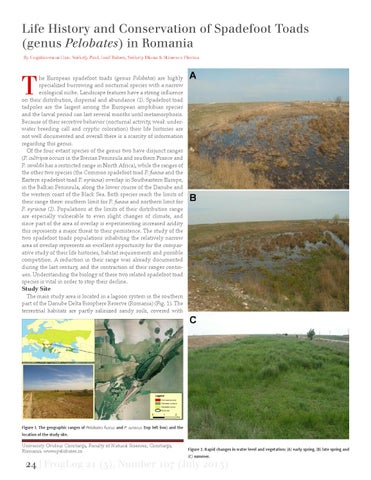
The main study area is located in a lagoon system in the southern part of the Danube Delta Biosphere Reserve (Romania) (Fig. 1). The terrestrial habitats are partly salinized sandy soils, covered with
Figure 1. The geographic ranges of Pelobates fuscus and P. syriacus (top left box) and the location of the study site.
University Ovidius ConstanĹŁa, Faculty of Natural Sciences, ConstanĹŁa, Romania. www.pelobates.ro
Figure 2. Rapid changes in water level and vegetation: (A) early spring, (B) late spring and (C) summer.
24 | FrogLog 21 (3), Number 107 (July 2013)
steppe vegetation, while wetlands are dominant (both temporary and permanent). The annual rainfall regime is low (350 mm) but the relative air humidity is high due to the extensive water bodies and the vicinity of the Black Sea. The extent and persistence of water bodies are extremely variable in the study area, depending on the Danube water flow, making the environment highly unpredictable (Fig. 2).
the youngest adults observed) was reached at a similar age. The two species experienced varying growth rates before and after reaching sexual maturity: males growth rate was higher before reaching sexual maturity in both species, but in P. syriacus growth rate continued at a similar rate even after reaching sexual maturity.
Figure 4. Male competition for females during reproduction in P. syriacus.
Figure 3. (A) Pelobates fuscus, (B) Pelobates syriacus.
Life-history Differences Between Spadefoot Toad Species
While there is little ecological differentiation between the two coexisting species in terms of habitat requirements and use, there are major differences in body size and sexual dimorphism. Pelobates fuscus is smaller in size and it shows a clear sexual dimorphism, with females larger than males, while P. syriacus is much larger in size with males slightly larger than females (Fig. 3). At metamorphosis the juveniles do not differ significantly in snout-vent length, but the ratio between the two species fuscus-syriacus decreases from 98% in metamorphs to 65% in adults. The changes in body mass are even more impressive, the ratio between fuscus-syriacus decreases from 89% in metamorphs to 24% in adults. We also found differences in the age structure of the syntopic populations: P. fuscus individuals were on average 5.0 years old (maximum age recorded 8), while P. syriacus were on average 7.4 years old (maximum age recorded 12), despite the fact that sexual maturity (i.e., the age of
We examined the adaptive value of interspecific variation in behavioural patterns, such as level of activity, since any type of movement includes trade-offs, in terms of energetic costs, exposure to predation and drought, but at the same time provides increased access to food. The nocturnal activity was monitored in a laboratory using webcams to capture time-lapse photographs of the toads’ movement, which were then used to obtain tracks for each individual. Our results showed that P. syriacus was significantly more active than P. fuscus with almost 2.5 overall distance covered and more than twice the speed achieved, but with approximately the same time spent outside burrows. This suggests that the species differ in patterns of foraging behaviour, P. fuscus being relatively sedentary (‘sit-and-wait’) whereas P. syriacus is a more active predator (‘widely-foraging’).
Reproductive Investment in Pelobates syriacus
We focused on the investment in reproduction in this species in an attempt to understand how resources are allocated to growth and reproduction and how the costs differ between males and females. Eastern spadefoot toads are explosive breeders, the reproduction lasting less than a week (Fig. 4). We found that in females body mass loss during mating and egg deposition averaged 27%, while in males it was 3.9%. Bigger females lost more weight than
FrogLog 21 (3), Number 107 (July 2013) | 25
smaller ones since they deposited larger egg clutches. The size of the egg clutches varied between less than 1000 to almost 6,000 eggs, with an average value of 2,800 eggs per clutch (3).
Adaptations to the Environment
The spadefoot toads have specific adaptations that mitigate the risks associated with inhabiting a highly variable and unpredictable environment. The persistence of water bodies varies largely between years, seasons and during a season, so the tadpoles are well adapted. In various controlled experiments, we found that tadpoles exposed to pond drying accelerated their development, managing to complete their metamorphosis before the water dried out. However, this reduction of the developmental time determined a smaller body size at metamorphosis. The response of the tadpoles was not influenced by actual water level, but by water level decrease rate. We also observed differences in the tolerance to salinity between the two species, with P. syriacus eggs and tadpoles having a higher survival rate.
Conservation Needs
The most serious threat to spadefoot toads in our study area is the reduction in the number and quality of aquatic habitats, mostly due to coastal development, coastal erosion and saltwater intrusion. The introduction of alien fish species that can tolerate low levels of oxygen (e.g. mosquitofish, goldfish, pumpkinseed sunfish)
represent an important threat to the survival of tadpoles. The recently reported range expansion of alien crayfish downstream the Danube represents a potential risk. Increased road kill mortality due to traffic intensification in the area represents an additional threat. Perhaps the highest threat to their survival is urban development, restricted now by the high protection status of the area. Many spadefoot toads populations are declining in the Black Sea coast region due to habitat loss. Although still abundant in our study site, they are nevertheless vulnerable. As long as human activities in the area are kept to the present level, no specific measures are required for the persistence of the spadefoot toads (Fig. 5). Acknowledgements Research in the area was possible thanks to the Danube Delta Biosphere Reserve Administration and the Ministry of Environment and Climate Changes of Romania permits. This work was supported by Romanian National Authority for Scientific Research, grant PN-II-ID-PCE-2011-3-0173. References 1. 2. 3.
A. Nöllert, Die Knoblauchkröte (Ziemsen Verlag, Wittenberg Lutherstadt, 1990). G. Džukić, V. Beskov, V. Sidorovska, D. Cogălniceanu, M. Kalezić, Acta Zoologica Cracoviensia, 48A, 1 (2005). D. Cogălniceanu et al. Copeia (in press).
Figure 5. Measuring spadefoot toads in early spring.
26 | FrogLog 21 (3), Number 107 (July 2013)
Aridification, Phenotypic Plasticity and the Fate of Mediterranean Amphibians By Urtzi Enriquez-Urzelai, Albert Montori & Gustavo A. Llorente
Fig. 1: Two snapshots of the same pond (Can Grau) in the Garraf Massif. (a) corresponds to November 2005, and (b) to July 2005. With climate change, the summer droughts as well as the rainfalls that fill the dried ponds are expected to be more extreme. This will certainly have a detrimental effect on Mediterranean amphibians. Photos: Albert Montori.
T
he aridification of the Mediterranean area is not a theory anymore; it is a reality. In the last few decades, a 1 ยบC average warming has taken place and it has produced an increase on the evapotranspiration. Without a parallel increase in rainfall, some authors have detected a progressive aridification. Moreover, further warming and aridification are forecasted over the coming decades (1). Lots of studies have modelled the climate in order to understand the impacts that climate change will have. Despite uncertainties, all models project a consistent tendency towards warmer conditions (1-6 ยบC increment depending on the model and the greenhouse gas emission scenario used) and less precipitation in the next century. In addition to average temperature increase, a greater occurrence of extreme hot events is expected (2). The pattern of precipitation is also expected to change (3) resulting in an increase in the incidence and severity of both drought and major storm events (4). These tendencies altogether will severely impact water availability. An increase of 2-4 ยบC in average temperature could reduce stream flow 4-21%. This, together with the expected precipitation decrease may result in losses of water availability up to 30% in the Mediterranean region. In this region as a consequence of the global change processes,substantial decreases in soil moisture and runoff are expected. By 2070 100-year droughts may happen every 10-50 years. In fact, water resource availability in the Mediterranean has already been affected by environmental, economic and demographic scenarios (2) (Fig. 1). The combination of temperature increase, less precipitation and an increase of water resource stress will produce, by the end of the 21st century, dry and arid lands of the Mediterranean region extending northward. The central and southern portions of the Iberian, Italian, Greek and Turkish peninsulas, parts of the southeastern Europe and the Middle East, northern Africa and the maDepartament de Biologia Animal, Facultat de Biologia, Universitat de Barcelona. Av. Diagonal, 643. 08028 Barcelona, Spain.
jor Islands (Corsica, Sardinia and Sicily) will be specially affected (2). Animal communities will accompany the geographical shift of the vegetation(there is some evidence this has already happened i.e., in Spain, 29 species of reptiles have expanded their ranges to the north). However, the shifts in ranges are geographically constrained in a lot of cases (e.g., the Cantabrian Sea and Pyrenees Mountains in the Iberian Peninsula) (5). Moreover, if we assume that other vertebrate groups, such as amphibians are low dispersal organisms (6), then their distributions are bound to contract, and some authors point out that some of them will become extinct.
Amphibians Directly Threatened
As we said above, temperature, precipitation and ultimately water availability will be affected by climate change. All these factors are known to condition amphibian reproduction and larval development and therefore, climate-induced changes in hydrology are potentially one of the biggest threats to most aquatic-breeding amphibians. Insufficient rainfall, extreme drought and/or shortened hydroperiods have been linked with (a) declines in anuran calling activity, (b) catastrophic reproductive failure in numerous pondbreeding amphibians, (c) metamorphosis at smaller body sizes, (d) the potential local elimination of paedomorphosis in salamanders, (e) local extinctions, and (f) changes on the phenology that may alter community dynamics, due to its influence on the outcome of competitive and predatory interactions (4, and references therein). Individual species within a community vary greatly in their hydrologic preferences. Some amphibian species show a clear preference for ephemeral, temporary or permanent water-bodies and other species are generalists that do not show a differential use of available water-bodies. These differences in hydrologic preferences are supposed to be reflected in the magnitude of developmental plasticity that each species can express. For instance, tadpoles of species that mainly explode temporary habitats show greater plastic responses in life history traits and a tendency towards a reduced larval period, compared to those occurring in permanent or pre-
FrogLog 21 (3), Number 107 (July 2013) | 27
dictable habitats. Developmental plasticity, environmental heterogeneity and habitat unpredictability are thought to be positively correlated. At the extremes of the hydroperiod range (predictably ephemeral or permanent) evolution may favour the development of specialist phenotypes with limited plasticity (fast developmental rates in ephemeral and slow developmental rates in permanent habitats) (7) (Fig. 2).
Fig. 2. Mean value and standard error of a given phenotypic trait for three species and two situations/habitats (A and B). Filled circle represents a specialist species which, regardless of the situation/habitat expresses the optimum value for the situation/habitat B (OB), filled inverse triangle illustrate a specialist species which expresses the optimum value for the situation/habitat A (OA) and empty square represent a plastic species that by means of phenotypic plasticity is able to express trait values close to the optimum in every situation/habitat.
Those strategies have evolved presumably slowly and gradually over “geological time.” Climate-change, though, is far quicker than this (8) and it is quickly changing the hydrological features of the Mediterranean basin. Therefore, species specialized in exploding permanent water-bodies that, besides, lack from a substantial phenotypic plasticity of life history traits, may be especially threatened. Thus, we believe that it is of uttermost importance to assess the magnitude and direction of plasticity in fitness-related traits in response to different environmental factors that each species show (6). Unfortunately, we ignore the breeding phenology, hydrologic preference and the magnitude and direction of plasticity of a lot of species.
for species that use permanent or predictable habitats for breeding. In addition to this, they report that species that inhabit permanent ponds tend to be prolonged breeders, opposed to species using ephemeral or temporary ponds, which are plastic (synchronizing their breeding period to rainfall episodes) and explosive breeders (Fig. 3). Based on the results of this study and since the patterns of precipitation are expected to change (3), we believe that the species with a fixed strategy may be more vulnerable to local extinctions than plastic species, that somehow will be able to adjust their breeding period with the new precipitation regime. A study conducted in the south of France (9) showed that seasonal winter–spring rainfall was associated with a decrease in extinction rates and an increase in colonization rates at individual ponds. Breeding was more stochastic in unpredictable and shallow ponds because of yearly drying up and in highly predictable and deep ponds due to the presence of predators. The authors demonstrated that ponds with intermediate rather than extreme variations in environmental conditions currently correspond to optimal breeding sites and they pointed out that amphibian monitoring coupled with fine-scale analysis of environmental conditions is necessary to understand species dynamics in the long run and to inform conservation efforts. This article is particularly interesting, since it assessed the idiosyncrasy that each type of pond has (based on hydroperiod) related to amphibian breeding success. In another paper (10) the authors managed to link the magnitude of phenotypic plasticity that each species could express and their preferred habitat type (ephemeral, temporary or permanent ponds). This was relevant, since they were able to validate the “adaptive developmental plasticity hypothesis.” They demonstrated species that use a wide variety of habitats or unpredictable environments show a greater plasticity (Fig. 4) and that at the two extremes of the hydroperiod (ephemeral and permanent ponds) occur specialist developmental phenotypes with limited plasticity. As we have said before, water availability will be reduced in the Mediterranean basin in the near future, and the evapotranspiration
Not Everything is Bad News
Although there is still a lot of work to be done, an extensive work body has focused on the phenology, differential use of available water-bodies and phenotypic-plasticity. For instance, a study has focused on the breeding phenology of an amphibian community in a Mediterranean area (7). They found that two species (Common toad [Bufo bufo] and Perez’s frog [Pelophylax perezi]) showed a relatively fixed reproduction date. The authors state that this strategy is suitable
Fig. 3. An egg clutch of the Natterjack toad (Bufo calamita). B. calamita is a plastic explosive breeder synchronizing its breeding period with the rainfalls. It uses ephemeral ponds where fast developmental rates have been selected to escape the risk of drying. Nevertheless, some clutches get exposed due to desiccation, what in turn leads to mortality, as we can see in the figure. Photo: Albert Montori.
28 | FrogLog 21 (3), Number 107 (July 2013)
be conducted. We know that species with low phenotypic plasticity, a preference for permanent ponds and low dispersal ability will be the most affected. Nevertheless we have to detect these species and study their requirements and limits. Once we have collected all the knowledge about all species’ plasticity, breeding preference and phenology, we will be able to accurately know how each species will be affected by global-change. This information will be invaluable to establish conservation plans. These conservation plans may contain specific measures to actively counteract the effects that climate-change may have on each species. For instance, we might be able to build man-made wetlands with the specific hydroperiod the species needs (particular to that area). Finally, we want to send a positive message. As we have repeatedly said, there is still a lack of knowledge but abundant research work is being carried out. The amount of scientific literature on amphibian phenotypic plasticity of life history traits in front of distinct environmental factors is growing year to year. Hopefully, in a few years we will be able to accurately predict the effects that climate-change will have on amphibian species. That may require plenty of work but the herpetologists (us) are committed to amphibian conservation. Acknowledgements We thank Eneko Aspillaga for useful comments on the manuscript.
Fig.. Species such as (a) the Common parsley frog (Pelodytes punctatus) and (b) the Mediterranean tree frog (Hyla meridionalis) use a wide variety of habitats, while typically breed in temporary ponds. These species’ tadpoles show a great plasticity in life history traits and a tendency towards a reduced larval period (10). Photos: Albert Montori.
will be higher. Therefore, the response of each species’ tadpoles to pond desiccation will be crucial for its survival. In a recent paper, the authors evaluated the response to pond desiccation in tadpoles of the Painted frog (Discoglossus pictus) (a north African native species, invasive in northeast Spain and south France) (11). They found that D. pictus accelerates its developmental rate when facing desiccation. Although this response was determined by food availability, the larval survival of D. pictus was very high even with scarce food. If we bring this study to the framework that we have developed through this article, we may expect D. pictus not to be challenged by the new hydrological conditions that climate-change will impose.
Generating Knowledge to Preserve
But, is all the knowledge presented in the previous section available for every Mediterranean species? Of course not. Extensive studies on breeding phenology and specific experiments focused at disentangling the magnitude of plasticity of each species should
References 1.
P. Riera, J. Peñuelas, V. Farreras, M. Estiarte, Ecol. Appl. 17, 91 (2007).
3.
M. Castro, J. Martín-Vide, S. Alonso, El clima de España: Pasado, presente y escenarios de clima para el siglo XXI (Ministerio de Medio Ambiente, Madrid, 2005) pp. 1-64.
2.
4. 5. 6. 7. 8. 9.
J. M. García-Ruiz, J. I. López-Moreno, S. M. Vicente-Serrano, T. LasantaMartínez, S. Beguería, Earth Sci. Rev. 105, 121 (2011).
S. C. Walls, W. J. Barichivich, M. E. Brown, Biology 2, 399 (2013).
G. Moreno-Rueda, J. M. Pleguezuelos, M. Pizarro, A. Montori, Conserv. Biol. 26, 278 (2011). M. Tejedo et al., Clim. Res. 43, 31 (2010).
A. Richter-Boix, G.A. Llorente, A. Montori, Amphibia-Reptilia 27, 549 (2006). G-R. Walther et al., Nature 416, 389 (2002).
H. Cayuela, A. Besnard, A. Béchet, V. Devictor, A. Olivier, Freshwater Biol. 12, 2629 (2012).
10. A. Richter-Boix, G.A. Llorente, A. Montori, Evol. Ecol. Res. 8, 1139 (2006). 11.
U. Enriquez-Urzelai, O. San Sebastián, N. Garriga, G. A. Llorente, Oecologia (2013), doi: 10.1007/s00442-013-2596-9
FrogLog 21 (3), Number 107 (July 2013) | 29
Urban Amphibians and the Challenges they Face: Connectivity of a Small Community of Amphibians During Spring Migration in Leeuwarden, the Netherlands
A male common newt (Lissotriton vulgaris) crossing the bicycle path in the Potmarge. Photo: Tariq Stark.
By Carlijn Laurijssens & Tariq Stark
I
n the spring of 2011 we walked alongside the river Potmarge, a these dead amphibians was not acceptable, being next to a “green� small nature area in the center of our hometown Leeuwarden. university (Van Hall-Larenstein University of Applied Sciences). Therefore we organized a projOur University is also loect to save these amphibians. cated in this area. Unfortunately Our goal was to safely transfer for the local amphibian commuthe migrating amphibians in nity, which is comprised of five this area from one side of the species (Lissotriton vulgaris, Bufo cycle path to the other. It was bufo, Rana temporaria, Pelohylax also a great chance for students ridibundus and Pelophylax klepton to experience fieldwork with esculentus) a cycle path lies across amphibians while earning some in the middle of this area. Durcredits at the same time. A proing their spring migration amfessor of the university had conphibians have to cross this path nections with the municipal of to reach their breeding waters (a Leeuwarden and they supplied small canal and pond close to the us materials and manpower. river). We have recently noticed a lot of dead common newts run Year One over on this path, crushed by biOur method consisted of a cycles. This gave us the idea for transect which was approxia new project. mately 120 meters long with Although the amphibians Tariq holding a common newt and common toad. Photo: Carlijn Laurijssens. drift fences set up on both sides in the area of Leeuwarden are of the path; this method is being protected by law, nothing was being done to reduce the number of used a lot in the Netherlands and other West European countries. amphibian deaths due to cyclists. Also we thought the presence of A pitfall trap (bucket) was dug in every five meters. In the buckets
30 | FrogLog 21 (3), Number 107 (July 2013)
species, sex and life stage were recorded on a field datasheet along with temperature, weather condition, morning or evening, date and cloud cover. One person collected all the data and put it in a datasheet and on the website http://www.padden.nu. On this website you can construct a daily bar chart and see how the migration is progressing. In addition the field protocol and other information concerning the project was compiled into a document which is updated regularly. During the morning and evening round we received a lot of posi-
The transect in the Potmarge. The city centre can be seen on the background. Photo: Jeroen Breidenbach.
A bar chart constructed during a period in April on the website www.padden.nu from the Dutch Reptiles, Amphibian and Fish Conservation. Chart from http://www.padden.nu/ Werkgroepen/Friesland/Leeuwarden/tabid/278/Default.aspx
Part of the transect. The drift fences were decorated this year! Photo: Jeroen Breidenbach.
tive reactions from people from the neighborhood. Some of them wanted to help or told us that their children would love to help out. Most were not even aware of all these wonderful creatures in their own backyard! Not only did we get positive reactions from people who walked by but also from the local media. We did not expect this at all! But it was very nice to have such media attention (newspaper and websites) which led to a different important goal. This goal was to inform people of these beautiful creatures so they would learn about them and maybe pay more attention to them. The reactions of most people were that they did not know about these amphibians in the Potmarge and they will pay more attention now when they walk or cycle through the Potmarge. The final tally for the first year was 539 animals: 285 L. vulgaris, 15
Close up of the drift fence and one of the pitfall traps. Photo: Tariq Stark.
holes were bored for drainage, as rainfall is high in this area and ground water levels rise quickly. Soon it became obvious that hibernation sites were mainly located along the edges of the river and the animals migrated towards the smaller bodies of water. The animals walked against the fences and fell in the buckets. Twice a day volunteers (mostly students and friends) checked the buckets (between 07.00-08.00 and 21.00-23.00) for animals and transferred them to the other side of the path. For each individual captured
Jeroen Breidenbach giving an TV interview for a local TV station, Omrop Fryslan. Photo: Tariq Stark.
FrogLog 21 (3), Number 107 (July 2013) | 31
P. klepton esculentus, 4 P. ridibundus, 18 R. temporaria and 217 B. bufo. Along the transect there were very few DOR’s but outside of the transect there were many. We did not have the equipment or manpower to seal the whole path. However, our transect is a hotspot and many animals reached their breeding waters safely.
Year Two
This year we had more time to organize the project. In the first year we had just a handful of volunteers, mostly friends of ours, but this year we had more than 50 volunteers, most of them were students. We were also aided in the coordination by a very enthusiastic and skilled fellow student: Jeroen Breidenbach. We were delighted to see that other students took coordination tasks on themselves. In years to come we will not be around but the project must go on! The document with the field protocol and all the other data will serve as a guideline for years to come and this year it was updated as well.
Carlijn holding a sub adult toad in the Potmarge. The Van Hall University of Applied Sciences can be seen in the background. Photo: Tariq Stark.
Carlijn Laurijssens and Ronald Brugge swabbing a frog for chytrid. Photo: Tariq Stark.
Tariq Stark and Jeroen Breidenbach swabbing a frog for chytrid. Photo: Carlijn Laurijssens.
Not all of this year’s volunteers had experience with amphibians or fieldwork to begin with. This is why we set up a training program for these students to give them information regarding the fieldwork, protocol and the species they would encounter. Last but not least: how you take skin swabs for chytrid (his was a new part of the project)? We are currently participating in an ongoing research project investigating chytrid (organized by the Dutch Reptile, Amphibian and Fish Conservation Society). In 2009 we sampled for chytrid in our hometown but not a trace was detected. The absence of a pathogen like Bd. is often very hard to proof. Sample size, for example, can contribute to this. Therefore we have sampled again in the Potmarge (and several other locations in our province). During spring migration it is easy to find lots of individuals and we could take the appropriate amount of samples (> 30/species). Although we had a rough start this year because of the very cold weather and consequently cold spring the volunteers transferred approximately 700 animals. This year we received a lot of attention from the public and the local media! We were interviewed by the local news paper (Leeuwarder Courant) and a local broadcasting channel Omrop Fryslan (a TV and radio interview). The city of Leeuwarden put a nice article about us on their website. To top it all off, we were nominated for an award for most “green” and innovative student idea for this year and by our University. Of course this is not a new idea but never before has it been utilized to train wildlife management students with fieldwork concerning amphibians. Not only were we nominated but we also won! We received an award and 750 Euros. We are going to invest this money in the project. We need new drift fences and we wish to extend the transect. During the whole
32 | FrogLog 21 (3), Number 107 (July 2013)
activity period a lot of the local amphibians fell into sewer drains and starved. We intend to also help them out with so called “frog ladders”. This ladder is placed in the sewer drain so that frogs, toads and newts can climb out themselves. This idea has received a national award in Holland in 2012 (Water Innovation Award). We are again nominated for another award in our hometown. Awards aside, the most important thing is to continue the work every spring and create more awareness for these amazing little creatures in our hometown!
Future
We hope the project we have initiated will become an integral part of a course at our university and that students, and hopefully people from the neighborhood, will continue what we have started. One aspect that would be great for next year is to see some volunteers from the neighborhood participating in the project! We make regular updates on Facebook page (Potmarge Amphibian Connectivity Project: a Closed Group mostly intended to coordinate our activities and is almost entirely in the Dutch language.) and on www.tariqstark.com. Acknowledgements We would like to thank Marcel Rekers and Martijn van der Ende from the University. The city of Leeuwarden and especially the ecological maintenance group led by Gilberto Squizatto were essential for this project. Our fellow coordinator from this year, Jeroen Breidenbach, was a tireless force; we could not have done without him. Last but not least a big thanks to all the volunteers! Without you guys, there would be no project!
We won the VHL Golden Globes Award for the most innovative and “green” student project that is self initiated. From left to right: Bridget Maste, Jeff Peereboom, Karen Schors, Koen van Lieshout, Jeroen Breidenbach, Tariq Stark, Carlijn Laurijssens and Merel Zweemer. Photo: Ronald Brugge.
A map of the river Potmarge. The area in the red outline is the project area. Google maps.
FrogLog 21 (3), Number 107 (July 2013) | 33
Two lucky amphibians (a common newt female and a sub adult common toad), although they don’t seem to agree, ready to be safely transferred. Photo: Tariq Stark.
An amplectant pair of Rana temporaria making their way to the breeding water. Photo: Tariq Stark.
34 | FrogLog 21 (3), Number 107 (July 2013)
WWF’s Program for Amphibian Wetlands in Finland By Timo Paasikunnas
T
he global decline in amphibians has been raised as an important topic in both the herpetological world and in the global media. The main reasons for the declines are as a result of human activities such as civil engineering and agriculture, which results in total or partial loss of habitat. Ecological corridors have been lost or reduced in size and ecosystems have become polluted. It is possible to mitigate these situations by planning and implementing restoration or creation of wetlands. This is what was started in our study site within the Loviisa River, eastern Uusimaa, Finland.
Survey of wetlands
Over the past five years, the WWF has created more than 30 wetlands in Finland. As part of the Wetlands Project, WWF devised a wetland and biodiversity plan for the Loviisa River, where agricultural water bodies are useful for helping biodiversity and water protection. The Ministry of Agriculture and Forestry (MMM) operate as a financier, and the Centre for Economic Development, Transport and the Environment (ELY) administer the delivery of the plan. WWF Finland has been conducting practical work and delivery of the plan with farmers and landowners. Project navigators are delegates of the municipality of Lapinjärvi and Loviisa, officers and of course farmers from the area of Loviisa River. Work in the drainage basin of the river identified important habitats both for amphibians and reptiles. Base surveys using long term amphibian and reptile research projects in the area were used in gaining initial information.
Amphibians in Drainage Basin
The Loviisa River drainage basin has diverse amphibian and reptile populations. Few of the amphibians are native to Finland. The species which occur are: Common frog (Rana temporaria), Moor frog (Rana arvalis), Common toad (Bufo bufo), Common newt (Lissotriton vulgaris) and Northern grested newt (Triturus cristatus). Except for the Northern crested newt, all the remaining Finnish amphibian species live in the Loviisa River drainage basin. The Common frog and Common newt are able to breed in temporary waters, ditches, stretches of rivers, streams and pools of melting snow. The Moor frog and Common toad both prefer wetter areas as opposed to the other Finnish amphibian species. Moor frogs breed mainly in the permanent water in Finland, mostly in sphagnum bogs, damp fields and meadows, around lakes and ponds in coniferous woods and in the sound of the Baltic Sea. Common toads breed more often in ponds within woodlands and tend to use permanent water, especially the primary ponds and lakes. Both the eggs and larvae of Common toads are distasteful, so they are able to thrive in fish ponds.
explosive breeders.. In the summer we surveyed usable summer habitats and estimated movements between different populations. In the autumn we surveyed possible hibernacula and investigated the timing of hibernation. These surveys were part of the larger research project which was to estimate the density of amphibian populations in Finland and examine their ecology.
What is good wetland and how to recognize and care those for amphibians?
Water bodies should be a stable environment, because this is of benefit for amphibian populations inhabiting temporary water bodies. It is important to consider the behavior of species outside the breeding season, which is very short in Finland, with Moor frogs only spending 1-2 days breeding during the spring. Not only are good water conditions important, but terrestrial habitats close to the ponds should be considered carefully. Careful planning for the annual cutting of vegetation is important especially if these are being used by amphibians during their active season. In addition, landscape ecology should be a part of planned wetland work as roads and cultivated lands can be a barrier to amphibians. Other species of bird, mammal and invertebrate should be considered, especially with totally new wetlands. Pond Risk Assessments are an important part in the planning of wetlands. Timing of pond restoration or creation of new ponds should be considered carefully. The best time for work in Finland is late summer or autumn. These kinds of careful planning help wetlands and offer a viable environment each year and provide a diverse environment.
The Present and Future
In the first newly created wetland we counted several spawn of frogs. Surveys are continuing and in the autumn we are looking for the hibernation places of frogs and studying their ecology. We also plan new, or restoration of wetlands, projects and are continuing metapopulation research in the Loviisa River drainage basin. Planned work by the WWF aims to enhance and create new wetlands where amphibian research can be conducted. The total area of the Loviisa River drainage basin is about 210 km2 but WWF surveys are mainly focused on agriculture and nearby areas. There is a possibility of establishing a new buffer strip along the 30 km shoreline of the river. Benefits of a wetlands and buffer strip is all-round protection including reducing flood risk, reducing surface run-off to river, nutrient provision and to mitigate eutrophication. All these works will benefit people who live near the river as well as the amphibians and ecosystem. The future is looking very good because farmers and landowners are really interested in the work and are being very positive toward restoration work. There is a team spirit of scientists, field workers, engineers, farmers, landAmphibian Surveys in the Drainage Basin Clean water bodies for amphibians can be found in the Loviisa owners, digger workers and all who want to help the diversity of River drainage basin and even particular species, such as the Moor nature, which has been great in this project. frog and Common toad, can be found there. The terrestrial habitats Acknowledgements are important for amphibians (after metamorphosis) for nutrient I would like to thank Alina Kallio, my spouse and colleague (Helsupply and providing damp resting places. Without a suitable terrestrial habitat a good pond is not very valuable. Surveys include sinki Zoo) for her help in the field. Also thanks go to our neighbor, many of the smaller water bodies from wooded and agricultural Thomas Nyqvist, for his many reptile and amphibian observations, areas and one of the larger coniferous ponds and its wide peat- and every landowner whose area was studied. Lastly, I would like to thank WWF and Elina Erkkilä (Conservation officer) who was a covered area (blue Rana arvalis pic). We conducted surveys mainly in the spring, because frogs are part of this wonderful program and her comments for the text.
FrogLog 21 (3), Number 107 (July 2013) | 35
Successful Breeding of Neurergus kaiseri in the Gerhart-Hauptmann Secondary-School Gelsenkirchen, Germany By Peter Bartsch & Peter Janzen
S
ince summer 2009, pupils of the Gerhart-Hauptmann-Secondary-School have been attending amphibian breeding projects at different zoo organizations in the German speaking area (Germany, Switzerland, Austria). The impressive Iranian Harlequin Newt (Neurergus kaiseri) has been kept at the school. A team was launched which includes 24 pupils, aged between 11 and 17 years. They meet with their biology teacher twice a week in the afternoon, during breaks every day and regularly during school holidays. During this time the newts are fed, different parameters are measured and observations of behavior are noticed. All parameters are analyzed by different software. The school team obtained six adult and captive bred Neurergus kaiseri from the zoo in Riga, Latvia. This was organized by Peter Janzen, organizer of the amphibian breeding project in the German speaking area. At the beginning of 2013 the pupils bred Neurergus kaiseri successfully. The breeding conditions of Neurergus kaiseri were as follows. The pupils started by setting-up an aqua terrarium (120 cm (L) x 60 cm (W) x 80 cm (H)) for the newts. The water-level was about 20 cm; the ground terrestrial section consisted of bricks and peat with drainage of foamed clay. The pupils arranged several hiding places with bark made of oak cork. The bottom of the water section consisted of small gravel. The water inside the aqua terrarium was cleaned by two filters and half of the water was changed once a week. The aqua terrarium was illuminated by a 24 watt T5 neon tube. The pupils fed the newts with Gammarus, red mosquito larvae, water fleas, earthworms, slugs and the larvae of wax moths. The first pair bonding was recognized at the beginning of December 2012. At that time the water parameters were: ●● temperature between 19 and 22 °C ●● total hardness 8°dH ●● electrical conductivity 490 µS/cm ●● pH 8
Under these conditions the pupils found the first larvae of the newts in January 2013. All together 12 larvae were found and separated in a different aqua terrarium (80 cm (L) x 35 cm (W) x 40 cm (H)). The water-level was approximately 16 cm. The bottom consisted of small gravel. This aqua terrarium was illuminated by a 10 watt T5 neon tube. The breeding of the newts took place under the following conditions: ●● temperature between 19 and 22° C ●● total hardness 7-8°dH ●● pH 7-8 ●● nitrite <=0.02 mg/l The larvae were fed small Artemia and later, water fleas, red and white mosquito larvae and grindal worms. Only live food was given. In the middle of May the larvae came into metamorphoses. The pupils made photos and film sequences of the pair bonding and the development of the larvae. Both were used for presentations. The next step will be the exchange of the raised newts with a zoo or a private breeder integrated into the amphibian breeding project. The pupils of the Gerhart-Hauptmann-Secondary-School made their contribution by increasing their knowledge of the breeding of Neurergus kaiseri. They supported the educating of the public of the amphibian crisis by writing articles, giving presentations and lectures.
36 | FrogLog 21 (3), Number 107 (July 2013)
The Herpetologists' League
EE Williams Research Grant The Herpetologists’ League is pleased to announce competitive grants for graduate student research for 2013. These awards are named in honor of the late Ernest E. Williams, the first Distinguished Herpetologist of The Herpetologists’ League.
Overview 1. An award ($1000.00 maximum amount) will be presented to one winner in each category: Behavior Conservation Ecology Physiology Morphology/Systematics 2. See HL web site for application form, complete rules and details: http://www.herpetologistsleague. org/dox/eewilliamsgrant.pdf. 3. Entries must be received by 5 PM Mountain Time on 15 December 2013. 4. Send complete application (cover page, proposal, budget, CV,) as a single PDF electronically to: Ann Paterson at apaterson@wbcoll.edu. Please put “EE Williams Research Grant” in subject line. 5. One letter of support should be sent, preferably by e-mail, directly by the supporter. 6. Proposals will be reviewed by at least two professional scientists, who will provide written feedback by April 2013. 7. Funding dispersed in April 2013 and winners announced at the Herpetologists’ League Business Meeting in Albuquerque, New Mexico, 2013.
Rules – please read, the rules have changed from last year 1. The applicant must be a member in good standing of The Herpetologists’ League. 2. The applicant must be registered and in good standing in a degree-granting program (M.S. and Ph.D. candidates eligible). 3. One proposal per applicant per year. 4. Project must be original work, authored and conducted by the applicant. 5. Projects that are already fully supported by other sources are not eligible. 6. The proposal category must be clearly designated. However, HL reserves the right to judge proposals under a category different
Photo: David Herasimtschuk.
from that requested based on evaluation of the subject matter and the number of proposals received in each category. 7. Previous winners are NOT eligible for the award in subsequent years. 8. A short report (2 pg) summarizing the results of the project and a reprint or .pdf of any publication arising from the project is due to secretary of HL when available.
Preparation guidelines (see web site for more details) 1. Word limit: 1200 words not including citations, budget, cover page or CV. 2. Double spaced, 12 pt font. 3. Margins: 1 inch. 4. Include the cover page provided at the HL website. 5. Include a detailed budget, as well as sources and amounts of current and pending support. 6. Clearly designate the proposal category on the cover page. 7. Arrange in advance for one letter of support to be sent separately by the supporter. 8. Include a two-page CV that includes telephone, e-mail and mailing addresses.
FrogLog 21 (3), Number 107 (July 2013) | 37
Awareness and Citizen-based Initiatives in Madagascar Boost the Conservation of its Endemic Amphibians By 1Franco Andreone, 2Falitiana Rabemananjara, 3Nirhy Rabibisoa, 4Harilala Rahantalisoa & 4Joseph Marcel Rakotondrasoa
Fig. 1. The carnival on the occasion of the “Tomato Frog Festival” in Maroantsetra.
T
he activity of the IUCN SSC Amphibian Specialist Group (ASG) Madagascar has been constantly improved in the last years through a series of actions, including field research, implementation of the technical support to Malagasy Protected Areas, establishment of a website (www.sahonagasy.org) and wide collaborations with other stakeholders. Among the other things some projects were also the object of special attention and included extended awareness and citizen-based initiatives. Talking about amphibian conservation is not an easy task, and this is especially valid in a country, like Madagascar, which is chronically affected by economic and political problems, and where daily subsistence is obviously the priority task for the majority of inhabitants. Discussing about the conservation of the approximately 300 described endemic frog species (and many other still undescribed ones) may appear somehow provocative when facing basic 1
Museo Regionale di Scienze Naturali, Via G. Giolitti, 36, I-10123 Torino, Italy; email franco.andreone@gmail and franco.andreone@regione.piemonte. it. 2SCAM (Societé pour la Conservation des Amphibiens à Madagascar) Sahonagasy, Lot II 12 CN Ambohimirary, Antananarivo 101, Madagascar, e-mail: frabemnjr@gmail.com 3University of Mahajanga, B.P. 652, Faculté des Sciences Campus Ambondrona, Mahajanga 401- Madagascar; email: nhcrabibisoa@gmail.com 4Vondrona Ivon’ny Fampandrosoana: Lot MB 397 Mahabo Andoharonofotsy, Antananarivo 102, Madagascar; e-mail: soahary@yahoo.fr
and urgent health, alphabetization and development needs. But it is also evident that the conservation and valorization of Madagascar’s extraordinary biodiversity are among the main directions and opportunities to generate economic and welfare revenues. Amphibians are among the most astonishing organisms in Madagascar, with an exceptional diversity and species richness: explaining and divulgating why this frog diversity is so important to highlight the environment conservation is a mandatory task and a great defy for all the conservationist community. The activity in terms of awareness increase and sensibilization has been quite intense for the ASG, whose members recently also associated themselves in an independent association, named SCAM (Societé pour la Conservation des Amphibiens à Madagascar) Sahonagasy (“sahona” means frog in Malagasy, and “gasy” is an abbreviation for “Malagasy”). Beside the publication of a series of popular booklets, written in several languages, including Malagasy (1, 2) some general events, addressed to the general public, were organized in the last years at several locations, sometimes structured as celebrative events. Here we resumed the most relevant ones.
38 | FrogLog 21 (3), Number 107 (July 2013)
Celebration of the Tomato Frog Festival iin Maroantsetra
On 13 and 14 June 2009, ASG in collaboration with the Madagascar Fauna Group organized a celebration of the Tomato frog, Dyscophus antongili, a colorful living in the town of Maroantsetra, NE Madagascar. This was the first celebration dedicated to an amphibian within a town and not within pristine (or presumed so) forests. This was done on the occasion of the inauguration of the “Tomato Frog Village” which aims protecting some of the most relevant frog populations in Maroantsetra (3). More than 800 persons participated, including a march through town. The “College Zanatany Maroantsetra” hosted the event, with lots of enthusiasm. The weekend program included “frog races”, drawing competitions,” frog calls and traditional dancers disguised in frogs (Fig. 1). th
th
The amphibian conservation project in Ankaratra
The project carried out on the Ankaratra Massif is aimed to safeguard the threatened amphibian species living there, including two micro-endemic and Critically Endangered montane stream frogs Boophis williamsi and Mantidactylus pauliani (4). This project started on 2010 for three years at the first stage and we hope to continue the surveys for the next five years to insure that the conservation activities have positive impact on these species. Most of the activities are currently under the umbrella of the mayors of Tsiafajavona Ankarata and Sabotsy Namatoana villages, including eight chiefs of local Fokontany (basic administration unit of the municipality), local-based population Association called VOI (“Vondron’Olona Ifotony”) and the forestry agents. As consequent fallout, the impact of the conservation program on local communities lowered illicit logging and charcoal exploitation. The people that make the major destruction of the forest are still not sensitized. In the Ankaratra Massif, the well-known political events of 2009 and turmoil accelerated the habitat degradation touched large parts of the exotic pine forest planted for the protection of hills’ crests and slopes. Luckily, large parts of the original altitude rain-
forests are still intact and permit the refuge of the amphibians. In terms of public awareness, the VIF (Vondrona Ivon’ny Fampandrosoana) association realized some leaflets written in Malagasy dealing with the local extraordinary biodiversity, the environmental degradation and the need of restoration activities involving all the stakeholders, especially the local based Association called VOI. These leaflets were distributed to the local populations and schools after sensitizing made by the forestry agents and VIF responsibles. Finally, some celebrations called hiragasy (Malagasy traditional songs and talks) have been organized on 22nd September 2012. The theme of these encounters dealt with the environmental protection and the biodiversity, coping with the traditional cultures and beliefs which are still very important at this area. Three groups of Malagasy traditional singers (or “Mpihira Gasy”) showed their talents provoking the public enthusiasm when hearing them talking about the presence of the “elders” who are the main protectors of the traditional habits and customs, the biodiversity and especially the threatened Amphibians Boophis williamsi and Mantidactylus pauliani (Figure 2). The local involvement concerns the patrol led by the “elders of the massif” (named “Ankaratra Tsy Rava Fenitra”) and the Forestry and Environmental Survey Committee called KASTI (“Komitin’ny Ala Sy Tontolo Iainana”). Each survey consists of looking at all the illicit practices and sensitizing of the people.
Saving the Harlequin Mantella in Antoetra Region
The Antoetra site named Fohisokina (or Vohisokina) is one of the most important locations of the rare and Critically Endangered Harlequin mantella, Mantella cowanii. Until 2003 this anuran was regularly exploited for the international pet-trade and subject to illegal trade after this period. Conservation International (CI), ASG Madagascar, Man and the Environment (MATE) and local community-based association “Fohisokina Miaro ny Sahonamena” collaborated in the last decade for the species and habitat conservation by realizing the first protected area for M. cowanii. Thanks to implementation of public awareness and local population involvement, significant results were achieved on the species and habitat conservation. As an example, illicit bushfires are virtually absent in the Fohisokina core area and the collection of species collection has stopped. Patrol and monitoring are still being done by local community-based trained people with the direct implementation of ASG and MATE through financial support of CI. In such a context, many communication and awareness tools were used to augment public consensus, mainly focusing on conservation of M. cowanii and its meaning for local communities and nearby habitat. Moreover, the major target of this action was to sensitize local population about the importance of this species in terms of endemism and tourist increase. These were some of the major events done to support the M. cowanii project: (a) in 2008 - durFig. 2. A group of local guides of Soanierana is singing about the importance of the environment and the biodiversity ing the “Year of the Frog” - M. cowanii was used inside the Ankaratra massif, narrating the history of the CR species Boophis williamsi and Mantidactylus pauliani.
FrogLog 21 (3), Number 107 (July 2013) | 39
the zebu. as a nature flagship (i.e, realizCurrently in 2013, no collecing dedicated stickers, leaflets, tions, no gold mining, no fire are etc.); (b) a “joro” (a traditional present in M. cowanii habitat. Due benediction to invoke the “rato our effort and all stakeholdzana”, the ancestors) was celers during the last three years all ebrated in 2010 to protect Foof the people around Fohisokina hisokina sites against evil and even though the town of Ambosibad luck and a festival with all tra are aware of the presence of M. stakeholders was subsequently cowanii in his region. done; (c) three thousands popular leaflets were published in French, Malagasy and English, illustrating the species, its morphology, biology, distribution and its ecological value and the conservation programs; (d) 1,000 booklets dealing about Fig. 3. A traditional benediction to invoke ancestors and get acceptance from all local the history of Fohisokina were stakeholders to conserve the Fohisokina site. realized and distributed to local schools (5); (e) 200 tee-shirts were branded and dispatched to References local communities (Figures 3-4); (f) several explicative panels were 1. F. Andreone, M. Bungard, K. Freeman. Ireo sahona tandindomin-doza eto placed in a frequented places (i.e., Office of the Rural Commune Madagasikara (Museo Regionale di Scienze Naturali, Antananarivo, 2009). 2. F. Andreone, M. Bungard, K. Freeman. Amphibiens menacés de Madagascar of Ivato, fairs, hotels in Antoetra and in Fohisokina); (g) footage (2ème edition). (Museo Regionale di Scienze Naturali, Antananarivo, 2008) showing the activities and conservation effort done in Fohisokina 3. Anonymous, Eighth Continent Quarterly. The Newlsetter of the Madagascar was distributed to Malagasy broadcasting radio stations, national Fauna Group (Summer 2009), 4 (2009). TV channels and daily newspapers. 4. M. Vences, F. Andreone, F. Glaw, N. Raminosoa, J. E. Randrianirina, D. Vieites, Italian Journal of Zoology, 69, 263 (2002). Further example of the impact results of such a sensibilization 5. N. Rabibisoa. Ny ela manova raha (Conservation International, Antananarivo, evenst was if a bushfire occurred around the site all of the commu2011) nity rush to help put out the fire. The bushfire is especially accident cause to supply the new germination of the herbs for the food of Fig. 4. T-shirts with the logo depicting the Harlequin mantella.
40 | FrogLog 21 (3), Number 107 (July 2013)
Ngome Forest, Kwazulu-Natal, South Africa: Long Term Survey of Amphibians
By 1Timo Paasikunnas and Alina Kallio
T
he Ngome Forest (Ntendeka Wilderness Area) of KwaZuluNatal, South Africa, covers 5230 ha, of which 2636 ha is indigenous forest and 2594 ha is grassland. Indigenous forests cover only 0.3 % of the South Africa, in addition the Ngome Forest is relatively isolated making it of particular interest. Ngome Forest contains numerous streams, cliffs, waterfalls, deep valleys and grasslands resulting in a wide variety of microclimates throughout the area. The forest is located in a summer rainfall zone. The forest is a combination of inland tropical forest and mist belt mixed Podocarpus forest. The habitat is excellent for many species of amphibian and other animals. Despite many excellent herpetological studies in South Africa, the Ngome Forest still has many opportunities for advancements in ecological knowledge. Long term ecological research of amphibian and reptile diversity is being conducted by the authors with a goal of providing a combined research model focused on forest habitat conservation and herpetological research. Knowledge of forest ecosystems is an important part of amphibian research.
mum group size of 12. Some forest trails are difficult to traverse, while many others are as wild as the forest itself. Trails are kept to a minimum and the net result of this management strategy is a reduced disturbance on nature. A deep valley, as well, gives a good and secure place even for bigger mammals to live without human impacts. Facilities are available for visitors at camping sites; showers, flushing toilet, rain-water tank (tested by author), wood and braai are also available. Campsites are in need of reconstruction and/or remodeling to better accommodate visitors. Camping in the forest, despite these imperfections, is still a wonderful experience (waking to the morning sounds of Samango monkys or Trumpeter hornbills duets, when you are taking an ice-cold shower, after a night excursion of frog hunting, what could be better?)
Recreational use of forest
Forty-five kms of trails exist in the forest with many paths lead to breathtaking view points. Hikers and nature lovers alike are important to forest conservation efforts even if at first this sounds paradoxical. It is important to think strategically when planning educational and marketing activities for forest conservation. Visitor numbers are considered carefully in an area so that they won’t cause unnecessary negative impacts on the forest. The Ngome Forest area restricts visitor numbers to 24 per day and with a maxiHelsinki Zoo; 1timo.paasikunnas@outlook.com
FrogLog 21 (3), Number 107 (July 2013) | 41
Field survey
Our herpetological surveys have been completed three times to date: 2008, 2011 and 2013 and we are trying to include different modern methods with the broad conservation needs of the forest in mind. Survey duration last between two to three weeks with several overnight camping trips in to the forest. Our work is based on Visual Encounter Surveys (VES) at different times throughout the day and night. Work is undertaken by walking and surveying every habitat, that looks suitable for amphibians; particular attention is given to stream habitats, searching carefully because of the great diversity of amphibian species in this habitat. Habitat type is recorded for each species found along with a photograph and standard measurements when possible. All observations are marked using GPS or using traditional paper maps and include a description of microhabitats and vegetation characteristics. In Finland we have conducted similar research with Glass lizards (Anguis fragilis). One method for studying “edge effects� is with the use of pitfall traps and drift fences. Edge effect research is indeed an effective way to observe species in the field. In ecotones amphibian diversity is often wider and our goal was to find out how much edge effect impacts amphibians. In 2013 our study was conducted in late summer and it is true that results are not yet very prolific due to this timing. A repeat of the study has been planned for December 2013. Field surveys have now covered approximately one third of the forest and there are still many areas that require further examination. During the March 2013 field trip we started working in the south-west side of the forest. That area is less disturbed than the north-east side, where the campsite is located and most our work has been conducted. Butterflies and other invertebrates are recorded during survey work when possible and results sent to African colleagues and specialists (SABCA South African Butterfly Conservation Assessment and SANSA South African National Survey of Arachnida). Reptile observations made will be added to SARCA, South African Reptile Conservation Assessment but checking almost 55 000 photographs
takes time! Ngome Forest also has a great diversity of epiphytic orchids which we are recording when possible. Larger mammal observations have mainly been done using camera traps on animals trails or photographing tracks, especially cats (Felidae) and to help shed further light on some of the those secretive species living in Ngome Forest. Acknowledgement We would like to thank our funder, Friends of the Helsinki Zoo for supporting our work. Helsinki Zoo has kindly given the authors time to conduct a month of work in South Africa and helped with logistics when working in Africa. Dr. Krystal Tolley and Dr. John Measey at SANBI provided helpful comments regarding the research and Adrian Armstrong, Ezemvelo KZN Wildlife, supplied valuable information and contacts which have made this research possible. Graham and Coleen Root who helped us with accommodation in Ntibane Bushweld Hideaway. Ari Turunen helped us with some practical work and Leila and Markku Kallio who cared for our animals and home while we were in Africa. Edge effect research March 2013 has done by license permit of SFW0002/03/13 Department Agriculture, Forestry & Fisheries. References
1. Carruthers, V. and L. Du Preez. Frogs & Frogging in South Africa. Struik Nature. (2011).
2. Ferguson, M. Ntendeka Wilderness Map and information. Forestry Branch, Conservation Planning section, Knysna. (1992).
3. Marziano, M. and N. Dandy.. Recreational use of forests and disturbance of wildlife-a literature review. Forestry Commission Research Report. (2012).
42 | FrogLog 21 (3), Number 107 (July 2013)
Reptile and Amphibian Program—Sierra Leone By Edward Aruna
R
eptile and Amphibian Program—Sierra Leone (RAP-SL) was founded in September 2012 with the vision of providing a base for Sierra Leoneans that want to take-up a career in herpetology and thus help bridge the gap in local information, through research and site actions for the conservation of reptiles and amphibians in Sierra Leone. It also will serve as a home for international Herpetologists that will visit Sierra Leone for studies on their species.The mission of RAP-SL is to document all reptile and amphibian species of Sierra Leone and promote the protection, conservation and management of Sierra Leone’s natural resources for sustainable development. The Program was borne out of the effort of the Sea Turtle Conservation Program in Sierra Leone over the last 11 years. During this 11 year period, it was observed that among the many species of reptiles and amphibians in the country, only the sea turtles were being protected by the country of Sierra Leone , and thus there existed a gap in local information on other reptile species and their relatives, amphibians. RAP-SL hopes to debut a database (supported with photos of species from the wild) that will be readily available to Sierra Leoneans and the world at large. It is glaringly clear that both reptiles and amphibians are facing threats from various human activities including deforestation, settlement expansion, constructions, agriculture, fear, road kill, pet and quest for protein in Sierra Leone. If Sierra Leone is to protect its biodiversity in totality, then there is the need for a group that will take up the aspect of documenting and developing conservation strategies for reptiles and amphibians, alongside the already established species conservation and protection agencies or organizations. This is the foundation upon which RAP-SL was borne. The main aim of RAP-SL is to have, after a planned five years of field work, a comprehensive list of reptile and amphibian species of Sierra Leone, in both published soft and hard copies and a developed management plan for the protection and conservation of reptiles and amphibians of Sierra Leone and implemented thereafter. Specific aims include: Producing field guide for reptiles and amphibians of Sierra Leone.
Ensuring that all threatened species of reptiles and amphibians are accorded protection in the country. Raising the awareness of locals about reptiles, amphibians and their habitats. Specific objectives include: To research and document all species of reptiles and amphibians, and threats faced by them in Sierra Leone. To support and promote programs on environmental education for the conservation of reptiles and amphibians of Sierra Leone. To collaborate and/or partner with both national and international herpetologists, organizations and programs for research and conservation work in Sierra Leone. To provide a forum for the exchange of ideas and scientific information on amphibians, reptiles and their habitat.RAP-SL is looking forward to experts that will devote their time in helping in species identification, fundraising and providing field guides and/or any other kind of support. It will be setting up a link from its dropbox public folder for herpetologist to help identify species from photos will be collecting from the field. Should anyone want to help please contact Edward Aruna. Edward Aruna Founder and Managing Director Reptile and Amphibian Program—Sierra Leone (RAP-SL) 7 McCauley Street, Murray Town Freetown, Sierra Leone Email: reptile.amphibianprogram.sl@gmail.com, edwardaruna@yahoo.com +23233470043, +23276645130 Our website will be up soon.
FrogLog 21 (3), Number 107 (July 2013) | 43
Unsutainable Hunting Jeopardizes the Future of Edible Frogs in Cameroon—What Can Local NGOs Do?
The Hairy Frog (Trichobatrachus robustus). Tadpoles and frogs are consumed by locals. Photo by: Mareike Hirschfeld.
By 1*Martin Etone & 2Mareike Hirschfeld
T
he Bakossi Landscape (including the Bakossi National Park and the proposed Integral Manenguoba and Mt Kupe Ecological Reserves in Cameroon) harbors more than 100 frog species, thus being exceptional with regards to amphibian species richness (1-3). Many frog species of the area are threatened. This is largely due to increasing deforestation through agricultural expansion, bushfires and trampling by grazing cattle herds. In addition, many edible frog species are subject to unsustainable hunting methods and practices. Hunting and trading in frogs is an old activity among local populations in and around the Bakossi National Park in Cameroon. People hunt frogs to satisfy their basic need for food, income and medicine (see 3). Frogs used for consumption or medical interests are among others Xenopus amieti, Trichobatrachus robustus, Astylosternus perreti, Conraua robusta and C. goliath (4). Most of the hunting methods and practices employed are non-selective, unsustainable and fall short of the legal requirements of national wildlife policies and regulations in Cameroon. Such poor methods and practices include: night hunting with the use of nets, cutlasses, sticks, Community Action for Development (CAD), P O Box 85 Bangem, Kupe Muanenguba Division, SW Region, Cameroon; communityactionfordevelopment@yahoo.com 2Museum fĂźr Naturkunde, Leibniz Institute for Research on Evolution and Biodiversity, Berlin, Invalidenstr. 43, 10115 Berlin, Germany, mareike.hirschfeld@mfn-berlin.de *Corresponding author
spears and chemical poisoning of streams. These activities do not only jeopardize the lives of frogs, but are also risky for frog hunters. As local people remain poor due to fluctuating and low cash crop prices in the world market, they resort to illegal hunting activities, thus increasingly placing immense pressure on wildlife resources. Worse still in early 2012, local communities reported the massive death of frogs along most stream courses in the small villages of Nteho II and Ebamut situated near the Bayang-Mbo Sanctuary. This could either be as a result of chemical poisoning or the outbreak of an unknown disease.
1
Piggery in a local village. Photo by: Martine Etone.
44 | FrogLog 21 (3), Number 107 (July 2013)
Famers with piglets. Photo by: Martin Etone.
From field experience, gathered by the Community Action for Development (CAD), a local conservation and development organization working in the SW Region of Cameroon, ignorance and poverty are the main driver behind illegal frog hunting. It is for this reason that CAD is helping to raise community awareness on the plight of amphibians and discouraging the current unsuitable frog hunting methods and practices employed by local populations in the Bakossi region. This is achieved through community-based meetings and explanation of aspects of wildlife law, as well as encouraging local people to define local strategies for amphibian management. People are very receptive to learning about the laws and agreed to meet again to help create village management structures to henceforth monitor and control illegal activities. In addition, CAD has been running training workshops on pig farming, organic vegetable production and beekeeping as alternatives to wild frog hunting. Beside the transfer of knowledge, CAD assists local people in setting up small-scale pig farming enterprises by providing improved piglets and farm inputs and tools. In order to sustain these efforts over a long period, CAD institutes a pig credit scheme with target groups, otherwise known as Passing Over-theGift. In this case, a piglet is donated to a beneficiary group member, who later passes on a piglet to another when his saw farrows. This continues until all members benefit. Also, beneficiaries of piglets sign protocol agreements to bind them to adhere to this approach.
As people increasingly spend more time taking care of pigs, the overall time spent on illegal frog hunting is reduced. By so doing, we are helping to curb pressure on edible frogs and alleviate extreme poverty among local communities. CAD hopes to be able to extend these efforts to more village communities in the project area and calls for future support of interested partners. For further information contact CAD, Community Action for Development on www.cadcameroon.org. References 1.
J. L. Amiet, Annales de la FacultĂŠ des Sciences de YaoundĂŠ 20, 33 (1975).
2.
D. C. Blackburn, Zool. J. Lin. Soc. 154, 611 (2008).
4.
M. Hirschfeld, pers. Observations (during the rainy seasons of 2010 and 2011).
3.
L. N. Gonwouo, M. O. RĂśdel, Salamandra, 44, 23 (2008).
FrogLog 21 (3), Number 107 (July 2013) | 45
Tapping into Amphibian Conservation Dear Friends, Colleagues and Supporters, Following the small interruption of a new tadpole to Team Tarrant on Valentine’s Day (left), The EWT-Threatened Amphibian Programme is up and hopping again, with some exciting new developments on the cards.
News
March and April seemed to be the month that people wanted to hear all about frogs. Between 13 March and the end of April I gave five talks to various interest groups, workshops and events. Those given at the end of April tied in with the international Save The Frogs Day, which saw 269 events held in 28 countries to bring awareness to the importance and plight of frogs. On 13 April I visited the Crowned Eagle Conservancy in Gillitts. What a gem! Under the careful nurturing and management of twins, Clive and Merv George, this stretch of riverine forest has been rehabilitated into a fantastic green zone in the Outer West suburbs of Durban worthy of Conservancy status. During surveying for a proposed 4-lane highway the Endangered Kloof Frog was discovered here. This beautiful species lays its eggs in unique clumps above the water on vegetation or rocks (photographs below cour-
tesy Nick Evans). On 30 April, I joined Cobus Theron of the EWT African Crane Conservation Programme at Penny Parks wetland in Kokstad to take a few local farmers and residents on a frogging expedition. Being quite late in the season and fairly cold, only two species were found, the Common River Frog, Amietia quecketti and the dainty Striped Stream Frog, Strongylopus fasciatus (below). This species has
very long back toes to help it move quickly through grass.
Bullfight: Bullfrogs up against developers in Gauteng
It’s nothing new. The Giant Bullfrog (Pyxicephalus adspersus) losing out to development in Gauteng. However, recently a number of major cases have been brought to my attention, in particular, the development of a massive housing estate and shopping centre in Rynfield, Benoni; and the extension of the K60 road in the Northern suburbs. These proposed developments threaten some of the last remaining habitat for the Bullfrog in the province. The species is nationally listed as a TOPS species (Threatened or Protected) and as such should not be subjected to any further habitat loss without proactive mitigation measures being put in place. Unfortunately these developers seem to have overlooked essential steps in the EIA process. It is hoped that with continued pressure from local residents, businesses and media, the wetland areas that fall within the proposed development sites are afforded some protection. A really positive example of how Bullfrog habitat can be effectively protected is that of the Total Petroport N14 Biodiversity Park, which manages grassland habitat and water bodies to ensure continued ecosystem integrity. I visited the
46 | FrogLog 21 (3), Number 107 (July 2013)
Biodiversity Park on 8 May, and was very impressed with how Total have preserved the landscape surrounding the Petroport to the benefit of not only Bullfrogs (right).
Project Updates
The Threatened Amphibian Programme has initially prioritised conservation projects for two of South Africa’s Critically Endangered frogs: 1) The Pickersgill’s Reed Frog Recovery Project The Pickersgill’s Reed Frog Recovery Project aims to secure habitat for this Critically Endangered species through stakeholder agreements such as Biodiversity Stewardship; guide habitat rehabilitation and restoration; guide potential translocations and reintroductions; and provide input into the ex-situ (captive breeding) programme for this species. Activities include implementation of a long-term monitoring protocol; developing a Biodiversity Management Plan with all relevant stakeholders; surveys of additional sites for potential populations; genetic analysis to determine whether habitat fragmentation has had any effect on gene flow between populations; and, raising public awareness about the importance of frogs. The Biodiversity Management Plan is currently underway, with a stakeholder workshop planned for early September (date to be confirmed). A monitoring protocol for all of KwaZulu-Natal’s threatened frog species, including Pickersgill’s Reed Frog has been submitted to Ezemvelo KZN Wildlife, for implementation at the end of 2013. On 8 May I visited the new Pickersgill’s Reed Frog breeding facility at the Pretoria Zoo (below). Ten individuals, of a total of 30, from the Johannesburg Zoo that were collected in Durban in January 2012 were transferred to Pretoria last month. The programme aims to establish husbandry protocols for breeding Pickersgill’s Reed frog in captivity. The EWT-TAP looks forward to formalizing
partnerships with the National Zoological Gardens, Johannesburg Zoo and uShaka Marine World in the near future. Through continued engagement with various stake-holders, land-owners and consultants working in the KwaZulu-Natal coastal region, new opportunities for monitoring and research are currently being investigated, including with Simbithi Eco-Estate near Balito, where a small population of Pickersgill’s Reed Frog was confirmed in January. 2) The Threatened Hogsback Frogs Project In collaboration with the EWT’s Source to Sea Programme, fund-
ing has been secured through Rand Merchant Bank for the Amathole Freshwater Species Conservation Project, which will be looking at the entire catchment area and species of concern therein. This project will allow for the placement of a Field Officer in the Eastern Cape to assist with surveys for the Critically Endangered Amathole Toad and Endangered Hogsback Frog. These surveys will be guided, in part, by ecological niche modelling which will be finalised before the beginning of the breeding season.
Partnerships
Many thanks to our donors, the Critical Ecosystem Partnership Fund, Columbus Zoo, and most recently the Mohamed bin Zayed Species Conservation Fund for their support of this new programme. We look forward to building many additional partnerships in 2013. An exciting prospect of formalising partnerships with the Amphibian Survival Alliance (ASA) and Amphibian Specialist Group (ASG) will help ensure continued growth of the Threatened Amphibian Programme. Research aspects of the programme projects will be done in collaboration with North-West University, Potchefstroom Campus. Best regards, Jeanne To get involved or find out more, please contact: Dr. Jeanne Tarrant Manager: Threatened Amphibian Programme Manager Endangered Wildlife Trust Hillcrest, KwaZulu-Natal Email: jeannet@ewt.org.za W + 27 31 7655471 | C + 27 83 254 9563 http://www.ewt.org.za/programmes/ACP/acp.html Or Nicola King Head of Conservation Funding Endangered Wildlife Trust Building K2, Pinelands Office Park, Ardeer Road, Modderfontein, 1609, South Africa Post Bag X11, Modderfontein, 1645, Johannesburg, South Africa Email: nicolak@ewt.org.za W + 27 11 372 3600 | Ext 44 | F + 27 11 608 4682 | C + 27 83 389 9998
FrogLog 21 (3), Number 107 (July 2013) | 47
African Journal of Herpetology Celebrates John Poynton By 1John Measey, 2Hendrik Müller & 3Simon Loader
John Poynton during the AAWG in 2002, Watamu, Kenya.
T
he 15th African Amphibian Working Group (AAWG) 2012 in Trento, Italy held a symposium in honour of the phenomenal contribution of Prof. John C. Poynton to our understanding of African amphibians(1). Now we are proud to cement this celebration with a special issue of African Journal of Herpetology (volume 62; issue 1) that contains a suite of articles on African amphibians. A foreword to this issue emphasises John’s contributions since his retirement (2), and follows on from a previous article celebrating his working life (3). Poynton who worked in Kwa-Zulu Natal, South Africa until his retirement in 1992, amassed a great deal of knowledge of the biogeography of southern African amphibians. After his retirement, he became a Research Associate at the Natural History Museum, London (NHM) and continued his amphibian research. While at the NHM, John’s studies focussed on East African Amphibians, building on his work in southern Africa. This new avenue of research has brought his work on the biogeography of African amphibians back to the forefront of current research. The centre-piece of this special issue is an article by Poynton reviewing work on the Afrotemperate amphibian fauna (4); a modified version of the key-note presentation that he made at the AAWG meeting in Trento. In addition, members of the African amphibian community have contributed a number of research articles which follow the main themes of Poynton’s own research: biogeogDepartment of Zoology, Nelson Mandela Metropolitan University, Port Elizabeth, South Africa. 2Institut für Spezielle Zoologie und Evolutionsbiologie mit Phyletischem Museum, Friedrich Schiller Universität Jena, Erbertstrasse 1, 07743 Jena, Germany. 3University of Basel, Department of Environmental Science (Biogeography), Klingelbergstr. 27, Basel 4056, Switzerland.
raphy (5-6), taxonomy (7) and morphology(8). You can find the special issue of African Journal of Herpetology at http://www.tandfonline.com/ther. John Poynton’s article is being made open access for a limited period, so we hope that you will take advantage of this and join us in this celebration of his career. References 1. 2.
3. 4. 5. 6. 7. 8.
S. P. Loader, M. Menegon, F. Pupin, A. Angulo, J. Measey FrogLog 20, 12 (2012).
S. P. Loader, M. Menegon, K. M. Howell, H. Müller Afr. J. Herpetol. 62, 1 (2013). R. Douglas Afr. Herp News 16, 10 (1991).
J. C. Poynton Afr. J. Herpetol. 62, 5 (2013).
S. P. Loader et al., Afr. J. Herpetol. 62, 21 (2013).
C. Schreiner, D. Rödder, G. J. Measey Afr. J. Herpetol. 62, 49 (2013).
D. Cruz, A. L. Dawson, D. C. Blackburn Afr. J. Herpetol. 62, 28 (2013).
M. Wilkinson, D. J. Gower, S. P. Loader, H. Müller Afr. J. Herpetol. 62, 21 (2013).
1
48 | FrogLog 21 (3), Number 107 (July 2013)
Early Detection of Amphibian Chytrid Fungus in Madagascar is Possible Through International Wildlife Trade Surveillance By 1,2*Jonathan E. Kolby & 3Katy Richards-Hrdlicka
T
he presence of amphibian chytrid fungus (Batrachochytrium dendrobatidis, Bd) has not yet been confirmed in Madagascar, providing a valuable opportunity to protect the nations’ extraordinary amphibian biodiversity. Bd has previously been confirmed in the amphibians of nearby eastern continental Africa, only a short flight from Madagascar, placing the nation in a high-risk geographic region for Bd exposure. To minimize the impact of disease following introduction, proactive surveillance is imperative for early detection prior to Bd establishment. Amphibians traded internationally can be sampled for Bd infection to provide an efficient surveillance tool complimenting field surveillance programs aimed to detect Bd presence in Madagascar. Thousands of amphibians are exported from Madagascar annually for the exotic Some of the species sampled for Bd in our trade surveillance included (clockwise, from upper right): Boophis microtympanum, pet trade and this expansive body of Boophis pyrrhus, Boophis rappiodes and Dyscophus guineti. Photos: Jonathan Kolby. wild-collected amphibians presents Any amphibian-importing country can provide assistance and a unique opportunity to sample a high volume and diversity of specimens for Bd infection. Results shared between field and trade promote early detection of Bd in Madagascar. A wealth of samples surveillance activities can be fed back into the system to guide sur- can be collected in a short time span and at minimal expenses comvey priorities and produce a highly sensitive detection system to pared to that required by expansive field surveys, allowing a costeffective approach to early detection. The presence of Bd in comidentify the presence and distribution of Bd in Madagascar. In 2012, 565 amphibians were sampled for Bd from a commercial mercially traded wild-caught amphibians must be interpreted with shipment exported from Madagascar and imported into the USA caution, as the infection status in wild populations may differ due for the pet trade. Ten species from four genera (Boophis, Dyscophus, to the opportunity for contamination between species and collecHeterixalus, Scaphiophryne) were selected for sampling based on tion origins after entering a captive environment prior to exportatheir patterns of national and altitudinal distribution to produce tion. Still, this information can identify Bd presence in the country and information representative of a potentially wide geographic range. In addition, some species were selected for their association with guide national field surveillance efforts towards the Bd-positive aquatic habitats, where a higher likelihood of Bd presence would species in question to investigate potential disease within that spebe expected. Immediately following arrival in the USA, skin swabs cies’ range of distribution. Early detection of Bd in Madagascar is were collected as the boxes were opened for the first time in an imperative to identify and mitigate potential sources of pathogen effort to prevent any potential domestic contamination. Sample introduction and prevent disease establishment in wild amphibian analyses via qPCR was completed by Katy Richards-Hrdlicka at populations. Yale University and the Amphibian Disease Laboratory at the San Diego Zoo and results will soon be made available.
One Health Research Group, James Cook University, Townsville, Australia. 2IUCN SSC Amphibian Specialist Group, Regional Co-Chair (Honduras). 3School of Forestry & Environmental Studies, Yale University, New Haven, CT
1
FrogLog 21 (3), Number 107 (July 2013) | 49
The Harlequin Mantella Mantella cowanii in Antoetra Region, High Plateau of Madagascar: New Steps in Conservation By 1Nirhy H. Rabibisoa, 1Mirana Anjeriniaina, 2Voahanginirina Rakotoniaina, 1Harison Randrianasolo, 1Falitiana E. C. Rabemananjara & 2Franco Andreone
Fig. 1. Fohisokina (or Vohisokina) Massif, selected habitat of Mantella cowanii in the Antoetra region, with view of the artificial lake where carp are bred for local consumption.
S
ince 2008, the conservation program of the Harlequin mantella (Mantella cowanii) in Fohisokina site (or Vohisokina), located in the Antoetra Region (Fig. 1), is moving on and scheduled activities are currently shared with the local association “Fohisokina Miaro ny Sahonamena” (= “Fohisokina protects the red frog,” abbreviated FOMISAME) to get a better protection of the site following the species action plan (1). Positive results are now evident and actions need to be continued and reinforced.
Population monitoring
One of us (M. A.) is carrying out her PhD thesis at the University of Antananarivo. The study concerns several aspects the ecology, distribution and population abundance of M. cowanii in Fohisokina. The used technique consists of catching the encountered individuals by quadrat sampling. The survey is usually carried out in the early morning (h. 05:00-09:00) before the temperature rises too much, and when frogs are more active. Each individual is photographed and recognized by checking its belly pattern (Fig. 2). In 2012 the total number of captured individuals of M. cowanii was 191 within a 2,500 m2 surface. The consequent estimation is around 750 individuals per hectare. This number suggests a positive evolution of the population when compared to data at the beginning of the conservation activities in 2008, when only 40 individuals were counted. Furthermore, regular ecological citizen-based
Fig. 3: School construction under progress.
surveys carried out by trained guides of FOMISAME were done every day in the warm-rainy season (October-April). This activity also supported the program on the patrol against illicit activities (i.e., gold mining extraction) within Fohisokina. Twice a year a session of the chytrid monitoring action is also being done (2).
Communication and public awareness
A booklet narrating the history of Fohisokina was published in 2011 by ASG and FOMISAME with the financial help of Conservation International Madagascar (3). It has been developed to increase the knowledge and the importance of the Fohisokina area to people. This handbook has been distributed to schools around Fohisokina and now it is used as a manual (book) in the Ivato municipality. In addition, footage was realized in 2012 with the help of CI, reporting the chronicles of the conservation program on M. cowanii with the participation of the local population in Fohisokina. A school building is currently under construction in the Ampadirana village around Fohisokina (Fig. 3). This construction is funded by the NGO, Man and The Environment.
Plant nursery and water quality
Fig. 2: Belly pattern of Mantella cowanii, used to recognize the individuals.
Fifteen hundred essential oil plants belonging to the species Ravensara madagascariensis were planted around the core site. The aim of this plantation was to improve the livelihood of local populations and mitigate the impact of climate change caused by bushfires. Moreover, the native
50 | FrogLog 21 (3), Number 107 (July 2013)
Haroungana madagascariensis was planted and cultivated in the buffer zone, close to the core of M. cowanii site. The water sources from Fohisokina supplies an artificial 1-hectare fishpond (carp) realized in 2009 (Fig. 5). This was done as a measure of compensation and to generate revenue. In 2013 the local community has begun to profit from the first production of carp through conservation of the water services. The water quality is another aspect related to M. cowanii conservation. A study to help better understand the hydrographic watershed quality in Fohisokina was completed in February 2013 by a student from Antananarivo University. The objective was to get physico-chemical indications of the pollution level according to potability and drinking water legislation of Madagascar. Fohisokina has five permanent sources for which the main physico-chemical factors were analyzed, as well as quantitative hydrological factors (i.e., temperature, depth, river bed and flow speed). This fieldwork suggests the water in Fohisokina has good physicochemical qualities upstream according to Malagasy legislation drinking standards, but still needs microbiological analyzes to understand whether
it is potable. The source surface is still covered by plants and mosses, herbs and forest relicts. In contrast, the downstream water is progressively bad due to the degradation of the environment by bushfire and erosion during the rainy season; this increases the turbidity of the water and contamination. Acknowledgements We are grateful to the stakeholders who supported the project, among which are Conservation International, Malagasy Administration forest, Man and Environment, VOI FOMISAME, Rural Commune of Ivato, Mohamed bin Zayed Species Conservation Fund and Brother Industries. References 1. 2. 3.
N. Rabibisoa, Mantella cowanii Action Plan. Conservation International, Antananarivo, Madagascar (2008); available at www.sahonagasy.org
F. Andreone, F. C. E. Rabemananjara, C. Weldon. Policymaking and preventing the introduction of chytrid fungus in Madagascar. World Congress of Herpetology, Vanvouver (2012). Abstract, 21.
N. Rabibisoa. Ny ela manova raha (Conservation International, Antananarivo, 2011).
Fig. 4: First carp production from Fohisokina fishpond.
FrogLog 21 (3), Number 107 (July 2013) | 51
Saving a Frog Leads to Increased Livelihoods and Pride in Fohisokina By 1Harison Randrianasolo, 2Mirana Anjeriniaina, 3Malala Andriambao and 4Nirhy Rabibisoa
Figure 1: Members of the Association FOMISAME during the renewal of the management transfer.
T
he Fohisokina Mountain is situated in the highlands of central Madagascar. It provides a great opportunity for both conservation and ecotourism due to its biodiversity and location. The site is one of the four remaining sites sheltering the Critically Endangered Harlequin mantella, Mantella cowaniii. This colorful species of frog is characterized by the red or orange bands that contrast against its black skin. It is listed in Appendix II of CITES and was previously highly exported. Its conservation is priority in the Action Plan for the conservation of Malagasy frogs (www.sahonagasy.org). In Madagascar, the transfer of management is one of the processes that aim to give responsibility to local stakeholders in the management of renewable resources, such as biodiversity, ecosystem or landscape, within the limits of their land to ensure sustainable management (conservation and valorization) of these resources. For this, local communities using the natural resources have the possibility of negotiating with the Ministry of Environment and Forest for a contract to manage these resources for an initial period of three years, renewable every ten years thereafter. The Fohisokina Conservation International Madagascar. corresponding author hrandrianasolo@conservation.org 2Faculty of Science, University of Antananarivo 3Direction Regional de l’Environnement et des Forets Amoron’I Mania 4IUCN SSC Amphibian Specialist Group.
1
Mountain, a 300 ha site is managed by a local association called FOMISAME. This is composed of local communities around the mountain of Fohisokina in the Commune rural of Ivato in the District of Ambositra. Most of its members are traditional farmers, and the school level is very low, primary level at most. Since 2009 Conservation International Madagascar and the Amphibian Specialist Group in Madagascar have been helping the association, first for its creation and then for understanding the need for the conservation of the flagship species for the region. Alongside this, development activities were carried out, such as the creation of an artificial lake for fish farming and reforestation. One thousand alevin were poured into the 1.5 ha artificial lake and 2000 individual Ravintsara and 8000 individual Harungana were planted. The members of the association were able to monitor this species and protect their habitat by building firewalls. Their activities have had positive impacts and increased the number of individuals of this species from 30 in 2005 to 450 in 2010. In addition, members of the Association ceased hunting and trafficking of these frogs. Reception facilities have also been built to attract tourists and the Association has begun to collaborate with ecotourism and culture companies, which will further improve sources of revenue for the local communities. Madagascar’s Ministry of the Environment and Forest recently decided to extend their management agreement with FOMISAME.
52 | FrogLog 21 (3), Number 107 (July 2013)
The agreement empowers FOMISAME to continue overseeing the protection of the Harlequin mantella frog. An official ceremony was held on March 15 in Fohisokina to celebrate the renewal. Farmers showed their pride in being able to save the endemic species by wearing new shoes and black and orange hats to imitate the frog’s distinctive colors. It is essential to say that the Fohisokina Mountain holds many faunistic and floristic endemic species. By its pattern, it constitutes a center of micro-endemism. Nearby, about 10 km to the east of Fohisokina the Zafimaniry, which is a world heritage site, acts as
a value added to the region. Together these two sites are of great tourist and ecotourism potential. A program of training appears necessary to ensure the sustainable management of this site. This may help the local association to develop and secure its crucial role of management of natural resources for a sustainable development of the zone combining the conservation and the valorization of the resources. Hopefully Fohisokina might be an easy site to visit by the herpetophile or for tourist in general. Funding was generously provided by Brother Industries and Gordon and Betty Moore Foundation.
Figure 2: Poster showing the activity undertaken around the habitat of Harlequin Mantella; and telling that if the best is coming, this little frog can bring development.
FrogLog 21 (3), Number 107 (July 2013) | 53
Ongoing Atlasing of the Amphibians in Southern Africa: The FrogMAP Virtual Museum By Les G. Underhill, Rene Navarro & Megan Loftie-Eaton
N
ineteen hundred and ninety-five was a watershed year for amphibians at the southern tip of Africa. The concept of the Southern African Frog Atlas Project (SAFAP) was invented over a few beers. The project got underway the following year. SAFAP covered South Africa, Lesotho and Swaziland. The primary objectives were to generate up-to-date distribution data for the amphibians of the region, and to re-assess the conservation status of each species (1). Both tasks were, at the time, essential. The most recent distribution maps were three decades old (2) and the Red Data book for frogs (3) had been compiled using quite limited information and before the objective criteria of 1994 had been standardized (4), and was therefore obsolete. At the point in time when SAFAP started, the total database of distribution records in museums, conservation authorities and private collections of researchers was approximately 17,000 historical records, some of which dated back a 100 years. These records were scattered and one of the project achievements was to compile them into a single database. During the seven-year data collection period for SAFAP (1996–2003), diligent and dedicated fieldwork yielded an additional 25,000 records of amphibian distribution. Thus, the size of the distribution database was more than doubled by SAFAP. The spatial scale of mapping for SAFAP was the “quarter degree grid cell” (QDGC), 15 minutes of longitude by 15 minutes of latitude, and about 675 km2 in area. There are 2007 QDGCs in the atlas region: South Africa, Lesotho and Swaziland. This spatial resolution is the most frequently used system for biological surveys and atlases in Africa (e.g., 5,6). The historical records provided data for 1253 QDGCs (63% of the total for the region) and the records collected specifically as part of SAFAP represented 1707 QDGCs (86%) and together provided data for 1756 cells (88%). Frog taxonomy is in flux; at the time of SAFAP fieldwork, 115 species were recognized. New species were being added at rate of about one per year (1). The Introduction to Minter et al. (2004) ended with this statement: “The SAFAP database will remain open and will be updated by the Animal Demography Unit as and when new data are made available.” However, there were no resources available for this project, and this commitment could not be honored. As a result, the database lay dormant until mid-2010 when it was re-opened for submission of records. Re-opening of the database was made possible by technology. The Animal Demography Unit had developed the concept of the “Virtual Museum” for the two atlas projects which started as the frog atlas ended, which were the reptile atlas (7) and the butterfly atlas (6). Both projects had their own Virtual Museum databases, which assembled collections of georeferenced digital photographs submitted to the projects as email attachments. Processing these records into the Virtual Museums was a time-consuming and therefore costly exercise. However, by 2010, “broadband” internet connections were finally becoming the norm in South African Animal Demography Unit, Department of Biological Sciences, University of Cape Town, Rondebosch, 7701, South Africa.
households. This was the point at which we took the opportunity to upgrade the Virtual Museum software to enable uploads of photographs to be made directly into the database over the Internet. In addition, the software enabled multiple “Virtual Museums” to be run off a single platform, at no extra expense. The opportunity to re-open the frog atlas database to submission of new records was grabbed, and the frog atlas project lives on with the simple but de-
Figure 1. Amphibian species richness in South Africa, Lesptho and Swaziland, based on records in the FrogMAP database, June 2013. The cutpoints for classes were chosen so as to make the number of grid cells in each class as equal as possible.
scriptive name FrogMAP. The response to FrogMAP has been steady. The project does not have a dedicated champion to drive it, and this is a real need. A total of 1094 records have been submitted, on a steadily increasing trajectory: an average of 10 records per month in 2011, 33 in 2012, and 78 in 2013 so far. The upwards step in submissions occurred in August 2012, when the first tentative steps in FrogMAP promotion were made. The record months for submissions have been February (73 records) and May (292 to date) of this year, 2013. The total size of the database on 19 June 2013 was 43,413. There is now at least one species recorded for 1749 QDGCs (86.4% coverage) (Figure 1). The FrogMAP Virtual Museum permits the uploading of both photographs and frog calls. The observer submitting the record to the Virtual Museum is encouraged to provide an identification. There is a panel of experts who do the formal identification from a drop-down menu which ensures standardization of taxonomy. Just over 200 grid cells, mainly in the Northern Cape, have no
54 | FrogLog 21 (3), Number 107 (July 2013)
amphibian records at all (Figure 1), The remaining grid cells have between one and 50 species. The overall pattern of species richness, exhibited in Figure 1, is undoubtedly correct, with the greatest species richness in the northeast, and along the south coast, including along the fold mountains of the Western Cape (1). However, much of the region remains undersampled, and this is especially true of the arid west, where many species remain hidden for long periods between sporadic rain events. Interim distribution maps for all species are available on the Virtual Museum website, with the records collected for SAFAP clearly distinguished from those collected subsequent to the opening of the FrogMAP Virtual Museum (Figure 2). Details of individual records are available in various formats; Figure 3 represents one of these. One of the promotion tools for FrogMAP is a weekly focus on a frog species; this is done on Fridays, and hence the concept of “Frog Friday” which has been expanded to “Thank Goodness It’s Frog Friday” and abbreviated to “TGIFF.” Frog Friday appears first on the Animal Demography Unit’s Facebook page, at: http:// www.facebook.com/animal.demography.unit. The Frog Friday information consists of a photograph of the species under the spotlight, usually selected from the FrogMAP database, together with a few paragraphs of descriptive text (Figure 4). Loosely linked onto FrogMAP is a Facebook group called Amphibians of Southern Africa at http://www.facebook.com/ groups/AmphibiansSouthernAfrica. The 296 members of this group are regularly encouraged to upload their photographs of amphibians to the FrogMap Virtual Museum. What the FrogMAP project needs at this point in time more than anything else is a person who is dedicated to encouraging people to participate. This person needs to have the capacity to maintain a project website, write promotional articles and newsletters and provide the feedback needed to sustain participation by individuals. The identification panel also needs regular encouragement and motivation. FrogMAP is the most important conservation project for frogs in the region. Without a knowledge of distributions, and how they are changing, conservation management initiatives cannot be determined objectively, and they certainly cannot be prioritized.
Figure 2. Interim distribution map for Hyperolius marmoratus. The summary statistics indicate that it has been recorded in 378 quarter degree grid cells; there are 46 “virtual museum” records (i.e., post 2010 data) for 27 cells, represented by turquoise circles, and 2038 records for 376 cells were carried forward from the SAFAP project. The virtual museum records have extended the known distribution by two quarter degree grid cells.
References 1. 2. 3. 4. 5. 6.
7.
L. R. Minter et al., Atlas and Red Data Book of the frogs of South Africa, Lesotho and Swaziland. Smithsonian Institution, New York, and Avian Demography Unit, Cape Town (2004). J. C. Poynton, Ann. Natal Mus. 17, 1 (1964).
W. R. Branch, South African Red Data Book – reptiles and amphibians. (South African National Scientific Programmes Report 151. CSIR, Pretoria 1988). G. N. Mace, S. N. Stuart, Draft IUCN Red List Categories, version 2.2. Species 21–22: 13–24 (1994). J. A. Harrison, D. G. Allan, L. G. Underhill, M. Herremans, A. J. Tree, V. Parker, C. J. Brown (eds). 1997. The atlas of southern African birds. Vol. 1: Non-passerines. Vol. 2: Passerines. BirdLife South Africa, Johannesburg.
S. Mecenero, J. B. Ball, D. A. Edge, M. L. Hamer, G. A. Henning, M. A. Krüger, E. L. Pringle, Rf. Terblanche, M. C. Williams. 2013. Conservation assessment of butterflies of South Africa, Lesotho and Swaziland: Red List and atlas. Saftronics, Johannesburg, and Animal Demography Unit, Cape Town Bates MF, Branch WR, Bauer AM, Burger M, Marais J, Alexander GJ & de Villiers MS. Atlas and Red List of the Reptiles of South Africa, Lesotho and Swaziland. SANBI, Pretoria. (In press).
Figure 3. Summary information for a selection of FrogMAP Virtual Museum records for Hyperolius marmoratus. Clicking on the photograph or the reference number provides fuller details. Each record also has a unique URL which can be used to simplify communication for individual records.
FrogLog 21 (3), Number 107 (July 2013) | 55
Figure 4. Typical Frog Friday posting on the Facebook “page� of the Animal Demography Unit (http://www.facebook.com/animal.demography.unit/). As far as feasible, the photograph selected to illustrate the posting is selected from the FrogMAP Virtual Museum. These postings appear weekly.
56 | FrogLog 21 (3), Number 107 (July 2013)
Jumping in to Frog Conservation: A New Program for the Endangered Wildlife Trust, South Africa By Jeanne Tarrant
F
ounded 40 years ago, the Endangered Wildlife Trust (EWT) operates at the frontline of conservation in southern Africa—uniquely working “on the ground” with local communities and businesses to save threatened species and eco-systems to the benefit of all people. The EWT runs a range of innovative conservation programs, delivered by a team of more than 70 dedicated staff who work in the field, focusing on conservation research and engaging with local stakeholders.Through a wide variety of partnerships and community-involvement programs, the EWT develops effective methodologies and best practice guidelines to promote harmonious co-existence and sustainable living for people and wildlife. It works predominantly outside of formally protected areas, to ensure that communities are empowered to appreciate and effectively manage their vital natural resources of local, national and global significance. As of September 2012 an exciting new program has been added to EWT’s repertoire: the Threatened Amphibian Program (TAP) addressing the need for involvement of the non-government sector in frog conservation in South Africa, where 29% of frog species are threatened, largely as a result of habitat loss. The program, managed by Dr. Jeanne Tarrant, aims to: Implement specific conservation actions to address direct threats to amphibian species and protect critical amphibian habitat; Support relevant research projects focused on critical knowledge gaps in amphibian conservation, and; Raise awareness through education and public initiatives regarding amphibians in a South African context. The Threatened Amphibian Program has initially prioritized conservation projects for two of South Africa’s Critically Endangered frogs:
1) The Pickersgill’s Reed Frog Recovery Project
Pickersgill’s reed frog, Hyperolius pickersgilli, has an extremely limited distribution along the coast of the KwaZulu-Natal Province. Only two of its sub-populations are offered formal protection, while the remainder are either facing destruction as a result of impending development or are in a gradual state of habitat decline. The Pickersgill’s Reed Frog Recovery Project aims to secure habitat for this Critically Endangered species through stakeholder agreements such as Biodiversity Stewardship; guide habitat rehabilitation and restoration; guide potential translocations and re-introductions; and provide input into the ex-situ (captive breeding) program for this species. Activities include implementation of a long-term monitoring protocol; developing a Biodiversity Management Plan with all relevant stakeholders; surveys of additional sites for potential populations; genetic analysis to determine whether habitat fragmentation has had any effect on gene flow between populations and raising public awareness about the importance of frogs. A monitoring protocol for threatened frogs, including Pickersgill’s reed frog, in KwaZulu-Natal Province has now been developed for the provincial conservation authority, Ezemvelo KZN Wildlife, for implementation at the end of 2013. Funding from Columbus Zoo & Aquarium, and the Mohamed bin Zayed Species Conservation Fund will be used toward developing the Biodiversity Management Plan and conducting additional research into distribution, ge-
netics and gaining a better understanding of this species’ behavior. Through continued engagement with various stake-holders, land-owners and consultants working along the KwaZulu-Natal coast line new opportunities for monitoring and research are currently being investigated, including with Simbithi Eco-Estate near Balito, where a small population of Pickersgill’s reed frog was confirmed in January.
2) The Threatened Hogsback Frogs Project
The Hogsback region in the Eastern Cape Province, South Africa, is home to some unique, yet very threatened frog species, appropriately names the Amathole toad, Vandijkophrynus amatolicus, which is Critically Endangered and the Hogsback frog, Anhydrophryne rattrayi, which is Endangered. The Hogsback Threatened Frogs project has three primary aims: establish a strong conservation network in the Hogsback/Stutterheim area to facilitate long-term conservation actions aimed at protecting key areas in this important biodiversity hotspot; to better understand the occurrence of threatened frog species, and where these might overlap with other threatened species prioritized for conservation; and to provide management recommendations for grassland and forest habitat for the frog and toad, respectively and support implementation of these
FrogLog 21 (3), Number 107 (July 2013) | 57
recommendations.A survey trip to the Hogsback area was in conducted in mid October 2012 by Dr. Jeanne Tarrant and Dr. Michael Cunningham (University of Pretoria). The trip coincided with the heavy rains that occurred throughout the Eastern Cape. The trip was largely for reconnaissance purposes to meet relevant stakeholders and to survey sites in the area for Amathole toads. A large area belonging to the Amathola Forestry Company was surveyed. Unfortunately we did not find the species in the same location in which it was rediscovered in 2011 (below Geika’s Kop). However, a new locality on private farmland near Hogsback was discovered, with a single male found in pristine habitat on top of Elandsberg Mountain. Both sites will be included for long-term monitoring and possible stewardship options. In addition, the Katberg Pass was surveyed during very heavy rain and parts of Winterberg were also visited to look for suitable habitat. The implementation of this project has been made possible through a small grant from the Critical Ecosystem Partnership Fund. In collaboration with the EWT’s Source to Sea Program, funding has now been secured through Rand Merchant Bank for the Amathole Freshwater Species Conservation Project, which will be looking at the entire catchment area and species of concern therein. This project will allow for the placement of a Field Officer in the Eastern Cape to assist with surveys for the Critically Endangered Amathole toad and Endangered Hogsback frog. These surveys will be guided, in part, by ecological niche modeling which will be finalized before the beginning of the breeding season.
Public awareness
Despite mixed social attitudes towards amphibians, the general public remain apathetic to the plight of amphibians and their importance in general. This is particularly relevant in South Africa where superstitious beliefs and fears often place frogs in a negative light. A small survey conducted by the Woman’s Leadership and Training Program involving 120 Zulu people in KwaZulu-Natal found that frogs are the second most feared animal (90%, after snakes, 98%), and that they are often purposefully killed. Overcoming such beliefs is thus crucial for improving the effectiveness of amphibian conservation efforts in South Africa.TAP aims to address this need through increased education efforts by working with local communities and schools to raise awareness about the importance of frogs. A survey of South Africans’ attitudes to frogs is underway to better understand superstitions and beliefs and how these can be overcome. TAP has also initiated a new national awareness day for frogs in South Africa, Save Our Frogs Day, the first of which was held on 1 December 2012, which saw 10 events taking place across the country (see FrogLog issue 105). The second Save Our Frogs Day is planned for February 2014.We look forward to building many additional partnerships in 2013, including with our national zoos and aquaria. An exciting prospect of formalizing partnerships with the Amphibian Survival Alliance (ASA) and Amphibian Specialist Group (ASG) will help ensure continued growth of the Threatened Amphibian Program. For more information contact: Jeanne Tarrant, Email: jeannet@ewt.org.za W + 27 31 7655471 | C + 27 83 254 9563 http://www.ewt.org.za/programmes/ACP/acp.html
Male Amathole Toad from Elandsburg near Hogsback, Eastern Cape, South Africa. The only specimen found during 2012 surveys.
58 | FrogLog 21 (3), Number 107 (July 2013)
Fig. 1. African Amphibians Lifedesk logo.
African Amphibians Lifedesk: An Online Gateway for Information Regarding African Amphibians By Breda M. Zimkus
T
he diversity of sub-Saharan amphibians is high in several regions across the African continent (1), corresponding to recognized biodiversity hotspots, including the Guinean Forests of Western Africa, Eastern Afromontane and Coastal Forests of Eastern Africa (2). The advent of DNA technology, as well as survey work in some countries that have previously received little attention, has led to an increase in the knowledge of many species, including their geographic range, morphology and ecology. This recent revival of African herpetology has also led to the description of many new and previously cryptic species. Despite this, Africa still remains one of the most poorly understood areas for amphibians globally with basic data lacking and the ecology and distribution of many species incompletely understood. This lack of knowledge is particularly worrying as concentrations of species are found in a number of sub-Saharan regions tha are seriously threatened by environmental change, most prominently the biodiversity hotspots of Africa (1). There is also a serious conservation risk to amphibians globally with the emerging prevalence of the fungal disease Museum of Comparative Zoology, Harvard University, bzimkus@oeb. harvard.edu
chytridiomycosis, which is implicated in the decline and extinction of many species (3). It is therefore imperative that basic taxonomic data be assembled to facilitate research on these species to address fundamental questions regarding their biology and conservation. The use of an online platform to assemble this data will allow this information to be more accessible. As many African herpetologists do not have access to original descriptions, taxonomic changes and updates of species distributions from scientific journals, online availability of this information is extremely useful in the identification and subsequent conservation of species. Secondly, conservation biologists can use this information to better assess Africa’s biological diversity, allowing them to make more informed decisions towards long-term conservation. The African Amphibians Lifedesk (http://africanamphibians. lifedesks.org) was created to serve as a gateway for information regarding African amphibian species. Members have the ability to write and edit species pages, upload images and maintain bibliographic resources. The goal of this project is to develop an authoritative, community-driven resource for information on African amphibians that focuses on comprehensive descriptions that can be used for species identification. Species pages on the African
FrogLog 21 (3), Number 107 (July 2013) | 59
Amphibians Lifedesk provide information regarding 1) common names, 2) taxonomy (including synonymies), 3) geographic distribution, 4) morphology, 5) life history, 6) habitat, 7) ecology, 8) life history and 9) conservation. Photographs of live animals and specimens, as well as literature references, are included. Many PDFs of original species descriptions and other publications have been uploaded from digital scans of pre-1923 publications and those digitized by the Biodiversity Heritage Library (BHL).
students and amateurs as experts can review and edit contributions before their publication. The website also facilitates scientific collaboration, allowing multiple authors to work together on a single contribution and permitting members to make new contributions to previously published pages. In addition to serving as a stand-alone resource, the African Amphibian LifeDesk feeds content directly into the Encyclopedia of Life (http://eol.org) and AmphibiaWeb (http://amphibiaweb.org), making its contributions more widely available to the general public. To become a registered member and make your contribution, visit http://africanamphibians.lifedesks.org/user/ register, or contact Breda Zimkus for more information (bzimkus@ oeb.harvard.edu). Acknowledgments: Special thanks to the following people for their contributions and valuable assistance with the African Amphibians Lifedesk: T. Dewey (EOL Rubenstein Fellows Coordinator), J. Hanken (MCZ), S. Loader (Universität Basel), C. Rinaldo (Ernst Mayr Library, MCZ), K. Schulz (Species Pages Coordinator, EOL), M. Sears (Ernst Mayr Library, MCZ), D. Shorthouse (LifeDesks Lead) and M. Studer (EOL). Additional thanks to Encyclopedia of Life for supporting B. Zimkus with an EOL Rubenstein Fellowship. References
1. S. N. Stuart, J. S. Chanson, N. A. Cox, B. E. Young, A. S. L. Rodrigues, D. L. Fischman, R. W. Waller. Science 205, 1783–1786 (2004).
2. N. Myers, R. A. Mittermeier, C. G. Mittermeier, G. A. B. da Fonseca, J. Kent. Nature 403, 853−858 (2000). 3. D. B. Wake, V. T. Vredenburg. Proc. Nat. Acad. Sci. USA 105, 11466−11473 (2008).
Portion of Phrynobatrachus krefftii species page from the African Amphibian Lifedesk, showing taxonomy, original published description, common names, photographs and beginning of species description.
The dynamic web-based platform used by Lifedesks has a number of features that make it particularly suitable for the online management and sharing of biodiversity information. Members have the ability to keep species pages in draft form and publish only when they have completed their contribution, at which point the information is available to the public. This format is ideal for both
60 | FrogLog 21 (3), Number 107 (July 2013)
Recent Publications Conservation and Ecology
Small range size and narrow niche breadth predict range contractions in South African frogs
Similar local and landscape processes affect both a common and a rare newt species By Mathieu Denoël, Amélie Perez, Yves Cornet & Gentile Francesco Ficetola
M. Denoël, A. Perez, Y. Cornet, G.F. Ficetola, PloS ONE 8, e62727 (2013). http://hdl.handle.net/2268/147925
By Emily A. Botts, Barend F.N. Erasmus & Graham J. Alexander
S
mall range size often increases a species’ susceptibility to decline. A narrow ecological niche is one factor that may cause species to inhabit a small range. We investigated whether specialized niches have made South African amphibians more vulnerable to range contractions. The South African Frog Atlas Project is a comprehensive dataset that combines a recent biological survey with historical species distribution data. It provided an opportunity to quantitatively compare range sizes, niche breadth and range size changes for amphibian species. An ecological niche factor analysis supplied comparative measures of climate and habitat niche breadth for each species. Niche breadth was related to range size changes using linear regressions. Ranges of species with narrow habitat niches were spatially compared to areas of high land transformation. Small range size was a significant predictor of range contractions for South African amphibians (R2 = 0.35). Furthermore, species with narrow habitat (R2 = 0.25) and climate (R2 = 0.21) niches had experienced more severe range contractions than species with broader niches. Among only endemic species, climate specialization (R2 = 0.27) became a better predictor of range size change than habitat specialization (R2 = 0.21). Habitat specialists were concentrated within two areas of endemism that also had higher than average (P < 0.0001) levels of land transformation. Small range size increased species’ likelihood of experiencing range contractions. Narrow niche breadth was also a significant predictor of range contractions, indicating that specialization may contribute to higher decline risk in small-range species. The role of climate specialization in predicting range contractions among endemics emphasizes the potential impacts of climate change. The spatial synchrony of contracting habitat specialists in highly transformed areas of endemism suggests that conservation efforts should target specialist species and the ecosystems where many such species occur. E. A. Botts, B. F. N. Erasmus, G. J. Alexander, Global Ecol. Biogeogr. 22, 567 (2013). http://onlinelibrary.wiley.com/ doi/10.1111/geb.12027/abstract
rarity. On the other hand, in agreement with the umbrella species concept, targeting conservation efforts on the most demanding species would also protect part of the populations of the most common species.
DNA barcoding applied to ex-situ tropical amphibian conservation program reveals cryptic diversity in captive populations Andrew J. Crawford, Catalina Cruz, Edgardo Griffith, Heidi Ross, Roberto Ibáñez, Karen R. Lips, Amy C. Driskell, Eldredge Bermingham & Paul Crump
A The crested (A) and the Smooth newt (B). Both pictures are representative of a rare and emblematic (A) and a more common and less protected (B) species. Figure reproduced from M. Denoël et al., PloS ONE 8, e62727 (2013). doi:10.1371/journal.pone.0062727
A
lthough rare species are often the focus of conservation measures, more common species may experience similar decline and suffer from the same threatening processes. We tested this hypothesis by examining, through an informationtheoretic approach, the importance of ecological processes at multiple scales in the Great crested newt Triturus cristatus, regionally endangered and protected in Europe, and the more common Smooth newt, Lissotriton vulgaris. Both species were similarly affected by the same processes, i.e. suitability of aquatic and terrestrial components of their habitat at different scales, connectivity among breeding sites and the presence of introduced fish. T. cristatus depended more on water depth and aquatic vegetation than L. vulgaris. The results show that environmental pressures threaten both common and rare species and therefore the more widespread species should not be neglected in conservation programs. Because environmental trends are leading to a deterioration of aquatic and terrestrial habitat features required by newt populations, populations of the common species may follow the fate of the rarest species. This could have substantial conservation implications because of the numerical importance of common species in ecosystems and because commonness could be a transient state moving towards
mphibians constitute a diverse yet still incompletely characterized clade of vertebrates, in which new species are still being discovered and described at a high rate. Amphibians are also increasingly endangered, due in part to disease-driven threats of extinctions. As an emergency response, conservationists have begun exsitu assurance colonies for priority species. The abundance of cryptic amphibian diversity, however, may cause problems for ex-situ conservation. In this study we used a DNA barcoding approach to survey mitochondrial DNA (mtDNA) variation in captive populations of 10 species of Neotropical amphibians maintained in an ex-situ assurance program at El Valle Amphibian Conservation Center (EVACC) in the Republic of Panama. We combined these mtDNA sequences with genetic data from presumably conspecific wild populations sampled from across Panama, and applied genetic distancebased and character-based analyses to identify cryptic lineages. We found that three of ten species harbored substantial cryptic genetic diversity within EVACC, and an additional three species harbored cryptic diversity among wild populations, but not in captivity. Ex-situ conservation efforts focused on amphibians are therefore vulnerable to an incomplete taxonomy leading to misidentification among cryptic species. DNA barcoding may therefore provide a simple, standardized protocol to identify cryptic diversity readily applicable to any amphibian community. Andrew J. Crawford et al., Mol. Ecol. Resour. (2012). Doi: 10.1111/1755-0998.12054
FrogLog 21 (3), Number 107 (July 2013) | 61
to ongoing climatic changes, and for the investigation of broad-scale gradients of species diversity, regarding the generality and explanatory power of the observed relationships.
Impact of Valley Fills on Streamside Salamanders in Southern West Virginia By Petra Bohall Wood & Jennifer M. Williams
V
alley fills associated with mountaintopremoval mining bury stream headwaters and affect water quality and ecological function of reaches below fills. We quantified relative abundance of streamside salamanders in southern West Virginia during 2002 in three streams below valley fills (VFS) and in three reference streams (RS). We surveyed 36 10- x 2-m stream transects, once in summer and fall, paired by order and structure. Of 2,343 salamanders captured, 66.7% were from RS. Total salamanders (adults plus larvae) were more abundant in RS than VFS for first-order and second-order reaches. Adult salamanders had greater abundance in first-order reaches of RS than VFS. Larval salamanders were more abundant in second-order reaches of RS than VFS. No stream width or mesohabitat variables differed between VFS and RS. Only two cover variables differed. Silt cover, greater in VFS than RS first-order reaches, is a likely contributor to reduced abundance of salamanders in VFS. Second-order RS had more boulder cover than second-order VFS, which may have contributed to the higher total and larval salamander abundance in RS. Water chemistry assessments of our VFS and RS reported elevated levels of metal and ion concentrations in VFS, which can depress macroinvertebrate populations and likely affect salamander abundance. Valley fills appear to have significant negative effects on stream salamander abundance due to alterations in habitat structure, water quality and chemistry, and macroinvertebrate communities in streams below fills. P. B. Wood, J. M. Williams, J. Herpetol. 47, 119 (2013).
Nonstationary effects of productivity, seasonality and historical climate changes on global amphibian diversity By Sidney F. Gouveia, Joaquín Hortal, Fernanda A. S. Cassemiro, Thiago F. Rangel & José Alexandre F. Diniz-Filho
E
xplanations to the gradients of species diversity are by no means geographically and taxonomically comprehensive. This is often due to different responses of regional faunas to common environmental factors (e.g. climate) across space, a condition known as spatial nonstationarity. In a recently published study, we evaluate possible effects of this condition on the effect of three factors commonly hypothesized to
S. F. Gouveia, J. Hortal, F. A. S. Cassemiro, T. F. Rangel, J. A. F. Diniz-Filho, Ecography, 36, 104 (2013).
Spatial
variation
of
standardized
coefficient
of
productivity as a predictor of amphibian species richness from the partial GWR analyses. Amphibian richness is progressively better explained by productivity in the regions with increasing model fit. Map: S. F. Gouveia. Reproduced with permission from John Wiley and Sons.
affect amphibian richness at large spatial scales: i) variability in historical climate, ii) current variability in temperature and precipitation, and iii) environmental productivity. We worked out theoretical predictions for these independent hypotheses that explicitly took into account spatial nonstationary, based on general knowledge of ecophysiological features of the amphibians. We compared two global analyses that assume stationarity–Ordinary Least Squares (OLS) regression and Spatial Eigenvector Mapping (SEVM)–to a spatial regression technique that incorporates nonstationarity in the relationships, named partial Geographically Weighted Regression (partial GWR). Besides accommodating spatial nonstationarity, this procedure allowed us to partition out the individual and shared contribution of each factor within individual sampling units, i.e. grid cells. Thereby, we were capable to assess the relative contributions of each predictor at a regional scale, unveiling the large-scale patterns caused by regional effects. We found that no single hypothesis fully explained the worldwide pattern of species richness, although environmental productivity was a better predictor of amphibian species richness than the other factors at both global and regional scales. In fact, spatial nonstationarity pervaded all relationships, and some regions showed overlap between pairs of predictors in their influence on species richness. We propose that the history of exposure of regional faunas to particular environmental conditions accounts for the geographical differences in the amphibian–climate relationships. For instance, amphibian faunas are less affected by seasonality in regions of long-term exposure to seasonal climates than in regions with a more recent history of exposure to this yearly climatic variability. This proposition is in line with the niche conservatism hypothesis. Our findings have potential implications for the endurance of regional amphibian faunas
62 | FrogLog 21 (3), Number 107 (July 2013)
Variable response of anuran calling activity to daily precipitation and temperature: Implications for climate change By Oscar E. Ospina, Luis J. Villanueva-Rivera, Carlos J. Corrada-Bravo & T. Mitchell Aide
L
ong-term monitoring of frog populations is needed to understand the effects of global change. To better understand the relationships between climate variation and calling activity, we monitored an anuran assemblage in a Puerto Rican wetland by sampling the acoustic environment for one minute every 10 minutes, for 41 months. By automating data collection using passive acoustic monitoring hardware, we collected more than 110,000 recordings. These recordings were analyzed using speciesspecific identification algorithms of four Eleutherodactylus species. The peak calling activity of E. coqui (>0.3 detection frequency) and E. cochranae (>0.2) occurred between April and September, and there was a clear decline in activity during the dry months of January–March. There was no clear annual pattern in E. brittoni or E. juanariveroi, but E. juanariveroi did show a significant decline in calling activity over the 41-month study (≈0.5 to ≈0.35). Calling activity of E. coqui and E. cochranae was positively correlated with temperature, while E. brittoni and E. juanariveroi responded negatively to temperature and precipitation. This difference in response to temperature and precipitation could be related to differences in body size and the location
Our analysis of more than 110,000 recordings (from November 2008 to March 2012) shows a significant decline in the calling activity of Eleutherodactylus juanariveroi. This decline in calling activity could be related to extreme changes in the patterns of precipitation. Photo: Luis Villanueva.
of calling sites among the four species. For example, E. brittoni and E. juanariveroi are small species that call from the tips of the vegetation. High temperatures and intense precipitation may cause them to retreat into the vegetation and reduce calling activity. In contrast, E. coqui and E. cochranae call lower in the vegetation and from leaf axils where they are more protected. Based on these findings, future scenarios of climate change could pose a threat for the survival of the populations of these four species. New climate regimes could negatively affect the calling activity, and thus diminish reproductive events.
estimated probability of occurrence and detection probability for each individual species. Nine of the amphibian species had higher probabilities of occurrence at WRP sites relative to agriculture. Species richness estimates were also higher at WRP sites. Five of the species were significantly more likely to occur at WRP sites than at agriculture sites; four of which were among the most aquatic species of anurans we encountered. We conclude that hydrologic restoration at the WRP sites may be providing suitable habitat for more species than any single agricultural site. Amphibians are useful for evaluating restoration benefits for wildlife because of their intermediate trophic position, and their dependence on hydrology to complete their life cycle make them ideal for evaluating the benefits of wetland restoration.
A quantitative assessment of the conservation benefits of the Wetlands Reserve Program to amphibians
H. Waddle, B. Glorioso, S. Faulkner, Restor. Ecol. 21, 200 (2013).
O. E. Ospina, L. J. Villanueva-Rivera, C. J. Corrada-Bravo, T. M. Aide, Ecosphere 4, 47 (2013).
By Hardin Waddle, Brad M. Glorioso & Stephen P. Faulkner
The Southern leopard frog (Lithobates sphenocephalus) was one of the frog species that appeared to benefit from WRP restoration in the Mississippi Delta. Photo: Brad Glorioso.
D. Cogălniceanu et al., ZooKeys 296, 35 (2013). doi: 10.3897/zookeys.296.4872.
Anuran amphibians as indicators of changes in aquatic and terrestrial ecosystems following GM crop cultivation: a monitoring guideline
A
lthough the Mississippi Alluvial Valley (MAV) originally consisted of nearly 10 million hectares of contiguous bottomland hardwood (BLH) forest, only 20–25% of the historical BLH forests currently remain. Most of the remnant BLH is in small patches surrounded by agricultural lands. The Wetlands Reserve Program (WRP) was established to provide for the restoration and protection of the functions and values of wetlands in agricultural landscapes. We surveyed 30 randomly selected WRP sites and 20 adjacent agricultural sites in the Mississippi Delta region of northwest Mississippi to assess the potential benefit of WRP restoration for amphibian populations. We sampled during repeat visits to each site from May through August 2008 and performed visual encounter and vocalization surveys. We analyzed observation data for the 11 anuran species encountered using a Bayesian hierarchical occupancy model that simultaneously
sampling effort is biased towards species with high detectability, protected areas, and large cities. The incomplete and biased species inventory in Romania may have several causes: difficult access due to low road density, complex landscape (with 15% of the territory above 800 m), limited funds available for large-scale inventory and monitoring projects, and lack of institutional support. The future sampling effort should be focused mostly on species with a high rarity score in order to accurately map their range. The geospatial database and outputs presented in this paper as occurrence records fill a gap in our knowledge. In addition, our mapping exercise may allow future predictions of species range shifts under climate change scenarios, as well as prioritization of conservation efforts and identification of important conservation areas for amphibians.
By Susanne Böll, Benedikt R. Schmidt, Michael Veith, Norman Wagner, Dennis Rödder, Cathrin Weimann, Tom Kirschey & Stefan Lötters
A Amphibian species richness within Romania at a 50 × 50 km grid resolution. Credit: D. Cogălniceanu et al., 2013.
Diversity and distribution of amphibians in Romania By Dan Cogălniceanu, Paul Székely, Ciprian Samoilă, Iosif Ruben, Marian Tudor, Rodica Plăiaşu, Florina Stănescu & Laurenţiu Rozylowicz
M
any countries do not usually provide quality distribution data due to less uniform and intensive recording effort. Sixty percent of the papers on Amphibians of Romania had been published after 2000. Despite this substantial increase in the inventory effort in Romania, there was no updated available distribution database, nor a published atlas. Nineteen species of amphibians inhabit Romania, of which nine reach here their range limit. To map their distribution, we georeferenced 26,779 amphibian species occurrences, and performed a spatial patterns analysis, checking for hotspots and patterns in species richness. The results of spatial statistics analyses indicate a biased sampling for Romania, with hotspots of sampling efforts clearly delineated. The
mphibians are a suitable indicator group for monitoring possible negative direct or indirect effects of GMO cultivation at the individual and population level. Direct effects could occur in aquatic ecosystems via uptake of GM pollen or GM detritus by anuran larvae. However, indirect negative effects caused by changes in cultivation practices (changes in pesticide use, for instance) are more likely. The VDI Guideline 4333 aims to ensure comprehensive monitoring of the different life-stages of anuran species that are common in agricultural landscapes of Austria, Germany and Switzerland. The guideline includes a novel approach to tadpole monitoring. To assess immediate effects, tadpole, metamorph and adult deformation rates are compared with naturally occurring deformation rates. Adult population size, adult body condition and juvenile emergence are monitored over multiple years to assess long-term effects of GM crop cultivation on population viability. At each study site, monitoring has to be carried out at multiple amphibian breeding sites which differ in their exposure to GM crop cultivation. All monitoring data have to be stored in a central database for future meta-analyses. #is will ultimately allow for generalized statements about the impact of GM crop cultivation on amphibians. Although specifically designed for GM
FrogLog 21 (3), Number 107 (July 2013) | 63
crops, VDI Guideline 4333 may also serve as a model for studying the effects of a wider range of stressors on amphibian populations in agriculture and forestry. Susanne BĂśll et al., BioRisk (2013). doi: 10.3897 Diseases and Toxicology
reduced abundance of soil-transmitted Cosmocercoides variabilis in adult salamanders. Burn extent was strongly, positively associated with the abundance of aquatically-transmitted of Gyrinicola batrachiensis in spotted frog larvae, likely as a result of greater host density in burned wetlands. These results show that effects of wildfire on amphibians depend upon burn extent and severity, isolation, and prior land use. Through subsequent effects on the abundance of amphibian parasites, our results also reveal how changes in disturbance regimes can affect communities across trophic levels. B.R. Hossack, W. H. Lowe, R. K. Honeycutt, S. A. Parks, P. S. Corn, Ecol. Appl. 23, 479 (2013).
Columbia spotted frog (Rana luteiventris). Photo: R. K. Honeycutt (US Geological Survey).
Screening bacterial metabolites for inhibitory effects against Batrachochytrium dendrobatidis using a spectrophotometric assay
C
By Blake R. Hossack, Winsor H. Lowe, R. Kenneth Honeycutt, Sean A. Parks & Paul Stephen Corn
rojected increases in wildfire and other climate-driven disturbances will affect populations and communities worldwide, including host–parasite relationships. Research in temperate forests shows that wildfire can negatively affect amphibian populations, but this research has occurred primarily outside of managed landscapes where interactions with human disturbances could result in additive or synergistic effects. Furthermore, parasites represent a large component of biodiversity and can affect host fitness and population dynamics, but they are rarely included in studies of how vertebrate hosts respond to disturbance. To determine how wildfire affects amphibians and their parasites, and whether effects differed between protected and managed landscapes, we compared population sizes of two amphibians and two nematodes relative to wildfire extent and severity around wetlands in neighboring protected and managed forests (Montana, USA). Population sizes of adult, male long-toed salamanders (Ambystoma macrodactylum) decreased with increased burn severity, with stronger negative effects for isolated populations and in managed forests. In contrast, breeding population sizes of Columbia spotted frogs (Rana luteiventris) increased with burn extent in both protected and managed protected forests. Path analysis showed that the same factors that affected amphibian abundance also affected parasite abundance. Burn severity both directly and indirectly
M. Bletz et al., Ecol. Lett. 16, 807 (2013). DOI: 10.1111/ele.12099
By Sara C. Bell, Ross A. Alford, Stephen Garland, Gabriel Padilla & Annette D. Thomas
Interactive effects of wildfire, forest management and isolation on amphibian and parasite abundance
P
characteristics of effective probiotics in relation to their interactions with Bd, their host, other resident microbes and the environment. To target at-risk species and amphibian communities, we develop sampling strategies and filtering protocols that result in probiotics that inhibit Bd under ecologically-relevant conditions and persist on susceptible amphibians. This filtering tool can be used proactively to guide amphibian disease mitigation and can be extended to other taxa threatened by emerging infectious diseases.
Boophis erythrodactylus. A frog species from the island of Madagascar at risk of decimation if Batrachochytrium dendrobatidis arrives on the island. Photo: Devin Edmonds, Association Mitsinjo.
Mitigating amphibian chytridiomycosis with bioaugmentation: Characteristics of effective probiotics and strategies for their selection and use By Molly Bletz, Andrew Loudon, Matthew Becker, Sara Bell, Doud Woodhams, Kevin Minbiole & Reid Harris
P
robiotic therapy through bioaugmentation is a feasible disease mitigation strategy based on growing evidence that microbes contribute to host defenses of plants and animals. Amphibians are currently threatened by the rapid global spread of the pathogen, Batrachochytrium dendrobatidis (Bd), which causes the disease chytridiomycosis. Bioaugmentation of locally-occurring protective bacteria on amphibians has mitigated this disease effectively in laboratory trials and one recent field trial. Areas still naĂŻve to Bd provide an opportunity for conservationists to proactively implement probiotic strategies to prevent further amphibian declines. In areas where Bd is endemic, bioaugmentation can facilitate repatriation of susceptible amphibians currently maintained in assurance colonies. Here, we synthesize the current research in amphibian microbial ecology and bioaugmentation to identify
64 | FrogLog 21 (3), Number 107 (July 2013)
ertain bacteria present on frog skin can prevent infection by the pathogenic fungus Batrachochytrium dendrobatidis (Bd), conferring disease resistance. Previous studies have used agar-based in vitro challenge assays to screen bacteria for Bd-inhibitory activity and to identify candidates for bacterial supplementation trials. However, agar-based assays can be difficult to set up and to replicate reliably. To overcome these difficulties, we developed a semi-quantitative spectrophotometric challenge assay technique. Cell-free supernatants were prepared from filtered bacterial cultures and added to 96-well plates in replicated wells containing Bd zoospores suspended in tryptone-gelatin hydrolysate-lactose (TGhL) broth medium. Plates were then read daily on a spectrophotometer until positive controls reached maximum growth in order to determine growth curves for Bd. We tested the technique by screening skin bacteria from the Australian green-eyed tree frog Litoria serrata. Of bacteria tested, 31% showed some degree of Bd inhibition, while some may have promoted Bd growth, a previously unknown effect. Our cell-free supernatant challenge assay technique is an effective in vitro method for screening bacterial isolates for strong Bd-inhibitory activity. It contributes to the expanding field of bioaugmentation research, which could play a significant role in mitigating the effects of chytridiomycosis on amphibians around the world. Bell et al., Dis. Aquat. Org. 103, 77 (2013). http://www.int-res.com/abstracts/dao/ v103/n1/p77-85/
Mapping the global emergence of Batrachochytrium dendrobatidis, the amphibian chytrid fungus By Deanna H. Olson, David M. Aanensen, Kathryn L. Ronnenberg, Christopher I. Powell, Susan F. Walker, Jon Bielby, Trenton W. J. Garner, George Weaver, the Bd Mapping Group & Matthew C. Fisher
T
he rapid worldwide emergence of the amphibian pathogen Batrachochytrium dendrobatidis (Bd) is having a profound negative impact on biodiversity. However, global research efforts are fragmented and an overarching synthesis of global infection data is lacking. Here, we provide results from a community tool for the compilation of worldwide Bd presence and report on the analyses of data collated over a fouryear period. Using this online database, we analysed: 1) spatial and taxonomic patterns of infection, including amphibian families that appear over- and under-infected; 2) relationships between Bd occurrence and declining amphibian species, including associations among Bd occurrence, species richness, and enigmatic population declines; and 3) patterns of environmental correlates with Bd, including climate metrics for all species combined and three families (Hylidae, Bufonidae, Ranidae) separately, at both a global scale and regional (U.S.A.) scale. These associations provide new insights for downscaled hypothesis testing. The pathogen has been detected in 52 of 82 countries in which sampling was reported, and it has been detected in 516 of 1240 (42%) amphibian species. We show that detected Bd infections are related to amphibian biodiversity and locations experiencing rapid enigmatic declines, supporting the hypothesis that greater complexity of amphibian communities increases the likelihood of emergence of infection and transmission of Bd. Using a global model including all sampled species, the odds of Bd detection decreased with increasing temperature range at a site. Further consideration of temperature range, rather than maximum or minimum temperatures, may provide new insights into Bd-host ecology. Whereas caution is necessary when interpreting such a broad global dataset, the use of our pathogen database is helping to inform studies of the epidemiology of Bd, as well as enabling regional, national and international prioritization of conservation efforts. We provide recommendations for adaptive management to enhance the database utility and relevance. D. H. Olson et al., PLoS ONE 8, e56802 (2013).
First survey for the amphibian chytrid fungus Batrachochytrium dendrobatidis in Connecticut (USA) finds widespread prevalence Kathryn L. Richards-Hrdlicka, Jonathan L. Richardson, Leon MohabirÂ
T
he amphibian chytrid fungus Batrachochytrium dendrobatidis (Bd) is an emerging infectious fungal pathogen of amphibians and is linked to global population declines. Until now, there has only been one survey for the fungus in the northeastern USA, which focused primarily on northern New England. We tested for Bd in a large number of samples (916 individuals from 116 sites) collected throughout the state of Connecticut, representing 18 native amphibian species. In addition, 239 preserved Wood frog Lithobates sylvaticus tadpoles from throughout the state were screened for the fungus. Bd presence was assessed in both the fresh field swabs and the preserved samples using a sensitive quantitative PCR assay. Our contemporary survey found widespread Bd prevalence throughout Connecticut, occurring in 14 species and in 28% of all sampled animals. No preserved L. sylvaticus specimens tested positive for the fungus. Two common species, Bullfrogs R. catesbeiana and Green frogs R. clamitans had particularly high infection rates (0.21-0.39 and 0.33-0.42, respectively), and given their wide distribution throughout the state, we suggest they may serve as sentinels for Bd occurrence in this region. Further analyses found that several other factors increase the likelihood of infection, including life stage, host sex and host family. Within sites, ponds with ranids, especially green frogs, increased the likelihood of Bd prevalence. By studying Bd in populations not facing mass declines, the results from this study are an important contribution to our understanding of how some amphibian species and populations remain infected yet exhibit no signs of chytridiomycosis even when Bd is widely distributed. K. L. Richards-Hrdlicka, J. L. Richardson, L. Mohabir, Dis. Aquat. Org. 102, 169 (2013). http://www.int-res.com/abstracts/dao/ v102/n3/p169-180/
Batrachochytrium dendrobatidis in amphibians of the Piedmont and Blue Ridge provinces in Northern Georgia, USA By Ryan Huang & Lawrence A. Wilson
T
he amphibian chytrid fungus, Batrachochytrium dendrobatidis has been found in the state of Georgia, USA but the
full extent of its distribution in that region is not well understood. Previous studies in Georgia have found a low prevalence of Bd. The objective of our study was to determine the extent of Bd infection in stream and stream-bank amphibians in two different physiographic provinces in Georgia: the Blue Ridge Mountains of the Southern Appalachian Mountains and the lowland Piedmont Province around the Atlanta, Georgia area. Ten sites were selected for Bd sampling. Five sites were located in the Blue Ridge province in Union County, Georgia located within the Chattahoochee National Forest and five sites were in the Piedmont Province near the city of Atlanta. Sampling was conducted from September 2010 through December 2010 with each site being sampled approximately once a month. Swab DNA extractions were conducted at Emory University. The DNA from each swab was extracted using DNeasy Blood and Tissue kit (Qiagen). To assess Bd presence, we used real-time PCR (Polymerase chain reaction) assays using SYBR green and an applied Biosystems StepOnePlus Real-Time PCR System. A total of 273 individuals comprising 14 species were tested for the presence of Bd of which 51 (18.7%) individuals tested positive. The most common amphibian in our study was the Black-bellied salamander (Desmognathus quadramaculatus; 57 captures in the Blue Ridge Province) and the most common anuran was the Northern cricket frog (Acris crepitans; 23 captures in the Piedmont Province). The species with the highest Bd-occurrence was the North american bullfrog (Lithobates catesbeianus; 80%; N=5) and the second most infected species was the Southern two-lined salamander (Eurycea cirrigera; 57%; n=47 individuals sampled). However the individual that was host to the greatest quantity of Bd was a Seepage salamander (Desmognathus aeneus; 99.09 ng/ÂľL). We found Bd infections in both the mountains and lowland areas. There was a greater prevalence of infection in both the warmer lowlands as well as the warmer months within the time frame examined. Our data indicates an increase of Bd infections since the previous published survey in Georgia (Timpe et al., 2008) from 1.88% to 18.7% infection rate, which is a conservation concern. However, the spatial and temporal scopes of sampling differed among our two studies making a comparison difficult. The possible trend toward greater infection rates in Georgia is a reason to closely monitor amphibian populations in this region. R. Huang, L. A. Wilson, Herpetol. Rev. 44, 95 (2013).
FrogLog 21 (3), Number 107 (July 2013) | 65
Natural stressors and ranavirus susceptibility in larval Wood frogs (Rana sylvatica) By Brooke C. Reeve, Erica J. Crespi, Christopher M. Whipps & Jesse L. Brunner
C
hronic exposure to stressors has been shown to suppress immune function in vertebrates, making them more susceptible to pathogens. It is less clear, however, whether many natural stressors are immunosuppressive. Moreover, whether stressors make disease more likely or more severe in populations is unclear because animals respond to stressors both behaviorally and physiologically. We tested whether chronic exposure to three natural stressors of Wood frog tadpoles—highdensities, predator-cues, and low-food conditions—influence their susceptibility to a lethal ranavirus both individually in laboratory experiments, and collectively in outdoor mesocosms. Prior to virus exposure, we observed elevated corticosterone only in low-food treatments, although other treatments altered rates of growth and development as well as tadpole behavior. None of the treatments, however, increased susceptibility to ranavirus as measured by the proportion of tadpoles that became infected or died, or the time to death compared to controls. In fact, mortality in the mesocosms was actually lower in the high-density treatment even though most individuals became infected, largely because of increased rates of metamorphosis. Overall we find no support for the hypothesis that chronic exposure to common, ecologically relevant challenges necessarily elevates corticosterone levels in a population or leads to more severe ranaviral disease or epidemics. Conditions may, however, conspire to make ranavirus infection more common in metamorphosing amphibians. B. C. Reeve, E. J. Crespi, C. M. Whipps, J. L. Brunner, EcoHealth (2013). Volume 10, Issue 2, pp 190-200 http://dx.doi. org/10.1007/s10393-013-0834-6
Cross-tolerance in amphibians: Wood frog mortality when exposed to three insecticides with a common mode of action By Jessica Hua, Rickey D. Cothran, Aaron B. Stoler & Rick A. Relyea
T
he evolution of insecticide tolerance and cross-tolerance to multiple insecticides has attracted substantial attention. However, tolerance and cross-tolerance in non-target organisms, such as amphibians, is often overlooked despite its potential to
Wood frog (Lithobates sylvaticus) adult. Photo J. Hua.
buffer natural systems from anthropogenic contamination. To test for tolerance and cross-tolerance, we exposed 15 populations of Lithobates sylvatica (Wood frogs) to three common acetylcholine esterase-inhibiting insecticides (carbaryl, chlorpyrifos, and malathion). To quantify tolerance, we conducted a time to death assay and found widespread population-leval variation in wood frog sensitivity to the three insecticides. We also demonstrate that these population-level patterns of tolerance were correlated between carbaryl and both chlorpyrifos and malathion. These findings suggest that amphibian populations that are tolerant to one pesticide may also be tolerant to several other similarly acting pesticides. With amphibians worldwide experiencing unprecedented declines and some of these declines being associated with insecticide use, quantifying the existence and prevalence of cross-tolerance may contribute important insights for conservation efforts. J. Hua, R. Cothran, A. Stoler, R. A. Relyea, Env. Tox. Chem. 32, 932 (2013).
In vitro culture of skin cells from biopsies from the Critically Endangered Chinese giant salamander, Andrias davidianus (Blanchard, 1871) (Amphibia, Caudata, Cryptobranchidae) By Sarah Strauß, Thomas Ziegler, Christina Allmeling, Kerstin Reimers, Natalie FrankKlein, Robert Seuntjens & Peter M. Vogt
A
primary skin cell culture of the Critically Endangered Chinese giant salamander, Andrias davidianus, was established from small biopsies using minimal invasive methodologies. Biopsies were taken from three animals simultaneously with assessment of two biopsy sampling techniques using samples from the tail tip. Cell culture was performed in a wet chamber at room temperature. Several culture media and supplementations were tested as well as culture containers and surface coatings. The handling of A. davidianus in a landing net, without transfer out of the tank, allowed easier biopsy withdrawal. Best outgrowth of cells
66 | FrogLog 21 (3), Number 107 (July 2013)
from explants was achieved in 60% DMEM/ F12 medium with supplementation. Cells started to grow out as monolayer within the first 12 hours, and after three weeks formed pigmented multilayers, then died after 10 weeks. Primary cultures of Andrias skin cells, as well as other amphibian primary cell cultures, can be used in future studies to evaluate effects of disease, pollution, regeneration, wound healing and could provide cells for use in reproduction technologies such as cryopreservation to preserve gene lines in this and other Critically Endangered species with minimal harm to the animals. S. Strauß et al., Amphib. Rep. Conserv. 5, 51 (2013).
Experimental mesocosms used to test the interactions between amphibian density, species composition and infectious disease. Photo: Catherine L. Searle.
Development and infectious disease in hosts with complex life cycles By Catherine L. Searle, Gisselle Yang Xie & Andrew R. Blaustein
M
etamorphosis is often characterized by profound changes in morphology and physiology that can affect the dynamics of species interactions. For example, the interaction between a pathogen and its host may differ depending on the life stage of the host or pathogen. One pathogen that infects hosts with complex life cycles is the emerging fungal pathogen of amphibians, Batrachochytrium dendrobatidis (Bd). We sought to determine how conditions at the larval stage can affect variation in development and patterns of Bd infection across amphibian life stages. We used outdoor experimental mesocosms to simulate natural pond habitats and manipulated the presence of Bd, the larval density, and the number of host species in larvae of two co-occurring amphibian species (Rana cascadae and Pseudacris regilla). We found that infection differed between species throughout development; P. regilla consistently had higher infection severity compared to R. cascadae. Additionally, while up to 100% of larvae were infected, only
18.2% of R. cascadae and 81.5% of P. regilla were infected after metamorphosis. This indicates that amphibians have the ability to recover from Bd infection as they undergo metamorphosis. Higher larval densities in P. regilla led to a shorter larval period, and individuals with a shorter larval period had lower infection severity. This led to a trend where P. regilla larvae reared at high densities tended to have lower infection prevalence after metamorphosis. We also found that exposure to Bd increased larval mortality and prolonged the larval period in P. regilla, indicating that P. regilla are susceptible to the negative effects of Bd as larvae. This study demonstrates that host density, species composition and pathogen exposure may all interact to influence development and infection in hosts with complex life cycles.
can explain population-level patterns of prevalence in nature, and suggests that natural or artificial selection for higher thermal preferences could reduce susceptibility to this pathogen. Similar individual-level insights could improve our understanding of environmental contextdependence in other diseases. J. J. L. Rowley, R. A. Alford, Sci. Rep. 3, 1515 (2013)
C. L. Searle, G. Y. Xie, A. R. Blaustein, PLoS ONE 8, e60920 (2013). doi:10.1371/journal. pone.0060920
Call for recent publication abstracts
I A Green eyed treefrog (Litoria serrata) fitted with a temperature-recording radio-transmitter. This species disappeared from many sites during epidemics of the
f you would like to include an abstract from a recent publication in this section of FrogLog please email: froglog@amphibians.org. We also encourage all authors of recent publications to inform Professor Tim Halliday (formerly DAPTF International Director) (tim.r.halliday@gmail.com) of their publication in order for it to be referenced on the AmpibiaWeb latest papers page. The full list of latest papers from AmphibiaWeb is also included in every edition of FrogLog following the recent publications abstract section.
disease chytridiomycosis in the late 1980’s and early 1990’s, but has subsequently recovered. Photo: Jodi J. L. Rowley.
Hot bodies protect amphibians against chytrid infection in nature By Jodi J. L. Rowley & Ross A. Alford
E
nvironmental context strongly affects many host-pathogen interactions, but the underlying causes of these effects at the individual level are usually poorly understood. The amphibian chytrid fungus has caused amphibian population declines and extinctions in many parts of the world. Many amphibian species that have declined or have been extirpated by the pathogen in some environments coexist with it in others. Here we show that in three species of rainforest frogs in nature, individuals’ probability of infection by the amphibian chytrid fungus was strongly related to their thermal history. Individuals’ probability of infection declined rapidly as they spent more time above the pathogen’s upper optimum temperature. This relationship
FrogLog 21 (3), Number 107 (July 2013) | 67
General Announcements Upcoming Meetings & Workshops June 2013 12–15, 8th Annual Great Basin Kingsnake Survey – Great Basin National Park, Baker, NV. July 2013 8–12, 2013 Spotted Frog Survey – Indian Valley, NV. 8–10, Southwest PARC Annual Meeting – University of New Mexico, Albuquerque, NM. 10–15, Joint Meeting of Herpetologists and Ichthyologists - Hosted by University of New Mexico Museum of Southwestern Biology – Albuquerque Convention Center, Albuquerque, NM 16, World Snake Day! 21-25, International Congress for Conservation Biology - Baltimore, MD 23 - Symposium: The Global Amphibian Conservation Action Plan: Connecting systems, disciplines and stakeholders to save amphibians - Hosted by the Amphibian Survival Alliance - Baltimore, MD
Internships & Employment The following information can be found at: http://www.parcplace.org/resources/ job-listings.html. Herp jobs are posted as a service to the herpetological community. If you would like to list a job opening for your organization, please send the announcement to: herpjob@parcplace.org Ranid Frogs Project Specialist , Arizona Fish and Game Department
30, 2013) Herpetology Field Technician - Green Diamond Resource Company Korbel, CA (Posted 04/18/13; Closing April 30, 2013) Sales Director Positions (2) - ZooMed Labs (Posted 03/17/2013; open till filled) MS Assistantship - Wildlife Biodiversity in NC Christmas Tree Farms - NC State University Raleigh, NC (Posted 03/17/2013; open till filled) Priority Amphibian and Reptile Conservation Areas (PARCAs) Field Technician - The Orianne Society
Sinton, TX (Posted 04/29/13; Closing May
GIS Intern Vacancy - HRM Ann Arbor and Lansing areas, MI (Posted 02/28/13; Closing March 22, 2013) Fisheries / Wildlife Technicians (7) USGS Forest and Rangeland Ecosystem Science Center Corvallis, OR (Posted 02//28/13; Closing 20 March, 2013)
Venomous Snake Construction Monitor
Nantahala Mountains of Georgia and North Carolina (Posted 03/21/2013; Closing March 28, 2013) Flat-tailed Horned Lizard Occupancy study, Arizona Game and Fish Department Yuma Desert of Arizona (Posted 03/21/2013; Closing 03/22/2013) Northeast Regional Blanding’s Turtle Field Technician, Massachusetts Cooperative Fish and Wildlife Research Unit Amherst, MA. (Posted 03/21/2013; Closing 4/3/13)
Laramie, WY (Posted 03/14/13; Closing March 25, 2013)
TX A&M, Kingsville: M.Sc. Fellowship for Women in the Wildlife Profession
Ann Arbor and Lansing areas, MI (Posted 02/28/13; Closing March 22, 2013)
Timber Rattlesnake Spatial Ecology Technician - The Orianne Society (TOS)
Threatened & Endangered Species Field Biologist, Florida Fish and Wildlife Conservation Commission
Patuxent, MD (Posted 05/05/13; Closing May 30, 2013)
Wildlife Inventory Intern Vacancy - HRM
Wood Turtle Monitors
Wyoming Toad Field Technician Position - Mortenson Lake National Wildlife Refuge
Amphibian Research Technician Needed
Fort Irwin National Training Center near Barstow, CA and Henderson, NV (Posted 02/28/13; Closing Mid - Late March)
North Carolina, South Carolina, Georgia, USA (Posted 03/21/2013; Closing March 31, 2013)
Phoenix, AZ (Posted 06/18/13; Closing June 21; 2013)
Holt, FL (Posted 05/05/13; Closing May 10, 2013)
Desert Tortoise Research Assitant - Penn State University
Desert Tortoise Telemetry Research Associate Las Vegas, NV (Posted 03/01/13; Closing March 14, 2013) Research Assistant for Bog Turtle and Bat Work (Seasonal) - Delaware Division of Fish and Wildlife Smyrna, DE (Posted 02/28/13; Closing March 22, 2013)
68 | FrogLog 21 (3), Number 107 (July 2013)
Northeast US (Posted 02/15/2013)
Northeast US (Posted 02/15/2013) Volunteer Herpetological Field Technician, Southern Illinois University Nachusa Grasslands, Franklin Grove, IL (Posted 01/29/2013; Closing 04/30/13) Unpaid Internship/Volunteer Position Northern Pacific Rattlesnake/California Ground Squirrel Research - Ohio State University Central and Northern California, USA (Posted 1/24/13; open till filled) Graduate Research Position - Applied Population Ecology - Penn State University University Park, PA (Posted 1/23/13; Closing 03/01/2013) Summer Research Internship at The Wetlands Institute through CNAH The Wetlands Institute, Cape May Peninsula of southernmost New Jersey (Posted 1/14/13; Closing 03/01/2013) Field technicians (3 Positions Available), Columbia Spotted Frogs in the Bighorn Mountains of Wyoming The University of Wyoming, Bighorn Mountains (north central Wyoming) (Posted 1/11/13; Closing 03/08/2013)
Herpetological Researcher/Educator Internship - Research 4 Reptiles LLC
in the natural sciences. The application deadline is 31 July 2013. Link
Wilmington, IL (Application Deadline April 1, 2013)
Rare and The Nature Conservancy - Inviting Solutions for Adapting to Climate Change. Rare and The Nature Conservancy jointly sponsor a “Solution Search” for programs and projects that feature biodiversity and ecosystem services as means for adapting to climate change. The contest invites contributions from communities, NGOs, academic institutions, and other organizations and individuals worldwide. Prizes are US$20 thousand for each of two winning entries, and US$5 thousand for each of two other submissions. Entries can be self-submitted or nominated by others. The closing date is 19 July 2013. Link
Wildlife Biologist - PARC Federal Coordinator Fort Collins, CO (Application Deadline July 30, 2013)
Funding Opportunities The following information is kindly provided by the Terra Viva Grants Directory, for more information please visit: http://www.terravivagrants.org/ July 2013 Japan Water Forum Fund. The Japan Water Forum makes small grants to grassroots organizations in developing countries. Activities for grant support include rainwater harvesting; digging wells; small-scale water supply; water-efficient irrigation; upgraded sanitation facilities; restoration of aquatic environment; approaches to solving gender issues; and others. Grants are up to US$1 thousand. In 2012, the application period was 12-25 July (monitor for changes 2013).Link NL Agency - Facility for Infrastructure Development (ORIO) 2013. The Facility for Infrastructure Development (ORIO) is funded by the Dutch Ministry of Foreign Affairs to finance public infrastructure for water, environment, energy, transport and logistics, and selected other sectors in over 50 eligible developing countries. Applications are invited from the central government authorities of these countries. Project costs of between €2 million and €60 million are shared between ORIO and the applicants. NL Agency appraises applications on a “first come, first served” basis until the available funding is exhausted (i.e., there is no calendar deadline). Link Organization for Women in Science for the Developing World (OWSD) - Postgraduate Fellowships 2013. OWSD supports female scientists in Sub-Saharan Africa and Least Developed Countries (LDCs) with doctoral fellowships in the natural sciences. The fellowships are for the pursuit of a doctoral degree at a host institution in a developing country, but not in the applicant’s home country. Applicants should be qualified young women science graduates (generally below 40 years of age), who have an M.Sc. degree or outstanding B.Sc.
Scottish Government - Climate Justice Fund. The Scottish Government’s Climate Justice Fund focuses on climate change adaptation in relation to water resources in Malawi, Rwanda, Tanzania, and Zambia. In 2012, the deadline for applications was 20 July (monitor for changes 2013). Link UK Natural Environment Research Council and India Ministry of Earth Sciences - Research on Monsoons in South Asia. The governments of the UK and India will collaborate on research to improve understanding of the processes that drive variability, seasonality, and predictability in the South Asian monsoon. The program will fund projects of 3-5 years co-led by principal investigators in the UK and India. The program anticipates making 2-3 grants. The closing date for outline proposals is 22 July 2013. Link U.S. Agency for International Development - Climate Risks in Ethiopia. USAID/Ethiopia announces funding to build community resilience to climaterelated shocks and disasters - while improving capacity to adapt to long-term climate change - in selected drought-prone areas of Ethiopia. USAID anticipates making one award of up to US$12 million over three years. Funding Opportunity APS-663-13-000004. The application deadline for concept papers is 18 July 2013. Link U.S. Agency for International Development - Forest Ecosystems in Central Africa. The governments of the USA and Norway will co-finance the third phase of the Central Africa Regional Program for the Environment (CARPE). The program aims to mitigate threats to biodiversity; improve forest management; reduce greenhouse gas emissions; and address rural poverty in the six countries of the Congo Basin. USAID invites applications from all types
of organizations and partnership consortia. Funding Opportunity RFA-660-13-000001. The application deadline is 19 July 2013. Link U.S. Fish and Wildlife Service - Migratory Birds and Wetlands in North America. The USFWS supports public-private partnerships to implement projects that further the goals of the North American Wetlands Conservation Act. These are projects for wetlands and associated habitats to benefit migratory birds. Applications are open to nonprofit organizations and associations; government units (at all levels); businesses and corporations; universities and other educational institutions; and international organizations. Matching funds are required. Application deadline are 04 January 2013 for Canada; 01 March 2013 and 26 July 2013 for USA; and 07 June 2013 for Mexico. Link Wildlife Conservation Society - Research Fellowship Program. The WCS offers one-year grants of up to US$20 thousand in its Research Fellowship Program. Grant recipients support WCS to implement its priorities for wildlife conservation in developing countries. The program funds conservationists in the early stages of their careers, with preference for projects that support the field research of graduate-level students. In 2012, the application deadline was16 July(monitor for changes 2013). Link World Bank - Robert S. McNamara Fellowships 2013. The Robert S. McNamara Fellowships support young researchers in developing countries for visiting fellowships of 5-10 months outside their home countries. The support is for individuals who are preparing their doctoral theses in developmentrelated topics, and who currently work in academic or research institutions. Applicants should be less than 45 years old, and must be nationals and residents of countries eligible to borrow from the World Bank. The maximum grant is US$25 thousand. The closing date for applications (English, French, or Spanish) is 31 July 2013. Link August 2013 Chicago Zoological Society - Conservation of Endangered Species. The Chicago Zoological Society administers conservation grants funded by the Chicago Board of Trade (CBOT). The Fund’s priority is to support projects that assist directly in the protection of populations of threatened and endangered species; or that protect a specific habitat that is of high biological value or that is
FrogLog 21 (3), Number 107 (July 2013) | 69
substantially threatened (IUCN Red List Status). Grants are up to US$5 thousand. Eligibility extends to chairs and officers in IUCN’s SSC Specialist Group; chairs and officers in AZA/WAZA; and all interested researchers. Grants are awarded twice a year. The next application deadline is 16 August 2013. Link CRDF Global - Research Cooperation USA-Russia. CRDF Global and the Russian Academy of Sciences (Urals Branch) invite proposals from joint U.S. and Russian teams for grants of up to US$48 thousand. Grants support basic research in the areas of energy, sustainable natural resources, and biodiversity and ecology. The deadline for proposals is 01 August 2013. Link Pro Natura Foundation - Applications 2013. The Pro Natura Foundation makes grants for nature conservation in Japan and internationally. For the 24th period (2013), the Fund aims to allocate a total of 20 million yen. Applications from countries outside Japan require the support of a nominator in Japanese language. The deadline for applications is 04 August 2013. Link September 2013 Ford Motor Company in China Conservation and Environmental Grants in China 2013. Ford Motor Company annually presents environmental awards to community groups, environmental NGOs, and individuals in mainland China for projects and communications in environmental protection. For 2013, the program will allocate a total of US$2 million for NGO capacity building, incubator projects, and environmental communications. The application deadline is 02 September 2013. Link
Future for Nature Foundation - Future for Nature Award 2014. The Future for Nature Award recognizes internationally outstanding efforts to conserve wild animals and plants. Work related to endangered species (IUCN’s Red List) is a priority. Candidates for the award should be no older than age 35. The Award offers international recognition, financial support, and reinforced linkages to an international conservation network. The application deadline is 08 September 2013. Link Stockholm International Water Institute - Stockholm Water Prize 2014. The Stockholm Water Prize is awarded annually for outstanding achievements supporting the availability, conservation, and protection of the world’s water resources. The award is open to individuals and organizations of any nationality whose work contributes broadly to the conservation and protection of water resources. The Stockholm Water Prize consists of an award of US$150 thousand and a crystal sculpture. The deadline for nominations is 15 September 2013. Link Swiss National Science Foundation (SNSF) - Research on Ecosystems and Food Security. The SNSF is collaborating with the Swiss Agency for Development and Cooperation (SDC) to promote research in (i) sustainable management of ecosystems for the provision of ecosystem services, and (ii) innovation in agricultural and food systems for food security. Applications for inter-disciplinary and trans-disciplinary research are invited from Swiss research groups working in collaboration with partners in Africa, Asia, and Latin America. The deadline for pre-proposals is 13 September 2013. Link
FrogLog Schedule January — Special Topical Edition April — The Americas — July Africa, West Asia, Madagascar,
Mediterranean and Europe
October — Asia, Russia and Oceania
70 | FrogLog 21 (3), Number 107 (July 2013)
October 2013 Academy of Sciences for the Developing World (TWAS) - Research Collaboration 2013. Research collaboration at TWAS includes the “TWAS Research Professors in Least-Developed Countries” and the “TWAS Visiting Scientists Program.” Both programs aim to build the capacity of universities and research institutes that are currently disadvantaged in terms of having outside connections. The costs of the programs are divided among TWAS, the host institutions, and the sponsoring institutions. The deadline for the Visiting Scientists program is 01 October; the deadline for the Research Professors program is 31 October. Link Royal Geographic Society - Grants with Deadlines in October and November. The RGS-IBG makes grants for geographical research, fieldwork, and teaching that include the following awards with deadlines in October and November: (i) Ralph Brown Expedition Award; (ii) Peter Fleming Award; (iii) Thesiger-Oman International Research Fellowships; (iv) Postgraduate Research Grants; (v) Geographical Club Award; and (vi) Hong Kong Research Grant. The application deadline for each of these programs is 23 November. Additionally, (vii) Journey of a Lifetime Award has a deadline on 04 October, and (viii) Neville Schulman Challenge Award has a deadline on 30 November. Link
Instructions to Authors Background
FrogLog has been one of the leading amphibian conservation community newsletters since the early 1990’s. Over the years it has been affiliated with different groups but has always strived to help inform the community. In 2005 FrogLog became the official newsletter of the IUCN SSC Amphibian Specialist Group and is produced on a quarterly basis. As the ASG’s newsletter members are encouraged to contribute to FrogLog’s content and direction. To aid in this process each edition of FrogLog focuses on one of the six broad geographical zones identified by the ASG. The publication schedule is as follows:
Publication FrogLog is published online at: www.amphibians.org and is Open Access. Review All contributions should ideally be channeled through Regional ASG Chairs, the details for which can be found at http:// www.amphibians.org/asg-members/. If for some reason this cannot be done, contributions will be reviewed by at least one individual within the ASG. FrogLog is not a peer-reviewed publication and the onus for submitting accurate information remains with the authors. Production Editor Candace M Hansen: cmhansen@amphibians.org Editorial Committee Claude Gascon (ASG Co-Chair) Phillip J. Bishop (ASG Co-Chair) James P. Lewis (ASG Program Officer) Robin D. Moore (ASG Program Officer) Candace M. Hansen (ASG Program Officer) Craig Hassapakis (Editor, Amphibian & Reptile Conservation) Additional reviewers will be requested as required. Submission of Manuscripts Manuscripts can only be received as electronic files. Text should be submitted in MS Word format and may contain tables, but figures should be sent as a separate attachment where possible. All documents should be sent to froglog@amphibians.org. Each file should be labeled in a style that illustrates clear association, i.e., authors_ name_ms and authors_name _figure1.
●● January—Special Topical Edition ●● April—The Americas ●● July—Africa, West Asia, Madagascar, Mediterranean and Europe ●● October—Asia, Russia and Oceania FrogLog invites contributions of research, reviews on current management and conservation issues, methods or techniques papers and, editorials. We also actively encourage submissions describing the current activities relating to projects and academic institutions in order to help inform the community as to the general state of current research and conservation activities.
Guidelines for Authors All manuscripts must be written in English. Title Titles should ideally be no more than 15 words. Authors Authors names should be written in full as follows: By James P. Lewis & Robin D. Moore Main body of text Use Georgia 11-point font. Genus and species names should be in italics as should the abbreviation for Batrachochytrium dendrobatidis, Bd. Suggested headings include Acknowledgements, Author Details, and References and Notes. Author details Author details may be provided, including affiliations and contact details. Figures Figures should be numbered and include brief, concise legends. Where photographs or illustrations are used please state whom the image should be credited to, e.g., Photo: James P. Lewis. Graphics should preferably be submitted in tiff or jpeg format in the highest possible quality. Resolution should be at least 300 dpi at the final size. Tables Tables may be included within the text file and should be numbered and include brief, precise legends.
Citation of literature FrogLog uses a numbering system for references and notes. This allows explanatory or more detailed notes to be included with the references. Journal names are abbreviated using common abbreviations to save space. Journals/Periodicals 1.
Books 2.
E. Recuero, J. Cruzado-Cortés, G. Parra-Olea, K. R. Zamundio, Ann. Zool. Fenn. 47, 223 (2010).
J. Gupta, N. van der Grijp, Eds., Mainstreaming Climate Change in Development Cooperation (Cambrdige Univ. Press, Cambridge, UK, 2010).
Technical reports 3.
G. B. Shaw, Practical uses of litmus paper in Möbius strips (Tech. Rep. CUCS-29-82, Columbia Univ., New York, 1982).
Paper presented at a meeting 4.
M. Konishi, paper presented at the 14th Annual Meeting of the Society for Neuroscience, Anaheim, CA, 10 October 1984.
Published Online Only 5.
N. H. Sleep, Geochem. Geophys. Geosyst., 10, Q11010 (2009): DOI:10.1029/2009GC002702.
Web site 6.
National Oceanic and Atmospheric Administration, Beaufort Wind Scale, http:// www.spc.noaa.gov/faq/tornado/beaufort.html (2012).
SPECIAL NOTE: Use only one space after all punctuation marks (this includes only one space after “periods” at the end of sentences). Further examples and details can be found on our web site at: www.amphibians.org/froglog/guidelines/
Disclaimer - Publisher, editors, reviewers and authors do not accept any legal responsibility for errors, omissions or claims, nor do they provide any warranty, express or implied, with respect to information published in FrogLog. The opinions represented in FrogLog articles do not necessarily represent those of the ASG nor any of its partners.
FrogLog 21 (3), Number 107 (July 2013) | 71
Coming up in FrogLog 108
Tell Us Your Amphibian Conservation Success Stories! Updates from Regional Groups in Asia, Russia and Oceania Recent Publications Grants
and Much More... 72 | FrogLog 21 (3), Number 107 (July 2013)
October 2013 Hylarana moccquardi from Sulawesi. Photo: Robin D. Moore iLCP.