Acknowledgments We are thankful to Dr. Mark Wilkinson (Natural History Museum, London) for helping us with the text of this note and to James P. Lewis (Froglog) for inviting us to write this note. We are in debt with Piktor Benmaman and Ricardo Alves da Silva for allowing us to use their pictures of Aparasphenodon brunoi and Scinax littoreus respectively.
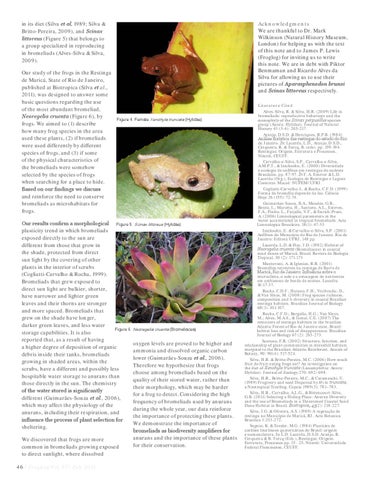
in its diet (Silva et al, 1989; Silva & Britto-Pereira, 2009), and Scinax littoreus (Figure 5) that belongs to a group specialized in reproducing in bromeliads (Alves-Silva & Silva, 2009). Our study of the frogs in the Restinga de Maricá, State of Rio de Janeiro, published at Biotropica (Silva et al., 2011), was designed to answer some basic questions regarding the use of the most abundant bromeliad, Neoregelia cruenta (Figure 6), by frogs. We aimed to (1) describe how many frog species in the area used these plants, (2) if bromeliads were used differently by different species of frogs, and (3) if some of the physical characteristics of the bromeliads were somehow selected by the species of frogs when searching for a place to hide. Based on our findings we discuss and reinforce the need to conserve bromeliads as microhabitats for frogs.
Figure 4. Female Xenohyla truncata (Hylidae)
Our results confirm a morphological Figure 5. Scinax littoreus (Hylidae) plasticity trend in which bromeliads exposed directly to the sun are different from those that grow in the shade, protected from direct sun light by the covering of other plants in the interior of scrubs (Cogliatti-Carvalho & Rocha, 1999). Bromeliads that grew exposed to direct sun light are bulkier, shorter, have narrower and lighter green leaves and their thorns are stronger and more spaced. Bromeliads that grew on the shade have longer, darker green leaves, and less water Figure 6. Neoregelia cruenta (Bromeliacea) storage capabilities. It is also reported that, as a result of having oxygen levels are proved to be higher and a higher degree of deposition of organic ammonia and dissolved organic carbon debris inside their tanks, bromeliads lower (Guimarães-Souza et al., 2006). growing in shaded areas, within the Therefore we hypothesize that frogs scrubs, have a different and possibly less choose among bromeliads based on the hospitable water storage to anurans than quality of their stored water, rather than those directly in the sun. The chemistry their morphology, which may be harder of the water stored is significantly for a frog to detect. Considering the high different (Guimarães-Souza et al., 2006), frequency of bromeliads used by anurans which may affect the physiology of the during the whole year, our data reinforce anurans, including their respiration, and the importance of protecting these plants. influence the process of plant selection for We demonstrate the importance of sheltering. bromeliads as biodiversity amplifiers for anurans and the importance of these plants We discovered that frogs are more for their conservation. common in bromeliads growing exposed to direct sunlight, where dissolved 46 | FrogLog Vol. 97 | July 2011
Literature Cited Alves-Silva, R. & Silva, H.R. (2009) Life in bromeliads: reproductive behaviour and the monophyly of the Scinax perpusillus species group (Anura: Hylidae). Journal of Natural History 43 (3-4): 205-217. Araujo, D.S.D. & Henriques, R.P.B. (1984) Análise florística das restingas do estado do Rio de Janeiro. In: Lacerda, L.D., Araujo, D.S.D., Cerqueira, R. & Turcq, B. (eds). pp. 159-194. Restingas: Origem, Estrutura e Processos. Niterói, CEUFF. Carvalho-e-Silva, S.P., Carvalho-e-Silva, A.M.P.T., & Izecksohn, E. (2000) Diversidade e ecologia de anfíbios em restingas do sudeste Brasileiro. pp. 87-97. In F. A. Estever & L.D. Lacerda (Org.), Ecologia de Restingas e Lagoas Costeiras. Macaé: NUPEM/UFRJ. Cogliatti-Carvalho, L. & Rocha, C.F.D. (1999) Forma da bromélia depende da luz. Ciência Hoje 26 (155): 72-74. Guimarães-Souza, B.A., Mendes, G.B., Bento, L., Marotta, H., Santoro, A.L., Esteves, F.A., Pinho, L., Farjalla, V.F., & Enrich-Prast, A. (2006) Limnological parameters in the water accumulated in tropical bromeliads. Acta Limnologica Brasileira. 18(1): 47-53 Izecksohn, E. & Carvalho-e-Silva, S.P. (2001) Anfíbios do Município do Rio de Janeiro. Rio de Janeiro: Editora UFRJ, 148 pp. Lacerda, L.D. & Hay, J.D. (1982) Habitat of Neoregelia cruenta (Bromeliacea) in coastal sand dunes of Maricá, Brazil. Revista de Biologia Tropical. 30 (2): 171-173 Mantovani, A. & Iglesias, R.R. (2001) Bromélias terrestres na restinga de Barra de Maricá, Rio de Janeiro: Influência sobre o microclima, o solo e a estocagem de nutrientes em ambientes de borda de moitas. Leandra 16:17-37. Rocha, C.D.F., Hatano, F.H., Vrcibradic, D., & Van Sluys, M. (2008) Frog species richness, composition and b-diversity in coastal Brazilian restinga habitats. Brazilian Journal of Biology 68(1): 101-107. Rocha, C.F.D.; Bergallo, H.G.; Van Sluys, M.; Alves, M.A.S., & Jamel, C.E. (2007) The remnants of restinga habitats in the brazilian Atlantic Forest of Rio de Janeiro state, Brazil: habitat loss and risk of disappearance. Brazilian Journal of Biology 67 (2): 263-273. Scarano, F.R. (2002) Structure, function, and relationship of plant communities in stressfull habitats marginal to the Brazilian Atlantic Rainforest. Annals of Botany, 90: 90(4): 517-524. Silva, H.R. & Britto-Pereira, M.C. (2006) How much fruit do fruit-eating frogs eat? An investigation on the diet of Xenohyla truncata (Lissamphibia: Anura: Hylidae). Journal of Zoology 270: 692–698. Silva, H.R., Britto-Pereira, M.C., & Caramaschi, U. (1989) Frugivory and seed Dispersal by Hyla truncata, a Neotropical Treefrog. Copeia 1989(3): 781–783. Silva, H.R., Carvalho, A.L.G., & Bittencourt-Silva, G.B. (2011) Selecting a Hiding Place: Anuran Diversity and the use of Bromeliads in a Threatened Coastal Sand Dune Habitat in Brazil. Biotropica, 43(2): 218-227. Silva, J.G. & Oliveira, A.S. (1989) A vegetação de restinga no Município de Maricá, RJ. Acta Botanica Brasilica 3:253-272. Suguio, K. & Tessler, M.G. (1984) Planícies de cordões litorâneos quaternários do Brasil: origem e nomenclatura. In L.D. Lacerda, D.S.D. Araújo, R. Cerqueira & B. Turcq (Eds.), Restingas: Origem, Estrutura, Processos pp. 15 - 25. Niterói: Universidade Federal Fluminense, CEUFF.