Searching for lost frogs of the Craugastor rugulosus group: Understanding their dissapearence and assesing their current population status. By Héctor Zumbado-Ulate , Adrián García-Rodríguez, Gerardo Chaves and Gilbert Alvarado.
T
he Craugastor rugulosus clade is formed by 34 species that extend from Mexico to Panama (Campbell and Savage 2000, Hedges et al. 2008, Ryan et al. 2011). Species occur from sea level to above 2000 m elevation but mostly in highlands above 1000 m (Savage 2002). All the species are mainly nocturnal as adult and inhabit rocky flowing streams where are usually found on boulders, sand banks or leaf litter (Savage 2002, Ryan et al. 2008). Amphibian decline events in Mesoamerica have greatly affected this clade (McCranie and Wilson 2002, Bolaños 2009). In Costa Rica, six of the eigth native species have not been seen for at least one decade (IUCN 2009). The only known stable populations belong to the species Craugastor ranoides in the northwest part of the country (Sasa and Solorzano 1995, Puschendorf et al. 2005, Zumbado-Ulate et al. 2007). Recently one specimen of Craugastor fleischmanni was found in Cordillera Volcánica Central (Ryan et al. 2011), where several species of this group occurred in the past. Currently, we are conducting anuran surveys using baseline ecological niche modeling tecniques to predict potential distributions of lost species (García-Rodríguez unpublished information). Field work for the C. rugulosus group have been focused in Cordillera Volcánica Central due to the historical home range of four target species in this area. However, new searching locations will be included to look for the other species of the complex.
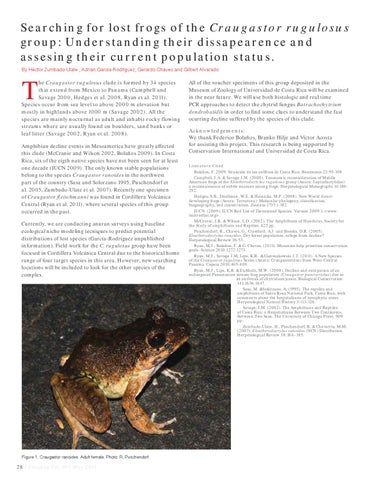
Figure 1. Craugastor ranoides. Adult female. Photo: R. Puschendorf.
28 | FrogLog Vol. 96 | May 2011
All of the voucher specimens of this group deposited in the Museum of Zoology of Universidad de Costa Rica will be examined in the near future. We will use both histologic and real time PCR approaches to detect the chytrid fungus Batrachochytrium dendrobatidis in order to find some clues to understand the fast ocurring decline suffered by the species of this clade. Acknowledgements: We thank Federico Bolaños, Branko Hilje and Víctor Acosta for assisting this project. This research is being supported by Conservation International and Universidad de Costa Rica. Literature Cited Bolaños, F. 2009. Situación de los anfibios de Costa Rica. Biocenosis 22:95-108. Campbell, J.A. & Savage J.M. (2000). Taxonomic reconsideration of Middle American frogs of the Eleutherodactylus rugulosus group (Anura: Leptodactylidae): a reconnaissance of subtle nuances among frogs. Herpetological Monographs 14:186292. Hedges, S.B., Duellman, W.E. & Heinicke, M.P. (2008). New World directdeveloping frogs (Anura: Terrarana): Molecular phylogeny, classification, biogeography, and conservation. Zootaxa 1737:1-182. IUCN. (2009). IUCN Red List of Threatened Species. Version 2009.1. <www. iucnredlist.org>. McCranie, J.R. & Wilson, L.D. (2002). The Amphibians of Honduras. Society for the Study of amphibians and Reptiles. 625 pp. Puschendorf, R., Chaves, G., Crawford, A.J. and Brooks, D.R. (2005). Eleutherodactylus ranoides. Dry forest population, refuge from decline? Herpetological Review 36:53. Ryan, M.J., Bolaños, F. & G. Chaves. (2011). Museums help prioritize conservation goals. Science 2010:1272-1273. Ryan, M.J., Savage J.M, Lips, K.R. & Giermakowski J.T. (2011). A New Species of the Craugastor rugulosus Series (Anura: Craugastoridae) from West-Central Panama. Copeia 2010:405-409. Ryan, M.J., Lips, K.R. & Eichholz, M.W. (2008). Decline and extirpation of an endangered Panamanian stream frog population (Craugastor punctariolus) due to an outbreak of chytridiomycosis. Biological Conservation 141:1636-1647. Sasa, M. &Solórzano, A. (1995). The reptiles and amphibians of Santa Rosa National Park, Costa Rica, with comments about the herpetofauna of xerophytic areas. Herpetological Natural History 3:113-126. Savage, J.M. (2002). The Amphibians and Reptiles of Costa Rica: a Herpetofauna Between Two Continents, Between Two Seas. The University of Chicago Press. 909 pp. Zumbado-Ulate, H., Puschendorf, R. & Chavarría, M.M. (2007). Eleutherodactylus ranoides (NCN) Distribution. Herpetological Review 38:184–185.