President’s Column
World Meteorological Day 2016: Face the future climate system, and their socioeconomic and ecological impacts, and promote applications of this understanding for the benefit of all Australians.” We also saw that 2015 was the hottest year on record and the world experienced soaring levels of drought, many heat-waves, coral bleaching episodes, extreme weather events and some coastal flooding. While weather and climate dominated the 2015 disaster trends, better warning systems meant fewer deaths (http://www. climatechangenews.com/2016/02/12/un-weather-andclimate-dominate-2015-disaster-trends/). That result is a great credit to the integrated functioning meteorological systems built by the NMHSs. With this in mind, I am sure we are all concerned to see positive outcomes for research and development and services (“for the benefit of all Australians”) emerge after recently proposed changes at CSIRO. Your Executive has already expressed concern for individuals affected (see http://www.amos.org.au/Main/News/President_s_report/ Main/President_s_report.aspx)
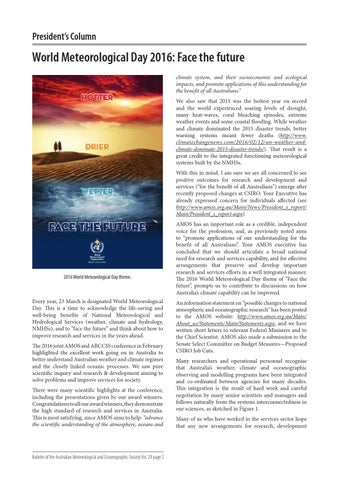
2016 World Meteorological Day theme.
Every year, 23 March is designated World Meteorological Day. This is a time to acknowledge the life-saving and well-being benefits of National Meteorological and Hydrological Services (weather, climate and hydrology, NMHSs), and to “face the future” and think about how to improve research and services in the years ahead. The 2016 joint AMOS and ARCCSS conference in February highlighted the excellent work going on in Australia to better understand Australian weather and climate regimes and the closely linked oceanic processes. We saw pure scientific inquiry and research & development aiming to solve problems and improve services for society. There were many scientific highlights at the conference, including the presentations given by our award winners. Congratulations to all our award winners, they demonstrate the high standard of research and services in Australia. This is most satisfying, since AMOS aims to help: “advance the scientific understanding of the atmosphere, oceans and
Bulletin of the Australian Meteorological and Oceanographic Society Vol. 29 page 2
AMOS has an important role as a credible, independent voice for the profession, and, as previously noted aims to “promote applications of our understanding for the benefit of all Australians”. Your AMOS executive has concluded that we should articulate a broad national need for research and services capability, and for effective arrangements that preserve and develop important research and services efforts in a well integrated manner. The 2016 World Meteorological Day theme of “Face the future”, prompts us to contribute to discussions on how Australia’s climate capability can be improved. An information statement on “possible changes to national atmospheric and oceanographic research” has been posted to the AMOS website: http://www.amos.org.au/Main/ About_us/Statements/Main/Statements.aspx, and we have written short letters to relevant Federal Ministers and to the Chief Scientist. AMOS also made a submission to the Senate Select Committee on Budget Measures—Proposed CSIRO Job Cuts. Many researchers and operational personnel recognise that Australia’s weather, climate and oceanographic observing and modelling programs have been integrated and co-ordinated between agencies for many decades. This integration is the result of hard work and careful negotiation by many senior scientists and managers and follows naturally from the systems interconnectedness in our sciences, as sketched in Figure 1. Many of us who have worked in the services sector hope that any new arrangements for research, development