Science Article
Climate model simulations of the meteorological effects of superflare events Tammas F. Loughran and Kevin J. E. Walsh School of Earth Sciences, University of Melbourne, Parkville, Victoria Address for correspondence: tammasfl@unimelb.edu.au Tammas Loughran was invited to submit an article following his presentation at the Victorian Postgraduate Student Symposium 2012. This article provides an insight into the presented work—Ed.
1. Introduction Flare events are common on the Sun and are sometimes associated with magnetic storms on Earth that cause havoc with our communication systems, satellites and power grids. However, observed solar flares pale in comparison to the events that can occur on other stars, where short duration events known as superflares release total energies of at least 1025 J. This is 100 times larger than the largest known event on the Sun—the Carrington event of 1859 (Tsurutani et al., 2003). They are thought to be caused by a similar mechanism to solar flares (Schaefer, 1989) and can occur on many different star types including those similar to the Sun (Schaefer et al., 2000). Since flares are caused by strong magnetic fields in the Sun’s atmosphere, observations of sunspots, and therefore the associated magnetic activity, indicate that superflares are unlikely to have occurred on the Sun in the last 400 years (Schrijver et al., 2012). Nevertheless, there exists evidence that there have been very large cosmic events in Earth’s history (Miyake et al., 2012) and a superflare is a good candidate for their origin (Melott and Thomas, 2012). Maehara et al., (2012) used observations of superflares from the Kepler telescope to estimate the frequency of a flare with a total energy of 1027 J on Sun-like stars to be about once every 800 years. Although it is unlikely, the possibility that the Sun will suffer a superflare is not zero. A superflare event could be devastating to modern society but the effects of such a flare on Earth’s weather have not yet been evaluated. In addition, what might a superflare imply for the habitability and likelihood of life on other Earth-like planets? In this study a climate model will be used to investigate the effects that radiation from a superflare would have on the weather and climate of Earth and Earth-like planets.
2. Calculating the Solar flux at Earth’s distance A method for calculating the evolution of radiation at the top of the atmosphere during a superflare is first developed. Here we follow Schaefer et al., (2000) who compiled a list of superflares that have been observed on
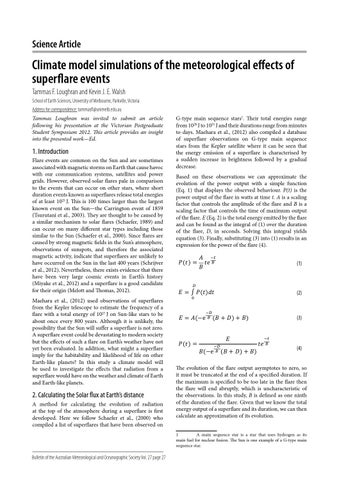
G-type main sequence stars1. Their total energies range from 1026 J to 1031 J and their durations range from minutes to days. Maehara et al., (2012) also compiled a database of superflare observations on G-type main sequence stars from the Kepler satellite where it can be seen that the energy emission of a superflare is characterised by a sudden increase in brightness followed by a gradual decrease. Based on these observations we can approximate the evolution of the power output with a simple function (Eq. 1) that displays the observed behaviour. P(t) is the power output of the flare in watts at time t. A is a scaling factor that controls the amplitude of the flare and B is a scaling factor that controls the time of maximum output of the flare. E (Eq. 2) is the total energy emitted by the flare and can be found as the integral of (1) over the duration of the flare, D, in seconds. Solving this integral yields equation (3). Finally, substituting (3) into (1) results in an expression for the power of the flare (4).
!!!! ! !
! !! !! ! !
(1)
! ! ! !!!!!" !
(2)
!!
! ! !!!! ! !! ! !! ! !! !!!! !
!
!! !!!! ! !!
! !! ! !!
(3)
!!
!! !
(4)
The evolution of the flare output asymptotes to zero, so it must be truncated at the end of a specified duration. If the maximum is specified to be too late in the flare then the flare will end abruptly, which is uncharacteristic of the observations. In this study, B is defined as one ninth of the duration of the flare. Given that we know the total energy output of a superflare and its duration, we can then calculate an approximation of its evolution. 1 A main sequence star is a star that uses hydrogen as its main fuel for nuclear fusion. The Sun is one example of a G-type main sequence star.
Bulletin of the Australian Meteorological and Oceanographic Society Vol. 27 page 27