Home computers to power climate change research Alvin Stone
Media and Communications Manager ARC Centre of Excellence Climate System Science, UNSW Any Australian with a home computer and an internet connection can now power up a climate model and help scientists find the causes of record high temperatures and drought that hit Australia and New Zealand in 2013. The online climate experiment, Weather@Home, has been created by a group of scientists from the ARC Centre of Excellence for Climate System Science, the University of Melbourne, University of Oxford in England, the UK Met Office, the University of Tasmania, and the National Institute of Water and Atmospheric Research in New Zealand. By signing up to Weather@Home, computer users can create climate model simulations that produce threedimensional representations of weather for 2013. They can watch these evolve in real time or let them run quietly in the background. “This project is an example of citizen science at its finest, producing important scientific results that can be published in peer-reviewed scientific journals and which have powerful implications for our future,” said Prof. David Karoly from The University of Melbourne. “Through the Weather@Home application, home computer users can produce climate model simulations and help answer the question—’Did human-caused climate change play a role in the extreme heat events of 2013?’.” “We need thousands of users, so we are encouraging people to sign up at the Weather@Home website1.”
1 www.climateprediction.net/weatherathome/australia-newzealand-heat-waves/
The weather simulations produced by the personal computers for this experiment will be divided into two groups. One will run simulations of weather in 2013 based on the current atmospheric composition with greenhouse gas emissions as they appear today. The other will simulate the weather in a world where humans have not changed the atmosphere with greenhouse gas emissions. These simulations can be run simultaneously across thousands of home computers. As each is completed and the results collated, the footprint of global warming will become clearer. “With thousands of simulations we can see how often the extreme temperatures of 2013 appear when there are no additional greenhouse gases in our atmosphere. We can then compare those results to the simulations produced in an atmosphere that is like our own,” said Prof. Karoly. “This will reveal the patterns of global warming and give us a clear idea of how the risk of extreme events has changed with the rise in greenhouse gases.” Prof. Karoly said this is only the first of many experiments that will use the Weather@Home application to assess the impacts of climate change in Australia and New Zealand. In the future, it will be used to assess the possible role of climate change in Australia’s Black Saturday bushfires in 2009, the record rain events in New Zealand in 2011 and the record rain events in eastern Australia in 2010 and 2011. I worked with climateprediction.net while I was undertaking my Ph.D. and I strongly encourage AMOS members to get involved with this fantastic initiative—Ed.
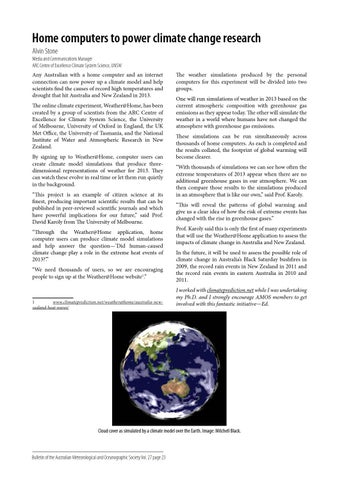
Cloud cover as simulated by a climate model over the Earth. Image: Mitchell Black.
Bulletin of the Australian Meteorological and Oceanographic Society Vol. 27 page 23