Chapter 6 — Slings and Sling Hitches 85
Choker Hitches
support material may be secured to the top of the load for the lower eye of the sling to bear against and maintain the proper choke angle. This supporting device should be secured so that it does not slip if tension on the sling is released during the hoisting operation. Finally, the sling should be long enough so that the choke is on the body of the sling and not on sling fittings.
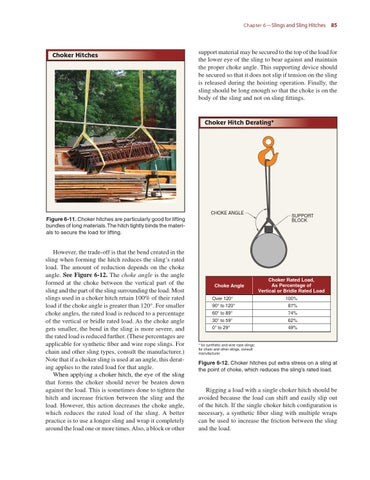
Choker Hitch Derating*
CHOKE ANGLE
Figure 6-11. Choker hitches are particularly good for lifting bundles of long materials. The hitch tightly binds the materials to secure the load for lifting.
However, the trade-off is that the bend created in the sling when forming the hitch reduces the sling’s rated load. The amount of reduction depends on the choke angle. See Figure 6-12. The choke angle is the angle formed at the choke between the vertical part of the sling and the part of the sling surrounding the load. Most slings used in a choker hitch retain 100% of their rated load if the choke angle is greater than 120°. For smaller choke angles, the rated load is reduced to a percentage of the vertical or bridle rated load. As the choke angle gets smaller, the bend in the sling is more severe, and the rated load is reduced further. (These percentages are applicable for synthetic fiber and wire rope slings. For chain and other sling types, consult the manufacturer.) Note that if a choker sling is used at an angle, this derating applies to the rated load for that angle. When applying a choker hitch, the eye of the sling that forms the choker should never be beaten down against the load. This is sometimes done to tighten the hitch and increase friction between the sling and the load. However, this action decreases the choke angle, which reduces the rated load of the sling. A better practice is to use a longer sling and wrap it completely around the load one or more times. Also, a block or other
Choke Angle
SUPPORT BLOCK
Choker Rated Load, As Percentage of Vertical or Bridle Rated Load
Over 120°
100%
90° to 120°
87%
60° to 89°
74%
30° to 59°
62%
0° to 29°
49%
* for synthetic and wire rope slings; for chain and other slings, consult manufacturer
Figure 6-12. Choker hitches put extra stress on a sling at the point of choke, which reduces the sling’s rated load.
Rigging a load with a single choker hitch should be avoided because the load can shift and easily slip out of the hitch. If the single choker hitch configuration is necessary, a synthetic fiber sling with multiple wraps can be used to increase the friction between the sling and the load.