Chapter 5 — Hydraulic Pumps 123
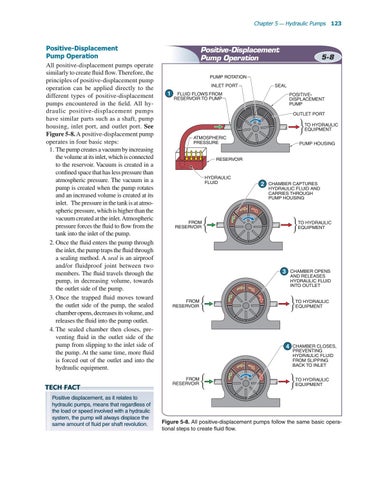
Positive-Displacement Pump Operation All positive-displacement pumps operate similarly to create fluid flow. Therefore, the principles of positive-displacement pump operation can be applied directly to the different types of positive-displacement pumps encountered in the field. All hydraulic positive-displacement pumps have similar parts such as a shaft, pump housing, inlet port, and outlet port. See Figure 5-8. A positive-displacement pump operates in four basic steps: 1. The pump creates a vacuum by increasing the volume at its inlet, which is connected to the reservoir. Vacuum is created in a confined space that has less pressure than atmospheric pressure. The vacuum in a pump is created when the pump rotates and an increased volume is created at its inlet. The pressure in the tank is at atmospheric pressure, which is higher than the vacuum created at the inlet. Atmospheric pressure forces the fluid to flow from the tank into the inlet of the pump. 2. Once the fluid enters the pump through the inlet, the pump traps the fluid through a sealing method. A seal is an airproof and/or fluidproof joint between two members. The fluid travels through the pump, in decreasing volume, towards the outlet side of the pump. 3. Once the trapped fluid moves toward the outlet side of the pump, the sealed chamber opens, decreases its volume, and releases the fluid into the pump outlet. 4. The sealed chamber then closes, preventing fluid in the outlet side of the pump from slipping to the inlet side of the pump. At the same time, more fluid is forced out of the outlet and into the hydraulic equipment. TECH FACT Positive displacement, as it relates to hydraulic pumps, means that regardless of the load or speed involved with a hydraulic system, the pump will always displace the same amount of fluid per shaft revolution.
Positive-Displacement Pump Operation
5-8
PUMP ROTATION INLET PORT
1
SEAL
FLUID FLOWS FROM RESERVOIR TO PUMP
POSITIVEDISPLACEMENT PUMP OUTLET PORT TO HYDRAULIC EQUIPMENT
ATMOSPHERIC PRESSURE
PUMP HOUSING
RESERVOIR
HYDRAULIC FLUID
2
CHAMBER CAPTURES HYDRAULIC FLUID AND CARRIES THROUGH PUMP HOUSING
FROM RESERVOIR
TO HYDRAULIC EQUIPMENT
3
CHAMBER OPENS AND RELEASES HYDRAULIC FLUID INTO OUTLET
FROM RESERVOIR
TO HYDRAULIC EQUIPMENT
4
FROM RESERVOIR
CHAMBER CLOSES, PREVENTING HYDRAULIC FLUID FROM SLIPPING BACK TO INLET TO HYDRAULIC EQUIPMENT
Figure 5-8. All positive-displacement pumps follow the same basic operational steps to create fluid flow.