124
Printreading for Residential and Light Commercial Construction
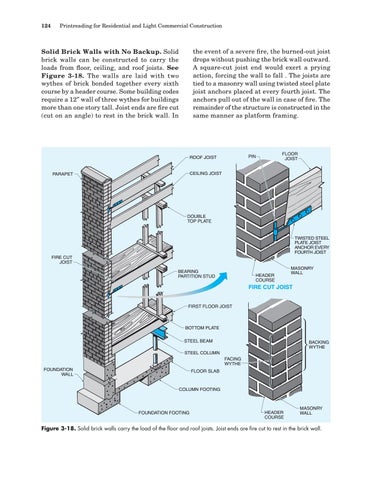
the event of a severe fire, the burned‑out joist drops without pushing the brick wall outward. A square-cut joist end would exert a prying action, forcing the wall to fall . The joists are tied to a masonry wall using twisted steel plate joist anchors placed at every fourth joist. The anchors pull out of the wall in case of fire. The remainder of the structure is constructed in the same manner as platform framing.
Solid Brick Walls with No Backup. Solid brick walls can be constructed to carry the loads from floor, ceiling, and roof joists. See Figure 3-18. The walls are laid with two wythes of brick bonded together every sixth course by a header course. Some building codes require a 12″ wall of three wythes for buildings more than one story tall. Joist ends are fire cut (cut on an angle) to rest in the brick wall. In
FLOOR JOIST
PIN
ROOF JOIST CEILING JOIST
PARAPET
DOUBLE TOP PLATE
TWISTED STEEL PLATE JOIST ANCHOR EVERY FOURTH JOIST FIRE CUT JOIST BEARING PARTITION STUD
HEADER COURSE
MASONRY WALL
FIRE CUT JOIST FIRST FLOOR JOIST
BOTTOM PLATE STEEL BEAM
BACKING WYTHE
STEEL COLUMN FACING WYTHE FOUNDATION WALL
FLOOR SLAB
COLUMN FOOTING
FOUNDATION FOOTING
HEADER COURSE
MASONRY WALL
Figure 3-18. Solid brick walls carry the load of the floor and roof joists. Joist ends are fire cut to rest in the brick wall.