118
Printreading for Residential and Light Commercial Construction
Southern Forest Products Association
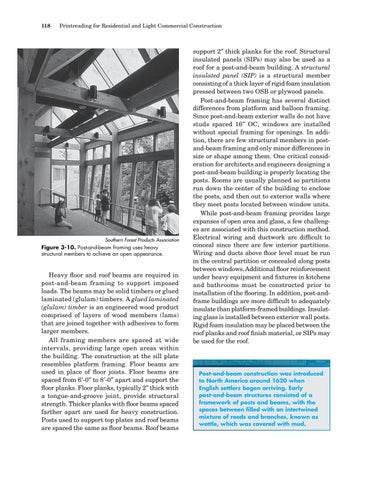
Figure 3-10. Post‑and‑beam framing uses heavy structural members to achieve an open appearance.
Heavy floor and roof beams are required in post-and-beam framing to support imposed loads. The beams may be solid timbers or glued laminated (glulam) timbers. A glued laminated (glulam) timber is an engineered wood product comprised of layers of wood members (lams) that are joined together with adhesives to form larger members. All framing members are spaced at wide intervals, providing large open areas within the building. The construction at the sill plate resembles platform framing. Floor beams are used in place of floor joists. Floor beams are spaced from 6′‑0″ to 8′‑0″ apart and support the floor planks. Floor planks, typically 2″ thick with a tongue‑and‑groove joint, provide structural strength. Thicker planks with floor beams spaced farther apart are used for heavy construction. Posts used to support top plates and roof beams are spaced the same as floor beams. Roof beams
support 2″ thick planks for the roof. Structural insulated panels (SIPs) may also be used as a roof for a post-and-beam building. A structural insulated panel (SIP) is a structural member consisting of a thick layer of rigid foam insulation pressed between two OSB or plywood panels. Post‑and‑beam framing has several distinct differences from platform and balloon framing. Since post-and-beam exterior walls do not have studs spaced 16″ OC, windows are installed without special framing for openings. In addition, there are few structural members in postand-beam framing and only minor differences in size or shape among them. One critical consideration for architects and engineers designing a post-and-beam building is properly locating the posts. Rooms are usually planned so partitions run down the center of the building to enclose the posts, and then out to exterior walls where they meet posts located between window units. While post-and-beam framing provides large expanses of open area and glass, a few challenges are associated with this construction method. Electrical wiring and ductwork are difficult to conceal since there are few interior partitions. Wiring and ducts above floor level must be run in the central partition or concealed along posts between windows. Additional floor reinforcement under heavy equipment and fixtures in kitchens and bathrooms must be constructed prior to installation of the flooring. In addition, post-andframe buildings are more difficult to adequately insulate than platform-framed buildings. Insulating glass is installed between exterior wall posts. Rigid foam insulation may be placed between the roof planks and roof finish material, or SIPs may be used for the roof.
Post-and-beam construction was introduced to North America around 1620 when English settlers began arriving. Early post-and-beam structures consisted of a framework of posts and beams, with the spaces between filled with an intertwined mixture of reeds and branches, known as wattle, which was covered with mud.