QUESTIONS
CRITICAL
Nonprofit boards are rethinking their mandates and missions in the light of evolving expectations about transparency, ethics, and community engagement. Here, Daniel H. Weiss, president and CEO of the Metropolitan Museum of Art in New York City, discusses how nonprofits and their boards are adapting—and explores the implications for orchestras. by Jesse Rosen
W
e shouldn’t be surprised that high-stakes, emotionally charged political divides and controversies would eventually show up in the board rooms and executive offices of arts and culture organizations. In New York City, home of the League’s headquarters, we’ve seen the Metropolitan Museum of Art, the Whitney Museum of American Art, and the Museum of Natural History all face public controversy over the affiliations of board member and donors, and the programming choices of curators, deemed by some to be antithetical to their missions. While orchestras have not yet experienced such public outcries, the underlying tensions and conflicts are present in many of our organizations as well. With this in mind, I invited Daniel Weiss, president and CEO of the Metropolitan Museum of Art, to talk with a group of orchestra executives about what he has learned from his experiences at the Met. In his cogent remarks, Dan reframed these “problems” as extraordinary opportunities for board and executive learning and for the sharpening of mission and pursuit of excellence. Dan subsequently and kindly agreed to this interview so we could capture his views for our wider Symphony audience. JESSE ROSEN: Everyone’s been noticing the public commentary and controversy in the museum community, particularly around curatorial decisions but also about board members, donors, and their affiliations. Does this feel to you like a passing change in the weather, or is this a climate change, something larger going on?
10
DAN WEISS: I think there is genuine, fundamental change in the ways in which our organizations function in the world. And therefore, by extension, the ways in which our organizations are perceived and what expectations the public and others have of us. I think it is a seismic change and call it a paradigm shift in how we operate, how we’re governed, how we’re
Chris Lee
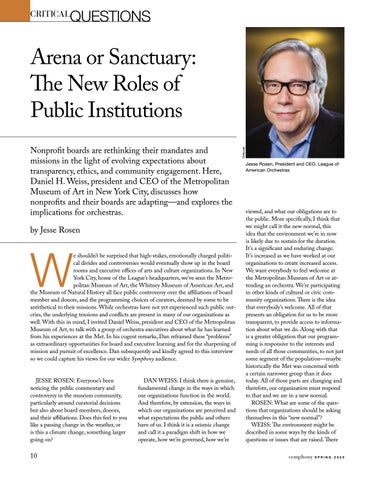
Arena or Sanctuary: The New Roles of Public Institutions Jesse Rosen, President and CEO, League of American Orchestras
viewed, and what our obligations are to the public. More specifically, I think that we might call it the new normal, this idea that the environment we’re in now is likely due to sustain for the duration. It’s a significant and enduring change. It’s increased as we have worked at our organizations to create increased access. We want everybody to feel welcome at the Metropolitan Museum of Art or attending an orchestra. We’re participating in other kinds of cultural or civic community organizations. There is the idea that everybody’s welcome. All of that presents an obligation for us to be more transparent, to provide access to information about what we do. Along with that is a greater obligation that our programming is responsive to the interests and needs of all those communities, to not just some segment of the population—maybe historically the Met was concerned with a certain narrower group than it does today. All of those parts are changing and therefore, our organization must respond to that and we are in a new normal. ROSEN: What are some of the questions that organizations should be asking themselves in this “new normal”? WEISS: The environment might be described in some ways by the kinds of questions or issues that are raised. There symphony
SPRING 2020