PRINCIPAL INVESTIGATOR
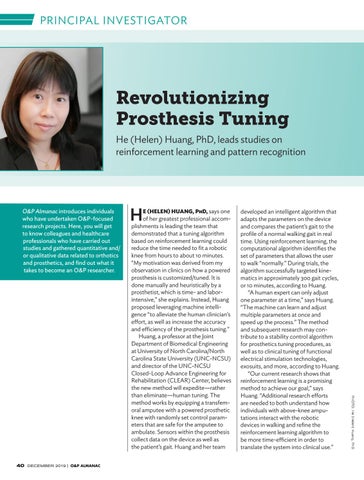
Revolutionizing Prosthesis Tuning He (Helen) Huang, PhD, leads studies on reinforcement learning and pattern recognition
O&P Almanac introduces individuals who have undertaken O&P-focused research projects. Here, you will get to know colleagues and healthcare professionals who have carried out studies and gathered quantitative and/ or qualitative data related to orthotics and prosthetics, and find out what it takes to become an O&P researcher.
DECEMBER 2019 | O&P ALMANAC
E (HELEN) HUANG, PhD, says one
of her greatest professional accomplishments is leading the team that demonstrated that a tuning algorithm based on reinforcement learning could reduce the time needed to fit a robotic knee from hours to about 10 minutes. “My motivation was derived from my observation in clinics on how a powered prosthesis is customized/tuned. It is done manually and heuristically by a prosthetist, which is time- and laborintensive,” she explains. Instead, Huang proposed leveraging machine intelligence “to alleviate the human clinician’s effort, as well as increase the accuracy and efficiency of the prosthesis tuning.” Huang, a professor at the Joint Department of Biomedical Engineering at University of North Carolina/North Carolina State University (UNC-NCSU) and director of the UNC-NCSU Closed-Loop Advance Engineering for Rehabilitation (CLEAR) Center, believes the new method will expedite—rather than eliminate—human tuning. The method works by equipping a transfemoral amputee with a powered prosthetic knee with randomly set control parameters that are safe for the amputee to ambulate. Sensors within the prosthesis collect data on the device as well as the patient’s gait. Huang and her team
developed an intelligent algorithm that adapts the parameters on the device and compares the patient’s gait to the profile of a normal walking gait in real time. Using reinforcement learning, the computational algorithm identifies the set of parameters that allows the user to walk “normally.” During trials, the algorithm successfully targeted kinematics in approximately 300 gait cycles, or 10 minutes, according to Huang. “A human expert can only adjust one parameter at a time,” says Huang. “The machine can learn and adjust multiple parameters at once and speed up the process.” The method and subsequent research may contribute to a stability control algorithm for prosthetics tuning procedures, as well as to clinical tuning of functional electrical stimulation technologies, exosuits, and more, according to Huang. “Our current research shows that reinforcement learning is a promising method to achieve our goal,” says Huang. “Additional research efforts are needed to both understand how individuals with above-knee amputations interact with the robotic devices in walking and refine the reinforcement learning algorithm to be more time-efficient in order to translate the system into clinical use.”
PHOTO: He (Helen) Huang, PhD
40
H