ACSA Member Spotlight
A Class Act New Deal Distillery teaches some of the tricks of the trade. BY JEFF CIOLETTI
G
rab a pen (and a glass) because, for much of the year, class is in session at New Deal Distillery in Portland, Oregon. New Deal has always been about knowledge sharing, as it runs one class that teaches enthusiasts (and those new to the spirits industry) the fundamentals of distilling, and another that explores how to mix with the end products. The distillery presents its popular Handson Whiskey Making Classes throughout the year, giving participants an introduction to fermentation, distillation and barrel aging of small-batch whiskey. “[The class] came about because it’s kind of a fun way to help finance a couple of whiskey barrels,” says Tom Burkleaux, head distiller and owner. “People are just fascinated by it
and honestly I think giving classes makes me a better distiller because I have to explain why you do things. It’s fun, people want it and it makes money for us, so what’s not to love about it?” New Deal limits each five-hour Sunday class to 15 students, who learn all aspects of the production process. Attendees assist with creating a whiskey mash, evaluating distillation cuts and assessing samples at various stages of the aging process. Grain choice, enzyme and yeast usage, distillation technique and an understanding of how barrel aging affects the final whiskey product are among the skills participants gain from the session. “We do, sort of, the mash in, they get to work on that,” explains Burkleaux. “[They learn] the differences between making beer and making wash.”
That last point is usually pretty eye-opening for any homebrewers who take the class because many incorrectly assume that the processes are identical. A sizable portion of attendees are “super spirit geeks,” he says, though a fair number of industry people sign up, as well as a few individuals just looking for a diverting way to spend a Sunday. During the evaluation process, students begin by tasting white dogs made from various grains to illustrate the sorts of flavors and aromas derived from the grains themselves. Then they get into aging, where things get a bit more complicated—even philosophical. “[We say] ‘this is something that’s been on chips for two years, does this feel like aging, can you cheat time?” Burkleaux says. “We do intermediate barrel ages and then we finish
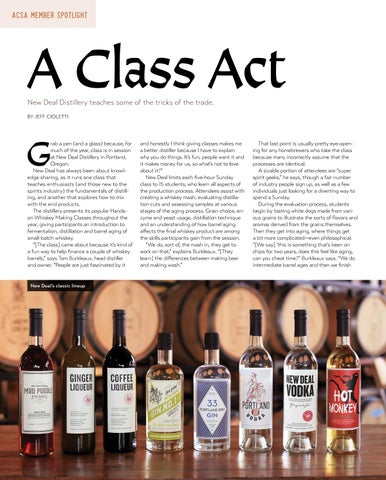
New Deal’s classic lineup
50 |
APR IL 2020
C R AF T S PI R I T S MAG .CO M