Smithsonian Institution
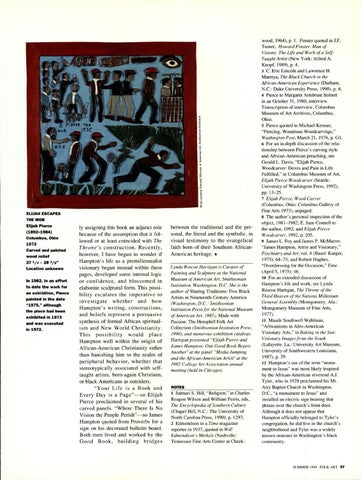
ELIJAH ESCAPES THE MOB Elijah Pierce (1892-1984) Columbus, Ohio 1972 Carved and painted wood relief 27 1/4
28 3/8"
Location unknown In 1982, in an effort to date the work for an exhibition, Pierce painted in the date "1975," although the piece had been exhibited in 1973 and was executed in 1972.
ly assigning this book an adjunct role because of the assumption that it followed or at least coincided with The Throne's construction. Recently, however, I have begun to wonder if Hampton's life as a premillennialist visionary began instead within these pages, developed some internal logic or confidence, and blossomed in elaborate sculptural form. This possibility escalates the imperative to investigate whether and how Hampton's writing, constructions, and beliefs represent a persuasive synthesis of formal African spiritualism and New World Christianity. This possibility would place Hampton well within the origin of African-American Christianity rather than banishing him to the realm of peripheral behavior, whether that stereotypically associated with selftaught artists, born-again Christians, or black Americans as outsiders. "Your Life is a Book and Every Day is a Page"—so Elijah Pierce proclaimed in several of his carved panels. "Where There Is No Vision the People Perish"—so James Hampton quoted from Proverbs for a sign on his decorated bulletin board. Both men lived and worked by the Good Book, building bridges
between the traditional and the personal, the literal and the symbolic, in visual testimony to the evangelical faith born of their Southern AfricanAmerican heritage.* Lynda Roscoe Hartigan is Curator of Painting and Sculpture at the National Museum ofAmerican Art, Smithsonian Institution, Washington,D.C. She is the author ofSharing Traditions: Five Black Artists in Nineteenth-Century America (Washington,D.C.:Smithsonian Institution Pressfor the National Museum ofAmerican Art, 1985), Made with Passion: The Hemphill Folk Art Collection (Smithsonian Institution Press, 1990),and numerous exhibition catalogs. Hartigan presented "Elijah Pierce and James Hampton: One Good Book Begets Another"at the panel "Media Jumping and the African-American Artist"at the 1992 College Art Association annual meeting (held in Chicago).
NOTES
Samuel S. Hill,"Religion," in Charles Reagon Wilson and William Ferris, eds., The Encyclopedia ofSouthern Culture (Chapel Hill, N.C.: The University of North Carolina Press, 1990), p. 1293. 2 Edmondson to a Time magazine reporter in 1937, quoted in Will Edmondson's Mirkels(Nashville: Tennessee Fine Arts Center at Cheek1
wood, 1964), p. 1. Finster quoted in J.F. Turner, Howard Finster, Man of Visions: The Life and Work ofa SelfTaught Artist(New York: Alfred A. Knopf, 1989), p. 4. 3 C. Eric Lincoln and Lawrence H. Marniya, The Black Church in the African-American Experience (Durham, N.C.: Duke University Press, 1990), p. 6. 4 Pierce to Margaret Armbrust Seibert in an October 31, 1980,interview. Transcription of interview, Columbus Museum of Art Archives, Columbus, Ohio. 5 Pierce quoted in Michael Kernan, "Piercing, Wondrous Woodcarvings," Washington Post, March 21, 1976, p. Gl. 6 For an in-depth discussion of the relationship between Pierce's carving style and African-American preaching, see Gerald L. Davis,"Elijah Pierce, Woodcarver: Doves and Pain in Life Fulfilled," in Columbus Museum of Art, Elijah Pierce Woodcarver (Seattle: University of Washington Press, 1992), pp. 13-25. 7 Elijah Pierce, Wood Carver (Columbus, Ohio: Columbus Gallery of Fine Arts 1973), unpaged. 8 The author's personal inspection of the object, 1981-1982; E. Jane Connell to the author, 1992; and Elijah Pierce Woodcarver, 1992, p. 205. 9 James L. Foy and James P. McMurrer, "James Hampton, Artist and Visionary," Psychiatry and Art, vol. 4(Basel: Karger, 1975): 64-75; and Robert Hughes, "Overdressing for the Occasion," Time (April 5, 1975): 46. 10 For an extended discussion of Hampton's life and work,see Lynda Roscoe Hartigan, The Throne ofthe Third Heaven ofthe Nations Millenium General Assembly(Montgomery, Ala.: Montgomery Museum of Fine Arts, 1977). 11 Maude Southwell Waldman, "Africanisms in Afro-American Visionary Arts," in Baking in the Sun: Visionary Imagesfrom the South (Lafayette, La.: University Art Museum, University of Southwestern Louisiana, 1987), p. 29. 12 Hampton's use of the term "monument to Jesus" was most likely inspired by the African-American reverend A.J. Tyler, who in 1928 proclaimed his Mt. Airy Baptist Church in Washington, D.C.,"a monument to Jesus" and installed an electric sign bearing that phrase over the church's front door. Although it does not appear that Hampton officially belonged to Tyler's congregation, he did live in the church's neighborhood and Tyler was a widely known minister in Washington's black community.
SUMMER 1994 FOLK ART 57