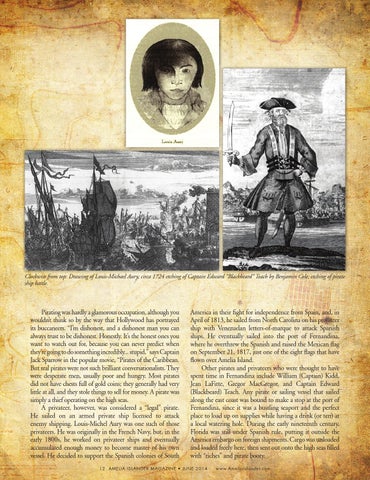
Clockwise from top: Drawing of Louis-Michael Aury; circa 1724 etching of Captain Edward “Blackbeard” Teach by Benjamin Cole; etching of pirate ship battle.
Pirating was hardly a glamorous occupation, although you wouldn’t think so by the way that Hollywood has portrayed its buccaneers. “I’m dishonest, and a dishonest man you can always trust to be dishonest. Honestly. It’s the honest ones you want to watch out for, because you can never predict when they’re going to do something incredibly... stupid,” says Captain Jack Sparrow in the popular movie, “Pirates of the Caribbean. But real pirates were not such brilliant conversationalists. They were desperate men, usually poor and hungry. Most pirates did not have chests full of gold coins; they generally had very little at all, and they stole things to sell for money. A pirate was simply a thief operating on the high seas. A privateer, however, was considered a “legal” pirate. He sailed on an armed private ship licensed to attack enemy shipping. Louis-Michel Aury was one such of those privateers. He was originally in the French Navy, but, in the early 1800s, he worked on privateer ships and eventually accumulated enough money to become master of his own vessel. He decided to support the Spanish colonies of South
America in their fight for independence from Spain, and, in April of 1813, he sailed from North Carolina on his privateer ship with Venezuelan letters-of-marque to attack Spanish ships. He eventually sailed into the port of Fernandina, where he overthrew the Spanish and raised the Mexican flag on September 21, 1817, just one of the eight flags that have flown over Amelia Island. Other pirates and privateers who were thought to have spent time in Fernandina include William (Captain) Kidd, Jean LaFitte, Gregor MacGregor, and Captain Edward (Blackbeard) Teach. Any pirate or sailing vessel that sailed along the east coast was bound to make a stop at the port of Fernandina, since it was a bustling seaport and the perfect place to load up on supplies while having a drink (or ten) at a local watering hole. During the early nineteenth century, Florida was still under Spanish rule, putting it outside the America embargo on foreign shipments. Cargo was unloaded and loaded freely here, then sent out onto the high seas filled with “riches” and pirate booty.
12 AMELIA ISLANDER MAGAZINE • JUNE 2014
www.AmeliaIslander.com