A SALUTE TO UTAH’S VETERANS AND MILITARY
GULF WAR
ON THE EDGE OF THE STORM
COVER PRICE $5
NOVEMBER 2016
SPECIAL EDITION FOR SUBSCRIBERS OF DESERET NEWS AND THE SALT LAKE TRIBUNE
SUU IS PROUD TO BE THE ONLY PURPLE HEART CAMPUS IN UTAH
SUU President Scott L Wyatt and Commander Dee Gibson
KUWAIT. Nov. 4, 1990. Responding to Iraq's invasion of Kuwait, troops of the U.S. 1st Cavalry Division deploy across the Saudi desert during preparations prior to the Gulf War. ap photo / greg english
2
va l o r : a s a l u t e t o u ta h ’ s v e t e r a n s a n d m i l i ta r y
november
2016
CONTENTS REMEMBERING PEARL HARBOR / 4 2 5 Y E A R S : T H E F I R S T G U L F WA R / 8 G O L D S TA R FA M I L I E S / 2 0 VETERANS ON CAMPUS / 22 I N N O VAT I V E PA R T N E R S H I P S / 2 6 F LY I N ’ H I G H D O W N S O U T H / 3 3
UTAHVALOR.COM UTAH MEDIA GROUP / 4770 South 5600 West, West Valley City UT 84118 utahmediagroup.com PROJECT TEAM / Brent Low, Publisher / Jed Call, Marketing Director Michelle Bridges, Project Manager / Megan Donio, Project Coordinator / Tyler Pratt, Creative Advertising: 801-204-6300 VALOR: A Salute to Utah’s Veterans and Military is a publication of Utah Media Group and distributed in partnership with Deseret News and The Salt Lake Tribune. Copyright © november 2016. All rights reserved. No part of this publication may be reproduced in any format without consent of Utah Media Group. Every effort has been made to ensure the accuracy of the information in this publication and assume no liability for errors, inaccuracies or omissions.
on the cover :
KUWAIT. Feb. 27, 1991. Burgan burning oil fields behind U.S. Marines. The Iraqi invasion of Kuwait took place in August 1990. It was followed by the Allied intervention under operation Desert Storm. After seven months of occupation and five weeks of war, the Allies liberated Kuwait. © burno barbey / promagnumphotos . com
november
2016
va l o r : a s a l u t e t o u ta h ’ s v e t e r a n s a n d m i l i ta r y
3
The attack on Pearl Harbor was a surprise military strike by the Imperial Japanese Navy against the United States naval base at Pearl Harbor, Hawaii Territory, on the morning of Dec. 7, 1941. The attack led to the United States' entry into World War II. (TOP) An aerial view taken from a Japanese plane of the attack on Pearl Harbor. nara photo (ABOVE) Sinking of the USS Arizona, 1,177 crew members were killed that day and more than 900 remain entombed on the ship; 319 sailors and 15 Marines on or off the ship are listed as survivors. nara photo (LEFT) The USS West Virginia took nine torpedoes at Pearl Harbor with 107 lives lost, including Capt. Mervyn S. Bennion. Although heavily damaged, "Wee Vee" was repaired to sail again until decommissioned in 1947. nara photo (CENTER) A night time view of the USS Arizona Memorial. pixabay . com
4
va l o r : a s a l u t e t o u ta h ’ s v e t e r a n s a n d m i l i ta r y
november
2016
REMEMBERING PEARL HARBOR 'A DAT E W H I C H W I L L L I V E I N I N FA M Y' 7 5 Y E A R S L AT E R by Michelle Bridges a n d b o b w e l s h fo r va lo r m aga z i n e
A
t 07:55 a.m. Hawaii time on Dec. 7, 1941, Japanese fighter planes attacked the U.S. base at Pearl Harbor, perpetrating one of the ghastliest attacks in American history. The assault lasted less than two hours, but claimed the lives of more than 2,400 people and damaged or destroyed nearly 20 American ships and more than 300 aircraft. As the nation commemorates the 75th anniversary of the attack, VALOR pauses to remember Utahns who were there.
KEN POTTS: A SURVIVOR'S STORY FROM THE USS ARIZONA To the memory of the gallant men here entombed and their shipmates who gave their lives in action on December 7, 1941, on the USS Arizona. —Memorial plaque at the USS Arizona Memorial For many, the stories and images of the attack on Pearl Harbor are told through the lenses of Hollywood or the dusty pages of history. In my quest for stories to share with VALOR, I come across some truly amazing individuals who bless me with their time and their stories. One balmy evening last September, I stepped up on the front porch of a modest home and knocked. I hadn’t made any preparations to meet the man inside, which was the cumulation of a week-long search for Ken Potts, 96, a survivor of Pearl Harbor and the USS Arizona. After a somewhat shaky self-introduction and request to have Potts share his story, I was told, “No. I don’t talk about my war stories.” Shocked into silence, I didn’t know how to november
2016
respond. But with a slight smile and nod of his head, Potts said, “But if you want to come in, I’ll chat a bit.” It appears that I shouldn’t have been letdown after Potts’ refusal. He doesn’t like to talk about the attack. Sometimes it’s hard to control his emotions, so he declines speaking requests. He says, “...no one should have to see or hear what we went through that morning.” He looks me in the eye and says, “...I’m not anything special for surviving the bombing. I’m much more than that one morning in time. I have lived and done more in my life.” I can respect that. But because of that one moment in time, he is sought out for recognition and interviews. Potts invites me into his “pool room” to see some “stuff.” The paneled room is where he keeps mementos from his experiences—maps, photos, news clippings, medals and a painting of the USS Arizona. In passing, he taps a stack of manila envelopes, postmarked 2016, holding requests for appearances, interviews and autographs from as far away as Austria. He said if he kept everything, it would be too much. He tries to personally answer all letters. “That’s my pride and joy,” Potts says as he points to a three-foot-high trophy in the corner. In 2011, Potts got a call from the band director at Timpview High School in Provo. The marching band had been invited to perform at activities commemorating the 70th anniversary of the attack. The band leader asked if Potts would be would be willing to go as a guest of honor, they would cover all expenses for him and his wife, Doris. Potts was touched by the sincerity of the band’s request. After returning home, the band leader va l o r : a s a l u t e t o u ta h ’ s v e t e r a n s a n d m i l i ta r y
5
called saying the band had won the competition in Hawaii and wanted him to have their trophy. Potts talked about bonding with students. “Now that’s a story worth sharing,” he says in passing. For the 75th anniversary Potts says, “If we can stay healthy...” Doris, he and their eldest son will travel to Pearl Harbor to honor his shipmates. Potts says he’s tired and it will be his last. I came away from the Potts’ home with a survivor’s story. I believe Potts survived so that he could keep his “buddies” stories, traditions and memories alive. Potts may say he hasn't done anything special, but he has—he survived.
IF YOU GO: Utah will honor the 75th anniversary of Pearl Harbor with a ceremony renaming the Payson facility to the Mervyn Strong Bennion Central Utah Veterans Home at 2 p.m. Wednesday, Dec. 7, 2016. The event will bring together veterans, dignitaries and the community. Director Jeff Hanson stated they hope to tell the stories of Bennion, the facility, Pearl Me r v y n S . B e n n i o n Harbor, World War II and the military courtesy of ron fox through speakers, music and exhibits. For more visit veterans.utah.gov/central-utah-veterans-home/
MERVYN S. BENNION: HIS KIND OF COURAGE His was a truly great soul and when the time came for him to make the supreme sacrif ice, he met his ordeal with that splendid courage, that disregard of self, and that kindness and thought of others which had endeared him throughout his life to his family and his many friends. In his hour of death, as in his way of life, he set the highest standard. —Adm. A.C. Perkins, Commander of the Atlantic Fleet Medal of Honor recipient Mervyn S. Bennion’s name will be added to the Utah Central Veterans Home in a dedication ceremony to honor the Utah native who lost his life as the Captain of the USS West Virgina during the bombing of Pearl Harbor. According to Jeff Hanson, director of the Payson facility, Maynard Sorensen, of St. George, submitted a “very detailed packet” to the Utah Department of Veterans and Military Affairs (VMA) to petition for the renaming. “What caught Director Gary Harter’s eye was Bennion was from Vernon about 50 miles from here, he had received the Medal of Honor and he paid the ultimate price with his life during the attack of Pearl Harbor.” Ultimately the Utah Building 6
va l o r : a s a l u t e t o u ta h ’ s v e t e r a n s a n d m i l i ta r y
Board has the final say of naming the building, although there was little objection from those sponsoring the petition. Hanson has steered the Payson facility since it opened in 2014. Every day he listens to incredible stories of courage and self-sacrifice from residents. “If you read Bennion’s story, it goes into a lot of detail about his character—a pretty impressive guy, devoted to his family, to his faith and to his country. He actually served on-board a ship during WWI so he was an older career soldier, dedicating his life in service to his country,” said Hanson. “The way I look at it is, Bennion’s story represents the stories of many service members who have been very courageous and who have sacrificed much,” said Hanson. “If you look at the complete picture, you realize this is a guy that can represent the facility going forward.”
USS UTAH: STATE'S NAMESAKE FOREVER PART OF PEARL HARBOR While we honor those who here gave their last full measure of devotion all of us hope and pray that the time will come when we no longer need to dedicate memorials to men who died in battle—that we will dedicate memorials to those who live in peace—to all nations and all men. —Utah Sen. Frank E. Moss, Memorial Day 1972 In the first wave of the attack on Pearl Harbor, 16 Japanese B5N2 Kate torpedo bombers headed to Ford Island from the northwest, the side of the island where the aircraft carriers USS Lexington and USS Saratoga were usually moored—when they were in port. Although the Japanese were reasonably sure that these mighty ships were out to sea, they thought it reasonable to send a few planes to that side of the island first. Who knows why? When the Kates reached the western side of the island two crews sent their torpedoes into the USS Utah, sinking her and killing 64 of her crewmen. Nonetheless, the USS Utah went quickly to the bottom. The tragedy is that this made absolutely no military sense since the USS Utah was no longer an active battleship and the Japanese pilots were instructed to ignore her. The seamen at Pearl Harbor tried vainly to make sense of USS Utah sinking, speculating that the timbers covering her parts of the ship made the Japanese think she was an aircraft carrier. When the war ended, interviews with Japanese participants in the raid somewhat cleared up the mystery. The Japanese fleet knew very well that the USS Utah was no longer even an operational battleship, and Minoru Genda and Mitsuo Fuchida, who respectively planned and led the attack, gave specific orders to their pilots to ignore the ship. However, the young pilots still mistook the Utah for an active battleship and attacked it. november
2016
F I G H T E R P I LOT S ‘WE TAKE CHANCES BECAUSE IT’S AN ADVENTURE’ The advancement of aviation in the state of Utah dates back to the courageous pilots a century ago, according to former Ogden Airport manager and retired fighter pilot Edward Rich. “They are pretty well forgotten, but they were heroic because the early airplanes were not dependable,” Rich said. “With engines in their infancy, they would quit for whatever reason, forcing pilots to make a lot of forced landings.” Rich attributes the state’s history of flight to Art Mortensen, affectionately known as Utah’s father of aviation. As a trained pilot instructor, Mortensen trained hundreds of fighter pilots and bombers at the Ogden Airport during World War II in preparation for their service in the Southwest Pacific. Mortensen is recognized in the Utah Aviation Hall of Fame located at Hill Air Force Base Museum. This fall the museum unveils a new exhibit highlighting the nearly 30 aviation inductees, formerly on display in a hallway between museum exhibits. The display will showcase interactive kiosks with videos of each hall of fame member. “I don’t know if the general public realizes the role of aviation in the state of Utah, but with Hill Air Force Base and the Ogden Airport, it was quite a mecca,” said Aerospace Heritage Foundation of Utah Executive Director Robb Alexander, Jr. “These recognized individuals really had an impact on flight and aviation not just here in our state, but worldwide because of their experiences and war campaigns.” The exhibit’s most recent inductee, Emmett “Cyclone” Smith Davis was one of the few pilots who made it out the day Pearl Harbor, Hawaii, was attacked. Witnessing the attack of Japanese dive bombers led Davis and his fellow crew to shoot down six planes and then rescue several planes on fire at the Wheeler Army Air Field. He continued flying after WWII, spending 23 years in the U.S. Air Force. The history of aviation in the state has seen amazing advancements, thanks to the heroism of not only early pilots, but those who continue
The most recent Hall of Fame inductee, Emmett “Cyclone” Smith Davis, took part in defending Wheeler Army Air Field during the attack on Pearl Harbor. courtesy of davis family to serve, says Rich. “Why do pilots voluntarily elect to be fighter pilots when they could be doing something much safer? We all have the same mentality as those in Davis’ era where we take chances because it’s an adventure.” —by Dana Rimington for VALOR
Recently completed Utah Aviation Hall of Fame, HIll Air Force Base Museum, Ogden. november
2016
courtesy of aerospace heritage foundation of utah
va l o r : a s a l u t e t o u ta h ’ s v e t e r a n s a n d m i l i ta r y
7
KUWAIT. Feb. 24, 1991. A convoy of U.S. Marine Second Division vehicles moves past a tank equipped with a mine-clearing sled as the ground war gets underway. ap photo / gene herrick
8
va l o r : a s a l u t e t o u ta h ’ s v e t e r a n s a n d m i l i ta r y
november
2016
THE FIRST
GULF WAR IT'S BEEN 25 YEARS SINCE THE U.S. 'STORMED' THE ARABIAN DESERT b y J o h n S . Re e d
A
f o r va l o r m a g a z i n e
fter the oil crises during the seventies, the national security policy of the United States increasingly focused on ensuring the free passage of Persian Gulf petroleum products to the economies of the developed world. This meant the planning necessary to defeat any regional power—Iran or Iraq—that might attempt to seize the production and export facilities of any other oil exporting nation in the Gulf. In late July 1990, the Iraqi Baath Party Dictator Saddam Hussein demanded that the Emirate of Kuwait accept Iraqi control over its oil reserves. When those demands were not met, the Iraqi Army occupied Kuwait on Aug. 2, and then assumed “jump off ” positions threatening Saudi Arabia. On Aug. 6, the United Nations condemned the invasion and demanded Iraq’s withdrawal. The U.N. authorized any of its member nations to use force to liberate Kuwait. This gave U.S. President George H. W. Bush the justification in international law to order the deployment of U.S. air and ground combat forces to Saudi Arabia sufficient enough to defend against further Iraqi aggression and prepare for an offensive to eject the Iraqi military from Kuwait.
november
2016
va l o r : a s a l u t e t o u ta h ’ s v e t e r a n s a n d m i l i ta r y
9
ONE ARMY U TA H U N I T S PA S S T H E ‘ L I T M U S T E S T ’ In the aftermath of the Vietnam War, the U.S. Joint Chiefs of Staff convinced Congress and Presidents Carter and Reagan that the active and reserve components should be unified into “One Army.” This would have three benefits. First, an upgrading of the equipment and personnel readiness of the reserves would reduce post-mobilization training times in the event of a large conflict against Warsaw Pact forces in Western Europe. Secondly, if reserve units were at a higher state of readiness the Army could pass more of its combat support and combat service support strength to the reserves, and keep 15 maneuver divisions active. And finally, if the reserves were fully integrated into U.S. contingency planning no future president could commit U.S. forces to combat without broad support from Congress and the American people. The mobilization of reserves thus became a “litmus test” of domestic support for any significant U.S. military effort overseas. This policy was reflected in President Carter’s creation of a “Rapid Deployment Force” in 1982 to defend Persian Gulf oil fields from external attack. The integration of active and reserve component units in Persian Gulf contingency planning required numerous reserve mobilizations during the DESERT SHIELD and DESERT STORM phases of the 1990-91 Gulf War. The Utah-based U.S. Army Reserve and Utah Army and Air Force National Guard units were deployed to the Persian Gulf area or to Europe to “backfill” for active component units sent to the Gulf.
u ta h a r m y r e s e rv e s Between September 1990 and February 1991, the 96th Army Reserve Command, Salt Lake City, mobilized over 3,000 reservists in seven medical, four quartermaster, and two engineer companies or detachments, along with one each of ordnance, transportation, chemical, postal, military police, judge advocate and military history units. Thirteen of these went to the Gulf region and four to
Europe, while three performed deployment support missions in the United States. Four Utah Army Reserve units were mobilized for DESERT SHIELD and DESERT STORM. The 244th Personnel Services Company (SLC) deployed to Fort Lewis, Washington, to assist mobilized reservists and later operated the post demobilization site. The 328th General Hospital (SLC) deployed to Rhein-Main Air Force Base in Germany where its individual members were assigned to various medical facilities within the 7th Medical Command in Germany, Belgium, Italy and Saudi Arabia. Two units supported VII Corps’ attack into Iraq. The 321st Medical Detachment (Air Ambulance) (SLC) flew 217 missions evacuating 424 patients, while the 419th Transportation Company (SLC) hauled 4.5 million gallons of fuel and 600 tons of cargo from Saudi Arabia to maneuver units inside Iraq.
u ta h a r m y n at i o n a l g u a r d The Utah Army National Guard deployed roughly 1,400 soldiers to the Persian Gulf or Germany. The 120th Quartermaster Detachment (Water Purification) (American Fork) was the first unit in the U.S. military to operate reverse osmosis water purification units in a tactical environment, in support of the 82nd Airborne Division. The 144th Evacuation Hospital (SLC) established a 400bed facility at King Khalid Airport in Saudi Arabia, eventually treating over 2,200 patients. The 625th Military Police Company (Murray) was the first MP unit to establish a processing center for Iraqi prisoners of war, eventually totaling 80,000. The 141st and 142nd Military Intelligence Battalions (SLC and Draper) provided individual and small groups of Arabic and Farsi linguists to support nearly all the active component maneuver units in the Persian Gulf, to include prisoner interrogations, document exploitation, and work with displaced non-combatants. The final Utah Army National Guard unit mobilized for Gulf War service was the 1457th Engineer Battalion (seven locations throughout Northern Utah) that deployed to Grafenwoehr, Germany, to backfill against the stripping of engineer units from NATO for service in the Gulf. The 1457th was briefly the only fully-mission capable U.S. engineer battalion in Germany, and it completed over $5,000,000 of military engineering projects to maintain the Army’s training infrastructure, so that units returning from the Gulf would be able to immediately resume training at Grafenwoehr.
u ta h a i r n at i o n a l g u a r d
KUWAIT. Feb. 24, 1991. A humvee in a convoy of vehicles travel along a path cleared through an Iraqi minefield as the ground war gets underway. The flags with the E sign mark where an Iraqi mine was blown up. ap photo
10
va l o r : a s a l u t e t o u ta h ’ s v e t e r a n s a n d m i l i ta r y
The Utah Air National Guard also made a significant contribution to DESERT SHIELD/DESERT STORM, centering around the use of KC-135A and E aerial refueling (“tanker”) aircraft. Personnel and assets were mobilized from: the 191st Air Refueling Squadron (Heavy), 151st Aerial Refueling Group, 151st Consolidated Aircraft Maintenance Squadron, 151st Civil Engineering Squadron, 169th Electronic Security Squadron, 151st Security Police Flight, and the 151st U.S. Air Force Clinic. These Air Guardsmen and women served in numerous Air Force bases in the U.S., Moron Air Base, Spain, and Jeddah Air Base, Saudi Arabia. —by John S. Reed for VALOR november
2016
SAUDI ARABIA. Sept. 19, 1990. AT4 recoilless weapon in Saudi Arabian Desert during Operation Desert Shield.
OPERATION DESERT SHIELD extended from Aug. 7, 1990, to Jan. 16, 1991, with an enormous logistical effort to move thousands of combat and support vehicles and millions of tons of cargo from the United States and Germany to Saudi Arabia, and the construction of the base infrastructure to house the over 540,000 Army, Marine, Air Force and Navy personnel eventually deployed to the theater. Four other U.N. member nations: the United Kingdom, France, Egypt and Syria became U.S. “Coalition partners,” contributing significant air and ground forces to the buildup. DESERT SHIELD ended and OPERATION DESERT STORM began on Jan. 17, 1991, with a fiveweek air campaign to destroy Saddam Hussein’s air defenses (radar systems and anti-aircraft missiles); military command-and-control systems; electrical generation plants; and chemical, biological and nuclear development and production facilities, using “smart bombs,” guided by laser designation systems. Coalition aircraft also relentlessly pounded Iraqi troop and armored vehicle positions along the Saudi-Iraqi border with a combination of guided and non-guided ordnance. Saddam responded by launching 88 SCUD missiles with high explosive warheads against U.S. logistical bases in Saudi Arabia and civilian targets in Israel. This triggered a “SCUD-hunting” effort by Coalition aircraft and crossnovember
2016
ap photo
border Special Forces teams, accelerated deployment of U.S. Patriot anti-missile systems to Saudi Arabia and Israel, and a diplomatic effort to convince the Israelis to not launch retaliatory airstrikes against Iraq, to prevent Egypt and Syria from backing out of the Coalition. Saddam also flooded the Kuwaiti coast with oil released from docked tankers, and later ordered the demolition of Kuwaiti oil wells, resulting in enormous fires and an ecological disaster that took several years to mitigate. By mid-February 1991 Coalition forces were distributed westward for roughly 500 kilometers along the Kuwaiti-Saudi and Iraqi-Saudi borders in five corps-sized elements. Two Coalition corps, one Saudi and one pan-Arab (Egyptian, Syrian and Saudi) were given a defensive role blocking Iraqi forces in Kuwait from launching raids into Saudi Arabia. While three U.S. corps made final preparations for offensive action into Kuwait and Iraq. From east to west these were: the I Marine Expeditionary Force (1st and 2nd Marine Divisions); the U.S. Army’s VII Corps (1st Armored, 1st Cavalry, 1st and 3rd Mechanized Infantry, and 1st British Armored Divisions); and the U.S. Army’s XVIII Airborne Corps (82nd Airborne, 101st Air Assault, and the 24th Mechanized Infantry Divisions, and the French 6th Light Armored Division). Two U.S. Armored Cavalry regiments were positioned on the boundary of the VII (2nd ACR) and XVIII Airborne Corps (3rd ACR). va l o r : a s a l u t e t o u ta h ’ s v e t e r a n s a n d m i l i ta r y
11
“I'M JUST A SOLIDER. I MAKE SURE TO GIVE MY SOLDIERS THE TOOLS THEY NEED AND THEY'LL ACCOMPLISH THE MISSION.” Randy D. Edwards, CSM (Ret.) y e a rs o f s e rv i c e : 38 years, Army, Utah National Guard, Army Reserves f ro m : Galesberg, Illinois n ow : Orem, Utah I have 38 years in military service. I started with Special Forces for 16 years, got out for a bit and came back just as the Gulf War was building up. I had a year with the Guard’s 1457th Combat Engineers before being asked to apply for first sergeant. I was hired and put in charge of Charlie Company. I was over everything: logistics, staff, equipment. In January 1990, we were notified we were going to be mobilized. For almost a year, the battalion and company staff were the only ones activated and we prepped to get our units ready. We let our first line leaders know so they could contact and orchestrate their platoons so that when the alert came down they could report to HQ within two hours. It took a lot of logistics to get all of our equipment and everything ready to roll. All the equipment owned by our company had to be boxed up, stored or moved to a logistical site for other units to use. It was worth millions of dollars. We weren’t allowed to take anything other than what we could get into five footlockers for the company and our duffle bags. That was it—our people and our personal weapons. Because where we were going, the equipment was already suppose to be in place. We left at the end of January 1991 and bussed into Seattle, Wash. Most of the logistics to get going was more in manpower, paperwork and qualifications. Ra n d y D. Ed wa rd s We did our weapons qualification, MOS training and testing, combat leadership courtesy photo tasks. We did skills task training from individual to collective—there are certain things that you do as a soldier, as a squad, as a platoon, as a company and on up. We were there for a couple of weeks before we shipped out to go overseas. We flew into Germany and ended up in the Grafenwoehr and Hones Feld area. We were re-issued equipment but most of it was taken out of the “boneyard.” We had to rebuild all of it because everything that was combat ready had been shipped forward to Kuwait. We had 13 vehicles that were “deadlined,” meaning some didn’t have batteries, others were missing tires, little bits and pieces, one didn’t have a track. By accident, or divine intervention, I ran into my nephew who said he could help get “stuff back at his unit.” With my colonel’s blessing, the next Saturday I borrowed a couple deuce-and-a-halves, some men and took the 200-mile trip and got what we needed. By Tuesday everything was up and running. We were the only unit combat ready. Our mission was to fill in for the active Army so they could move forward and do their job in Kuwait. Many believed national guard “played on the weekend and didn’t do much” but they found out we “train like we fight.” We do everything that the active Army does but we only have two days a month and two weeks in the summer. They found out we don’t go to “summer camp” we do summer training, we work hard 24/7. We were able to prove to the active Army that wheeled vehicles could keep up with tracked vehicles. We showed them that not only could we keep up with them, we could be ahead of them, have obstacles already built so that when the tracks arrived they could actually move into emplacement and be ready to fire immediately. We cleared mines, put in mine fields, built obstacles, put in bunkers, dug trenches, cleared concertina wire and made sure all IEDs were cleared so the Army could move. Once we proved all we could do, everybody wanted us. Active Army units were literally asking for the 1457th Combat Engineers because they were winning their training wars and meeting their certifications. It was amazing. When we weren’t in the training arena, we were doing construction on the civilian side helping the German people build roads, bridges and fences. Over the six months we were there we built over $2 million worth of projects. We all found out we never really did stop and rest, we were working all the time and by the time we got back in June, we were exhausted. We did one mission after another. We were recognized as a superior unit and we were awarded as such as a whole battalion, all four companies—Alpha, Bravo, Charlie and Delta. That’s where you’re recognized by Congress by having a major contribution to the war. Being able to excel above and beyond expectations. And we did—the entire 1457th—in every way, every day. —VALOR
12
va l o r : a s a l u t e t o u ta h ’ s v e t e r a n s a n d m i l i ta r y
november
2016
For reasons that he took to his grave, Saddam believed that the Coalition would not actually attack him, and after moving a total of 43 divisions into position in and near Kuwait he failed to give them realistic orders or basic guidance other than to die in place. He located most of his best equipped and politically most loyal Republican Guard divisions along the border of Iraq and Kuwait. They were thus not in a position to support his other divisions along the Coalition-Iraqi line of contact on the east-west Saudi-Iraqi border. Saddam was also deceived by a feint conducted by the 5th Marine Expeditionary Brigade, which remained on amphibious assault ships of Kuwait to threaten, but not execute, a classic Marine “across-the beach” landing. Feb. 24, 1991 was “G-Day” or the commencement of ground operations to liberate Kuwait. The 100-hour campaign is best envisioned as an enormous swinging door pivoting on I Marine Expeditionary Force. I MEF attacked directly into Kuwait, experiencing the Marines’ most intense (but thankfully brief ) combat since the reoccupation of Hue City during the Vietnam War’s 1968 Tet Offensive. Units of XVIII Airborne Corps moved the farthest in an over 200-kilometer arc, reaching the Euphrates River by Feb. 26, while the armor heavy VII Corps fought a series of battles to breach Iraqi defenses and swing east to envelop Iraqi forces in Kuwait. President Bush ordered an end to offensive operations at 8 a.m. Feb. 28, Gulf time, after Coalition forces had neutralized 43 Iraqi divisions and destroyed roughly 8,000 armored fighting vehicles of all types, shot down over 100 Iraqi aircraft, and captured 80,000 prisoners. The Gulf War was fought with a mix of weapon systems fielded during different stages of the earlier Cold War. B-52G strategic bombers that first flew in the early 1960s flew missions against Iraqi troop concentrations, while radar-invisible F-117A “stealth fighters” delivered precision guided bombs onto command and control facilities in Baghdad. The Patriot missile system proved able to intercept incoming Iraqi SCUDs. Air Force F-15 and F-16 and Navy F-14 and F-18 fighters maintained (TOP) SAUDI ARABIA. Nov. 15, 1990. U.S. Army Pfc. Terrell Crable, ( foreground right ) and Pfc. Anthony Perocchi of Dresden, Tenn., are on guard duty in a foxhole during change-of-command ceremonies for the 18th Airborne Corps Artillery during Operation Desert Shield. Bedouin businessman Hamed Fahadas, ( background ) leads another Bedouin riding a camel to the ceremony. ap photo / dave martin (BOTTOM) SAUDI ARABIA. Nov. 23, 1990. Air Force Senior Airman John Marino of West Haven, Conn., catches up on his reading while Staff Sgt. John Burrell of Mount Holly, N.J., keeps him company in front of a C-5 cargo plane. Both men are aircraft mechanics. ap photo / diether endlicher november
2016
va l o r : a s a l u t e t o u ta h ’ s v e t e r a n s a n d m i l i ta r y
13
air supremacy over the battlefield while also striking Iraqi tactical targets. The ground campaign validated the combination within U.S. armored and mechanized infantry divisions of the extremely capable but also extremely complex turbine-powered M1A1 Abrams main battle tank and the M2 Bradley infantry fighting vehicle, along with the field artillery’s Multiple Launch Rocket System, a profoundly lethal weapon that neutralized entire Iraqi Army battalions. Several older weapons systems saw their last combat use in the Gulf War: the battleship USS Missouri, location of the Japanese surrender ceremony in September
1945, fired its 16-inch main guns and launched Tomahawk cruise missiles against hardened Iraqi targets, while the A-7E Corsair II, the Navy’s primary strike aircraft since 1968, flew its final missions in the Gulf. For the first time, U.S. tactical units used the global positioning system to navigate over the essentially featureless terrain of southern Iraq. U.S. Gulf War casualties, out of an in-theater serving population of 584,342, were 148 hostile and 235 non-hostile deaths, which included roughly 35 “blue on blue” deaths, mostly incidents in which U.S. aircraft misidentified and fired on U.S. vehicles and their crews at night. The single
(TOP RIGHT) SAUDI ARABIA. Jan. 12, 1991. U.S. Marines with the 1st Marine Regiment, 1st Marine Division, stationed at Camp Pendleton, Calif., conquer Iraqi-style trenches during an exercise in the Saudi Arabian desert. ap photo / sadayuki mikami (ABOVE) KUWAIT. Jan. 31, 1991. A Marine Cobra gunship files over a column of allied tanks during the battle for Khafji on the Saudi-Kuwait border. Iraqi and coalition forces continue a second day of fighting in the first major ground engagement of the Persian Gulf War. ap photo / peter dejong
14
va l o r : a s a l u t e t o u ta h ’ s v e t e r a n s a n d m i l i ta r y
november
2016
“WE WERE TRADED SO MANY TIMES FROM GROUP TO GROUP TO GROUP; WE DIDN'T KNOW WHO OUR COMMANDER WAS AND WHO WASN'T.” Dave Coons, M.Sgt. (Ret.)
y e a rs o f s e rv i c e :
30 years, Army, Army Reserves f ro m : Salt Lake City n ow : Bountiful
Al Syndergaard, M.Sgt. (Ret.) y e a rs o f s e rv i c e : 30 years, Army, Army Reserves f ro m : Mt. Pleasant n ow : Taylorsville
John Harry Trease, CW4 (Ret.) y e a rs o f s e rv i c e : 41 years, Army, Army Reserves f ro m : Hooper n ow : Farr West
John Wilson, Maj. (Ret.)
y e a rs o f s e rv i c e :
26 years, Army, Army Reserves f ro m : Payson n ow : Provo
EDITOR'S NOTE: This is a conversation with four members of a medevac flight crew. All four served active tours in Vietnam and Desert Storm. HARRY: The 321st (HA) MED/DET was an Army Reserve unit based out of Ft. Douglas. We all had flight time in all three phases of Desert Storm: the build up, the ground war and the aftermath. JOHN: We were a unit of 53 people, isolated in a war of more than 100,000. We were basically non-existent because we were so small. We were like a flea on a big dog. We went into survival mode. We had no transportation, no way of getting back and forth to port to get our helicopters flyable to become a functioning unit. We made it work. Finding our own way—some were less than kosher, others were definitely not politically-correct. DAVE: Our aircraft was shipped overseas in pieces: rotor blades off, tail rotors off, sink elevators off. It was done that way so we could shrink wrap ’em and get ’em onboard. The first time they put our aircraft on a boat it started to sink out of San Francisco, so they came back, unloaded, and put us on another ship which set us back at least a week. AL: We were in port, but John said our aircraft was 20 miles away. We needed a truck and so we commandeered some “flustrated cargo”—basically cargo that didn’t match up with a unit. A deuce-and-a-half with a big Conex box on the back came our way. We unloaded the Conex and we had a truck. John traded two mini bottles of booze for a Humvee. We were in business. HARRY: We put guys on the side of the truck, lifted the main rotor blade up, then they would lift it on top of the Conex where we had more guys and they would grab it and slide it up to people up on the aircraft to put the bolt in. No one had torque wrenches. We would tighten it down as much as we could, safety wire it, and fly it off. AL: The maintenance truck with all the gear and tools, except for the mechanic’s toolboxes, to put everything back together didn’t catch up with us ’til two days before the ground war.
IRAQ . February 1991. Soldiers from the 321st Helicopter Ambulance, Medical Detachment. courtesy of dave coons ground attack … HARRY: Two hours before we crossed the border … DAVE: We barely knew what GPS was … HARRY: There were eight satellites in the air and you could probably get three at any one time, then you’d have to try to get a triangulation on those and it wasn’t always very accurate, then sometimes that would go down and you’d have lapses in time on the GPS where you wouldn’t have anything to navigate by other than a map … DAVE: And you know what the terrain looks like—flat, one color and no reference points at all. We reverted back to the old 1940s gear of navigation … DAVE: We flew 0-200 feet … JOHN: Then you complicate that with the pitch black of night … HARRY: We installed the GPSs in less than three hours and by the time we broke the border, the last of rest were installed. We never did an operational check before we left, we had to do it the next day on the fly.
HARRY: The military had never activated national guard and reserve units to the magnitude that they did in Desert Storm. Take us, we fell under a reserve med group. We never served a day with that med group. We got put into a great, big, large encampment after the ground war where supposedly that med group was in charge. We were thrown in as a lone, six-helicopter detachment to the active Army’s 2nd Armored Cavalry Regiment that was the left flank of the main force in liberating Kuwait.
DAVE: During the ground war, we were part of a convoy of 692 vehicles … HARRY: It was almost 8 miles wide and 40 miles long. JOHN: The 2nd ACR commander was trying to get the convoy all together and wondered how he’d incorporate us into his big view of combat. Our view was taking care of people. We suggested that we “leapfrog.” We’d wait ’til the last element of the convoy (our support vehicles) came even with our birds, then we’d wind ’em up, fly to the front, land, shut down and wait for the them to catch up—then do it all again. The Hueys burned 90 gallons of fuel an hour and this helped conserve fuel.
JOHN: Here’s one example of how weird it all was. New GPS units were put on out in the desert just before the
DAVE: We were called up in September, landed in-country on Jan. 16, 1991 and made it home for Mother’s Day. —VALOR va l o r : a s a l u t e t o u ta h ’ s v e t e r a n s a n d m i l i ta r y
15
“IRAQI SOLDIERS WERE SO HUNGRY ALL THEY WANTED TO DO WAS SURRENDER ... I MEAN THEY WALKED IN.” Brock McLean, Lt. Col. (Ret.) y e a rs o f s e rv i c e : 38 years, Marines, Utah National Guard, Army Reserves f ro m : Murray, Utah n ow : Murray, Utah I was the commander for the 625th Military Police Company during Desert Shield, Desert Storm and Desert Peace (as it was called when we came back). We were mobilized in November 1990 and spent time at Ft. Lewis, Wash., going through classes and training. Anyone who wasn’t a MP got trained as one while we were there, but it was a crash course. We spent Christmas in Washington; we were that close and they wouldn’t let us go home. But for New Year’s, they let our spouses come up if we wanted them too. The 625th’s mission was to guard POWs. Basically if there was a war, we would set up a POW camp here in the United States and they would ship the prisoners to us and we’d watch ’em. It didn’t work out that way. The U.S. decided to do it over in the Middle East instead. All these different types of MP companies came together at this huge POW camp to work together. We helped with processing, escorted where needed, performed traffic control points, but no interrogations or law enforcement. It was called “battle field circulation control.” In January we took all of our equipment and personnel and loaded it onto three planes for Saudi Arabia. At first our brigade stayed in Khobar Towers. Every night we had SCUD attacks, everyone was nervous and no one was getting any sleep wrapped up in chemical suits with masks. I made the decision to move my unit out to where the POW camps were being built. We started doing work details and right up to the ground war we were busy building the encampment. Before Desert Storm started we had maybe 50 to 80 prisoners. Then the ground war started and B ro c k Mc L e a n they came in troves. They came in all different uniforms, they weren’t getting fed, they were louse ridden—when courtesy photo we processed them, they went through decontamination where they got cleaned up, got new clothes and we would fed them and they were happy about that. I remember when they first came in we would give them an MRE, they didn’t care, they would eat it because they were hungry. As time went on, we used to take food to them and they started to complain it wasn’t what they were used to eating. So we accommodated them by getting whatever they wanted, we would take it to them and they would prepare it themselves. We kept POWs ’til the end of the ground war. And then we kept them for about 30 days more because the Saudis weren’t ready to take everybody. What they were trying to do was take everybody and process them back to Iraq and let them go home. But it wasn’t going as smoothly has they would have liked. Of course, nothing ever does … We had to wait for the process to work. By the first part of April we were down to almost no prisoners. They had all gone back to Saudis. We assumed they just repatriated them back to Iraq. They piece mealed how the companies got sent home. The active-duty units were ground pounders, infantry, and they had nothing left to do, their mission was done; so you might as well send them home. Well, all the support units were mostly reserve or national guard they still had missions to do—we had prisoners so we stayed. Our troops did a really good job. Everybody worked toward the same goal. We took care of all the prisoners. I had about 110 that went over with us and 110 came home. —VALOR
16
va l o r : a s a l u t e t o u ta h ’ s v e t e r a n s a n d m i l i ta r y
november
2016
greatest loss of U.S. lives occurred on Feb. 25, 1991, when an Iraqi SCUD missile struck a barracks in Saudi Arabia, killing 28 Army Reservists from Pennsylvania. An additional 467 U.S. personnel were wounded. The Gulf War was fought in accordance with a national security doctrine announced during the first Reagan Administration, the “Weinburger Doctrine,” that stated conventional U.S. forces would not be committed to ground combat unless five essential “tests” were met. First, force must only be used to defend a vital U.S. national interest. Second, sufficient strength must be deployed to quickly overpower the enemy. Third, military operations must be directed toward a clearly attainable political “end state” which would verify that the U.S. had achieved its war aims. Fourth, Congress and the American people must demonstrate a willingness to tolerate the likely level of U.S. casualties, and fifth, force must only be used after all diplomatic means of resolving the precipitating crisis had failed. In the Gulf War these tests were met, and the U.S. reached a militarily achievable war aim. As the U.N. resolution authorizing the use of armed force to liberate Kuwait could not be stretched to include the destruction of Saddam Hussein’s Baath party regime within Iraq, and President George H. W. Bush conformed to that specific, limited international mandate. John S. Reed is a member of the history faculty of the University of Utah, teaching courses in U.S. political, economic, foreign relations and military history. He vividly remembers drawing a very high draft number in the summer 1970 lottery, which meant he was not drafted to serve in Vietnam. Later, however, he became an army reservist, and served for 26 years, with one deployment to Baghdad, Iraq, as a staff officer during the “surge” of 2007-2008. His research interests include the post-1898 history of U.S. counterinsurgency efforts, the last 11 months of World War II in Europe and the Pacific, and the social distribution of combat risk in the U.S. from 1942 to the present.
(FAR LEFT) KUWAIT. Feb. 25, 1991. An Iraqi soldier holds up the Quran and a white flag as he surrenders to Saudi and American forces inside Kuwait. Large numbers of prisoners were taken from fortified Iraqi positions by the Allied Forces along the coast highway north of the Kuwait-Saudi Arabia border. ap photo / laurent rebours (ABOVE) KUWAIT. March 11, 1991. Oil wells burn out of control outside Kuwait City as the county begins to gather equipment and personnel to cap the fires and return the oil industry. ap photo / greg gibson (LEFT) KUWAIT. March 5, 1991. A Kuwaiti refugee woman shields her child from a rainstorm as a long line for cars loaded with refugees approaches Kuwaiti City. The woman had gotten out of a car in the line to wash her child in the rain puddles. ap photo / david longstreath november
2016
va l o r : a s a l u t e t o u ta h ’ s v e t e r a n s a n d m i l i ta r y
17
An F-16C Fighting Falcon fighter aircraft from the 388th Tactical Fighter Wing, Hill Air Force Base, Utah, is prepared for a strike against targets in Iraq and Kuwait during Operation Desert Storm. courtesy of u . s . air force
1990 AU G U S T
SEPTEMBER
O C TO B E R
N OV E M B E R
Hill supports Desert Shield
Final group deploys
Shield to postpone DOD cuts
Commander says Hill units stay busy
17
Ogden Air Logistics Center has sent support people and provided supplies to units deploying to the Middle East in response to the Iraqi invasion of Kuwait.
31
Hill members deploy to Gulf Elements of the 388th Tactical Fighter Wing and other Hill units deployed accompanied in spirit by 20,000 Hill AFB workers.
18
7
Final major contingent of people deploying from Hill AFB departed Sept. 2. Additional supplies continue to be shipped from Hill.
14
Reservists face another call-up Department of Defense officials foresee a call-up of as many as 14,500 reservists and Air National Guardsmen by late September.
va l o r : a s a l u t e t o u ta h ’ s v e t e r a n s a n d m i l i ta r y
5
Operation Desert Shield, the largest U.S. military deployment since Vietnam, is expected to only delay plans to reduce size of U.S. military.
12
Movers support Desert Shield big-time Reservists in the 67th and 68th Aerial Port Squadrons moved more than 12 million tons of cargo in and out of Hill AFB that was destined for the Middle East.
2
30
Desert Shield logistics a tough task A Hill Airman writes: “The objective of the logisticians in a situation is to get the unit, personnel and support equipment where it’s needed, when it’s needed. Thank goodness the decisions we made at Hill were correct because we were ready in less time than expected.”
november
2016
‘C A N D O’ AT T I T U D E HILL AFB TEAMS GARNER HEADLINES The U.S.-led coalition effort to destroy Saddam Hussein’s war machine and his invasion to overpower Kuwait was the largest air campaign since World War II and established the U.S. Air Force dominant presence in the modern battlespace. More than 60,000 Airmen were deployed, nearly 70,000 sorties were generated with 30 different airframes, more than 9,300 laser guided bombs were deployed, more than 130,000 passengers and 700,000 short tons of cargo were transported in support of Desert Storm.
The total force at Hill Air Force Base played a vital role in build up to the fight itself. A Hill Airman writes: “I have been impressed with our teamwork. It was noticeable from day one with our ability to show equipment. The same cooperation has been evident as many pulled together to support details for the good of the wing. Your ‘can do’ attitude has come through time and time again. That same emphasis of teamwork has been evident in our aircraft maintenance unit and operations fighting team.”
1991 D EC E M B E R
JA N UA RY
F E B RUA RY
M A RC H
Deployed find desert brutal to a point
Hill commander proud of U.S. efforts
Shield to postpone DOD cuts
Allies crush Iraqis, ceasefire declared
A Hill Airman writes: “Service personnel are finding the desert brutally inhospitable in many ways. The obvious concern of sun, heat, wind, sand and lack of water must constantly be respected and protected against. Numerous life forms are just waiting to take advantage of a prospective new host in the desert wastes.”
25
22
Less than 100 hours after a massive allied land offensive kicked off to oust Iraq from Kuwait, President Bush declared Kuwait liberated and Saddam Hussein defeated.
7
november
2016
18
Air Force Logistics Command supports Storm effort More than 44,000 tons of cargo flowed through AFLC bases and was completed on more than 50 aircraft. As first reports of successful air strikes against targets in Iraq and Kuwait made their way to the United States, it quickly became apparent that AFLC’s hard work had paid off.
8
Hill pilots fly into “Eye of the Storm” Pilots from the 388th Tactical Fighter Wing have flown in combat daily since Operation Desert Storm began. For the majority of pilots, this is the first time they’ve flown in combat and the first time the United States has used the F-16 in combat. Pilots call the aircraft “very effective.”
1
15
Troops get heroes’ welcome Those returning from Operation Desert Storm said they are appreciative of their warm welcome home.
va l o r : a s a l u t e t o u ta h ’ s v e t e r a n s a n d m i l i ta r y
19
'ONE SIZE FITS ALL' G O L D S TA R FA M I L I E S F I N D S T R E N GT H T H RO U G H C O M M O N P U R P O S E by SPC Nathaniel Free fo r va lo r m aga z i n e
O
n the last Sunday of September, a dozen or so families gathered in the banquet hall of Famous Dave’s in West Jordan for a special ceremony. The room was filled to capacity, yet utterly silent. Everyone was standing with hands over their hearts, as soldiers from the Utah National Guard reverently, respectfully, retired the flag. It is a scene that has likely played out across the nation this weekend, in different ways, in different venues, but with the same purpose: to honor the mothers and families of those who have made the ultimate sacrifice.
The first officially recognized Gold Star Mothers consisted of 25 brave women who were united in Washington, D.C., by this same symbol of hope, courage, loyalty and sacrifice. In 2011, President Barack Obama issued a presidential proclamation commemorating the last Sunday of September as not just a day for mothers, but also a “Gold Star Mother’s and Family’s day.” This year marks the 80th anniversary of a dream that was shared by those early mothers, and once again, Gold Star families were drawn together for strength, encouragement and understanding.
During times of war, patriotic mothers in the United States have been known to display a flag with a single blue star as a way to show their support for a loved one who fought overseas. Suzanne Wagstaff was one such mother. Her son, Matthew, was an Army Warrant Officer 3, fulfilling his dreams of flying helicopters. One day, Wagstaff got a knock on the door, and two uniformed gentlemen stepped into her home to deliver the devastating news. Matt’s Black Hawk had crashed during a covert military operation in Afghanistan.
“Through unspeakable sorrow, our Gold Star families suffer from loss that can never be restored—pain that can never truly be healed,” declared President Obama, in his proclamation from the White House, on Sept. 25, 2016. “It is because of their selfless character and unfailing grace that Americans can come home each day, gather with family and friends, and live in peace and security.”
Quietly, often unceremoniously, a gold star will replace the blue star of service. Today, the Wagstaff family has a flag with a gold star hanging in the window of their home. This tradition is thought to arise from the gold gilt star that has historically been worn on a black armband by women in mourning. It was a badge of honor. “[A] personal message of courage and understanding,” as one mother, Caroline Seaman Read, described it in a letter to President Woodrow Wilson in the final months of World War I. “That patriotism means such exalted living that dying is not the harder part.” 20
va l o r : a s a l u t e t o u ta h ’ s v e t e r a n s a n d m i l i ta r y
At Arlington National Cemetery, Chief of Staff of the Army Gen. Mark A. Milley placed a wreath on the Tomb of the Unknown Soldier and spoke to the mothers in attendance. On social media, #GoldStarMothersDay began trending as people took to Twitter, Facebook, and Instagram to pay their respect. And here in West Jordan, Famous Dave’s donated pit-smoked barbeque and their rustic banquet hall in support of this year’s day of remembrance. Following the flag ceremony, President Obama’s 2016 White House proclamation was read in full, and several women shared personal stories. “Just as he was leaving to get on that plane, he turned and blew me a kiss. And I had an overwhelming sense, right november
2016
(ABOVE) Suzanne Wagstaff, a Gold Star Mother, at her grandson Kacey Hardman's football game with her daughter Cassie and husband Ron Wagstaff. (RIGHT) Suzanne always wears a Gold Star locket along with her son Matthew Wagstaff’s dog tags. valor photos / nathaniel free
then, that he was never coming home,” Jan Hendrickson recalled, of her son, Cody, who lost his life shortly after graduating from Basic Combat Training.
where the Gold Star community steps in. “Grief is one size fits all. It does not care how young or old you are, short or tall, rich or poor, grief envelops all of us the same.”
Hendrickson’s first experience with the Gold Star community was an event held at a Golden Corral restaraunt, shortly after her son had passed away. “We left and I cried for three days,” she said. “I didn’t want to go back. But as time went on, I realized that I had to change my life.” She attended more events, started to get to know the other Gold Star women, and soon recognized that they were all in the same boat. She was able to draw strength from the words of another Gold Star Mother, Janice Chance, who also lost her son in Afghanistan: "Yes, I cry, but I do not drown in my tears and I refuse to be paralyzed by my pain … I have chosen to become better." It was then that Hendrickson realized, “We are stronger together than we are apart.”
Similarly, the Gold Star community is one size fits all. The two resounding messages at the dinner that night were “Nobody mourns alone” and “Come as you are.”
The main reason that these mothers are stronger together, explained Wagstaff, is because they’re in a community of people who understand exactly what each other is going through. “You feel like you’re going crazy that first year. Your short-term memory doesn’t really work, and there’s a range of emotion that goes from nonstop tears and anger to numbness—all in a matter of minutes. It’s constant.” It helps, said Wagstaff, to know that you’re not alone. That’s november
2016
Clutching a Gold Star locket close to her heart, Wagstaff said, “One of the only ways to heal, is to serve.” And that’s exactly what she has done. It’s her way of giving back. Her journey through grief may have started with Gold Star Mothers, but she has evolved. Inspired to work with Adobe’s volunteer outreach program, she is once again planning their annual “Thank a Veteran” event on Veterans Day at the Adobe building in Lehi. “None of us serve alone,” said Brig. Gen. Christine M. Burckle, during her closing remarks at the annual dinner. “Which is why I challenge everyone out there to not only thank our service members, but also thank their daughters, their sons, and their spouses for their sacrifices as well.” Nathaniel Free is a U.S. Army soldier and journalist (MOS 46Q ) serving with the 128th Mobile Public Affairs Detachment in Draper, Utah. He is the author of five novels and founder of LegacyLeaf, a personal writing service that specializes in professional bios, ethical wills, and biographical sketches.
va l o r : a s a l u t e t o u ta h ’ s v e t e r a n s a n d m i l i ta r y
21
(LEFT) At the University of Utah, the “Boots to Utes” effort does everything possible to help student-veterans succeed. courtesy of university of utah (ABOVE) The main goal of the Utah Valley University Veterans Success Center is to have veteran-students “buddy up.” It is key for them to make personal, professional and educational connections. courtesy of utah valley university (BELOW) Bringing all the services into one place was one solution that has helped Salt Lake Community College keep veterans on campus. courtesy of salt lake community college
22
va l o r : a s a l u t e t o u ta h ’ s v e t e r a n s a n d m i l i ta r y
november
2016
VETERANS ON CAMPUS S U C C E S S C E N T E R S O F F E R S T R E E T-C R E D A N D S U P P O RT A S V E T S F I N D A P L AC E O F T H E I R OW N by Hank McIntire f o r va lo r m aga z i n e
T
he Servicemen’s Readjustment Act of 1944, more commonly known as the G.I. Bill of Rights, was the landmark legislation that arguably cemented the link between military service and education in the United States. In part, the law was passed to correct the conditions that affected veterans returning from World War I, many of whom struggled during the Great Depression because they had no education or job training to fall back on when hard times hit. Since the passage of the G.I. Bill, a familiar sight has been veterans dotting college campuses, completing degrees or learning trades to fulfill their dreams and to support themselves and their families. However, what is not so familiar to outside observers and to still-serving and former service members is a dedicated space on campus for these student-veterans to recharge, reconnect or find resources to help them get through school—or even through the day. Fortunately, the public and private colleges and universities in the state of Utah have all set aside time, space, and funding to help support student-veterans in their studies and to enhance their on- and off-campus experience. VALOR recently visited four such new or notso-new veteran service centers along the Wasatch Front— Utah Valley University, the University of Utah, Westminster College and Salt Lake Community College—to meet their directors and staffs and to get an idea of who and what student-veterans might find on any Utah college campus when they walk through those doors.
november
2016
THE BUDDY SYSTEM At Utah Valley University in Orem, thirty-something director Sheldon Holgreen offers a ready smile and a warm handshake to his vets and visitors. Both Holgreen and UVU’s Veteran Success Center in the Woodbury Business building celebrated their one-year anniversary in October 2016. Holgreen has 15 years in the military, is a chief warrant officer in the Utah Army National Guard and served tours in Iraq and Afghanistan. He has a staff of 10 in his center: three-full-timers, two part-time employees and five students in work-study programs, nearly all of whom have worn the uniform or are currently serving. “Our goal is that the first person they meet when they come through the door is another vet,” said Holgreen. That experience is pivotal because the 800 studentveterans at UVU need someone they can relate to from a personal, professional and educational standpoint, Holgreen said. He recalled that he struggled himself as a student at UVU after returning from his first combat tour. It was so tough for him to cope with everything that he dropped out of school. “There were no veterans center back then, and I didn’t make any connections,” he admitted. But Holgreen aims to change that for others by using a very simple formula. “One of the biggest keys to success for student-vets is to find a buddy,” he explained. “They need to realize, ‘I had a battle buddy or wingman in the military and I need one here at school.’” va l o r : a s a l u t e t o u ta h ’ s v e t e r a n s a n d m i l i ta r y
23
One of the ways Westminster’s Sylvia O’Hara has earned the trust of student-veterans is by nudging them to leave their comfort zones and realize they already have many of the tools they need to succeed. courtesy of westminster college
UTAH SYSTEM OF HIGHER EDUCATION VETERAN AFFAIRS DIXIE STATE UNIVERSITY Veterans Affairs Specialist: Steve Roberts 435-652-7699, dixie.edu/veterans/ SALT LAKE COMMUNITY COLLEGE Veterans Affairs Specialist: Darlene Head 801-957-4289, slcc.edu/veterans/index.aspx SNOW COLLEGE Veterans Affairs Specialist: Miriam Thomas 435-283-7065, snow.edu/offices/veteran_services/ SOUTHERN UTAH UNIVERSITY Veterans Affairs Specialist: Christine Byrnes 435-865-8477, suu.edu/veteransaffairs
A PLACE TO GET ANSWERS At the University of Utah, Paul Morgan leads the “Boots to Utes” effort as director of the Veterans Support Center on the top floor of the Olpin Student Union, where the center has been for the last two years. Morgan combines his Marine career as a data-comm officer, time as a smallbusiness owner and nearly completed Ph.D. credentials with his gentle, fatherly presence to serve the 1,000-plus student-veterans on the U. campus. He noted the 3,000 visits his vets made to the center in the past year and observed that “half of those were socializing, and I really enjoy that part of the job.”
UNIVERSITY OF UTAH Veterans Affairs Specialist: Paul Morgan 801-587-7722, registrar.utah.edu/veteran/ UTAH STATE UNIVERSITY Veterans Affairs Specialist: Tony Flores 435-797-7886, usu.edu/registrar/veterans UTAH VALLEY UNIVERSITY Veterans Affairs Specialist: Sheldon Holgreen 801-863-8212, uvu.edu/veterans/ WEBER STATE UNIVERSITY Veterans Affairs Specialist: Charlie Chandler 801-626-6039, weber.edu/vetaffairs WESTMINSTER COLLEGE Veterans Affairs Specialist: Sylvia O’Hara 801-832-2202, westminstercollege.edu/veterans UTAH APPLIED TECHNOLOGY COLLEGES Most UATC have not developed dedicated spaces for veterans to gather, but they do have representatives to help guide veterans with available educational resources: Bridgerland Applied Technology College, batc.edu Davis Applied Technology College, datc.edu Dixie Applied Technology College, dxatc.edu Mountainland Applied Technology College, mlatc.edu Ogden-Weber Applied Technology College, owatc.edu Southwest Applied Technology College, swatc.edu Tooele Applied Technology College, tatc.edu Uintah Basin Applied Technology College, ubatc.edu —source:
24
veterans . utah . gov
va l o r : a s a l u t e t o u ta h ’ s v e t e r a n s a n d m i l i ta r y
The U. center has a conference room for staff meetings, but Morgan explained that the space is more often used by student-veterans as a study hall, with a bit of commiserating mixed in. “In the same conversation they talk about a suicide bomber who died right in front of them, and then they switch to a discussion on calculus,” he said. Morgan sees himself as an answer man more than anything, but he knows his limits. “We will bend over backwards to do everything possible to help them succeed,” he promised. “If we don’t have the service, we’ll find the person who does. This is a great place to get answers.”
THE TOOLS TO SUCCEED Just down the hill at Westminster College is Sylvia O’Hara, the only full-time cast member in her self-called “one-person show” as director of the Center for Veteran and Military Services, which opened Sept. 11, 2015. She november
2016
WALKING THE TALK At Salt Lake Community College is Darlene Head, who started on that campus in 1982 and became director of Veterans Services in 2005. She has more time in the saddle than her counterparts at other campuses, and they look to her for ideas and experience. Head credits the administration at SLCC for being a big part of the success of the center. “They have been very supportive with people, funding and space,” she said. “If the administration doesn’t support this kind of endeavor, it won’t go anywhere. The student-veteran population is about 1,200, and nearly 200 of them graduate each year. Part of Head’s secret to a steady throughput is understanding why veterans drop out of school. “I found that our student-veterans leave campus for three reasons: financial, they didn’t feel like they fit in, and they felt lost,” Head explained.
serves the 100 student-veterans in the 2,600-member Westminster student body. O’Hara served six years in the Utah Army National Guard, most of that time as a public-affairs specialist. Her husband, also a member of the military, deployed to Iraq in 2007-2008, so O’Hara brings both the soldier and spouse perspective to her work as she assists student-veterans and spouses or dependents, who also can qualify for military-education benefits. She also earned some of her stripes as a support specialist at the University of Utah’s Veterans Support Center, where she gained valuable experience for her current post. At first, O’Hara admitted, her freckles, engaging smile, dark-rimmed glasses and mild manner appeared to throw some of her walk-ins, who seemed to need time to figure her out. “Early on, I was sharing my story as much as they were,” she said. “They wanted to know that I was genuine, that I’d served and that I understood them.” But O’Hara won them over by listening and linking them with the right people with the right answers. “I’m a connector,” she said. “It’s taken a year, but I’ve earned my street-cred with them.” One of the ways she has earned that trust is by nudging student-veterans to leave their comfort zones and realize they already have many of the tools they need to succeed. “I want them to get involved on the campus; they kind of keep to themselves,” she observed. “The best way to break those stereotypes is for somebody to hear their story. They have the skills they need, but they still need to learn how to use them in the classroom.” november
2016
Bringing all the services into one place—in the basement of SLCC’s student center—was one solution that has helped Head and her staff keep her veterans on campus. For example, she found that when she sent student-veterans to the Disability Resource Office, they wouldn’t go. So Head changed the title of the employee from Disability Advisor to Veterans Accessibility Advisor and brought the advisor down to the center. The number of student-veterans served by the renamed and relocated advisor tripled. It was a question of knowing the audience, Head recalled. “If you don’t understand their language and culture, you don’t know how to serve them,” she said. Head is not a veteran herself, but she speaks proudly of her father, who was in the Navy during the Korean conflict, and she keeps pictures of him above her desk. When she speaks about “my veterans,” tears flow. For her, word of mouth is big in the military community, and Head feels that the one-on-one orientations she offers to student-veterans is one thing that keeps them coming back. “I want every veteran who walks through the door to know right off that we care,” she said, as her voice broke with emotion. And Head reflects the commitment of all of Utah’s on-campus, veteran-center directors and staff. “We’ve got their back,” reassured Head. “Our goal is to let them know they are supported and feel comfortable in the civilian community. They might have some challenges, but they are not broken. We do make a difference as we serve our veterans and give them a hand up.” Hank McIntire served 26 years from 1988 to 2014 with the Utah Army National Guard and U.S. Army in both Military Intelligence and Public Affairs. He is currently an assistant professor in the Department of Communication at Utah Valley University.
va l o r : a s a l u t e t o u ta h ’ s v e t e r a n s a n d m i l i ta r y
25
INNOVATIVE PARTNERSHIPS WIN-WIN SOLUTIONS GIVE T O T H E C O M M U N I T I E S T H E Y S E RV E b y D a n a R i m i n g to n f o r va l o r m a g a z i n e
I
n Utah, innumerable resources go into ensuring the success of military installations and government programs, including a number of highly impactful partnerships between Utah’s higher education institutions and applied technology colleges that foster innovation and bring increased business into the state. The partnerships facilitate a prosperous collaboration since the Department of Defense and government programs often have the funding and specific requirements for jobs and programs, but the learning institutions have the means for implementing the research and education courses to fulfill military and government needs. “As Utah tries to attract new business or new military missions to the state, one of the first things we ensure is that we can provide the highly educated workforce these businesses require. Because we are a business-friendly state, it’s natural to expect our state universities and technical colleges to respond to the education needs of the business community we hope to attract,” said Utah Defense Alliance Executive Director Kevin Sullivan. “The military installations in Utah are predominantly manned by Department of Defense civilian employees, rather than active-duty military members who come and go. These civilian employees are typically Utah residents who fulfill their education needs within the state. In addition, as our military has become more technically advanced, the services require a more technically educated workforce to operate and maintain today’s sophisticated weapons systems. That technical education needs to be provided by Utah universities and technical colleges if we want to retain a military presence in the state,” Sullivan added.
26
va l o r : a s a l u t e t o u ta h ’ s v e t e r a n s a n d m i l i ta r y
Utah universities and applied technology colleges are currently providing impressive partnerships, enabling local military installations and government programs to advance and fulfill employment requirements. “As a result of these partnerships, the military gets employees with the right education and skills to do their jobs, the education institutions are ensured a continuing stream of students for their most relevant course offerings, and the state is able to supply a well-educated workforce for our employers, both military and non-military,” Sullivan said. Over the past five years, Weber State University has added engineering degree offerings in response to a growing need for software engineers at Hill AFB, and both Davis and Ogden Weber ATCs have expanded their composite repair courses due to similar growth in Hill’s composite maintenance requirements, according to Sullivan. “This kind of support from Utah’s institutions of higher education is absolutely required for Hill’s future as the base transitions to operating and maintaining weapons systems such as the F-35 and F-22,” Sullivan said. The projected employment needs at Hill Air Force Base is staggering, making it difficult for them to keep up, explained Davis Applied Technology College President Michael Bouwhuis. Consequently, the base is reaching out to Utah schools for help and the local schools are responding. For instance, in addition to a vast number of business community partnerships, the DATC has an ongoing partnership with Hill Air Force Base, which includes the Career Pathways Program, allowing the base to identify employees to obtain november
2016
At Davis Applied Technology College, students like Angel White Quills in the welding technology program learn their trade using training equipment supplied by Lincoln Electric. courtesy of davis applied technology college
certified training at DATC, and the Utah Aerospace Pathways Partnership, in conjunction with Boeing and ATK, enabling specific training for students and leading to employment in an industry with great need for highly-trained employees. “At the DATC, we provide a channel for directing students within our programs to achieve the specific requirements for employees on base,” Bouwhuis said. Utah Science Technology and Research Initiative (USTAR) is a state program that facilitates partnerships between community entrepreneurs, university researchers, and larger technology companies aimed at increasing economic prosperity, providing grants, incubator programs, networking opportunities and technology mentoring. “Utah has a unique culture, one which is predisposed for action. Also, it’s an entrepreneurial mindset, and small size, offering a sort of operational agility over what other states can assimilate,” said Thom Williams, USTAR’s Managing Director. “Connecting the community with our universities and vice versa enhances the state’s ability to rapidly mature technology and enhance economic benefit in terms of jobs created, tax revenue generated, and quality-of-life enhanced. Utah’s recognition of the attributes is one of the reasons that USTAR was created.” Originally designated to work with the state's two research universities—University of Utah and Utah State University— USTAR has recently expanded to work closely with all november
2016
universities through regional outreach offices. Headquartered in St. George, USTAR South Director Shirlayne Quayle is working to identify new ways to interact with both Southern Utah University and Dixie State University. “We are mainly about making connections and getting the word out that we are here to help,” she said. Williams believes partnerships between the state’s institutions of higher learning and the military must continue to thrive so both can benefit. “It is the ideas and theories generated at our universities, that once matured, will position our military far ahead of our adversaries through continued maintenance of technical superiority. And for Utah, advantages come through enhanced security, and of course, economic impacts.” Across the state these types of partnerships flourish. In the following pages, VALOR explores five such partnerships: understanding and caring for aging veterans; engineering a virtual prosthetic hand that eliminates the pain of a phantom limb; researching environmentally-friendly rocket motors; developing innovative cybersecturity countermeasures; and securing our communities to keep them safe. Dana Rimington is a professional writer with over 12 years of experience covering feature stories involving education, politics, military, government, and business in Davis County for The Salt Lake Tribune, Standard Examiner, and Hill Air Force Base’s Hilltop Times. She now focuses her time as a freelance writer for magazines and as a marketing content writer for businesses across the country.
va l o r : a s a l u t e t o u ta h ’ s v e t e r a n s a n d m i l i ta r y
27
BYU
V E T E R A N C U LT U R E ‘ T H E S E S T U D E N T S S I T D OW N A N D L I S T E N TO V E T E R A N S ’ S TO R I E S ’ b y J e ff L . Pe e r y
pa r t n e r s h i p : b r i g h a m y o u n g u n i v e r s i t y n u r s i n g d e pa r t m e n t & v e t e r a n s a d m i n i s t r at i o n a n d h o n o r f l i g h t
In 2012 Michelle Obama and Jill Biden announced the Joining Forces campaign and charged 150 organizations and 625 nursing schools—including Brigham Young University—with educating nurses in preparing to meet health needs unique to veterans and their families.
As part of their clinical practicum for their public and global health course, a group of BYU nursing students spend time each spring learning how to care for the veteran population. Participation with an Honor Flight to Washington, D.C., is part of the program. (LEFT) BYU nursing student Paige E. Newman visits with veteran Preston Hyatt. courtesy of
Associate dean and teaching professor Dr. Kent Blad believes the veteran population needs to be understood the most. “Learning who they are and what they have experienced will help a nurse to better care for them,” said Blad.
brigham young university
Developing empathy and emotional understanding of their patients is one clinical aim of the BYU College of Nursing’s public and global health course. Designed and implemented by Blad and associate teaching professor Ron Ulberg (both veterans), this course teaches students to safely and competently care for the veteran population. “When the class began in 2005, BYU had the only nursing program in the country that dedicated a semester to caring for veterans,” said Ulberg. “Other nursing schools are now pushing for veteran-care classes, but the BYU program certainly leads the way.” To become even better caretakers, 16 senior nursing students each spring spend a term learning military culture from its best teachers: the veterans themselves. “These students sit down with veterans and listen to their stories,” said Blad. “They visit several areas of military importance to further immerse themselves in this culture, such as the Walter Reed National Military Medical Center, the VA War Related Illness and Injury Study Center, Arlington National Cemetery, and multiple veteran memorials.” The college also co-sponsors an Honor Flight each spring that allows veterans to visit and reflect at their war memorials in Washington, D.C. BYU nursing students have the opportunity to serve as program guardians—providing constant companionship to each veteran as well as offering medical and personal care.
28
Through the help of a grant from BYU, and donations from caring alumni and friends of the college, funds were obtained to cover the cost for both the sponsored veterans and for the students and support staff. One measurement of success for Blad’s/Ulberg’s influence is that 6 of 27 students from the past two years have been hired at VA facilities due to their desire to work with veterans from taking this class. “By participating in this course, I learned how vital it is to ask questions of veterans about their experiences and encourage them to talk,” said Arlene
va l o r : a s a l u t e t o u ta h ’ s v e t e r a n s a n d m i l i ta r y
Johnston, a 2013 nursing alumna and Orem resident. “Nurses who are non-judgmental listeners can be a safe place in which veterans can express their feelings, which helps in their healing process.” The students learn that nurses must be better listeners to not just their veteran patients, but to all in their care. Sometimes the hardest wounds to heal are not the visible physical wounds but the unseen wounds; every effort made to help veterans heal emotionally, spiritually, and mentally will increase the quality of life in this population.
november
2016
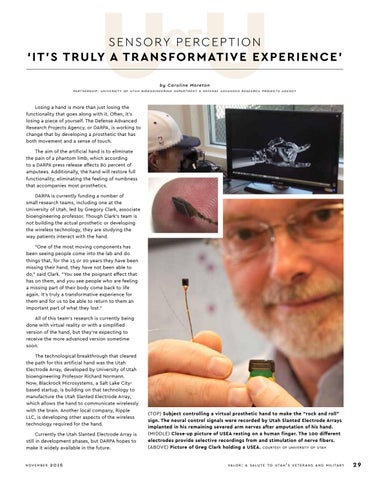
UU of
S E N S O RY P E RC E P T I O N ‘ I T ’ S T RU LY A T R A N S F O R M AT I V E E X P E R I E N C E ’ b y Ca ro l i n e M o re to n
pa r t n e r s h i p : u n i v e r s i t y o f u ta h b i o e n g i n e e r i n g d e pa r t m e n t & d e f e n s e a d va n c e d r e s e a r c h p r o j e c t s a g e n c y
Losing a hand is more than just losing the functionality that goes along with it. Often, it’s losing a piece of yourself. The Defense Advanced Research Projects Agency, or DARPA, is working to change that by developing a prosthetic that has both movement and a sense of touch. The aim of the artificial hand is to eliminate the pain of a phantom limb, which according to a DARPA press release affects 80 percent of amputees. Additionally, the hand will restore full functionality, eliminating the feeling of numbness that accompanies most prosthetics. DARPA is currently funding a number of small research teams, including one at the University of Utah, led by Gregory Clark, associate bioengineering professor. Though Clark’s team is not building the actual prosthetic or developing the wireless technology, they are studying the way patients interact with the hand. “One of the most moving components has been seeing people come into the lab and do things that, for the 15 or 20 years they have been missing their hand, they have not been able to do,” said Clark. “You see the poignant effect that has on them, and you see people who are feeling a missing part of their body come back to life again. It’s truly a transformative experience for them and for us to be able to return to them an important part of what they lost.” All of this team’s research is currently being done with virtual reality or with a simplified version of the hand, but they’re expecting to receive the more advanced version sometime soon. The technological breakthrough that cleared the path for this artificial hand was the Utah Electrode Array, developed by University of Utah bioengineering Professor Richard Normann. Now, Blackrock Microsystems, a Salt Lake Citybased startup, is building on that technology to manufacture the Utah Slanted Electrode Array, which allows the hand to communicate wirelessly with the brain. Another local company, Ripple LLC, is developing other aspects of the wireless technology required for the hand. Currently the Utah Slanted Electrode Array is still in development phases, but DARPA hopes to make it widely available in the future.
november
2016
(TOP) Subject controlling a virtual prosthetic hand to make the “rock and roll” sign. The neural control signals were recorded by Utah Slanted Electrode Arrays implanted in his remaining severed arm nerves after amputation of his hand. (MIDDLE) Close-up picture of USEA resting on a human finger. The 100 different electrodes provide selective recordings from and stimulation of nerve fibers. (ABOVE) Picture of Greg Clark holding a USEA. courtesy of university of utah va l o r : a s a l u t e t o u ta h ’ s v e t e r a n s a n d m i l i ta r y
29
USU
RO C K E T S C I E N C E ‘ W E U S E O F F -T H E - S H E L F C O M P O N E N T S TO C R E AT E P R AC T I C A L S O L U T I O N S ’ b y D a n a R i m i n g to n
pa r t n e r s h i p : u ta h s tat e u n i v e r s i t y e n g i n e e r i n g d e pa r t m e n t & n at i o n a l a r e o n a u t i c s a n d s pa c e a d m i n i s t r at i o n
Students and faculty at Utah State University watch as a small rocket motor is tested. USU has developed a method to make a safer, next-generation motor using printed ABS plastic and inexpensive components. courtesy of utah state university Recently a Utah State University engineering team received a $200,000 grant from National Aeronautics and Space Administration (NASA) to continue development of a new generation of “green” small rocket motors. While electronic sensors in spacecraft have become highly sophisticated in emerging space programs, propulsion systems have been lagging behind, resulting in a big push by NASA and the Department of Defense to develop less toxic alternatives for in-space propellants, according to Professor Tony Whitmore, chief researcher for the team. Consequently, engineers at USU have developed an alternative, non-toxic propellant using multiple layers of printed ABS plastic using conventional 3-D printers. When a low-power electrical charge is applied, a small amount of material on the surface evaporates, creating a highperforming rocket motor.
30
“It’s not very often we get to be on the leading edge of technology, but we are now emerging from the market with the ability to build a simple, relatively inexpensive non-toxic rocket propeller system,” said Whitmore. The grant money from NASA will help Whitmore’s team test the motors and ensure other parts on the spacecraft aren’t adversely affected. Creating the non-toxic small rocket motor also comes with a smaller price tag. “We can actually make rockets systems for a couple hundred dollars to accomplish the same thing as other companies that spend thousands of dollars,” Whitmore said. “Working with toxic propulsion is becoming prohibitively expensive, so there are a lot of labs looking to get rid of that, and we are one of the potential technologies companies are looking into.”
unique. “It has been a realistic transition from the academy side to the real industry side of things, working on a project that requires a real solution,” Merkley said. “It’s a kind of like a dream to help propel space exploration and make small satellites more usable with better cost production. Going through this process I’ve seen how good our research is here. We may not have the fancy equipment at a fancy school, but it worked to our advantage because we used off-the-shelf components to create a practical solution.” Recently the team traveled to NASA’s Marshall Space Flight Center in Huntsville, Ala., where NASA took notice of their rocket propulsion system. “It was an eye opener and a big step forward for our team,” Merkley said.
Student Stephen Merkley has been working on the project for the last two years and says the opportunity has been
va l o r : a s a l u t e t o u ta h ’ s v e t e r a n s a n d m i l i ta r y
november
2016
UVU
CY B E R S EC U R I T Y C O U N T E R M E A S U R E S ‘ YO U N E V E R K N OW W H O T H E B A D G U YS A R E ’ b y H a n k M c I n t i re
pa r t n e r s h i p : u ta h va l l e y u n i v e r s i t y i n f o r m at i o n s y s t e m s a n d t e c h n o l o g y d e pa r t m e n t & u . s . d e pa r t m e n t o f l a b o r
In July 2016, Utah Valley University received approval from the Utah Board of Regents for five new graduate degrees. Among these new graduate programs, which will all begin fall semester 2017, is a Master of Science in Cybersecurity. According to Dr. Basil Hamdan, assistant professor of Information Systems and Technology at UVU, this new degree is unique in the West and is among only a handful of such programs in the nation. “We’re excited that our program is the only one in the state of Utah,” said Hamdan. “Our goal is to establish a center of academic excellence in cybersecurity, which will be a very prestigious designation.” Hamdan explained that cybersecurity is not just a concern for organizations such as the well-known, three-letter agencies of the U.S. government—the NSA, FBI and CIA— but large, medium, and even mom-and-pop enterprises deal with data-security issues.
“Every organization needs cybersecurity,” he said. “They all have data that needs to be protected from intruders. Small businesses are very vulnerable because credit cards can be compromised because of poor cybersecurity countermeasures. There is so much at stake.” The seeds of UVU’s new Cybersecurity graduate program were planted with a $3 million grant from the U.S. Department of Labor and grew from a basic certificate to an associate’s and later a bachelor’s degree. These “stackable” credentials now culminate with a master’s, and Hamdan credits ongoing conversations and partnerships with local businesses and government entities, where the need for this advanced degree was communicated to UVU professors and university officials. “There is a huge shortage in cybersecurity expertise,” he added. “This is a national issue. When our students graduate, they have the potential to go
anywhere. There is a huge demand and a small supply in terms of the numbers and market needs.” With the new program, which blends technical training and managerial courses, UVU computer-science students, a number of whom are military veterans or currently serving, are opting to remain at the school to pursue this degree. One such student, Hamdan said, is actually deployed with the U.S. military to Kuwait and dials in via Skype at 4 a.m. Kuwait time, to attend class. “Part of the vision the university had was to help students prepare to work for network and cybersecurity,” said Hamdan. “The IT companies such as those in Utah County’s Silicon Slope are potential employers, as are the state of Utah, educational institutions and the healthcare field. Our ultimate goal is to increase awareness of cybersecurity and the threats that are out there. You never know who the bad guys are.”
According to Fortune magazine if companies don’t invest in educating their employees about security risks they pose the largest risk in the organization. Large investments in security often do not account for user error and its effects. i stock images
november
2016
va l o r : a s a l u t e t o u ta h ’ s v e t e r a n s a n d m i l i ta r y
31
WSU
BUILDING BRIDGES ‘ WO R K I N G TO K E E P O U R C O M M U N I T Y S A F E R’ b y D a n a R i m i n g to n
pa r t n e r s h i p : w e b e r s tat e u n i v e r s i t y l aw e n f o r c e m e n t a c a d e m y & h i l l a i r f o r c e b a s e s e c u r i t y f o r c e s
Weber State University has recently solidified a partnership between the Law Enforcement Academy and Hill Air Force Base Security Forces resulting in an impactful collaboration to further each agencies’ goals. The public/private partnership agreement allows law enforcement cadets access to select buildings on base for realistic training scenarios and civilian and military officers from the Security Forces on base additional training at WSU. “The academy runs on such a small budget that we have a really tough time renting out facilities we can use for training that would enhance training for our cadets, and now we have the use of facilities on base for training, building searches, crimes in progress, and instruction on responding to active shooters,” said Academy Director Jack Rickards. As a part of the reciprocal agreement, which took two years to complete, security forces from the 75th Air Base Wing can attend classes at the academy. Rickards says they have trained up to 100 of Hill AFB’s security forces in various radar operations and testing. “At the academy we are thrilled to be involved with the Air Force because their airmen are mixing with our cadets, and there is a great connection between two different types of police agencies that work right next to each other,” Rickards said. According to John Felty, with the 75th Security Forces at Hill Air Force Base, it is a mutually beneficial partnership. “As a community of law enforcement, it makes a lot of sense for us to work together since we all have the same goals,” Felty said “We are reaching out off-base and building bridges to keep those relationships strong because we all do the same thing at the end to make our community safer.”
Weber State University students and military officers from the Security Forces at Hill AFB train together in various radar operations. A recent agreement allows cadets and service members from two different types of police agencies to work next to each other in a mutually beneficial partnership. courtesy of weber state university
The partnership also allows cadets from the academy the opportunity to associate with civilian and military officers going through the same classes, which leads to positive interactions between the two organizations. Sometimes it is difficult to maintain instructors for certain types of curriculum. “Weber State offers these courses that are hugely beneficial. We had a requirement, and the academy resourced it to fit our schedule. We look forward to our continuing partnerships with the academy.”
32
va l o r : a s a l u t e t o u ta h ’ s v e t e r a n s a n d m i l i ta r y
november
2016
FLYIN’ HIGH DOWN SOUTH J ROTC A I M S TO ‘C R E AT E B E T T E R C I T I Z E N S’ T H RO U G H L E A D E R S H I P A N D T E A M WO R K by David Cordero fo r va lo r m aga z i n e
G
lenn Whicker knew he wanted to work with America’s youth in the next phase of his life, but the Kaysville native didn’t envision a return to a state he hadn’t lived in for 26 years—never mind the thought of retiring to one of the West’s retirement meccas. Whicker, a colonel in the United States Air Force, was concluding a long career in early 2006. Along the way, he had heard of the Air Force’s Junior Reserve Officers’ Training Corps ( JROTC) and his interest was piqued. He earned his second bachelor’s degree in education and applied for three programs in Virginia while stationed at the Pentagon, his final stop as an active-duty officer. One day, Whicker decided to check the job postings on the internet. Out of nowhere, it flashed in front of him. There was a new unit set for Dixie High School in St. George. “I don’t know how they got on the list because it has to be approved by the Secretary of the Air Force and I got an advanced copy of what had been approved that year and St. George was not there,” Whicker says, still baffled more than a decade later. “I quickly put in an application and I was really glad I did. This is the perfect place for this program.”
has more than 1,600, according to the U.S. Army Cadet Command. In the beginning its goals were to create a fertile training ground of enlisted recruits and officer candidates. Now, Whicker says, the objective is to simply “create better citizens.” This is done through leadership training and teamwork—traits that are among the great appeals of the Armed Forces and, for many veterans, the reason for their nostalgia toward the service. But in the early 2000s there were no JROTC units in St. George, and that rankled local veterans such as Dick Werner and Audre Wells. Werner was assigned to the USS Arizona and was on leave when Pearl Harbor was attacked. Wells, part of the first group of women to join the Marine Corps during World War II, was the first drum major of the branch’s female band and in later years the first female post commander of the American Legion in St. George.
—∞—
They wanted nothing more than to bring JROTC to St. George—so much so that Werner was known to frequent the Dixie High School office and push for a unit. The lobbying paid off eventually when the idea was given an audience—newly appointed Washington County School District Superintendent Max Rose.
A century ago, President Woodrow Wilson signed the National Defense Act of 1916, which established a program of voluntary military training of college students under a single federally-controlled entity, called the Reserve Officers’ Training Corps. The JROTC, for high school students, began in the same year with six units. It now
Wells put her son Rick Bensemon into action. A retired Air Force major, Bensemon started a JROTC unit in Rexburg, Idaho, in 1994, and is a virtual evangelist for the program. When the subject of JROTC is broached, Bensemon’s cadence quickens as he describes it as a “leadership lab where you learn leadership by being leaders.”
november
2016
va l o r : a s a l u t e t o u ta h ’ s v e t e r a n s a n d m i l i ta r y
33
JROTC IN UTAH The Army, Navy, Air Force, Marines and Coast Guard each operate their own versions of the program for high schoolers. Visit online portals for each branch to find programs. AIR FORCE au.af.mil/au/holmcenter/ AFJROTC Clearfield, Provo, Northridge (Layton), Dixie (St. George), Utah Military Academy (Riverdale). ARMY usarmyjrotc.com/jrotc-program Ben Lomond and Ogden (Ogden), Independence (Provo), Taylorsville (SLC). NAVY njrotc.navy.mil/host_schools West (SLC). Checkout Sea Cadets hosted at Hill Air Force Base. utahseacadets.org
Dixie High School’s Air Force JROTC cadets present the colors at various community and service activities. courtesy of dixie high school jrotc
Instead of Bensemon preaching JROTC to the WCSD big wigs, he brought four of his cadets from Layton’s Northridge High School to a school district meeting. “When we presented the idea to Max Rose, ( JROTC) couldn’t have happened quick enough for him,” Bensemon recalls. “Without Max Rose’s support it never would have happened.” —∞— When Whicker began Dixie High’s program, it was the Dixie High Air Force JROTC in name if not in composition. The program pulled kids from grades ninth through 12th from a total of 12 of the county’s secondary schools (ninth graders are considered middle schoolers in the WCSD). “The thing that makes it work is the transportation (department) for the district. Those guys bend over backwards to get all cadets funneled into here and then get them back to their schools for second period each day.” The program began with 68 cadets in 2006 and 10 years later has 270 students. On any given day, cadets could be involved in aviation training, presenting the colors and various leadership and service activities. A new St. George unit was added at Pine View High School in time for the 2016-17 school year, which allows for greater growth. More than 1,000 students have passed through Whicker’s program, and with them an abundance of success stories. Quinten Parker earned an appointment to West Point and is on the football team. In 2015, Andria Webb 34
va l o r : a s a l u t e t o u ta h ’ s v e t e r a n s a n d m i l i ta r y
MARINES mcjrotc.marines.mil COAST GUARD gocoastguard.com Neither the Marines nor Coast Guard operate programs in Utah.
became the first female cadet to earn her pilot’s license as part of the Dixie JROTC aviation program. And earlier this year two cadets—Cole Cutner and Jack Wright—accepted invitations to attend retired U.S. Army Gen. Tommy Frank’s Four Star Leadership Camp in Hobart, Okla. Only 67 youths nationwide were chosen to participate in the camp. Whicker says he was in the right place at the right time. “St. George has a strong veteran base. It’s got an administration that is supportive both at the school and district level. It’s got parents that are patriotic and very interested in their children learning citizenship,” Whicker says. Then he smiles. “It was a confluence of perfect conditions to make this a successful program.” The program’s director, for whom 12- to 14-hour days are not atypical, may have had something to do with it. “We would be lost without Col. Whicker molding the young men and women,” says Marti Bigbie, commander of American Legion Post 90 in St. George. “He really is a driving force for the kids.” For Whicker, this type of retirement sure beats a rocking chair. David Cordero has been a professional writer for more than 15 years and has won several first place awards in state and regional writing contests on a variety of subjects, including sports, education and military matters. He has written for newspapers, newsletters, magazines, websites and programs. He lives in St. George with his wife Julie and their two children. Follow him on Twitter: @davidcorderosr
november
2016
Col. Glenn Whicker (Ret.) has piloted Dixie High School’s Air Force JROTC program for the past decade. Students participate in aviation training, presenting the colors and various leadership and service activities. courtesy of dixie high school jrotc
november
2016
va l o r : a s a l u t e t o u ta h ’ s v e t e r a n s a n d m i l i ta r y
35
Does Your Adolescent Use Pain Relievers? PRA Health Sciences is currently seeking adolescent volunteers for an investigational study in Salt Lake City. Your child may qualify if they are: • A healthy male or female • 12-17 years old • Using over-the-counter pain relievers, including at least 5 times in the past month • Available for 1 overnight stay (with parent), plus a follow-up phone call Qualified study participants may receive compensation up to $500. A parent may also receive compensation up to $250.
3838 S 700 E #202 • Salt Lake City, UT
Call: 801-269-8200 • Volunteers.PRAHS.com B506008 Site 1003 Version 1.2 03 OCT 2016
Peripheral Neuropathy WarNiNg! South Jordan, UT—The most common method your doctor will recommend to treat your neuropathy is with prescription drugs that may temporarily reduce your symptoms. These drugs have names such as Gabapentin, Lyrica, Cymbalta, and Neurontin, and are primarily antidepressant or anti-seizure drugs. These drugs may cause you to feel uncomfortable and have a variety of harmful side effects. Peripheral neuropathy is a result of damage to the nerves often causing weakness, pain, numbness, tingling, and the most debilitating balance problems. This damage is commonly caused by a lack of blood flow to the nerves in the hands and feet which causes the nerves to begin to degenerate due to lack of nutrient flow.
Figure 2: When these very small blood vessels become diseased they begin to shrivel up and the nerves begin to degenerate. As you can see in Figure 2, as the blood vessels that surround the nerves become diseased they shrivel up which causes the nerves to not get the nutrients to continue to survive. When these nerves begin to “die” they cause you to have balance problems, pain, numbness, tingling, burning, and many additional symptoms. The main problem is that your doctor has told you to just live with the problem or try the drugs which you don’t like taking because they make you feel uncomfortable. There is now a facility right here in South Jordan that
offers you hope without taking those endless drugs with serious side effects. (see the special neuropathy severity examination at the end of this article) In order to effectively treat your neuropathy three factors must be determined. 1) What is the underlying cause? 2) How Much Nerve Damage Has Been Sustained. NOTE: Once you have sustained 85% nerve loss, there is likely nothing that we can do for you. 3) How much treatment will your condition require? The treatment that is provided at The Scranton Clinic has three main goals: 1) Increase blood flow 2) Stimulate small fiber nerves 3) Decrease brain-based pain The treatment to increase blood flow utilizes a specialized low-level light therapy (not to be confused with laser therapy) using light emitting diode technology. This technology was originally developed by NASA to assist in increasing blood flow. The low level light therapy is like watering a plant. The light therapy will allow the blood vessels to grow back around the peripheral nerves and provide them with the proper nutrients to heal and repair. It’s like adding water to a plant and seeing the roots grow deeper and deeper. The amount of treatment needed to allow the nerves to fully recover varies from person to person and can only be determined after a detailed neurological and vascular evaluation. As long as you have not sustained at least 85% nerve damage there is hope! The Scranton Clinic will do a neuropathy severity examination to determine the extent of the nerve damage for only $45. This neuropathy severity examination will consist of a detailed sensory evaluation, extensive peripheral vascular testing, and a detailed analysis of the findings of your neuropathy. Dr. Scranton will be offering this neuropathy
Figure 1: Notice the very small blood vessels surrounding each nerve. severity examination from now until December 31st, 2016 Call 801-937-4412 to make an appointment with Dr. Scranton to determine if your peripheral neuropathy can be treated. The patient and any other person responsible for payment has a right to refuse to pay, cancel payment, or be reimbursed for payment for any other service, examination or treatment that is performed as a result of and within 72 hours of responding to the advertisement for the free, discounted fee, or reduced fee service, examination or treatment.
Figure 3: The blood vessels will grow back around the nerves much like a plant’s roots grow when watered.
CALL (801) 937-4412 TODAY! Dr. Rob Scranton, D.C., Chiropractic Physician
4755 Daybreak Pkwy, #102
South Jordan, UT 84095 • www.SouthJordanNeuropathy.com