SUMMER
THE VISUAL ART QUARTERLY OF ST. LOUIS
2017
Jim Frederick, Mother Nature, (photo credit: Maxine Ward)
CONTENTS IN REVIEW (PGS. 01-09) EXECUTIVE EDITOR AND CO-FOUNDER SARAH HERMES GRIESBACH
CREATIVE EDITOR AND CO-FOUNDER AMY REIDEL
INTERIM ASSOCIATE CREATIVE EDITOR ADDOLEY DZEGEDE
DIRECTOR OF LAYOUT AND DESIGN MAXINE WARD
PRINCIPAL PHOTOGRAPHER RICHARD REILLY
WEB DESIGN AND ADMINISTRATION AMY MILLER
SOCIAL MEDIA AND OUTREACH MANAGER KRISTA VALDEZ
CONTENT CONTRIBUTORS BRUCE ALVES III KEVIN DECKER CAMERON GRAY SARAH HERMES GRIESBACH JOE KOHLBURN ANN TECLA LUNDQUIST PETER MANION DANIELLE MCCOY LACY MURPHY
NELSON PEREZ PETER PRANSCHKE ERIN MCGRATH RIEKE EDO ROSENBLITH RACHEL SACHS ANNE TREEGER RICH VAGEN TIMOTHY WAGNER SARAH WEINMAN ADRIAN WRIGHT
Covers: Michael Drummond, Queens, (image courtesy of World Chess Hall of Fame)
Our reviews are written without regard to the theme of each issue. Here you will find independent, thoughtful analysies written by established and emerging art writers. We welcome new writers to join in our effort to document some of the incredibly abundant art events that our region offers. And we encourage everyone everywhere to seek out exhibition opening events for a fun, free date night or an intriguing evening out alone. Nervous? Please, don't be. Break through that oh-so-pervasive invisible barrier that keeps so many of us from thinking we belong at public art events. Whoever you are, these art events are for YOU. (Follow our Facebook page for constant updates on what's happening where and when.)
ARTIST INTERVIEWS (PGS. 10-11) Read what established artist-gallerist, Charles Houska, and recent Visionary in the Arts recipient, Kat Reynolds, have to say about their respective art practices. If inspired, consider interviewing someone in our area whose story you think needs sharing.
COMMUNITY VOICES (PGS. 12-19) All of our contributions to this section come from artists drawn to this issue’s loose theme, “Art and Humor.” Peter Pranschke provides our first ever commissioned artwork in the form of his cartoon spread. We received more than one description of art projects that deal with the very cruel use of humor to reinforce racial stereotypes and to justify white violence and the oppression of black people in America. The combination of all of these essays provides interesting insight into the varied life experiences and perspectives of our regional artists.
COMMENTARY (PGS. 20-22) When we are sent a “heart-story,” it goes over here in the Commentaries. These, too, are an important record of our regional art world, because these essays present hot topics that shape our time and place. We've thrown in a new feature from the editors for this issue. We organized a list of Summer Hits for your viewing pleasure. This list provides just a taste of the art exhibitions that you could experience over the course of these three hot summer months. We hope you will check out something in a new-to-you neighborhood and learn something new about your little part of the world while getting to know the work of an artist!
Bruce Alves III, Fairy Dust Smuggler, (image courtesy of the artist)
Introducing Addoley Dzegede! While Creative Editor and Co-Founder, Amy Reidel, is away on happy family leave, Addoley, a local artist and art educator, is lending her discerning eye to All the Art. Last Winter, we asked our All the Art community to come up with images and ideas that would address the topic of “Art and Humor,” perhaps finding some humor in the dark side of current affairs. After all, it’s said that laughter is the best medicine. We stated in that letter that previous issues sometimes seemed overwhelmingly gloomy and that something fun was called for. Oh boy. Looking over the content of this issue we were quickly reminded of humor’s capacity to take on the most scary, devastating, challenging, hurtful, and upsetting aspects of our lives. Humor is more than amusement, it is a tool. Most artists that responded to our call find that a spoonful of humor helps the social criticism go down. Theirs are not light and frothy subjects. Far from it.
And then there is the issue of how to write about humor. Here at All the Art, we know that art can be funny. Why, we’ve laughed at art, or er - with art, from the Super-Duper Realists of the mid-nineteenthcentury to the brief and more recent Arte Sandwiche movement of the twentieth-century. So, we figured this humor theme for our Community Voices section would be easy. But, it turns out, explanations of humor are generally just not that funny. Who knows what new insights will come to your editors when regional artists and writers respond to our Fall -Take Care of Artists!- theme. This September, we will share what they bring us on the loose subject of artists’ wellness. As for the unpredictable nature of this and every call for contributions, we welcome surprises and invite all to participate!
All the Best,
Executive Editor and Co-Founder
Interim Associate Creative Editor
314.704.8870
addoley@gmail.com
IN REVIEW
JUAN WILLIAM CHÁVEZ:
SUN HIVE
Juan William Chávez: Sun Hive at the Craft Alliance Center of Art + Design showed a mix of sculpture and paintings, all built upon the varying aspects of a cultural and personal identity and all they encompass. Taking both elements of his cultural heritage and his practice working with bees, Chávez creates pieces that elevate a communal relationship that has existed for thousands of years. Many of the sculptures include items from beekeeping. Hive Worker I and Hive Worker II show two gloves, used for protection when working with a bee hive, mounted on metal rods, displayed upright. Other than the display, they are shown unaltered. Their importance as an object becomes more than respect of the work they aid in. The gloves become almost reliquary.
Likewise, Hive Tool I transforms an object into a relic. Many of the sculptures are assemblages, made up of pieces and materials used in beekeeping, creating abstract works that both reference beekeeping and are, at the same time, not direct depictions. Hive Tool I highlights a small hand shovel, its spade draped in golden brass. Above the shovel, suspended by a wooden frame, sits –or floats– an artificial honeycomb. The purpose of the shovel—that it plays a role in working bees—is immediately clear. Clear too, is its importance. While the objects may be recognizable, their arrangement in the assemblages, as with Hive Tool I, Hive tool II, and Hive Tool III, placed within old wooden frames, creates an almost Duchamp-esque abstraction. While Chávez, in these smaller sculptures, takes materials from beekeeping or those indicative of Peru to create abstracted works,
Juan William Chávez, installation view (image courtesy of Craft Alliance Center of Art + Design) 01 ALLTHEARTSTL.COM SUMMER 2017
IN REVIEW
CRAFT ALLIANCE the most representational piece in the show takes the opposite approach. Originally made for and shown at Artspace in San Antonio, Hive Body presents the tall, demanding presence of a beehive sculpture made of recycled materials salvaged from a camper van. It is such a convincing representation of a beehive, the stacked boxes, that it is almost alarming to see it indoors. This hive is not, however, made of anything related to the care of bees or honey collection. The piece that appears to show the strongest visual connection to beekeeping is also the piece that contains the least connected materials. It is this play that makes Sun Hive so intriguing and engaging. In perhaps his most referential depiction of his Peruvian roots, and perhaps the center of the show, is the unmissable Shaman’s Blanket. Sitting on what appears to be a large,
IN REVIEW Juan William Chávez, installation view (image courtesy of Craft Alliance Center of Art + Design)
metallic, thermal blanket, is a collection of objects, some of them easily recognizable: a beekeepers mask, a smoker, a hive box. Others are perhaps not obviously recognizable, but their use clearly important; ropes, small tools, or containers. And then there are objects whose purpose is entirely foreign and unclear. A large drum-like container sits in the back, covered in a wax dripping. Its original use may not be important in this context, but it has become an anchor of the piece, its size, shape, weight, and worn exterior, defining a feeling of ritual mysticism. Accompanying the sculptures are five ink on canvas paintings. All five, Hive Mound I-V, feature a beehive as the central focus. Generally consisting of the same basic shape, a mound with a square shape on top, they represent a visual exercise in meditation and the strongest representations of many of the key elements of bee life. The repetition in these drawings, reusing the same basic strokes, gives the opportunity for contemplation and meditation. The act of
drawing becomes routine and orderly. Motions become set, a means to the product. Bees, in their roles as queen, worker, or drone, carry out their tasks. Thought is not part of the equation, the repetition in the Hive Mound series so keenly highlights that. Beyond the process, the black ink evokes an association to Buddhist art and Japanese ink paintings, further pressing the zen, meditative nature of the paintings. The beehive standing atop the mound, shown with simple black ink strokes, is reminiscent of a temple or Buddhist pagoda. Surrounding the hive is a flurry of paint in gold, black, and white. It is difficult to separate individual strokes. They work much stronger as a whole, as a swarm. This surrounding activity gives the beehive a halo and transforms it into an iconic image. Like many of the pieces in Sun Hive, and like much of life, the connections are numerous. Throught his art practice Chávez is able to connect cultures thousands of miles apart. The overall shape of the paintings create a triangle, or a ray of sunshine emanating from the hive,
IN REVIEW
or a pyramid—like the stepped pyramids of South America. The importance of the hive is elevated to the point at which everything radiates. Sun Hive celebrates inspiration —both being inspired and what inspires. Cultural roots, spiritualness, work, community, and ritual are themes throughout. There are so many layers, so much to take in, so many paths to see, that make the art of Chávez inviting and rewarding. -Rich Vagen
www.craftalliance.org www.juanwilliamchavez.com
SUMMER 2017 ALLTHEARTSTL.COM 02
IN REVIEW
LAUREL PANELLA:
IN SUSPENSION Reese Gallery, a very small and intimate space, provides artists with an opportunity to present their artworks in a way that not only makes it easy to view, but also to confront. In Suspension, an exhibition of works on canvas by Laurel Panella, seemed made for the space. Her large paintings—all in a similar grey hue that reveals subtle changes as you stare deeper into them—were spaced equally apart. Some gallery visitors observed a greenish hue, I saw more yellows, which is an intriguing effect of painting in the grey scale. Panella achieves that grey nuance well within this work. As an artist and an art lover, I find that when I come across work that makes me ask questions, I try to place myself in the artist’s shoes to find a personal connection. I was immediately drawn to Laurel’s work. My looking gave way for a moment for me to think, to question and to later react to things that perhaps she herself had never considered. As critic in this moment, I notice a lack of detail in the figures’ hands and feet. They appear perhaps unfinished, particularly in the
context of the detailed forms and faces of the figures. Perhaps this is intentional. Often, such curiosities have a purpose. Each of Panella’s painted figures holds this unusual pose—captured as a photograph would in a moment of dance, reflection, exercise or death. What happened just before that made them hold this active pose? I imagined a backstory that provided me with an understanding of each person and their pose. Panella, a resident of East Tennessee and 2015 graduate of Washington University’s Sam Fox School of Design and Visual Arts, describes her large scale figure paintings as “demonstrating individuals of different races, physical sizes and chronological age in postures of surrender.” The muted color and large-sized canvases seemed to make the room at Reese feel larger. The paintings sat just a bit higher than my eye view. As the figures appear to rise upon the canvas, the canvases themselves look to be floating upward, against gravity. I felt like a
REESE GALLERY
concert-goer staring up from the floor with the bright lights of the gallery, the color variations reflected just so subtly. At the same time, it felt like looking at an array of old photographs from a forgotten drawer. Panella’s figures are painted very large and not to scale, another poignant consideration. The detailed folds of the figures’ clothes appear soft, as if moving by a current coming up from below. The lightness of the work adds to this uplifted form. The paint is soft and creamy with pink undertones and a painterly stroke that when examined closer reveals the hand of the painter ever so slightly. It is that feeling which gives the work life. That visible sign of the painter’s process and the shifting hue of the painted greys could not come across if the artwork were simply a photo reproduction. -Peter Manion
www.thereesegallery.com www.laurelpanella.com
Laurel Panella, In Suspention installation view (image courtesy of Ruth Reese Gallery) 03 ALLTHEARTSTL.COM SUMMER 2017
IN REVIEW
IN REVIEW
P.M.L.
PAINTING ALL MY LIFE THE GALLERY WITHIN, WEBSTER GROVES CHRISTIAN CHURCH The opening event for Jim Frederick’s retrospective exhibition, P.M.L., at The Gallery Within of Webster Groves Christian Church was also a benefit for Doorways, a local agency for people living with HIV/AIDS. The exhibit marked the debut of The Gallery Within’s new mission to make social issues their spotlight, rather than just a feature of their curatorial planning. Another debut: Frederick’s first time exhibiting his artwork in a church. There is a synergy between Frederick’s art and the church space. Frederick’s paintings are a natural fit in the church, the bold shapes and colors echoing those of the stained glass windows. The geometric shapes and intersecting lines in some paintings explicitly mirror windows in form and content, and others more subtly, simply in the colors of the palette or the ethereal energy conveyed in their layered abstract shapes. Doorways and windows are implicit and explicit in his art, evoking the margins in which Frederick and his community reside, and the margins on which the gallery focuses its mission. This theme of liminality also symbolizes the transitions that are constant features in the lived experience of a person with HIV.
Susan Sontag warns us not to metaphorize illness, but it's hard to miss the meaning here: the way one living, struggling, painting with illness, hovers a little closer to the spiritual plane. The easily-made connection between Frederick’s art and the church space further reinforces the sense of resonance rooted in the various intentional connections of the exhibit. According to Reverend Jeff Moore and gallery director John Dyess, church parishioners also pray in this multipurpose space. As a viewer, I could imagine praying amid Frederick’s bright paintings to be a distinct and powerful kind of spiritual experience. Frederick paints in an engrossing Abstract Expressionist style, with an openness afforded by its layered texture, energetic brushwork, and vivid, saturated hues. The artworks, mostly abstract and all evocative, range the gamut in tone and emotion. The expressiveness of the artworks—perhaps the joyful ones even more so—takes on a more poignant meaning when one considers the deterioration in Frederick’s mobility and verbal ability. Frederick incorporates this experience into his art, infusing his paintings with the emotions of his experience, reflected in the names of exhibited artworks: Window Pain, Chaos, Apathy. Frederick’s illness
has influenced the course of both his life and his art, bringing him back to his family and limiting his mobility—and subsequently changing the way he paints. The chronology of the exhibited artworks, spanning more than a decade, showcases shifts in his artmaking over the course of his adult life, his art practice and his illness. The exhibit was a long time coming. Reverend Moore first suggested it to Frederick two years ago, after meeting and befriending the artist during weekly breakfasts at Doorways. Moore spoke of having an elaborate vision for the exhibit opening from early on, one that took time to manifest and proved remarkably intact at the opening—an exhibit that would benefit Doorways, feature a performance by Gateway Men’s Chorus, and of course, showcase Frederick’s art from his time in Dallas and St. Louis. In essence, a celebration not only of Frederick’s art, but also of his life and community.
-Rachel Sachs www.wgcc.org
Jim Frederick, Chaos (left) and Apathy (Right) (photo credit: Maxine Ward) IN REVIEW
SUMMER 2017 ALLTHEARTSTL.COM 04
IN REVIEW
TRANSPARENCY SHADE: SEEING THROUGH THE SHADOW
PROJECTS + GALLERY Transparency Shade: Seeing Through the Shadow, curated by Senegalese-born multidisciplinary artist Modou Dieng, is a visually stunning and thought-provoking array of multimedia works crafted by seven diverse artists (Ayana Jackson, Hank Willis Thomas, Kendell Carter, Kahlil Irving, Zoë Buckman, Philip Aguirre y Otegui, and Michael Reidel) unified by themes of vision and visibility, of seeing and being seen, and of identity formation in an ever-changing socioeconomic and political landscape.
Through photography, sculpture, collage, and installation, the seven artists acknowledge and transform artistic precedents and traditions, intentionally appropriating source material to create a foundation for further inquiry into the relationship between viewer and object and between artist and subject. Thus, both the artist and viewer are compelled to engage in a process of questioning and meaning-making based on their respective positions.
This particular emphasis on the examination of relationship and cultivation of identity and meaning is poignantly illustrated through the conceptual photography of Ayana Jackson and Hank Willis Thomas. Jackson’s works are a visual analysis of the history of photography and its relationship to the black, or nonwhite, body. Jackson deftly appropriates historic images, assuming the role of black women to portray the dignity and resiliency of ancestors and confront the subjugation and denigration of the black body during American colonial expansion. By removing the subjects in Diorama and What will you tell about me? from their original visual backgrounds and placing them against new, incongruent backgrounds, Jackson illustrates the theatrical compositions intended by the white photographers and their elitist contemporaries. As the black bodies of her ancestors are put on display, Jackson employs repetitious use of self (via Photoshop) to take on the burden of the male gaze. Thomas similarly engages with the viewer through rousing visual imagery and symbolism drawn from and inspired by various twentieth-century social movements. With Amelia Falling, for instance, the artist a ppropriates the image of a female Civil Rights activist beaten by Selma police on March 7, 1965, infamously known as Bloody Sunday. Printed on mirrored glass, the work enables the viewer to see themselves in a historical moment, thereby bridging our understanding between past and present events and circumstances. As developed, the work also stands to represent the struggle of many African Americans to achieve a unified identity due to racialized oppression and the internalization of negative perceptions reflected by white society – or what W.E.B. DuBois referred to as “double consciousness.” With I Am A White Agitator Thomas both invokes and pays tribute to the power of the political signs and symbols that helped to define the social justice movements of the twentieth and twenty-first centuries. As with Amelia, the message of Agitator is easily recognizable and relevant to the present day struggle for equality and social justice. The perceived gulf between past and present becomes compressed.
Zoë Buckman, Let Her Rave, (photo credit: Keith Decker) 05 ALLTHEARTSTL.COM SUMMER 2017
IN REVIEW
IN REVIEW
Kendall Carter’s enveloping installation work, featuring the mixing of objects, materials, and art historical and design traditions, embodies the idea of art as an experience. His distinctive approach—largely influenced by street art and hip hop culture—suggests a bridging (or blurring) of social/cultural divisions and serves as a reference point on contemporary notions of identity, race, gender, and consumerism. Carter’s technique is an integral part of his messaging, as is seen in his use of repetition as a metaphor for branding. The artist credits hip hop culture, with its pattern of sampling and combination and fusion of distinct influences, as the foundation for his work. For Carter, hip hop represents how are we are in the world, how we live our lives and how we come to be. Carter’s work includes various bronze-casted objects and materials, such as athletic shoes and formal apparel that reflect intersecting art and design traditions. (The practice of bronzing was once considered the highest form of sculpture in Ancient Greece and prominent across Africa, Europe, and East Asia. Bronze alloy is also considered ideal for sculpture, as it expands while setting and fills in the finer details of a mold.) Zoë Buckman's work, Let Her Rave, references a problematic stanza in Yeats' Ode to Melancholy (‘Or if thy mistress some rich anger shows/ Imprison her soft hand, and let her rave/ And feed deep, deep upon her peerless eyes.’). The artist neatly wraps pairs of boxing gloves in reconstituted wedding dress material and juxtaposes 'soft,' feminine fabrics with hard, thick metal chains. As such, Buckman explores themes relating to the systemic and causal manifestations of gender-based aggression in the past and present. Other artists featured in Transparency Shade, such as Philip Aguirre y Otegui, Kahlil Irving, and Michael Riedel, similarly draw from and expand upon artistic precedents in sculpture, collage, and experimental printmaking, sometimes reinventing and reinterpreting their own works (i.e., Riedel). Collectively, all seven artists, each with their distinctive style and emphases, employ and confront appropriation to offer visually rich meditations on how we come to see ourselves and each other in an increasingly complex, uncertain and ever changing globalized world. Transparency Shade is on display at Projects + Gallery (4733 McPherson) from April 7 until May 27, 2017. -Keith Decker
Kendell Carter, Effigy for a New Normalcy VII (Accepting Greatness 2), 2017 (photo credit: Keith Decker)
www.projects-gallery.com IN REVIEW
SUMMER 2017 ALLTHEARTSTL.COM 06
IN REVIEW
LEARNING TO SEE:
RENAISSANCE AND BAROQUE MASTERWORKS FROM THE PHOEBE DENT WEIL AND MARK S. WEIL COLLECTION SAINT LOUIS ART MUSEUM To flaunt a gift before it’s entirely given might seem a bit imprudent, but one can easily pardon the Saint Louis Art Museum for its eagerness to share the treasures recently promised by Phoebe Dent Weil and Mark S. Weil. With 82 of the over 150 works on view from the fifteenth through eighteenth centuries, Learning to See: Renaissance and Baroque Masterworks (on view through July 30th), honors not only the Weils’ unwavering devotion to classical antiquity and early engraving, but their larger curiosity about the ways in which early modern thinking and making differ from our own.
examine them at length. These are dense pieces that reward a perspicacious and patient pair of retinas. “This promise pushes our collection forward by light years,” says Wyckoff. On many pieces, the imprint of collector is more prominent than the name of
the artist—to own often meant to brand a work as publicly yours. To collect on its own was its own vocation, arguably its own kind of art. During my second visit to the exhibit, I overheard an ardent voice on the other side of
A sense of both gravity and calm await those stepping through the gallery’s stately glass doors. Deep teal walls enclose a dimmed interior; the space feels ornate but intimate, as though one has shrunk and is touring a tabernacle. Illuminated such that the general space has a hushed, shadowed quality, the refulgence of the bronze and copper sculptures on display are thrown into relief. One’s eyes adjust gradually to the glowing works on paper from Renaissance and Baroque masters. Appropriately, a magnifying glass is Plexi-glassed aside the entrance. Thematically grouped into sections ranging from the more conceptual—Devotion and Theatricality and Allegory and Myth—to the literal—Print Culture and Bronze and Clay—Learning to See was curated by the dynamic duo Elizabeth Wyckoff and Judith Mann. Mingling prints with sculpted objects of both decorative and religious significance, the sheer diversity of works would feel overwhelming were it not for how thoughtfully they are organized. What they share in common is a love of particulars—the undulating marble hairs weaving the eyebrows of emperor Marcus Aurelius, the delicate dragons in the foreground of Giorgio Ghisi’s Allegory of Life, the extravagant folds of Ariadne’s tunic in a seventeenth-century bronze, the lion skin worn by Greek goddess Omphale in a Flemish engraving by Aegidius Sadeler. In many of the engravings on display—especially those of German artist and intellectual Albrecht Dürer —the details of are so meticulous, it almost aches the brain to 07 ALLTHEARTSTL.COM SUMMER 2017
Albrecht Dürer, Nemesis (image courtesy of the Saint Louis Art Museum) IN REVIEW
IN REVIEW
the title wall. “This piece is full of in-jokes,” the voice said, pointing out subtle innuendos in a woodcut engraving by Dürer. “Notice how here the artist had to cut against the grain, which is very difficult. These curvy lines are the hardest to do….” The same voice lingered in the room adjacent, observing a Dutch engraving of an erotic suicide via asp: “This one looks like a turtle-head, but it’s supposed to be a snake’s.” As tempting as it was to eavesdrop indefinitely, I sauntered over to the speaker, expecting to see an elder docent with a group of visitors. Instead, it was none other than Mark Weil himself—gesticulating in a sweater and blue jeans as he described the works up close. The steady rise of his voice had the energy of a schoolboy showing off a cache of baseball cards, and yet Weil is resident expert, not simply a connoisseur. “The craftsmanship of this one is just exquisite,” he reflected out loud to his companions. “I was looking for things that are really special….” Concluding his talk, it is clear how deeply Weil cares about not only the rich history behind each object, but the importance of sharing this section of his collection with the general public. “With this kind of exhibition, you have to keep coming back,” he concluded about twenty minutes later. “There’s always going to be something you didn’t see before, or that you see again in a new way.” Listening in on this private tour felt a gift of itself—a reminder of how art can not only inspire, but rejuvenate the body and soul.–– -Eileen G’Sell www.slam.org
Albrecht Dürer, Knight, Death, and the Devil, (image courtesy of the Saint Louis Art Museum)
Rembrandt van Rijn, Faust (The Scholar in His Study), (image courtesy of the Saint Louis Art Museum)
Bust of Marcus Arelius, (image courtesy of the Saint Louis Art Museum) IN REVIEW
Albrecht Dürer, Saint Jerome in His Study, (image courtesy of the Saint Louis Art Museum) SUMMER 2017
ALLTHEARTSTL.COM 08
IN REVIEW
IMAGERY OF CHESS: ST. LOUIS ARTISTS
WORLD CHESS HALL OF FAME 64 squares on an 8x8 grid. 16 pieces: a king, a queen, two rooks, two knights, two bishops, eight pawns. The objective? To place the opponent’s king in a state of inescapable capture. A game of skill and strategy that originated in India in the sixth century and a game that has transcended time and culture. This is the game of chess. In 1944, a group of chess enthusiasts and creatives came together under one roof at the Julien Levy Gallery in New York to present the “Imagery of Chess.” In this 1944 exhibit, modernist artists, writers, musicians, expatriates and radicals presented new ways of thinking, interpreting and presenting one of the world’s oldest and most durable games. Participating artists, such as John Cage, Alexander Calder, Marcel Duchamp and Max Ernst broke open the widely-known constraints of the traditional chess board to explore ideas of space, movement and form. On March 23rd, 2017, the World Chess Hall of Fame opened their doors to the St. Louis community with their presentation of The Imagery of Chess: St. Louis Artists, which
features twenty leading artists, writers, musicians and composers who were all commissioned by Shannon Bailey, the Chief Curator of the World Chess Hall of Fame, to re-examine chess in a “new, contemporary way.” This exhibit is a testament to the 1944 exhibit in New York. Upon entering the gallery, the viewer faces famed St. Louis fashion designer Michael Drummond’s Queens. Two separate, stately gowns in black and white stand at the center of the room. The two figures are attached at the base through their fabric indicating a delicate interconnectedness and even suggest that pain will occur should one figure sever from the other. Drummond clearly analyzes the power of the queen within the chess game while also seeking a narrative about the interconnectedness within our society today. Jessica Baran and Nathaniel Farrell’s poetic exchange, Some Other Ways, evokes their thoughts and something of their daily life in 64 unique poems. The black vs red, woman vs man téte-á-téte is published in a broadsheet format on newsprint and sits prominently on a
pedestal for viewers to page through as they walk in the gallery. The short dueling poems hold the poets’ day-to-day musings (pawn poems?) and evidence of our dynamic political atmosphere. Adrian Octavius Walker examines individual chess pieces as members of a black family unit in Black Rank. These striking photographs show individuals gridded on the gallery wall to face off with the viewer. Walker uses the roles of king, queen, bishop, knight, rook and pawn to examine day to day strategic living. Yuko Suga’s Image Re: In Glass is a half of a chess board pushed up against a mirror. The irony of the vanity aspect of this installation is not lost on the competitive chess player. Reflective of the original Imagery of Chess exhibit, Suga’s piece invites the viewer into the game to face the chess player’s greatest competitor: oneself. -Erin McGrath Rieke www.worldchesshof.org
Imagery of Chess installation view (image courtesy of World Chess Hall of Fame) 09 ALLTHEARTSTL.COM SUMMER 2017
IN REVIEW
HAPPY À LA HOUSKA By Sarah Weinman
Originally from Springfield, Illinois, Houska earned a degree in Visual Communication from Illinois State University. After he graduated, he moved to Chicago to work as a graphic artist. “My background is based on putting art on products, but I was always drawn to painting,” he explained. “In my free time in Chicago, I hand-painted designs on jean jackets and sold them in boutiques.” After a year, Houska quit his job to become a full-time artist. He remained in Chicago for two more years before moving back to Springfield with plans to save money and head to Los Angeles. He said, “My art career really took off in the Midwest, which led to Duane Reed Gallery exhibiting my work in St. Louis. That’s when I fell in love with the city and decided to move here in 1998.”
The dogs feature another of Houska’s signature motifs: oversized, close-set eyes. “The eyes have been a gradual development,” Houska explained. “I used to paint the pupils in the middle of the irises so my characters looked at the viewer. Now, all the characters look away from the viewer.” He continued, “The eyes are a humorous detail – they seem mischievous. There’s something endearing and childlike about them. They give the animals more emotional depth.” Though animals are probably the most noticeable theme in Houska’s work, he explores other themes as well. Now he is painting a series of Asian-inspired scenes, and he also painted a Greek and an Indian series. “For me, these series are much more about the colors and design motifs than the cultures,” he said. “In the Asian series, I modeled my clouds and water after the way they’re depicted in Asian art.”
One piece in the Asian series is titled Chinoiserie: Asian Interior. In this bustling scene, three Chinese-inspired blue and white porcelain vases sit on a wooden table. Brown branches with pink flowers weave their way in front of and behind the vases. In the background rise green bamboo stalks, the silhouettes of a pagoda and a Japanese torii gate, and blue stylized clouds against a yellow sky and orange sun. If viewers look closely, they will find Houska’s goldfish as a design element in the vases. Houska’s success motivates him to help other artists succeed. In 1999 he bought the building at 4728 McPherson Avenue for a residence, studio, and gallery. He turned the first floor into Houska Gallery, where he displays not only his work, but also the work of emerging local artists. “I’m very lucky to be a full-time artist and always wanted to help others as much as possible,” he said. “I like to find new artists and promote them.”
Many St. Louisans are familiar with Houska’s art. His work has been featured on Metro buses and, for Children’s Hospital, he created exterior fiberglass sculptures which also serve as vehicle barriers. Houska is known for his brightly-colored, stylized paintings. He invented a series of animal characters which populate his pieces. “The fish and fishbowl grew out of this cast of characters,” he said. “After 1995, every painting has my signature image of the goldfish, and I started using the fishbowl more and more.” These two motifs resonate with Houska because he was a swimmer, and his Central West End gallery storefront feels like being in a fishbowl. He considers his work Pop Art and names Roy Lichtenstein, Andy Warhol, and Keith Haring as major influences. He said, “I always loved color and outlining figures in black, which makes the colors pop more.” One exemplary piece titled Still Life with Pups depicts two dogs, one yellow and one purple, in a bright, busy room. Under a red chair is a fishbowl with an orange goldfish inside. Between the chairs sits a table with a vase which holds another goldfish and two large red flowers. Two additional goldfish leap from the vase and fly over the dogs’ heads.
Charles Houska, Chinoiserie: Asian Interior, (image courtesy of the artist) ARTIST INTERVIEWS
SUMMER 2017 ALLTHEARTSTL.COM 10
ARTIST INTERVIEWS
“People always smile when they see my art,” noted local artist Charles Houska. “If it makes them happy for just a moment, that’s great.”
In addition to exhibiting local artists, Houska works with local schools. He and students paint murals at the schools, or 15-foot-long canvases which the schools keep and display.
“I want to make happy art. I paint to make people happy,” he said. www.houska.com
STRUCTURAL HUMOR By Sarah Hermes Griesbach
A conversation between All the Art editor Sarah Hermes Griesbach and recent St. Louis Visionary Award winner Kat Reynolds. The digital videos discussed were part of a Spring group exhibition at the Luminary titled Oppositions. Sarah Hermes Griesbach: Kat! Tell me about your video projects On the court and 30 mins til the next one.
ARTIST INTERVIEWS
Kat Reynolds: I’m funny, I guess. But my work isn’t really directly funny. A group exhibition titled Black Humor, Laughing at our Pain inspired me to challenge myself. Though I was not part of that project, its theme led me to develop a series of videos on that subject. I worked with two performance artists, Vaughn Davis Jr. and Todd Johnson and ended up learning a lot in the process. Todd Johnson is an established videographer who uses humor in his own work, because he is actually funny. I asked both Vaughn and Todd to laugh for what was
an unnaturally long time in places around the city that are impregnated with strong structural racism. SHG: What locations did you use? KR: I placed Vaughn Davis Jr. in a secluded basketball court in a wealthy neighborhood. It’s about one mile from Forest Park, a place that is described as our most inclusive public park but that has no basketball courts. I filmed Todd Johnson laughing at a bus stop. Public transportation issues are heavily tied to structural racism. There are stereotypes about who takes public transportation. Lately, the Post Dispatch deemed Metro some kind of war zone. That news is almost hysterical, though this is not news for those who have been living with our public transportation for so long. Todd will perform at a third location I’m working on. He’ll laugh outside of a gated community. And I’m using an abandoned school building. That has added significance because there is a “For Sale”
sign tied to the school fence. I read it as “For Sale: Public Education in St. Louis.” I’m also considering using a corner store with a “No Loitering: Police Order” sign. So, people can’t even stand around there, a place that is often the only place to go in their own communities. It’s indicative of Black Life - must keep it going, always moving, always working. SHG: Why laughing? KR: Laughter can be interpreted in different ways. Is the person mentally ill? Explicit laughter, black joy, black emotions are all not allowed in public space. It’s a pretty long video of one person laughing - between six and seven minutes. It’s pretty jarring. And it isn’t just the viewer who gets uncomfortable. It’s hard laughing in public. It’s a really embarrassing thing. Both performers did a fantastic job.
www.theluminaryarts.com www.theunsuspended.com
Kat Reynolds, 30 minutes Til the Next One, (image courtesy of the artist) 11 ALLTHEARTSTL.COM SUMMER 2017
Kat Reynolds, On the Court, (image courtesy of the artist) ARTIST INTERVIEWS
AN ARTIST’S TOOLBOX By Cameron Gray
Humor is an artist’s perfect tool for bringing people to consider something that they might not otherwise have. Humor’s light expression allows an artist to explain their life view and their life experiences so that the harshest realities can be consumed and digested without all the acid reflux that a straight-up “telling it like it is” might cause. That brief moment when the art consumer is qualifying the question of "why am I laughing at this sculpture?” leads to other questions, which may just lead to others. Marcel Duchamp's Fountain is an art object that has caused decades of audiences to ask each other, “Do you get it?” usually while laughing at the audacity of the artist, the curator, the museum, the whole art world for presenting a urinal on a pedestal and calling it “Art.” Duchamp’s Fountain always stood out to me as the perfect example of humor opening an art discussion about something deeper. What makes this art object so great is that, by definition, a urinal is a fountain, but when an art historian thinks of a fountain they might picture Bernini’s elaborate Fontana dei Quattro Fiumi in Rome. It certainly doesn’t fit that notion of what a fountain is supposed to be. This very unfountain-like fountain was also a “ready made” work of art, in that the porcelain object was not made by the artist, only chosen by him. By presenting the urinal as what it is and titling it as he did and submitting it to an art exhibition, Duchamp forced his 1917 viewers (of which there were few, as the now celebrated Fountain was originally rejected by the exhibition committee) to consider theretofore unseen ideas of high art. With that one chuckle at seeing a urinal in a gallery, we are pushed to consider new ideas of naming and renaming and claiming and creating and accepting and rejecting and reinventing and reexamining what art is.
Delaware: Page from an American History Textbook, Emanuel Leutze’s iconic nineteenth-century painting of George Washington becomes something very different from the original. The reference is essential to understand the message of the new “history” painting. While this painting comments on the legacy of botanist, inventor, environmentalist and force of nature George Washington Carver as an important African American “founding father,” it also makes clear that despite our impact on culture and history, African Americans are still seen as coons, as lesser beings, our stories largely untold. Taking cues from Duchamp and Colescott, I use both of their approaches in a series I’ve titled, The Adventures of Black Superman. Following the format of Action comic book covers, starting with the first issue in which Superman was introduced, I create my own narrative. I replicated Action Comic #1 but changed Superman’s skin color and inserted a Klansman in the corner holding a kryptonite noose. It’s titled, He Didn't Stand a Chance. Like Colescott, I have appropriated an iconic image and modified its structure to comment on our present times. On the original cover, people run in fright and Superman is almost shown as a villain. Making him black, I am playing on the stereotype of the scary negro, a black man who is waiting for his opportunity to take everything from white people. Knowing
that an infinitely powerful black being is not acceptable, the KKK only needed one issue to find out his weakness and are ready for a lynching. Similar to how Duchamp asks the world to consider the very idea of art and artmaking by presenting his Fountain, saying that his intent was to shift the focus of art from physical craft to intellectual interpretation, I wish to take something we understand when it is presented in one form (Superman) and twist that common understanding to get to something new. It is playful and somewhat light—after all we are talking about children’s picture stories—but the content is deeper than that. I push my viewer to reconsider the superhero and to think about the role of race in creating heroes and villains. I hope that the viewer will “get it”—that they will see the trap set by a society that has framed black masculinity as inherently bad. You can laugh at art. It is encouraged because it forces you to qualify what makes a piece funny and what that truly means. Humor opens ideas up to a wide audience, and is a vehicle to deeper meaning, a key to unlock the juxtapositions of life. It is a good appetizer for a more filling meal, if you are willing to digest it.
COMMUNITY VOICES
Does art have to be serious? Nah. Can art convey a deep message in a light frothy, satirical way? Absolutely.
With Duchamp-like wit, Robert Colescott pokes fun at traditional art concepts. Colescott uses playful insertions of unexpected figures into famous scenes as his device to make viewers aware of the African American stories missing in our material culture. Colescott achieved international attention by re-appropriating art historical paintings to create his own version of those narratives, this time with black subjects. In his painting, George Washington Carver Crossing the Cameron Grey, Tintin in the Congo, additional info (image courtesy of the artist) COMMUNITY VOICES
SUMMER 2017 ALLTHEARTSTL.COM 12
COMMUNITY VOICES Depicting a true story based on a short series of everyday events allows me to offer the reader my perspective, which isn't necessarily more insightful than any other point of view, but is nonetheless authentic and, in my opinion, provides plenty enough content in itself. Only after a cartoon is finished or I've had adequate time to fully digest it, does a deeper meaning sometimes become apparent. For me, this cartoon is about perception. We draw all kinds of conclusions based on how we perceive our surroundings, either correctly or incorrectly. What's funny about this cartoon is that, based on my actions and appearance, the homeless man draws the wrong conclusion about me and assumes I'm also homeless. But what is perhaps even funnier is the look of shock on my face in response, which communicates something about the (most likely inaccurate) perception I have of myself.
13 ALLTHEARTSTL.COM SUMMER 2017
COMMUNITY VOICES
COMMUNITY VOICES
SUMMER 2017 ALLTHEARTSTL.COM 14
COMMUNITY VOICES
Peter Pranschke, The Adventures of Peter the Person, (image courtesy of the artist)
NO LAUGHING MATTER BY WORK/PLAY
Danielle and Kevin McCoy of WORK/PLAY describe their video installation, The Truth is Said in Jest, an installation they submitted for the Empowerpoint group exhibition at The Luminary on Cherokee last Fall. With The Truth is Said in Jest, the viewer is front row to slapstick comedy reels and animations set in the 1940s and 50s. But who is the targeted audience? As a person of color, it is demeaning to watch your fellow black man or woman poke fun at themselves all for a hearty chuckle and the almighty dollar. I am reminded of the movie Bamboozled, where the black actors go through the tedious process of painting themselves in blackface for modern day television—watermelon, cotton field sets and all. It was difficult to digest what I was watching, and I left with a sense of sadness in the pit of my stomach. Not at the Wayans
Brothers for creating the piece, but that so many of my ancestors had to embark upon the same journey for laughs, when in reality, WE were the punchline. We want the viewers of The Truth... to question the notion of humor within the black community. As you watch Disney shorts portraying Africans as savages, lazy and big-lipped, working in cotton fields and doing a little jig or tap dance, it gives the same feelings as watching Bamboozled. The visuals are uniquely paired with audio from black comedic greats Paul Mooney, Dave Chappelle, and Aries Spears whose words permeate through the headphones, providing a 90-second sting of reality that truly blends the two together. So while the black community grins largely through our agony as seen through comedy, we are constantly reminded of what our people have endured throughout history.
WORK/PLAY, still from The Truth is Said in Jest, (public image taken from Boondocks)
Continuously struggling to make our pain palatable to onlookers while we subject ourselves to comedic satire. These visuals, these jokes are just a Mickey Mouse Band-Aid attempting to conceal deep wounds. But remember, this is only for entertainment‌
www.w-o-r-k-p-l-a-y.com
THE LASTING LAUGH By Anne Treeger
COMMUNITY VOICES
Try this riddle on for size: What has gently sinuous lines, an explosively psychedelic palette, and a penchant for political, social, and cultural commentary so searing it can burn the retina with indelible imagery? Give up? If you're one of the fortunate familiar with the inimitable art of Mary Nichols, you'll know that therein lies the answer. Completely original, comprised of heartfelt odes to the natural world, biting satire regarding repugnant bigots, insufferable bullies, misguided presidents and the like (in the national climate right now, these descriptions are redundant), meditations on social justice indignities, lamentations on disquieting headlines or tragic current events, Nichols's expansive, prolific body of work runs the gamut of relevant contemporary subject matter while paying homage to groundbreaking artists throughout antiquity. Her canvases summon glimpses of Vincent Van Gogh's vibrating energy and tumultuous colors, the outrageous wit and fearless caricatures of Honore Daumier, the magically realistic surrealism of Salvador Dali.
15 ALLTHEARTSTL.COM SUMMER 2017
Enter her physical world, and you've come upon a whimsical fantasy of light, color, and a mystical presence, a cornucopia of transformative alchemy; books become birdhouses, river stones assemble into peace signs, lone brittle sticks are revived into vividly patterned snakes. Nichols breathes new life into the familiar and overlooked, seeing a fancifully adorned jewelry box in a classic wooden cigar container, a foundational pole for an acrobatic moth in a discarded pencil, a cleverly constructed candleholder in an old colored glass wine bottle. Deep in the heart of Florissant lies this hidden gem. Walk into her yard, and among the thick array of sunflowers and robustly blooming buds, you'll find found and natural materials exchanging their humble origins and identities for center stage-worthy artistic statements. Inside, you'll be engulfed by canvases of assorted ilk: the traditional woven, reclaimed wooden boards, essentially any surface that will welcome paint. Along with her live-in partner and sometimes collaborator, Steve Lawson, an amply skilled musician, photographer, and painter, Nichols lives and breathes her art. Every time you visit, the display will change, as COMMUNITY VOICES
in galleries in a progressive Museum. Sometimes, in her generosity, the work even goes on loan. I have many Mary Nichols originals
Mary Nichols, Untitled, (photo credit: image courtesy of the artist)
gracing my walls in their temporary home, along with others she's given me as gifts, and and still others I eagerly bought. Her last exhibit, entitled The World As I Know It, at the SOHA gallery January 20th through
February 5th of this year, featured beautifully ethereal portraits of birds and butterflies, but dig deeper and each piece tells a story about the world as she knows it (and as WE know it too given the universality of her work), her sharp eye for nature a conduit for her
perceptive views on life, its resounding glories juxtaposed with its gross injustices. Her art stimulates thinking and invokes feeling at once, powerfully moving the mind, heart, and spirit. Mary Nichols is no joke. Her work, though, has a lot of punch lines.
HUMOR ME By Timothy Wagner
Timothy Wagner, a mixed media artist residing in St. Louis, responds to our prompt on art and humor:
My work has changed drastically throughout the last decade. I was once heavily influenced by large-scale non-objective art I encountered in academia. After years of what I experienced as a repetitive state, I broke away from that style. Then, I met my wife. We talked about travel, being in nature and enjoying the simple things in life, and I took a new approach to my art practice. It was as if she painted a picture on the inside of my eyelids. She challenged me to create work that people can relate to. I revisited older styles of work, visited numerous galleries during the First Friday Art Crawls, and toured museums. Now, I use color theory, repurposed materials, and superimpose subtle images and found imagery that I find thought-provoking on a subconscious level. Since I began working with mixed media, I have been able to do my part as an artist to help the environment. Working with paper as medium and utilizing repurposed materials is eco-friendly, and I am able to create work on a unique surface—blocks of wood from scrap yards, reclaimed canvas, recycled paper, vinyl records and much more. I began using a variety of mediums. I played with found images and experimented with
Timothy Wagner, Hawk (image courtesy of the artist)
different photo transfers and learned how to handle and work with different gels. My art signifies migration, travel, flight, and following a dream. Birds have become my source of inspiration. I do my best to study the different aspects of birds and give my artworks a “bird’s eye view.” After developing a concept and composing a new visual language, I have developed an art form that gives me delight.
www.tewagner.com COMMUNITY VOICES
Timothy Wagner, Peacock, (image courtesy of the artist)
SUMMER 2017 ALLTHEARTSTL.COM 16
COMMUNITY VOICES
My work itself is not humorous in any shape or form, though my inspirations are drawn from humorous conversations, my surroundings, and artists that I admire. I did not understand humor in the fine arts until I attended college, went to various lectures, and met with history and art professors at Webster University. These teachers had a huge impact on my career as an artist. Through trial and error, written exams, visual guides, and some influential teachers, I have been able to understand the concepts, context, and humor in the art world today. Some major movements such as Fluxus, Dadaism and Surrealism and artists names I can’t quite pronounce all use humor in their work.
CURIOUSER AND CURIOUSER
By Bruce Alves III
Art for me has always been about the process of discovery, taking the “what ifs” and making them a reality. At no point in a person’s life are the “what ifs“ more prevalent than in the imaginative mind of a child. A single stick in a child’s hand can be anything from a wizard’s wand, to a snake, to a divining stick to Atlantis. Currently the work I create revisits that time in my life when anything was possible and the rules of reality did not seem to limit what you could do.
Continuing what I began in my last couple semesters of graduate school, I would like to continue my research on play. I would like to take my work and go beyond just the object, I would like to create an experience that brings the audience back to the last moment they thought, “What if?”
www.brucealvesiii.com
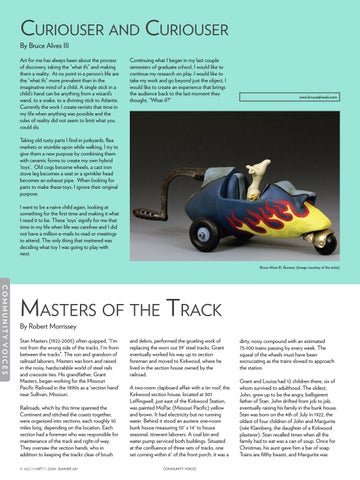
Taking old rusty parts I find in junkyards, flea markets or stumble upon while walking, I try to give them a new purpose by combining them with ceramic forms to create my own hybrid ‘toys’. Old cogs become wheels, a cast iron stove leg becomes a seat or a sprinkler head becomes an exhaust pipe. When looking for parts to make these toys, I ignore their original purpose. I want to be a naïve child again, looking at something for the first time and making it what I need it to be. These ‘toys’ signify for me that time in my life when life was carefree and I did not have a million e-mails to read or meetings to attend. The only thing that mattered was deciding what toy I was going to play with next. Bruce Alves III, Burnout, (image courtesy of the artist)
COMMUNITY VOICES
MASTERS OF THE TRACK By Robert Morrissey
Stan Masters (1922-2005) often quipped, “I'm not from the wrong side of the tracks, I'm from between the tracks”. The son and grandson of railroad laborers, Masters was born and raised in the noisy, hardscrabble world of steel rails and creosote ties. His grandfather, Grant Masters, began working for the Missouri Pacific Railroad in the 1890s as a 'section hand' near Sullivan, Missouri. Railroads, which by this time spanned the Continent and stitched the coasts together, were organized into sections, each roughly 10 miles long, depending on the location. Each section had a foreman who was responsible for maintenance of the track and right-of-way. They oversaw the section hands, who in addition to keeping the tracks clear of brush 17 ALLTHEARTSTL.COM SUMMER 2017
and debris, performed the grueling work of replacing the worn out 39’ steel tracks. Grant eventually worked his way up to section foreman and moved to Kirkwood, where he lived in the section house owned by the railroad. A two-room clapboard affair with a tin roof, the Kirkwood section house, located at 301 Leffingwell, just east of the Kirkwood Station, was painted MoPac (Missouri Pacific) yellow and brown. It had electricity but no running water. Behind it stood an austere one-room bunk house measuring 10' x 14' to house seasonal, itinerant laborers. A coal bin and water pump serviced both buildings. Situated at the confluence of three sets of tracks, one set coming within 6' of the front porch, it was a COMMUNITY VOICES
dirty, noisy compound with an estimated 75-100 trains passing by every week. The squeal of the wheels must have been excruciating as the trains slowed to approach the station. Grant and Louisa had 12 children there, six of whom survived to adulthood. The oldest, John, grew up to be the angry, belligerent father of Stan. John drifted from job to job, eventually raising his family in the bunk house. Stan was born on the 4th of July in 1922, the oldest of four children of John and Margurite (née Klamberg, the daughter of a Kirkwood plasterer). Stan recalled times when all the family had to eat was a can of soup. Once for Christmas, his aunt gave him a bar of soap. Trains are filthy beasts, and Margurite was
splendor, ”...for the first few minutes you just marvel with awe at the years of handwork, the perfection of design and architecture. Then you begin to feel it's too much and too overdone. You can't appreciate or digest so much perfect beauty all crammed into one place—there are too many centers of interest—each of which is a masterpiece in itself, and the whole mass together is almost incomprehensible (sic)”. In language reminiscent of Samuel Clemens, he concludes, “It's like eating too much fruitcake—a little would have been far more tasty and easily digestible”. Honorably discharged in 1946, he and Carlene married the following year. Upon his return to St. Louis, he discovered the homestead at 301 Leffingwell had been demolished. Stan Masters, 301 Leffingwell (image courtesy of Robert Morrissey Fine Arts and Antiques)
miserable trying to keep the children fed and the house clean. Yet from an early age, Masters knew he wanted to become an artist. As a high school student he drew a cartoon of himself as a precocious baby swaddled in diapers, holding a crayon in each hand. Standing proudly by his stick-figure masterpieces, he beams, “Someday I'm going to be a famous artist!”
Masters graduated from Kirkwood High in 1941 and entered the Army the following year to serve in WWII, stationed in Pennsylvania to guard—you guessed it—railroads. It was here where he met his future bride, Carlene Feister. Deployed to Italy, where he was company artist, he spent time in Rome and eventually toured St. Peter's Basilica. A delightful letter home to his mother offers an intriguing glimpse into the mind of the 22-year-old artist as he describes the overwhelming
Some 25 years later, in 1970, after a successful career in commercial art and a brief period of experimentation, Masters began his career as a watercolor artist. Working in the American Realist tradition of Winslow Homer, Edward Hopper, and Andrew Wyeth, the antithesis of Baroque Rome, his narrative art tells a uniquely American story. It’s the story of America in transition, where the rural lifestyles of the past yield to the urbanization of the present, carried forward by none other than the railroad. www.robertmorrissey.com
LAUGHING WITH A MOUTHFUL OF BLOOD
A few years ago the photographer Matthew Leifheit asked me a very pointed question, "I would like to be clear that I am wondering in regards to your art specifically and not you personally. Do you think you're funny?” My response was: Almost everything I make is essentially jokes. When I create something, I usually do it to amuse myself. The first time I saw a shrink, he said, after observing me for forty-five minutes, "You like to play, don't you?" This fact is true. You can describe all my artwork this way: I like to play. The best reaction anyone can have to my work is to laugh out loud. If you do not, that is fine, but if you do laugh, I will like you so much better. One time I left my sketchbook on a table and a gaggle of children found it. While looking through it, they laughed hysterically at each drawing in the book. The sound of eight children laughing hysterically at my drawings is
COMMUNITY VOICES
By Edo Rosenblith
quite a sound. Once a man looked at a few of my prints and exploded with maniacal laughter. Then he decided to purchase three of them. I asked him what he was going to do with them, and he said he would hang them in his office. It turned out he was a shrink. I sometimes think that my audience is just shrinks and kids. Humor is an essential aspect of my artwork. With almost every image I make, if I cannot inject some levity into it, then for me the picture is not worthwhile. Humor allows me to tackle subjects that are often too traumatic or troubling when addressed in a straightforward manner. Our natural instincts are to avoid difficult topics. Humor allows a visual hook for the viewer to first become engaged with an image. It is only after becoming engrossed with a picture, what screenwriters call "the slow reveal," that the subject of the artwork gives up all its ghosts.
Edo Rosenblith, Burka Babes (image courtesy of the artist)
www.edorosenblith.com COMMUNITY VOICES
SUMMER 2017 ALLTHEARTSTL.COM 18
HALF FULL AND 100% HILARIOUS By Nelson Perez
Remember the first time you looked at a painting and were overwhelmed by emotion, a longing for a lost love or memories of innocence past? To this day, when you see the work you feel something much like driving past your old school or the house you grew up in. Well, that is probably not what is going to happen when you gaze upon the work of Nelson Perez, of Vodka Bacon Studios. I can say that because I am Nelson Perez and that is never my intent.
COMMUNITY VOICES
The use of humor is the cornerstone of my style. It is also exactly how I approach life. Crap happens, always has and always will. It is up to you to decide how you meet it, and I choose to emphasize the good. I love using ironic imagery in my artwork. I feel that there is plenty of art out there that clearly addresses the macabre directly, and when there is visceral response, you may lose an opportunity to make someone think about why they feel that way. No matter what my subject matter is, I love using cheerful and colorful images. It is meant to make you think about social issues in a non-threatening fashion, so you are in an emotionally safe place to think of and process what you see. Or it is just meant to make you smile. What always makes me chuckle is the viewer who has no clue about my intent when looking at my work until it is too late and they have already thought about it. Even my artist name, Vodka Bacon Studios, addresses social issues like alcoholism and obesity. To be honest, it has nothing at all to do with either of these issues, but for a second there, you believed me.
As far as my family goes, there was no surviving without a thick skin and a sense of humor. My parents mastered the art of lifting you up while keeping you humble. I was taught early on that if I worked hard I could be anything I wanted to be, but not to be an idiot enough to think I was the best there is. There is always someone who is better and who should be a motivation to me to work harder. These lessons molded me as an artist and as a person. Art is not an imitation of life but a component of it. In my situation, it is a necessity. It is how I express myself and, more importantly, it is now my career. I am blessed to be able to do this for a living, and I can say it is only possible because I am not afraid to laugh at my art.
Nelson Perez, Imperialism, (image courtesy of the artist)
www.vodkabaconstudios.com
There is no doubt that art can be beautiful and can brighten up a home or an office. Art also goes beyond aesthetics and matching a sofa. It is a tool to express ideas and provoke the viewer to see things differently, and if there is anything definite in this world, it is that I think differently. I credit this to many years of working in social service and to growing up with my family. For nearly a decade, I worked as a case manager in poverty-stricken neighborhoods in South St Louis. I worked with families that faced some of the most daunting situations imaginable. The one thing that always struck a chord was the way so many of the people who prevailed did so by facing life with a sense of humor, no matter the gravity of their situation. Those who gave in to the negative rarely moved beyond their situation. I adopted this ideology and luckily it has spilled over into my art. 19 ALLTHEARTSTL.COM SUMMER 2017
Nelson Perez, Keep It 100, (image courtesy of the artist) COMMUNITY VOICES
OBLIVIOUS EXPRESSION By Joe Kohlburn
Editors’ Note: If this commentary essay feels like a discussion for art insiders, we recommend reading Edward Helmore’s succinct tutorial published on April 2 in The Guardian on the controversy surrounding the inclusion in this year’s Whitney Biennial of Dana Schutz’ painting of Emmett Till’s open casket funeral. https://www.theguardian.com/us-news/2017/apr/02/emmett-till-painting-reopened-america-wounds-rac e-exploitation-dana-schutz In his book “The Joke and Its Relation to the Unconscious,” Freud suggests that jokes, much like dreams, satisfy our unconscious desires. If he is right, what do we make of racist jokes? Are these fulfilling an unconscious desire to see the other in light of the joke’s premise? If art has the relationship to dreams (and subsequently jokes) that Andre Breton suggested, what of artistic misappropriations of struggle? What of art that displays black suffering without a personal stake in it? What of Dana Schutz? What desire does her image of Emmett Till satisfy? In a recent essay for Hyperallergic, Coco Fusco writes, “There is a deeply puritanical and anti-intellectual strain in American culture that expresses itself by putting moral judgment before aesthetic understanding. To take note of that is not equitable with defending whiteness, as critic Aruna D’Souza has suggested — it’s a defense of civil liberties and an appeal for civility.” While this essay is brilliantly written, calling for polite discourse in the face of historical trauma is defending whiteness in this context, ‘civility’ is mostly a coded paradigm that privileges the hyper-educated (like Fusco herself) by virtue of their training and familiarity with the intricacies of institutional grammar.
Schutz’ abstract representation of Emmett Till is analogous to a call for civility. Her work not only obscures the horror of history, but romanticizes the inherent tragedy of Till’s murder. Schutz’ painting is no simple misstep, and we cannot excuse it as mere personal expression. Those lining up behind Hannah Black’s letter are honoring their own outrage within the context of the institution, and then seeking to undermine the institution by questioning the preciousness of art. The exaltation of art objects, after all, can often detract from a principal purpose of art itself. Schutz’ painting is primarily an intellectualization of the real. It is breaking down what the world presents into platonic forms, and reassembling those forms in new compositions to promote a universal distillation, a ‘proto-authenticity’. As Theo van Doesburg wrote for De Stijl’s first manifesto in 1918 (Harrison and Wood 2006, 281), ‘There is an old and new consciousness of time. The old is connected with the individual. The new is connected with the universal.” van Doesburg’s manifesto responds to the trauma of the First World War. The reality of this trauma was, if not ubiquitous, probably more obvious in its intricacies to the institutional apparatus than is the reality of black struggle in America. How coldly clinical to ask that black folk calmly discuss their own oppression. Why defend hegemonic institutional apathy that incorporates black pain into regular museum programming, and absolves itself of complicity in this pain by acknowledging and then failing to contextualize it? White artists appropriating images like that of like Emmett Till is problematic. Hannah Black’s letter is not censorship, it’s a return of the proverbial chicken to the roost. It’s a consequence of oblivious expression. White artists are not used to being asked to account for
their actions in this way. Let us not mistake Black pointing the problem out for the problem itself. Accusations of censorship, out-of-control ‘identity politics’, or ‘fascism’ are overwrought for a number of reasons, not least of which that they deal in theoretical or potential oppressions. Earnest calls to reexamine privilege, or refrain from interpreting black pain through a white lens, on the other hand, respond to current and historical oppression occurring all around us constantly, whether or not we are aware of it. Furthermore, censorship is not simply calling for an artist’s work to be taken down, but actually removing the work. That’s a fine hair of a difference, but one that has yet to be split with either Kelley Walker—whose controversial exhibition at the Contemporary Art Museum St. Louis (CAM) was discussed by Kohlburn in our Winter issue of this year—or Schutz. What is changing is the preciousness of art as object within the space of the institution. This has happened before in other contexts (e.g. Dada). What we’re seeing is iconoclasm. Criticism of these white artists is centered on their use of the black body as imagery. No longer is an artist’s work guarded against critique simply because it is endorsed by art elites, by tastemakers, and so on. I can certainly appreciate that the structures of power could just as easily remove thoughtful art, as recently occurred with David Pulphus’ painting in Washington, DC. That said, an artist should be able to explain their work, and should be responsible for their artistic decisions. Engaging black struggle does not provide absolution for white artists. This should not be the goal. These conversations should be at least as fraught for the beneficiaries of the system as they are for those who labor and suffer under it.
By Ross Kelly
Throughout art’s long and complicated history, we have seen style, method, media, and intention respond to social and political climates shifting. From Nouveau Realism re-interpreting how we see reality to Art Deco representing modern luxury and craftsmanship that was valued in the 1920s and 30s, art movements have enjoyed varying degrees of success and longevity. The more common
ones, needless to say, are salient pieces of human history and have, along with responding to the human condition, also helped to shape us as a culture and individuals. These movements have solidified themselves in our books, movies, classrooms, and minds. But, not all movements were created equal. Some of them came and went without a notice. Here are a few examples of art movements that didn’t COMMENTARY
quite have what it takes to impact us like the others and make it into the history books. Super-Duper Realism Super-Duper Realism came about as an outgrowth of Realism in the midnineteenth-century. Whereas Realism sought to capture truth and authenticity, Super-Duper SEASON YEAR ALLTHEARTSTL.COM 20
COMMENTARY
ART MOVEMENTS THAT NEVER QUITE CAUGHT ON
Realism sought to really, really capture truth and authenticity. The Super-Duper Realists were not satisfied with portraying scenes. They felt that there was just no way to be as accurate and honest with a brush and paint or pencil and paper. Their solution was to just write down directions to whatever they intended to portray, and urge others to go look at it. Having no gallery appeal, along with complaints of going at the wrong time of day or too long of a journey, the movement quickly collapsed. The art community eventually told the Super-Duper Realists to “just draw the stupid picture and get over it, idiot.” Pre-Neo-Post-Dada Surrealism This was a very short movement started by a painter named Fraindry Cohlertharz who had a very hard time with calendars. Unsure of what and when he was painting, he cast a wide net hoping he was at least a little bit right in naming his movement. Cohlertharz would later take his own life when he found out he was just an Expressionist. Arte Sandwiche Briefly popularized in the twentieth-century by a chain of galleries in the U.S. called Subway, art enthusiasts could watch sandwich artists construct custom pieces before their very eyes. Though technically edible, art lovers were discouraged from eating the pieces, or sandwiches, due to them being terrible. Art’s Movements Conceptual artist, Arthur Grambus, thought he was onto something by using his own stool to create sculptures of his family. The pieces revolted both the art community and his family. It was perpetuated for a short amount of time by another artist named Arthur Smalk, but he quickly abandoned his work upon repeatedly being thrown out of restaurants for smelling like art.
Subway, Turkey Bacon Avacado Sub, (photo credit: _Bubby_www.flicker.com)
Rocodecoco
Photography
Whereas most movements grow organically out of an artist’s, or group of artists’, impulse to fill deficiencies in the art world, Rocodecoco was quite the opposite. Late-twentieth-century artist Ronny di Belgger, who thought he was hot shit, felt that he was undeserving of the inattention he was receiving as an artist. After having taken every class the Duluth Community Art Center has to offer, he set out to secure himself a place in art history forever. However, Ronny lacked any real imagination and had a proclivity for things with funny names, so he started glueing fishing lures to statues of the Empire State Building. He would spend all of his savings traveling the world in promotion of his movement, selling T-shirts that said “I GOT ROCODECOCO’d AND THEN BOUGHT THIS SHIRT”. The highlight of di Belgger’s short career was when he met Yoko Ono, who really liked his work.
Not unlike the Super-Duper Realists, photography practitioners were after a more accurate portrayal of our world. Using light, chemicals, and a lens, photography was able to capture images exactly as they appeared in person. Unfortunately for bolsters of the “art,” there didn’t seem to be any sort of market for the form. There is no clear reason for lack of interest, but art historians have speculated that it was a little too real. Others believe that the public didn’t like cheaters and would rather just have their artists “just draw the stupid picture and get over it, idiot.” Examples of photographs can be seen at www.pictures.com
www.rosskelly.org
COLLABORATING ART INSTITUTIONS
COMMENTARY
By Lacy Murphy
In case you missed it, this spring, the city of St. Louis was home to two exhibitions showcasing art from Fin-de-Siècle Paris. Degas, Impressionism, and the Paris Millinery Trade was curated by Simon Kelly, curator of Modern and Contemporary art at the Saint Louis Art Museum (SLAM) in collaboration with the Fine Arts Museum of San Francisco. Spectacle and Leisure in Paris: Degas to Mucha, 21 ALLTHEARTSTL.COM SUMMER 2017
curated by Elizabeth C. Childs, Etta and Mark Steinberg Professor of Art History at Washington University was exhibited on campus at the Mildred Lane Kemper Art Museum. The two exhibitions harmonized through their similar interests in a specific temporal range and geographic location, and found more common ground in a concentration on modern industry, consumer culture, COMMENTARY
gender, and class. Through an array of media, both shows provided a broad overview of the consumption of modern life in Paris, yet each through a distinctly different lens. Degas, Impressionism, and the Paris Millinery Trade explored the city of Paris as a global fashion capital through paintings, pastels, drawings, and prints of hat-making by the
Parisian avant-garde. The ornate hats on display at SLAM invited viewers to feast their eyes on the smooth, supple velvet, intricate lace, complicated beadwork, and exotic birds of nineteenth century hat fashion. Spectacle and Leisure in Paris examined the representation and consumption of modern life both through fine art and commercial graphic design. The complexity of the art scene in Paris unfolded in the rooms of the exhibition. Mass reproduced commercial posters hung in the same room as Degas pastels while short films from the era played nearby. The eclectic collection of these works on display in these
two exhibitions captured perfectly the vibrancy and dynamism of the modern city of Paris. Yet these exhibitions offered more than an opportunity to take in the enamoring glamour of the city of Paris. Each are individually serious academic achievements. For the first time ever, the exhibition, Degas, Impressionism, and the Paris Millinery Trade, reunited all of the milliner paintings and gave much-needed attention to the frequently neglected series of milliner pictures created by Degas. Likewise, Spectacle and Leisure in Paris was an ambitious project, carefully mapping the complex and
diverse sites of entertainment and relaxation in the modern city along with the new industries and technologies that emerge in tandem. What was certainly a “Paris moment” in Saint Louis was birthed from a thrilling and rewarding time of conversation and collaboration between various institutions within the city. This collaboration created an exciting synergy that will undoubtedly lead to fruitful future endeavors as well. www.kemperartmuseum.wustl.edu www.slam.org
SUMMER HITS LIST Seeing Suggestions, from the Editors Closes June 25
Closes July 28
Open through Aug 3
Shimon Attie: Lost in Space (After Huck) / Saint Louis Art Museum (SLAM)
Adrian Wright, Terrell Carter, Joy Lalita Wade and Kenneth Calvert / St. Louis Bread Company Cares Community Cafe, Clayton
Frida y Diego / International Photography Hall of Fame
www.slam.org/exhibition/nmsattie.php
Four well-loved St. Louis area artists were invited to transform this innovative donations-based Panera Bread shop & we predict you’ll be moved to leave a little extra dough in exchange for the delicious cinnamon rolls and tomato basil bread.
Closes July 2
Closes July 29
Jeannie Liautaud: The Grandparents Project / The Dark Room
Almost Now, Just Then… / Projects + Gallery
“The portraits aren’t meant to be revelatory, they’re meant to be sincere.” Sincerity and Grandparents - as the progeny of sarcastic and sardonic seniors, we are interested in this exhibit curated by Jason Gray www.thedarkroomstl.com/jeannie-liautaud-the-grandparents-project
Closes July 16 Drawing from the Collection: 40 Years at Laumeier / Whitaker Foundation Gallery at the Adam Aronson Fine Arts Center A stellar cast of artists are connected through their drawings in this looking-back exhibition
Kat Reynolds, Jen Everett, Kahill Irving, Lyndon Barrois Jr., Addoley Dzegede, WORK/PLAY group exhibit, what more needs to be said? www.projects-gallery.com
Closes July 30 Tennessee Williams: The Playwright and the Painter / Saint Louis University Museum of Art (SLUMA) Rare opportunity to view 18 paintings by University City High School graduate (just like All the Art editor Sarah Hermes Griesbach and Nelly) Tennessee Williams www.slu.edu/sluma
www.laumeiersculpturepark.org/anniversary-exhibition
COMMENTARY
A photographic diary of history, art, politics and tumultuous love as hot as summertime in St. Louis www.iphf.org/events/diegoyfrida
Closes Aug 13 Color Key / Contemporary Art Museum, St. Louis, front room Three award-winning St. Louis artists (two editors with All the Art!) code the world in their own visual language and help us see truths that words can’t easily describe www.camstl.org/exhibitions/front-room/creative-stimulus
Open through Aug 13 Urban Planning: Art and the City 1967–2017 St. Louis community artist intellectuals engage with an established cadre of national community artist intellectuals. These people carry explosives, paint, caulk, bees and a manifesto wherever they go. We can’t wait to see St. Louis under their influence www.camstl.org
SUMMER 2017 ALLTHEARTSTL.COM 23
COMMENTARY
Float down the Mississippi-Milky Way surrounded by a NASA Earth night-city-sky in a timeless noplace with the ghosts of Huck and Jim and perhaps a Ferguson police officer? Your interpretation is as good as ours.
Open through Aug 26
Closes Sept. 18
Through mid-Nov.
Higher Ground: Honoring Washington Park Cemetery, Its People and Place / The Sheldon Art Galleries
My Medicine, East Meets West, juried exhibition / The Foundry Art Centre, St. Charles
Ann Tecla Lundquist: Connections / EverBank at Hanley and Eager Road, 7th floor
Art to cure us! Which may be as good a solution as any in this current Medical West we live in
Participatory, you get free money AND a wish!
Jennifer Colten’s photographs, Denise Ward-Brown’s video and oral histories and Dail Chambers’ panels and art installation document many stories of Washington Park Cemetery, the historically African-American cemetery established in 1920 that was split and partially paved over by Interstate 70, then by Lambert Airport and later by Metrolink. www.thesheldon.org/current-exhibits.php
Closes Sept. 17 Reigning Men: Fashion in Menswear, 1715–2015 / Saint Louis Art Museum The transmission of gender through modes of appearance over the last 300 years is more than enough to pique our interest.
www.annteclalundquist.com/current-exhibit
www.foundryartcentre.org
June 9 through Oct. 7 Blue Black / Pulitzer Arts We have all come to feel connected to the Ellsworth Kelly’s Blue Black on the back wall of the Pulitzer. Glenn Ligon will pick expand Kelly’s exploration of the two colors as guest curator. We are excited by the possibilities driven by the limitations of this theme. www.pulitzerarts.org/exhibition/blue-black
www.slam.org/exhibitions/reigningmen.php
SPECIAL THANKS TO
COMMENTARY
FOR YOUR CONTINUED SUPPORT FROM ALL OF US AT ALL THE ART
23 ALLTHEARTSTL.COM SUMMER 2017
COMMENTARY
TRAVELING NORTH ON I-55? TRY LAKE POINT GRILL, SPRINGFIELD’S ONLY AUTHENTIC WOOD BURING OVEN
HOME OF
2 BLOCKS EAST OFF EXIT 90 (TORONTO ROAD) FULL MENU FOR LUNCH AND DINNER
THE DIFFERENCE IS IN THE TASTE (217) 679-3900
WWW.LAKEPOINTEGRILL.COM
SUMMER
2017