around A-S Doctors Dialogues > “If we can tap into our imagination, it helps us deal with something we are facing. In an imaginary land, kids can go where THEY want to be. It’s an opportunity to work
Parenting in Today’s World Allen-Stevenson partnered with four doctors who have worked with the School and know the community well to offer a four-part doctors dialogue series titled: Parenting in Today’s World. Being a parent is both joyful and challenging at times. In today’s world, this role feels like it has become even more stressful and complex. The hope is that by discussing some of the questions and concerns parents have, parents, and thus students, will find themselves in a less stressful and anxious place.
Lamplighter
through what’s in their heads that
30
we aren’t aware of.” —Dr. Schwartzman
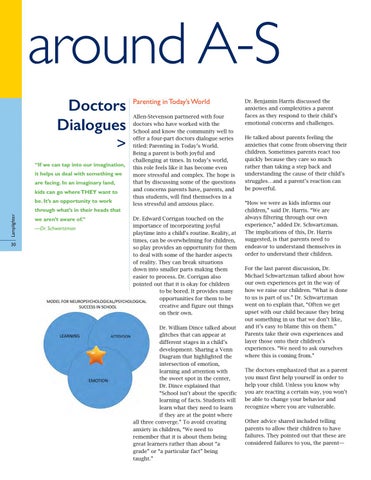
Dr. Edward Corrigan touched on the importance of incorporating joyful playtime into a child’s routine. Reality, at times, can be overwhelming for children, so play provides an opportunity for them to deal with some of the harder aspects of reality. They can break situations down into smaller parts making them easier to process. Dr. Corrigan also pointed out that it is okay for children to be bored. It provides many opportunities for them to be creative and figure out things on their own. Dr. William Dince talked about glitches that can appear at different stages in a child’s development. Sharing a Venn Diagram that highlighted the intersection of emotion, learning and attention with the sweet spot in the center, Dr. Dince explained that “School isn’t about the specific learning of facts. Students will learn what they need to learn if they are at the point where all three converge.” To avoid creating anxiety in children, “We need to remember that it is about them being great learners rather than about “a grade” or “a particular fact” being taught.”
Dr. Benjamin Harris discussed the anxieties and complexities a parent faces as they respond to their child’s emotional concerns and challenges. He talked about parents feeling the anxieties that come from observing their children. Sometimes parents react too quickly because they care so much rather than taking a step back and understanding the cause of their child’s struggles…and a parent’s reaction can be powerful. “How we were as kids informs our children,” said Dr. Harris. “We are always filtering through our own experience,” added Dr. Schwartzman. The implications of this, Dr. Harris suggested, is that parents need to endeavor to understand themselves in order to understand their children. For the last parent discussion, Dr. Michael Schwartzman talked about how our own experiences get in the way of how we raise our children. “What is done to us is part of us.” Dr. Schwartzman went on to explain that, “Often we get upset with our child because they bring out something in us that we don’t like, and it’s easy to blame this on them.” Parents take their own experiences and layer those onto their children’s experiences. “We need to ask ourselves where this is coming from.” The doctors emphasized that as a parent you must first help yourself in order to help your child. Unless you know why you are reacting a certain way, you won’t be able to change your behavior and recognize where you are vulnerable. Other advice shared included telling parents to allow their children to have failures. They pointed out that these are considered failures to you, the parent—