6
www.4x4mart.co.uk
4x4 MART | SEPTEMBER 2010
BUYING USED: JEEP WRANGLER
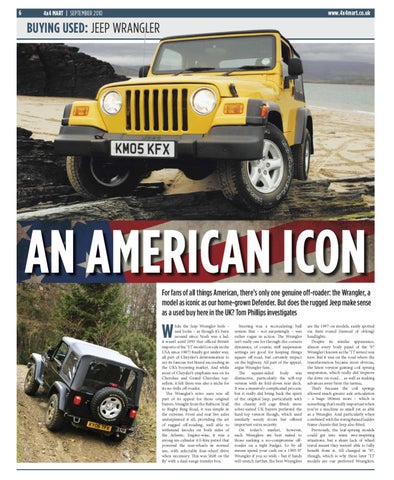
AN AMERICAN ICON For fans of all things American, there’s only one genuine off-roader: the Wrangler, a model as iconic as our home-grown Defender. But does the rugged Jeep make sense as a used buy here in the UK? Tom Phillips investigates
W
hile the Jeep Wrangler feels – and looks – as though it’s been around since Noah was a lad, it wasn’t until 1993 that official British imports of the ‘YJ’ model (on sale in the USA since 1987) finally got under way, all part of Chrysler’s determination to see its famous 4x4 brand succeeding in the UK’s booming market. And while most of Chrysler’s emphasis was on its Cherokee and Grand Cherokee topsellers, it felt there was also a niche for its no-frills off-roader. The Wrangler’s retro aura was all part of its appeal for those original buyers. Straight from the Rubicon Trail to Rugby Ring Road, it was simple in the extreme. Front and rear live axles underpinned it all, providing the art of rugged off-roading, well able to withstand knocks on both sides of the Atlantic. Engine-wise, it was a strong six-cylinder 4.0-litre petrol that powered the rear-wheels in normal use, with selectable four-wheel drive when necessary. This was ‘shift on the fly’ with a dual-range transfer box.
Steering was a recirculating ball system that – not surprisingly – was rather vague in action. The Wrangler isn’t really one for through-the-corners dynamics, of course; stiff suspension settings are good for keeping things square off-road, but certainly impact on the highway. All part of the appeal, argue Wrangler fans… The square-sided body was distinctive, particularly the soft-top version with its fold-down rear deck. It was a massively complicated process, but it really did bring back the spirit of the original Jeep, particularly with the chunky roll cage fitted; more sober-suited UK buyers preferred the hard-top version though, which used similarly weedy doors but offered important extra security. On today’s market, however, such Wranglers are best suited to those seeking a no-compromise offroader on a tight budget. So by all means spend your cash on a 1993-97 Wrangler if you so wish – but if funds will stretch further, the best Wranglers
are the 1997-on models, easily spotted via their round (instead of oblong) headlights. Despite its similar appearance, almost every body panel of the ’97 Wrangler (known as the ‘TJ’ series) was new. But it was on the road where the transformation became most obvious, the latest version gaining coil sprung suspension, which really did improve the drive on-road… as well as making advances away from the tarmac. That’s because the coil springs allowed much greater axle articulation – a huge 180mm more – which is something that’s really important when you’ve a machine as small yet as able as a Wrangler. And particularly when combined with the strengthened ladder frame chassis that Jeep also fitted. Previously, the leaf-sprung models could get into some awe-inspiring situations, but a sheer lack of wheel travel meant they weren’t able to fully benefit from it. All changed in ’97, though, which is why these later ‘TJ’ models are our preferred Wranglers.