ENERGY
management system for rural water schemes to avoid unnecessary visits to systems. But the municipalities dismissed the idea due to the potential risk of theft to the system being a major concern. As such, we developed a highly efficient Energy Security system for protection which now Vodacom is looking into purchasing for protection of their cell sites. The Water boards requested we upscale the solar system to supply Kilowatts of energy to help reduce their dependency on Eskom and to upscale the Leak Detection system to help solve the 7.2 Billion Rand non-revenue water problem in South Africa. We are now developing, together with 4th Element Groups CFO Ms Benzi Kuzwayo, innovative business models to help the system break even in less than two years of operations. “How it all begun was with grandma running out of water in her community five years back and her telling me: ‘My child, you want to be an engineer one day, solve my water problem first’.” – Hollo Matlala, 4th Element Group Jeanne Rose, CEO of Eco2 Partnership South Africa, won in the Breakthrough Innovation category at the 2011 GCIP South Africa Awards for finding an environmentally friendly solution to the waste tyre problem in South Africa. Jeanne says that “winning the Breakthrough Innovation award at SA’s 1st Cleantech was an early step in our journey to bring a world-first technology to market.” One of the major obstacles faced early on was the realisation that the UNFCCC did not have a reference methodology in place to enable a project like theirs to claim carbon credits despite the clear indication that their projects would be eligible. This meant breaking new ground with the development of a bespoke methodology describing their continuous reduction and distillation (CRD) technology. After nearly 24 months of active effort, and the completion of a rigorous validation and verification process, the methodology was approved in September 2013 at the 75th meeting of the Executive Board of the Clean Development Mechanism (CDM) of the United Nations in Bonn, Germany. “Our plants in South Africa will be the first waste to energy projects in the world that will be eligible for carbon credits under this approved methodology”, says Jeanne. “Our decision to pursue an onerous and costly route to register a new methodology has resulted in an internationally recognised validation and endorsement of the carbon reduction capabilities of our technology.” Jeanne suggests that “too many fledgling enterprises fail because of lack of business development support.” Her advice
to any start-up is to “take advantage of programmes like Cleantech to assist with refining and honing your business model.” Going through the GCIP provided Jeanne’s business with access to resources and valuable networking opportunities and they “will continue to be able to draw on the expanded Cleantech network as our business evolves and develops,” she says. Since their win in 2011, Eco2 Partnership SA has: • successfully tendered and been awarded processor status in the REDISA waste tyre management initiative • achieved UNFCCC approval for their carbon methodology • entered into significant and credible partnerships with suppliers including AKER ENGINEERING (Performance guarantee on the plant) and SIEMENS (monitoring technology and sensors) • achieved full funding for their first plant to be operational in the third quarter of 2015 Their advice for future Cleantech Entrepreneurs: • Customers are becoming more aware of alternative sustainable products – previously a huge challenge for green entrepreneurs. • It can take a while to find the right funding and forge sustainable partnerships. It is wise to be circumspect and not to rush in. • Cleantech businesses need to be flexible and customer-centric. The GCIP for small and medium-size enterprises (SMEs) started in honour of the COP17 in 2011 as a competition to promote clean energy innovation. Entrepreneurs compete to bring out their skills and identify the most promising clean tech innovations in the country. The GCIP is a United Nations Industrial Development Organization (UNIDO) and the Global Environment Facility (GEF) initiative hosted and jointly implemented in South Africa by the Technology Innovation Agency (TIA). Based on the successful Cleantech Open Accelerator, the GCIP initiative aims to spur local innovations in energy efficiency, renewable energy, waste to energy, and water efficiency; maximizing every participant’s chances of being successful in the programme and raising their probability of achieving sustainable commercial success. The GCIP combines a competition and a business accelerator programme to offer participants progressing through the programme extensive mentoring, training, access to investors and opportunities to showcase their innovations to the media and the public.
www.alive2green.com/publications/green-economy-journal/
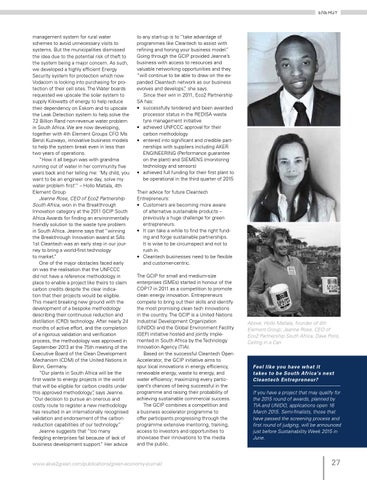
Above: Hollo Matlala, founder of 4th Element Group; Jeanne Rose, CEO of Eco2 Partnership South Africa; Dave Pons, Ceiling in a Can
Feel like you have what it takes to be South Africa’s next Cleantech Entrepreneur? If you have a project that may qualify for the 2015 round of awards, planned by TIA and UNIDO, applications open 16 March 2015. Semi-finalists, those that have passed the screening process and first round of judging, will be announced just before Sustainability Week 2015 in June.
27