AFSCME union shows at holiday party to educate on negotiations PAGE X
The Alestla-la-lalidays are here! See where to celebrate locally PAGE 5
Cougars to rebrand as “66ers” in honor of Route 66 centennial PAGE 7
CAS educators grapple with ethics of classroom AI use
DYLAN HEMBROUGH editor-in-chief
In the wake of SIUE’s phase two program prioritization memos, which asked departments in the College of Arts and Sciences how generative AI can be integrated into their courses, educators are still figuring out how best to move forward amidst new questions of ethics and teaching methods.
How can AI be integrated into the classroom?
According to many faculty members in the College of Arts and Sciences, use of generative AI by students varies widely between departments and courses.
Particularly for faculty teaching introductory courses, the advent of AI has added “substantially” to their workload as it provides a new avenue for plagiarism and cheating. Dean of the College of Arts and Sciences Kevin Leonard said overwhelming workloads are a concern he is investigating.
“One of the things that I am interested in doing is trying to determine how much work is increasing, because that does sometimes happen. A technological change can lead to additional work, and that’s something I’m very sensitive to,” Leonard said. “I don’t want to be the AI police, and I don’t want faculty spending their time doing that.”
Faculty do still have to keep an eye out for academic misconduct, however. Instructor of English Jen Yoder said that in some classes, more than half of her students have turned in AI-generated work.
“I have actually had to fight really hard to not have students use AI,” Yoder said. “It’s been so overwhelming.”
It isn’t just plagiarism concerns that take up educators’ time. Educators have to stay up to date about new developments in their fields, so many faculty have taken the time to learn what they can about the new technology. That takes extra hours — especially when the technology is constantly changing.
“It became pervasive so quickly. There’s a lot of catch-up,” Professor of English and Director of First-Year Writing Matthew Johnson said. “As a teacher of writing — also as a specialist in digital literacies — I need to know it. I need to investigate it. I need to research it. I need to use it. I need to understand it so I can think about how it can be integrated or not integrated. I need to create experiences with it.”
Leonard said “reimagining” assignments to better fit the current curriculum should be a routine activity for educators, regardless of whether or not AI is involved. And other educators, like Professor of English and Director of Undergraduate Studies in the English Department Valerie Vogrin, said that while
AI has added to their workloads, it hasn’t been unmanageable.
After attending a symposium in the summer put on by the American Association of Colleges and Universities, Leonard formed a committee within the College of Arts and Sciences to investigate potential applications of generative AI in the classroom.
“What I would like to see is very open, transparent discussions of ethical AI use. I know there are faculty who have told me that they think AI is just simply unethical, and there are good reasons for that,” Leonard said. “I wanted a team that would include people who were more enthusiastic about using AI as well as some
people who would be pretty skeptical about it.”
Yoder is on this committee too. While the committee is still relatively new, Leonard said some headway has been made, such as a dynamic AI ethics resource guide.
Some faculty have implemented new lessons or teaching methods to tackle the issue of generative AI. Johnson, for example, uses it as a topic of discussion to further students’ understanding of the technology.
“What I prove to students is that ChatGPT will produce what they already
Chimega Mart to bring checkout-free shopping to SSC
GAVIN QUINLAN
reporter
Chimega Mart, a cashierless convenience store using Amazon’s “Just Walk Out” technology, is coming to the SSC early in the spring semester.
Shoppers will enter by scanning their method of payment at the entrance. “Just Walk Out” stores use artificial intelligence, computer vision and shelf sensors to track customers and what they take from the shelves. Shoppers will be charged automatically after leaving the store. All payment methods, including residential meal plans and Cougar Bucks, will be accepted.
The store is named after the first of SIUE’s two live cougar mascots, Chimega, who lived on campus from 1968 to 1982.
Kelly Jo Hendricks, director of the MUC and the SSC, said that Chimega Mart will likely open in February. The decision to open Chimega Mart was meant to address issues students face obtaining fresh food, especially outside Center Court’s hours of operation.
“The Student Success Center is one of the longest-open buildings on campus … It made perfect sense for us to place something there so that if students are there at 10:00 at night studying and are hungry or want a snack, it’s just not chips and soda out of a vending machine,”
Hendricks said. “Chimega Mart will have fresh foods. It will have fresh salads [and] some things that can be heated up in microwaves. It will have a wide variety of offerings.”
SIUE will be the third college in Illinois to use Amazon’s “Just Walk Out” technology. Hendricks said that plans to open such a store began in 2022 after the closure of Kaldi’s Coffee left vacant space in the SSC.
Kelly Jo Hendricks Director of the MUC and SSC “
lines pile up, especially after classes, there are a lot of people there. Some people don’t even get their food because [the lines] are just so long … Staff is a different story. It means less jobs for kids and staff here, especially exchange students.”
This has been a labor of love. Our hope and our plan is to better serve the students and to give them some choices.”
“We’d been sitting on an empty storefront in the Student Success Center since COVID,” Hendricks said. “I know there are a lot of folks who were very big Kaldi’s Coffee fans, and it’s a local brand, but after COVID … we didn’t have [the] staff that we needed downstairs, let alone [for] some of our outside food venues.”
Junior biology major Hamza Hussein said that he believes Chimega Mart will allow easier and faster access to food than Center Court because of the absence of checkout lines.
“It would be more time-saving not having to wait in a line,” Hussein said. “In the cafeteria when
While Chimega Mart does not require a staff at all times, workers will still need to restock and prepare its inventory. Hendricks said it is still unclear how the store will be staffed, though it will be primarily operated by Dining Services after opening.
MUC Dining Services Director Jessica Alford could not be reached for comment.
According to Amazon’s “Just Walk Out” website, “the way employees spend their time is only shifting,” and that the technology does not eliminate jobs. In 2023, an article by an Amazon staff member said that no biometric data is collected from customers.
Hussein said he understands concerns that may rise due to the technology being used, but is still in favor of Chimega Mart.
“I feel like we hand over a lot of data as it is already, and I wouldn’t
be totally concerned about somebody scanning me when I probably get scanned and my data sold every day. You can’t hurt what’s already been hurt,” Hussein said.
Graduate CMIS student Ugo Okonkwo said that while the technology is beneficial, it’s important to question how it works and address potential risks before use.
“How do [the computers] reconcile … if the item that you’re picking up is actually [yours] and not someone else’s, since there’s no human identifier?” Okonkwo said. “I will look into … identifying the cybersecurity nature of the data and the goods required in that whole interface. That’s one critical thing for me, based on my field.”
Graduate industrial-organizational psychology student Joshua Mcguire said that while he can understand hesitation surrounding the technology, students do not have to use Chimega Mart if they are uncomfortable doing so.
“I guess I could see how students are hesitant to use it because of the scanning and tracking, [but] you kind of sign up for that by walking in,” Mcguire said.
Hendricks said that two years of the work behind Chimega Mart was dedicated to negotiating contracts with Amazon, including understanding how their technology would collect and use data.
“Clearly, SIUE is not going to enter any contract where there’s purposely any intent of putting people’s credit cards or personal
information out there,” Hendricks said. “The response we got back in terms of the technology and the storage sufficed our legal team for us to move forward with it.”
According to Hendricks, Chimega Mart may be the start of a wider effort to mitigate campus food deserts, areas where substantial or fresh food is difficult to obtain. Alumni Hall and Founders Hall, areas in Cougar Village and the Health Sciences Complex are among the food deserts she listed.
“This has been a labor of love,” Hendricks said. “Our hope and our plan is to better serve the students and to give them some choices … We’ll see how this operation goes and how successful it is, and then maybe the day will come sometime in the future that we could look to expand it.”
1. Do you use AI for schoolwork?
TOTAL VOTES: 84
2. HAVE YOU EVER CHEATED ON AN ASSIGNMENT WITH AI?
3. DO YOU BELIEVE AI IS AN ETHICAL TECHNOLOGY?
AFSCME Local 2887 attends university holiday party with a message
BRANDI SPANN opinion editor
Understaffing and unfulfilled back pay obligations led AFSCME Local 2887 to arrive as a united front at the university-wide faculty and staff holiday party in the Meridian Ballroom on Dec. 9.
Members wore their signature green “Stronger Together” T-shirts donning buttons reading, “SIUE has a MINOR problem.” Members walked around the room answering questions and telling their co-workers about the conditions they have been facing.
Union Vice President Tyler Toussaint said their hope for showing up together at the holiday party was to connect with their co-workers and inspire people who have authority to advocate for the departments that are short-staffed.
Alumni Hall Building Service Worker Nathaniel Wilson said the union wanted to demonstrate their disagreement with the chancellor and the Board of Trustees.
In May 2024, Information Technology Services, Building Service Workers, Clerical Workers and the Graduate School merged with AFSCME and began contract negotiations that still have not been resolved.
According to Wilson, union members wanted to emphasize that university employees are real people whose voices deserve to be heard and properly compensated.
“We’re at 50 percent capacity, meaning we don’t have all our positions filled,” Wilson said. “It kind of feels like we’re in an unofficial hiring freeze. We’re trying. We’ve been asking for new positions to be filled. We’re being pushed to our breaking point.”
“We want to settle a contract quick. We don’t want to be in a prolonged fight,” Wilson said. “But we can only fight for what we believe we deserve.”
President of AFSCME Local 2887 Ben Kaminski works in financial aid. He said that administration has been tough on their “customer service skills” — emphasizing service to students over a fair workplace — while practically freezing hiring and being inundated with an influx of students.
Toussaint said the university has been replacing retroactive back pay payments with stipends.
“They’re asking us to forego back pay,” Toussaint said. “They want to give out a stipend, or nothing at all.”
Toussaint started as a building service worker in 2017 making 30 percent above minimum wage.
“I would like to stay in that range, because this used
administration.
to be a good, nice job. I’m working for minimum wage now,” Toussaint said. “We can’t bring anybody in the door … They’re asking us to cover more for less on top of stagnating our wages.”
According to IT Manager and Unit Chair for ITS/ Professional Jason Warner, after months of back and forth,
the union is hoping to accept the initial offer that the university gave them when negotiations began.
“Now that we want to accept it, they’re trying to tell us that they never offered it,” Warner said. “[ITS is] looking to get the same salary increases that they gave clerical [workers].”
Wilson said his sister, who
COUGARS IN THE WILD
is also a BSW, has not received the back pay that the university promised her, and he has witnessed how that has influenced her life.
“I have seen and dealt with the consequences,” Wilson said. “[She’s] really struggling.”
“Minor, let us accept your offer,” Warner said.
ASL instructor advocates for ASL minor, Deaf pride
MICHAL KATE REYNOLDS managing editor
Editor’s Note: This interview was interpreted by ACCESS’ Lead ASL Interpreter Amy Miller.
An advocate for deaf people and rights, American Sign Language Lecturer Jerry Covell is aiming to bring ASL and Deaf culture courses to SIUE, as well as create an ASL minor for students.
Formerly, Covell coordinated an interpreter training program at MacMurray College in Jacksonville, Illinois. Before coming to SIUE, Covell said he taught at St. Louis Community College in Florissant Valley’s interpreter program.
On his commute to St. Louis from Springfield, Illinois, Covell would pass SIUE, and he decided to reach out to connections he had at the school from MacMurray to propose teaching ASL classes for all students. Previously, ASL classes were only available for speech pathology students.
we have to start with ASL and lay a foundation with those classes.”
Covell said student interest in ASL has grown. In January 2024, Covell taught two classes. Now, due to ASL’s popularity, there are more sections available for students to take. Covell said he currently teaches two sections of ASL courses and will be teaching a Deaf culture course in the spring.
“[ASL is a nationwide] trend,” Covell said. “The students actually describe ASL as a necessity, part of their career readiness [and] the ability to communicate across lines with people.”
Jerry Covell
Covell said he met with Dominic Dorsey in the ACCESS office, College of Arts and Sciences Dean Kevin Leonard and Chair of the Department of Foreign Languages and Literature Olga Bezhanova about creating these courses.
“Amy and the ACCESS office worked together to [begin] the program with me,” Covell said. “We wanted a Deaf studies department and [planned to] branch out from there to have Deaf [education], social work, different tracks underneath that. But in order to do that,
Currently, Covell said he is working on a proposal for an ASL minor. He said he surveyed students in his courses about their interest in the minor, and according to Covell, the survey received 120 responses out of 142 students.
“The students in the survey are saying SIUE needs to take a better position and promote it and get the word out there,” Covell said. “So, students are really wanting to see some type of career minor or major related to ASL here at SIUE. Our students see the value of being able to communicate with deaf people.”
Covell said he has always viewed himself as a “noise-maker,” especially when advocating for the Deaf community and for Deaf education.
“I really don’t accept ‘no,’ for an answer well,” Covell said. “I get out there and push, push, push for what I need or what I want, or try to find a way to negotiate and make things work.”
During his senior year of college, Covell said he was one of the “Deaf Pres-
ident Now Four,” a group of students who advocated for a deaf president of Gallaudet University in Washington D.C. through the “Deaf President Now” protests in 1988. Covell said at the time, the university was reviewing two deaf people and one hearing person for the position. Because of his involvement with the protests, Covell said he was included in the
“
I really don’t accept ‘no’ for an answer well. I get out there for what I need or what I want, or try to fnd a way to negotiate and make things work.”
Jerry Covell American Sign Language Lecturer
2025 “Deaf President Now!” documentary, which is available on Apple TV.
“Through those years, I had already been making a name for myself for changing policy or forcing the college to drop their policy. I was just really into policy,” Covell said. “[I was] just always out there giving my bit and pushing things through. Deaf people for years and years have been very oppressed. We’ve always been told, ‘You can’t do that, you can’t become this, you can’t become that, you’re deaf, you can’t.’”
Covell said while in college, he had a “gut feeling” the university was not going to pick a deaf president. He said at the time, many people oppressed deaf people with the belief that they could not take care of themselves or
have careers, like being a scientist or a university president.
“We’re talking about a narrative that people accepted as a fact,” Covell said. “The protest started with [the idea that] deaf people can. They needed to be given the opportunity. So, we decided to push. We had different rallies, we had candlelight vigils, we had community and alumni support sending things to the board. And the board picked the hearing person to be president.”
Covell said Gallaudet had an “audist” view of deaf people, believing hearing people to be superior to deaf people. He said the protests were a “turning point” against the university’s audism, as well as for Deaf pride.
“After the protest, they added Deaf studies, ASL studies [and] linguistics of ASL, and people were like, ‘I’m proud, I want to learn about my culture. I want to learn about my language. I want to be able to spread that.’ And that started after the protest,” Covell said.
Since the protests, Covell said Gallaudet has had four deaf presidents, including their first deaf female president. Covell said this is a “ripple effect” of what occurred at the “Deaf President Now” protests.
Covell said even 37 years later, he still notices people discussing the protests and their impact on Deaf rights and culture.
“They remember, and they can see, ‘Wow, that changed history,’ and the impact and how positive it was,” Covell said. “And they have a positive view on their deafness compared to people in the past. We don’t want to be fixed. We are happy with who we are.”
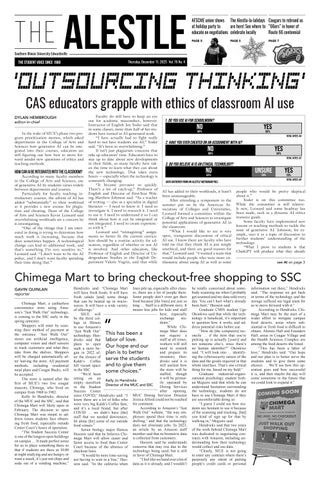
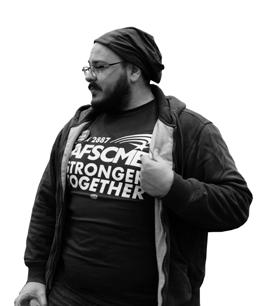
Many staff members, such as Bruce Meier (center) and Sheryl Myers (right), were seen wearing American Federation of State, County and Municipal Employees (AFSCME) shirts at the annual faculty and staff appreciation party in protest of what they say is unfair treatment by SIUE
| Gavin Rask / The Alestle
SIUE Police Department plans new program to strengthen relationships with students
AIDAN KARSTEN intern
Hoping to increase trust and communication on campus, the SIUE Police Department plans to roll out a student-centered outreach initiative next semester.
Through social programming, collaborative events and increased visibility, the department hopes to build deeper trust and create stronger connections with the campus community.
At the center of the initiative is a clear purpose: improving relationships between students and the police who serve them every day. Chief David Goodwin said the intent behind the program is rooted in accessibility, communication and mutual understanding.
“We want to create more consistent opportunities to talk with students, hear what’s on their minds and work together on campus safety priorities. At its core, this is about building trust, improving communication and making sure stu-
dents know we are accessible, responsive and committed to their success and well-being,” Goodwin said.
Next semester’s programming is still being finalized, but the department has already outlined several activities aimed at giving students a clear, personal look at the people behind the uniform. Early ideas focus on blending education, transparency and approachability, much of it shaped with direct input from SIUE Student Government members.
“Coming into my presidency, I really wanted to focus on building relationships with different departments, one of those being the police department,” Student Body President Jenna Nestor said. “I’ve been working with Chief Goodwin to find a way for us to share the resources and show their responsibilities and duties.”
One of the first planned components is a social media series designed to show the daily responsibilities of different department members.The series is intended to humanize the department and show students aspects of police work they
rarely see.
“We also talked about joint SIUE Student Government and SIUE PD engagement opportunities, including tabling events, campus walks and presentations on topics students tell us matter most, including sessions that help debunk common myths about the police,” Goodwin said.
Those student perspectives are key to the effort. The Police Department wants this to be more than a one-way outreach program, as students will help shape topics, formats and activities during planning. The Police Department wants the initiative’s long-term success to depend on ensuring students feel heard and genuinely involved.
The department also hopes the program will encourage students to feel more comfortable interacting with officers in everyday situations. While emergencies and crisis response often define public views of police work, the department wants to emphasize its role as a supportive partner and resource for students.
Sergeant Kasey Hoyd agreed with
this sentiment.
“We are hoping this partnership will highlight the ability of the Police Department and the students to work together in a positive light. We hope to create understanding, provide education on safety and security and hope to find out more about what the students’ needs are from the Police Department, so we can service the students more effectively,” Hoyd said. By creating consistent opportunities for casual conversation, educational engagement and shared experiences, police representatives believe they can reduce barriers that often exist between campus officers and the students they serve.
According to police members, building trust cannot be achieved through one-off events. Instead, it requires ongoing communication and intentional interactions, something the department says this program aims to deliver.
As the spring semester approaches, more detailed schedules and finalized activities will be shared with the SIUE community.
CAS educators discuss solutions to AI problems after prioritization memos
know. We’re not interested in what we already know. We’re interested in what we don’t know, and that takes analysis and critical thinking,” Johnson said. “It proves to the students that the students are more intelligent than AI. It proves to the students that they don’t need AI. They need me, each other and the critical thinking skills that they develop.”
Others, like Chair of the History Department Jason Stacy and Chair of the English Department Kristine Hildebrandt, have begun reworking their assignments to make them more proactively AI-resistant. Stacy said his students create lesson plans that they then must teach themselves, and Hildebrandt said she has students write about themselves early in the semester to use as a baseline for later assignments.
Other disciplines have little use for AI in the classroom. Chair of the Department of Anthropology Corey Ragsdale said much of his department’s learning is explicitly human-focused. Interim Chair of the Department of Philosophy Chris Pearson said the idea of using AI as a tool for thinking runs contrary to the mission of his department.
“Our fundamental goal is to get people trained up to think for themselves and to reason through ideas and lines of argument, and that equips them to make decisions, choices about how they’re gonna think about the world,” Pearson said. “Farming that out to a computer is just the antithesis of what the core aim of the discipline is, so you can see the source of the genuine worry here for philosophy faculty — that it threatens the very core of what we’re trying to do for students.”
“It’s fundamentally wrong to outsource thinking,” Vogrin
said. “If I encourage my students to use AI, and they end up being less able to think when they get their bachelor’s degree, how am I serving them?”
Should AI be integrated into the classroom?
SIUE began the program prioritization process last spring in an effort to improve curricula in certain departments, according to the memos that were sent out by administration. When the phase two memos were sent out, each department that received one was given a list of questions about improving their curriculum. Among those questions was a bullet point about AI: “How should the curriculum be changed to help students to develop their ability to ethically use generative artificial intelligence tools?”
Leonard said his intent with the wording of the question was to produce dialogue about the idea of AI integration, not necessarily to force departments to do so.
“I didn’t wanna ask the question, ‘Should you do this or not?’ because it’s really easy for anyone to say no, and that doesn’t necessarily stimulate thinking about what could we do,” Leonard said. “If you ask a question that says, ‘What could you do?’ it invites people to think more creatively about options and potential.”
However, many educators said they had some worry about losing autonomy in their curricula.
“I felt like that was leaving room for some kind of a slippery slope,” Vogrin said. “I appreciate so far that the university has left it up to individual faculty. But … with so many top-down decisions being made and forced onto departments, it doesn’t make me feel comfortable. It makes me uneasy.”
“Certainly that point in the
memo reads as if we expect you to make some effort in integrating AI into your curriculum or your classrooms,” Pearson said. “That can be problematic if, upon true reflection and investigation, you think it’s a bad idea in your field.”
On the other hand, Chair of the Department of Public Administration Nancy Huyck said she interpreted the question as a way to elicit conversations on the subject of AI, and that they were successful in that regard.
“My interpretation of the
It’s fundamentally wrong to outsource thinking. If I encourage my students to use AI, and they end up being less able to think when they get their bachelor’s degree, how am I serving them?”
Valerie Vogrin Professor of English
question was [that] its intention was to spur faculty discussion of the topic or use it as an opportunity to get faculty talking about AI, where ideas were to be shared with administration as part of a formal response to the memo,” Huyck said. “I just looked at it as an opportunity to get faculty feedback.”
Margaret Smith, interim director of the IRIS Center for Digital Humanities, said she wishes the university as a whole would consider more voices.
“There’s a shard of shared governance in doing things by committee, but when those committees are formed outside of the Faculty Senate and the unions — they’re formed by the administration with handpicked people — that’s not really shared governance,” Smith said.
Smith also said she worries about putting too much empha-
sis on AI as a necessary job skill, citing the program prioritization letters as proof that SIUE is moving in a direction of career readiness rather than a place where students are encouraged to truly expand their horizons.
However, Leonard said that in addition to contending with changing fields, the American Association of Colleges and Universities reported many students have reported feeling unprepared for AI in the workplace.
“Our primary mission here at SIUE, and at most universities, is not to prepare students with very highly-specific job skills,” Leonard said. “Our mission is to prepare students for careers and for lives beyond the university.”
What’s the solution?
There is currently no university-level guidance on AI use in the classroom. Leonard said the absence of a university-wide policy thus far has likely given the technology the time it needs to evolve — and time to be studied with regards to education.
“I think the fact we didn’t adopt a policy right away was probably a good thing,” Leonard said. “A lot of universities that moved very quickly to adopt a policy ended up abandoning those policies or had to shift very dramatically … as people began to understand what the large language models were capable of doing and how they might actually be very helpful.”
“My vision of the College [of Arts and Sciences] is not one where we offer a one-size-fitsall [method],” Leonard said. “I think it’s really important for individual faculty to have different ways of approaching a subject.”
Interim Chair of Social Work Erik Alexander said a university-wide policy outlining AI plagiarism could be beneficial to departments, so long as it is broad enough to allow de-
partments to forge their own paths ahead.
“I would like a university policy that clearly defines plagiarism and AI. We already have a plagiarism policy that I think is very good and is very clear. There needs to be some sort of policy that incorporates AI into that,” Alexander said. “That would give departments and faculty enough guidance to then create our own discipline-specific standards, but without that university-level guidance, it makes it really challenging to do it in our departments.”
SIUE does offer faculty other resources for AI, with mixed reviews as to their usefulness. Huyck said she has attended sessions on AI put on by the Center for Faculty Development and Innovation. Hildebrandt has attended these sessions too, and while they were helpful for her, “a workshop here and there” is not enough for the faculty.
Smith said she wants the university to encourage students to have discussions amongst themselves about AI use and ethics, which she said is something students have been “excited” to engage in conversations about.
Ragsdale said the ethical concerns of AI are one reason he is hesitant to implement a policy about it in his department. Alexander agreed.
“We could talk about part of SIUE’s strategic plan — one of the pillars is sustainability,” Alexander said. “If you take sustainability to mean environmental impact, that would seem to conflict with everything we know AI is doing to the environment.”
The common thread among educators within CAS is that, whatever the university’s response to the advent of generative AI is, it must be holistic.
contact the editor: lifestyles@alestlelive.com (618) 650-3528
‘TELL US YOUR STORY’
English instructor inspires campus connection through ‘Humans of SIUE’ initiative
BRANDI SPANN
opinion editor
It’s not often that something you find at a yard sale inspires a campus-wide initiative.
But, that’s what happened to Established/Tier II Instructor Keith Edwards after he introduced a visual rhetoric activity to his English Composition I class.
Edwards’ activity was inspired by a book he found at a yard sale. The book, “Humans of St. Louis” — inspired by “Humans of New York” — gave him the idea to have his students search for the people and stories that make SIUE the community that it is.
“Humans of New York” was a photography project started by Brandon Stanton in 2010. The project tells the story of the people of New York “one story at a time” by featuring photos and brief narratives of people Stanton encountered.
“Humans of St. Louis” began in 2014 by social work students Lindy Drew and Dessa Somerside, who wanted to bring Stanton’s philanthropic movement to the St. Louis region. Now, a decade later, Edwards is bringing it to SIUE.
His students were asked to find two peers on
campus that they didn’t know and, with permission, photograph them and get a brief biography of who they are.
“I was amazed at how they dug into it,” Edwards said. “You know how people are around here, buried in their cell phone. These kids went up and explained the project to them, and the kids put down their cell phone. The photographers and the photographed were both interested in this, and they were both engaged with it.”
Edwards had students put together PowerPoint presentations of the peers they interviewed.
“Never before has this ever happened to me where one student said, ‘Can I go first? Can I go after him? Can I go after her?’” Edwards said.
Freshman secondary education and history student Leah Wood ap preciated how the project brought her out of her shell.
“I was very nervous to go up to a stranger and interact with anybody, so it took quite a bit of cour age and quite
DESTINY ALBRECHT
copy editor
“We really wanted to create a space, specifically for Black students, but also for any students who are interested in African American literature, to [be] able to engage in Black literature on a deeper level,” Co-founder of BLAC Makayla Mallon said.
The Black Literary Analysis Club provides an engaging community where students can dive into expressive discussion, short readings and creative activities that help them access and appreciate Black literature.
African American literature graduate student Mallon and junior psychology major Aniya Sykes co-founded BLAC to give students a space to explore the Black literary
a bit of walking around just to find someone who seemed kind enough to even acknowledge me or to be willing to talk to me,” Wood said.
“I picked someone at Union Station. She was the cashier there. She was more than happy to do it once I explained what the project was and what we were doing. And then, after that, I was like, ‘Okay, I got this. We’re good,’” Wood said.
Following the positive reviews from students, Edwards presented the idea of expanding the project, and students agreed to turn “Humans of SIUE” into a club with the Kimmel Belonging and Engagement Hub.
According to Edwards, students want the club to be an authentic way to highlight real student life at SIUE. They envision that it could aid in easing the transition into day-to-day life at SIUE.
“[Students] were thinking, ‘If I was coming to SIUE for the first time, I would want to see real faces, real stories, warts and all, and give a voice to people that are usually mar-
ginalized and don’t have a voice too, like LGBTQIA+, women, people of color, people that are struggling with anxiety, depression, food insecurity,’” Edwards said.
“I feel like allowing people the space to tell the story that they want to tell is important,” freshman biology student Atticus Whitten said. “Keeping the questions purposely vague is beneficial.”
Whitten said that the project is similar to getting to know a friend. The interview is more of a conversation.
“We’re in a stage right now of life where we don’t necessarily understand each other. There’s not a whole lot of intimate con versations going on, especial ly with peers. Having access to learning about other people who are in your class or that you’ve seen in the Quad, and knowing that you’re more similar than you realize, helps build empathy. It helps build understanding and kind of destroys that barrier,” Whitten said.
Wood said that she knew practically no one when she came to SIUE. As a commuter, she is excited to have another place to find familiar faces, make connections and read the stories of her peers.
The club hopes to develop a website where they
will display the faces and stories of students they interview. They also hope to provide links to local resources to support the campus community’
“I want this to stay a student-led, student-driven project,” Edwards said. “They know more about being students than I do.”
The club is currently working with the Kimmel and students interested in the project. They plan to officially begin the initiative in January.
“Everybody has a story to tell,” Whitten said. “They’re all equally important.”
For more information, email Keith Edwards.
BLAC shines light on Black creatives
diaspora. The club encourages participants to engage personally with the material and express themselves beyond the classroom.
During meetings, members analyze diverse types of media, from short texts to films featuring personal Black narratives across genres including scifi, horror, queer studies and historical, according to Mallon.
This past semester, BLAC hosted a variety of events, ranging from movie showings to guest speakers. One such event was a screening of Ryan Coogler’s “Sinners.”
“We’re [wanting to take] it out of just text on pages and try to make it more engaging, [but] still academic, in a sense,” Mallon said.
According to sophomore secondary education major and BLAC Officer TaCoreyia Johnson, the screening was a hit, sparking lively discussion and reflection.
The club also organized events with
speakers Omar Olivas, an SIUE dance instructor and experienced choreographer who discussed the difference between Hoodoo and Voodoo, as well as Danielle Hall, a SOAR success coach and current graduate student who spoke about author Zora Neale Hurston and experiences through the lens of Black individuals.
In addition, members read excerpts from notable Black authors and poets, followed by discussions that encouraged them to reflect on what they thought of the texts and how they could relate to the material personally.
According to Mallon, the club strives to maintain academic integrity while providing a relaxing space for students to discuss.
“[The club is for] Black intellectuals to have a place to talk and the space to open up willingly, but also outside of the classroom. To be able to have their voice outside of their academic voice, I think that’s very important,” Sykes said.
Looking ahead, BLAC plans to continue innovating. Next semester, members can look forward to events such as R&B yoga, more guest speakers and the “One Year Later” discussion panel, where they will be reflecting on political and social topics one year into the Trump administration.
“All of our members are Black, [and] we have been affected in a large way … We want to be able to have a space where we are discussing what’s happening [and] maybe give some verbiage to some of the things we’re feeling and also seeing,” Mallon said.
Through its mix of media, activities and discussion, BLAC strives to provide a relaxing space for academic analysis. With its continued growth and evolving program, the club is promoting literary exploration and building a community where students can engage intellectually, emotionally and creatively.
For more information about the club, visit their page on GetInvolved.
Reegan Countryman
Jazmin Moore Photos submitted by Leah Wood
Alest la-la-lalidays Happy
10 small businesses in Edwardsville to shop at this holiday season
AUDREY O’RENIC sports
editor
With the holiday season swiftly approaching, Edwardsville shoppers don’t have to look far to find unique and meaningful gifts.
Afterwords Books - 441 E. Vandalia St.
Afterwords Books is a family-owned bookstore with books, audiobooks and unique items crafted by local artists. Shoppers with something specific in mind can make a purchase in-store or online. Gift cards are also available online.
A Wildflower Shop Inc.
2131 S. State Route 157
Flowers are always a great gift to give during the holidays. A Wildflower Shop Inc. features a wide variety of flowers, plants, ornaments, holiday decor and more. Flowers and merchandise are available in-store or online.
Keepsake Candle Company - 100 N. Main St.
Keepsake Candle Company specializes in eco-friendly hand-poured candles. Shoppers can choose from a variety of curated scents or even create their own candle in a candle-pouring workshop for a thoughtful, personalized gift. Products are available instore and online.
ZIENA Boutique - 2329 Plum St., Suite 200
ZIENA Boutique offers unique clothing pieces, jewelry and even Labubus. Their customizable charm bracelet and trucker hat bars make wonderful personalized gifts. Products are available in-store and online.
Goshen Winter Market - North Second Street
The Goshen Winter Market is the perfect place for unique gifts, as they feature fresh local produce, artisanal goods and community vendors. The winter market is only open from 10 a.m. to noon on Dec. 20. For more information, visit their website.
Water Sweets Soap Company
6108 Shoger Drive, Suite C
Water Sweets Soap Company is a family-owned business that specializes in handcrafted bar soaps, sugar scrubs, bath bombs and lip butters. Products are available instore or online. Gift cards are also available.
Goshen Coffee Roasters
6120 Shoger Drive, Suite A
From fresh coffee blends to curated teas and custom merchandise, Goshen Coffee Roasters offers something unique for any coffee enthusiast. Many products are available as gift bundles, which make excellent stocking stuffers. Gift cards are available in-store and online.
EXO: Nail Bar, Med Spa, Lounge - 2 157 Center
EXO is a one-stop shop that offers nail care services, medical spa treatments and a specialty lounge with food and drink options for anyone looking to unwind this holiday season. Gift cards are available in-store or on their website.
Trusty Chords Record Shop
1514 Troy Road, Suite C
Trusty Chords Record Shop is a great place to shop for music fans as they offer a wide variety of vinyls, CDs and music-related merchandise. Products are available in-store only. For more information, visit their Facebook.
Heroic Adventures
1005 and 1007 Century Drive
Heroic Adventures is the ideal holiday shopping spot for comic fans with its large selection of comic books, graphic novels, board games, card games and miniatures. Products are available in-store only. For more information, visit their website.
Happy Holidays, and more importantly, happy winter break. To get your break started, here is The Alestle’s guide to all things holiday. From activities to gift ideas, we’ve got you covered.
Getting in the spirit: Upcoming local holiday events
AIDAN KARSTEN intern
As the semester winds down and the holidays inch closer, the Metro East area has plenty of festive events on the calendar.
56th Annual Way of Lights Shrine of Our Lady of the Snows Belleville, IL
MICHAL KATE REYNOLDS managing editor
As the holidays approach, the book reader in your life is sure to be looking forward to new books to be put on their shelf. Here are some “good reads” to add to their collection
Contemporary Fiction Gifts
These contemporary fiction novels are for the reader who loves character-based and slowpaced writing.
“The Idiot” by Elif Batuman
This debut novel by Batuman follows the college experience of linguistics student Selin Karada who and befriends another student, Ivan, who she is romantically interested in.
“Intermezzo” by Sally Rooney
“Intermezzo” walks readers through the messy lives of two brothers. The story explores grief, familial relationships and love.
Nostalgic Christmas and Holiday Display
West End Service Station
Edwardsville, IL
Running nightly through Dec. 31, the Way of Lights remains one of the Metro East’s longest-running and most beloved Christmas attractions.
Visitors can drive or walk through sections of the display, which features more than one million lights, nativity scenes and glowing holiday installations across the shrine’s grounds.
The display is open from 5 to 9 p.m. every night.
Winter Celebrations 2025
Saint Louis Art Museum
St. Louis, MO
Taking place from 10 a.m. to 4 p.m. Dec. 13-14, the Winter Celebrations festival is a free two-day cultural event highlighting global holiday traditions.
Visitors can expect international musiVisitors can expect international music and dance groups, hands-on art activities, storytelling and exhibits that explore winter customs from different cultures. The atmosphere is warm and family-friendly, but also appealing for students who want something creative and an educational experience.
‘Good reads’ for the book reader in your life
Dark Academia Reads
The “dark academia” genre is great for readers who love the feeling of reading by the fire or studying in the library.
“Babel: Or the Necessity of Violence: An Arcane History” by R.F. Kuang
Another novel set at a prestigious university, “Babel” takes place at a fictional version of the University of Oxford, where orphan Robin Swift studies multiple languages to attend the Royal Institute of Translation. This novel touches on race, class and the complexity of language.
“Ninth House” by Leigh Bardugo While also considered a fantasy novel, “Ninth House” has all the makings of a dark academia. After surviving a homicide attempt, Alex Stern is offered a full ride to Yale University as part of one of the university’s secret societies, which participate in occult and sinister activities.
Classic Novels
If you know a reader who loves older, timeless stories, I recommend these well-loved classics.
“The Count of Monte Cristo” by Alexandre Dumas
This book, originally published in France in the 1840s, is a thrilling tale of Edmond Dantès as he seeks revenge against those who imprisoned him. While “The Count of Monte Cristo” is available in a shorter, abridged version, I recommend the unabridged edition.
“The Handmaid’s Tale” by Margaret Atwood
Originally published in 1985, “The Handmaid’s Tale” is a modern classic. The novel follows Offred, a Handmaid in an America where women’s rights are stripped away. “The Handmaid’s Tale” is challenging and thought-provoking — an absolute must-read.
Edwardsville’s West End Service Station is hosting a holiday open-house event 10 a.m. to 4 p.m. through Dec. 21. The small historic gas station is decorated with classic Christmas pieces, retro-themed displays and vintage seasonal memorabilia that highlight local history as much as holiday cheer.
WonderLight’s Christmas
World Wide Technology Raceway Fairmont City, IL
Running through Jan. 4, the mile-long, fully synchronized light and music experience features animated displays, towering tunnels of bulbs and a soundtrack that streams directly through your car’s radio.
The show is open from 5 to 10 p.m. every evening, making it an easy weeknight or weekend stop for students heading home from campus.
O’Fallon Holiday Lights at Central Park O’Fallon, IL
Open nightly through Dec. 30, O’Fallon’s Central Park transforms into a community-designed holiday light walkway. While not as large as the region’s major drive-through shows, its neighborhood feel and walkable layout make it a cozy, approachable option for students and families.
For more book suggestions, please scan this QR code or visit our website at alestlelive.com
Fantasy Books
If you know someone who loves to escape into magical worlds, these fantasy books are perfect for your gift list.
“The Priory of the Orange Tree” and “A Day of Fallen Night” by Samantha Shannon
“The Roots of Chaos” series follows multiple characters across several kingdoms. These books are rich in plot, featuring ancient queendoms, dragons, and a magical sisterhood dependent upon an orange tree. “A Day of Fallen Night” is the prequel to “The Priory of the Orange Tree,” but both books can stand alone.
“The Fellowship of the Rings” by J. R. R. Tolkien
“The Lord of the Rings” is a well-known series and a wonderful introduction into the fantasy genre. This book takes place in Middle-earth, where a Hobbit named Frodo Baggins must go on a quest to save his world.
Romance Books
The romance genre is popular amongst readers, as the genre explores romantic connections between characters. Here are two romance novels that will be great gifts for your romantic reader.
“Happy Place” by Emily Henry
In “Happy Place,” main characters Harriet and Wyn have kept the secret of their break-up for months. To ensure they don’t spoil their vacation with their closest friends, the two decide to pretend to still be together.
“Red White & Royal Blue” by Casey McQuiston
When the son of the president of the United States and the Prince of Wales engage in an intense rivalry, their families decide to force the two to form a truce. As they begin a fake friendship to appease their families, the two also fall into a secret relationship.
HAVE A COMMENT?
Let us know by scanning here: Campus Box 1167 Edwardsville, Illinois 62026-1167
LETTERS TO THE EDITOR POLICY:
The editors, staff and publishers of The Alestle believe in the free exchange of ideas, concerns and opinions and will publish as many letters as possible.
Letters may be submitted to: The Alestle Morris University Center Room 0311
All hard copy letters should be typed and double-spaced. Letters should be no longer than 500 words. Include phone number, signature, class rank and major.
We reserve the right to edit the letter for grammar and content. Care will be taken to ensure that the letter’s message is not lost or altered.
Letters to the editor will not be printed anonymously except under extreme circumstances. We reserve the right to reject letters.
TORRE JOURNEY reporter
“A Matter of Opinion” is an opinion column that features a personal, anecdotal account of an experience relevant to college students. Each edition, a staff member will write about something important to them in order to share advice, start conversations and invite our readers to connect with one another.
My spiritual journey has shown me grace where organized religion didn’t. For the same reason, I think spiritual plurality can enhance understanding across DEI initiatives.
Typically, religion is systematic and offers a formal theology to help understand one’s beliefs. Spirituality, though more broadly categorized, can include the individual perspectives and wholeness we experience through expression and connection.
I grew up Nazarene Christian and, while my family isn’t devout in their faith, they are strong believers in the Bible and hold a deeply spiritual expression of Christianity. At the age of 14, I stepped away from the church when parts of my identity, like coming out as gay, were seen as being in direct confict with the teachings of my church.
Spirituality
requires inclusivity, diversity and pluralism
I remember one night, after a youth group, my pastor gave me a ride home. I felt like I was fumbling with a divine humility in my chest. I felt compelled by the teachings of my faith to be honest with my pastor and tell him I was gay.
The pang in his chest was audible. I watched as years of being a do-gooder kid who volunteered at every bake sale, walked the candles to the front of our Christmas ceremony and went early to Sunday service had been rinsed from his expression. He told me not to come back.
That moment never ruined my connection to faith. I spent the next few years exploring, fnding and adopting a new form of faith, Celtic Paganism. Along the way, I learned that anyone spreading exclusion in faith must not be fully embracing an all-inclusive idea of creation — which also means embracing the parts of all of us that are beyond labels and simple defnition.
The Pagan community is broadly made up of ancient and classical, nature-based religious groups. It also includes religions that center on philosophies, mysticism and polytheism. It is incredibly accepting of
different lifestyles and identities.
In 2020, in the height of the COVID-19 pandemic, I became a Pagan minister and began training with Ar nDraiocht Fein, a Pagan organization, in Druid clergy traditions — the priesthood traditions of Celtic Paganism.
The deeper call I felt to Paganism and Druidism was also because of my Irish heritage. I began looking beyond a Western lens of identity to reconnect with my ancestry. In embracing an ancestral connection to spirituality and religion, I had realized that my modern sense of identity would have to shift around concepts of whiteness, colonialism and heritage.
On April 7, I attended a lecture on religious and cultural identities as a part of the ADEI leadership Certifcate training offered by the Kimmel Belonging and Engagement Hub.
One of the most important points discussed was the origins of universities for exclusively training white, male clergy. Another was the need for true allyship through positionality, which is the understanding of advantages and disadvantages of social positions of different people. These two points make a clear connection to the need for diverse faith groups on college campus-
es that can enhance a collective understanding while providing diverse representation.
This brought me to focus on the cultural value that spirituality brings to the current discussion on diversity, equity and inclusion policies by the U.S. government. One argument by groups like the authors of Project 2025 and the Trump administration is that DEI policies are exclusionary to white men.
However, as a white man, I have found deeper levels of connection to diversity in others through my spiritual outlook on ancestral practices. I have learned that by gaining insight into my own cultural history, I can make connections to the diverse backgrounds of other people. I understand why culture and identity matter so much to all of us.
Even though my beliefs are not widely accepted in mainstream society, they belong to something old and nature-based. Throughout my life, they allowed me to embrace and accept the identities of other cultures, people and lifestyles. The SIUE community can build on its success to create a diverse spiritual community by continuing its ADEI initiatives and supporting the plurality of faith already here.
BRANDI SPANN Opinion Editor
MICHAL KATE REYNOLDS Managing Editor
DYLAN HEMBROUGH Editor-in-Chief
AUDREY O’RENIC Sports Editor
CHLOE WOLFE Lifestyles Editor Torre
SAM MUREN Podcast Producer
SOPHIE HAWKINS Online Editor
Thursday, 12.11.25
Cougars to take new identity for Route 66 centennial
AUDREY O’RENIC sports editor
SIUE Athletics will take on a new look in 2026 to celebrate the centennial of Route 66, a historic highway that runs directly through Edwardsville and has long been a part of the region’s identity.
Each of SIUE’s athletic programs will appear as the
66ers at least once during the year-long celebration.
“We’ve got 16 sports, about 280 student-athletes here at SIUE, and we want them all to be bought into what we’re doing every single day,” Director of Athletics Andrew Gavin said.
Route 66, also known as “the Mother Road” and “Main Street of America,” is a historic roadway that stretches from Chicago to Los Angeles.
Of its 2,448 miles, 301 run through Illinois.
President and CEO of Great Rivers and Routes Tourism Bureau Cory Jobe, who collaborated with SIUE Athletics on the project, said Illi-
nois is anticipated to see high rates of international travel due to a combination of the Route 66 centennial, the 250th birthday of the United States and the FIFA World Cup.
“We’re actually seeing some interest from European travelers [who are] flying to Chicago [and] traveling Route 66 [to experience] the FIFA World Cup in Kansas City,” Jobe said.
Route 66 is best known for its rich transportation history and unique roadside attractions, but Jobe says the 66ers add something new to the legacy.
“[The 66ers] couldn’t be a better fit with all the excite-
VIEW FROM THE SIDELINES:
Women’s basketball freshmen dunk on fresh start TO Season
SAM MUREN podcast producer
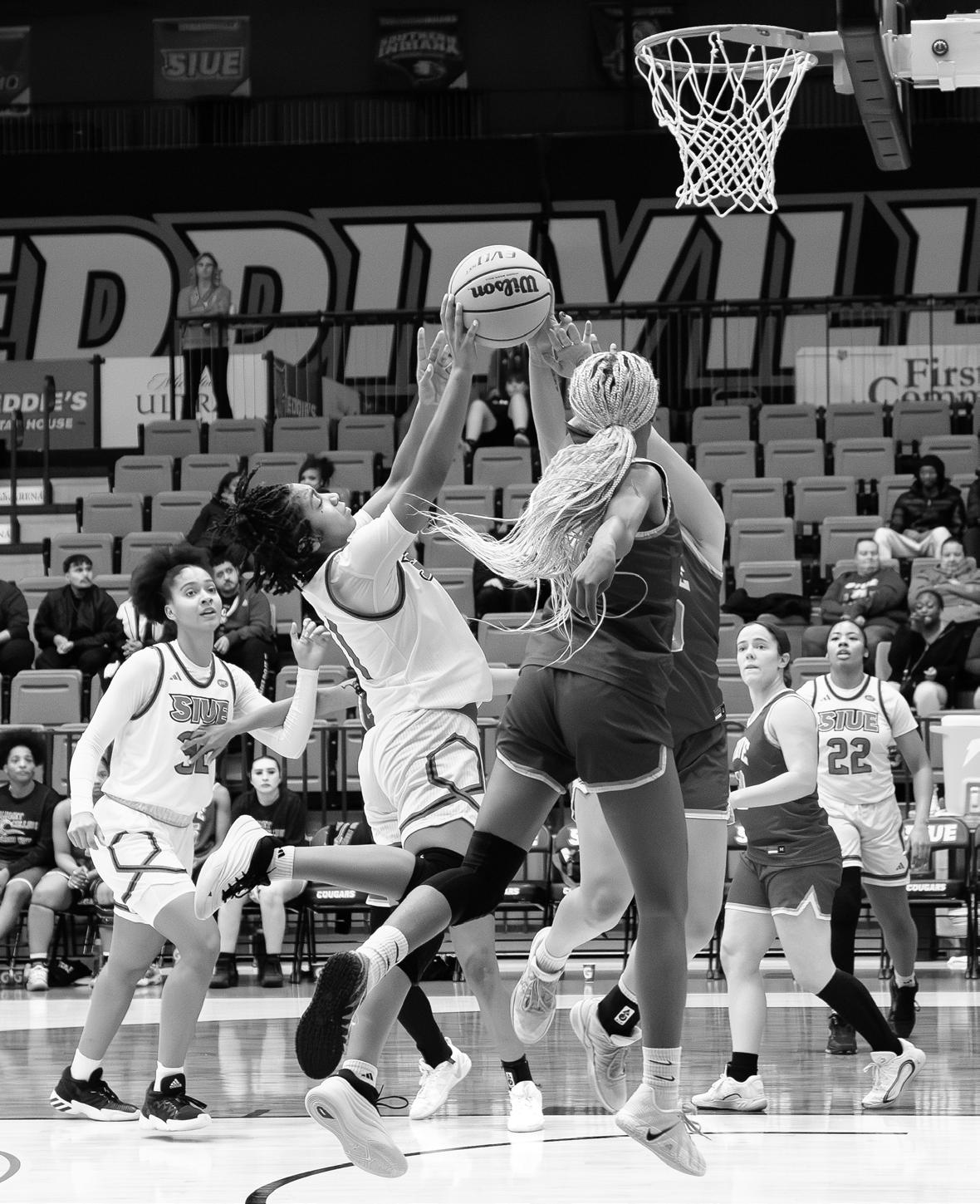
Freshman guard Kiyoko Proctor and freshman forward Lauren Miller have swept the court with a winning sensation this season heading into the end of 2025.
SIUE holds a 5-3 record to start the year, the team has shown significant growth during the off-season.
Miller opened the season earning Ohio Valley Conference Player of the Week backto-back weeks. Proctor earned the honor the week following.
Proctor (109) and Miller (101) combine for 210 points to lead the Cougars in scoring.
The two freshmen have engraved success into the start of the season.
Proctor leads the team in points, 3-point percentage, assists and steals. She tallied 26 points against Indiana State University in the Cougars’ 8171 win.
Miller has proven her success through several games. She has two 20-point games. Her highest, with 25, came in a 56-51 win against Eastern Kentucky University.
Miller and Proctor’s stats alone are impressive, but they’ve been well-supported with the players around them.
Senior guard Macy Silvey and graduate forward Adebukola Akomolafe have provided scoring support in abundance.
Despite the dominant stats, the real note of change is the appearance on court.
Proctor is a lethal presence on the court for other teams. Her ability to take control of
the ball and capitalize on opportunities that are least expected have been the dagger in many of the Cougars’ games this season.
SIUE has desperately needed someone who can spark moments that give opponents no hope in getting back in the game. Proctor has been that player, and her talent has been fun to watch.
Miller is another notable player every night. She may not be as flashy as Proctor, but that is why she is so good. Miller controls the game very subtly.
Her rebound control, both defensively and offensively, allowed the Cougars to maintain pressure with the ball — which the team struggled to do over the last few seasons. The best strategy to win is to hold the ball more than your opponent, and Miller provides a great asset for getting the ball
ment around the campus [and] the sports program,” Jobe said. “It was just a perfect opportunity to really go after a whole new audience.”
“SIUE is surging,” Gavin said. “We want to continue the momentum. We want to continue to be [at the] top of [the] mind to our community and this initiative certainly helps us continue to do that.”
The 66ers will debut in the men’s and women’s basketball games against the University of Southern Indiana on Jan. 1 at First Community Arena. Spring and fall match ups will be announced at a later date.
66ers Winter Season Schedule: Jan. 1 – Men’s and Women’s Basketball vs. University of Southern Indiana
Jan. 10 – Wrestling vs. Pennsylvania Western University at Edinboro and University of Arkansas at Little Rock
Jan. 17 – Women’s Tennis at University of Illinois Springfield (Springfield is on Route 66)
Feb. 13 – Women’s Tennis vs. Bradley University Feb. 15-17 – Golf at Palm Valley Golf Course in Goodyear, Arizona (Phoenix is on Route 66)
Feb. 26 – Men’s and Women’s Basketball vs. Western Illinois University
Track and Field prepares as indoor season begins
PARIS THOMAS IV reporter
With the indoor season underway, the SIUE men’s and women’s track and field program is heading into competition with excitement and ambition.
One of the newer faces on the roster, graduate student Norman Mukwada, joined SIUE after competing at Florida A&M University. Mukwada is a sprinter who mainly competes in the 200- and 400-meter sprints. Mukwada said his transition into the team has been good, in part due to the hospitality.
“It’s a different environment and new people, but we work together, and I really love my teammates,” Mukwada said. “We support each other so we can achieve what we want to achieve. It’s about togetherness.”
for SIUE.
Eight games in, SIUE holds a winning record. Their wins have shown good indicators, but their losses are more interesting. They’ve lost to University of Missouri, Northern Illinois University and Northwestern University.
The responses to these games is what has changed since last season. So far, the Cougars have yet to lose in back-to-back games. That mental resolve in games after a loss is refreshing for fans.
They’ll have a chance to bounce back again in their next game against Valparaiso University at 6 p.m. on Dec. 12 at the Athletics-Recreation Center in Valparaiso, Indiana.
The Cougars will start OVC play at 3 p.m. on Dec. 18 at Eastern Illinois University to take on the Panthers and former teammate Ava Stoller.
Freshman Olivia Hansen is an international addition to the team. Competing in hurdles and sprints, Hansen will take on her first Division I season after previously competing through private club programs in Sweden.
“Here, I finally have a team to compete for,” Hansen said. “That gives me a higher purpose, and I want to do everything to benefit the team.”
Hansen said that, for her first season, she has set big goals for herself. She hopes to break 58 seconds in the 400 and reach the mid-8-second range in the 60-meter hurdles.
“I do track because I enjoy it,” Hansen said. “My results don’t define me as a person. If I work hard, I’ll get good results, but I want to find joy in what I’m doing.”
Returning Cougars like senior Konrad Sacha are reacclimating themselves to the indoor season. Sacha said indoor is more technical due to the tighter turns and shared lane racing in events like the 400-meter sprint.
Last season, Sacha ran sever-
al events, including the 60-, 200and 400-meter sprints, as well as the 4x400 meter relay. Sacha’s 400-meter time at the Ohio Valley Conference Indoor Championships was 49.2 seconds.
Sophomore sprinter Darrelle Rice has been focusing on both her mental and physical health leading into this season. Rice is coming off a strong indoor season with personal bests of 8.13 seconds in the 60-meter hurdles and 26.4 seconds in the 200-meter sprint.
“I’ve dealt with injury, but I refuse to let it define me,” Rice said. “I plan to come back strong.”
Men’s and women’s track and field head coach Marcus Evans said that the key to the beginning of the season is confidence and support. Despite track being a mainly individual sport, he said his teams pride themselves on being there for each other.
With training through a period with final exams, Evans said student-athletes are encouraged to communicate needs as they balance the student-athlete schedule.
“The student side is always going to come before the athlete side,” Evans said. “There’s no competition more important than graduating.”
Evans said the program is looking to be on podiums and be national qualifiers.
“We’ve gone from near the bottom of the standings to one of the best finishes in school history last year,” Evans said. “We want to keep pushing forward. Anything can happen at a conference championship.”
For now, the Cougars are focused on their first meets of the season, competing hard, learning where they stand and returning ready to grow.
SIUE’s next meet is the Alexis Jarrett Invitational on Jan. 6 at the University of Missouri in Columbia, Missouri.
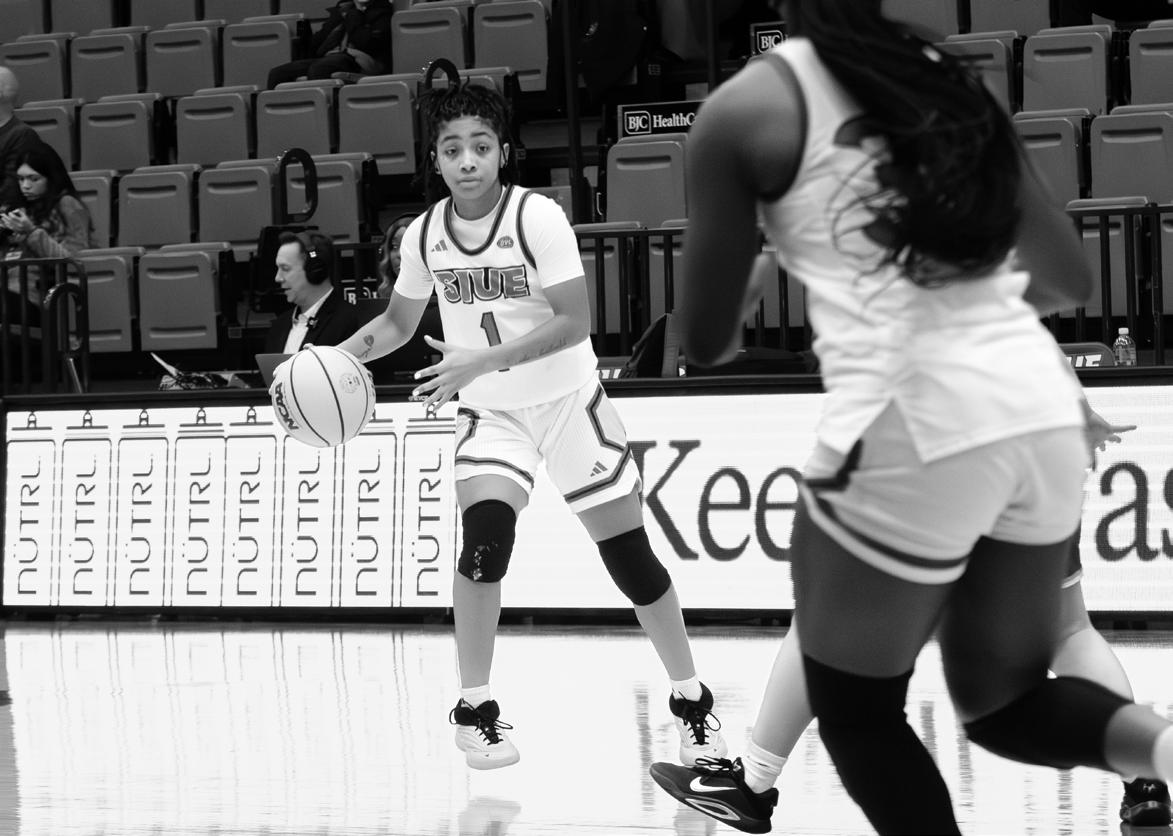
Freshman guard Kiyoko Proctor dribbles through Calumet College during Saturday’s matchup. The Cougars defeated the Crimson Waves, 68-28. | Gavin Rask / The Alestle
Women’s basketball dominates Calumet in 68-28 victory
DESTINY ALBRECHT copy editor
The Cougars dominated Calumet College of St. Joseph’s Crimson Wave with a 68-28 victory, showcasing their defensive strength on Dec. 4, at First Community Arena.
The Cougars jumped to an early lead with a slick pass sequence from freshman guard Kiyoko Proctor to senior guard Macy Silvey to graduate student forward Syanne Mohamed, ending with two points for the Cougars.
The first quarter set the tone as the Cougars’ man-to-man defense, paired with frequent guard switches, stifled the opposition’s scoring opportunities.
Despite a few mistakes throughout, the Cougars quickly redeemed themselves with strong defensive plays, including a standout block from sophomore redshirt guard Emiyah Cobb. By the end of the quarter, the other team had scored only four points while committing five fouls.
The Cougars continued to capitalize on Crimson Wave’s
foul trouble, turning free-throw opportunities into easy points.
Notable performances came from Mohamed, who contributed both offensively and defensively with multiple scores and blocks, and Silvey, who hit backto-back three-pointers.
By halftime, the Cougars had built a sizable lead due to efficient ball movement, strong rebounds and an impressive defense.
After the break, the Cougars maintained control despite resting starters for a large amount of the time. Early in the half, Crimson Wave managed to grab some points, including a few three-pointers.
However, the Cougars’ suffocating defense and disciplined play maintained the large deficit. Sophomore forward Adriana Blazquez contributed five rebounds, helping maintain possession and control of the game.
Freshman forward Sy’Rae Stemmons made an impression on the court, earning praise for her consistency and scoring ability.
“She has been a really consistent player when it comes
to our day-to-day practice and showing that she’s got an ability to score the basketball, and that’s why she’s here,” head coach Sam Quigley Smith said. “She’s a freshman that’s playing at a high level and learning a lot, so this was a great opportunity for her.”
The Cougars’ dominance was evident on the scoreboard, leading 59-17 at the end of the third quarter and ultimately closing out the game at 68-28. The Cougars’ height and guard approach allowed them to control the pace and secure the victory.
Looking ahead, Smith said the team’s goal of adaptability and execution was top priority.
“To win a league or to win a conference championship, I think you have to be able to adjust and to execute certain things when an opponent calls for them, so we certainly have been working on that. We want to be a team that’s really versatile and can adjust on the fly, and so we were trying to explore and experiment with that a little bit,” Smith said.
The Cougars will take on the Panthers at 3 p.m., Dec., 18 at Eastern Illinois University.
Men’s basketball trampled by Broncos, falls 83-73
AUDREY O’RENIC sports editor
Men’s basketball is aiming to regroup after Saturday’s 83-73 loss to Western Michigan University at First Community Arena.
The Broncos set the tone for the game by adding the first points on the board. While WMU had no problem making the ball into the basket, SIUE struggled with precision.
By half, the Cougars scored just 11 of their 32 shots (35 percent), while the Broncos checked in at 13 of 21 (62 percent). WMU led at half 36-28.
“We didn’t move the ball like we needed to,”
head coach Brian Barone said.
“[We] got a little stagnant in the first half, [and] there was some frustration.”
Barone said the team saw brief success when they used a strategy that previously worked for them at their most recent game at University of North Florida, where the Cougars won 72-63.
“One area we did have success was in the second half, when we went to the three quarter press-in trap,” Barone said.
With nearly 13 minutes left in the game, the Cougars went on a 10-point run that began with a good free throw from senior guard/forward Ring Malith.
However, the Broncos were able to regain and maintain the lead for the rest of the game.
“We weren’t able to turn it [around], but there’s some positives that took place throughout the game,” Barone said. “It’s a great opportunity to really take ownership on your level of production [and] take ownership on what this team totally needs to move forward.”
Malith said the non-conference games have been helpful with developing the new team identity.
“We got a couple new players, so we’re really trying to figure it out, but I like where we are going and we’re gonna get better,” Malith said. “Every loss,
you just got to take it as a lesson.”
In addition to the new roster, players like junior guard Tyler King and redshirt sophomore forward Darrion Baker are just now taking the court after suffering injuries.
“Tyler King [is] a really good player. He’s been playing just for about a month now,” Barone said. “[Baker] is finally getting into that groove coming off his injury.”
Malith led the Cougars in scoring with 20 points, which earned him Ohio Valley Conference Player of the Week honors. Senior forward Myles Thompson scored 13, and Baker tied his career high with 12.
The Broncos hit 27-47 (57
percent) to outshoot the Cougars, who went 28-64 (44 percent). WMU also outrebounded SIUE 36-23.
The Broncos improved their overall record to 5-5, and the Cougars fell to 6-4.
“[We’ve] got Eureka [College] next Sunday, which is going to be a big game for us, because any game is a big game,” Barone said.
“We just need to regroup, stay focused on what the goal is and keep growing as a team,” Baker said.
The Cougars will play in a Family Day Doubleheader against Eureka College at 1 p.m., on Dec. 14, at the First Community Arena.
Wrestling finishes fifth with 149-lbs winner at Cougar Clash
SOPHIE HAWKINS online editor
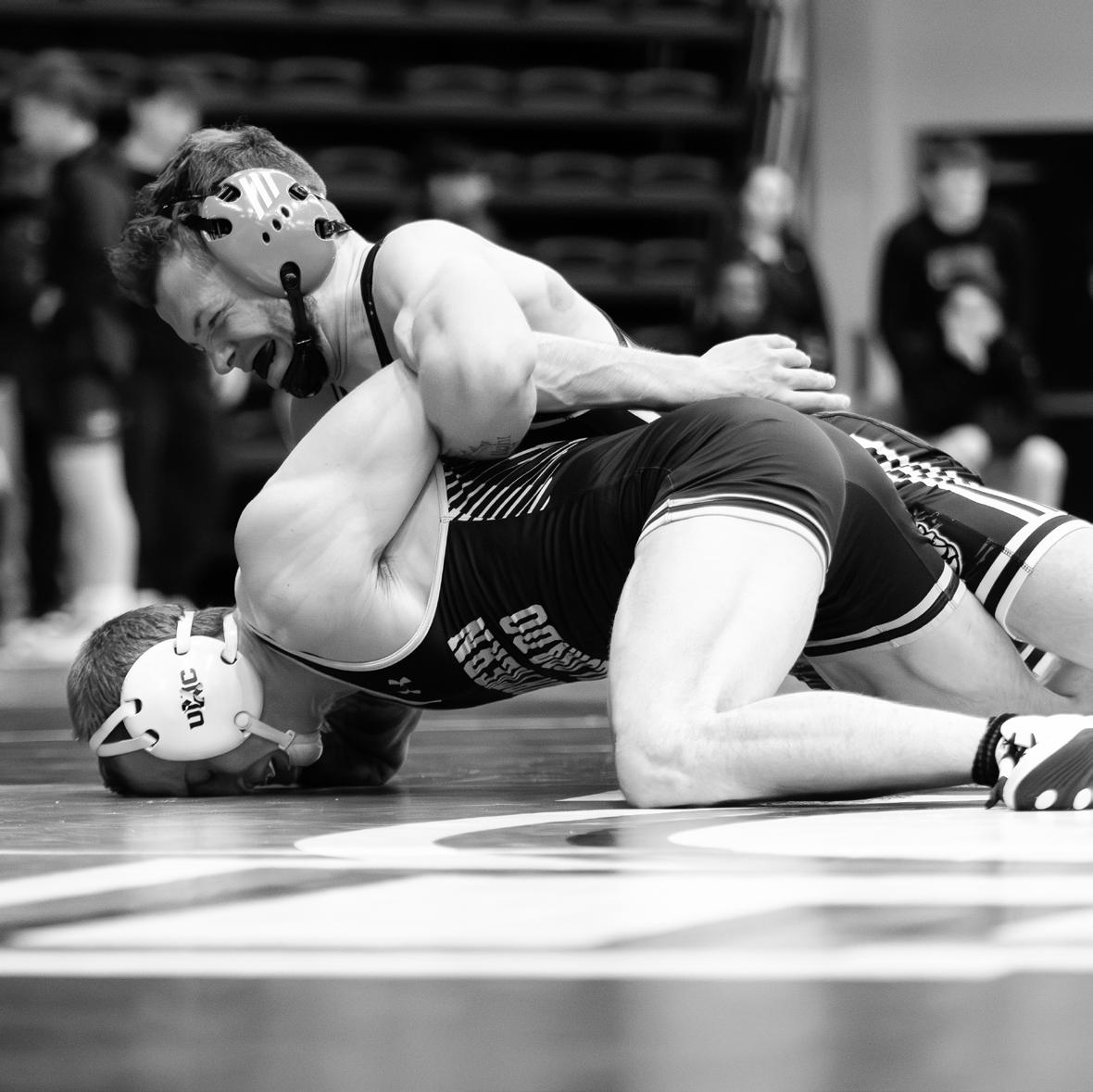
On Sunday, Dec. 7, at First Community Arena, redshirt senior Caleb Tyus became the first Cougar to win the Cougar Clash title twice, with the team taking fifth out of eight teams overall.
“We picked up a few nationally ranked wins, which is always important when you’re trying to put guys at the national tournament at the end of the year,” associate head coach Daryl Thomas said.
Tyus secured first place in the 149-pound weight class.
“I knew it was my last time [competing in the Cougar Clash], so I definitely had a little more pressure,” Tyus said. “I really wanted to be able to do it and say that I was not only the first one to win [the Cougar Clash], but be the first one to win it twice.”
Tyus won his first three
duals, leaving him in the finals with Oklahoma State’s Casey Swiderski, a redshirt junior and returning All-American.
“I knew [Swiderski] was a tough opponent. It’s actually a funny story, I remember wrestling him back in 6th or 7th grade, and I lost to him at one of the national tournaments, so I was definitely thinking about that a little bit as well,” Tyus said. “I went in there with a little bit of fire. I knew he was a tough opponent. I knew it was gonna be a physical match, and that definitely showed out there.”
Tyus ended the final with an 8-1 decision against Swiderski.
Redshirt junior Marcel Lopez finished third in the 133-pound class, with a 4-3 decision against University of Northern Iowa’s Julian Farber. Lopez said that with tournaments like the Cougar Clash, it’s more difficult to keep momentum.
“It’s a long day of wrestling,
and [I] dropped a match on the front side and had to come back,” Lopez said. “The hardest part of the day is coming back and getting back into the win column, so stringing together a couple wins to end the tournament felt good, and I’m pretty satisfied with my performance, but there’s still a little bit of work to do.”
Among Tyus and Lopez were nine other Cougars that finished in the top eight for their weight class.
“A big part of our program is building the process. This is the place to go if you want to build, if you want to grow not only in wrestling but as an individual,” Tyus said. “I hope that helps to show what SIUE can do as far as development.”
With three wins in a row in the regular season matches and a strong performance at the Cougar Clash, the Cougars hope to continue their success for the remainder of the season.
Freshman guard Kiyoko Proctor shoots in a matchup against Calumet College on Dec. 4. | Gavin Rask / The Alestle
Redshirt senior Caleb Tyus battles Northern Colorado at the Cougar Clash on Sunday. | Gavin Rask / The Alestle