FOR THE RECORD
What did brunol say?
Notes from the Architect of the first Controlled Human Cryonics Preservations By R. Michael Perry
D
ante Brunol (full name: Mario Dante Bruno-Lena) was an experimental physician and biophysicist active in the late 1960s in southern California. Records indicate he was born at Locana, Italy, 14 Feb. 1926 and died at Boscanero, Italy, on 1 Jan. 1978, when he was not yet 52 years old.1 He is mainly remembered in cryonics for devising the first protocol for cryopreserving a human being with the hope of eventual resuscitation (“The Method for Freezing Humans”2), and for his role in two of the earliest human cryopreservations, those of James Bedford (January 1967) and Marie Phelps-Sweet (August-September 1967).3 At the time of the freezing of Bedford it appears he was employed at the University of Southern California near where the freezing took place. Apparently he lost his position briefly as a result of his involvement but soon regained it (some details are unclear).4 Robert Nelson, who headed the Cryonics Society of California and organized the freezings, offers this description in his 1968 book about the Bedford freezing, We Froze the First Man: Dr. [Brunol] is a very colorful gentleman. Born in Northern Italy, his fair hair and skin and light blue eyes belie the stereotyped image most Americans have of Italians. His accent, however, gives him away. Throughout our association I was ‘Bob-a-Nelson’ to him and this and his courage will always provoke fond memories of the fiery, dedicated scientist who did so much to advance the concept of cryogenic interment.5 6
This article mainly consists of material by Brunol himself relating to these cryonics cases recently discovered in Alcor’s archives, much of it not previously published. Included is an article by Brunol, “Is Suspended Animation a Crazy Dream?” and an unpublished letter to Saul Kent and Curtis Henderson from October 1967, replying to a letter of Saul Kent which is also included. (All pieces included here are lightly edited by me. See “DB” in Sources for full, original correspondence as PDF file—RMP.) Brunol here shows mixed feelings about the fledgling practice of cryonics and its principals, including Robert Ettinger and Robert Nelson, and is very concerned that the material not be published, fearing (no doubt rightly) a negative impact on his scientific career. By way of additional background, at the time of Brunol’s writing four people had been cryopreserved with some idea of eventual reanimation. The first was a woman frozen in April 1966 by CryoCare Equipment Corporation in Phoenix, Arizona.6 This was after embalming and several weeks of storage in a mortuary refrigerator. (She was thawed and disposed of conventionally around the time of the second freezing.7) The second freezing was that of James Bedford in January 1967, carried out by the Cryonics Society of California, headed by Robert Nelson, with Dante Brunol presiding. Unfortunately, Brunol’s complicated perfusion apparatus could not be properly activated on the short notice he was given before Bedford Cryonics / May 2015
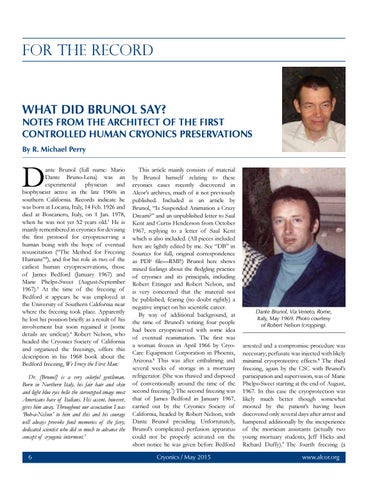
Dante Brunol, Via Veneto, Rome, Italy, May 1969. Photo courtesy of Robert Nelson (cropping).
arrested and a compromise procedure was necessary; perfusate was injected with likely minimal cryoprotective effects.8 The third freezing, again by the CSC with Brunol’s participation and supervision, was of Marie Phelps-Sweet starting at the end of August, 1967. In this case the cryoprotection was likely much better though somewhat mooted by the patient’s having been discovered only several days after arrest and hampered additionally by the inexperience of the mortician assistants (actually two young mortuary students, Jeff Hicks and Richard Duffy).9 The fourth freezing (a www.alcor.org