040
FEATURE
In a Realm of its own GPT Audio Visual boss, Glen Thurecht, offers this personal account of the rarest of jobs: a five-star hotel in Canberra. Text / Glen Thurecht
Photos: courtesy Realm Hotel
The words ‘Canberra’ and ‘modern, worldclass accommodation’ aren’t normally heard in the same breath. That was until earlier this year when the Hotel Realm opened its doors. Located near the heart of Canberra’s parliamentary triangle, the Hotel Realm offers five-star facilities that include a large capacity, variable layout function room, ancillary function rooms and six boardrooms. They required a fully-integrated high-end audiovisual system to complement the modern facilities: five-star audiovisuals for a five-star venue. GPT Audio Visual is a Canberra-based engineering and installations company. We were awarded the contract to provide a complete audiovisual turnkey project design, supply, installation and commissioning. As we incorporate both engineering-based consultancy and installation services this allows us to provide tight integration of the audiovisual system with other services such as architectural, electrical, data, MATV, mechanical and structural engineers. Our engineering consultancy includes both acoustic and audiovisual engineering services, which enabled the Realm systems to be designed in compliance with local environmental noise laws.
THE BRIEF
The brief from the engineering team at Doma Constructions, developers of the Hotel Realm project, was simple: provide audiovisual facilities to allow 80 percent of all bookings for the function rooms to be serviced without the need for external hire equipment, and provide quality sound and vision outputs suitable for a five-star hotel facility. Budget was not initially a design constraint factor. The financial justification for this audiovisual 80/20 rule is based on the savings gained from hiring less equipment and fewer operators. Audiovisual facilities are costed separately when a function room is booked, providing direct income attributed to the system. THE DESIGN
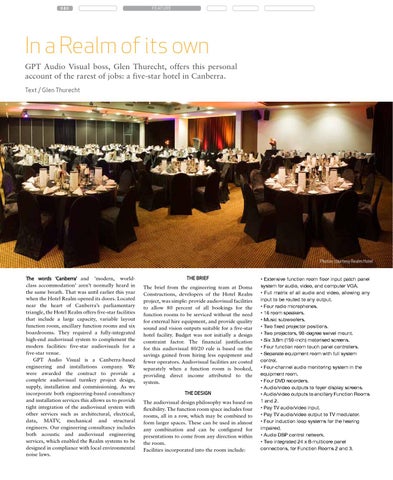
The audiovisual design philosophy was based on flexibility. The function room space includes four rooms, all in a row, which may be combined to form larger spaces. These can be used in almost any combination and can be configured for presentations to come from any direction within the room. Facilities incorporated into the room include:
• Extensive function room floor input patch panel system for audio, video, and computer VGA. • Full matrix of all audio and video, allowing any input to be routed to any output. • Four radio microphones. • 16 room speakers. • Music subwoofers. • Two fixed projector positions. • Two projectors, 90-degree swivel mount. • Six 3.8m (150-inch) motorised screens. • Four function room touch panel controllers. • Separate equipment room with full system control. • Four-channel audio monitoring system in the equipment room. • Four DVD recorders. • Audio/video outputs to foyer display screens. • Audio/video outputs to ancillary Function Rooms 1 and 2. • Pay TV audio/video input. • Pay TV audio/video output to TV modulator. • Four induction loop systems for the hearing impaired. • Audio DSP control network. • Two integrated 24 x 8 multicore panel connections, for Function Rooms 2 and 3.