10
I O
T R I U M P H E A R O U N D
C A M P U S
NIH PHOTO
(continued from p. 9)
Julie Esh: ‘Helping a community realize its strengths’ As she was building her self-designed major in social change and development, Julie Esh decided she had to test what she was learning in the classroom out in the “real world.” She finally settled on a semester program in Washington, D.C., in spite of some initial misgivings. “I had always thought that Washington was just politics—and I wasn’t interested in politics. But in going there, I learned that the government is actually the largest and, at times, the most effective force for creating social change. . . . Every other person I worked with in Washington had something to do with the government, whether they were policymakers, citizens or grassroots organizers. They were all working with the government to improve things.” Last spring Esh was a tutor and intern at Thurgood Marshall Academy Public Charter High School (TMA), which serves students in southeast Washington with extreme educational needs. Students in this part of the city typically score well below grade level on math and reading tests, and dropout rates are extremely high, with more than 40 percent of ninth graders failing to finish high school. In contrast, TMA has designed a special curriculum and support system to ensure that every one of its students graduates and goes on to college. For her internship, Esh worked with the associated non-profit organization, The Full Potential Foundation, which solicits additional funding, business partnerships and volunteers to support TMA. In addition to working as a volunteer tutor, Esh helped organize a gala auction that raised nearly $200,000. “One of my main goals in taking on an internship was to experience and learn more about how a non-profit organization is effectively run,” Esh says. “My main purpose for choosing TMA was because it was in its first year as an organization and still dealing with many of the problems and issues that come up in the initial stages of development.” She will take these insights with her after graduation this May. PHOTO COURTESY OF J. ESH
Last spring, Julie Esh worked as a tutor and intern at Thurgood Marshall Academy, a charter school in southeast Washington. She says she learned much about the challenges facing non-profit organizations today.
“Basically I learned about how to be an effective change agent in a community, listening to the needs of community members, serving as a link to outside resources and helping a community realize its strengths,” Esh concludes.
Josh Cecil: Witnessing policymaking in action During his stay in Washington this past fall, senior Josh Cecil met former Israeli prime minister Benjamin Netanyahu and attended gatherings that included Bill and Hillary Clinton, Democratic National Committee chair Terry McAuliffe, and entertainers such as James Taylor and Janet Jackson. But this glimpse of Washington’s “fishbowl,” while exciting, was only a small part of Cecil’s experience interning with the Carmen Group, a government relations firm. He also helped create client proposals and compiled research about prospective clients as well as competitors. Cecil developed an information packet analyzing the feasibility of a prospective partnership with a public transportation company, and presented his findings to the Carmen Group senior associates. And he attended and reported on pertinent Congressional hearings, and wrote speeches for several of the firm’s confidential clients. The political science major also spent several weeks in New Hampshire working on Governor Jeanne Shaheen’s bid for a U.S. Senate seat. “It was great!” says Cecil of the campaign. “We had 17-hour days and what little sleep we got was had on the floor of the local YMCA, but it was completely worth it! She did not win but I gained valuable campaign experience.” In addition to his internship, Cecil worked on a senior thesis exploring border security issues that have developed since the 9-11 terrorist attacks. Being in Washington gave him immediate access to legislative debates on these issues. “I [attended] Congressional hearings pertaining to border security,” he notes, adding that he also received assistance from Michigan Senator Debbie Stabenow, the Cato Institute, the Center for Immigration Studies and the Public Policy Institute of California. Cecil found an expert adviser in Governor Shaheen, who is directly involved with legislation affecting U.S.Canada border crossings. “She’s a great resource,” says Cecil. A focus of Cecil’s thesis and Shaheen’s Smart Border declaration with Canada is control of the U.S.-Canada border. In contrast to the heavily patrolled U.S.Mexico border, the Canadian border has relatively light security, except at the major ports of entry. Since 9-11, Cecil explains, legislators have sought a balance between openness—which is important for business—and control—which is important for keeping out terrorists. A member of Albion’s Gerald R. Ford Institute for Public Policy and Service, Cecil
says he benefited immensely from this opportunity to observe and analyze governmental responses to pressing national concerns. “I can now research these issues and talk about them [knowledgeably],” he explains. “I’ve gained a lot of professional confidence.”
Lori Sanders: Providing political intelligence for business Her spring 2002 internship with the Business Industry Political Action Committee (BIPAC) taught Lori Sanders that successful business executives also must be savvy about politics and government—a valuable insight since she intends to pursue a career in management. A member of Albion’s Carl A. Gerstacker Liberal Arts Institute for Professional Management, Sanders gained a broader understanding of the complex interaction of business and government today from her experience at BIPAC, which provides political analysis for business leaders as well as research on campaigns and elections. Her responsibilities included making logistical arrangements, running registration and preparing literature for numerous BIPAC political briefings, PAC workshops, and informational breakfasts with members of Congress. “I loved my job. Not only did I work with a terrific group of people, I also had many exciting duties,” enthuses the senior economics/management major. For BIPAC’s annual awards dinner, she helped make video tributes for the honorees, which involved interviewing several business leaders and members of Congress. As with many interns, Sanders notes that a highlight of the off-campus experience was the ability to see the practical application of her education. “I learned a great deal about the business environment and relating to others.” She adds, “So many times I had that ‘I can’t believe I’m actually living here’ feeling. It was amazing being able to see the White House on my walk to work, and being able to see the Washington Monument from almost anywhere. . . . I spent many weekends touring the National Mall and seeing all of the wonderful monuments and museums. I also took advantage of going to lectures, plays, concerts and festivals. . . . It was a lifechanging experience.”
Nate Sowa: Harnessing biotechnology to fight disease His experience as a fellow with Albion’s Foundation for Undergraduate Research, Scholarship, and Creative Activity gave Nate Sowa a definite advantage in landing his latest research opportunity—with the National Institutes of Health (NIH). This past fall, Sowa, a senior biology major, was one of only six interns selected for a project (run through Colgate University) at the Laboratory of Molecular Biology in the NIH’s National Cancer Institute, and he was one of the few undergraduate interns at the NIH. The biotherapy lab where he worked focuses mainly on refashioning organisms and parts of organisms to battle various diseases. Sowa had considerable professional independence as a member of the lab’s research team. “I designed, conducted, and reported on
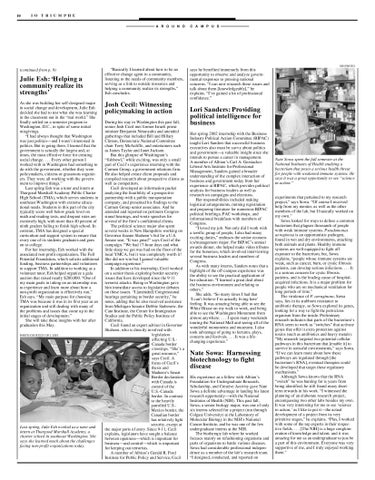
Nate Sowa spent the fall semester at the National Institutes of Health studying a bacterium that poses a serious health threat for people with weakened immune systems. He says it was a great opportunity to see “science in action.” experiments that pertained to my research project,” says Sowa. “Of course I received help from my mentor, as well as the other members of the lab, but I basically worked on my own.” Sowa looked for ways to defuse a common bacterium that plagues thousands of people with weak immune systems. Pseudomonas aeruginosa is an opportunistic pathogen, found in wet and dry environments, attacking both animals and plants. Healthy immune systems are well-equipped to fight off exposure to the bacterium, but, Sowa explains, “people whose immune systems are weak, such as cancer, burn, or cystic fibrosis patients, can develop serious infections. . . . It is a serious concern for cystic fibrosis patients, and is the leading cause of hospitalacquired infections. It is a major problem for people who are on mechanical ventilation for long periods of time.” The virulence of P. aeruginosa, Sowa says, lies in its stubborn resistance to antibiotic therapy, so Sowa explored its genes, looking for a way to fight the pernicious organism from the inside. Preliminary research indicates that parts of the bacterium’s RNA seem to work as “switches” that activate genes that offer it extra protection against toxins (such as antibiotics and heavy metals). “My research targeted two potential cellular pathways in this bacterium that [enable it] to survive in stressful environments,” says Sowa. “If we can learn more about how these pathways are regulated through [the bacterium’s RNA], eventual therapies could be developed that target these regulatory mechanisms.” Although Sowa knows that the RNA “switch” he was hunting for is years from being identified, he still found many shortterm rewards in his work. “I witnessed the planning of an elaborate research project, encompassing two other labs besides my own. It was very interesting for me to see ‘science in action,’ as I like to put it—the actual development of a project from its very primitive stages,” he explains. “Plus, I worked with some of the top experts in their respective fields. . . . [The NIH] is a huge conglomeration of knowledge and talent, and it was amazing for me as an undergraduate to just be a part of this environment. Everyone was very supportive of me, and I truly enjoyed working there.”