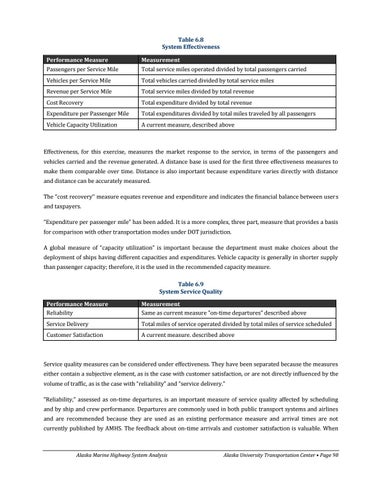
Table 6.8 System Effectiveness Performance Measure
Measurement
Passengers per Service Mile
Total service miles operated divided by total passengers carried
Vehicles per Service Mile
Total vehicles carried divided by total service miles
Revenue per Service Mile
Total service miles divided by total revenue
Cost Recovery
Total expenditure divided by total revenue
Expenditure per Passenger Mile
Total expenditures divided by total miles traveled by all passengers
Vehicle Capacity Utilization
A current measure, described above
Effectiveness, for this exercise, measures the market response to the service, in terms of the passengers and vehicles carried and the revenue generated. A distance base is used for the first three effectiveness measures to make them comparable over time. Distance is also important because expenditure varies directly with distance and distance can be accurately measured. The “cost recovery‘’ measure equates revenue and expenditure and indicates the financial balance between users and taxpayers. “Expenditure per passenger mile” has been added. It is a more complex, three part, measure that provides a basis for comparison with other transportation modes under DOT jurisdiction. A global measure of “capacity utilization” is important because the department must make choices about the deployment of ships having different capacities and expenditures. Vehicle capacity is generally in shorter supply than passenger capacity; therefore, it is the used in the recommended capacity measure. Table 6.9 System Service Quality Performance Measure Reliability
Measurement Same as current measure ”on-time departures” described above
Service Delivery
Total miles of service operated divided by total miles of service scheduled
Customer Satisfaction
A current measure. described above
Service quality measures can be considered under effectiveness. They have been separated because the measures either contain a subjective element, as is the case with customer satisfaction, or are not directly influenced by the volume of traffic, as is the case with “reliability” and “service delivery.” “Reliability,” assessed as on-time departures, is an important measure of service quality affected by scheduling and by ship and crew performance. Departures are commonly used in both public transport systems and airlines and are recommended because they are used as an existing performance measure and arrival times are not currently published by AMHS. The feedback about on-time arrivals and customer satisfaction is valuable. When
Alaska Marine Highway System Analysis
Alaska University Transportation Center • Page 98