S08 ORME 1 2018 - Rockwell_BHGE_Big Data_Eilbeck_Layout 1 30/01/2018 15:48 Page 32
Technology
Innovation and big data drive
oil optimism Kurt Kuckein, director of marketing, DDN Storage, discusses the potential for effective interpretation of seismic data to drive efficiency and profitability in oil exploration. HE OIL INDUSTRY has every reason to be optimistic. While the market continues to experience weak crude prices, increasing competition from low-cost US shale resources and renewables, the heightened M&A activity and requisitioning of projects that were delayed during the downturn just a few short years ago are sure signs of recovery and growth. Often it is the lessons learned during downturns that are forgotten when growth occurs. For companies operating more costconsciously, a disciplined eye on operating cost means the difference between prosperity and failure. And in this recovery period these lessons learnt will pay dividends. If we look back just two years, during the worst of the downturn, when capital spending remained under extreme pressure, investment in high performance computing (HPC) technology carried on apace. You would be perfectly within your rights to question why that was so. Numerous economic strategists encourage investment in bear markets. For oil, scratch below the surface and reasons for investing in HPC in a restrictive fiscal market are plentiful. In my view, at least, there is one factor that has had the biggest impact on profitable/reduced risk exploration – effectiveness of interpretation of seismic data. For oil companies, a better understanding of subsurface structures directly translates to reducing exploration risk and cost. Essentially, the higher the accuracy of the company’s view of the geological area, the better its chance of success when it drills. To get the best subsurface view, oil companies rely on high fidelity simulations and modelling. Outside of the use of higher-fidelity images the only discernible factors to faster discovery is the mathematical algorithms you apply to the data; the amount of data and the speed in which you can model it. To achieve these increases in competitive advantage, oil companies have two options: improve the mathematical algorithms, which takes substantial time; or, add to and improve
T
32
oilreview.me
Issue 1 2018
Image credit : Cobalt/AdobeStock
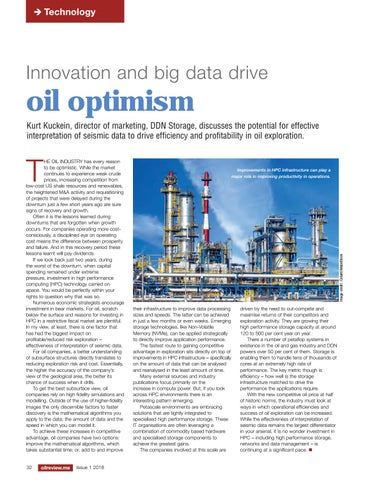
Improvements in HPC infrastructure can play a major role in improving productivity in operations.
their infrastructure to improve data processing sizes and speeds. The latter can be achieved in just a few months or even weeks. Emerging storage technologies, like Non-Volatile Memory (NVMe), can be applied strategically to directly improve application performance. The fastest route to gaining competitive advantage in exploration sits directly on top of improvements in HPC infrastructure – specifically on the amount of data that can be analysed and reanalysed in the least amount of time. Many external sources and industry publications focus primarily on the increase in compute power. But, if you look across HPC environments there is an interesting pattern emerging. Petascale environments are embracing solutions that are tightly integrated to specialised high performance storage. These IT organisations are often leveraging a combination of commodity based hardware and specialised storage components to achieve the greatest gains. The companies involved at this scale are
driven by the need to out-compete and maximise returns of their competitors and exploration activity. They are growing their high performance storage capacity at around 120 to 500 per cent year on year. There a number of petaflop systems in existence in the oil and gas industry and DDN powers over 50 per cent of them. Storage is enabling them to handle tens of thousands of cores at an extremely high rate of performance. The key metric though is efficiency – how well is the storage infrastructure matched to drive the performance the applications require. With the new competitive oil price at half of historic norms, the industry must look at ways in which operational efficiencies and success of oil exploration can be increased. While the effectiveness of interpretation of seismic data remains the largest differentiator in your arsenal, it is no wonder investment in HPC – including high performance storage, networks and data management – is continuing at a significant pace. n