Technology
S13 ORA 1 2015 - Technology 01_Layout 1 26/02/2015 14:52 Page 54
Offshore ports are the way forward - Khalifa. Working at Damen Shipyards in Cape Town.
research vessels, modular barges and pontoons. It recently completed two FCS 5009 patrol boats, the first of their kind to be built locally. “This continues our policy of building in Africa for Africa,” said Friso Visser, Damen’s sales manager Africa. He said the versatile patrol boats have consistently shown themselves to be an ideal solution for patrolling an EEZ (Exclusive Economic Zone). This is especially important in areas where there are densely packed maritime boundaries and with lots of oil and gas about, such as the prolific Gulf of Guinea. Experts are predicting a rise in offshore disputes as the industry pushes out into ever deeper waters, both in West Africa and in eastern Africa. Most recently, two cases, involving Kenya and Somalia, and Ghana and Côte d’Ivoire, have been referred for arbitration.
Security concerns
Indeed, while safety has always been top priority in the maritime sector, security is now high on the agenda too. While the International Maritime Bureau’s 2014 annual report shows reported global piracy to be at its lowest level in eight years, there’s still plenty to watch for, not just off the coast of Somalia, but in West Africa too, where there were 41 reported incidents alone. Many further attacks went unreported, the IMB says. Five vessels were hijacked, including three tankers, one supply ship and a fishing vessel. In Nigeria, 14 of the 18 reported attacks involved tankers and vessels associated with the oil industry, mostly product tankers. A lot of piracy activity was reported during the year in the waters to the south and west of the Brass oil export terminal. Vessels were also hijacked in and around Ghanaian waters, while seven vessels were boarded whilst at anchor in Pointe-Noire, Republic of the Congo, another key oil port. Finding ways to beef up onboard security is
Floating LNG ports have taken time to develop...but that looks set to change. 54 Oil Review Africa Issue One 2015
likely to be high in the minds of all those working in the offshore industry and in the associated maritime industries. The energy sector is already extremely security conscious, and vessels have deployed armed security guards, but the busy seas off places like Nigeria means policing remains fraught with difficulty.
Offshore ports
One possible solution to some of the problems Africa faces, from bottlenecks to security, is the development of offshore ports, which already exist in other parts of the world. With a limited amount of coastline suitable for deepwater ports, it could make sense to bring the port out to the ship, many experts argue. Similarly, floating LNG (liquefied natural gas) or FLNG ports, have long been mooted by the energy industry, but have taken time to develop because of the complexity and safety considerations. That
project in Africa, it’s a technical leap for all, including Cameroon, which will be joining the small number of LNG exporting nations. The country has struggled for years to find solutions for its stranded offshore gas.
Continued growth
Golar is one of the world's largest independent owners and operators of LNG carriers. It also delivered the world's first Floating Storage and Regasification Units (FSRU) based on the conversion of existing LNG carriers. At the start of this year, the company signed a deal with Nigeria LNG Limited (NLNG) for two time charters, more evidence that business goes on despite the oil price slide. NLNG is to retire earlier than planned three of its smaller and less efficient LNG carriers in favour of more modern and technically advanced ships. New innovations in LNG carriers include significant reduction in boil-off and fuel efficiency
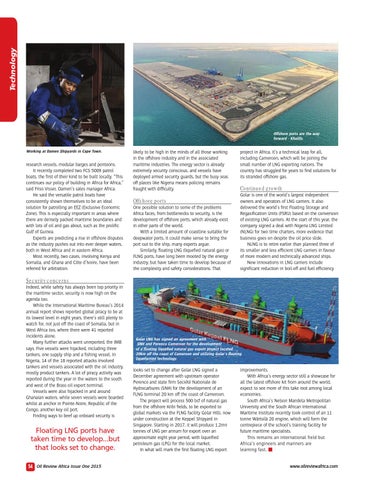
Golar LNG has signed an agreement with SNH and Perenco Cameroon for the development of a floating liquefied natural gas export project located 20km off the coast of Cameroon and utilizing Golar's floating liquefaction technology.
looks set to change after Golar LNG signed a December agreement with upstream operator Perenco and state firm Société Nationale de Hydrocarbures (SNH) for the development of an FLNG terminal 20 km off the coast of Cameroon. The project will process 500 bcf of natural gas from the offshore Kribi fields, to be exported to global markets via the FLNG facility Golar HIlli, now under construction at the Keppel Shipyard in Singapore. Starting in 2017, it will produce 1.2mn tonnes of LNG per annum for export over an approximate eight year period, with liqueified petroleum gas (LPG) for the local market. In what will mark the first floating LNG export
improvements. With Africa’s energy sector still a showcase for all the latest offshore kit from around the world, expect to see more of this take root among local economies. South Africa’s Nelson Mandela Metropolitan University and the South African International Maritime Institute recently took control of an 11 tonne Wärtsilä 20 engine, which will form the centrepiece of the school’s training facility for future maritime specialists. This remains an international field but Africa’s engineers and mariners are learning fast. ■
www.oilreviewafrica.com