S07 FEAG 6 2012 Crop 02_Layout 1 18/12/2012 14:28 Page 23
Crops
Tough times ahead for Philippine banana industry? HILE THE AMERICANS believe that an apple a day keeps the doctor away, Filipinos put their trust on the banana to keep them away from illnesses. Its vast health benefits is as important to the Philippine agricultural sector as the local banana industry is the third biggest in the world and the country’s fifth largest export industry, according to the Pilipino Banana Growers and Exporters Association (PBGEA). The industry’s growth continues this year as data from the Bureau of Agricultural Statistics show that banana production from July to September 2012 grew 2.36 per cent, from 2,269 thousand tonnes in 2011 to 2,322 thousand tonnes on the same quarter. The increase was attributed to additional area harvested in Northern Mindanao, Davao Region Central Mindanao and CARAGA regions. On the average, production for the quarter shared 21 per cent to the annual banana production during the past five years. On the other hand, Philippine banana exports rake in at least an average of PHP30.2 billion (US$738.75mn) annually and remits nearly PHP500 million (US$12.23mn) in taxes. Of the 273 types of bananas that are grown in the country, only three species are widely cultivated: Cavendish or locally known as latundan (the export variety), Cardaba or Saba and Lakatan. Aside from consuming it fresh, the fruits are processed into banana chips, catsup, vinegar, animal feed and other cooked preparations while the rest of the trees are manufactured into handicraft items, clothing, paper sheets, cardboard and many others. According to PBGEA, the banana industry contributes greatly to the economy such as providing employment, development of related industries (transport, food, consumer goods, entertainment), increased income opportunity as a cash crop, prompts improved infrastructure support from government and private organizations and increased tax collection for local government. In terms of social impact, the industry helps provide basic needs through the availability of food, housing, clothing and employment, education, health care, migration back to family instead of having to look for livelihood elsewhere and less occurrence of domestic and juvenile related crime and conflicts. According to PBGEA, the local banana
W
FAR EASTERN AGRICULTURE Issue Six 2012
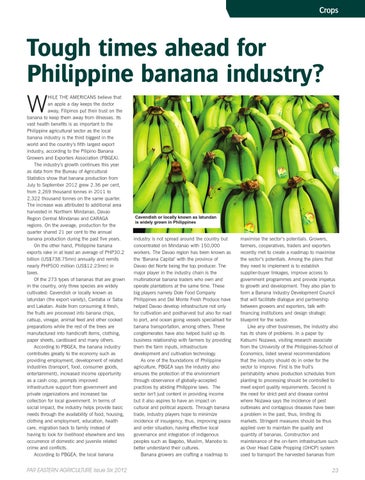
Cavendish or locally known as latundan is widely grown in Philippines
industry is not spread around the country but concentrated on Mindanao with 150,000 workers. The Davao region has been known as the ‘Banana Capital’ with the province of Davao del Norte being the top producer. The major player in the industry chain is the multinational banana traders who own and operate plantations at the same time. These big players namely Dole Food Company Philippines and Del Monte Fresh Produce have helped Davao develop infrastructure not only for cultivation and postharvest but also for road to port, and ocean going vessels specialised for banana transportation, among others. These conglomerates have also helped build up its business relationship with farmers by providing them the farm inputs, infrastructure development and cultivation technology. As one of the foundations of Philippine agriculture, PBGEA says the industry also ensures the protection of the environment through observance of globally-accepted practices by abiding Philippine laws. The sector isn’t just content in providing income but it also aspires to have an impact on cultural and political aspects. Through banana trade, industry players hope to minimize incidence of insurgency, thus, improving peace and order situation; having effective local governance and integration of indigenous peoples such as Bagobo, Muslim, Manobo to better understand their cultures. Banana growers are crafting a roadmap to
maximise the sector’s potentials. Growers, farmers, cooperatives, traders and exporters recently met to create a roadmap to maximise the sector’s potentials. Among the plans that they need to implement is to establish supplier-buyer linkages, improve access to government programmes and provide impetus to growth and development. They also plan to form a Banana Industry Development Council that will facilitate dialogue and partnership between growers and exporters, talk with financing institutions and design strategic blueprint for the sector. Like any other businesses, the industry also has its share of problems. In a paper by Katsumi Nozawa, visiting research associate from the University of the Philippines-School of Economics, listed several recommendations that the industry should do in order for the sector to improve. First is the fruit’s perishability where production schedules from planting to processing should be controlled to meet export quality requirements. Second is the need for strict pest and disease control where Nozawa says the incidence of pest outbreaks and contagious diseases have been a problem in the past, thus, limiting its markets. Stringent measures should be thus applied over to maintain the quality and quantity of bananas. Construction and maintenance of the on-farm infrastructure such as Over Head Cable Propping (OHCP) system used to transport the harvested bananas from
23