S06 FEAG 4 2014 - Crop 01_Layout 1 01/09/2014 11:28 Page 21
Crops
Successful management of Phytophthora on durian requires an integrated approach including good soil, orchard and tree crop management, the cultivation of genetically resistant varieties and rational use of fungicide. Copper containing compounds such cuprous oxide are the only group of fungicides that will control all stages of Phytophthora on durian while simultaneously controlling, or at least suppressing, another half dozen less widespread diseases. As a purely protective (prophylactic or protectant) fungicide cuprous oxide does not enter the plant, so any residues are purely external.
Copper control of Phytophthora Cuprous oxide can used to control various stages of Phytophthora infection and disease on durian as follows. • Seedling dieback — spray the seedlings with cuprous oxide using a flat fan nozzle to obtain large droplets in a spray drench application. • Collar, foot and root rot — Scrape off affected parts of the tree collar leaving several cm of clean wood around the excised area, paint with a thick suspension of cuprous oxide and seal with petrolatum grease. Cut off any infected roots, remove and destroy and seal any root ends with the cuprous oxide paint before applying a layer of petrolatum grease. • Stem or patch canker on tree trunks and branches — Scrape off all infected bark and wood and at least two cm more from the edge of the lesion to leave only undamaged bark and clean healthy wood. Paint with cuprous oxide canker paint and seal completely with petrolatum grease. Also seal cut ends of pruned branches with cuprous oxide canker paint and petrolatum grease. • Foliar blight — spray the entire canopy (branches, twigs, leaves and fruits) with cuprous oxide using hydraulic sprayers fitted with hollow cone nozzles or by using
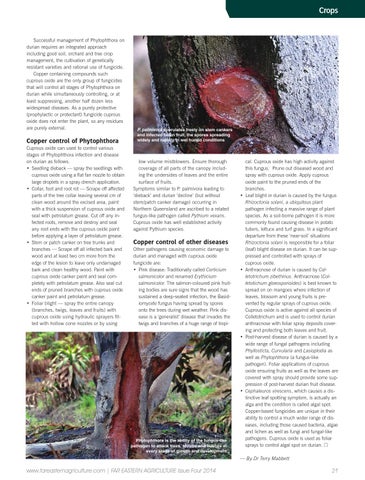
P. palmivora sporulates freely on stem cankers and infected fallen fruit, the spores spreading widely and rapidly in wet humid conditions
low volume mistblowers. Ensure thorough coverage of all parts of the canopy including the undersides of leaves and the entire surface of fruits. Symptoms similar to P. palmivora leading to ‘dieback’ and durian ‘decline’ (but without stem/patch canker damage) occurring in Northern Queensland are ascribed to a related fungus-like pathogen called Pythium vexans. Cuprous oxide has well established activity against Pythium species.
•
Copper control of other diseases Other pathogens causing economic damage to durian and managed with cuprous oxide fungicide are: • Pink disease: Traditionally called Corticium salmonicolor and renamed Erythicium salmonicolor. The salmon-coloured pink fruiting bodies are sure signs that the wood has sustained a deep-seated infection, the Basidiomycete fungus having spread by spores onto the trees during wet weather. Pink disease is a ‘generalist’ disease that invades the twigs and branches of a huge range of tropi-
•
•
•
Phytophthora is the ability of the fungus-like pathogen to attack trees, shrubs and bushes at every stage of growth and development
cal. Cuprous oxide has high activity against this fungus. Prune out diseased wood and spray with cuprous oxide. Apply cuprous oxide paint to the pruned ends of the branches. Leaf blight in durian is caused by the fungus Rhizoctonia solani, a ubiquitous plant pathogen infecting a massive range of plant species. As a soil-borne pathogen it is more commonly found causing disease in potato tubers, lettuce and turf grass. In a significant departure from these ‘near-soil’ situations Rhizoctonia solani is responsible for a foliar (leaf) blight disease on durian. It can be suppressed and controlled with sprays of cuprous oxide. Anthracnose of durian is caused by Colletotrichum zibethinus. Anthracnose (Colletotichum gloeosporioides) is best known to spread on on mangoes where infection of leaves, blossom and young fruits is prevented by regular sprays of cuprous oxide. Cuprous oxide is active against all species of Colletotrichum and is used to control durian anthracnose with foliar spray deposits covering and protecting both leaves and fruit. Post-harvest disease of durian is caused by a wide range of fungal pathogens including Phyllosticta, Curvularia and Lasioplodia as well as Phytophthora (a fungus-like pathogen). Foliar applications of cuprous oxide ensuring fruits as well as the leaves are covered with spray should provide some suppression of post-harvest durian fruit disease. Cephaleuros virescens, which causes a distinctive leaf spotting symptom, is actually an alga and the condition is called algal spot. Copper-based fungicides are unique in their ability to control a much wider range of diseases, including those caused bacteria, algae and lichen as well as fungi and fungal-like pathogens. Cuprous oxide is used as foliar sprays to control algal spot on durian. n
— By Dr Terry Mabbett
www.fareasternagriculture.com | FAR EASTERN AGRICULTURE Issue Four 2014
21