S07 FEAG 2 2014 - Crops 2_Layout 1 3/25/2014 11:10 AM Page 26
Crops
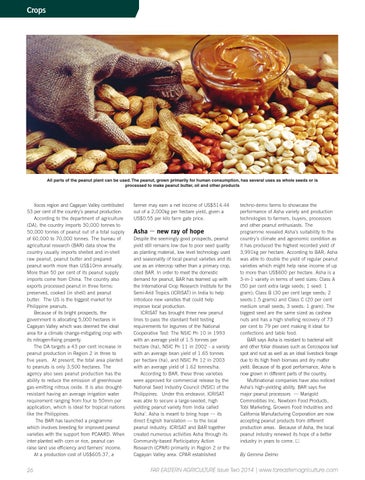
All parts of the peanut plant can be used. The peanut, grown primarily for human consumption, has several uses as whole seeds or is processed to make peanut butter, oil and other products
Ilocos region and Cagayan Valley contributed 53 per cent of the country’s peanut production. According to the department of agriculture (DA), the country imports 30,000 tonnes to 50,000 tonnes of peanut out of a total supply of 60,000 to 70,000 tonnes. The bureau of agricultural research (BAR) data show the country usually imports shelled and in-shell raw peanut, peanut butter and prepared peanut worth more than US$10mn annually. More than 50 per cent of its peanut supply imports come from China. The country also exports processed peanut in three forms: preserved, cooked (in shell) and peanut butter. The US is the biggest market for Philippine peanuts. Because of its bright prospects, the government is allocating 5,000 hectares in Cagayan Valley which was deemed the ideal area for a climate change-mitigating crop with its nitrogen-fixing property. The DA targets a 43 per cent increase in peanut production in Region 2 in three to five years. At present, the total area planted to peanuts is only 3,500 hectares. The agency also sees peanut production has the ability to reduce the emission of greenhouse gas-emitting nitrous oxide. It is also droughtresistant having an average irrigation water requirement ranging from four to 50mm per application, which is ideal for tropical nations like the Philippines. The BAR has launched a programme which involves breeding for improved peanut varieties with the support from PCAARD. When inter-planted with corn or rice, peanut can raise land use efficiency and farmers’ income. At a production cost of US$605.37, a
26
farmer may earn a net income of US$514.44 out of a 2,000kg per hectare yield, given a US$0.55 per kilo farm gate price.
Asha — new ray of hope Despite the seemingly good prospects, peanut yield still remains low due to poor seed quality as planting material, low level technology used and seasonality of local peanut varieties and its use as an intercrop rather than a primary crop, cited BAR. In order to meet the domestic demand for peanut, BAR has teamed up with the International Crop Research Institute for the Semi-Arid Tropics (ICRISAT) in India to help introduce new varieties that could help improve local production. ICRISAT has brought three new peanut lines to pass the standard field testing requirements for legumes of the National Cooperative Test: The NSIC Pn 10 in 1993 with an average yield of 1.5 tonnes per hectare (ha), NSIC Pn 11 in 2002 - a variety with an average bean yield of 1.65 tonnes per hectare (ha), and NSIC Pn 12 in 2003 with an average yield of 1.62 tonnes/ha. According to BAR, these three varieties were approved for commercial release by the National Seed Industry Council (NSIC) of the Philippines. Under this endeavor, ICRISAT was able to secure a large-seeded, high yielding peanut variety from India called ‘Asha’. Asha is meant to bring hope — its direct English translation — to the local peanut industry. ICRISAT and BAR together created numerous activities Asha through its Community-based Participatory Action Research (CPAR) primarily in Region 2 or the Cagayan Valley area. CPAR established
techno-demo farms to showcase the performance of Asha variety and production technologies to farmers, buyers, processors and other peanut enthusiasts. The programme revealed Asha’s suitability to the country’s climate and agronomic condition as it has produced the highest recorded yield of 3,991kg per hectare. According to BAR, Asha was able to double the yield of regular peanut varieties which might help raise income of up to more than US$600 per hectare. Asha is a 3-in-1 variety in terms of seed sizes: Class A (50 per cent extra large seeds; 1 seed: 1 gram); Class B (30 per cent large seeds; 2 seeds:1.5 grams) and Class C (20 per cent medium small seeds; 3 seeds: 1 gram). The biggest seed are the same sized as cashew nuts and has a high shelling recovery of 73 per cent to 79 per cent making it ideal for confections and table food. BAR says Asha is resistant to bacterial wilt and other foliar diseases such as Cercospora leaf spot and rust as well as an ideal livestock forage due to its high fresh biomass and dry matter yield. Because of its good performance, Asha is now grown in different parts of the country. Multinational companies have also noticed Asha’s high-yielding ability. BAR says five major peanut processors — Marigold Commodities Inc, Newborn Food Products, Tobi Marketing, Growers Food Industries and California Manufacturing Corporation are now accepting peanut products from different production areas. Because of Asha, the local peanut industry renewed its hope of a better industry in years to come. n By Gemma Delmo
FAR EASTERN AGRICULTURE Issue Two 2014 | www.fareasternagriculture.com