S01 CAF Issue 3 2018 Start_Layout 1 08/06/2018 15:29 Page 4
AGENDA
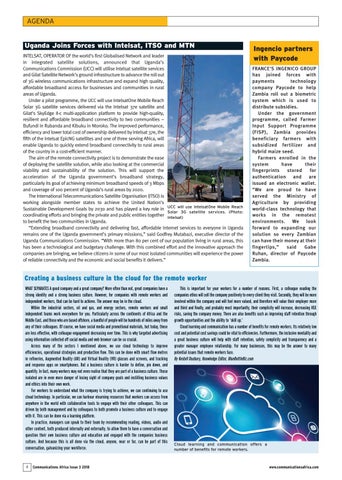
Uganda Joins Forces with Intelsat, ITSO and MTN INTELSAT, OPERATOR OF the world’s first Globalised Network and leader in integrated satellite solutions, announced that Uganda’s Communications Commission (UCC) will utilise Intelsat satellite services and Gilat Satellite Network’s ground infrastructure to advance the roll out of 3G wireless communications infrastructure and expand high quality, affordable broadband access for businesses and communities in rural areas of Uganda. Under a pilot programme, the UCC will use IntelsatOne Mobile Reach Solar 3G satellite services delivered via the Intelsat 37e satellite and Gilat’s SkyEdge II-c multi-application platform to provide high-quality, resilient and affordable broadband connectivity to two communities – Bufundi in Rubanda and Kibuku in Ntoroko. The improved performance, efficiency and lower total cost of ownership delivered by Intelsat 37e, the fifth of the Intelsat EpicNG satellites and one of three serving Africa, will enable Uganda to quickly extend broadband connectivity to rural areas of the country in a cost-efficient manner. The aim of the remote connectivity project is to demonstrate the ease of deploying the satellite solution, while also looking at the commercial viability and sustainability of the solution. This will support the acceleration of the Uganda government’s broadband strategy, particularly its goal of achieving minimum broadband speeds of 3 Mbps and coverage of 100 percent of Uganda’s rural areas by 2020. The International Telecommunications Satellite Organisation (ITSO) is working alongside member states to achieve the United Nation’s Sustainable Development Goals by 2030 and has played a key role in UCC will use IntelsatOne Mobile Reach Solar 3G satellite services. (Photo: coordinating efforts and bringing the private and public entities together Intelsat) to benefit the two communities in Uganda. “Extending broadband connectivity and delivering fast, affordable Internet services to everyone in Uganda remains one of the Uganda government’s primary missions,” said Godfrey Mutabazi, executive director of the Uganda Communications Commission. “With more than 80 per cent of our population living in rural areas, this has been a technological and budgetary challenge. With this combined effort and the innovative approach the companies are bringing, we believe citizens in some of our most isolated communities will experience the power of reliable connectivity and the economic and social benefits it delivers.”
Ingencio partners with Paycode FRANCE'S INGENICO GROUP has joined forces with payments technology company Paycode to help Zambia roll out a biometric system which is used to distribute subsidies. Under the government programme, called Farmer Input Support Programme (FISP), Zambia provides beneficiary farmers with subsidized fertilizer and hybrid maize seed. Farmers enrolled in the system have their fingerprints stored for authentication and are issued an electronic wallet. “We are proud to have served the Ministry of Agriculture by providing world-class technology that works in the remotest environments. We look forward to expanding our solution so every Zambian can have their money at their fingertips,” said Gabe Ruhan, director of Paycode Zambia.
Creating a business culture in the cloud for the remote worker WHAT SEPARATES A good company and a great company? More often than not, great companies have a strong identity and a strong business culture. However, for companies with remote workers and independent workers, that can be hard to achieve. The answer may be in the cloud. Within the industrial sectors, oil and gas, and energy sectors, remote workers and small independent teams work everywhere for you. Particularly across the continents of Africa and the Middle East, and those who are based offshore, a handful of people will be hundreds of miles away from any of their colleagues. Of course, we have social media and promotional materials, but today, these are less effective, with colleague engagement decreasing over time. This is why targeted advertising using information collected off social media and web browser can be so crucial. Across many of the sectors I mentioned above, we use cloud technology to improve efficiencies, operational strategies and production flow. This can be done with smart flow metres in refineries, Augmented Reality (AR) and Virtual Reality (VR) glasses and screens, and tracking and response apps on smartphones. But a business culture is harder to define, pin down, and quantify. In fact, many workers may not even realise that they are part of a business culture. Those isolated are in even more danger of losing sight of company goals and instilling business values and ethics into their own work. For workers to understand what the company is trying to achieve, we can continuing to use cloud technology. In particular, we can harbour elearning resources that workers can access from anywhere in the world with collaborative tools to engage with their other colleagues. This can driven by both management and by colleagues to both promote a business culture and to engage with it. This can be done via a learning platform. In practice, managers can speak to their team by recommending reading, videos, audio and other content, both produced internally and externally, to allow them to have a conversation and question their own business culture and education and engaged with the companies business culture. And because this is all done via the cloud, anyone, near or far, can be part of this conversation, galvanizing your workforce.
4
Communications Africa Issue 3 2018
This is important for your workers for a number of reasons. First, a colleague exuding the companies ethos will sell the company positively to every client they visit. Secondly, they will be more involved within the company and will feel more valued, and therefore will value their employer more and third and finally, and probably most importantly, their complicity will increase, decreasing HSE risks, saving the company money. There are also benefits such as improving staff retention through growth opportunities and the ability to ‘skill up.’ Cloud learning and communication has a number of benefits for remote workers. Its relatively low cost and potential cost savings could be vital to efficiencies. Furthermore, the inclusive mentality and a great business culture will help with staff retention, safety complicity and transparency and a greater manager employee relationship. For many businesses, this may be the answer to many potential issues that remote workers face. By Kestell Duxbury, Knowledge Editor, BlueBottleBiz.com
Cloud learning and communication offers a number of benefits for remote workers.
www.communicationsafrica.com